
A gift from Claude Whatham ~

When I was about thirteen, we were given a green parrot from South America called Chico. A shot of me, rowing down a lake with the parrot on my shoulder, was used to replace the test card image of Carol Hersey playing tic tac toe with a hideous clown.

Chico was wonderfully tame and came everywhere, chatting away in Spanish. He was much more affectionate – and less of a treat – than Beauty, the parrot with a Lancastrian accent who played Polly in Captain Flint’s cabin. One minute he’d be sitting on Tamzin’s shoulder, the next, he’d be on mine.
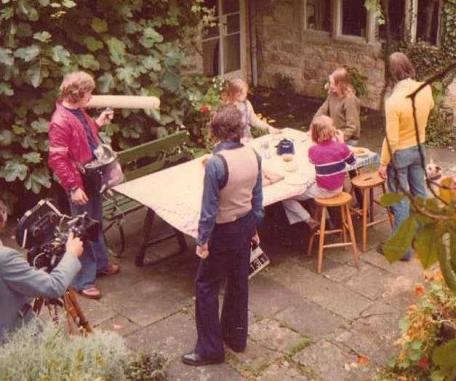
We didn’t always have tea with a parrot, but once the film of Swallows and Amazons was on general release I was often invited to appear on radio or television. This usually entailed going to a studio to appear on a magazine programme such as Points West or Nationwide. However, Robin Hellier, who had just begun working for the BBC on Animal Magic, was thrilled to hear that I really did have a green parrot and brought a film crew from Bristol to our house. We didn’t know at the time that some of the footage taken would end up filling endless small gaps in the schedules.

Although the focus of the item was a profile of my role in Swallows and Amazons, the aim must have been to get as many animals on the programme as possible since they also featured our donkeys having their feet trimmed. The faithful parrot was still on my shoulder. I don’t know what the blacksmith thought.

I thought Robin Hellier was a brilliant director, far better than Claude Whatham at letting us know what he wanted to achieve. I was able to tell Robin this when I found myself working with him in South Africa twenty-two years later. He laughed, admitting that it was the very first film he ever directed. Being conscientious, he took the trouble to write to let me know when it was to be broadcast, although I can’t remember ever seeing it go out.
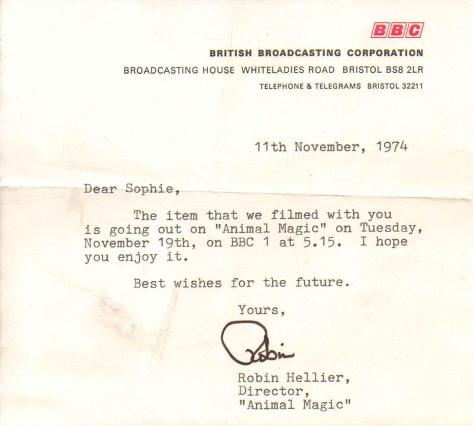
Children’s television was watched by everyone I knew in the 1970s. Letters poured in. My mother loved getting them. The volume was such that I think she had to answer some of them for me.
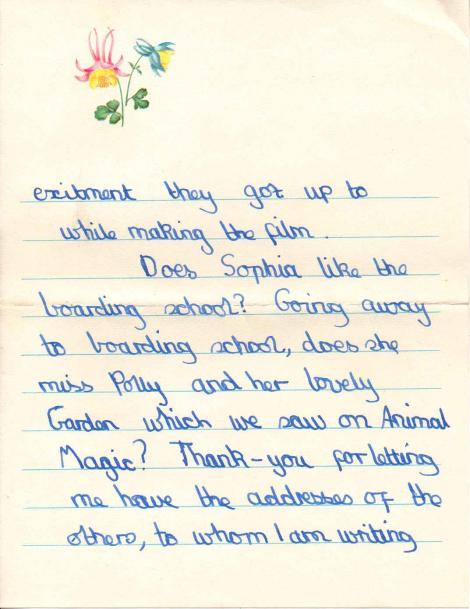
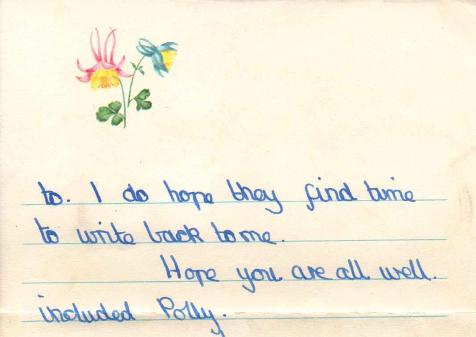
And over the years the letters have kept coming.

These came from a girl I corresponded with for years. My friends at university were amazed to find letters arriving addressed to Titty, but they were always charming. I appreciated them more and more as the years went by.

My mother only wrote me one proper letter while I was away at boarding school. It was to tell me that Chico had died. He spent so much time flying free that he caught a virus off wild birds and could not be saved. I was utterly inconsolable.
Animal Magic continued to featured through our childhood until 1982, when I started working at BBC Television myself. Johnny Morris, who presented the series, became a legend in his own time and is remembered with great affection.
A WildFilm History interview of Robin Hellier can be viewed on this link:
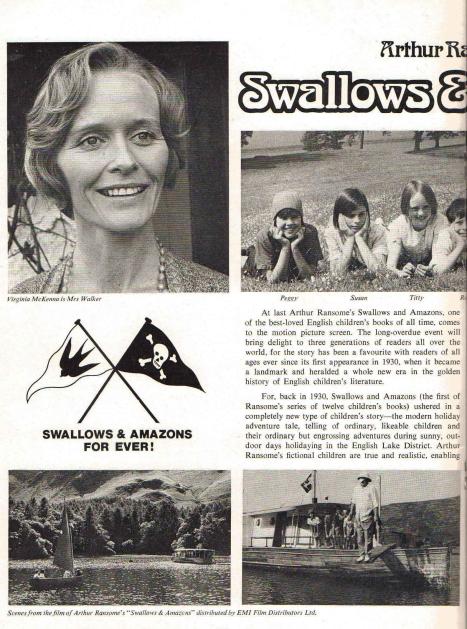
I opened the pages of the programme at the film premiere to find one of the publicity photographs of us taken at Bank Ground Farm. I wasn’t sure the face Simon was making would sell a cinema ticket.
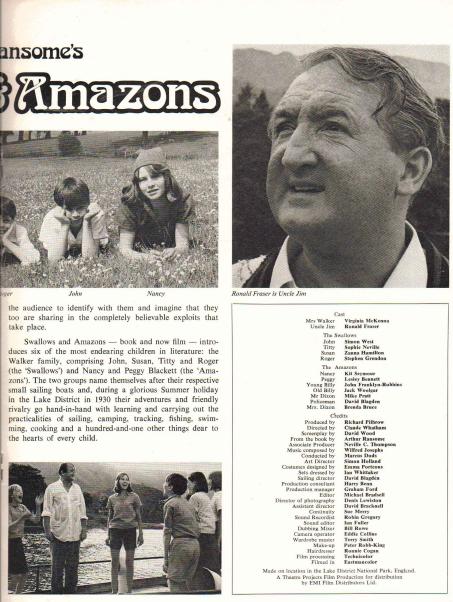
But the film was now out. It had to sell itself. Everyone was waiting to hear what critics from within the movie industry felt about it.

Would this photograph ever sell the film?

I think my mother must have written to Barry Norman, inviting him to bring his daughters to one of the promotional events held at the Commonwealth Institute. I wonder if she met him at the Preview of the Premiere. He was then presenting BBC Television’s Film 74 and writing a weekly column in The Guardian newspaper. Here is his reply:

Barry Norman enjoyed it! The Radio Times says that he was looking at ‘films for the family over the Easter holidays’. Film 74 was shown on BBC TWO at 10.15pm – and repeated on Fridays even later so he must have been speaking to parents. Here’s his theme tune.
One thing that strikes me when I open the March 1974 copy of ‘Films and Filming’, kept by my mother, is that ‘Swallows and Amazons’ has to be one of the most enduring movies to come out at the time. Sean Connery opted to appear with Charlotte Rampling in ‘Zardoz’. I’ve neither seen or heard of it. Why couldn’t he have played Captain Flint with us? I did see Steve McQueen in ‘Papillon’ but had no desire to watch it more than once. Richard Lester’s version of ‘The Three Musketeers’ was also made in 1973. Even though it stared Oliver Reed, Raquel Welch, Richard Chamberlain, Michael York and dear Spike Milligan I don’t think it can have been broadcast on television as many times as ‘Swallows and Amazons’.
The magazine goes on to review ‘The Optimists of Nine Elms’ starring Peter Sellers, ‘Magnum Force’ starring Clint Eastwood, ‘Herbie Rides Again’ starring Stephanie Powers and many others, films I have never heard of. ‘American Graffiti’ came out in the States, directed by George Lucas starring Richard Dreyfuss, Ron Howard, Paul Le Mat and Harrison Ford. It made gross profits of more than U$200 million becoming one of the most profitable films of all time, but I wonder how many times it has been shown on British television this year? Do your children know anything about it? Has it been projected in the pouring rain for loyal fans sitting on a lake shore?
I his book, ‘A Theatre Project’ Richard Pilbrow says, ‘We had a success.’ He quotes Variety magazine, “Charming, delightful, beautifully made film,” but said it was, ‘Not a hit but a reasonable success that continues to play, principally on television, around the world.’ Richard goes on to quantify how it did financially. ‘The world of film finance is a distinct mystery. Our production costs were just under £300,000. Over the years, income trickled in from an international market. Curiously the costs inexorably rose to match the income. The costs of marketing the movie always seemed to equal receipts at the box office. In 2004 our film actually recouped. That’s why I have the temerity to call it a success.
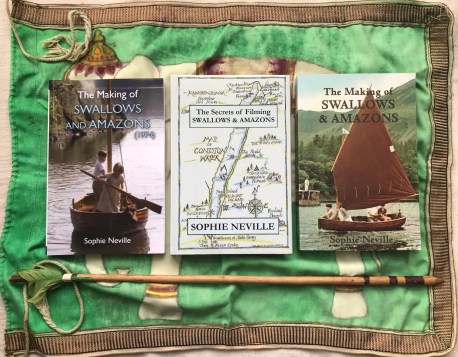
Not all the newspapers thought so in 1974. You can read how much we hated the publicity in any of the books on how the film was made:

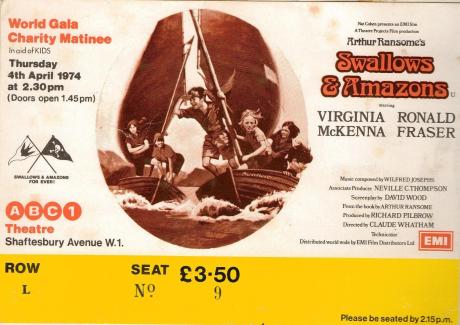
The Premiere of Richard Pilbrow’s movie ‘Swallows and Amazons’ was held at the ABC Shaftesbury Avenue on 4th April 1974. Can you imagine the shock of finding a picture of myself on the cinema tickets when they arrived in the post?
There were adverts in the newspapers. It was to be a Royal Gala charity matinee in aid of the charity KIDS.
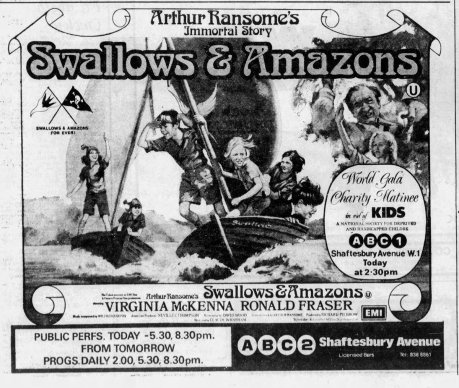
I didn’t know what to wear. I wished that we’d been able to put on our costumes but it was clear I had to find an appropriate dress. Sadly, I had grown out of the trendy one we bought in Carnaby Street. Shoes were another problem.

Nowadays one would be inundated by offers of designer dresses to model on the red carpet. As it was, my mother bought me green pinafore dress that I agreed would work for an afternoon event. I was not so happy about wearing ballet shoes. Please note these were real ballet shoes and I was now thirteen. I would have preferred court shoes with buckles. Ironically these zoomed out of fashion whilst ballet shoes have been loved by all ever since. My bobbed hair had grown out but Mummy put it in Carmen rollers. I am not sure the result was that successful but I liked it at the time.
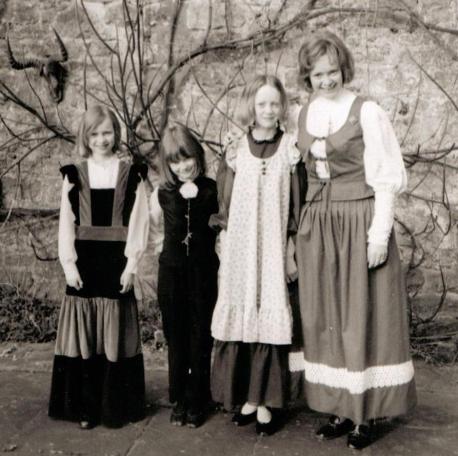
My sisters were terribly brave and wore velvet with their ballet shoes. The dress from Carnaby Street was slightly large for Perry, seen here on the left, but she coped. At least it was fashionable. Mum bought herself a blue outfit that was deemed the height of fashion. When I arrived in London I found Suzanna had found a Laura Ashley pinafore whilst the Amazons had both got away with wearing trousers. They looked far more sophisticated.
There was an awful lot of fuss about who should or could come and who couldn’t . Mum had insisted on bringing, not friends of mine, but two of the nuns from my school.
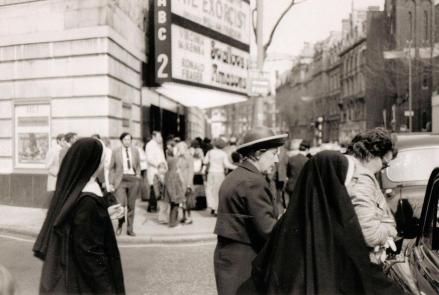
So, I went off to my first premiere with my headmistress, Sister Ann-Julian and my housemistress, Sister Allyne. Not very cool in a thirteen year old’s world. The Exorcist was out at the same time. They made no comment.
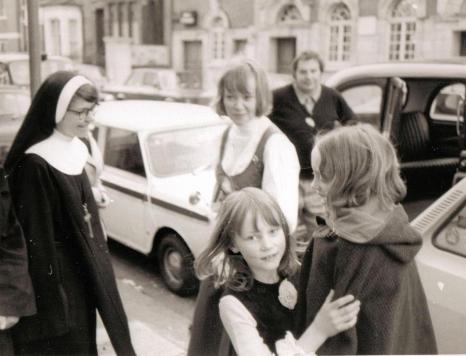
In fact Sister Allyne proved the very best person to take. She was a performer herself. I am pretty sure she had been Australia’s foremost flautist. She must have understood the turmoil in my little head and was undoubtedly praying for me. I would not be surprise to learn that spiritual protection was granted by her presence alone. She would have been an exorcist in her own right – a real one. Perry remembers that she had been sick in the taxi. This was probably because she didn’t travel much.

Claude Whatham defied any plans my mother might have made by taking the six of us in the cast, and only the six of us, out to lunch at a wonderful bistro where we able to order beef-burgers, relax and enjoy ourselves.

There was no red carpet when we arrived at the cinema in Shaftesbury Avenue but rather smart programmes were sold, one of which I still have. Until that point I had no idea that it was to be a Royal Gala held in aid of charity.
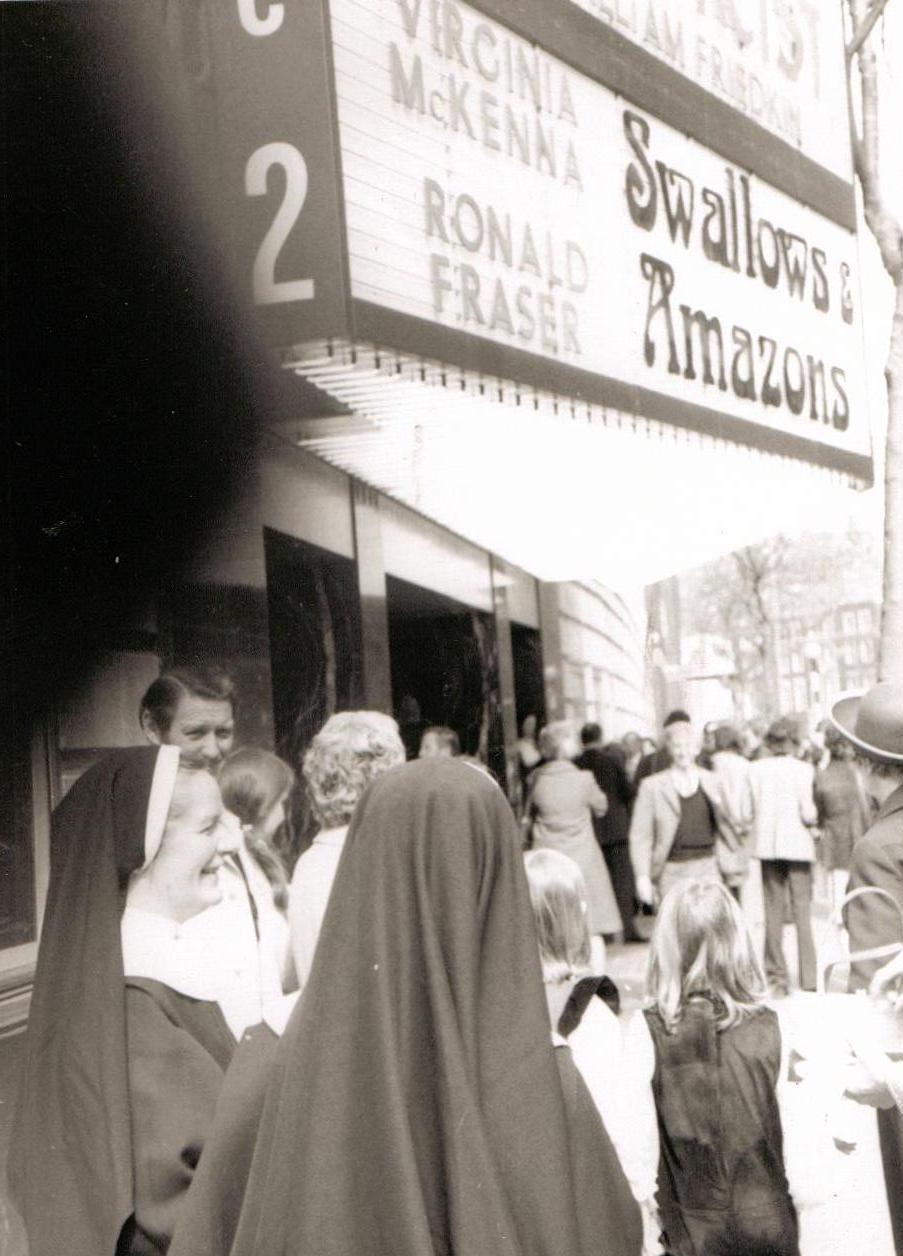
I was suddenly acutely aware of how I came across on the big screen. As the film was shown I groaned inwardly. It was like seeing endless photographs of oneself which were not exactly glamorous. I cringed. All Sister Allyne said was how much she enjoyed seeing the owl – a natural history shot that was added after all our hard work and effort on the drama.

My mother was terribly impressed by the special guests. Princess Helena Moutafian was present with Earl Compton, chairman of the charity KIDS. I’m afraid I don’t remember meeting them but was interested to hear that she later became patron of the Young ME Sufferers Trust.
We walked down onto the stage with Ronnie Fraser to be presented to the audience. Sadly Virginia McKenna could not be there, although she sent her eldest children – Will and Louise Travers. Bobby Moore, who’d played for England came with his family, as did Mrs Spike Milligan. The Hollywood star Patricia Neal, who won an Oscar for her leading role in the Paul Newman film Hud and appeared in Breakfast at Tiffany’s , brought her sweet little girls. Julie Ege was a lovely Norwegian actress who appeared as Voluptua in Up Pompeii with Frankie Howard. I think Richard Pilbrow might have known her as he had produced the West End version. She was known as a Bond Girl since she’d appeared in ‘On her Magesty’s Secret Service’ with Diana Rigg when George Lazenby played Bond and Telly Savalas was Bolfeld. We didn’t know any of this but I think having a Bond Girl at your premier was quite the thing.
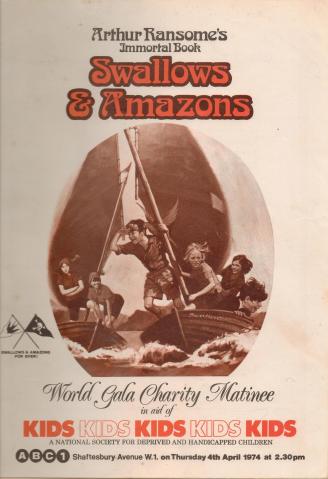
I have a few precious posters of the film. The colour poster, which hung in the London Underground is still on the cover of some of the DVD’s. I always quite liked the design, except for the rather jarring colour of my blouse, which for some reason is pink. Far more attractive were the huge sepia posters hung outside cinemas. They were very special. I still have one but it’s enormous and I am unsure what to do with it.

What the papers had to say about the film was a different matter. The first time we saw Swallows and Amazons was not at the film the premiere but at ‘The Preview’. This was held at a viewing theatre in London to which I assume journalists were invited. I only wish they’d been asked to bring their children. The cast was re-united, meeting up with various members of the production team, to see the film for the very first time. We were utterly amazed at how sunny everything looked. Denis Lewiston’s insistence that we should wait for clouds to pass, while we shivered, had paid off. It was wonderful to see how the film had been put together. We had not known that Claude would add shots of wildlife, which add so much to the movie. I loved the scene he included of cattle standing in the still lake at dawn.
You can read about how we made the film and find more photos in these publications available online or to order from libraries.
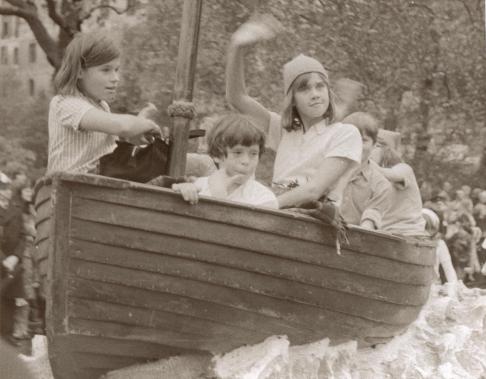
Our first major public appearance for the promotion of ‘Swallows and Amazons’ was The Lord Mayor’s Show . For the first time since the filming we climbed into our costumes and then into Swallow who had been mounted on low-loader. Afloat on a float, we made ready to sail through the City of London.

It must have been early November and was so very cold before we set off that we needed to keep our own coats on. We were anxious this would spoil things for people. I’m sure it would not have made much difference. Did anyone know who we were? The film hadn’t come out. We were riding on the wave that Arthur Ransome and his books were so well loved by the people of our nation.

What was fun, if a little odd, was that it was the first time, indeed the only time, that the Swallows and the Amazons had been in a dinghy together. As we were taken through the streets of London passers-by started to wave at us and we waved back. Soon it was waves all round. Being Titty, I had Swallow’s flag to fly. John let Nancy take the tiller.

We were amazed to find huge crowds of people had gathered and that it was all rather fun. I don’t know why but Sten must have joined my mother on the pavement by the time this shot was taken. I can see the back of his head in this next photograph. He is wearing the tartan hat Claude Whatham bought him at Blackpool fun-fair.
Jeremy Fisher Frog was leaping about in front of us, which was rather amazing. With him danced other representatives from the Tales of Beatrix Potter, The Royal Ballet’s wonderful feature film that also came out in 1973/4. We were marking the 35th anniversary of EMI, whilst bringing the Lake District to London Town, which is something we all could celebrate.
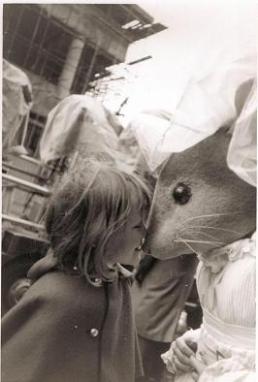
Since we didn’t have to talk to anyone, we were able to enjoy being involved in the pageant, which included so many icons of British Life.

I hadn’t met a Pearly Queen before, but there was a whole clan of them in their glorious suits, lovingly embroidered with mother of pearl buttons. I resolved to collect enough to adorn my own jacket. My favorite view was of HM the Queen’s gold state coach pulled by her lovely white horses, six in hand. I’d been to see them at the Royal Mews when we came up for my first interview at Theatre Projects offices in Longacre when I first met our director Claude Whatham.

My mother took a photograph of the Queen’s Drum Horse. Much later she found that he was a stallion, on offer as part of a British Horse Society breeding improvement scheme. He was brought over to service her Irish mare Gerty. The result was a lanky skewbald called Nimrod, an enormous gelding who Andrew Parker Bowles rejected on behalf of the British Army. This proved an error. Like most heavy horses Nimrod was just slow to grow. He eventually became a national dressage champion, although not in our hands.

We have one last photograph which shows that the float in front of us depicted an EMI film crew, with 2K lights, a camera and technicians. It is studing this photograph that made me feel that we were not in Swallow as the transom seems so differnet. I don’t suppose anyone else noticed.

Funnily enough I was in a boat for the Lord Mayor’s Show this year. We rowed up the Thames in the Lord Mayor’s procession on Saturday 12th November.
I am on the crew of the Drapers’ Barge, Royal Thamesis a 33 foot shallop, which I last rowed on the tideway for the re-creation of Nelson’s funeral covered by Sky TV. You may have seen her taking part as the in the Queen’s Jubilee Pageants. We have been asked to take part in the procession of boats that heralds the Lord Mayor’s Show this coming November.
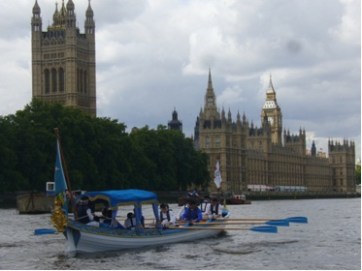
This colour footage shows various aspects of the Lord Mayor’s procession in 1973 including the Queen’s Gold State Coach built in 1762 and a float with Daleks, which must represent Doctor Who, a series I worked on about ten years later when at the BBC.

When a television drama is ready to be transmitted there is a little publicity, but not much. Photographs might be taken for the cover of the Radio Times or a book to accompany the series, there might be a Preview at BAFTA to which journalists from the colour supplements and daily newspapers are invited, but, because the programme can be advertised on air, the actors are not intensively involved in the promotion. A feature film is very different.
Whilst we didn’t mind our photographs being taken while we were acting, and were fine about Mum clicking away with her little instamatic, we all hated having promotional photographs taken for ‘Swallows and Amazons’. They were usually so posed, set up by strangers who had no idea of the story. Virginia McKenna tried to make it fun for us but this is what we all felt about this photo-call:

Why were the Amazons at Holly Howe? Why weren’t we with any of the boats? It was all terribly hot and difficult to squint into the sunshine. Only Mrs Batty’s dog seemed to be enjoying the attention.
The glare of the flash bulbs had started on day one. As Suzanna said in her diary, it made us feel ‘right twits.’

Claude Whatham was very good at explaining things to children. Looking back I wish that he had explained why the publicity was so important, but of course this was not his job and he would have been busy setting up the next shot. Certainly once the filming had finished we needed to know how important it was to promote the film. Richard Pilbrow really wanted to make a sequel, particularly an adaptation of Ransome’s twelfth book in the series – ‘Great Northern?’ He loves the Outer Hebrides and has a house on Col. I think we might have been a little keener about publicity shots if we had been told that the out-come could have been going up there for another summer. We would have been able to look forward to the possibility, but I don’t suppose he was at leave to even suggest it.
Journalists were introduced to us and looked after by our unit publicist Brian Doyle. Brian had worked on ‘Straw Dogs’ in 1971, the thriller that starred Dustin Hoffman, Susan George and Peter Vaughan. Susan George had of course played Titty, or ‘Kitty’ in the black and white BBC adaptation of Swallows and Amazons in the early 1960s. She was now regarded as glamorous sex symbol in British cinema – setting me rather a daunting example. Much easier for Brian to publicise her then me. She had a gorgeous figure with beautiful, thick, blonde, hair. I had what my sister still calls ‘tendrils’ and my mother calls ‘bits’. And was skinny with crooked teeth.
Brian was a lovely man. He had an amazing career, going on to work on films such as Ken Russell’s Valentino with Rudolf Nureyev and Leslie Caron, The Wild Geese, Alien, Educating Rita starring Michael Caine and Julie Walters and the James Bond movie For Your Eyes Only – with Roger Moore in the lead role . He even has his name on the credits of one of George Lucas’ Star Wars films.
This was the profile he wrote for me:
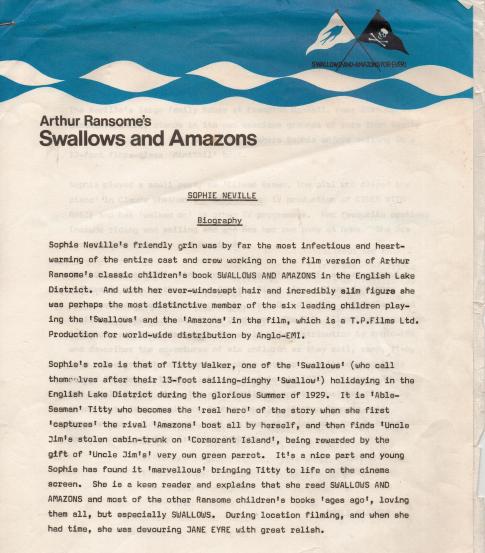
Brian adored Children’s literature. His own children came up to stay on location over their half-term and spent hours playing with my sisters, indeed they all appeared together as extras in the scenes shot at Bowness, and can be seen playing on the beach. Sadly Brian died, very suddenly, in 2008. His daughter told me that he left a collection of 35,000 books.
I still have Brian’s announcement:

At this the journalists moved in. From all over the place!
There was a very trendy women’s magazine in the early 1970s called Over 21, which the senior girls at school used to read. My mother was thrilled to find that Celia Brayfield had written a double page feature. I was amazed. I didn’t mind the picture of us gutting fish, but started reading with trepidation.
(If you can read this, I’m afraid page one comes second.)


I read it, looked up the word etiolated in the dictionary and burst into tears.
Far worse was to come.

One of the questions I was asked when we returned from filming ‘Swallows and Amazons’ in 1973 was about the food. This could only properly be answered by going into considerable detail.
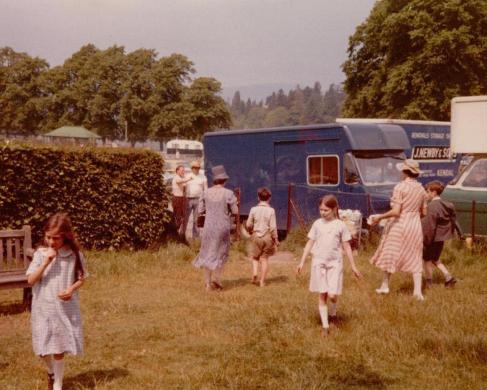
When on location, our breakfast, coffee, lunch and tea were provided every day from the back of a location catering van staffed by a couple called John and Margaret who had come up from Pinewood. My mother always referred to their van as ‘The Chuck Wagon’. There wasn’t perhaps as wide a choice as there is with location catering today, but good hot meals were produced on time, whatever the weather and wherever we might be.
If we ever filmed on a Sunday there would be a full roast meal. At other times they would enchant us with a choice that might include spaghetti, a dish that was new to England – or at least where we lived – in 1973. It was the kind of special meal that my mother would cook for a dinner party, served with a spoon and fork so you could swirl the pasta properly. As children we were allowed to go to the head of the queue so that we could avoid having to queue up in the rain. We’d take out plates to tables in one of the red double-decker buses. You could help yourself to knives and forks and paper napkins on the way in. We had to be careful not to get food on our costumes.
I remember when location caterers first started providing salad buffets in addition to hot lunches in the 1980s. It was such a relief not having to queue. Salads were not regarded as food for the working man back in the early 1970s but Suzanna thought otherwise. Indeed she would eat little else.
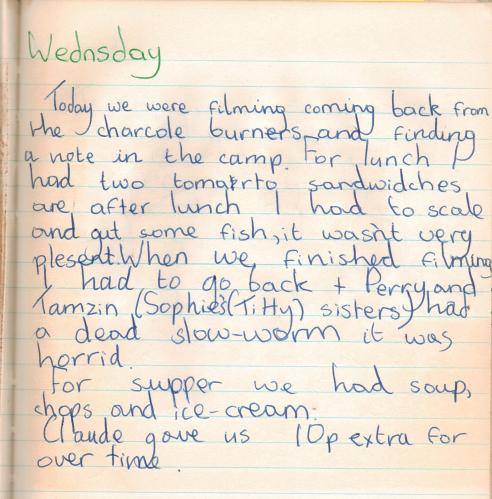
Despite the fact that Suzanna often only ate tomato sandwiches for lunch, the catering budget must have been considerable. The call sheet always seemed to specify ‘LUNCH for approx 70 persons’.
When friends came to visit us on location my parents were sensitive to this and bought a picnic, which was very much how we lived normally. This was always carried in a wicker basket and set out on a car rug, cold squash in one thermos flask, hot coffee in another. Triangles of processed cheese with ham and pickle sandwiches. No cool bags or bottles of wine. You couldn’t buy ready-made sandwiches from petrol stations or supermarkets then but if you went to a bakery they would make you a filled bap while you waited.

As anyone who has read Arthur Ransomes’ books will know, the Swallows were very organised when it came to provisions. Milk from the farm, buttered eggs, seed cake, apples, molasses (toffees) and grog – I loved it all. I wasn’t too sure about fried perch but the pemmican and potato cakes cooked by Man Friday with a great knob of butter were utterly delicious. And I loved the buns from Rio. We didn’t have peas to shell on the film. Apples must have seemed a realistic alternative.
Again we have to rely on The Mate Susan for details. Surely she was modeled on Ransome’s own efficient wife Evgenia? In this extract from her diary Suzanna mentions that Richard Pilbrow’s two children came to watch the filming. She knew Abigail from London.
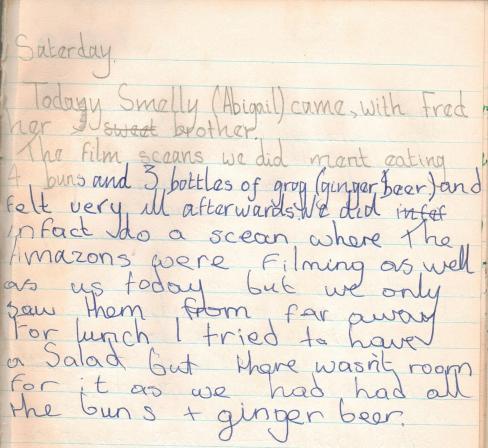
Mum became worried quite early on that Suzanna wasn’t eating enough. The solution came when she was taken out to dinner at a restaurant where she was able to chose from a wide menu.

As a result Suzanna was often given steak for supper back at the Oakland’s Guest House while the rest of us had whatever was on offer, which was a bit of a swizz.

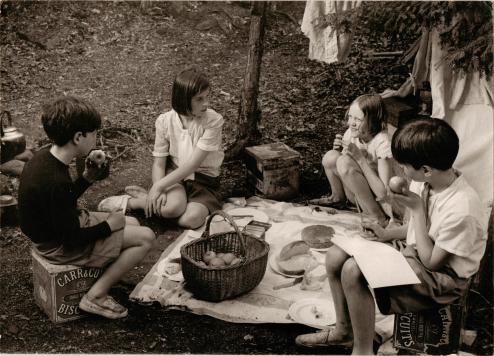
Suzanna was of course completely right about insisting on eating salads and fresh fruit. She chivvied, encouraged and begged both the caterers and Mrs Price for more and more fresh raw food. She loved strawberries. Virginia McKenna won her heart by bringing her two boxes of fresh strawberries when she was ill with tonsillitis at the start of the filming. These would have been early English strawberries and a great treat in 1973. John and Margaret managed to find enough for us all later in the summer. They were presented in a manner that would have pleased the men working on the film crew but Mate Susan wasn’t so happy about this.

I’ve included this photograph before but it provides proof that food was an important issue. Please note that Mate Susan is first in line, inspecting everything on offer.

If you would like to read more about what it felt like to appear in Swallows and Amazons, I have bought out a paperback: ‘The Making of Swallows and Amazons’ for sale online or available from any library worldwide.

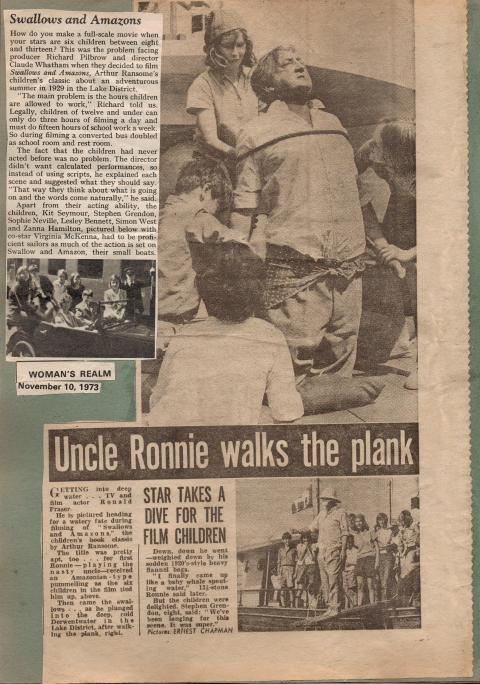
Being back at home for the summer holidays was lovely. I must have been pretty tired. But, adjusting to real life when articles like this one appeared in Woman’s Realm was tricky. Everyone seemed to be reading about me in their dentist’s surgery.
‘What was it like?’ I was often asked.
How could I begin to describe working like this ~

‘Did you have lots of lines to learn?’
How could I explain that this is how we worked on the dialogue?

‘What were the others like?’
How could I tell people about the whole crew, that I’d had working relationships with so many adults?
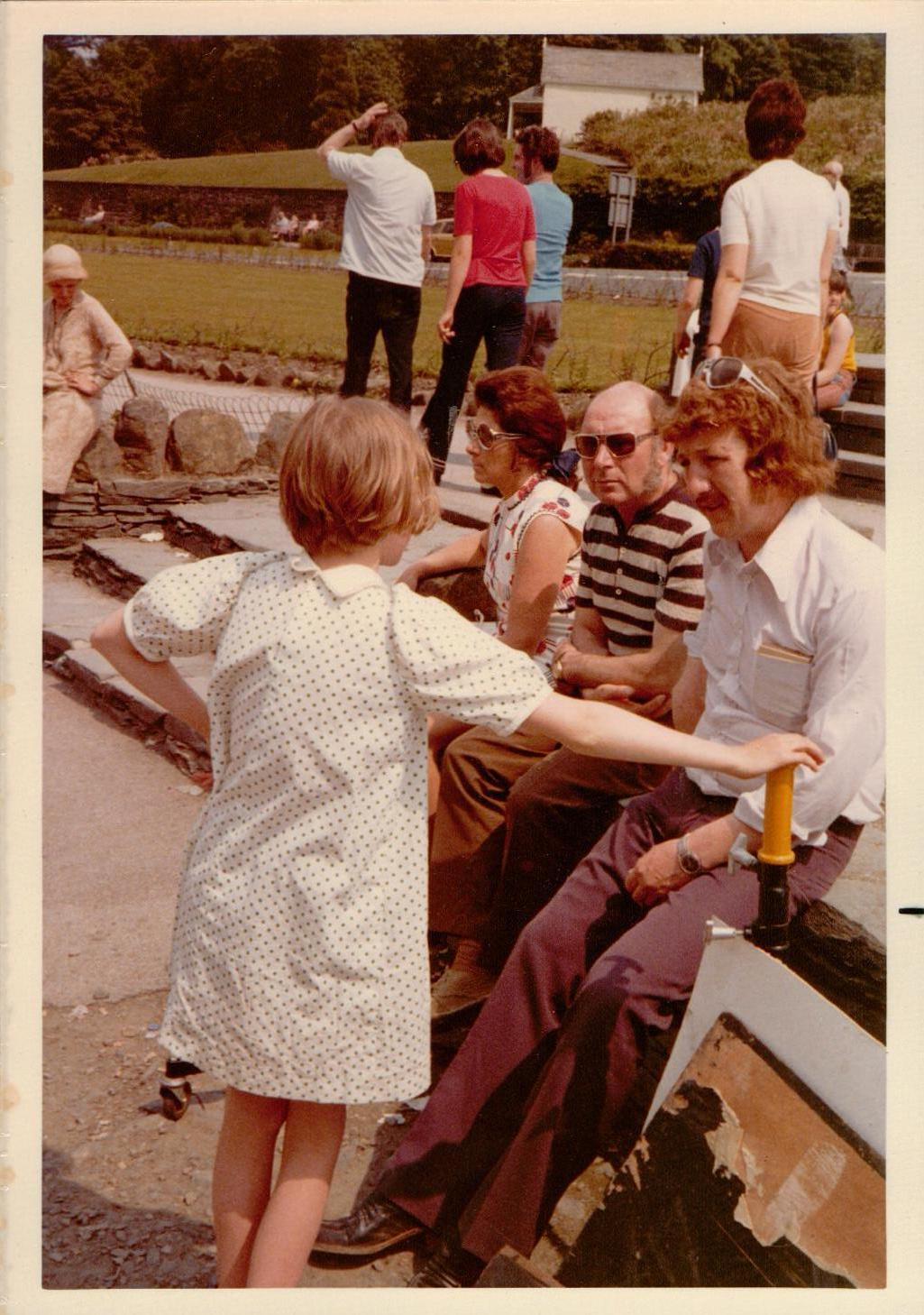
Technical questions were much easier to answer than, ‘How did you feel?’ No one wanted to know that most of the time I felt cold.
‘Did you have to wear make-up?’ This was a difficult one, as we didn’t wear conventional make up but my legs were regularly coated in a layer of foundation so as not to appear shockingly white. You can see the smooth effect in the photograph above. Suzanna was amusing about this in her diary. She hated being sponged down with a matt base and sun-bathed whenever she could so as to avoid it in the near future.

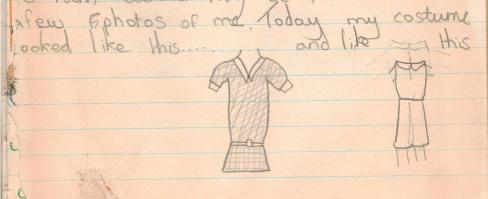
‘What did you wear?’
Suzanna drew pictures of the two dresses she wore at Bank Ground Farm. I always rather liked her blue gingham one. Unlike the Duchess of Cambridge I have never worn a yellow dress apart from the sleeveless one I had to climb into to play Titty. It was really too short for 1929. I remember the costume designer, Emma Porteus, confiding in Mum that they would cheat on the length a bit. Hem-lines were very much above the knee in 1973. Arthur Ransome would have turned in is grave. Luckily Titty’s dresses just look a little out-grown.
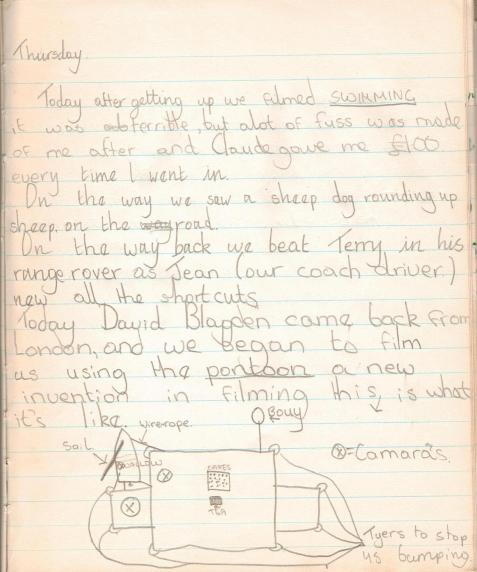
‘How did they film you sailing?’
Again Suzanna provided wonderful graphics of this. I don’t think I’ve yet published this page of her diary.
‘What was Virginia McKenna like?’
This question was easy. ‘She was lovely.’

Many years have gone since we sat amongst the daisies at Bank Ground Farm. I am now happy to talk about anything. Do click on the comment box below or go on a Facebook page to ask any questions you might have about the filming of ‘Swallows and Amazons’.
You can read more in ‘The Secrets of Filming Swallows and Amazons’ available online for £2.99


It was time to say goodbye. We’d had the most wonderful seven weeks filming on the Lakes but the end had drawn in with the clouds. It was time to go home.


Since we lived in Gloucestershire it was a long drive south. I’m not sure how Jane and Sten Grendon got back, as I don’t think Jane drove, but we must have dropped off some of their things on our way past their village.
I remember seeing my real sisters and walking around the garden in the afternoon sunshine, looking at all that had changed. We’d left in early May, now it was full summer and the school holidays. I don’t know how I had the energy left to write up my diary.

‘Shall we go and put flowers on Luppy’s grave?’ Perry asked. I hadn’t heard that our dear old dog, the sheep dog I had known all my life, had died while we were away. I was inconsolable. Mum explained that they hadn’t wanted to tell me when it happened as we were filming, she thought that the sadness on my face would have come through on camera. I understood this but was still desolate. Having had to cope with the grief of losing Luppy, on top of the heartbreak of leaving everyone I had grown so close to in the Lake District, I was not in a good way.
One of the most treasured things that I had returned with – apart from the lump of Cumbrian slate Jean McGill had given me – was a hard-back copy of ‘Swallows and Amazons’ signed by the entire cast and crew.

Here you can see inscriptions from Virginia McKenna who had played my mother and Ronald Fraser who obviously saw himself as Uncle Jim rather than Captain Flint.

Mike Pratt and Brenda Bruce who appeared as Mr and Mrs Dixon, Jack Wolgar and John Franklyn-Robbins who embodied the Charcoal Burners with Brian Robylas (sp?) and Moria Late who played Mr and Mrs Jackson.

It is interesting that all the children signed their character names with their real names in brackets. We must have grown to associate ourselves more with the characters names than with our own.

Claude Whatham wrote, with thanks, and Richard Pilbrow enchanted me by drawing a picture of Wild Cat Island at night.

Sadly, we didn’t manage to nab everyone on the crew, but collected a few signatures.

The only other signature on this page is from Brian Doyle, Mum’s friend the publicity manager on the movie who encouraged us to collect the autographs.

At the back of the book David Blagden, who played Sammy the Policeman as well as overseeing the sailing.

David drew me a picture of what must be a vision of himself, sailing into the sunset in his little yacht Willing Griffin that had taken him across the Atlantic.

Phyllis B was my tapestry-making stand-in. Simon Holland our art director (set designer) drew me a wonderful set of crossed flags that were also paint brushes ~ a logo for my life.

I have a signature from Kerry Darbishire (I thought she’d written Dartisnine) who played Bridget’s Nurse, our Fair Spanish Lady. Like the actors who played the Jacksons, she was not credited on the movie but played a significant part. She still lives in Cumbria.

We left Jean McGill, our driver and unit nurse, in Bowness-on-Windermere.

Eddie Collins was the camera operator, Ronnie Cogan our hairdresser, Joni Turner was a local lady who worked on a few days as Suzanna’s stand-in.

Terry Smith was the wardrobe master, Albert Stills is Albert Clarke who took the black and white photographs day after day. Terry Needham was our long-suffering second assistant director.

On the last page I have a very classy signature from Robert – who I think was one of the Keswick boatmen looking after the Lady Derwentwater.

Denis Lewiston the DoP also left his mark on my life.

Peter Robb-King signed himself ‘Make-up for the Stars’ and Gareth Tandy as ‘The Whip-cracker’, which surprised me as I had never seen his whip. Graham Ford obviously didn’t want me to change and Margaret Causey, our tutor, sent her love. We’d been though so much together and in such confined spaces.

Interestingly, I also have an inscription from Ian Fuller the sound editor listed as if he was around on location. I am sure he was the chap I would have met next. Claude and Richard would have gone straight down to the cutting rooms to edit the film. It is not usual for actors to enter such territory but our adventure was to continue. We were soon to be summons to the Elstree Studios of EMI at Borehamwood in Hertfordshire, just off the A1.

You can read more in the ebook ‘The secrets of filming Swallows and Amazons’ or paperback entitled ‘The Making of Swallows and Amazons’ available from all online retailers.


Our director, Claude Whatham had a problem. Despite two attempts he had failed to shoot the key scene when the Walker children – who had just arrived at Holly Howe – discover the Peak at Darien and look out over the lake to spot Wild Cat Island for the very first time. He saw it as crucial to the motivation of the story.
Claude had shot the sequence of us running down the field at Bank Ground Farm in the evening light. He had what would technically be called our POV (point of view) of the island. He had nothing in between. There was no dialogue but without the right light the sequence would not cut together. And now it was raining, endlessly. We waited around all day, yet again, hoping for the weather to clear. It did not.


I can’t believe that we went, what would now be termed, wild swimming in the Lake District after making such a fuss about recording the swimming scenes at Peel Island. Even if it was raining the water must have been fairly warm. I don’t suppose we were in for that long. I’m now rather shocked that we dried our hair by sticking our heads out of the windows of the mini-bus. We could have all been decapitated.
While Claude was busy looking at the sky I spent the rest of the day industriously sticking small photographs into my scrap-book. Mum had her camera films developed by Triple Print so that she had some to give away. This was the result:

Two of these tiny photographs show us sitting in the Grizedale Forest with Wilfred Josephs who composed the music for Swallows and Amazons. He had visited us on location when we were shooting the charcoal burners scenes. If I blow up this tiny photograph you can see a little more of him.

Wilfred had written a canon with the idea that he could do something musical with our voices. Our efforts were being recorded by Robin and his assistant when Mum took these snap shots. The words went in a round, like this:
Swallows: ‘Swallows sail the ocean-wide, Natives we can not abide.’ (Sung in a high register)
Amazons: ‘We are the Amazons.’ (Sung beneath us in a low register)
What Wilfred soon discovered was that, apart from Lesley Bennett, we were all pretty useless at holding a tune. Whatever was recorded on that day near the charcoal burners’ hut never made it to the final sound track – or even the LP that EMI brought out to accompany the movie.

Mum was thrilled to meet Wilfred Josephs. He was fantastically talented, with a huge list of credits to his name. Born in 1927, he qualified as a dentist at the Universtity of Durham ~ where I also studied ~ before becoming a full-time composer in the early 1960s. His career was launched when his Requiem in memory of the Jews who were lost to the Holocaust won La Scala. He went on to compose 12 symphonies, 22 concertos and was commissioned to write a number of overtures, ballets, operas and other vocal works. In the field of television he is perhaps most well know for producing the theme music for I,Claudius, Enemy at the Door, The Prisoner and Pollyanna. He worked for Claude Whatham on the movie score for All Creatures Great and Small that starred Anthony Hopkins and Simon Ward, as well as the television drama W.Somerset Maugham and the serial Disraeli, which Suzanna Hamilton appeared in.
In the early 1970s Wilfred had also composed the theme music for Claude’s BBC play of Laurie Lee’s auto-biography Cider with Rosie, which Sten and I had acted in. Wilfred Josephs sadly died at the age of seventy, but I found that someone has put his haunting composition for Cider with Rosie onto YouTube. It was so good to hear it again. It comes with colourful cider-making images but – unless passionate about cider – you can have a look at more of my scrapbook while you listen to it. Like the film-score to Swallows and Amazons the orchestra was conducted by Marcus Dods.
Some of these tiny photographs from the contact sheets that Richard Pilbrow gave us are fascinating.


You can read more about making the film in the ebook entitled ‘The Secrets of Making Swallows and Amazons’ here:

You can listen to Wilfred Owen’s haunting music for ‘Cider With Rosie’ here
 Sophie Neville