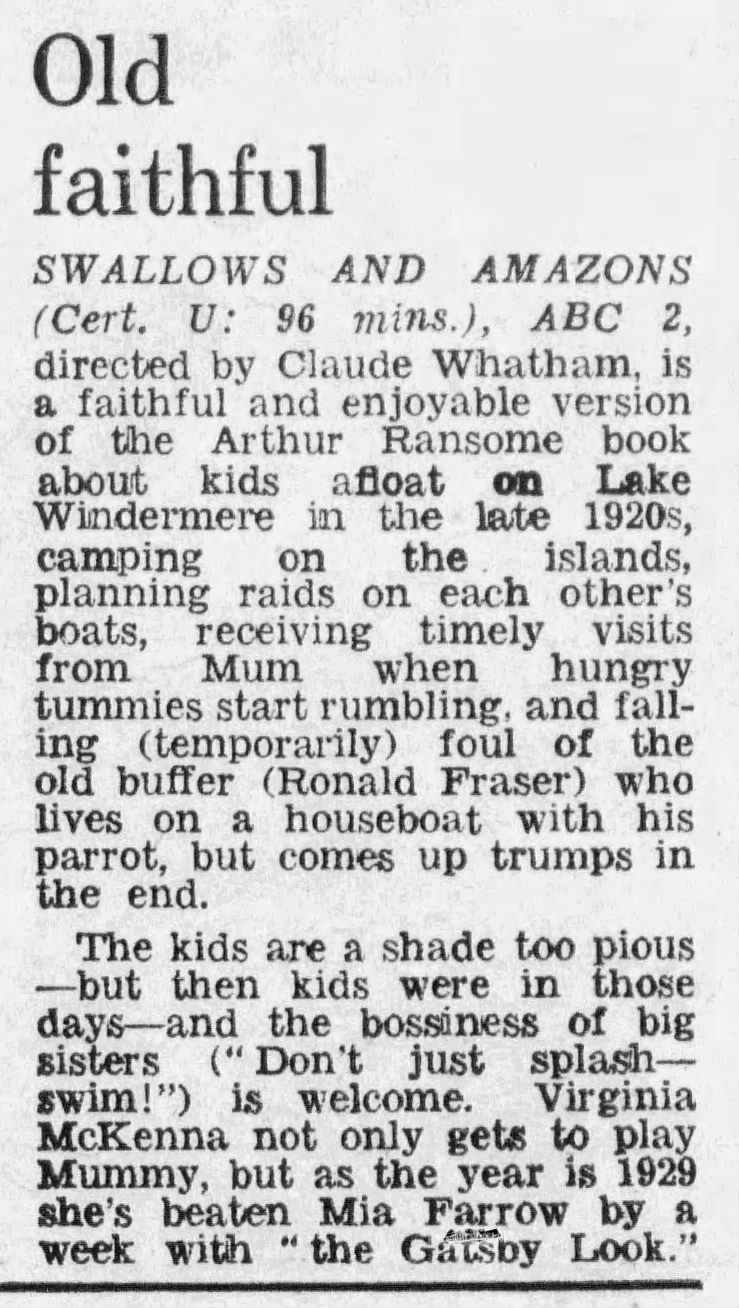
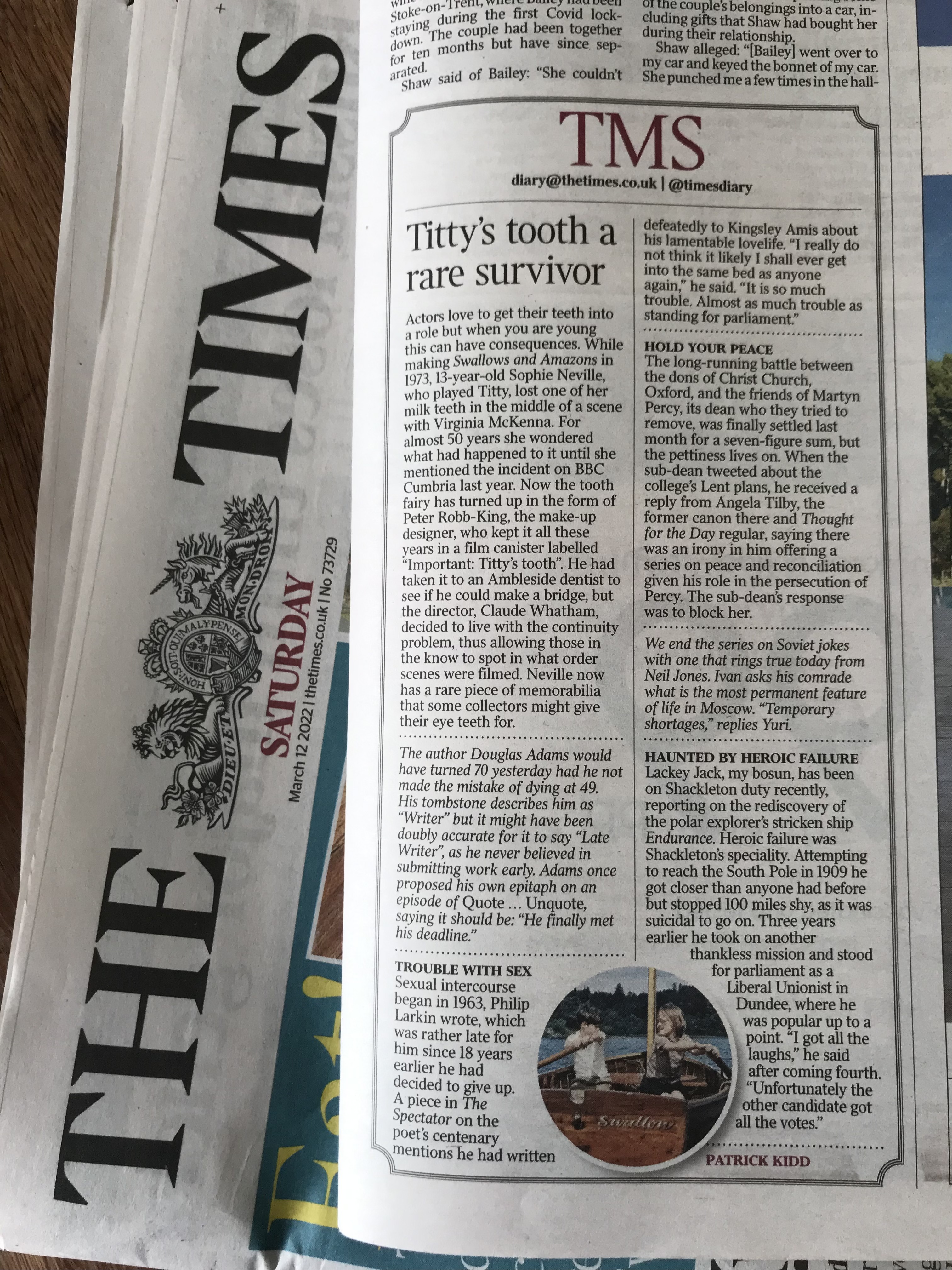
It’s possible to spot the gap by watching the film trailer for the 1974 movie of ‘Swallows and Amazons’ with further information on the International movie data base also seen here:
Sophie Neville, aged 12, without tooth. Suzanna Hamilton, aged 12, with beautiful teeth.
Are you looking for a special Birthday or Christmas present for someone who happens to love the original film of ‘Swallows and Amazons'(1974)?
Author Sophie Neville
Paddy Heron of Children in Read has a huge number of amazing books listed in a charity auction being held to raise funds for BBC Children in Need. Nearly £21,000 has already been pledged, which is amazing. We have 3 days left to bid, so you have time to chat to the family!
‘The Making of Swallows and Amazons (1974)’ is listed as Lot 298, in the section ‘Film & Television’ above Nigella Lawson’s book ‘Coot, eat, repeat’.
and scroll down until you see the image of the book you would like to bid on, then click on the price button and you can enter a bid when the large image pops up. You don’t pay until you win on the final day. I will pay the postage within the UK and inscribe the copy to whom you wish.
What the bidding page looks like
We now have another bid for £101. Copies on Amazon.UK – where is it has 47 reviews, are now listed as costing about £76. I promised that if the bidding went higher than £78 I would personally inscribe this large paperback edition and include a signed first edition hardback copy of my autobiographical book ‘Funnily Enough’, worth £15, which includes a few pages about filming ‘Swallows and Amazons’ in the Lake District.
‘Funnily Enough’, Sophie Neville’s illustrated diary
I said that the bidding goes any higher than £101, I will include a copy of ‘Ride the Wings of Morning’, my memoir about leading a Swallows and Amazons style life camping in Africa:
Ride the Wings of Morning by Sophie Neville
To read about taking part in the same auction last year, please click here
If you need to know more about the auction, please contact Paddy Heron at Children in Read: childreninread@yahoo.com
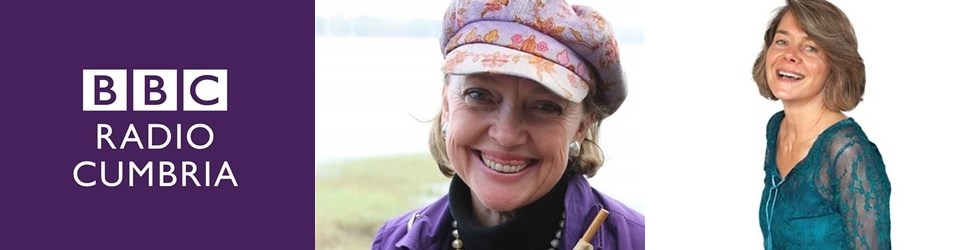
Earlier in the year, I spoke to Helen Millican on BBC Radio Cumbria about making the original film of ‘Swallows and Amazons’ in the Lake District, back in the summer of 1973. We have had an amusing development.
Sophie Neville speaking to Helen Millican on BBC Radio Cumbria
I had been chatting away, telling Helen that people like hearing about all the disasters we had whilst filming on location. One odd thing that went wrong was that one of my milk-teeth fell out in the middle of shooting a scene with Virginia McKenna on Peel Island. At the time, I was somewhat distracted and self-conscious about this but could do no more than try to keep my mouth shut.
Virginia McKenna and Sophie Neville ~ photo: Daphne Neville
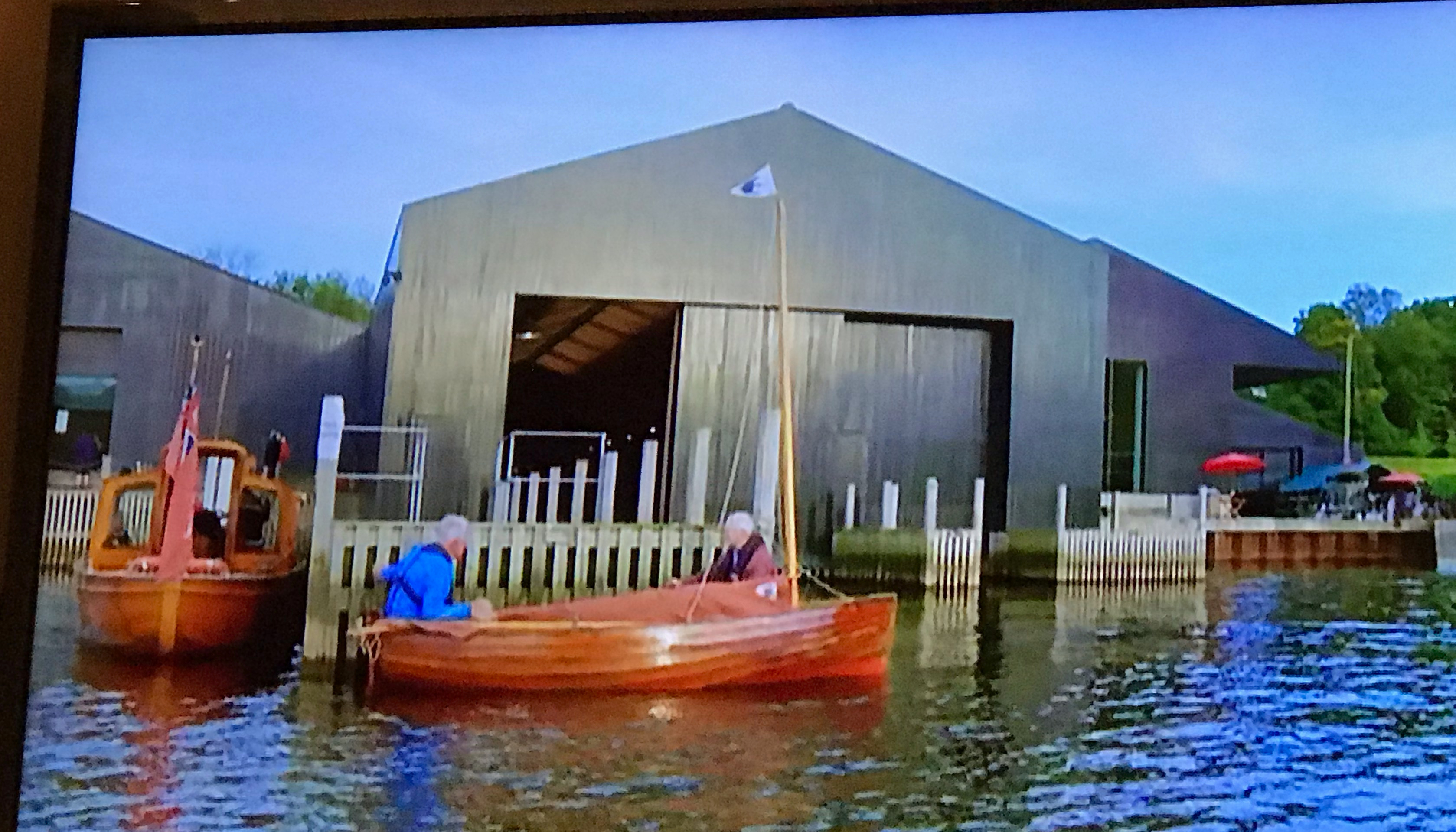
However, viewers often spot the fact that my tooth suddenly disappeared. They still talk about it nearly fifty years later. Helen assured me that the tooth fairy was bound to turn up with it, suggesting I could then take the small canine on BBC ‘Antiques Roadshow’, which was being recorded at Windermere Jetty museum in Cumbria at the time.
The tooth that went missing – top right
Amazingly, the missing tooth has been sent to me.
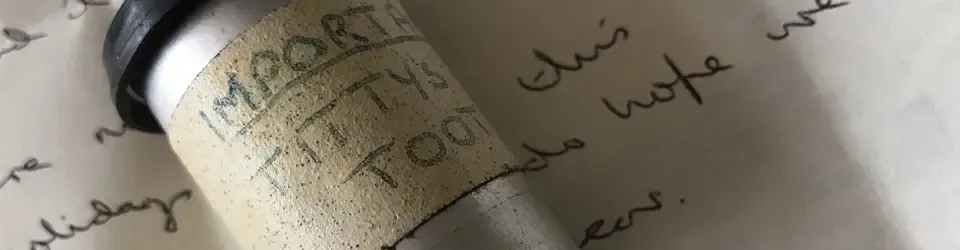
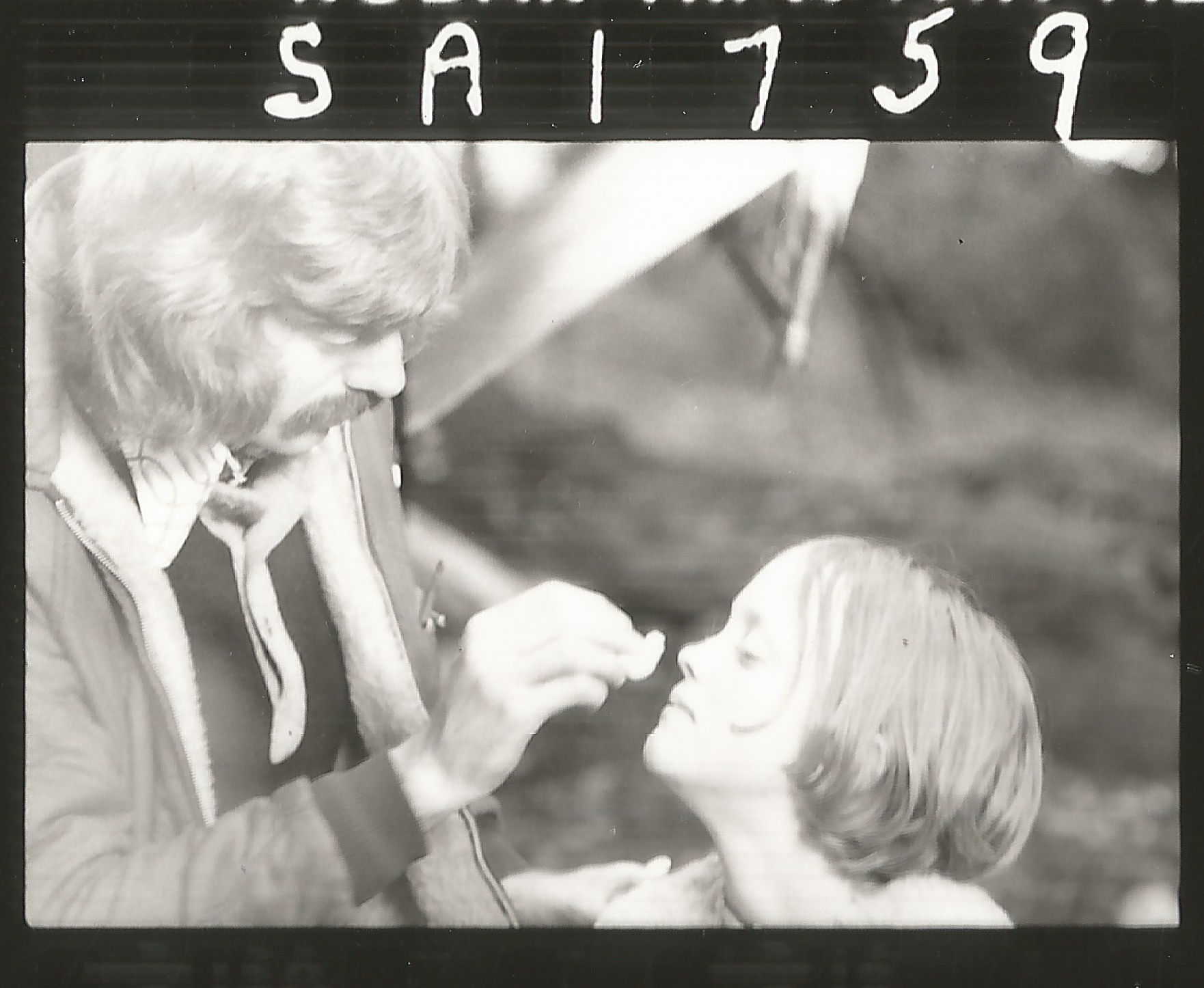
Peter Robb-King, the Make-up Designer on ‘Swallows and Amazons’, rang to say that he had kept it safely in a metal film canister labelled ‘Titty’s tooth’. He promised to send it to me in the post so that I could add it to my bizarre collection of movie memorabilia – valued by Marc Allum at £4,000 to £6,000.
Sophie Neville being made up for the part of Titty by Peter Robb-King in 1973
Helen was delighted to hear that the tooth had materialized after 48 years. “Wow, Sophie what a result, after we made such a joke of it as well! That might just take your valuation up to the next level!”
Peter explained that he took the milk tooth to a dentist in Ambleside to ask if a bridge could be made to temporarily replace it but I remember the director, Claude Whatham, saying that he would ‘have to live with it’ – it being something of a continuity problem as he was yet to shoot earlier scenes of us sailing to the island. As a result, film fans can now work out which sequences were shot right at the end of our time on location even though they come before the scene with Man Friday (played by Virginia McKenna) in the storyline.
My missing tooth, kept since 1973
Peter Robb-King went on to have an amazing career in film, working on ‘The Rocky Horror Picture Show’, ‘Aliens’, and a number of ‘Indiana Jones’, ‘Batman’ and ‘Star Wars’ movies. He told me that he originally found it difficult to break into Make-Up Design as a man, but managed to win a post as a trainee on ‘The Avengers’ in 1968. ‘Swallows and Amazons’ (1974) was his first job as a Make-Up Supervisor, proving a break-through for him and other members of the film crew. It was the first film made by the producer Richard Pilbrow and David Wood’s first screenplay. Suzanna Hamilton, who played Susan, went on to star in many movies including ‘1984’ with John Hurt and ‘Out of Africa’ opposite Meryl Streep. She has recently had a guest appearance on ‘EastEnders’.
Peter Robb-King can be glimpsed right at the end of this cine clip taken on location
Now retired, Peter and his wife live in Maidenhead but enjoy travelling around. We had a long chat about the green parrot as he later adopted a young one that was rescued while making an Indiana Jones film in Sri Lanka. Stephen Spielberg looked after another parrot from the clutch.
You can read more about the disasters that befell us whilst filming in ‘The Making of Swallows and Amazons’, signed copies of which are available from libraries, The Nancy Blackett Trust book shop and other online distributors.
If you enjoy ebooks, ‘The Secrets of Filming Swallows and Amazons (1974)’ has links to behind-the-scenes cine footage and is very good value at £2.99 – available on Kobo, Smashwords, iTunes and on Kindle here
Lakeland Arts, based at the Windermere Jetty Museum, ask how the original film of ‘Swallows and Amazons’ was made on location in the Lake District in 1973 –
You can find out more in the illustrated paperback, suitable for all age of readers, entitled ‘The Making of Swallows and Amazons’, which makes a good Christmas present when combined with the 40th Anniversary DVD with DVD extras.
Simon West, Suzanna Hamilton and Sophie Neville in Swallow about to leave the Houseboat. Amazon’s white sail can be seen the other side ~ photo: Daphe Neville
Viewers of the original film ‘Swallows and Amazons'(1974) have written to point out that when the Amazons sailed up to Captain Flint’s houseboat there was a terrible crash. I found the quote from ‘The Picts and The Martrys’, which made me realise why this horrified anyone who knows the characters well:
“…when you come sailing along and fetch up with a bump against Jim’s new paint.”
“We never do,” said Nancy. “Remember when we came and made you and Uncle Jim walk the plank last summer? We were aboard and rushing the cabin before you knew we were anywhere near.” ‘Picts and Martyrs’ by Arthur Ransome p.14
Simon West as Captain John and Sophie Neville as Titty taking Captain Flint’s Houseboat : photo~ Daphne Neville
Jane Sullivan noticed Captain Flint yelled, “Death or Glory!” as the Swallows and Amazons laid siege to his houseboat. ‘Is that a pre-echo of the East Anglian stories?’ she asked.
Jane also noted: ‘In the closing credits, I notice they spell For Ever as two words, which it is as it should be, rather than the modern way which confuses the adjective “forever” with the adverbial phrase “for ever”.’
Peel Island whilst we were filming in 1973 ~ photo: Martin Neville
Most people are familiar with the fact that Peel Island was used as the location for Wild Cat Island in the 1974 film.
Peter Dowden of the Arthur Ransome Group, pointed out that Peel Island is a classic example of a rocher moutonnee or sheepback, shaped by glacial erosion. Larger examples in Sweden are known as flyggbergs. Others comment that it’s easy to imagine the island as Captain Flint’s schooner the Wild Cat, which sails to the Caribees in ‘Peter Duck’ and is set on fire by Gibber the monkey in ‘Missee Lee’.
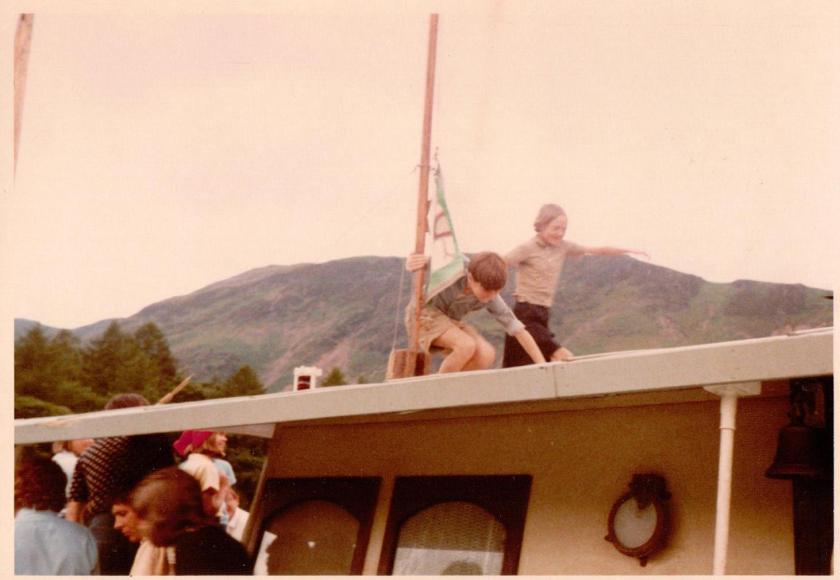
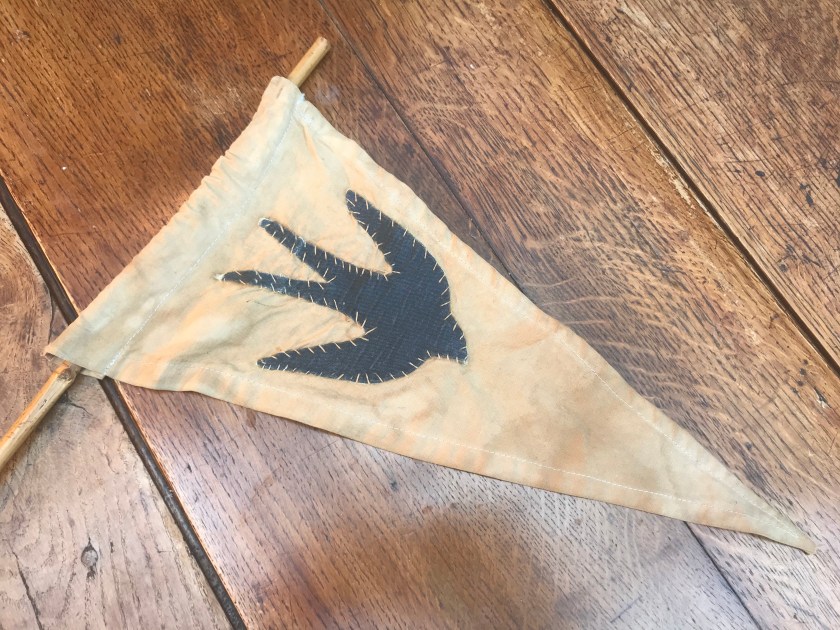
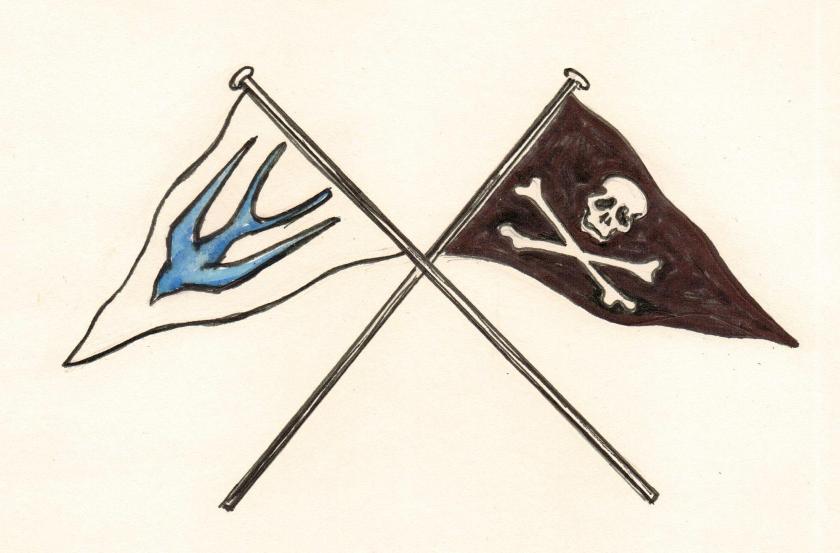
Peter also wrote about burgees. He noted, ‘Traditionally, creatures shown on flags face towards the “hoist” – the bit of the flag that is attached to the mast. So head near the mast and tail near the flappy part of the flag (called the ‘fly’). He went on to say, “someone did the research and Arthur Ransome drew the Swallow flag both beak to hoist and beak to fly!”
Our art director, Simon Holland, made what I considered the mistake of having the swallow on Swallow’s burgee flying away from the mast.
My publisher asked me to draw our crossed flags, a sketch which was later stolen and used all over the place from the call sheet of the 2016 movie to badges for sale on eBay.
Paul Thomas, of the Arthur Ransome Group, explained that Swallow and Amazon are standing lugsail dinghies, rather the balanced lugsails as I had been told. “Swallow’s keel was designed for sailing in shallow estuaries and grounding on shifting shoals with sails tanned to protect them from rot and sunshine.”
“What is particularly impressive, to me,” Roger Barnes, president of the Dinghy Crusing Association, commented, “is how well done the sailing scenes are, and sometimes in pretty strong winds. Most sailing in films is really unconvincing.” Roger added: “The boom jaws off the mast as they first approach Wild Cat Island is the only major flaw with that aspect of the film.” I had never noticed! We were bitterly cold on that day when we first sailed Swallow in front of the camera.
Roger Barnes’ illustrated book, The Dinghy Cruising Companion, published by Bloomsbury, included my behind-the-scenes photo of Swallow, where you can see the jaw back in place.
You can also see the jaws in this film still (c) Studiocanal:
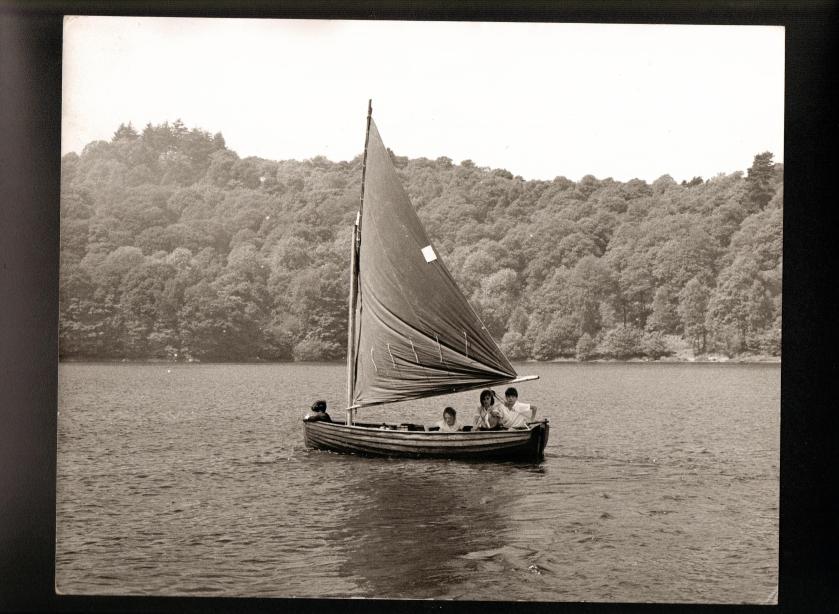
Sten Grendon, Sophie Neville, Suzanna Hamilton and Simon West as the Swallows sailing on Coniston Water in 1973 (c)StudioCanal
Please do add a comment below or write in with any points you notice that I can add to a third edition of ‘The Secrets of Filming Swallows and Amazons’, an ebook available from a variety online stockists. You can look at the first pages here.
I spoke on BBC Radio Cumbria, asking if I could meet anyone involved in filming the original film of ‘Swallows and Amazons’ (1974). It was made on location in the Lake District with a young crew.
~Nick Newby of Nicole End Marine~
Nick Newby of Nichol End Marine in Portinscale came to find me while I was in the Keswick. As a young man in the 1970s, he provided boats for a number of films and was contacted by Graham Ford, the production manager of Swallows and Amazons in the Spring of 1973. Graham had began working with Mike Turk who had started building boats for TV and films at his family firm, Turk’s Launches, but this was based on the Thames in London. They needed help from someone in the Lake District who knew about traditional boats.
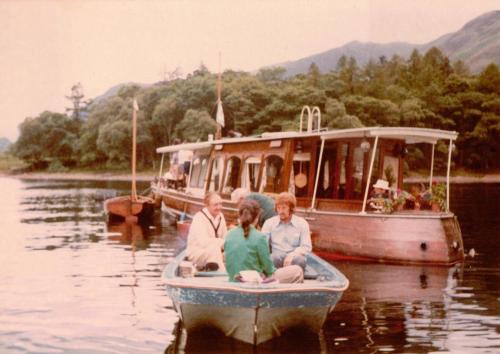
~Ronald Fraser being trransported by Dory to The Lady Derwentwater in 1973~
Arthur Ransome had clearly based Captain Flint’s houseboat on the Esperance, originally a steam launch cruising on Windermere. You can read more about her and see photos here.
‘Since she was sitting on the bottom of Whitecross Bay at the time,’ Nick told me, ‘the film crew decided to use the Lady Derwentwater.’ This was a launch licensed to carry 90 passengers that Nick had worked on and knew well. ‘She is about 58 foot long and quite a rigid boat, having four full length steel RSJs set inside her. She was built the Lakes in 1928. We moored her at Brandelhowe in Great Bay for the filming. You need to be careful getting in, as there is a rock shelf.’ Unlike the Esperance you could see the view over the lake from her large cabin windows, which enhanced interior scenes. The Lady Derwentwater, whose nick-name is Dishy, has since been re-built with a different stern, but you can book a passage and go out on the lake in her yourself.
~The Lady Derwentwater today~
Nick told me that Captain Flint’s eight foot Wright’s dinghy, the houseboat’s tender, had been made by Wright’s Brothers of Ipswich. The Jackson’s ‘native canoe’, rowed out to Peel Island by Virginia McKenna was ‘a family fourteen’ Wright’s sailing dinghy with a centre case. He knew many of the traditional boats in the Lakes. ‘I served me time as a yacht and boat builder at Shepherd’s in Bowness Bay.’ This company was based the green double-story boat sheds featured in the ‘Rio’ scenes. ‘During the winter we used to have to break the ice on the buckets of water when we were rubbing down boats. The sail lofts had a square panel in the apex so we could poke the 8 to 10 metre masts inside. A boom could go up the stairs but a mast certainly couldn’t. ‘
~Virginia McKenna with Sophie Neville and DoP Denis Lewiston~
‘Amazon belonged to a chap called Vosey who was rather reluctant to let her be used for the filming,’ Nick said. ‘We did her up a bit after the filming.’ I gather she had been used in the black and white BBC serial of Swallows and Amazons made in 1962 when Susan George played the party of Kitty.
~Swallow sailing towards the filming pontoon in 1973~
I believe Swallow had been found at Burnham-on-Crouch as she was built by Williams King and Sons. Mike Turk, who had built a shallop for the 1966 movie ‘A Man For All Seasons’, purchased her for the film and brought her up to the Lakes. She had no added buoyancy. Nick claims that being a wooden boat she would never sink but I reminded him that we came close to hitting the MV Tern on Windermere when loaded with camping gear, which was a bit scary.
~MV Tern on Windermere today~
Swallow was later used at Elstree Studios when the sound was dubbed onto the finished film. Mike kept her out of the water in his store at Chatham until SailRansome bought her at auction in 2010. She was sensitively restored by Pattersons, has a new sail, added buoyancy bags and is now available for anyone to sail in Cumbria.
~Mike Turk’s filming pontoon with Swallow attached in 1973~
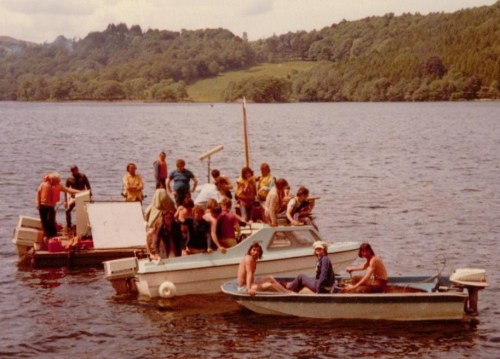
‘Mike already had the flat-bottomed filming pontoon. It had originally been used for carrying a vehicle. We added twin outboard engines and rigged scaffold under the water so that either Swallow or Amazon could be attached to it but still keel over naturally as they sailed. When the dinghy went about, I would turn one outboard and thrust the other into reverse so that the pontoon went about with them.’ I remembered that the first time they tried this Swallow’s mast footing broke. Amazon’s mast-gate broke on another occasion. Nick had to persuade a friend to let him borrow his welding workshop and managed to mend it over night, so that she could be ready on set first thing the next day.
~The camera pontoon, Capri and one of the Dorys used behind-the-scenes~
Nick went on to say the pontoon leaked a bit. ‘We would have to pump out hull every morning.’ The Capri used behind the scenes was Nick’s equivalent of a marine Land Rover. ‘It had a reinforced glass fibre hull for increased capability and a 55-horse power engine that had been used for the Olympics. We used it for Ken Russell’s film ‘Tommy‘, the rock opera with Roger Daltry and The Who. Once, when we were using it for Swallows and Amazons, Clive Stuart shoved it into gear with rather too much gusto. Someone only just managed to grab the director, Claude Whatham, before he was flung over the back. ‘Claude was spitting feathers after that.’
~Suzanna Hamilton, Simon West, Sophie Neville & Sten Grendon with David Stanger at the helm of the Dory in 1973~
Mike Turk provided two Dorys, built at his yard, to use as run-around boats. One was driven by David Stanger who is now skipper of a launch on Ullswater. It was a stable boat but you needed to watch how it was not overloaded. Water came over the bows one day giving my mother rather a shock.
‘The boating world is a small world,’ Nick assured me. This July, forty-five years after making the film, he brought his grand-daughter to watch ‘Swallows and Amazons’ at the Alhambra Cinema in Keswick and gamely came up on stage for a Q&A to explain how some of the sailing scenes were achieved.
Mike Turk, Swan Upper and Queen’s Waterman, who provided boats for numerous films from Moonraker to Hornblower, sadly passed away aged 78. You can read his obituary here. He went on to work on a number of James Bond movie. You can see his film credits here.
A group of Arthur Ransome enthusiasts clubbed together to buy Swallow from Mike’s collection in 2010. She is currently kept on a trailer at Kendal in the Lake District. If you would like to sail her, please visit SailRansome.com
For Nicol End Marine, about two miles outside Keswick on Derwentwater please click here
You can see Swallow – and learn of her value – on BBC Antiques Roadshow, towards the end of the first episode recorded at Windermere Jetty museum in September 2020. It is on BBC iplayer here
You can read more about making the 1974 film Swallows and Amazonshere
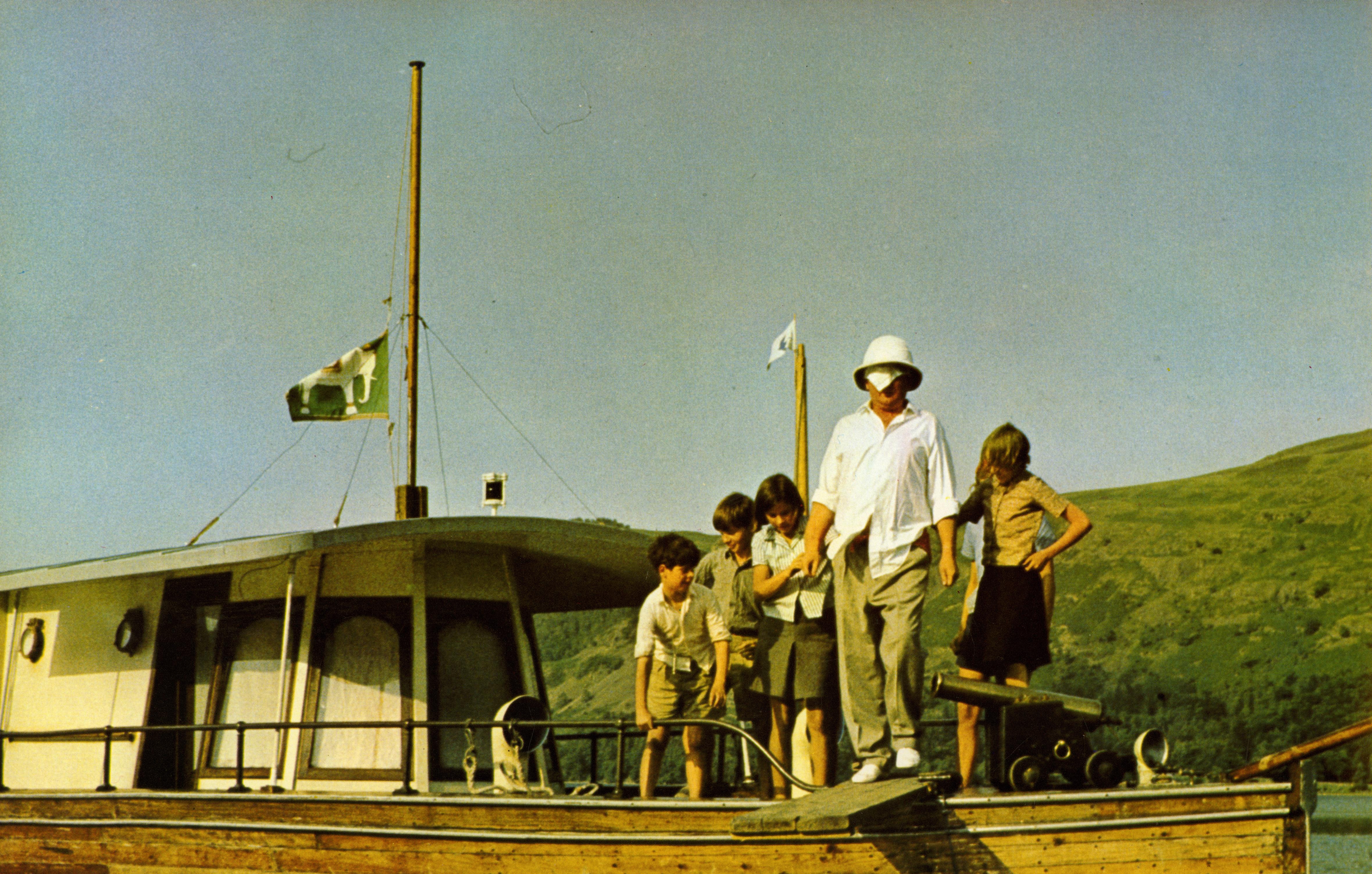
The 45th Anniversary of filming the original film ‘Swallows and Amazons’ on Derwentwater, when Ronald Fraser was obliged to walk the plank in a solar topi in July 1973, was marked by a special screening of the film at the Alhambra in Keswick.
Kerry Derbyshire, who played Vicky’s nurse came on stage and we demonstrated how one of the visual effects was achieved.
I brought one of the original arrows that the Amazon pirates fired over my head. It looks so dangerous on film that the shot was cut from the television version but is included in the re-mastered cinemascope edition that we are now able to watch on the big screen. You might be able to spot a few other things that went wrong while we were filming, such as the time I inadvertently slipped up to my waist in water.
Nick Newby from Nicole End Marine came along to tell us how the elegant Lakeland steamer, the Lady Derwentwater, had been converted for her starring role as Captain Flint’s houseboat. She was appropriately dressed for the part by the award-winning set designer Ian Whittaker, who went on to receive an Oscar for Best Art Direction on ‘Howards End’ starring Sir Anthony Hopkins and Emma Thompson. His astonishing list of nominations can been seen here.
Swallow, the 1930s sailing dinghy used in the original film, was at the lakeside for Arthur Ransome enthusiasts to admire. She is looked after by Rob Boden, from Kendal, who is happy to take people for a sail by prior arrangement via the SailRansome website here.
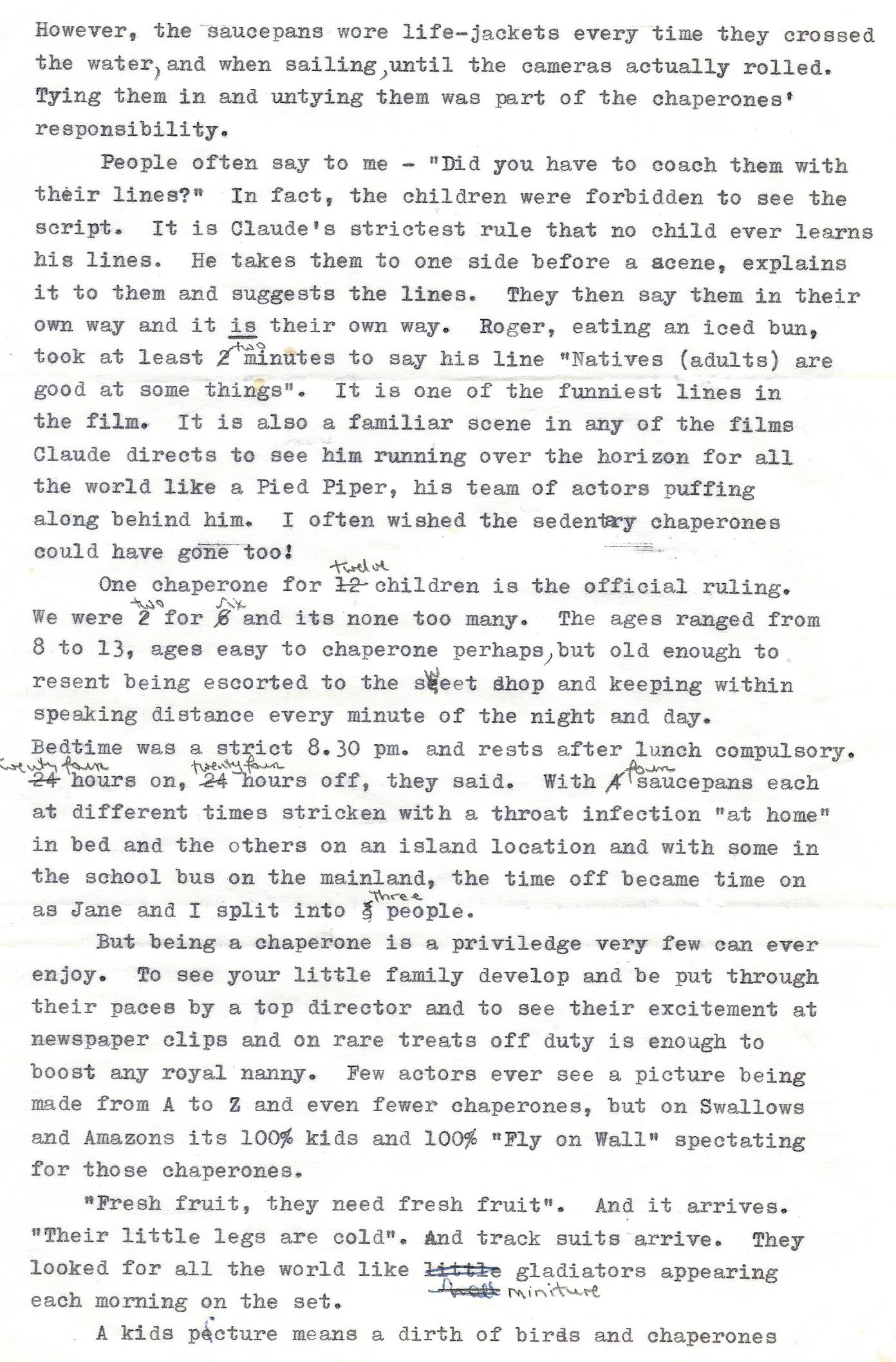
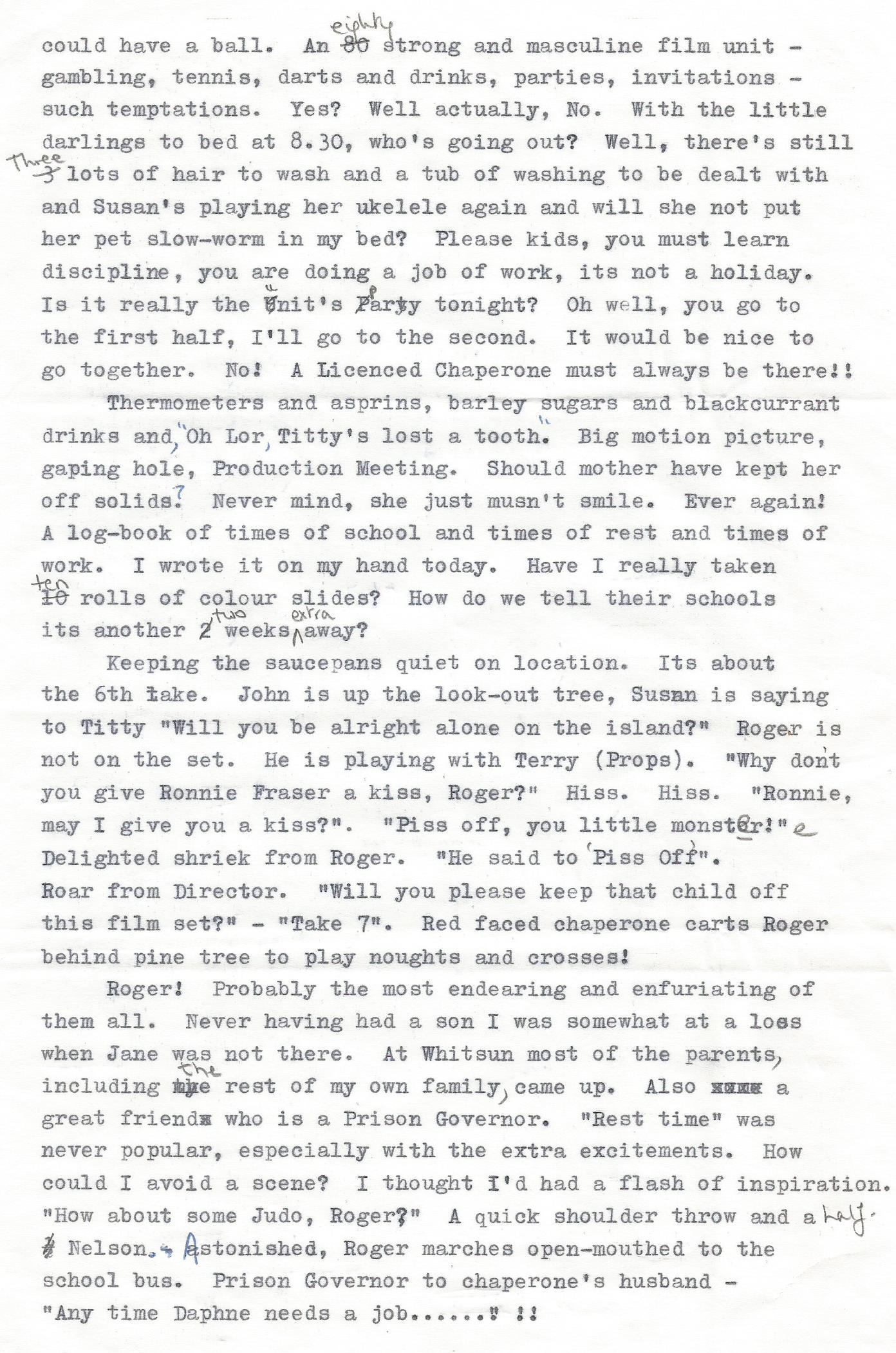
In 1974, my mother, Daphne Neville, was commissioned to write an article about working on the original film of ‘Swallows and Amazons’ for Woman magazine, which claimed to be ‘The world’s greatest weekly for women’. Here are some extracts from her type script:
Simon West, Stephen Grendon, Suzanna Hamilton and Sophie Neville playing the Walker children in ‘Swallows and Amazons’ 1973 ~photo: Daphne Neville
Daphne Neville with Sophie Neville and Simon West on Coniston Water
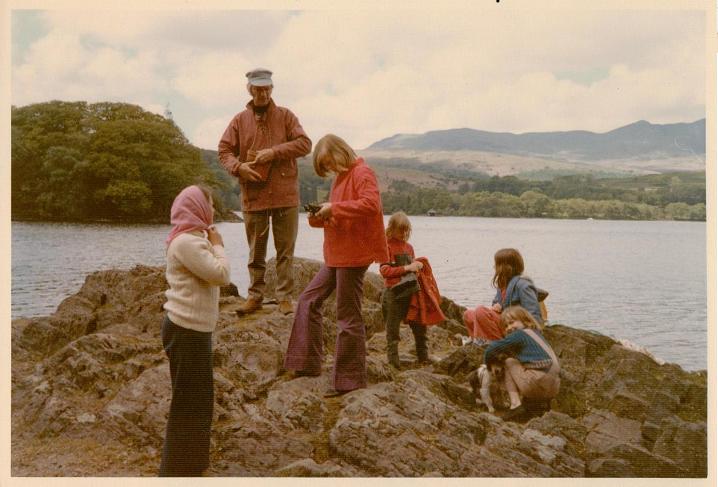
Our guests: Jane, Michael, Clare and Lucy Selby and their dog, Minnie on the shore of Conniston Water with my sisters Perry and Tamzin in 1973
I was amazed to read some of this. ‘….a dirth of birds’? Was that really how my mother spoke in the early ‘Seventies? I had no recollection that ‘Nomansland’ had been displayed on the front of our double-decker bus. I never remembered there only being bathroom at Oaklands Guesthouse or that Mum had to wash out clothes. I do remember Ronald Fraser shouting, ‘Piss off you little monster’. I have the photo:
Sten Grendon sitting on top of Ronald Fraser during a break in the filming of ‘Swallows and Amazons’ on Derwentwater ~ photo: Daphne Neville
More to follow…. If you would like to see photos of Daphne Neville appearing in movies herself, please click here
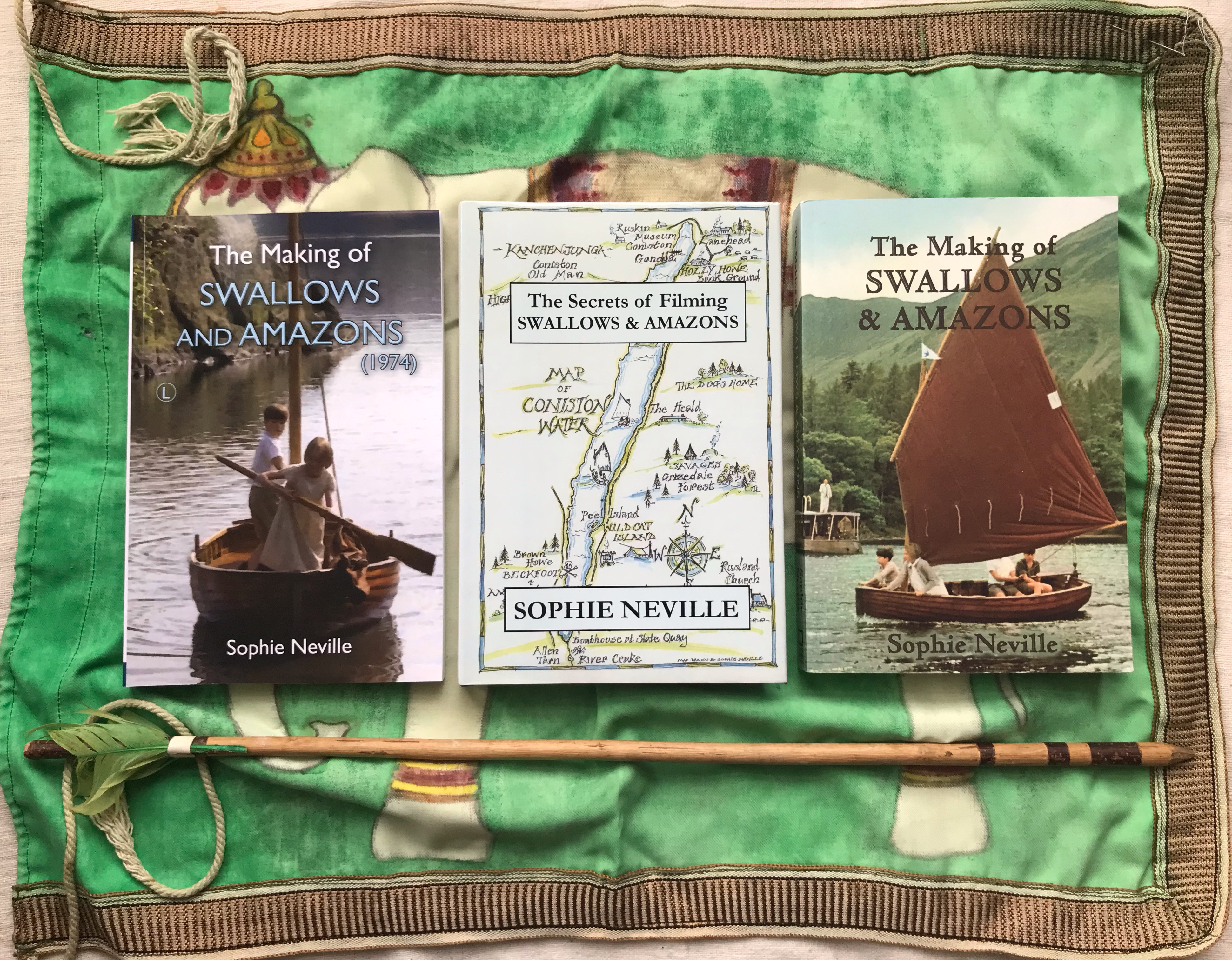
You read about how we made the original movie ‘Swallows and Amazons’ in any of these books that retail online and can be ordered from bookshops or libraries:
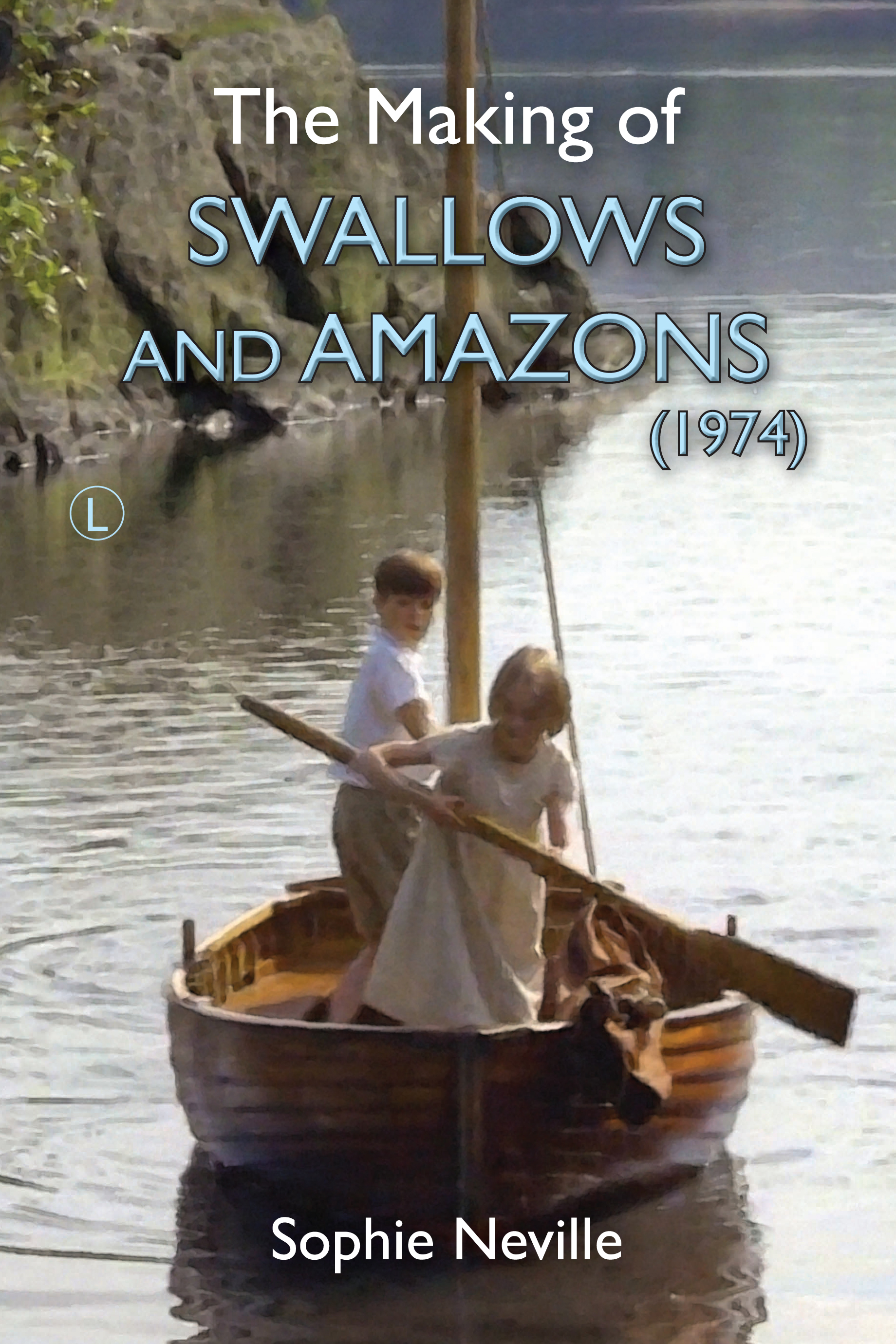
Different editions of ‘The Making of Swallows and Amazons (1974) by Sophie Neville’
When the original feature film of ‘Swallows & Amazons’ was made in 1973, Peggy Blackett was played by Lesley Bennett, who was aged thirteen at the time. She can be seen here on location at Bank Ground Farm above Coniston Water in the Lake District.
For the last thirty-eight years, Lesley has been living in the Netherlands. I met up with her for lunch at Schiphol Airport on my way back from sailing Arthur Ransome’s cutter, the Nancy Blackett, through the inland waterways of Zeeland. (Please see the last two previous posts.) I nearly didn’t make the meeting. A man had been arrested for planting a bomb on a train just north of Middleberg, but the authorities must have acted quickly as I wasn’t delayed for long.
Lesley had brought along a blue file of documents and a number of black and white movie stills that she’d been given by Richard Pilbrow, the producer of ‘Swallows and Amazons’ (1974) on one of our last days in Ambleside after filming had finished. We could both remember them spread out on a table at the unit hotel so we could each chose the ones we appeared in. I had picked one where Lesley and I are sitting together, our hair bobbed in line with the 1930’s, I wearing a cream silk dress, Lesley in a dark top looking very pretty:
~A publicity shot featuring Virginia McKenna, with Kit Seymour, Sten Grendon, Sophie Neville, Lesley Bennett, Simon West and Suzanna Hamilton, published in the Guardian and other newspapers~
Lesley’s parents, who lived near Tonbridge in Kent, originally learnt that Theatre Projects were looking for children to take part in the film when the Associate Producer, Neville Thompson, wrote to their local sailing club. Lesley explained that her father, who was very well organised, kept a copy of the letter sent to the Secretary of the club in January 1973. Plans were made for Lesley to be interviewed for a part with her younger sister Lyn, who sadly fell ill and couldn’t make the audition. The letter contains a mistake that might explain why Lesley ended up playing Peggy when she was thirteen years old.
Lesley got on well with Kit Seymour who ended up playing her elder sister, Nancy Blackett – ‘terror of the seas’. Both girls would sail well and enjoyed being out on the lakes. Lesley told me that the reason why she held her hands between her legs in this photograph is that it was so cold when we were filming on Peel Island.
‘Kit would fold her arms and I’d try to keep my hands warm.’ Although I wore a cardigan in this scene, Swallows had been cold too. I remember thinking that at least the Amazons wore knitted hats. Otherwise their costumes were simple short-sleeved shirts and long shorts with black plymsols, worn without socks.
~Kit Seymour as Captain Nancy and Lesley Bennett as Mate Peggy in 1973~
Lesley told me their hats had been quite a problem – not quite a full-blown movie disaster but a they caused consternation in Consiton. The first scene the Amazons shot was set in the garden of Beckfoot, the Blacketts’ house. Although it does not lie on the ‘Amazon River’ at the northern end of the lake, Brown Howe on the western shore of Coniston Water was used as the location and the crew set up the 35mm Panavision camera, along with reflector boards and enough lighting to bring sunshine to Westmorland. When everyone on the production was ready, Gareth Tandy, the third assistant led the Amazons down to the set wearing red knitted stocking caps – with no bobbles. Beanies were not quite what either the director or producer had expected. Lesley has a photo showing the great discussion that ensued:
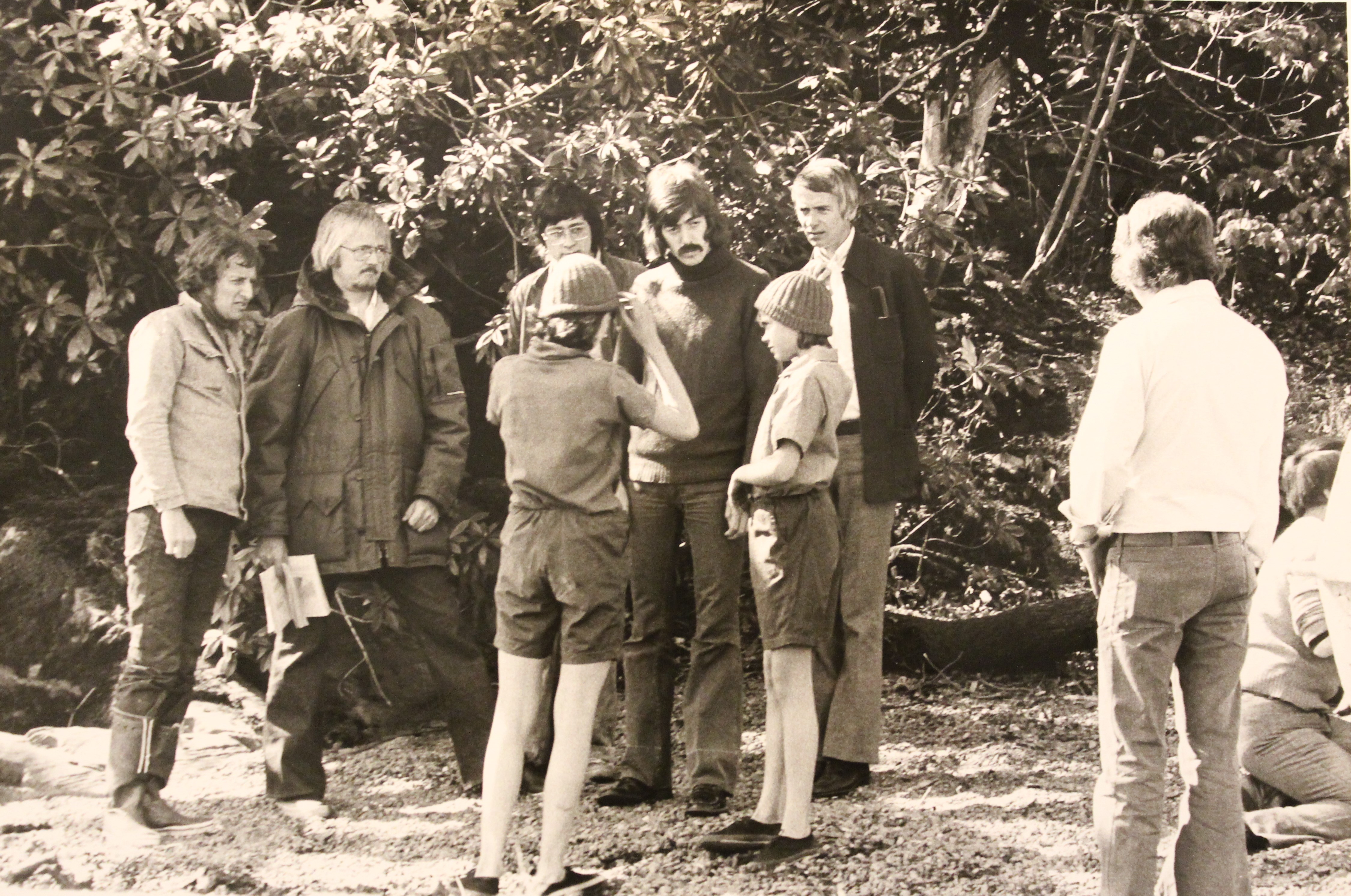
~Director Claude Whatham, Producer Richard Pilbrow, 3rd Assistant Director Gareth Tandy, Make-up Artist Peter Robb-King, Hairdresser Ronnie Cogan and Associate Producer Neville Thompson with Kit Seymour and Lesley Bennett at Brown Howe on Coniston Water in May 1973 ~
In the end Claude Whatham shot the scene with the girls bare-headed, their hair blowing all over the place, even though it was meant to be ‘dead-calm’ in the story. This looked natural as they were at home but they needed to look like pirates in every other scene.
~Nancy and Peggy running down to Amazon at the Blackett’s house Beckfoot~
Wooly hats with ‘longer ends’ were knitted locally at some speed. Red is not a good colour on the screen. I remember a couple of bright pink ribbed bobble-hats arrived when we were filming on Peel Island but they were deemed a complete disaster and rejected in favour of scarlet ones originally described by Arthur Ransome even if the colour might look a bit jarring on screen.
Emma Porteous, the costume designer, was back in London. No one on the production knew anything about knitting or subtle shades of wool. When the third pair of hats arrived we were all a bit worried about the fatness of the bobble-end, as they didn’t quite match the illustrations in the books, but no one knew what else to do. Time ran out and the producer was forced to compromise. ‘They were warm but prone to flop about,’ Lesley said, ‘and sometimes flopped forward, which looked a bit silly.’ I’d never noticed this but it was captured in one photograph:
Kit Seymour and Lesley Bennett as Nancy and Peggy Blackett in 1973
Mum was given the pink version of the hats. She kept them for years but no one ever wore them.
A fascinating guidebook produced by Hayloft Publishing, written by David Banning with a foreword by Sophie Neville.
‘This is the finest comprehensive guide to the history of movies filmed in Cumbria and the Lake District, since the early twentieth century to the present day… it will take you on a journey through the filmic landscape of one of the world’s most beautiful places.’
It is difficult to find copies now but the Daisy Roots Bookshop have one on Ebay here
‘You will be able to immerse yourself in the lush green world where Star Wars created an alien landscape or take a trip around Swallows and Amazons country, not to mention joining the ranks of Withnail and I pilgrims or sampling the nostalgic Brief Encounter tea rooms where a tiny piece of grit kick-started an enduring romance.’
To read more, please click here for Cumbria Todayor click on this image for a review in the Cumberland & Westmorland Herald:
For more information from Hayloft Publishing, and to buy this book, please click here
Terry Abraham, who made the film Life of a Mountain, writes: There are countless books covering aspects of the most beautiful corner of England but none which reveal little known facts regarding it as a location for filming. David thoroughly and interestingly brings to light the great number of films both large and small that have featured Lakeland on camera. Some less obvious than others but no less absorbing, you may well wish to seek out and visit where productions have captured the scenic delights of Lakeland. David’s book is an engaging and enlightening read and definitely one for the shelf alongside other works celebrating England’s finest landscape.
David Banning lists ten of the best films made in Cumbria. Please click on these links for the International Movie Database details and film trailers:
You can see a shot of Derwent Water at 1.23 mins into the official film trailer for Star Wars after ‘This Christmas’ graphics, here:
Review of ‘An A-Z of Cumbria and the Lake District on Film by David Butters
I received this book as a gift from a friend. I live near the Lake District and visit it as often as I can; I now have new reasons for going!
As the title suggests, the book discusses, in alphabetical order, virtually every film that has been shot either partly or wholly in the general areas we now know as Cumbria and the Lake District. And what a fascinating collection of titles it encompasses! I knew that The Dambusters flew over Derwentwater, that Brief Encounter utlilised Carnforth Railway Station, and that Swallows and Amazons, the 1974 version, was filmed almost entirely around Windermere and Coniston lakes. But I had no idea that Snow White and the Huntsman featured a cave in Little Langdale, for instance; or that The French Lieutenant’s Woman made use of a large house overlooking Lake Windermere. The animated classic The Plague Dogs apparently took inspiration from the Lake District countryside; and the village of Greendale in the TV and cinema favourite Postman Pat is based on a village near Kendal.
A brief synopsis of each film accompanies a description of the localities involved, and also some background information and stories: I especially enjoyed the story behind the famous shower scene in She’ll be Wearing Pink Pyjamas! (You’ll have to buy the book!)
This is a fabulous book, a guide book as well as an enjoyable read, and well worth a 2nd Edition, please publishers! It has given me fresh impetus to explore the Lake District and Cumbria even further. Unreservedly recommended.
‘Swallows and Amazons'(1974) filmed on location in the Lake District in 1973