How the chance of acting in the movie Swallows and Amazons began in Stroud in the Cotswolds

When I first published ‘The Secrets of Filming Swallows and Amazons’, someone left a review online saying they thought it a good idea for a novel but that it was a bit farfetched.

This amused me. It was a non-fiction book, written because the extraordinary story was true. Of all the roles, in all the novels ever written, I was asked to play Titty in Swallows and Amazons, an EMI film made in 1973 for universal distribution.

The offer came out of the blue. Within a year, I, an ordinary schoolgirl, found my image on the front of daily newspapers and on film posters pasted on the walls of the London Underground. All this happened nearly fifty years ago and yet the publicity never ends.

Swallows and Amazons (1974) now distributed by StudioCanal

Arthur Ransome, a haunted foreign correspondent, who escaped from Russia with Trotsky’s secretary, wrote Swallows and Amazons in 1929 while suffering from stomach pains so bad they prevented him from travelling. He said that the book wrote itself, but it is clear that he was self-medicating, grieving his own childhood, when he’d been longing to make friends and prove himself to his father who died when he was only thirteen.

Tweed-clad and continuously pipe-smoking, Ransome was oblivious to Lakeland weather. I acted out his almost-real fantasy in nothing but a thin cotton dress and a pair of enormous navy blue elasticated knickers. My book on ‘The Making of Swallows and Amazons’ is not a novel, not a fantasy. It is a true story. The movie is streaming on Amazon Prime where you can watch the trailer.

Why was I cast in the film? Why me? I had loved all the Arthur Ransome books I’d read in the Swallows and Amazons series, imagined myself exploring Wild Cat Island and the Great Lake in the North. Did I ever ask the Lord if I could live out the stories for myself?

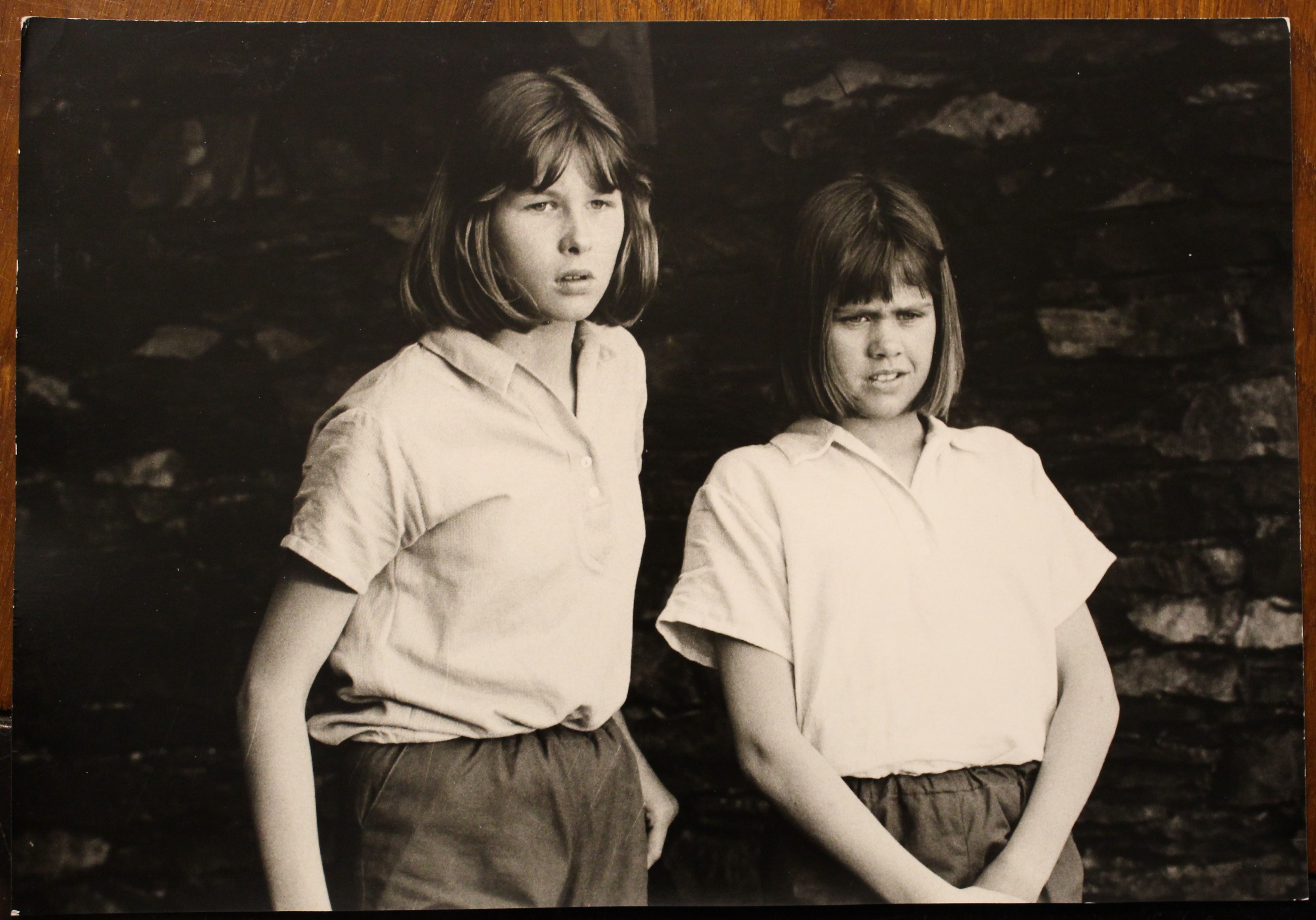
The reality began in Stroud, at the Subscription Rooms. I put up my hand when someone asked if there was a ten year-old girl who could play the piano. They didn’t say, “play well.”

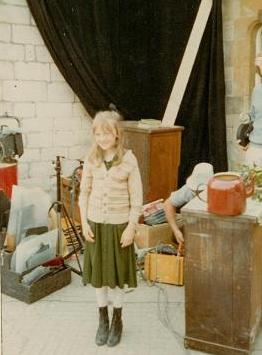
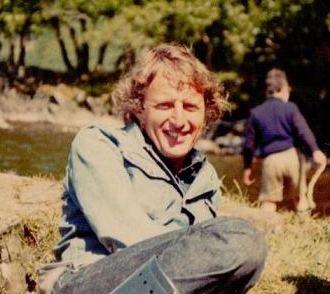
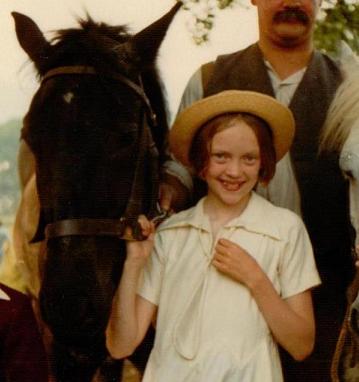
A young director called Claude Whatham, who lived in the Cotswold village of Camp, was looking for children to appear in the 1971 BBC adaptation of ‘Cider With Rosie’, based on Laurie Lee’s haunting memoir. He needed to find a little girl who had been to a village school near Stroud. I had attended Oakridge Parochial Church School when it was heated by pot-bellied stoves and the vicar told us Bible Stories.

I was chosen to play Eileen Brown, who shared a desk with Laurie Lee and accompanied him as he played Oh Danny Boy on his violin at the Christmas concert.

Sophie Neville in the 1971 BBC adaptation of ‘Cider with Rosie’, directed by Claude Whatham

My music arrived three days before filming began. It consisted of endless cords – a complicated accompaniment with no tune. To tackle the piece, I’d needed to practice for seven hours a day with the help of my long-suffering piano teacher from Far Oakridge.

Claude Whatham ~ photo: Daphne Neville

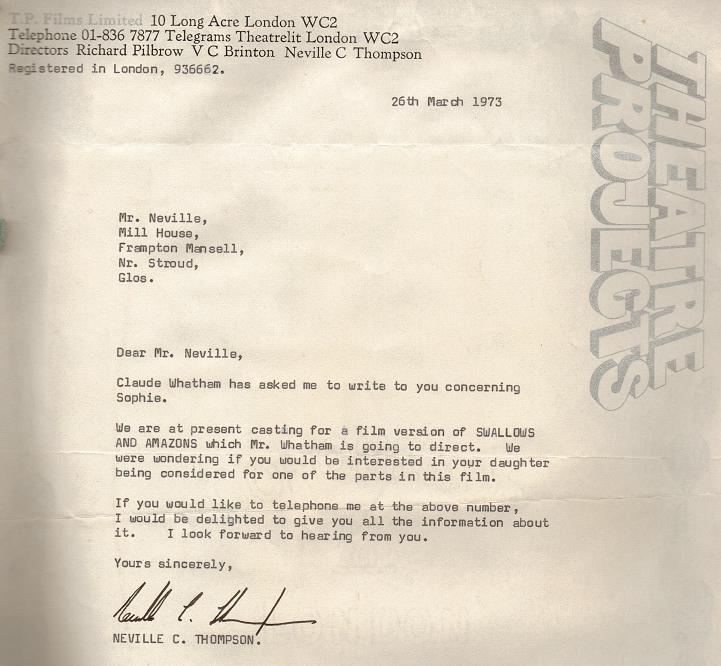
The director must have remembered me as a determined little girl because two years later a letter arrived, addressed to my father, only he was working in South Africa. My mother very nearly didn’t open it, however the words Theatre Projects were embossed on the envelope and she was intrigued.

But she did. We drove up from Gloucestershire to collect Dad from Heathrow and went straight to Long Acre near Leicester Square for an interview with Claude.

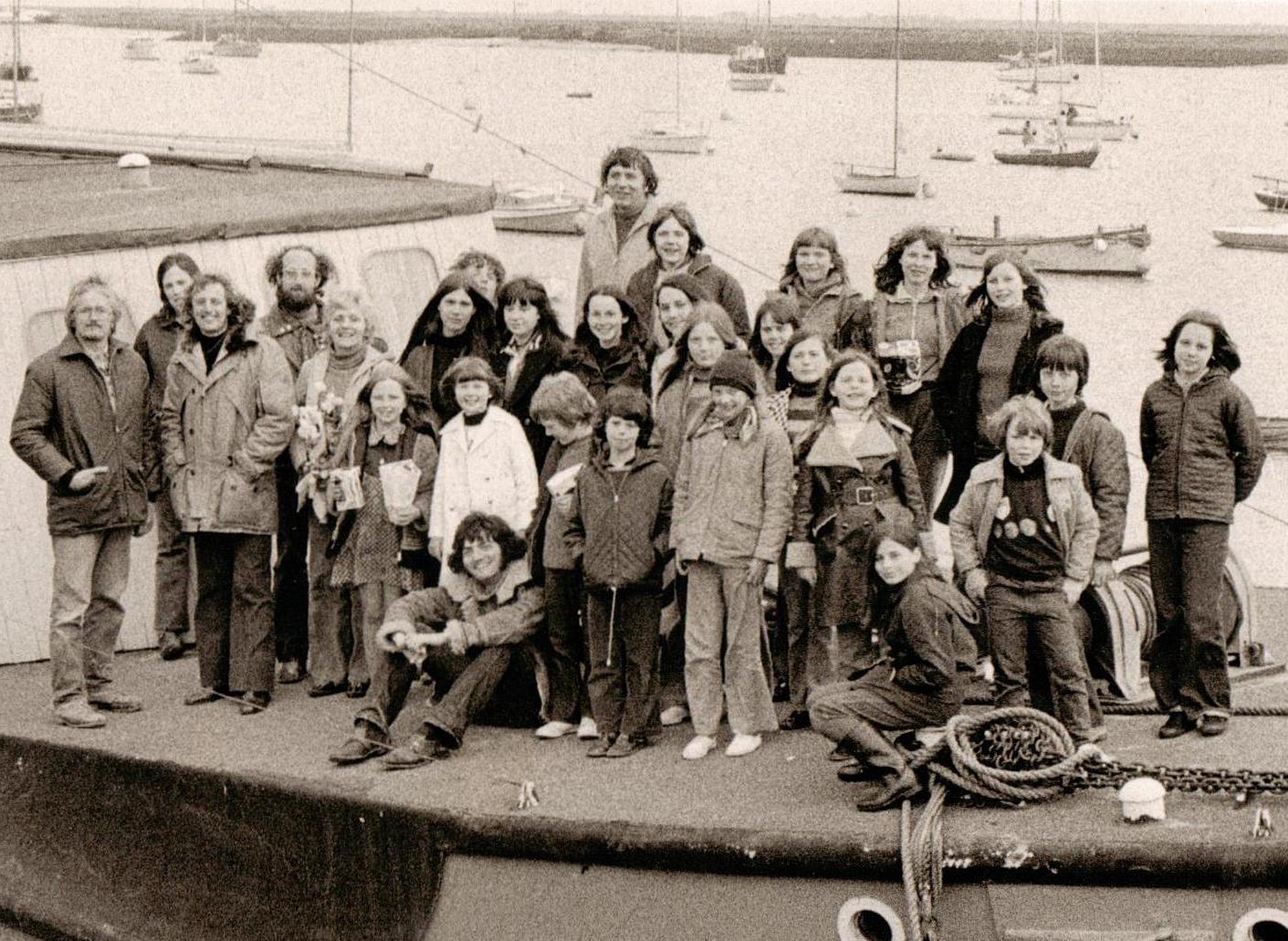
I was then invited to take part in a sailing audition at Burnham-on-Crouch in Essex – miles from the Cotswolds. The producer, Richard Pilbrow, was determined that any child chosen for a part knew how to sail. I had grown up beside one of the few lakes in Gloucestershire and knew how to row a Thames skiff. I’d added my own sail, made from a green dust sheet, but was no expert.

There were four other girls auditioning to play Titty. They were all smaller and prettier than me, with straight teeth. I didn’t think I was in with a chance.

The filming was to commence on 14th May 1973 and continue through the summer term. Our local authority – Gloucester County Council – needed my headmistress’ permission for me to miss five weeks of school.

Only, I didn’t go to school in Gloucestershire. I went to an Anglican convent in Berkshire. The nuns prayed about the proposition. They gave their permission – if I was chosen.

I didn’t think I was right to play Titty at all. I was three years too old and too tall. Ransome’s illustrations in the books portrayed girls with straight, dark hair. I didn’t know it but the character had been inspired by a real little girl called Titty Altounyan. I share her Scots, Irish and English heritage, but she was one quarter Armenian and had dark colouring.

However, unknown to us, Mrs Ransome had asked that ‘an English Rose’ should play Titty. Claude Whatham cast Sten Grendon, who had played Little Laurie Lee, as my younger brother Roger. Mrs Ransome – NB:the lady who once been Trotsky’s private secretary – was not happy that he had black hair. She nearly cancelled the film, but conceded when she saw him with a short-back-and-sides.

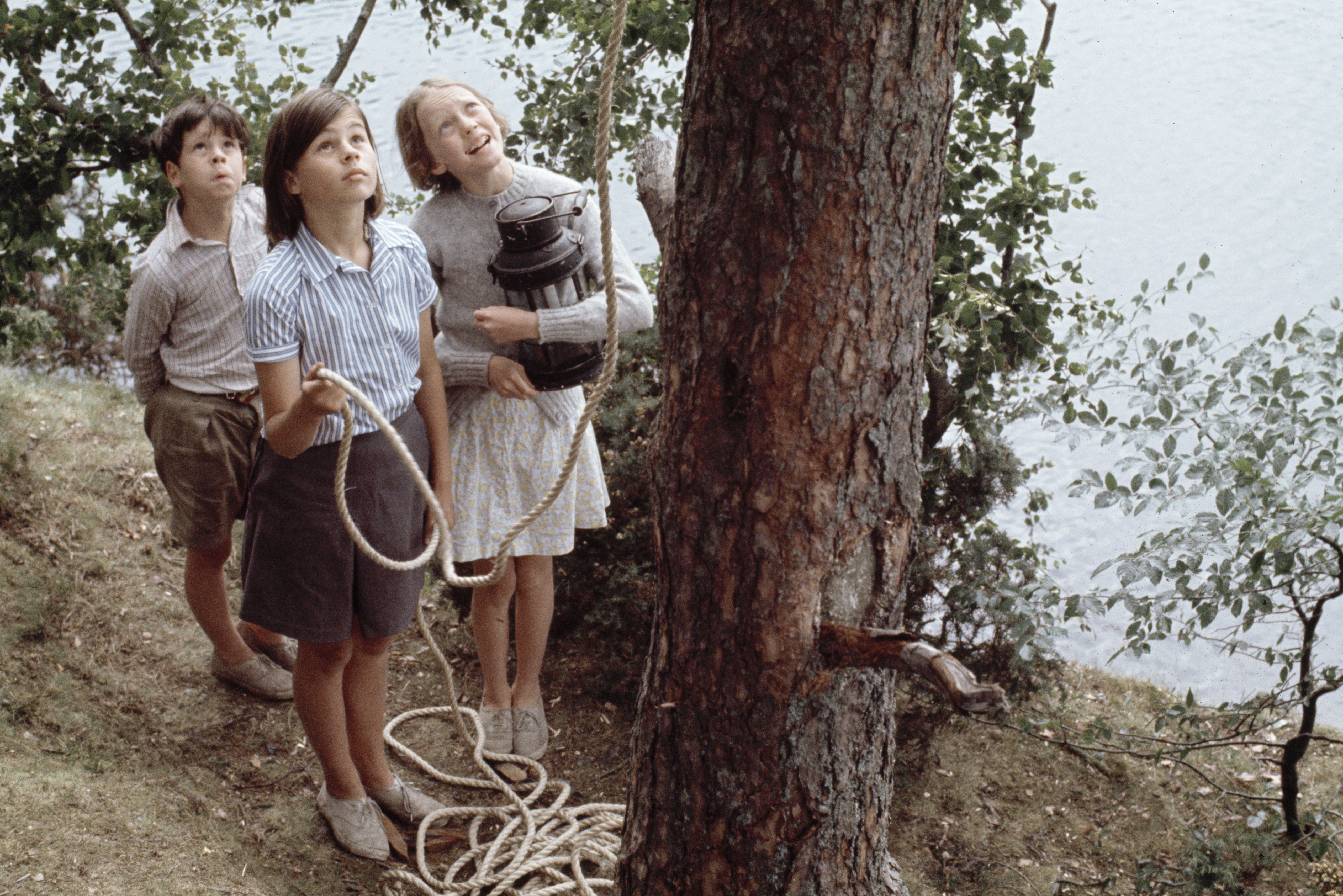
Sten Grendon as Roger and Sophie Neville as Titty rowing Swallow (c)StudioCanal

Sten claims we had the best parts. He grew up in the Whiteway Community and later went to school in Eastcombe. He now lives in France but still has family living in the Cotswolds. Back in 1973 his mother Jane, and my mother, Daphne, travelled up to the Lake District to look after us all.

Daphne Neville with Sten Grendon, Suzanna Hamilton, Sophie Neville, Jane Grendon and Simon West

In at the deep end. Whoomph! We literally had to swim for it. The water was icy, but we had plenty of support. I was able to embody my part because Suzanna Hamilton, who played my sister, was so brilliant. She anchored us, as did Simon West, who played John. He was only aged eleven but very bright and a confident sailor.

Stephen Grendon as Roger Walker with Suzanna Hamilton on location in 1973

Making the film was character-building stuff. While it was an inspiration and privilege to work under arc lamps with Virginia McKenna, it was often chilly and involved a lot of hanging around.

Stephen Grendon, Simon West, Virginia McKenna, Suzanna Hamilton and Sophie Neville, trying not to look as tall as she was in 1973 ~ photo: Daphne Neville

Virginia had four children of her own and brought us together as a team. While making things fun, she got us to focus and concentrate as we recorded the first scenes at Bank Ground Farm.

Virginia McKenna at Bank Ground Farm
Virginia McKenna at Bank Ground Farm in 1973 ~ photo: Daphne Neville

Arthur Ransome had been inspired as a boy by two of his aunts who left for Peking to serve as missionaries. They must have had great adventures. One even received a Boxer arrow in her bonnet. The story of Swallows and Amazons is about a family of four children on holiday who embark on something of a missionary journey themselves when they are allowed to sail off in a dinghy called Swallow to explore an island on a lake. They are confronted by two local girls, the Amazons, who are behaving badly, as their Uncle Jim has retired to his houseboat so that he can concentrate on writing his memoirs.

There is a strong undercurrent of fatherless-ness. Ransome had lost his own father before he could prove himself. The Swallows, whose father is in the Navy, come alongside the Amazons, who have lost their father and are being ignored by their uncle. They unite, make friends and have a lot of fun, whilst relishing in their independence granted because they are not duffers.

The crisis, in the story, is about the draft of a book being stolen, which I can only think must have been Ransome’s greatest fear. No one believes Titty, the youngest girl, who is sure she heard the burglars, so – in the film – she gets Roger to help her row Swallow to Cormorant Island where she finds it in what looks like a treasure chest.

Producer Richard Pilbrow with Neville C Thompson on Derwentwater in the Lake District in 1973
Producer Richard Pilbrow and Production Associate Neville C Thompson on Derwentwater in the Lake District in 1973

Richard Pilbrow and Claude Whatham had a tough time making the movie. Filming in the Lake District with its unpredictable weather and pressure from tourists was not easy. We faced endless problems and over-ran by two weeks.

But Mum was praying, Granny was praying, the nuns must have been praying for me – we needed the covering: I was the only girl who never fell ill. Swallow’s mast broke. I fell in. Water sloshed into a support boat. The rain poured down. We nearly crashed into the Tern. Our life jackets proved useless. There was a gas leak in our bus. We could have had an explosion. Most of the crew smoked continuously.

Sophie Neville with Daphne Neville in the Lake District

The behavior of some members of the film crew was pretty toxic. Many drove too fast. A cow fell on to the producer’s car. I fell out of a tree whilst playing. Suzanna cut her finger. Ronald Fraser was almost permanently pickled. Someone got hit in the eye by a baseball. The film set was vandalized and I lost a tooth halfway through filming a scene with Virginia McKenna.

Virginia McKenna and Sophie Neville on Peel Island
Virginia McKenna with Sophie Neville keeping her mouth shut ~ photo: Daphne Neville

We pushed on. Ran the race with perseverance. Somehow the challenges gave the finished film an edge, an enduring quality that made it into a classic.

Sophie Neville as Titty

The crew began asking if I would go on to act. The big question: was this a calling on my life? I didn’t just play Titty. I’d been part of the production team, suggesting that Ransome-like title graphics were used, that Seymour’s voice was used for Nancy. I didn’t want to act. I wanted to become a film director.

I’d enjoyed the post production work at Elstree Studios but disliked the fuss around the cinema release. Seeing yourself on camera always feels uncomfortable. The premiere of Swallows and Amazons was daunting.

Premier ticket for the Gala of ‘Swallows and Amazons’

It was first screened at the ABC in Shaftesbury Avenue alongside The Exorcist. But look! I literally had two guardians. My mother invited the nuns from school.

The ABC in Shaftesbury Avenue in 1974. It is now the Odeon Cinema.

Sister Allyne came. She didn’t flatter me but she was there.

Sister Allyne, Daphne Neville, Tamzin Neville and Sophie Neville

Like it or not, I ended up promoting the film on television. After I featured in ‘Animal Magic’, an image of me, rowing up the lake at Bakers Mill in the Cotswolds with a green parrot on my shoulder was used to replace the test card.

I grew too tall to continue playing children on screen and there was not much money for film finance in the 1970s when inflation was roaring. Sister Allyne prepared me for a film test for a musical Disney adaptation of ‘The Old Curiosity Shop’ but I wasn’t chosen. The movie flopped. I returned to my lessons.

At the age of fifteen I had a leading part in an adventure film with Vic Armstrong and Sophie Ward, called ‘The Copter Kids’, and I had a few little television parts in serials like ‘The Two Ronnies’ and ‘Crossroads’ while I was a student, but the drive wasn’t there. It was just as well. I didn’t have the bone structure.

Suzanna Hamilton playing Susan with Sophie Neville as Titty busy writing the ship’s log

Suzanna had a strong desire to act professionally and fought for parts. She went on to appear in Tess directed by Polanski, 1984 opposite John Hurt, Out of Africa with Meryl Streep, Whetherby with Vanessa Redgrave, Brimstone and Treacle with Sting, and a number of increasingly dark movies. She survived to appear in Casualty, New Tricks, Eastenders and is still working.

What she hated was the publicity. It’s a difficult part to any job. As she said at the age of twelve, having your photo on the front page of the Evening Standard ‘makes you felt a right twit’. She was furious with me for writing about her under sung talent in the Telegraph even though she looked beautiful in the arms of John Hurt.

I developed a burning desire to direct and went into television production. I made my first documentary for Channel 4 whilst driving from London to Johannesburg. I must have begun directing at the BBC at the age of 27 and produced my first series aged 29, but overdid it and was hammered by ill health. It was a good training. I learnt endurance, how to edit and I grew used to working to deadlines. I understood about moving the audience, cliff-hangers and bringing out books to accompany your work.

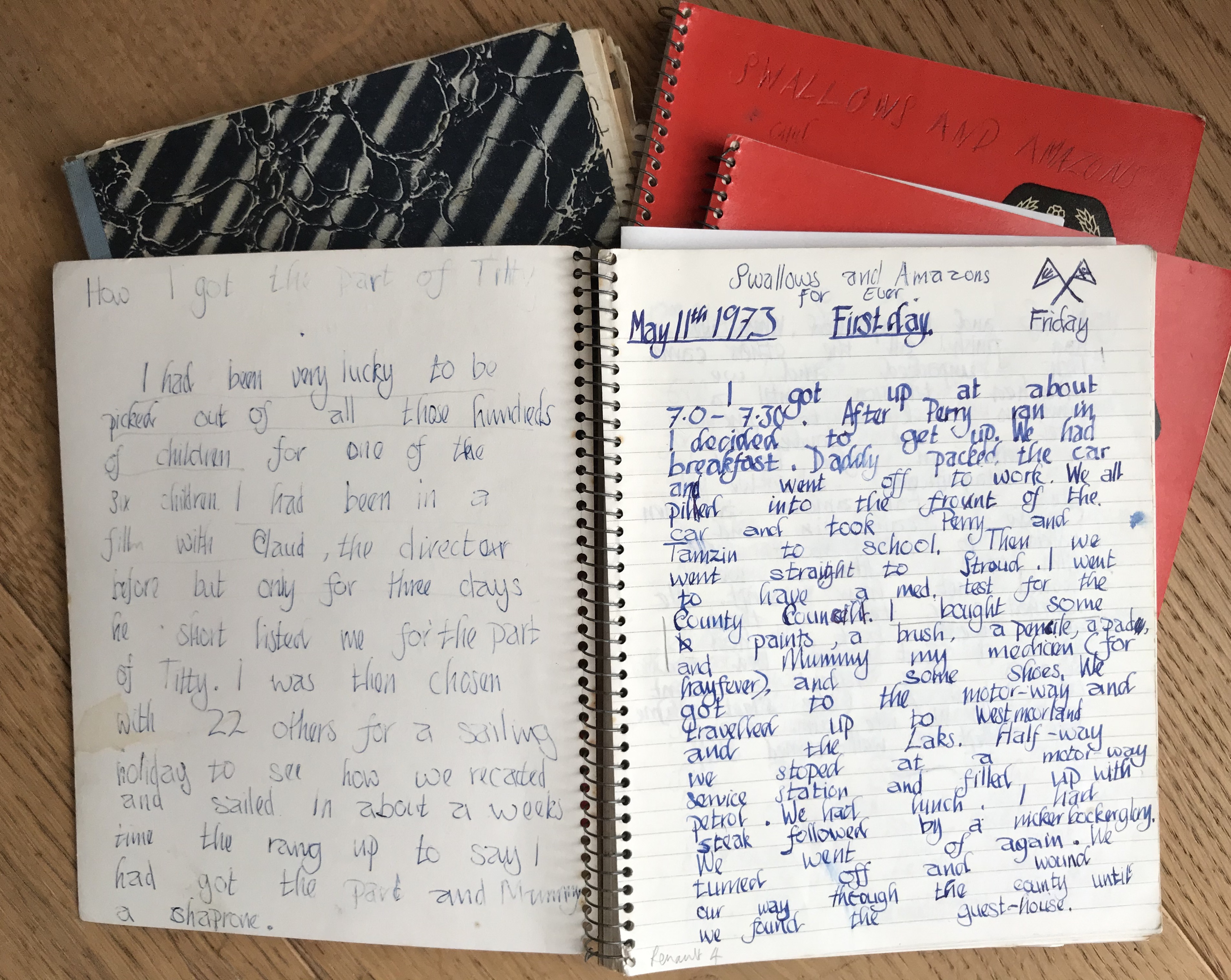
I didn’t learn to embrace the marketing aspect until I worked in the safari industry when I was assured it comprised 50% of the job. This attitude helped when I became and wildlife artist and later an author. After writing two books my readers – and my formatter – implored me to write about the making of Swallows and Amazons, especially once they learned that I had kept a diary whilst making it – as did Suzanna.

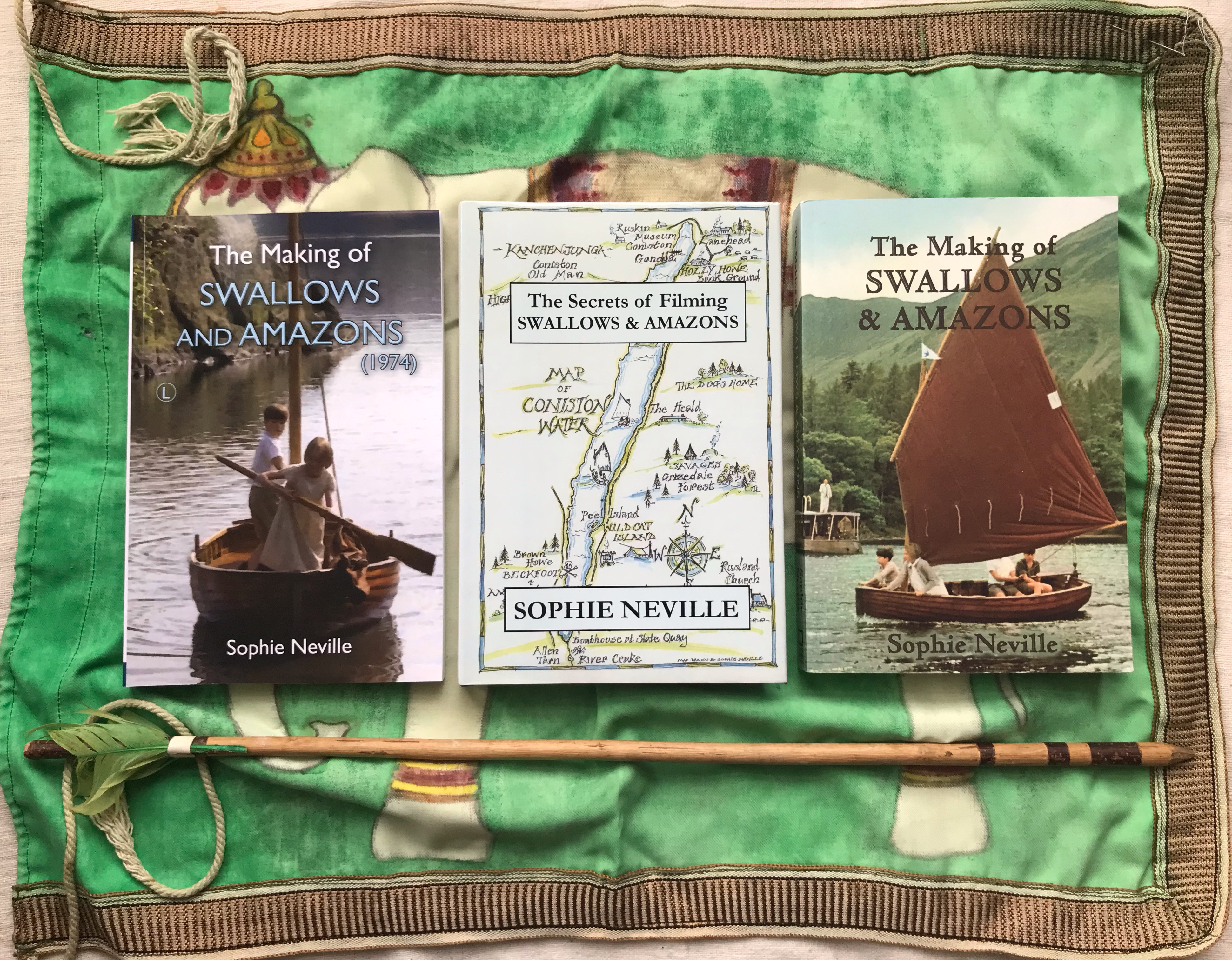
I first brought this out as a multimedia ebook, which is now in its second edition. It includes links to the cine footage my parents took on location. There are two versions of the paperback entitled ‘The Making of Swallows and Amazons’, seen here on the flag we captured.

'The Making of Swallows and Amazons (1974) by Sophie Neville'
Different editions of ‘The Making of Swallows and Amazons (1974) by Sophie Neville’

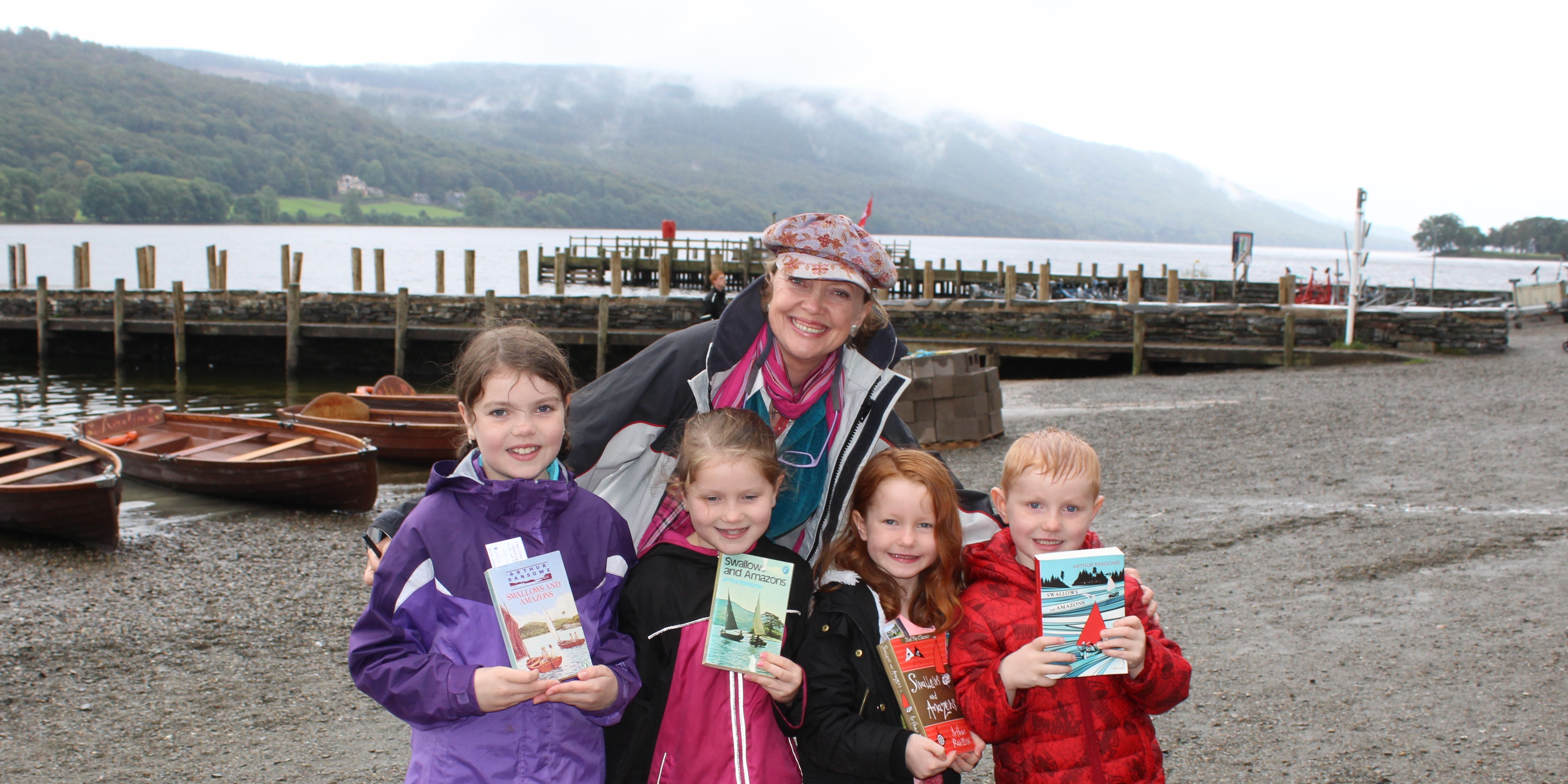
It has been a delight to figurehead a story about sailing, a pillar of childhood that has influenced so many. Parents want me to engender a love for the outdoor life, sailing and exploring the lakes and countryside.

I hope I have helped to attract the right kind of people to the Lake District, that we have been able to inspire young people to read Arthur Ransome’s books, to get out into the countryside and sail, fish, go camping, build friendships, whatever the weather.

In the footsteps of Ransome’s great aunts, I went on a Bible Society mission to China. The people we met thanked us for coming, saying they hadn’t received European visitors for forty years. ‘But we’ve seen Europeans in town.’ ‘Them? They have just come to make money, not visit us.’

Does the old film shine a light, offer solace? People write in to tell me that the film of Swallows and Amazons carried them through a difficult patch. Some watch it once a week. It exists to remind people that they need not despair.

Does the symbolism still hold? It was my self-appointed job in the screenplay to wait, alone, and light the lantern, to be a light in the darkness that could be seen for miles.

Swallows and Amazons was not made to make money. It wasn’t the producer’s motivation. Richard Pilbrow just loved the books and wanted to bring them to life. We children didn’t do it for the money. There wasn’t very much. I earned £7.50 a day and was given a book token for appearing in the Lord Mayor’s Show. Even today, StudioCanal were reluctant to pay my expenses for re-launching the 40th Anniversary DVD when we were interviewed for the Extras package.

It doesn’t matter. I have been so warmly greeted so warmly by fans of the film. I was invited to become President of the Arthur Ransome Society, and have been offered numerous opportunities to speak about my books. I’ve passed on most of my speaking fees to charity – sending disadvantaged children in South Africa on an environmental course that has literally changed their lives.

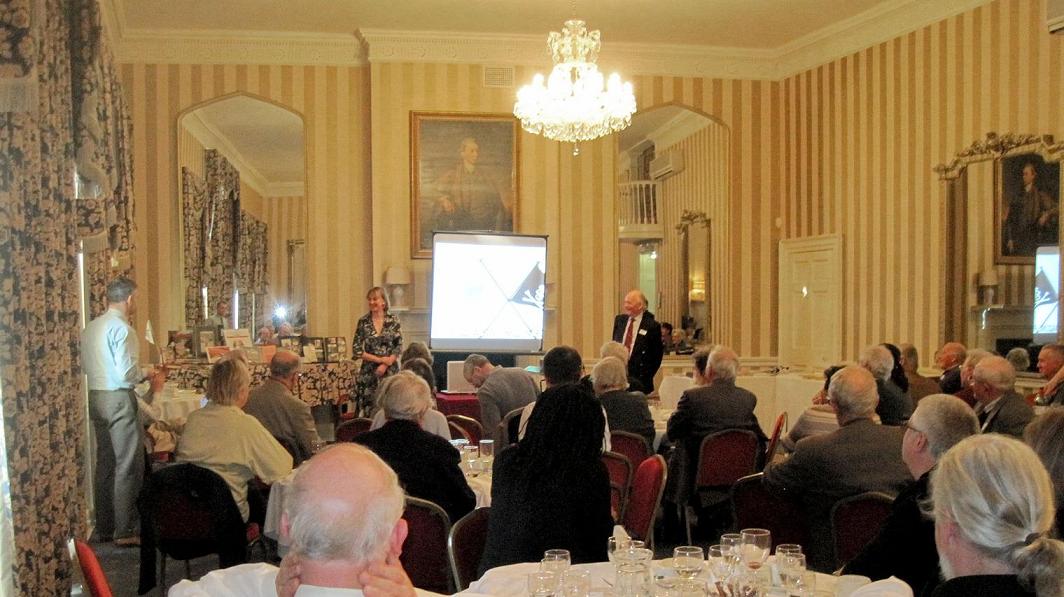
Sophie Neville speaking at The Arthur Ransome Society

The treasure Titty found wasn’t pieces of eight. It was heavy to carry, but she was rewarded for her tenacity. She was given her heart’s desire, and parrots live a long time. They can easily outlive their owners.

The author Julia Jones points out that, ‘the treasure that was finally unearthed on Cormorant Island was a book. It might or might not have been a good book but the message of the story is quite clear: if you’re convinced that there’s something hidden under the rocks, all you can do is keep digging.’ 

An extra ordinary thing happened. When Richard Pilbrow was awarded an honorary degree from he invited Suzanna and I to lunch in London. As we left the restaurant in Covent Garden a group of buskers outside where singing the final sea shanty from the film, What Shall We Do With the Drunken Sailor? What were the chances of that? We hurried on to find transport and found ourselves outside the cinema where the premier had been held.

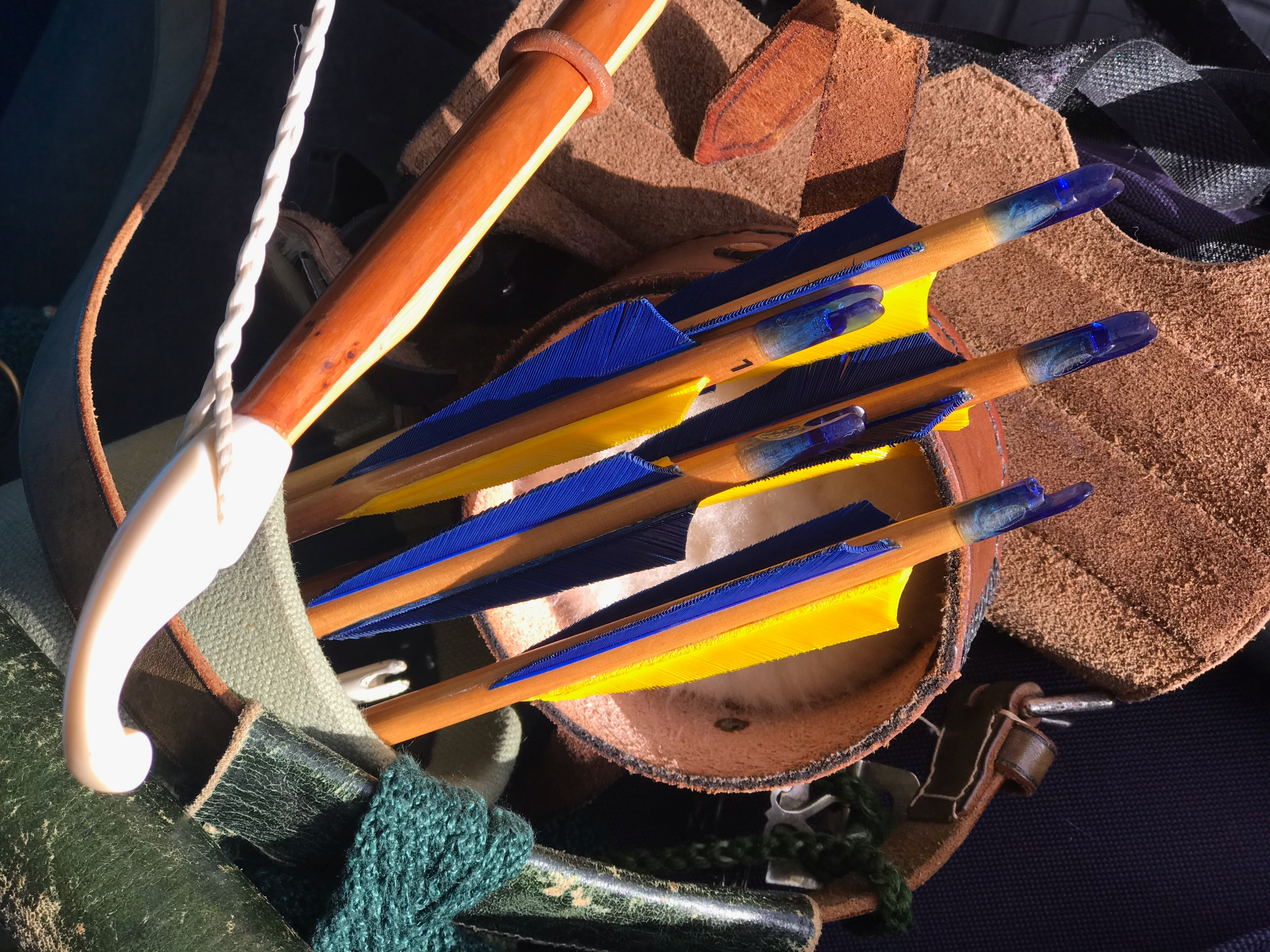
Something else happened to me as a result of Swallows and Amazons. Not what you might expect. We all wanted to learn to shoot with a bow and arrow. The next film role I was offered was as an archery champion. I kept up the sport, and ended up meeting my husband at a long bow meeting in the village where I was born. He was the chairman of the archery society. I won the Best Lady’s Gold. These are my colours:

Sophie Neville's bow and arrows

Proverbs 23-23 talks of wisdom, instruction and insight. My name, Sophia, means wisdom. My hope is that others gain wisdom and insight from what I have written.

You can read more in ‘The Making of Swallows and Amazons’, which is coming out as an audiobook. It will available from all the retailers and is currently on Scribd here.

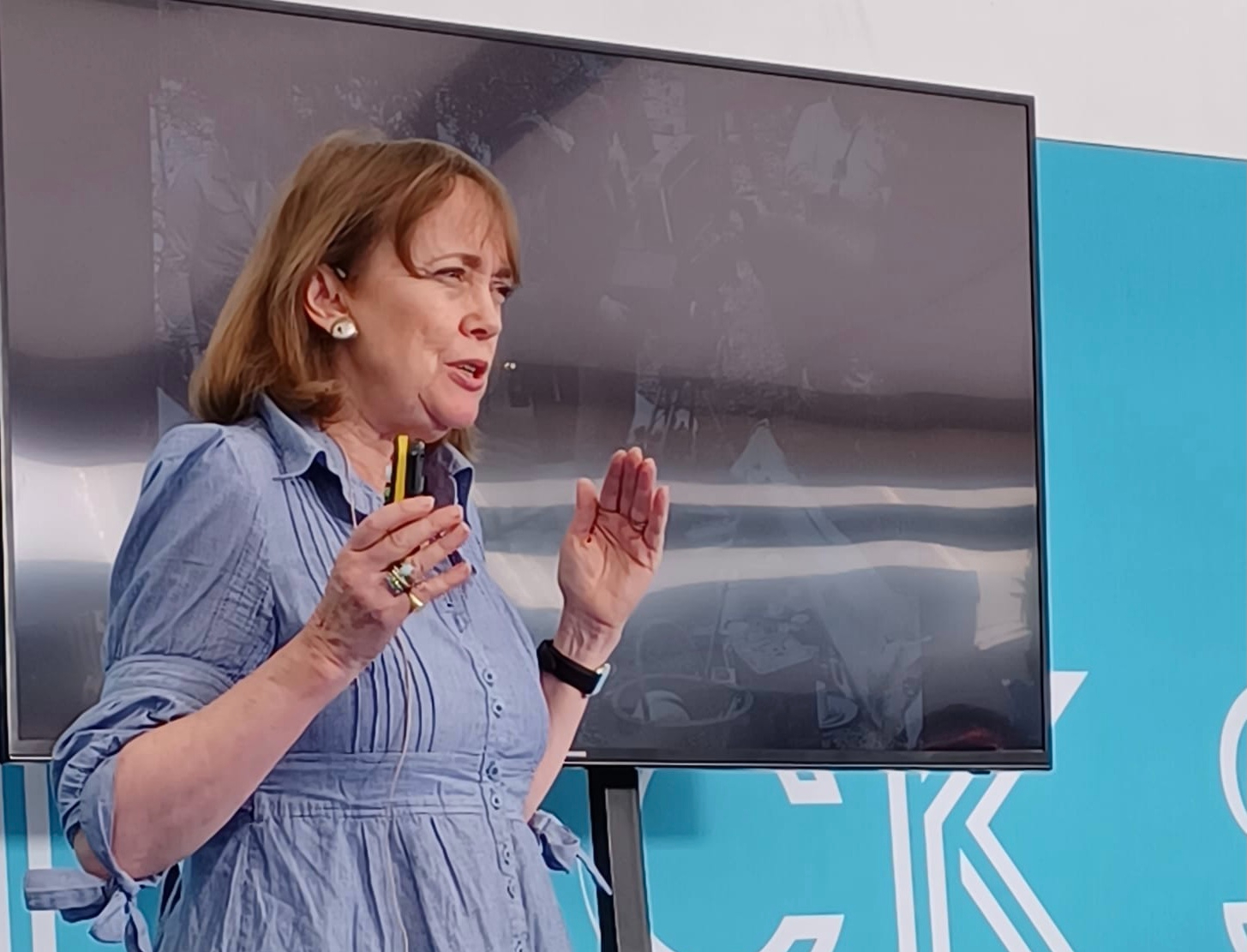
Sophie Neville has been speaking at the Stroud Christian Book Festival.

A write up of Sophie’s talk for BookBlest – the first Stroud Christian Book Festival – on The Making of Swallows and Amazons can be found on this website here

If you missed Sophie’s talk on ‘The Making of Swallows and Amazons’, you can read about her adventures in one of these editions, available online.

'The Making of Swallows and Amazons (1974) by Sophie Neville'
Different editions of ‘The Making of Swallows and Amazons (1974) by Sophie Neville’

There is a brief resume of the talk on this website, here Prepare to be taken back to the 1970s:

Discovering more about the film poster design for the movie ‘Swallows and Amazons'(1974)

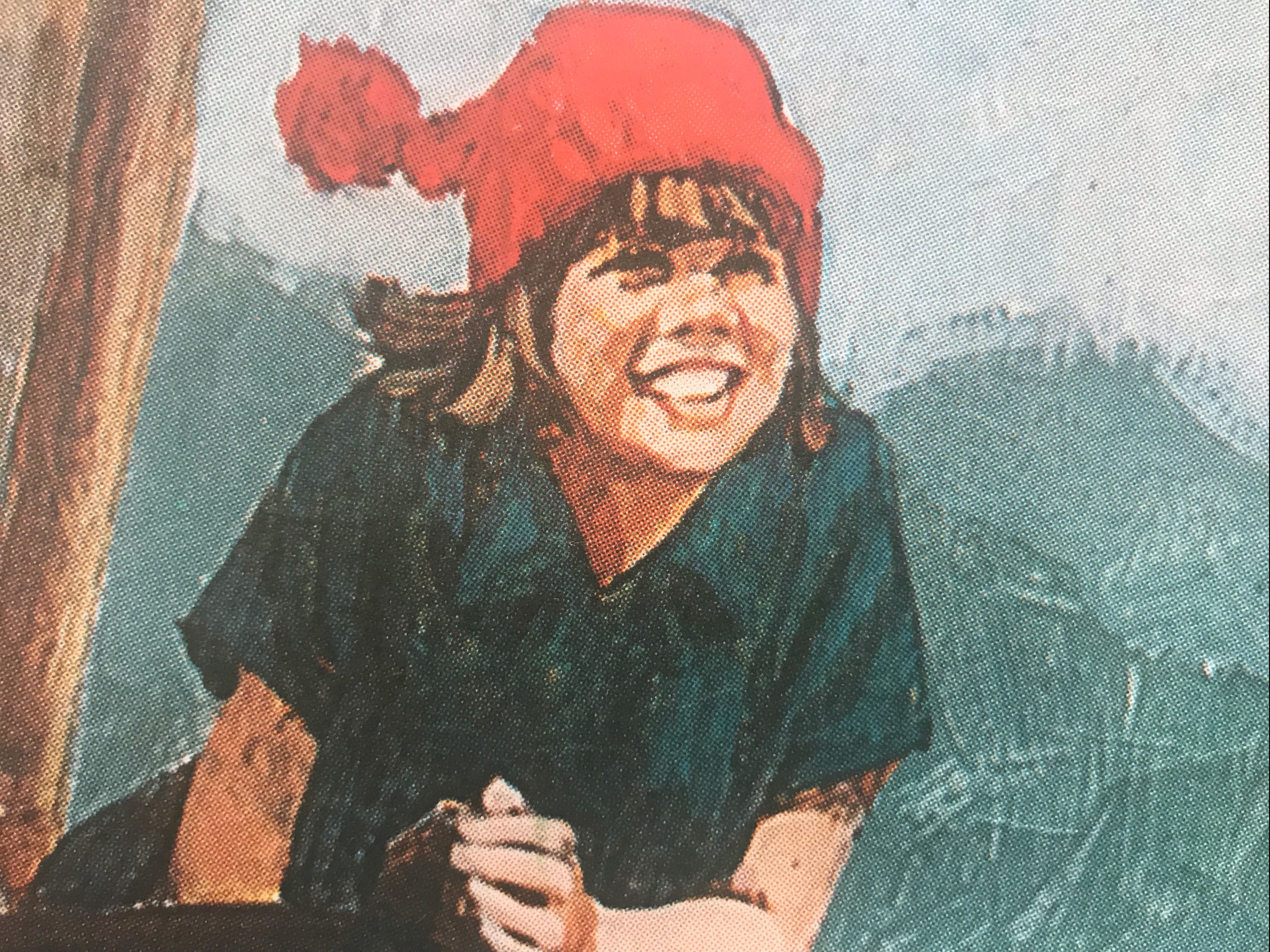
Sophie Neville as Titty in 'Swallows and Amazons' (1974) by the film poster artist Arnaldo Putzu
Sophie Neville portrayed by Arnaldo Putzu

Why is it that film posters have become more valuable than oil paintings ?

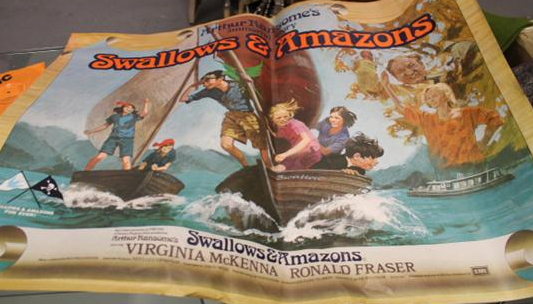
I have only just learned that the poster for the 1974 film of ‘Swallows and Amazons’ was painted by the Italian artist Arnaldo Putzu.

Thomas Connery enlightened me, writing: ‘Whether it be Space 1999, The Railway Children, The Rollers or Jaimie Sommers, he always captured likeness’ of stars faithfully and remarkably accurately.’ 

I agree. He portrayed Virginia McKenna well. I wonder how large the original painting was and if any of the sketches have survived.

Virginia McKenna in 'Swallows and Amazons' (1974) by the film poster artist Arnaldo Putzu
Virginia McKenna in ‘Swallows and Amazons’ (1974)

I have been given brown eyes and look a bit worried but am hugely honoured to have been featured at all. Kit Seymour looked far more cheery.

Kit Seymour as Nancy in ‘Swallows and Amazons’1974

A version of the artwork was used on cinema tickets, establishing the green parrot as one of the stars. I do like the way that Roger’s head looks out from the oval. This one gives Amazon a dark sail and shows the Amazons adopting different poses from on the poster. Nancy has folded arms and Peggy has her hands on her knees. Her stance is comic but a bit improbable. They have the wind behind them. What if the boat had gybed?

Premier ticket for the Gala of ‘Swallows and Amazons’

The ticket matched the souvenir programme for the film premier held in Shaftesbury Avenue on 4th April 1974. You can see inside this in an earlier post here.

Swallows and Amazons premier programme
The programme from the 1974 premier of the movie ‘Swallows and Amazons’

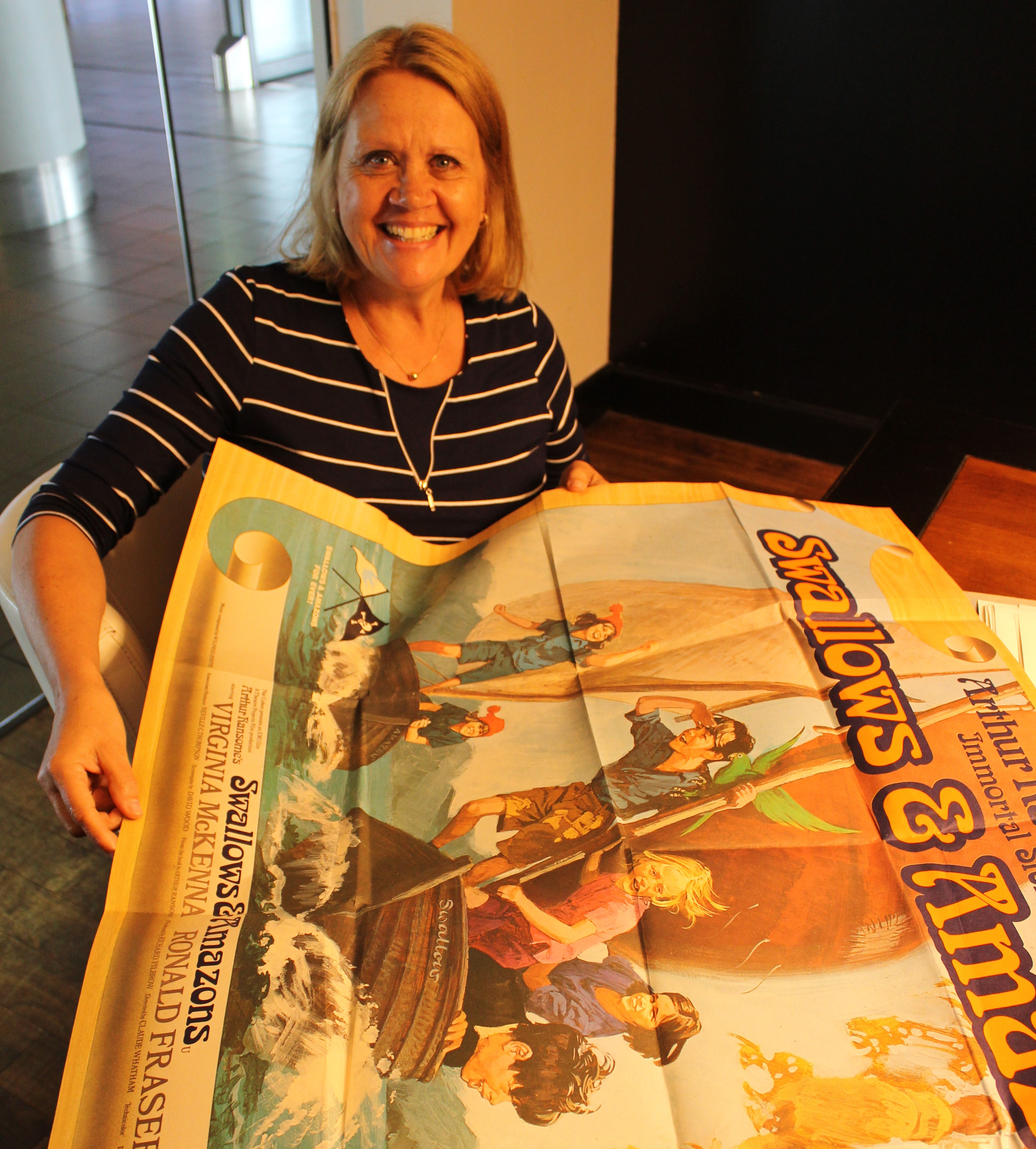
I also have a large sepia poster given to my mother by a cinema. I can remember being too shy to ask for it, but she persevered. I haven’t seen another since.

As children, we all asked, ‘Who was sailing the boats?’ Magnus Smith, who now looks after Swallow, says that you can tie off the mainsheet and Susan could just about be controlling Swallow’s tiller, but Amazon looks a bit precarious. I don’t expect Arnaldo had any experience sailing dinghies. Ours were on a collision course, pitched at odd angles with rather high reefing points but he added a swashbuckling spirit, and a bit of white water spray, which is always exciting.

Swallows and Amazons (1974) sepia film poster (c) StudioCanal
Arnaldo Putzu’s poster for the EMI film Swallows & Amazons (1974)

Arnaldo Putzu (1927-2012) began working for Rank in the 1950s and moved to London in 1967. He worked on the advertising material for many iconic movies including That’ll Be The Day, featuring David Essex and Ringo Starr, which Claude Whatham directed in 1972 prior to working on Swallows and Amazons for EMI Films. Is that the cover of the LP in the right hand corner? Claude Whatham gave me a copy. It included the song ‘Smoke Gets In Your Eyes’.

That'll be the Day -the film post by Arnaldo Putzu
Poster design by Arnaldo Putzu

This one is bordered by fairground lights, where as ours had been given the feel of a treasure map, with the credits on the reverse, which was clever. The original lettering, trendy in the mid-seventies, faded from fashion for a while but came back on-trend for the 40th Anniversary. The painting was somehow ageless, being used for the DVD cover up by StudioCanal until 2016. They still sell it as a jigsaw puzzle or on a mug.

According to The Guardian, ‘Putzu created some of the most famous Italian film posters of the 50s and early 60s, painting such stars as Sophia Loren and Gina Lollobrigida.’ By 1973 ‘Putzu found himself the top-rated and most in-demand poster illustrator working in Britain. His output over the 1970s included oddball Hammer Horror fantasies such as Creatures the World Forgot and Legend of the 7 Golden Vampires. For the Get Carter posters he put the ruthless gangster (played by) Michael Caine into an unlikely floral jacket, demonstrating the whimsical humour that makes his best posters unforgettable.’ An original of this poster signed by Michael Caine was once valued by Sotherby’s at between £4,000 to £6,000.

You can see more of of Putzu’s artwork here.

Lesley Bennett in 'Swallows and Amazons' (1974) by the film poster artist Arnaldo Putzu
Lesley Bennett in ‘Swallows and Amazons’ (1974)

Lesley Bennett, who played Peggy, still has her copy of the original film poster. She should probably get it signed by the actors. Others were pasted in London Underground stations, which I found alarming as a child.

Lesley Bennett who played Peggy in Swallows and Amazons 1974

I spied a framed poster on display at Windermere Jetty Steamboat museum, where it was featured on BBC Antiques Roadshow. There is more about the movie memorabilia, which was valued by the expert Marc Allum, here.

Swallows and Amazons film poster
Sophie Neville at Windermere Jetty museum in 2020

Some originals have been for sale on this site here. Studiocanal sell various prints here.

You can read about the adventures we had making the movie in ‘The Making of Swallows and Amazons’ and the multi-media ebook entitled ‘The Secrets of Filming Swallows and Amazons’ which retails for £2.99. You can ‘Look inside’ and read the first section for free here:

Swallows and Amazons, 1974 is currently streaming on Amazon Prime Video where you can watch the film trailer. HotDog.com has a review of Amazon’s streaming service, including a 30-day free trial offer.

Sophie Neville speaking at the Southampton International Boat Show #SIBS22

Inspirational speaker, Sophie Neville
Southampton International Boat Show 2022

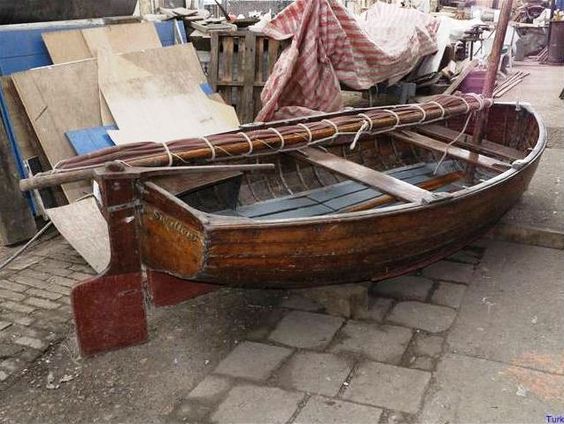
In 2022, Swallow, the dinghy that starred in the original film Swallows and Amazons was on display at the Southampton International Boat Show, greeting families as they arrive.

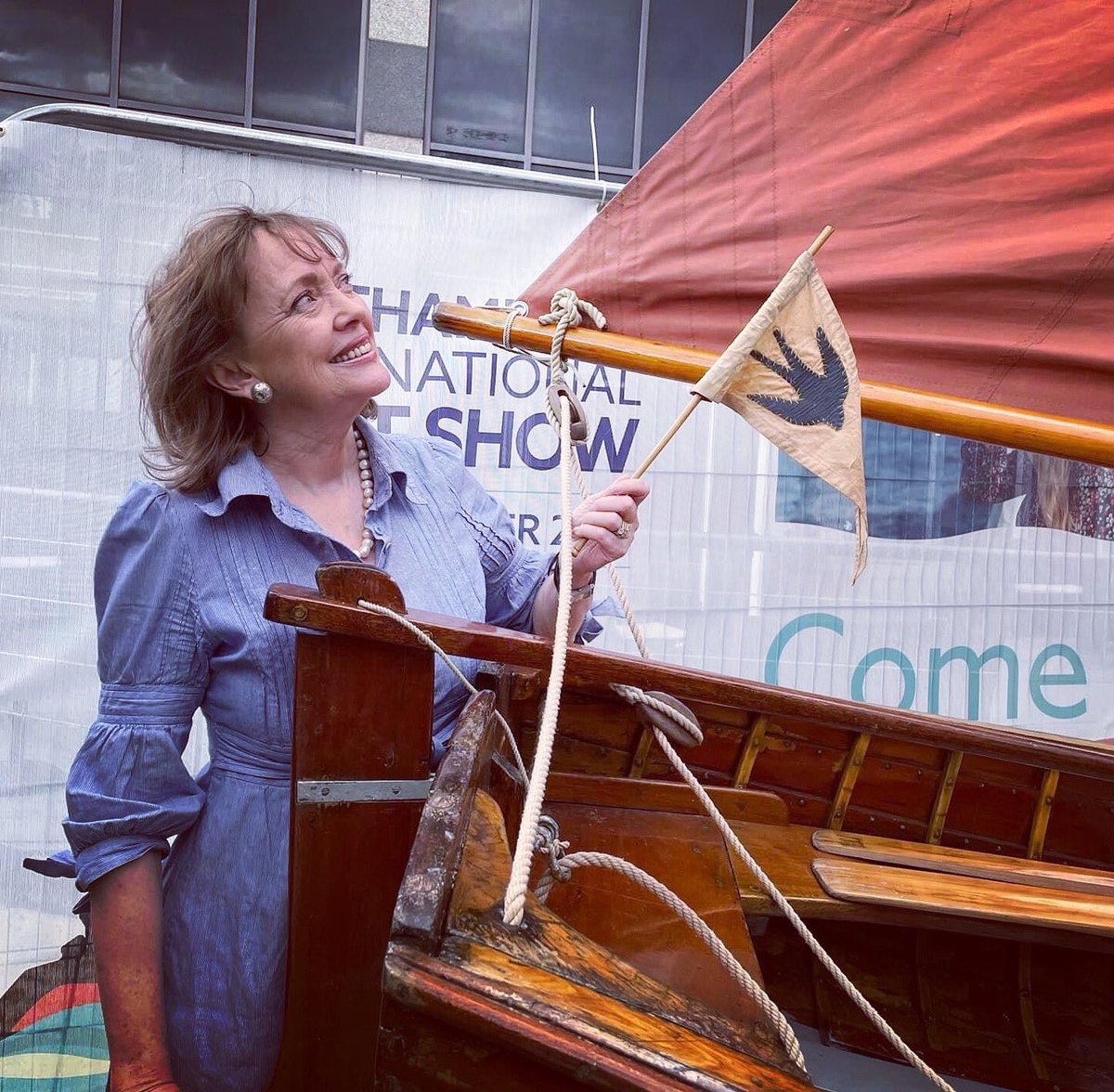
Sophie Neville who once played Titty Walker with her good little ship

Sophie Neville gave talks on filming afloat and the movie was made on location in the Lake District fifty years ago.

Over 103,000 people visit the show. Although busy, it did not feel crowded. There is a lot to see and do.

Speaker Sophie Neville
Sophie Neville speaking on the Foredeck Stage at #SIBS22

Thanks to the help of excellent technicians, presentations proved popular, with ‘inspiring talks on the Foredeck Stage’.

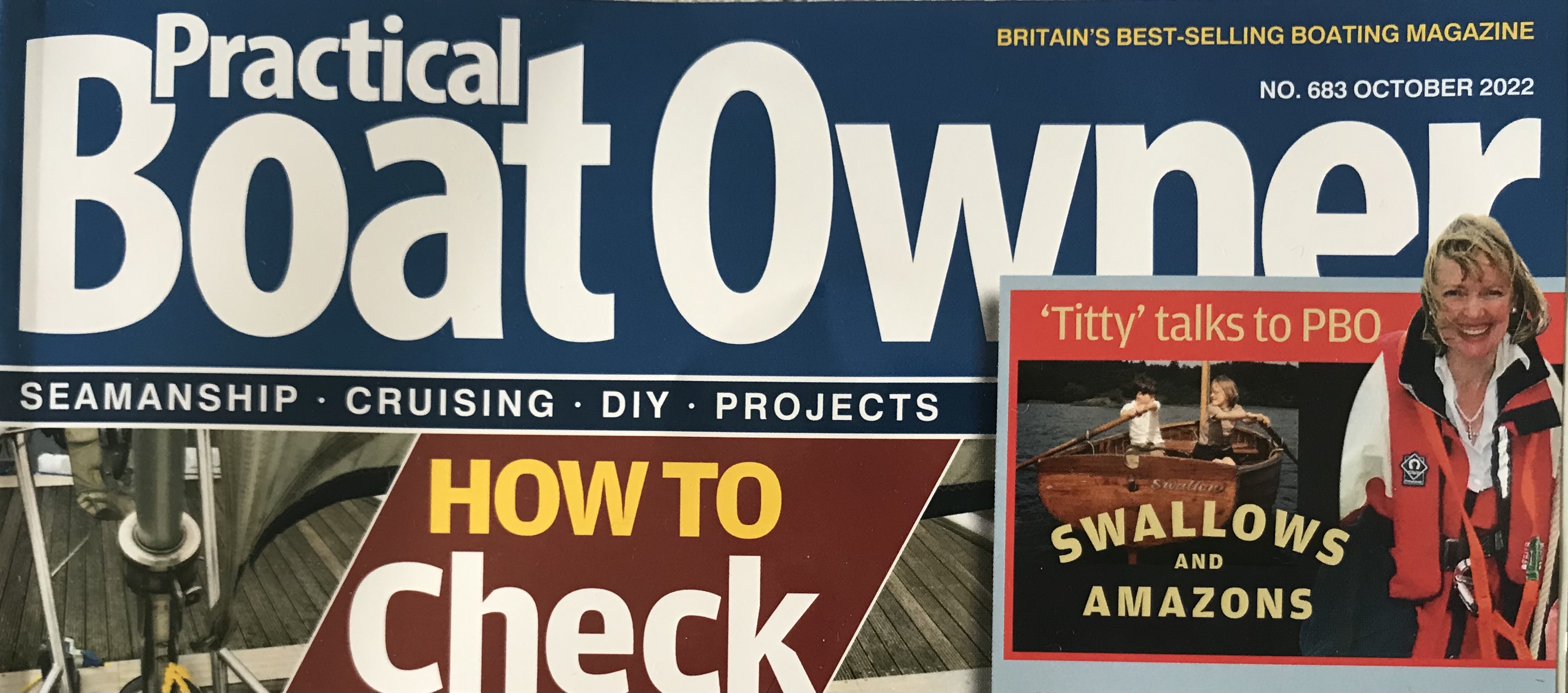
On the cover or Britain’s bestselling boating magazine

Sophie signed copies of ‘The Making of Swallows and Amazons‘ at Future Publishing’s corner stand.

“It was a great opportunity to meet film fans, readers and feature writers.”

Nick Jeffery the yacht publicist with Sophie Neville at the Southampton Boat Show

You can find a four-page feature on Swallow in Practical Boat Owner magazine.

A 4-page feature article in the bestselling magazine Practical Boat Owner

You can apply to The Arthur Ransome Society to take Swallow or Amazon out yourself on the Norfolk Broads next summer.

Sophie Neville with Swallow from Swallows and Amazons (1974)

If you are unable to get to the Southampton International Boat Show this year, you can watch an in-depth interview released this week by Your Take:

Your Take interview Sophie Neville on Zoom

Authors who mention the 1974 film of ‘Swallows and Amazons’

People often write to say how much they have enjoyed the original film ‘Swallows and Amazons’ (U) produced by Richard Pilbrow in 1974, which is currently streaming on Amazon Prime. Being suitable for all ages, it is often screened at outdoor festivals and is on Netflix in Europe.

‘Is it a good movie?’ people enquire of Google.

Helen Fielding mentions the DVD of Swallows & Amazons 1974 in the first edition of ‘Bridget Jones: Mad about the Boy’ claiming it to be more edifying for her children to watch than ‘Beverley Hills Chihuahua 2‘.

Dame Margaret Drabble told Claude Whatham, the director, how much she loved Titty in his film of Swallows and Amzons, which was a huge compliment.

Sophie Neville as Titty in 1973

Elspeth Huxley CBE – author of thirty books including The Flame Trees of Thika – loved the 1974 film of Swallows and Amazons, reviewing it for The Tatler magazine under her married name, Elspeth Grant.
Simon West, Sophie Neville and Suzanna Hamilton appearing in The Tatler

There is special interest from a number of authors –

Wendy Clarke, who has set some of her psychological thrillers in the Lake District auditioned for the part if Titty in 1973. You can read her story on another post here.

When Catherine Lamont from Australia wrote on Facebook to say, “Just read a 2020 book mentioning ‘Swallows and Amazons’ (someone spotted in a bookshelf belonging to one of the main characters): The Enigma Game, by Elizabeth Wein” the author hrself, Elizabeth Wein, wrote in to say, “Not just in The Enigma Game – I namedropped Swallows & Amazons in my novel Code Name Verity, too! It was given to me by my grandmother’s best friend when I was seven and was one of my favorites. My own children, who never actually read it, were huge fans of the film”.

Christine Stevenson said that she was introduced to Swallows and Amazons by ‘The Unlikely Voyage of Jack de Crow’ by AJ Mackinnon about his journey from Shropshire to the Black Sea in a Mirror dinghy.

According to Kathryn Hughs in The Mail on Sunday BOOKS section, Robert Twigger ‘grew up in the 1970s obsessed with Swallows and Amazons’. He’s written 36 Islands: In Search of the Hidden Wonders of The Lake District… And a Few Other Things Too. It was well reviewed by Country Life.

Mail on Sunday - A homage to Swallows, Amazons and a girl with a rather rude name!

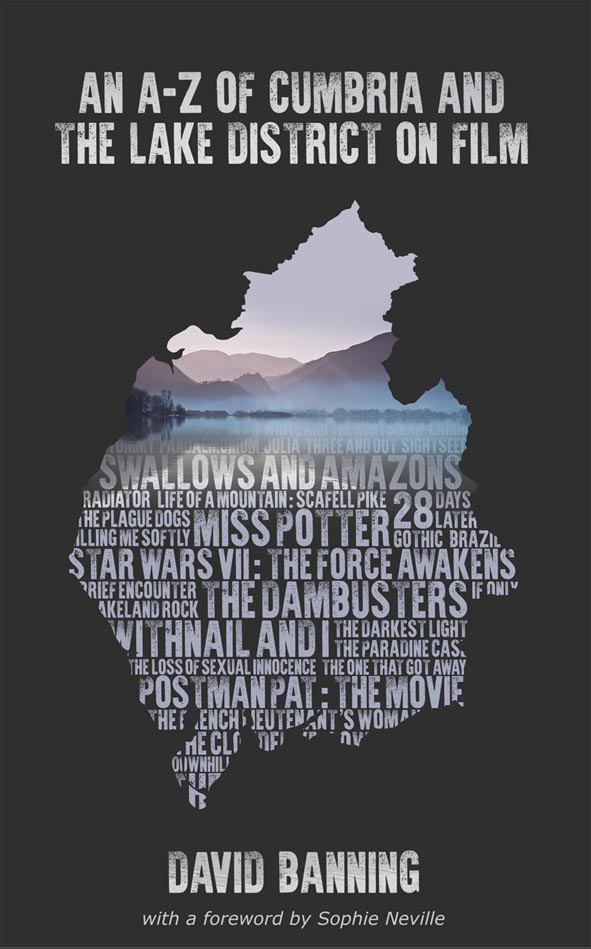
The arts curator David Banning profiled the 1974 movie of Swallows and Amazons in his book on films made in Cumbria and the Lake District, which you can see here.

Trevor Boult, who writes books on ships and sailing, is a great fan. He kindly donated the royalties from his most recent book Boats Yet Sailing to The Arthur Ransome Trust. You can order a copy direct from the publisher here.

For a list of well known people who love the Swallows and Amazons books, please click here

Do you know of any other authors who have written about the film? Please leave any information in the comments section, below.

Wilfred Joesph’s title music for ‘Swallows and Amazons'(1974)

You can read the first section about how the film was made back in 1973, for free, on the Amazon preview of the ebook here:

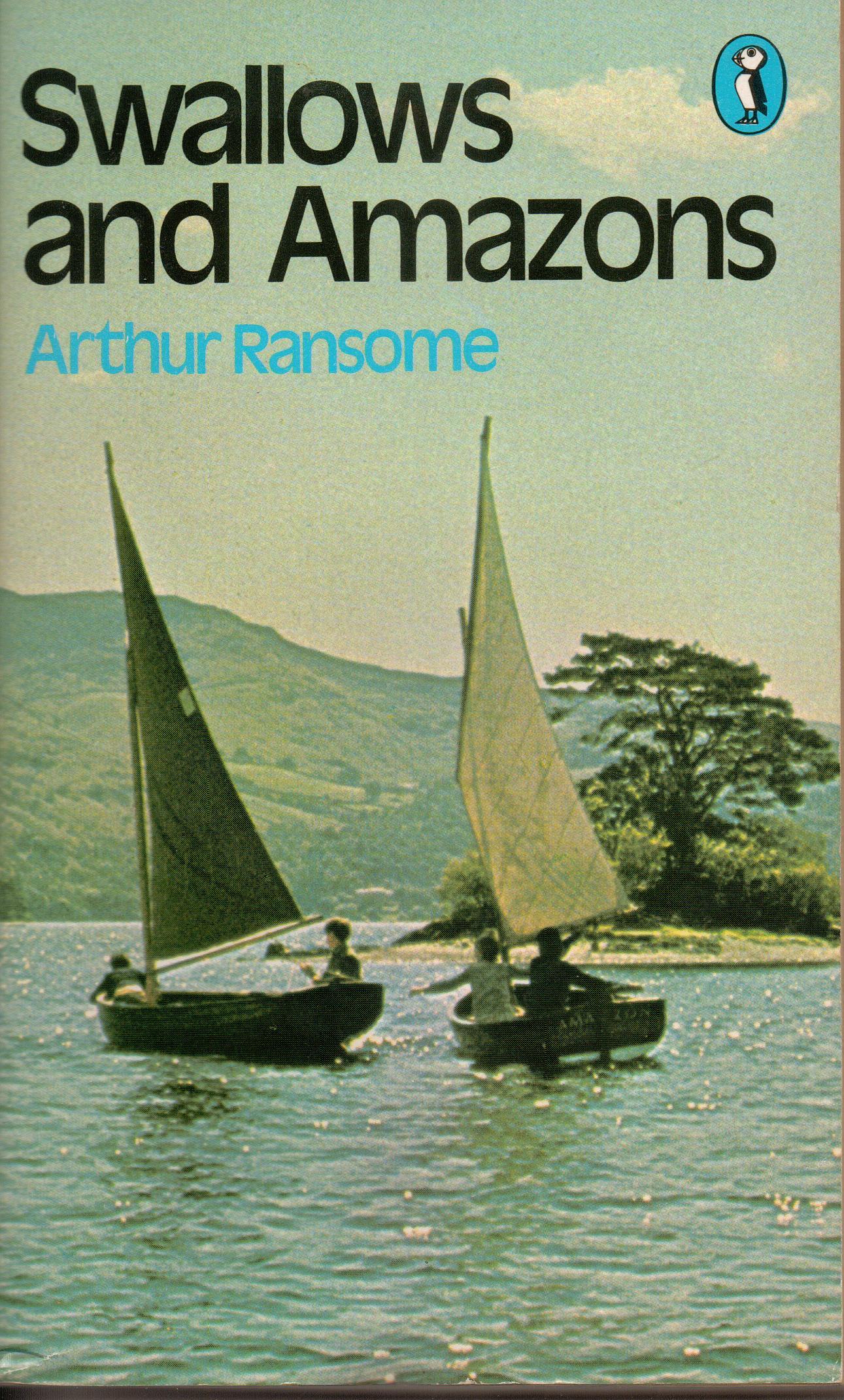
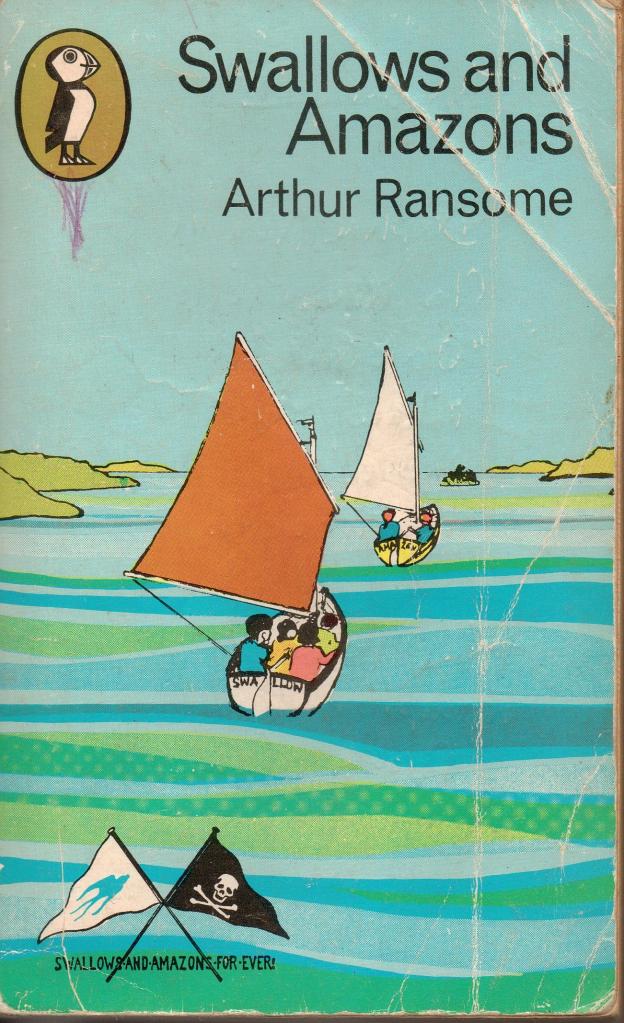
The Puffin paperback copies of ‘Swallows and Amazons’

The school term is over, ‘Swallows and Amazons’ is on BBC iPlayer and Christmas missives are arriving in the post. I have just been sent this homemade card from someone who came to the premier of the original film in 1974, when I was fortunate enough to play Able seaman Titty.

Image (75)

~Captain Flint hanging Christmas decorations around his houseboat on a card made from a Puffin book cover~

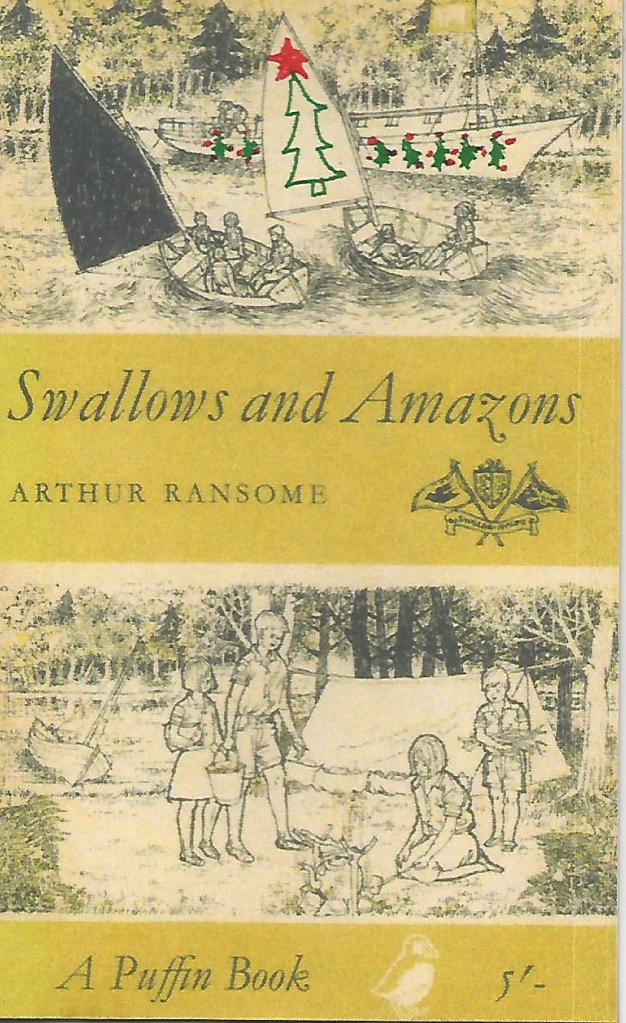
I dug out the Puffin paperback of Swallows and Amazons my father gave me when I was a girl and read avidly, along with other books in the series, by the time I was eleven years-old. It is a 1970’s edition in which I’d underlined everything Titty said. I must have re-read this copy when busy preparing for filming the 1974 movie financed by EMI.

'Swallows and Amazons' Puffin book cover 1970

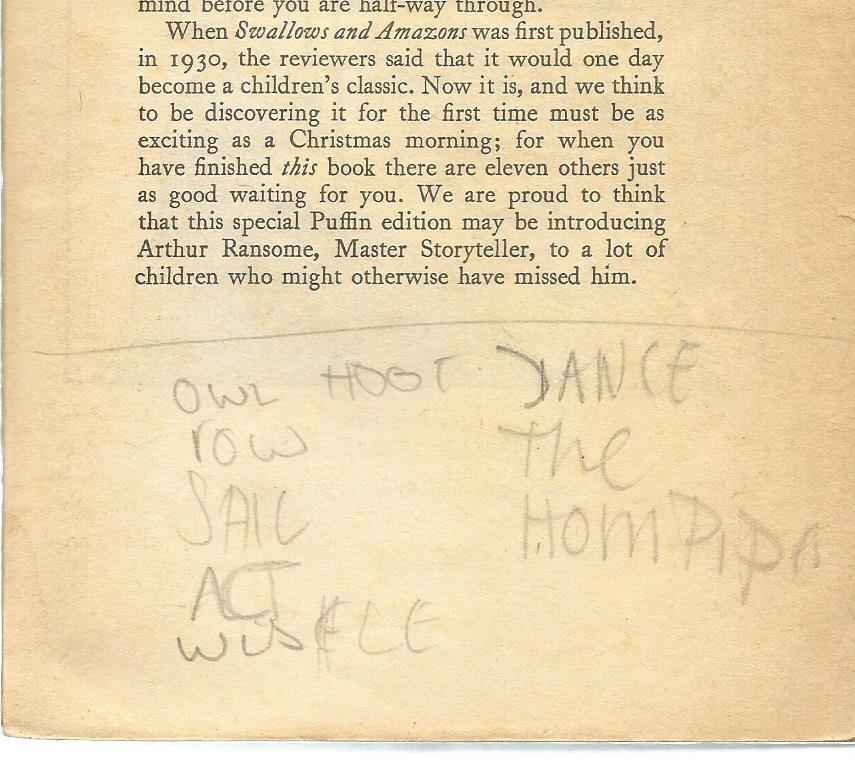
Kaye Webb, the editor, had written an introduction saying, ‘This book is about sailing, fishing, swimming, camping, and piratical exploits.’ She wanted to make it available to children, thinking that discovering Swallows and Amazons ‘for the first time must be as exciting as a Christmas morning.’

Underneath, I’d noted down the skills I would need to acquire before playing the part of Titty. ‘Owl Hoot’, was one item, ‘wisle’ (sic) another. I was somewhat apprehensive about dancing the Hornpipe but excited about ‘being a cormorant’, having no idea how cold this experience would prove.

My 1970 Puffin edition of Swallows and Amazons

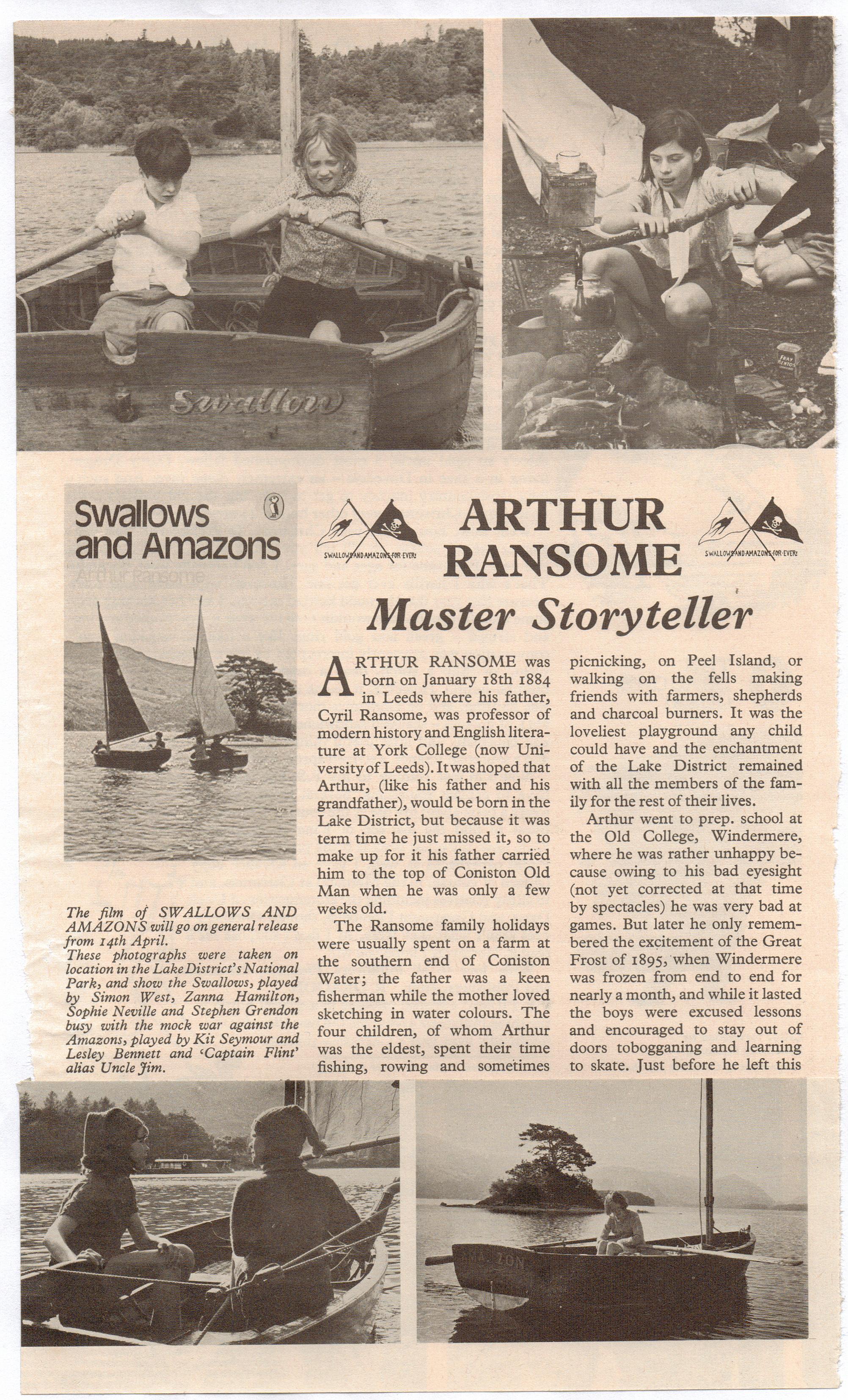
According to Trade News, 75,000 copies of a new Puffin paperback were brought out to accompany the original film. A still was used from the scene where the Swallows sail both dinghies from Cormorant Island. It retailed for 35p. Meanwhile Jonathan Cape printed 12,500 copies with the original dust jacket to accompany the release on 4th April 1974.

Swallows and Amazons 1984 Puffin book cover

Today, I am most interested in Ransome’s prose, amused to find the phrase ‘X marks the spot where they ate six missionaries’ does not appear within the pages of the book. It was given to Titty in 1973 by the screenwriter David Wood. However, there are words of wisdom a-plenty that were not used in the film adaptations:

‘I like cooking,’ said mate Susan.

‘If you want to go on liking it, take my advice and get someone else to do the washing up’, is Mother’s reply. (I wonder who might have said this in reality.)

‘You can be wide awake and not see a thing when you aren’t looking’ is one of Roger’s observations.

John was able to look back to ‘a different, distant life’, which is exactly how it feels when the excitement of Ransome’s world spoils you for the ordinary. It’s true: those involved in outdoor activities develop in leaps and bounds ending up, ‘not at all what they had been.’

What is it about Arthur Ransome’s writing that captures your imagination? Rowing? Sailing? Cooking over a camp fire? Which book has most influenced your life?

Article on Swallows and Amazons on Puffin Magazine

You can read about the adventures we had bringing out the original film in different versions of ‘The Making of Swallows and Amazons (1974)’, which is now available as an audiobook.

'The Making of Swallows and Amazons (1974) by Sophie Neville'
Different editions of ‘The Making of Swallows and Amazons (1974) by Sophie Neville’

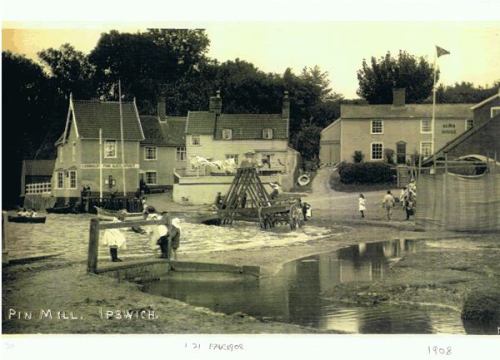
The Arthur Ransome Jamboree at Pin Mill in Suffolk

Arthur Ransome Pin Mill Jamboree

One year, not so very long ago, members of the Nancy Blackett Trust hosted an Arthur Ransome Jamboree at Pin Mill in Suffolk. It was a day to remember.

Pin Mill from the Water

Although Ransome is remembered for his ‘Swallows and Amazons’ books set in the Lake District, he moved to the east coast of Suffolk in 1935 where he set a number of other books in the series. It seemed fitting to mark the 80th anniversary of the publication of his inspirational sailing book ‘We Didn’t Mean to Go to Sea’ that begins at Pin Mill.

Sophie Neville with Nancy Blackett

It is possible go aboard the Goblin, since she was modelled on Ransome’s own favourite little yacht, the Nancy Blackett. I joined her at The Royal Harwich Yacht Club where she was moored alongside Peter Duck one of his other much-loved yachts, named after the adventurous book he wrote that begins in Lowestoft. I met up with Octavia Pollock, a feature writer from Country Life, and walked down the riverside to enjoy supper at the Butt and Oyster in Pin Mill where Ransome himself often ate.

Map of the Jamboree

Soon after leaving university, I worked behind the camera on the BBC TV adaptations of ‘Coot Club’ and ‘The Big Six’, Ransome’s two books set on the Norfolk Broads, in which the Coots also visit Beccles in Suffolk.

It was the Swallows who made it to Pin Mill. I first went there when The Arthur Ransome Society asked me to give a talk about making the BBC TV serial entitled, ‘Swallows and Amazons Forever!’ and signed copies of ‘The Making of SWALLOWS and AMAZONS – 1974’.

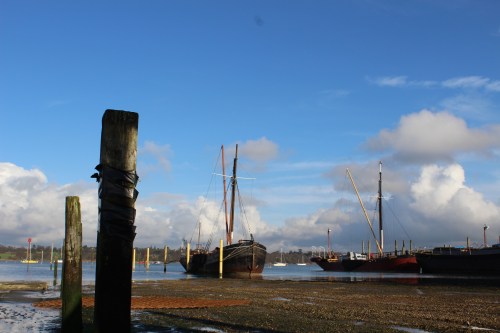
Pin Mill

~The Orwell at Low tide~

During the Jamboree celebrations, Arthur Ransome’s biographer Professor Hugh Brogan was interviewed by erstwhile BBC reporter Tim Fenton at the Pin Mill Sailing Club. 

the-life-of-arthur-ransome-by-hugh-broganHugh spoke eloquently, telling me that he was motivated by rage to write The Life of Arthur Ransome after a Fleet Street reviewer of the original film ‘Swallows & Amazons’ described him as ‘right-wing’.
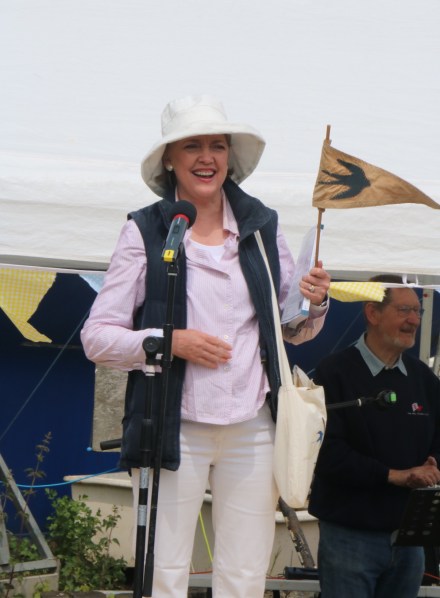
Sophie Neville opening the Arthur Ransome Jamboree at Pin Mill~ Sophie Neville ~

This VisitEngland event was great fun. There was a geo-caching route along the footpath from Shotley to Pin Mill. Marine artists Claudia Myatt and Christine Bryant hosted drop-in sessions on the riverside where visitors could also find the Rabble Chorus singing, while the author Julia Jones spoke about her children’s books set on the Orwell at the sailing club.

Nancy blackett product shop

~Mugs with artwork by Claudia Myatt sold in aid of the Nancy Blackett Trust~

There was an outdoor installation of old Pin Mill images enabling you to look back in time. These were taken by Arthur Ransome himself of the building of his boat Selina King at King’s boatyard nearby. It was the first public exhibition of these pictures ever seen and was appreciate by the hundreds of visitors who turned up.

Pin Mill archive photo

The Pin Mill Studio also hosted an exhibition of photographs from the restoration of Melissa, a barge restored to her former glory by Webb’s boatyard, with additional archive images of Pin Mill from the early 1900’s.

The Vintage Mobile Cinema, as seen on BBC Television’s Reel History of Britain, screened unique archive film of Pin Mill and Shotley.

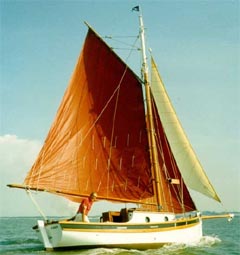
The Nancy Blackett

~The Nancy Blackett in her 85th year~

A Pin Mill ‘Wooden Boat’ race was held along the stream leading down to the river and you could take a ride on the Victorian swing boats on the Common as in years gone by. There was a ‘pirates and seafarers’ fancy dress competition for children and an Arthur Ransome lookalike competition (pipe and moustache) along with stalls and sideshows from local groups, charities and organisations.

Live music, including shanties from Pin Mill favourites, High Water Mark and a performance of We Didn’t Mean to go to Sea by pupils from Holbrook Academy who entertained visitors while cream teas, a barbecue and refreshments were served at the Butt and Oyster and Pin Mill Sailing Club.

T-shirts celebrating this special anniversary were sold along with gifts to generate funds for The Nancy Blackett Trust, who celebrate their 20th anniversary this year.

Do let us know if you came along by leaving a comment!

To read more please visit the Nancy Blackett website by clicking here.

The Nancy Blackett by Claudia Myatt

You can read about the making of the original film of Swallows and Amazons here:

1 error 2 many – notes for a third edition of ‘The Making of SWALLOWS & AMAZONS’

The Making of SWALLOWS & AMAZONS

Guy Willson, a reader from Papua New Guinea, has written to say: ‘I have read your book and I really liked it.  I could see behind the scenes and often read between your lines as well.’

‘When you were making the movie (in 1973) I was on my way to Norfolk Island as a starting point of my adventures in the South Seas; so I never knew of the release of your film until much later when I had children of my own that had reached the age to go ‘avasting’ and ‘timber shivering’, when we were living in Rye in the 1990’s.’

‘Some years ago I restored a 13ft clinker dinghy and after adding a false keel, added a standing lugsail and trailed her up to Coniston for my children to sail… I had in mind an article from Classic Boat on the Swallow, how the Altounyan children preferred Swallow as a boat because they could stow more things in her and she could still sail well.  I had noticed on a drawing in the article that Ransome had given her an extra 2 or 3 inches of false keel and this helped tremendously in reducing her leeway.  I added a piece of oak to do the same thing but gave her an extra 9” aft and planed it down to a feather edge forward so the she would go about a bit easier. Well, it worked and Eaglet would have done the original Swallow proud.’

Swallow on Coniston

Swallow – the 12′ dinghy used in the film

‘If you would permit me a little correction: you described the rig as being gaff rig, but this is not so.  Both the boats, originals and the ones you sailed were in fact luggers.  The nearest thing to a gaffer among the luggers is the Gunter Rig which has jaws at the front of the yard but is hauled up by a single halyard. You can see this in the Mirror dinghy (in truth it is about halfway between the two). However the lug rig of Swallow is known as a ‘standing lug’ and it can be used to go about freely.  After hauling up the sail on its traveller; the peak of the yard is raised by the downhaul line (usually attached to the bottom of the boom).  This tightens the luff of the sail and lifts the outer end of the boom as well giving the best efficiency to the sail.’

image005

A gaff rigged cutter

‘Lugsails were the working sails of England for most boats less than 60ft but they were usually rigged with a ‘dipping’ lug as the mail sail and a standing lug aft.  This dipping lug had to be dropped and the yard hauled round behind the mast every time they went about.  It was a powerful sail and they found their best expressions in the three masted Bisquines which used to raid British shipping in Napoleonic days.  You can still see them at the classic boat events at Douarnenez and Brests, where I took the gaff schooner Soteria in 2006.’

image002

Soteria at Douarnenez

‘If you had had a gaff rig you would most probably have needed a jib to balance it (unlike the American catboats which have their masts right up in the bow, not even a space for the Boy Roger on those! Thanks for writing a lovely book which I will pass on to my daughter.’

Blu-ray X marks the spot
“X marks the spot where they ate six missionaries”

‘You did such a grand job as Titty and I am not really surprised to find that you are a bit of a wordsmith. I am a missionary (uneaten) in Papua New Guinea and we are planning to sail back there in our steel schooner see www.livingwatermission.org  On our return we will be calling in at Erromanga in Vanuaatu where ‘x’ was the spot where two missionaries were eaten.  Recently the descendant of one of them, John Williams, went to Erromanga for a service of reconciliation.’

If you have noticed any errors in ‘The Making of SWALLOWS & AMAZONS’ please use the Comments box to let us know so that we can make corrections! We might be able to bring out a third edition. Readers who already have a Kindle edition will be able to update it free of charge.

'The Making of Swallows and Amazons (1974) by Sophie Neville'
Different editions of ‘The Making of Swallows and Amazons (1974) by Sophie Neville’

Can you remember ‘Swallows & Amazons’ coming out in the cinema?

Swallows and Amazons at the Belfast Film Festival
‘Swallows & Amazons’ at the Belfast Film Festival ~ photo by Debbie Davidson who said, ‘We had a fab day watching the movie, reliving our childhood.’

The film ‘Swallows & Amazons’ (1974) was screened at the Belfast Film Festival. Curiously, the ‘Terms and Conditions of Entry’ specified:
 
  • CHILDREN UNDER 16 MUST BE ACCOMPANIED BY AN ADULT
  • NO GLASSWARE OR CANS PERMITTED ON SITE
  • NO BARBEQUES OR NAKED FLAMES
This was ironic since, ‘Swallows and Amazons’ is about children cooking on campfires, eating canned bully beef or ‘pemmican’ while swigging ‘grog’ out of bottles, as far as possible form adult supervision. However, the movie was shown outside – on a huge screen under the trees opposite Belfast City Hall. ‘THIS OUTDOOR EVENT’, they declared, ‘WILL HAPPEN REGARDLESS OF WEATHER CONDITIONS’. Since the story is about camping this did seem apt but as you can see from the photograph above, it was an idyllic sunny summer’s day.
.

Ronald Fraser walking the plank
Ronald Fraser walking the plank in ‘Swallows & Amazons’ (1974)

‘How lovely…we love seeing this wonderful film,’ Gerry Spiller said.

‘My Mother took me to see the film when it was first released, it was in a double bill with ‘Born Free’, which also had Virginia McKenna in. In those days you could just sit in the cinema and see the film again if you wanted to. We did.’  Jon Ford

‘Ok, a confession. When I was twelve I was a spoilt little brat. My parents had decided to take my brothers and I out for a surprise. I refused to go until I was told what it was as I hated surprises. My parents wouldn’t tell me so I very nearly didn’t go. I went only after being told by my big brother that if I didn’t he would hit me. The surprise? A trip to the cinema to see Swallows and Amazons! ‘ Marc Grimston, Author

‘Can’t believe how long ago it was. I remember going to see the film at the Aylesbury Odeon and loving it.’ Kate Pearson

‘… the first film I saw in a cinema, Swallows & Amazons, ABC Colchester April 1974. Cinema now a pub.’ Fabian Breckels on Twitter

It was on at the local cinema. My son was too young to go so I offered to take a neighbour’s child on condition that the neighbour’s older child baby-sat for me.’ Janet Mearns

‘One of my all time favourite films. Watched it just the other day in fact. I never seem tire of it. Especially after a trip to the Lakes.’ John Heath

Nancy and Peggy on Wild Cat Island
Lesley Bennett and Kit Seymour as the Amazons when filming in 1973
‘I don’t know why we missed it when it was first shown (I was six at the time)…  it came back to the cinema for another showing a few years later and the place was almost empty, so it felt as if they’d put it on specially for us.’ David Cooper

Rather like David, missed it as a child. Which makes me rather sad in retrospect. Had no idea it existed until I discovered it through ‘Google’! a few years ago. I now have two copies of it on DVD.’ Paul Thomas

‘I was 11 when the film came out and I was already a huge S&A fan. I loved the film and you, well Titty really, she became my first ever crush. Thank you for the excellent portrayal of Titty. Thanks also on behalf of my own daughters who also fell in love with the film, probably due to my regular screenings!’ Mike Embleton

swa_co_tra_ 008
Sten Grendon and Sophie Neville on Derwentwater in 1973
‘I finally got to see it while we stayed at Bank Ground Farm our first visit to England. Loved it, cried over it, was delighted to finally see it after many years of sharing a love of Swallows & Amazons books with my mother, my sisters & my children! Mrs. Batty kindly put it on for us to watch in the farmhouse living room.’ Elizabeth Rondthaler Jolley, USA

It was two years ago in my 36th year. I found it somewhere on internet after I have read the first (book) to my son. And then we watched together. It was perfect. In Czech republic where I live, Ransome was in my childhood one of the most favourite authors.’ Jiri Precek, Romania

‘In June 1973 I was 9 months into my 3 year teacher training course at Didsbury Teacher Training College… It was not for many years – probably 15 that I contacted Cape for info about locations – still have the reply !!’
Martin Robinson

John and his Flagship with Nancy and Peggy
Sten Grendon, Simon West, Kit Seymour and Lesley Bennett on Peel Island 1973
‘I was 9 in 1974 and saw the film about four times that summer (I think it was shown with Born Free as a double feature) and I had a huge crush on Lesley Bennett! (Where is she now?) I read all the books several times over during the 70’s . Reading your memories made me re-read the book and watch the film for the first time since the 70’s and I have to say the film holds up very well!’ Richard Meads, Worthing, West Sussex

The DVD reviewer Stuart McLean writes: ‘The cast were pretty much the same age as me in 1973 (when it was filmed) and I remember enjoying this tremendously when it came out in 1974, forty years ago. Back then, the idea that four school-kids could take off in a boat for days at a time with no life-jackets seemed perfectly plausible. These days it would be cause for 24 hour rolling news reports.’ Please click here to read on.

Simon Hodkin first went to see  Swallows & Amazons in Wales some forty years ago. He kept a scrapbook full of souvenirs, including a letter from Arthur Ransome.

Can you remember the first time you saw the film?  Please add to the Comments box.

To watch a filmbeat interview about making the film please click here

You can read about how the film was made here:

Lucy Batty of Bank Ground Farm

lucy batty
Virginia McKenna with Lucy Batty at Bank Ground Farm on 15th May 1973

We were sad to hear that Lucy Batty has passed away. She was 87. Our thoughts are with her family. She will be fondly remembered by visitors from all over the world who were made so welcome at Bank Ground Farm above Coniston Water in the Lake District, which she ran as a guest house for many years. It was also used as a film location, becoming known as ‘Holly Howe’ in Richard Pilbrow’s 1974 movie, Swallows & Amazons.

Bankground Farm
Bank Ground Farm in the Lake District

I first met Mrs Batty when we filmed in her home back in 1973 and returned to stay with her in 2003 when the BBC asked Suzanna Hamilton and myself if we would appear in Countryfile, which they were filming at Bank Ground Farm with Ben Fogle. It was then that she had time to show me her photo albums. What a life she led! She was very proud of having brought up seven children on the farm, “Two of my own and five that came with my husband,” she explained. “Getting them all off to school in the mornings was such hard work that my in-laws came to help on my first day.They all wanted bread and dripping for breakfast, with sugar sprinkled on top.”

Sophie Neville with Lucy Batty at Bank Ground Farm, Westmorland in 1973 ~ photo: Daphne Neville
~ Sophie Neville with Lucy Batty  in 1973~

“A magistrate once asked me what running a B&B entailed. ‘It’s much like looking after cattle,’ I told him. ‘You bring ‘um in, feed ‘um, see they’re bedded down, turn ’em out and muck’um out.’ He flung back his head and roared with laughter.”

She had a great sense of humour. I have a cutting from an article in The News written by Brenda Colton and published on 25th May 1973. It reads:

‘When Mrs Lucy Batty was asked if her house could be used for the setting of the film Swallows and Amazons, with guest star Virginia McKenna, she was delighted. After all, her home, Bank Ground Farm on the east side of Coniston Water, near Brantwood, was the setting chosen by Arthur Ransome for his children’s book Swallows and Amazons.

Mrs Batty thought it a good idea that the story should be filmed in an authentic location, and she felt she should be able to put up with a few cameras and film men for a while. But she just did not realise the scale of a “medium budget” film like this one, or what the production staff could do to her house. It was not the two double-decker buses coming down the path and parking on the farm that she minded, nor the numerous vans, lorries, cars and caravans. It was not even the difficulty of having 80 men and women wandering round the farmhouse carrying equipment here, there and everywhere. But when art director Simon Holland started tearing up her lino and carpet in the kitchen to get to the bare stone floor, she did get a little annoyed. Especially when he removed all the electric sockets, lights and switches, pushed all the kitchen furniture into the larder and whitewashed the newly papered walls.

Have you seen the kitchen?” Mrs Batty said to me. “The larder is piled high with my furniture; and you would not believe the tip my lounge is in. But they are a funny lot. I asked if I could wash the beams in the kitchen for them, and they said ‘Oh no, we want them to look old.’ I have even had to hunt out a lot of old pottery from the cellar for them.

But I have given up now. I have just left them to it.”

What she never knew was that Ian Whittaker the set dresser went on to win an Oscar for set design and received Academy Nominations on three other classic movies.

The News article on Swallows

What I really did not know, until I watched the BBC documentary ‘Country Tracks’, was that Mrs Batty reached the point when she locked out the crew. She explained that when she was originally asked if we could film on her property she did not quite realise the scale of operations and only asked for – or accepted – a location fee of £75. She said that she decided that £75 was not enough, padlocked her front gate and wouldn’t let them back in until they agreed to pay her £1,000. It was a lot of money, more than double the fee I received for acting in the whole movie.

To read a little more about filming of Swallows & Amazons at Bank Ground Farm, please click here.

Sophie Neville holding the horses
Sten Grendon, Sophie Neville & Simon West with Mr Jackson at Holly Howe

For the amusing clip of Lucy Batty being interviewed by Ben Fogle about hosting the film company please click here and fast forward.

Bank Ground Farm the location used for Holly HoweFor Bank Ground Farm’s website please click here

I am sure many people reading this have their own memories of Mrs Batty who was such a great character. Please do add them to the Comments box below. I feel it would be a tribute to all the hard work and love she put into making Bank Ground available over the decades for so many to enjoy.

Stephen Grendon, Simon West, Virginia McKenna, Suzanna Hamilton and Sophie Neville, trying not to look as tall as she was in 1973 ~ photo: Daphne Neville
The farmhouse as Holly Howe in 1973

You can read more about the adventures we had making the original film Swallows and Amazons here: