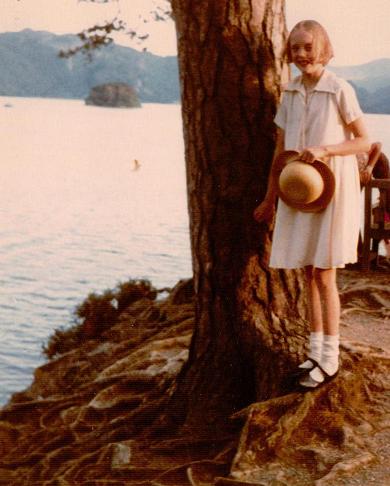
Sophie Neville as Titty about to discover the Captain Flint’s trunk hidden on Cormorant Island ~ photo: Daphne Neville
Stephen Grendon on Derwent Water looking out to ‘Cormorant Island’ ~ photo: Daphne Neville
What a day!
A bright sunny day on Derwentwater. I wore what was my favourite costume, not least because I had the option of wearing a vest beneath the blouse and I didn’t have to worry about the divided skirt. I went to such an old fashioned school that I owned a pair of grey flannel culottes myself, to wear on the games field, and thought them very much the sort of thing Titty would have worn.
My mother in a skirt with her sister wearing a divided skirt in 1953
The cotton dress and buttoned up grey cardigan were a bit crumpled by the time I dropped Amazon’s anchor off Cormortant Island.
Roger, meanwhile was in long shorts or knickerbockers as the real Altounyan children would have called them, kept up with a snake belt. His even longer underwear was an item requested by Claude Whatham the director who, being born in the 1920s himself, had worn exactly the same sort of underpants as a child. As the day warmed up Claude stripped down to a pair of navy blue tailored shorts and sailing shoes. We were on a desert island after all. Even if it was a desert island in the Lake District.
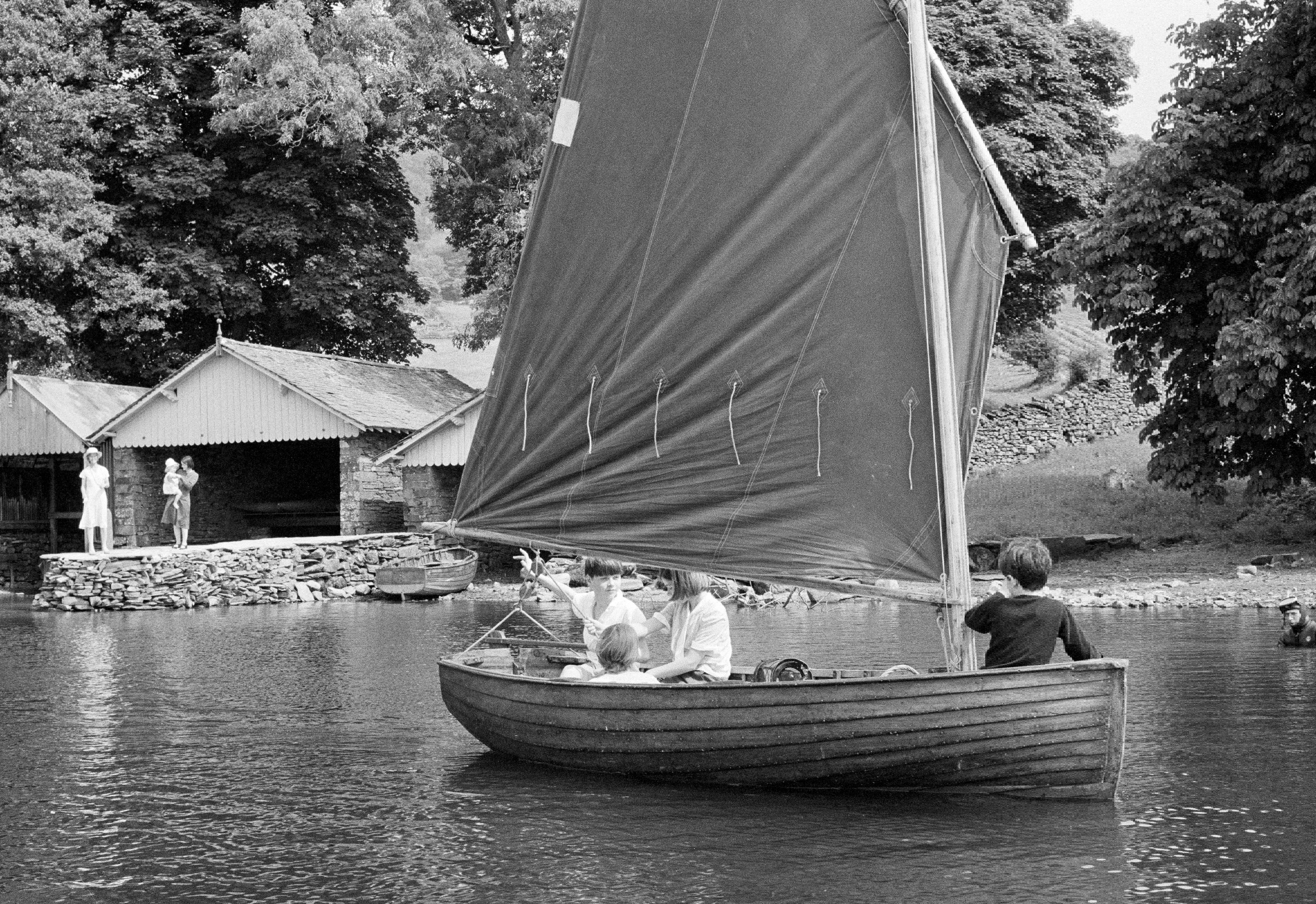
Amazon moored near Cormortant Island on Derwentwater with the pontoon and safety boats. What is the real name of the island used for the location?
In Arthur Ransome’s book of ‘Swallows and Amazons’ the hunt for the treasure is slightly different and Captain Flint’s trunk lies buried under rocks. I wasn’t expecting the set-up with the tree trunk, although I think it works well and looks good, giving movement to the sequence. The only hesitation was that Claude didn’t want me to get hit by the rocks as they slid off. This was a pity as I would have jumped aside.
Long shots of sailing Swallows and Amazon on Derwentwater in 1973
I am not sure why the Amazon had not been bailed out. I can remember having to lie in the bilge water, which proved cold and uncomfortable. Perhaps it gave my performance an edge. Titty would have been cold and stiff after a night wrapped in the sail. Great grey clouds were gathering by then and we were all getting tired.
Sophie Neville playing Titty Walker in the captured Amazon, with David Cadwallader, Bobby Sitwell, Eddie Collins, Claude Whatham and two electricians holding reflector boards on the camera punt: Photo ~ Daphne Neville
Being together in a confined space becomes difficult to endure after while, not least when the space is a pontoon on a lake with not much to sit on. Small boys tend to muck about and become annoying when they are bored. The time had come when someone was going to crack – and they did. The result was silence. A sobering moment. And one very wet pair of knickerbockers.
In the end three of us went home in wet underwear. Gareth Tandy, the third assistant director – who I think was only about 18 – was pushed in to the lake, this time to great hilarity.
John and Susan find Titty has moored the Amazon off Cormorant Island
The big question, of course, it what is the name of the island on Derwentwater that we used as the location for Cormorant Island? Duncan Hall has written in to suggest it is called Lingholm Island (or possibly One Tree Island). What is the name of the larger island, seen in the background of shots, that represents Wildcat Island? Is it Rampsholme Island?
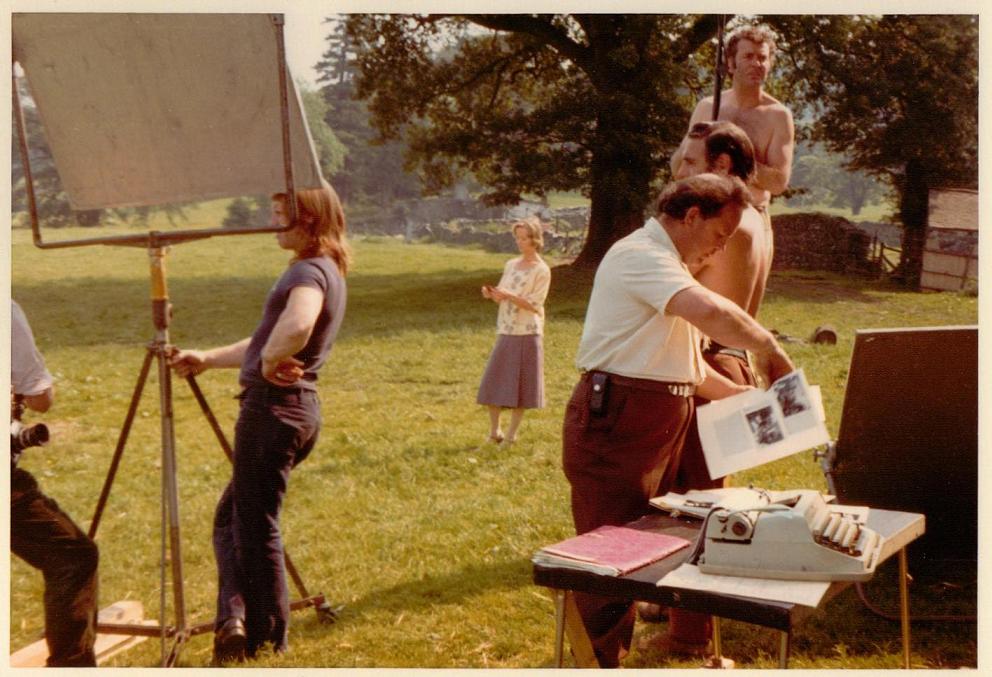
The pontoon on Derwentwater with Richard Pilbrow, Bobby Sitwell, Denis Lewiston, Claude Whatham, David Cadwalader and Sophie Neville aged 12 playing Titty. Cameraman Eddie Collins looks on ~ photo: Daphne Neville
I have one behind-the-scenes clip of the crew on the pontoon – shot on a sunny day. It looks most bizarre. It was. You can see how cramped and overloaded we were and guess at the patience demanded of us all. Imagine how long it took to set up shots, while exposed to the elements. It was quite a stable raft but when we went for a take it was vital that everyone kept completely still or there would have been camera wobble. We used a conventional boat with a cabin when we filmed ‘Coot Club’ and ‘The Big Six’ on the Norfolk Broads ten years later in 1983. It proved much easier – but had more wobble.
The ebook on ‘The Secrets of Filming Swallows and Amazons (1974)’ is available on Amazon Kindle and other platforms. You can read the first section for free here:
Fifty one years ago this day, we were filming with Dame Virginia McKenna at the location used for Arthur Ransome’s Holly Howe above Coniston Water. It was a day of days – the sunshiny day that we had all be waiting for.
Dame Virginia McKenna at the other side of the boat houses at Bank Ground Farm in 1973 ~ photo: Daphne Neville (c)
First Assistant Director David Bracknell standing-in (or kneeling-in) for Roger with Dame Virginia McKenna at Bank Ground Farm. The great trees in the background are sadly no longer there ~ photo: Daphne Neville (c)
The gift of a day when buttercups and daisies were still out in the field that flows from Holly Howe to the lake. Roger was able to tack up the meadow to receive the ‘despatches’ from Mrs Walker, described in the opening pages of Arthur Ransome’s book.
Dame Virginia McKenna reading the IF NOT DUFFERS telegram to Sten Grendon as Roger
‘…Each crossing of the field brought him nearer to the farm. The wind was against him, and he was tacking up against it to the farm, where at the gate his patient mother was awaiting him.’
Dame Virginia McKenna having her hair adjusted by Ronnie Cogan ~ photo:Daphne Neville (c)
I don’t think you can tell that this section of the scene was recorded seven whole days later than the sequence that runs directly on from this when the Boy Roger delivers the very same ‘If not duffers’ telegram to Captain John.
The hole that had been dug for the camera alongside our picnic had been filled in. You can see this from Mother’s perspective when I was milling about near the lake looking towards the island I couldn’t actually see.
Dame Virginia McKenna on location at Bank Ground Farm (Holly Howe) in the Lake District. Property Master Bob Hedges is working in the foreground. Lee Electric lighting assistants stand-by with reflector boards while Assistant Sound Recordist Gay Lawley-Wakelin waits on a box with the boom ~ photo: Daphne Neville (c)
Poor Sten, he had to run up the field on what proved to be our hottest day in a sleeveless sweater. I remember Jean McGill, the Unit Nurse ministering cool drinks and a flannel soaked in cool eau de Cologne to make sure he did not get dehydrated. We all wanted a go with the cool cloth on the back of our necks at lunch time.
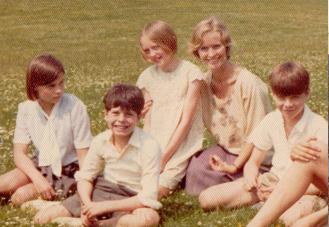
The Walker Family ~ Suzanna Hamilton playing Susan, Stephen Grendon as Roger, Sophie Neville as Titty, Dame Virginia McKenna as Mother and Simon West as John. photo: Daphne Neville (c)
It was good to escape the heat by getting out on the water. We shot the scene set on the old stone jetty at the boat houses below the farm when Titty leads ‘Good Queen Bess’ down to the harbour to inspect her ship. I didn’t realise she had a large box of matches in her hand. Virginia kept it a surprise from us in real life. I was excited to find out that Simon Holland, the Designer had painted the branded cover by hand.
Farewell and adieu to you fair Spanish ladies
As the call sheet specifies, our dinghy Swallow had been loaded with all the tents and camping equipment that had been on Peel Island the day before. I didn’t realise at the time quite how often the design team had struck camp and made it up again. I just sat on top of the equipment singing Adieu and Farewell, not very well, as we sailed out onto Coniston Water, waving goodbye to our Fair Spanish Ladies.
Claude Whatham with Dame Virginia McKenna. Mrs Jackson stands patinetly at the door ~ photo: Daphne Neville (c)
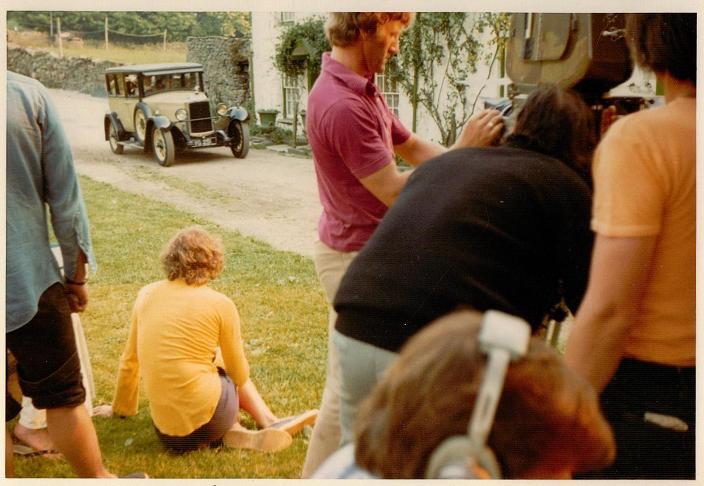
I am sure that we had already recorded the scene in David Wood’s screenplay when the Walker family arrive at Holly Howe, but Claude decided to take advantage of the golden light and shoot it again. I am sure this was a good decision. It had been a long day and we were tired but the excitement of our arrival is tangible.
Director Claude Whatham, in a 1970s yellow long-sleeved t-shirt, watching the taxi drive up to Mrs Jackson’s front door in 1929. DoP Dennis Lewiston sets up the shot with Focus-puller Bobby Sitwell ~ photo: Daphne Neville (c)
Nurse with Baby Vicky, the ship’s baby at Holly Howe ~ photo: Daphne Neville(c)
My mother observed that Mrs and Mrs Jackson, Mrs Walker’s nurse and Vicky the ship’s baby, who were listed as Extras on the call sheet, were particularly well cast. Kerry Darbishire, who played the nurse, told me later that she had a daughter of the same age as Tiffany Smith seen here as Vicky. She could have brought her along. It was important they were there, playing ‘The stay-at-homes.’ Vicky anchored Mrs Walker to the farm, making it impossible for her to sail to the island with the Swallows.
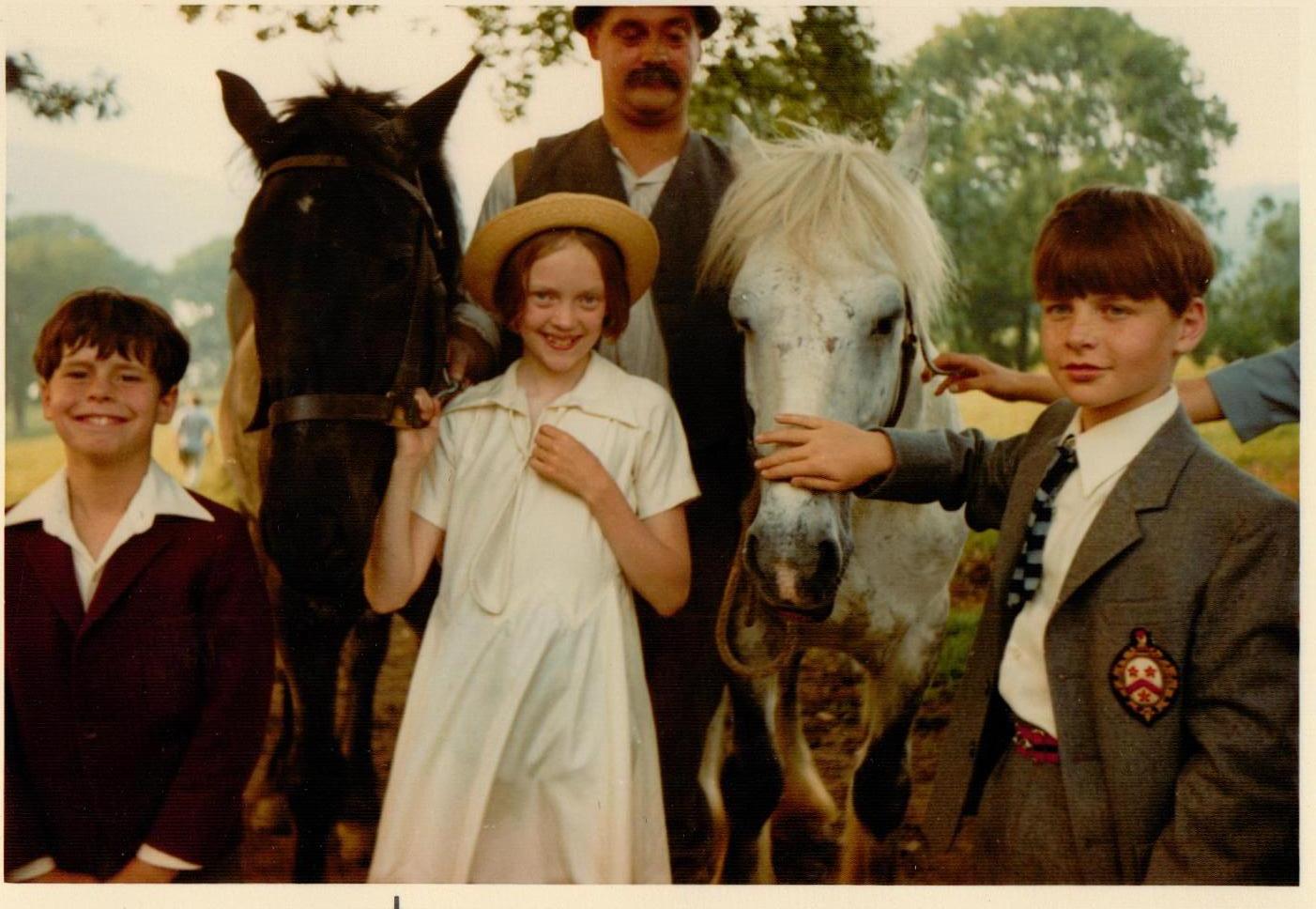
Stephen Grendon, Sophie Neville and Simon West with Mr Jackson at Holly Howe~ photo: Daphne Neville
It must have been a long day for the little girl. It was a long hot day for all of us, but a happy day.
Simon West, Stephen Grendon, Suzanna Hamilton & Sophie Neville playing the Walker children in ‘Swallows and Amazons’ 1973 ~photo: Daphne Neville(c)
The women who had been taken on as our stand-ins the day before did not seem to be around to help limit the hours we spent on set. David Bracknell, the first assistant director stood in for Roger. One of the women later claimed that she played Virginia McKenna in long-shots but the only long shot was taken of the Spanish Ladies on the jetty and I’m pretty sure that is Dame Virginia herself.
Stephen Grendon, Simon West, Dame Virginia McKenna, Suzanna Hamilton and Sophie Neville, trying not to look as tall as she was in 1973 ~ photo: Daphne Neville(c)
What I really did not know, until I watched the documentary broadcast last Sunday, was that Mrs Batty, who held the lease on Bank Ground Farm, had locked out the crew. She explained that when she was originally asked if we could film on her property she did not quite realise the scale of operations and only asked for – or accepted – a location fee of £75.
Lesley Bennett’s photo of the double decker buses at Bank Ground Farm in 1973
The arrival of the two red double-decker buses, the Lee Electric van, the generator and other lorries, not to mention the Make-up caravan rather daunted her, as did the furniture moving activities involved at the start of the filming when we shot the interior scenes. The idea that the film would bless her Bed & Breakfast and Tearoom business for the next fifty years alluded her. She said that she decided that £75 was not enough, padlocked her front gate and wouldn’t let the crew back in until they agreed to pay her £1,000. It was a lot of money, more than double the fee I received.
Sophie Neville with Lucy Batty at Bank Ground Farm in 1973 ~ photo: Daphne Neville(c)
You may have seen the BBC documentary about the making of Swallows and Amazons, when Ben Fogle interviewed Suzanna Hamiltonand myself at Bank Ground Farm for ‘Big Screen Britain’. This was re-packaged on a programme called Country Tracks. My father’s 16mm footage had been skillfully inter-cut with an interview with our Director, Claude Whatham.I did not know that it was being broadcast but was able to watch on-line.~The Author Sophie Neville at the boatshed in 2013~
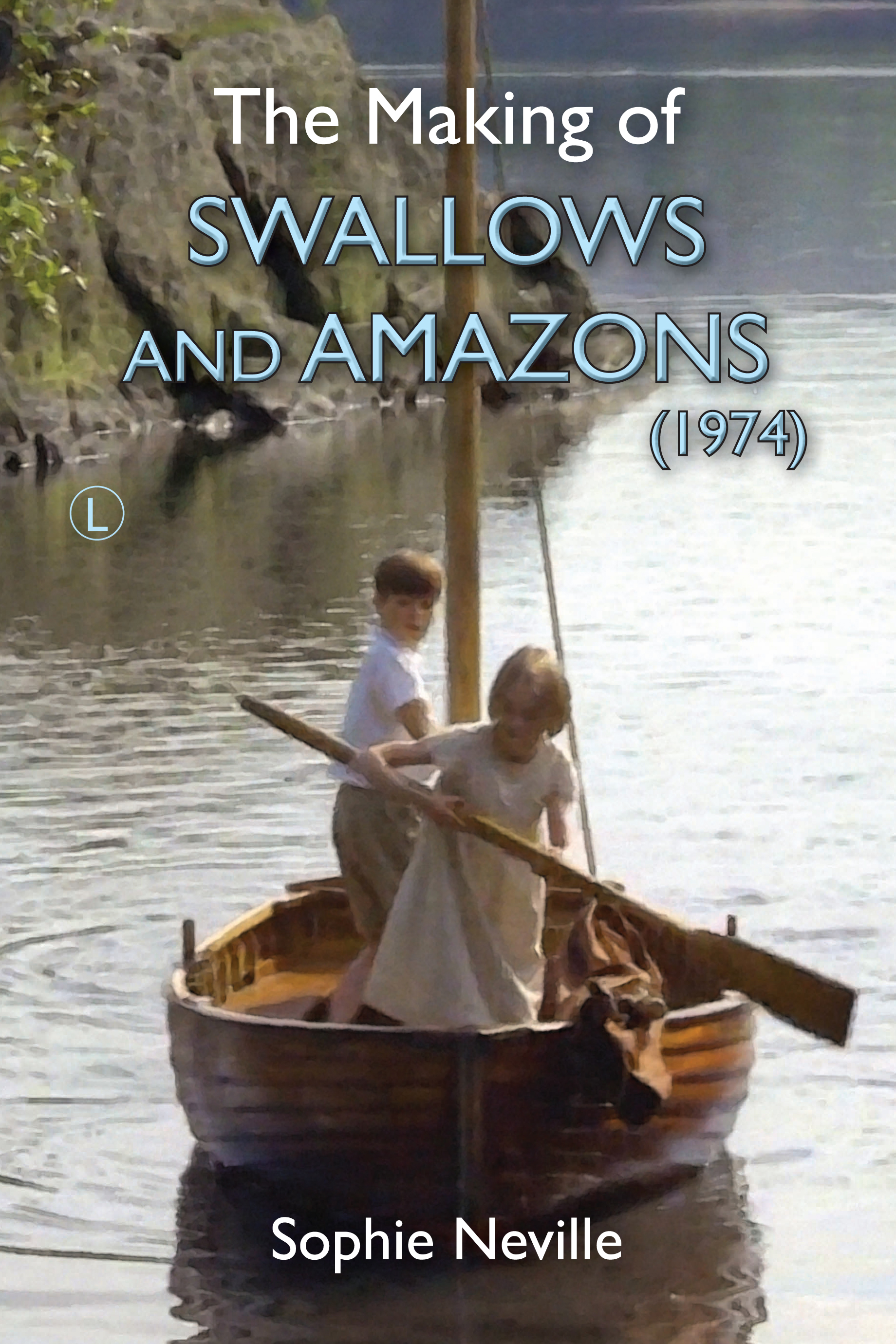
If you would like to read more, ‘The Secrets of Filming Swallows and Amazons (1974)’ is available on Amazon Kindle and all ebook platforms and the paperback on ‘The Making of Swallows and Amazons’ can be found in Waterstones from all online stockists.
14th May 1973 – and it was the first day of making the original movie ‘Swallows & Amazons’ on location in the Lake District. A huge effort had been made to ‘dress’ Haverthwaite Railway Station, at the southern end of Windermere. The aim was to bring across the feel of a bustling holiday destination in the summer of 1929. Local people had been fitted with costumes in the Ambleside Church Hall, there was a horse and cart, porters’ trolleys laden with trunks and a number of old bikes, which were all of great interest to us.
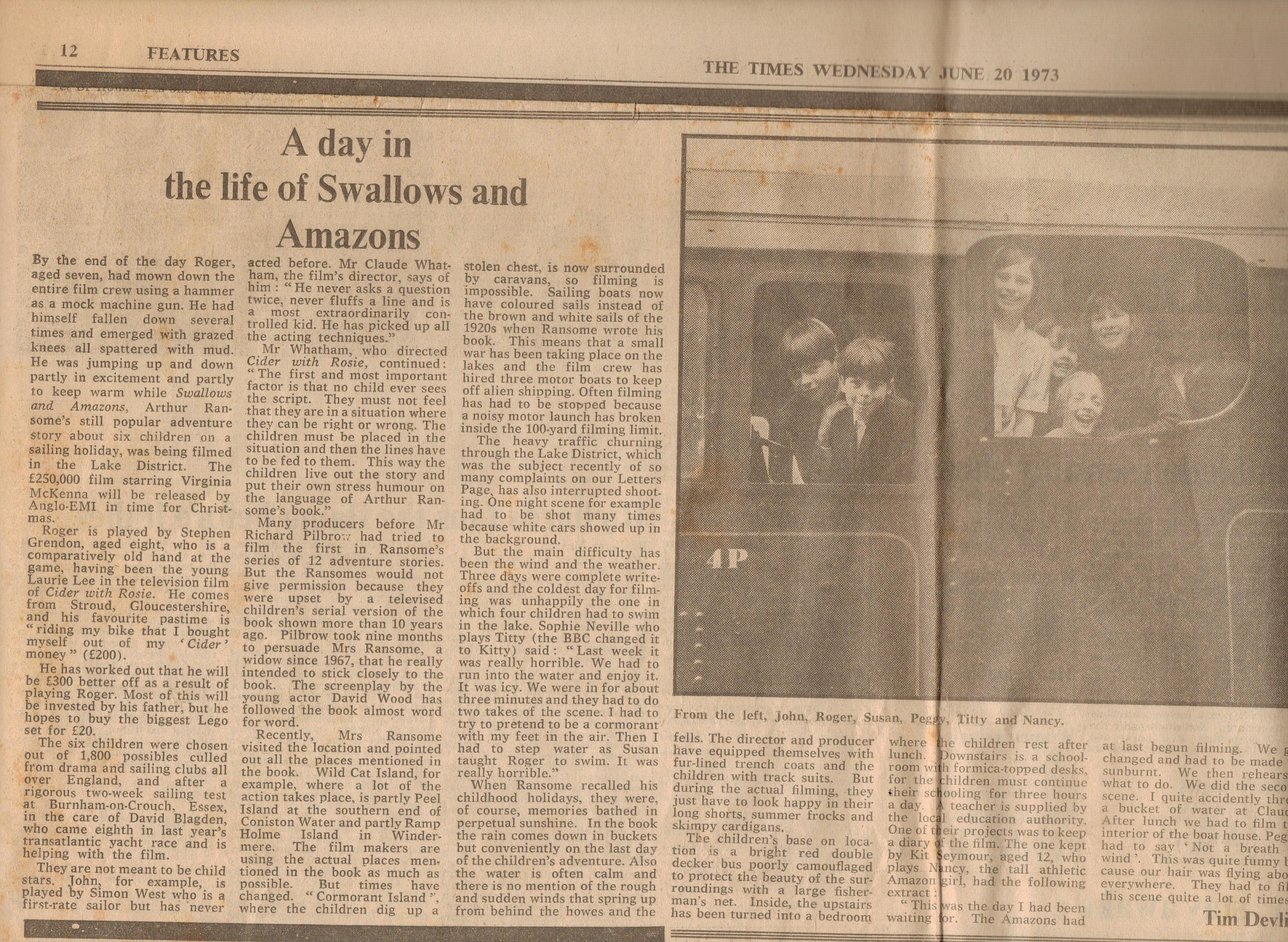
Having stepped down from the steam locomotive, where the Times photographer must have taken this shot (below) before we children were piled into an open-topped period vehicle, for further photographs.
A photograph taken for The Times of us all aboard the steam train at Haverthwaite
I thought the publicity photographs taken that day were silly, especially since Kit Seymour and Lesley Bennett, who played the Amazons, were wearing ordinary clothes rather than period costumes, but the results were later published far-afield from The Guardian to Woman’s Realm.
Viewers ask how old we were at the time. Sten Grendon, who played Roger was aged 8, Simon West (John) was aged 11. Although Titty is described as being aged 9 in the books, I was 12, as were Suzanna Hamilton (Susan) and Kit Seymour (Nancy). Lesley Bennett (Peggy) was 13, but looked younger. Virginia McKenna, who played my mother, has just been awarded a DBE – not before time!
A publicity shot featuring Virginia McKenna, with Kit Seymour, Steven Grendon, Sophie Neville, Lesley Bennett, Simon West and Suzanna Hamilton, taken on the first day of filming and published in the Guardian and other newspapers
The yellow motor used in the film for our taxi was superb. Would a real Lakeland taxi have been so grand? I recorded in my diary that Sten, playing Roger, hung out of the window as the director, Claude Whatham, ‘filmed us driving out of the station, along the platform at top speed.’
Once this shot was ‘in the can’ Virginia McKenna was interviewed by journalists while we were hurried away to get on with our lessons. Our tutor taught us Art. I drew the a picture of the motor car.
Director Claude Whatham talking to Virginia McKenna
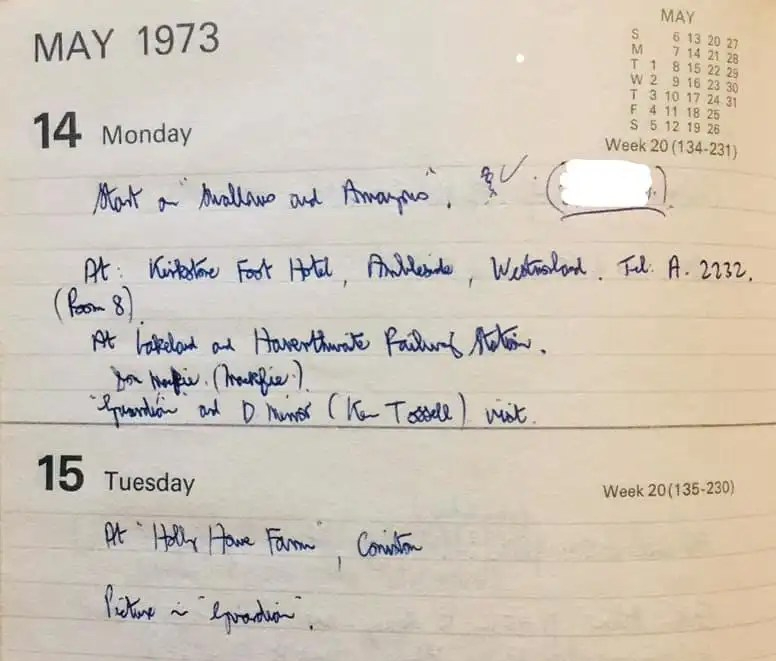
Journalists from the Times, Guardian and Daily Mirror were looked after by our publicist, Brian Doyle, whose diary was a little more functional than mine. I’m now struck by the telephone number for the unit hotel: Ambleside 2232
Dairy kept by Brian Doyle, the publicist on ‘Swallows and Amazons’
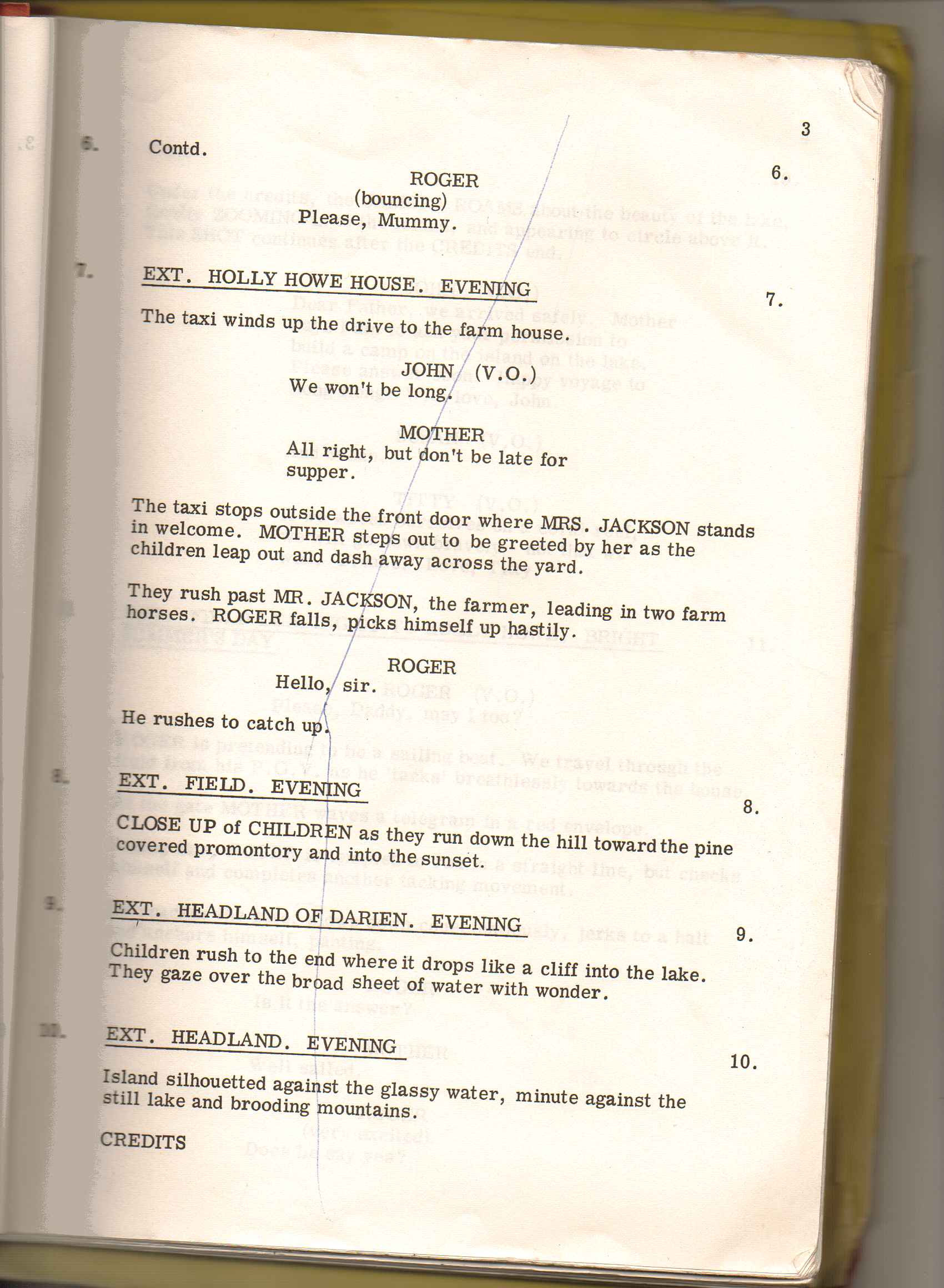
Arriving at Holly Howe in the taxi was truly exciting. It was not filmed the next day, as I think rain had set in. Claude waited for good evening light. But I remember the thrill of drawing up outside the farmhouse in the old car and pulling on my hat as we spilled out and ran past the big farm horses Mr Jackson was leading into the yard. Our OOV (out of vision) dialogue was added later.
The screenplay of the 1973 film ‘Swallows and Amazons’ adapted from Arthur Ransome’s book by David Wood
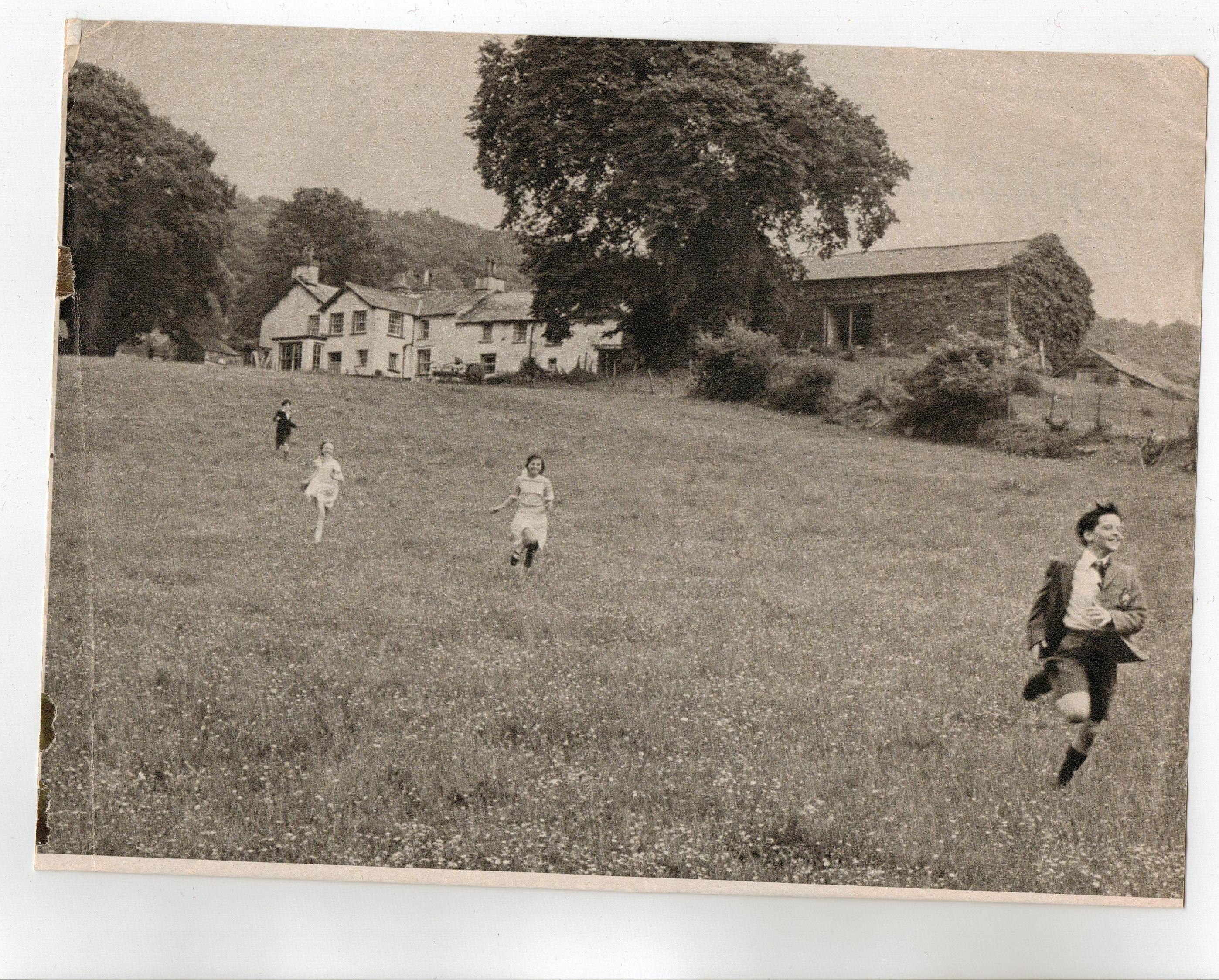
If you ever go to Bank Ground Farm near Coniston, named Holly Howe by Arthur Ransome in his books, you must run down the field to the lake as we did. As soon as you arrive. And at top speed. And you will be filled by the same feeling of elation as we were when we played the Walker children.
Steven Grendon, Sophie Neville, Suzanna Hamilton and Simon West at Bankground Farm above Coniston Water in the Lake District
The slope, formed by glacial scouring and subsequent deposits long ago, is steeper than you might think. We became adept at the art of glaumphing, advocated by Ransome in the book.
What struck me when I returned to Bank Ground Farm one Spring, was that sadly the great trees have gone from around the old farm gate and the boatsheds down by the lake. They must simply have reached the end of their lives, but their glory was captured on celluloid to be remembered forever.
Sten Grendon, Sophie Neville and Simon West with Mr Jackson at Holly Howe~ photo: Daphne Neville
Most Arthur Ransome devotees will know that the Peak at Darien, where once stood stout Cortez, is familiar to readers as it appears in two of the illustrations in the book. Sadly it can not be found below the farm in real life. Mrs Ransome said that you could find the headland on Windermere. In April 2011, when I was on an early recce with Nick Barton, CEO of Harbour Picture Productions, we did pass one promising spot. However Richard Pilbrow and Claude Whatham chose Friar’s Crag on Derwent Water for the location. I didn’t know it but Christina Hardyment writes in her excellent book, Arthur Ransome and Captain Flint’s Trunk, that they had found the very place Ransome had in mind, “without the slightest idea that they were quite right to be doing so.” She found that Ransome had marked up postcard of Friar’s Peak for his illustrator Clifford Webb to work from in 1930. It feels completely right when you are there, with the iconic view of an island under the towering mountains. It was over a shot of this that the opening titles were added.
Sout Cortez was not around. Neither were we children. By the time we had been transported from Coniston to Derwent Water for this scheduled scene the sun was going down. We’d been delayed by the make-up artist who was determined to tone down the tans we had developed. This took ages as he used a very small sponge. My mother was frustrated, as she thought that this would never have shown up, but he put his foot down with the result that we were ‘late on set’ for the evening shots. Mum grabbed this photo but it was a disaster. Claude Whatham was very annoyed.
Sophie Neville as Titty arriving too late in the day to film at Friar’s Crag on Derwent Water. The island portrayed as Wildcat Island can be seen in the distance ~ photo: Daphne Neville
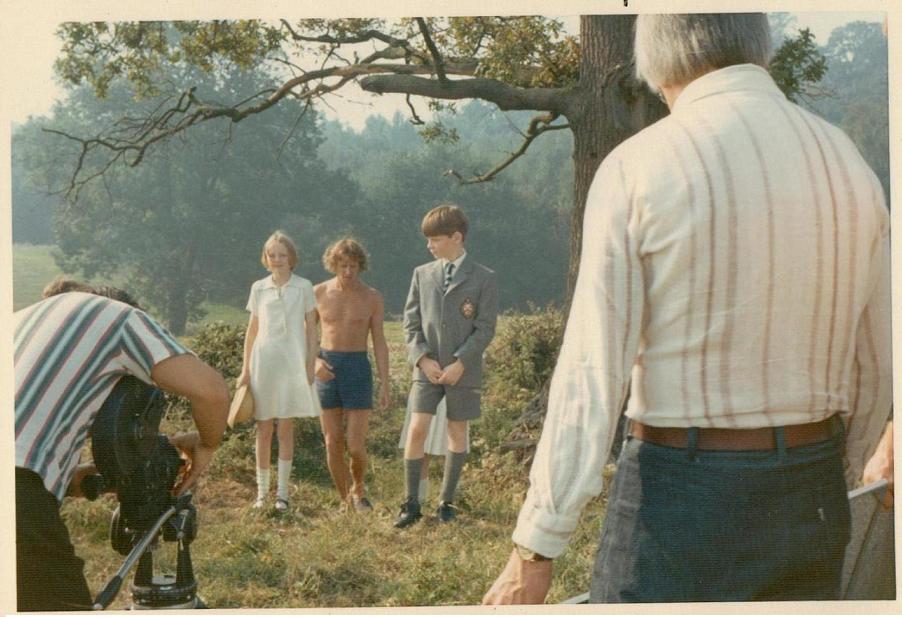
One of the big secrets of the film is that the sequence when we run up to the Peak at Darien and first set eyes on the island in the lake was shot under an oak tree in Runnymede, near the River Thames. We were not an island at all. It must have been an expensive ‘pick-up shot’ but Claude had made an effort to gather together the same crew members and I was back in my lovely silk dress once more. We knew how to act by then and the joy of being together again shows on our faces. The result was a scene to set the film off on the right foot. We were jubilant and so excited, that, like swallows, we could have taken flight.
Sophie Neville, Claude Whatham and Simon West with Richard Pilbrow, right ~photo:Daphne Neville
I would have to check with Richard Pilbrow to be certain, but I think that Simon Holland, the Art Director, penned the SWALLOWS and AMAZONS graphics for the opening titles. I remember a discussion about the font type. A very fashionable script used on the poster of the film was favoured. I said that they ought to use the handwritten capitals that Clifford Webb had penned on the map in the opening cover of the book, which were copied by Simon Holland (and me) on our chart. This was chosen.
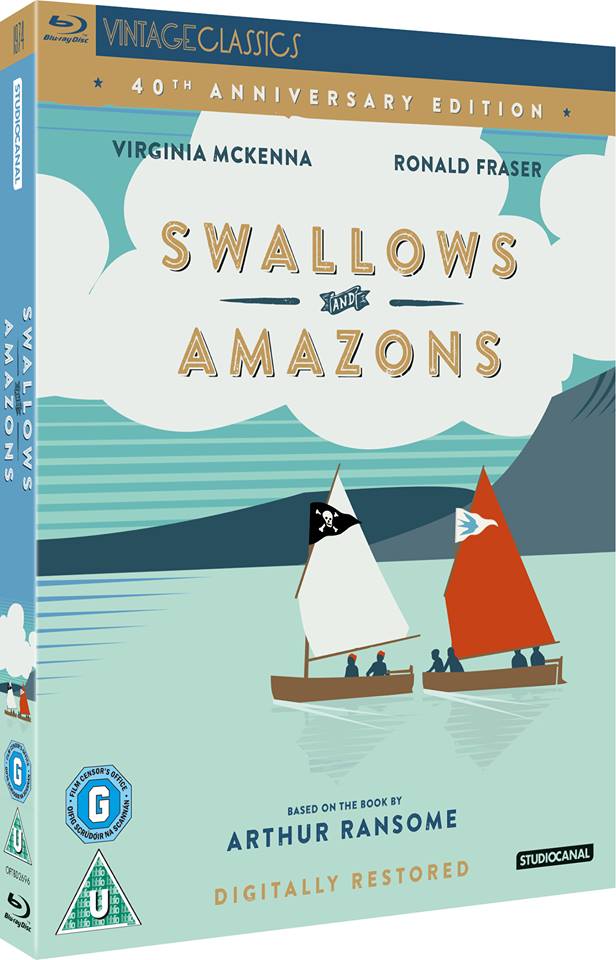
A snazzy Seventies’ font, had been used for the titles of Lionel Jefferey’s movie The Railway Children and the poster of Swallows & Amazons. For sometime a DVD has been available which gives you both movies released by EMI Films.
Click on this image to see the poster of the film
As a viewer I felt that this soon dated it, whilst Swallows and Amazons sailed onto our television screens in the 1980’s and 1990’s, without being spoilt by what became most unfashionable graphics. Of course that particular retro font is now all the rage.
You can read more about the trials of producing the classic film in ‘The Making of Swallows and Amazons’ published by the Lutterworth Press, available online, at all good bookshops and to order from libraries.
The remastered DVD with subtitles and an Extras package is available online.







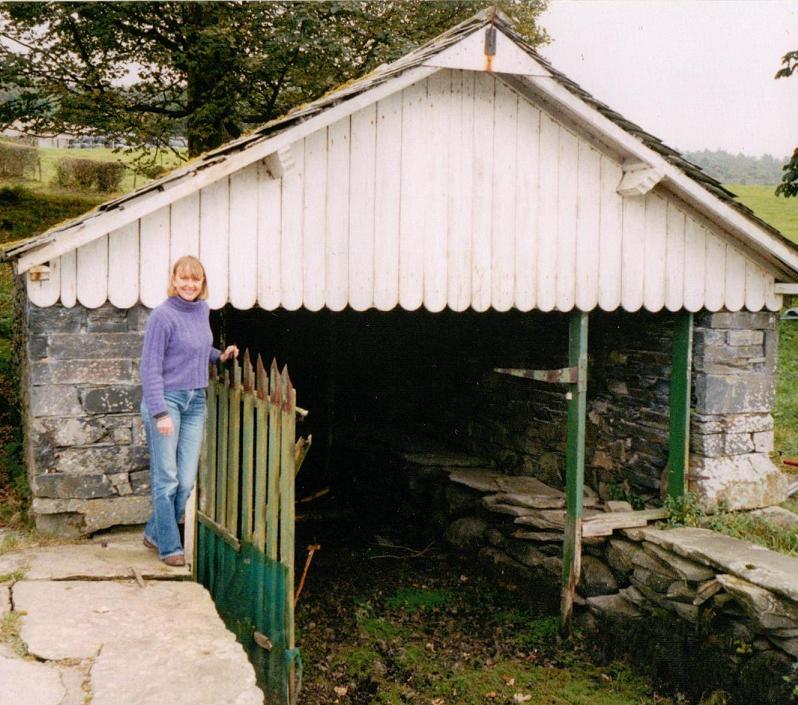 ~The Author Sophie Neville at the boatshed in 2013~




 Sophie Neville