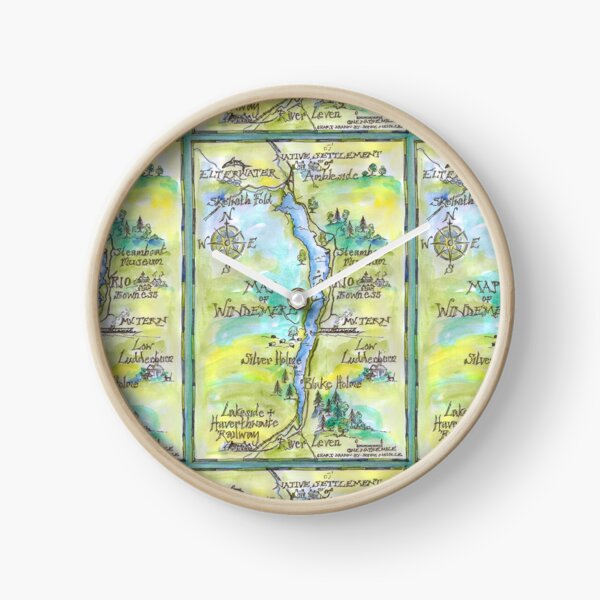
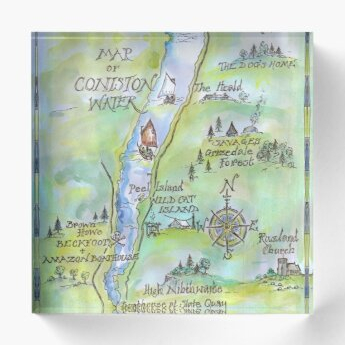
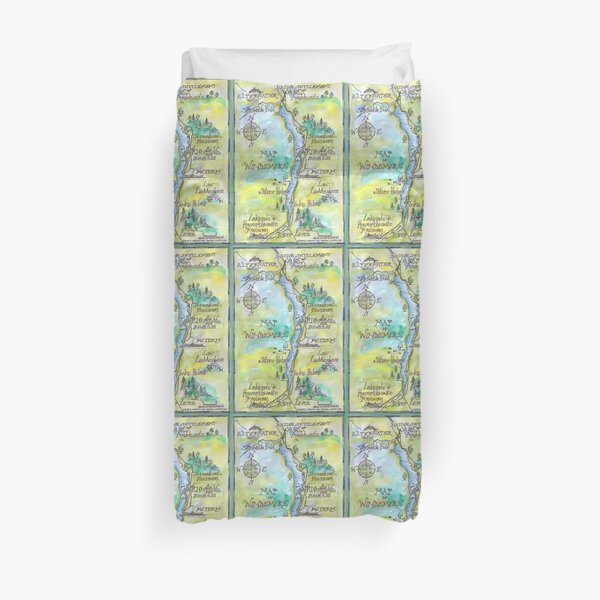
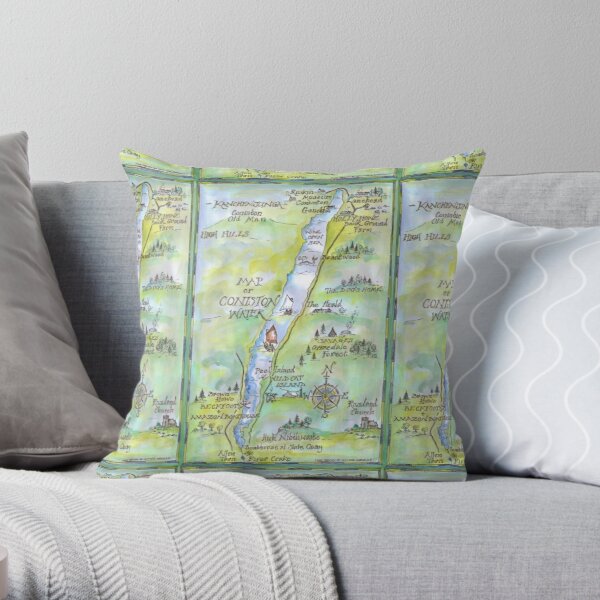
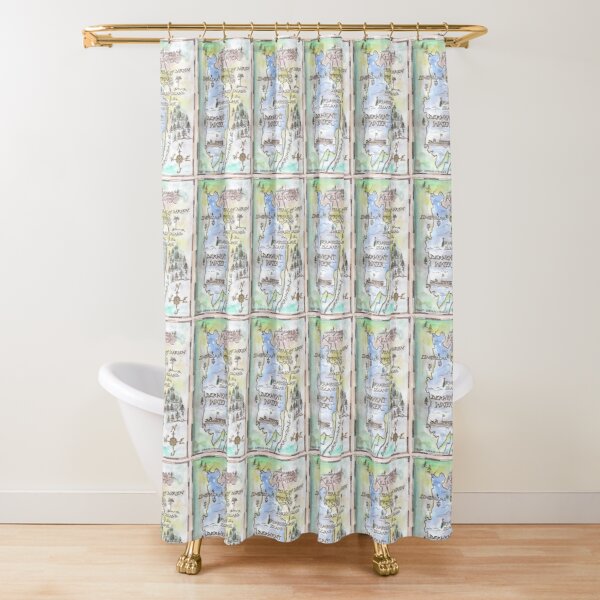
I’ve used the maps I drew to illustrate my book on ‘The Making of Swallows and Amazons, 1974’ to bring out a ‘Sophie Neville collection’ of gifts.
Map showing film locations around Coniston Water
Map of film locations on Derwentwater in the Lake District
Map showing some of the film locations around Windermere
Each of the three different maps, seen above, have been printed on cushions, bedding, bath mats, shower curtains, coasters and items of clothing that make perfect presents for Swallows and Amazons enthusiasts.
To view the collection that feature Coniston Water, Windermere and Derwentwater, please click here.
I returned to the shingle beach at Tanner’s Lane on the Solent with my friend, also called Sophie, who took care of the dog while I collected plastic pollution. Having cleaned the same beach seven days ago, all I found was a black plastic lid washed up with a number of micro plastics. I plan to return in another week and begin counting the pieces as an indication of what is being washed up on a 500 metre stretch of the Solent. I guess the amount will depend on whether we have another storm or winter picnic-ers.
We then walked half a mile up the only lane to the beach. I filled my feed bucket with about 5Kgs of crisp packets, cups, flowerpots, a tin and two glass bottles. My friend was interested in how much more rubbish we spotted on our way back to the car. Litter picking is like that. You see into ditches from a different perspective. Cyclists visiting the New Forest were interested to see how much had been thrown onto the verges of the National Park and were horrified to see how much we collected.
9th January
We drove through the New Forest the next day, taking note of the verge-side litter. Where does it come from? What kind of motorist can ignore the fact they are driving through a National Park? Cyclists must notice every piece.
I later extracted three items from the Lymington River. Two were cups with plastic lids and plastic straws from McDonalds. The nearest is a 25 minute drive away, yet I often find their packaging. Is it dropped by commuters, visitors or delivery people?
11th January
I found an old carrier bag, put on gloves and collected a bag full of litter on my way into town, finding old things like a neck brace left in the street. The bag is deposited in a municipal bin, as advised. What distressed me was looking over the flood barrier to see so much rubbish dumped in the Nature Reserve.
I walked the dog around Bradbury Rings Iron Age Fort in the afternoon, collecting about 20 items of litter. Although ancient rubbish is the life-blood of archaeologists, I think we can spare them Coke tins.
12th January
I spent 40 minutes collecting litter, walking through the park and along the Solent Way, passing the Yacht Haven. There seemed to be more litter on the ground than a council operative was collecting from the plentiful municipal bins. I found a brand new bag-for-life before picking up two canisters of laughing gas by the Yacht Club. What can I do but re-cycle them?
15th January
Storm Brendan hit us hard for two days but the skies finally cleared and enabled me to get down to the coast to collect plastic bottles and wrappers along with two fishing buoys that had blown in from the Solent. It was a joy to be out in the New Forest National Park and felt good to be doing something worthwhile but can I make a difference?
For a list of things I take on a Solent beach clean, please click here
Sophie Neville in Portugal on the 150th beach/river clean of 2019
Wednesday 1st January 2020
“Hello Sophie,” a passing driver called out. “Are you still collecting plastic?”
“My first beach clean of the year!”
I managed 150 beach or riverside litter collections last year. My aim is to make it 200 for 2020. As someone wrote to ask why I stopped my last‘Diary of a lone litter-picker’ back in April, I thought I’d start it up again. It may not be that consistent but I am fuelled by rage. The first thing I picked up toady was a deflated helium balloon found on the road to the Solent shore. Isn’t helium a finite resource? Don’t we need it for medical procedures?
I came across two ‘disposable’ barbecues lying abandoned on the beach.
“Do you think someone will return for these?” I asked the only other person about on New Year’s Day.
“Doubt it.”
I added the aluminium trays to the purple bucket I use to collect litter. Only one drinks can graced it’s depths today but I stopped repeatedly to pick up cotton bud stalks along with small pieces of PVC fishing twine and red, white or blue micro- plastics washed up by winter tides.
A runner ran past. Will all this bending keep me fit, I wonder. There was a little polystyrene and four boxes of fireworks left beside the municipal bin.
It was a mild but misty morning. I walked along with my dog listening to cries of seabirds. How many of them have plastic in their gullets?
On returning home, I looked up the Marine Conservation Society and see from their 2019 report that they have a number of different classifications for items such as ‘Sewage related debris’. They need more data to campaign and change Government policies. I decide to join.
Thursday 2nd January
It was windy with rain threatening, so I decided to take my dog down a lane running alongside the river marking the boundary of the Lymington Reedbeds Nature Reserve in the New forest National Park. This is just above the high tide level and prone to flooding. I cleaned the area two months ago. In about 500 yards I collected:
3 x glass booze bottles, 3 x booze cans, 3 x drink cans, 7 x plastic drinks bottles, 5 x cigarette packets and 30 x crisp/sweet wrappers. This weighed 3kgs. Apart from one sandwich the contents of the packaging could not be described as health-giving.
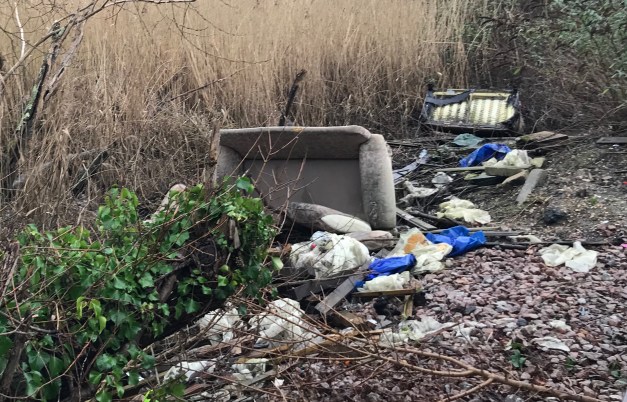
I had to leave a discarded boiler, a rusting wheelbarrow, a length of soggy carpet and a number of bottles lying out of my reach. This fly-tipping has languished in the ditches here for sometime but I need to commandeer help and a suitable vehicle.
Friday 3rd January
A lovely sunny day when I cleared litter from the rest of the lane running along the river. What do people expect will happen to the cans and plastic flung into the reserve? One tin was dated 2011. Four of the wrappers had been neatly knotted before being chucked in the ditch. From the evidence collected, I strongly suspect their owner to be drink-driving on his or her way to work every day.
Sadly, I will need to return with a long-poled grabber for plastic bottles chucked deep into the brambles. I need a vehicle to collect a large car part, a plastic tub and a number of ‘Bags for Life’ stuffed with litter lying abandoned near the footpath to the pub. It could be worse. I found nine different items of stolen property along this lane last year – iPhones, lap tops, two empty jewellery boxes and a handbag in which a mouse had made its nest.
It was my friend’s birthday, so I took her a card, walking along the estuary with a bucket to collect the inevitable litter. What should I do with parts that have obviously fallen off cars? I hung one up in case its grateful owner comes along along. I also hung a soggy sweatshirt from the railing, although I doubt if it will be claimed.
I was down by the water, fishing out plastic bottles when a car passed belching clouds of choking white smoke. After extracting an old carry-mat from the reeds I found two puzzled men looking under the bonnet of their car. Their glamorous passenger stood shivering by the estuary. I pointed them in the direction of the local garage but feel I should have left the mat in case they needed it.
Saturday 4th January
In an effort to record data, I sort yesterday’s litter into re-cyling bags full of tins and plastic bottles. Glass bottles go in an outside sink for washing, wrappers into my domestic rubbish bags. They should go into Council litter bins or litter bags.
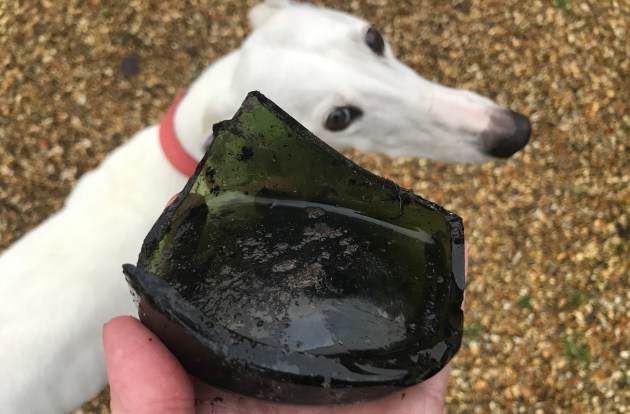
I returned to the Solent and began collecting plastic deposited by winter tides. When I first moved to this area fifteen years ago, the foreshore was multi-coloured with debris. The coast now looks clean at first glance but I picked up about 200 tiny pieces of fishing twine and micro-plastics in a few hundred yards. There were quite a few spent shot-gun cartridges left by wild-fowlers. I found a baby’s dummy and a used cigarette lighter. There is often one. New Forest ponies roam here and yet I have retrieved buckets of broken glass in the past and find a jagged bottle base that could easily lame a horse. It has obviously been there for years.
Sunday 5th January
A stereo speaker was washed up on the shore this afternoon. I wouldn’t want to hit one at sea. I spied a Corona bottle, the bobbly ‘every bubble’s passed its FIZZical!’ type that we yearned for as children in the 1960s. How old would it be? 50 years-old? Could I still redeem the deposit? Hopefully soon.
Monday 6th January
I walked back from town, unable to pass litter lying on the causeway over the Lymington River. I had no bucket with me but where there is rubbish there is usually something you can use as a container. I found a broken umbrella, filling its folds with plastic cup lids, bottle tops, and assorted trash including a Pepsi Cola tin that would have otherwise rolled into the tidal river.
Tuesday 7th January
I should have rushed out early when we had two minutes of sunshine but I was distracted and the rain set in. Instead, I read through litter-picking posts on Facebook, absorbing information on bottle return schemes and the call for an end to single use plastics. I reckon we need to support anyone who is doing anything before the world is swamped in rubbish and the food chain poisoned. Do let me know what you are doing in the comments box below.
For a list of things found on Solent Beachcleans last year, please click here
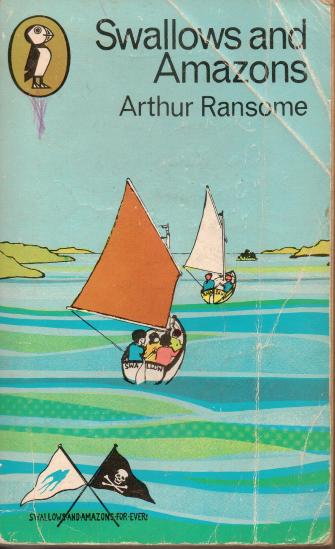
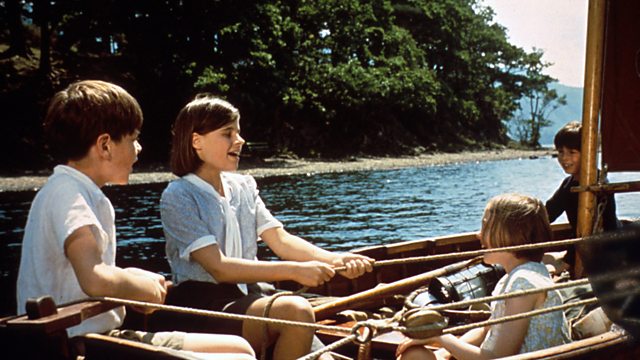
The school term is over, ‘Swallows and Amazons’ is on BBC iPlayer and Christmas missives are arriving in the post. I have just been sent this homemade card from someone who came to the premier of the original film in 1974, when I was fortunate enough to play Able seaman Titty.
~Captain Flint hanging Christmas decorations around his houseboat on a card made from a Puffin book cover~
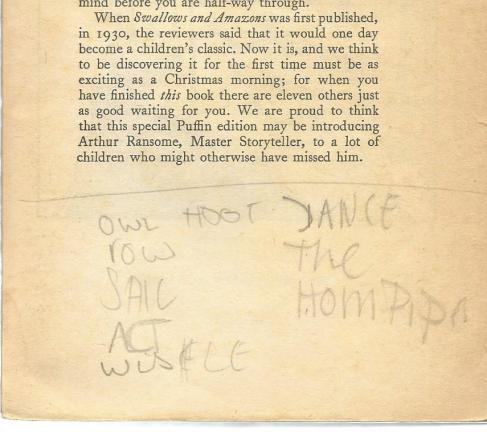
I dug out the Puffin paperback of Swallows and Amazons my father gave me when I was a girl and read avidly, along with other books in the series, by the time I was eleven years-old. It is a 1970’s edition in which I’d underlined everything Titty said. I must have re-read this copy when busy preparing for filming the 1974 movie financed by EMI.
Kaye Webb, the editor, had written an introduction saying, ‘This book is about sailing, fishing, swimming, camping, and piratical exploits.’ She wanted to make it available to children, thinking that discovering Swallows and Amazons ‘for the first time must be as exciting as a Christmas morning.’
Underneath, I’d noted down the skills I would need to acquire before playing the part of Titty. ‘Owl Hoot’, was one item, ‘wisle’ (sic) another. I was somewhat apprehensive about dancing the Hornpipe but excited about ‘being a cormorant’, having no idea how cold this experience would prove.
According to Trade News, 75,000 copies of a new Puffin paperback were brought out to accompany the original film. A still was used from the scene where the Swallows sail both dinghies from Cormorant Island. It retailed for 35p. Meanwhile Jonathan Cape printed 12,500 copies with the original dust jacket to accompany the release on 4th April 1974.
Today, I am most interested in Ransome’s prose, amused to find the phrase ‘X marks the spot where they ate six missionaries’ does not appear within the pages of the book. It was given to Titty in 1973 by the screenwriter David Wood. However, there are words of wisdom a-plenty that were not used in the film adaptations:
‘I like cooking,’ said mate Susan.
‘If you want to go on liking it, take my advice and get someone else to do the washing up’, is Mother’s reply. (I wonder who might have said this in reality.)
‘You can be wide awake and not see a thing when you aren’t looking’ is one of Roger’s observations.
John was able to look back to ‘a different, distant life’, which is exactly how it feels when the excitement of Ransome’s world spoils you for the ordinary. It’s true: those involved in outdoor activities develop in leaps and bounds ending up, ‘not at all what they had been.’
What is it about Arthur Ransome’s writing that captures your imagination? Rowing? Sailing? Cooking over a camp fire? Which book has most influenced your life?
Article on Swallows and Amazons on Puffin Magazine
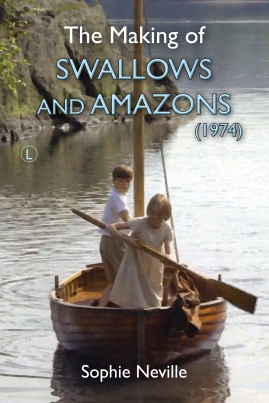
You can read about the adventures we had bringing out the original film in different versions of ‘The Making of Swallows and Amazons (1974)’, which is now available as an audiobook.
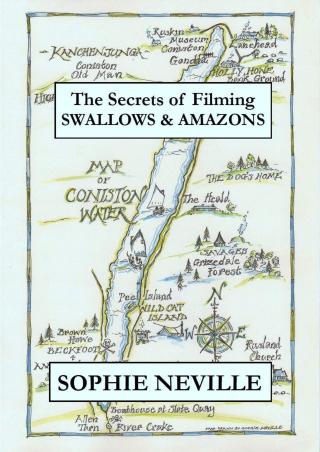
Different editions of ‘The Making of Swallows and Amazons (1974) by Sophie Neville’
If you enjoy ‘Swallows and Amazons’ do think of joining The Arthur Ransome Society who often visit the film locations or the Arthur Ransome Group on Facebook where you will meet like-minded people – of all ages. Most are dinghy sailors who love the books.
Lat time ‘Swallows and Amazons'(1974) was screened on BBC Two, at least one film fan held a TV party with a 1930’s theme. Others ‘stoked up the wood-burner and settled down to spend an afternoon re-living summer in the Lake District’, adding, ‘It is as if Christmas wouldn’t be Christmas without ‘Swallows and Amazons’ – a timeless classic to watch again and again.’
For the latest edition of the paperback on ‘The Making of Swallows and Amazons(1974)’ with details of where the film was made and what those who appeared in it are doing now, Please click here
The ebook, entitled ‘The secrets of filming Swallows & Amazons (1974)’ is similar with a few more stories for adult readers and has links to behind-the-scenes cine footage. It can be downloaded from iTunes, Smashwords,Kobo and Amazon Kindle
It would be lovely to hear from anyone who saw it in the cinema when it first came out in cinemas in the summer of 1974 – more than forty-five years ago.
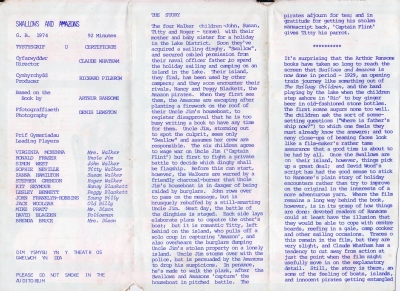
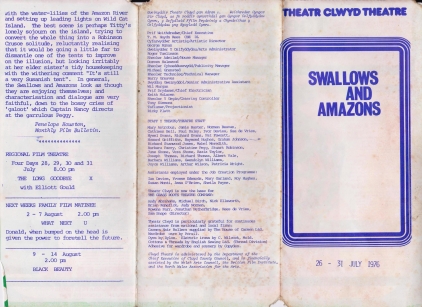
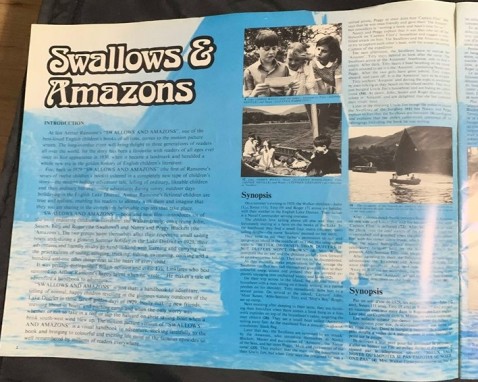
Simon Hodkin kindly sent in this cinema programme that he has kept since watching the movie when he was a boy growing up in North Wales.
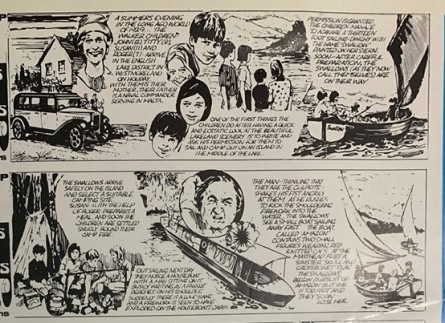
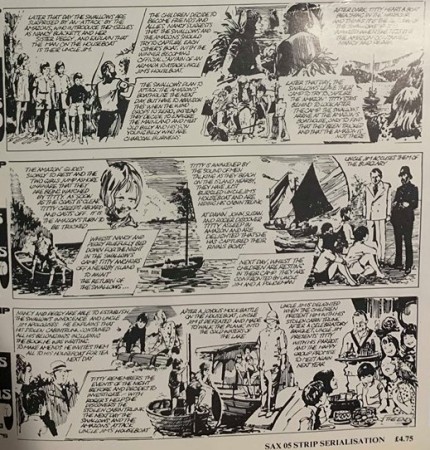
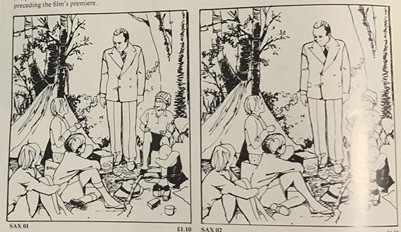
Arthur Herbertson managed to track down these rare publicity sheets for ‘Swallows and Amazons’ typical of movie games of the period:
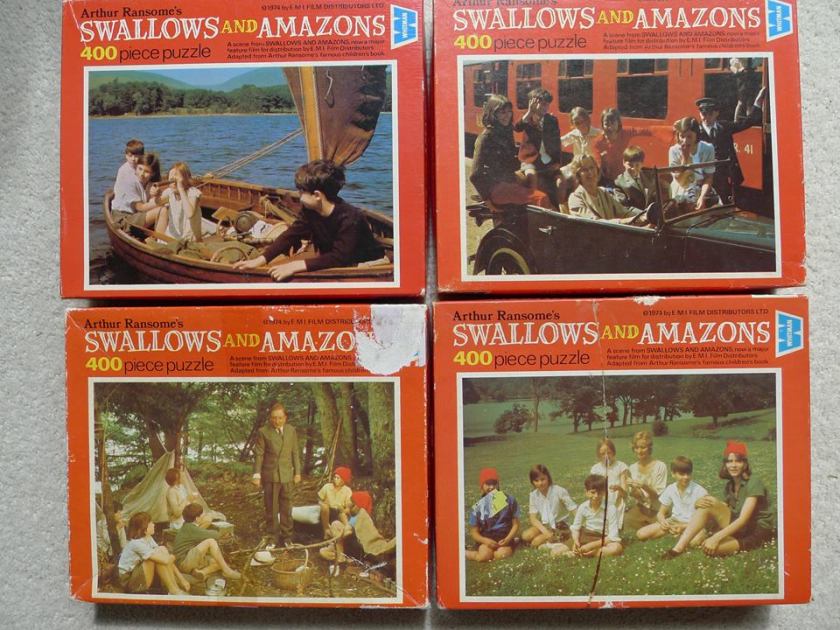
Arthur has a collection of the four jigsaw puzzles and the Puffin paperback that came out with the film.
There was a vinyl LP narrated by the screenwriter David Wood that you can still purchase.
Arthur found a publicity brochure that I had never seen before.
To read comments from people who saw the film at the cinema in 1974, please click here
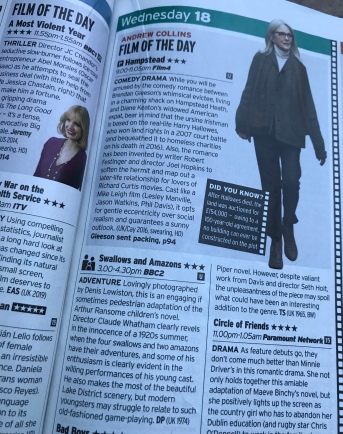
The original story was written by Arthur Ransome in 1929 ninety years ago, so the film hits the half-way mark between the original readers and today’s audience. It’s funny, the critics in 1974 are asking the same question as raised in the billing this week: Do ‘modern youngsters struggle to relate to such old-fashioned game playing’?
Do add your thoughts to the comments below.
~Billing in the Christmas edition of the Radio Times 2019~
Almost every day I go litter picking it proves to be an adventure. Truly. I find lost things, usually gloves or vehicle parts but treasures too. I return what I can to the rightful owners using the local community Facebook page – within reason.
I have found:
A selection of balls – lots of tennis balls
A shuttlecock
A horseshoe
One half-chap
Unused cable ties
A marine pump accepted by grateful boat owner
The guard for a yacht’s compass:
~I had to ask what this item was. It is unbroken~
Amusing children’s toy that flashes and bounces
2 x bags that once held camping equipment
A picnic chair folded into a sleeve
A brand new ‘disposable barbecue’
Pair of secuteers, rather blunt – so possibly chucked
Brand new tube of Ibuprofen gel
Euros 15
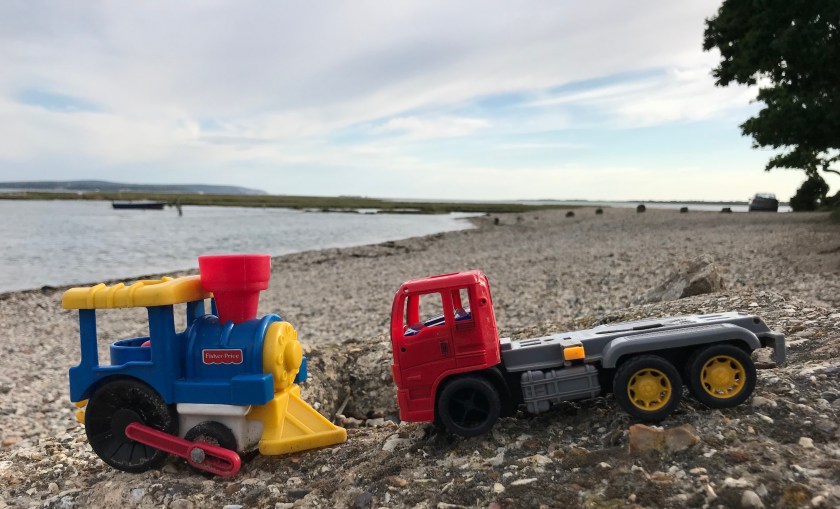
Toy sand moving vehicles
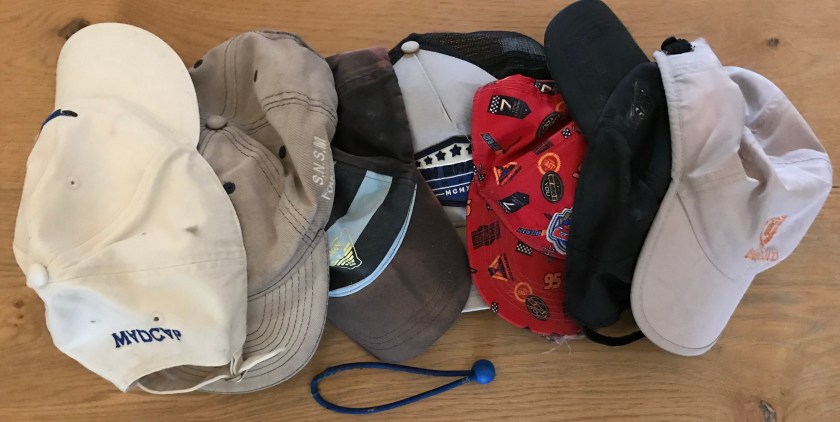
A selection of yachting caps – most have to be thrown away but some can been redeemed. One was labelled and returned to its owner.
When is a half-used can of Jungle Formula insect repellent lost and when is it litter?
I once came across a red plastic chopping board washed up on the coast. Lost or discarded?
I’m sure you will have seen abandoned pub glasses, left behind when the taxi arrives. I could equip my kitchen if I didn’t return them to nearby pubs. How many are taken outside and left for others to gather?
~Stolen, abandoned or both? This was returned to the nearest pub~
And then there is the manna:
2 x unopened bars of chocolate
Huge quantity of potatoes that fell off a lorry that drove past while I was wondering what to cook for supper
2 new unopened cans of larger
Total of 5 x unopened and brand new bottles of larger
A large bottle of Dutch beer. Litter might prove my salvation.
~A mouse’s nest made in an old milk bottle. I left it alone~
But what of the risks?
How many people are injured or killed by litter?
I spent twelve years living in southern Africa. We noticed that mosquitoes breed in stagnant water found in old car tyres and drink cans. If we removed the litter from an area the mosquito population dropped overnight, often to zero. Malaria is one of the biggest killers in the world. It was once prevalent in the UK. We need to stop litter and control rubbish worldwide to reduce the spread of this disease alone. To read a litter about recycling accomplished by Environment Club members in a corner of rural South Africa, please click here.
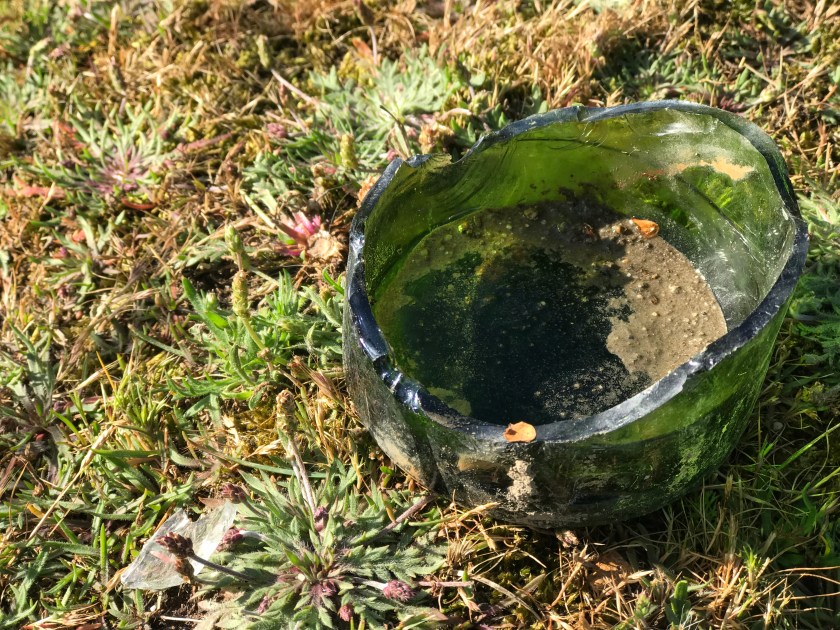
~Broken bottle found where New Forest ponies graze~
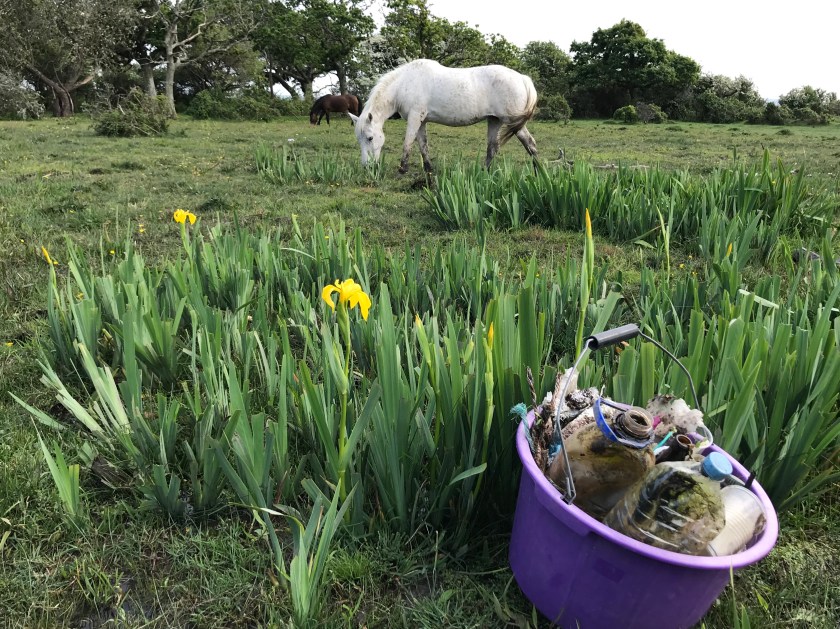
I found this heavy duty bucket, a pink feed bucket and an orange one, washed up on the Solent shore where I’ve been collecting #plasticpollution over the years. They are not that big but, since it is important to collect small pieces of plastic, each one often holds 250 pieces of marine rubbish by the time I head home. Two of these prove all I can carry when full, especially if I come across glass.
My aim is to collect litter every day rather than exhaust myself by doing too much at one time. I find buckets better than bags that blow about in the wind. I can collect broken glass, setting the bucket down to reach difficult pieces. A larger pannier with flip-up lids, might be good for windy beach-cleans but I use these feed buckets gifted to me by the sea. They make picking up bags of other people’s dog poo bearable.
I usually put on Wellington boots, an old jacket with pockets for things I might keep and wear a hat suitable for getting under bushes. I take a mobile phone in case I get stuck in the mud or need help. This is used to photograph and record my findings. That’s it. The rubbish has been washed clean by the sea, so I only wear gloves when it’s cold.
Having said this, I am very careful how I pick up harmful waste. Batteries and old flares can leak caustic chemicals.
I find odd things that have grown into the landscape and require tools before they can be extracted. I needed to take a pair of secuteers to cut a polystyrene tray out of a black thorn bush on the coast. The vegetation had grown around it.
At times, I find so much rubbish that my pink bucket is often not large enough but I can’t carry more back from remote areas. I return for glass bottles. They don’t blow away.
Traffic makes it dangerous to collect litter from roadside verges, even on country lanes. It can be terrifying. I have decided to avoid certain main roads. Do look up the Keep Britian Tidy website and gen-up on safety issues if you decide to go litter-picking. You need to wear a high-vis jacket of some kind. I take my orange bucket, wear rubberised gloves and barbecue tongs to reach into hedges. I prefer tongs to a litter grabber.
Litter-pickers working in groups along roadsides tell me it is essential to wear High Vis tabbards and have Men at Work signs put out if possible. Apart from offering safety, the jackets give you status, encourage PR chat and interaction with the public. The litter can be filthy. Some take a bottle of hand sanitiser.
~Litter collected from a 100 meters along a lane in the New Forest National Park~
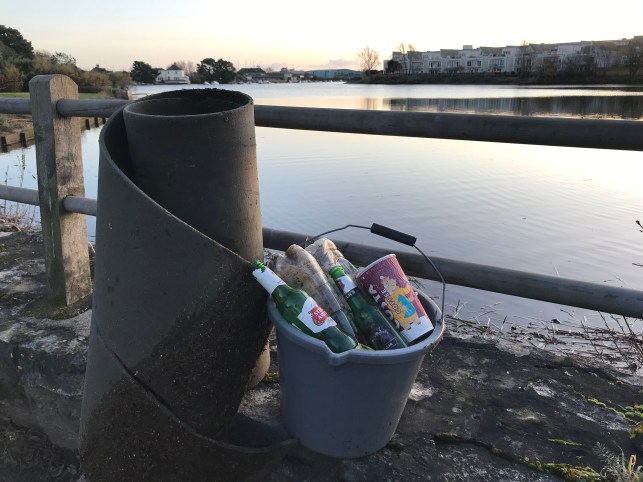
I sometimes take three buckets: one for tins, one for plastic and glass bottles and one for general waste. It cuts time when it comes to sorting the rubbish for recycling afterwards when I’m tired.
I re-use old plastic containers with decent lids to dispose of ‘sharps’ and keep a stock of plastic bags supplied by the council. I have hand-held luggage scales to weigh them. A full black plastic bag can weigh between 5kgs and 10 kgs.
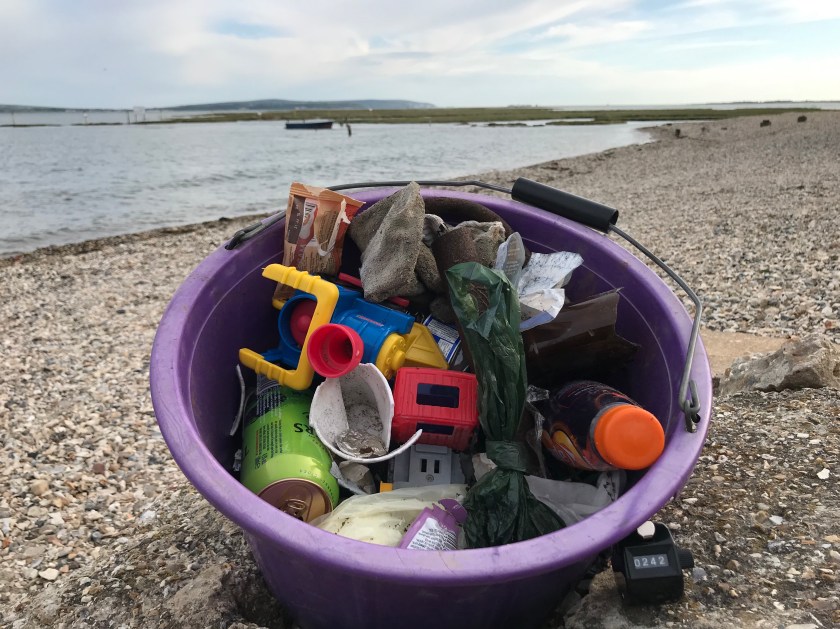
I have just bought a small tally counter. Once you get used to clicking in with the same hand that is holding the bucket and the dog lead, it is a huge encouragement. See if you can guess how many items are in this bucket before looking at the counter, bottom right.
Problem items include road signs, bollards and sand bags that the council don’t regard as their property. They get left by contractors. I find a huge number of car parts that need to be taken to the dump. I would have loved to send all these things to build a stage at Glastonbury or something that would be of use.
Some councils are very well organised. Please click here for an example. They request that you ask permission before collecting rubbish. Whilst I have checked with my local nature reserve, my own council didn’t respond. Not with-standing this, I walk the pavements and pick up what is not meant to be there. I can’t think who would object.
It is good to survey an extreme area before you begin. There is one filthy bay on the Solent I still need to tackle. It requires a planned attack, removing the broken glass first.
Do record, what you find, keeping lists and a map of where you have been. We now have an informal network of people in our community who look after different roads in the area. Do register with Keep Britain Tidy, who will send you details of Health and Safety, posters and more info.
Why do people drop litter? Name the sin. Is is because they are lazy or something more? What do they think will happen to a broken umbrella left in a country lay-by? I find plastic that has been carefully folded before being chucked into the New Forest National Park.
Does throwing unwanted stuff away give people a carefree feeling? Does it give them release, a drop of dopamine? Make them feel cleansed? Is it a symptom of something more? In her autobiography, Michelle Obama cites ‘bitterness’ as one outcome of what Barack Obama described as ‘a cynicism bred from a thousand small disappointments over time.’
I find quite a few glasses taken out of pubs and abandoned rather than returned. What’s this defined as? Isn’t it petty theft? Incarnate laziness? Drunken, callous behaviour that is becoming seen as normal, even acceptable? Or a mixture of all three. And what is the outcome? Broken glass on the pavements?Surely an increase in prices to cover the cost. I found a glass and took it to the local pub only to be told they didn’t want it back. A perfect, straight-sided glass tumbler that just needed washing. Their plan was to break and re-cycle it. I was shocked by the abject acceptance of waste. Break up a perfectly good glass? The bar staff gave it back to me. I filled it with flowers and gave it to a friend.
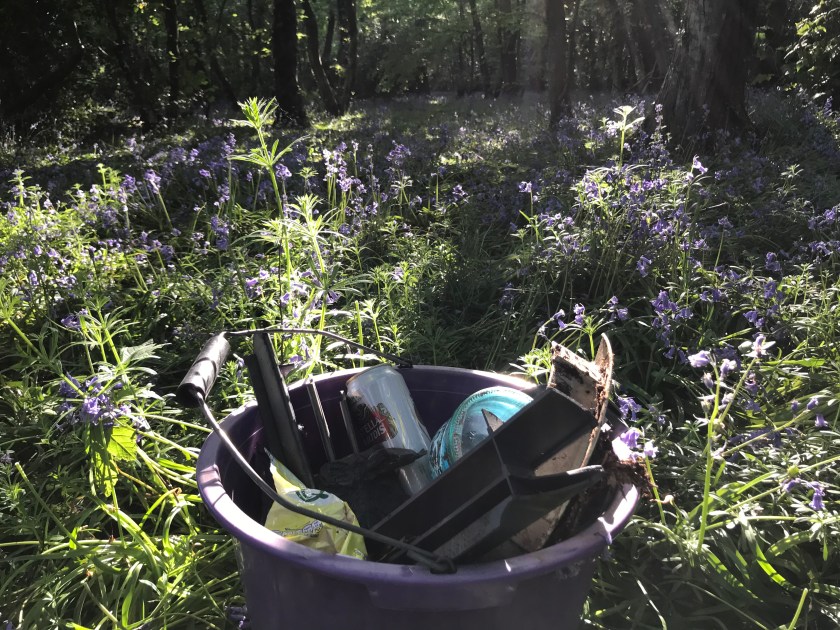
Tonight I decided to walk in the bluebell wood – possibly one of the most beautiful sites on this planet. I took my bucket doubting whether I would find much. I soon began collecting empty bottles of alcohol that had been tossed out of high vehicles into the wood. Had people been drinking while driving work vehicles such as vans or trucks?
I then came across more than I could possibly carry. Hub caps, lights and other vehicle parts had been dumped on this private property, just a little way from the road. I could tell by the date on the crisp packets that accompanied them that they had been there since 2005. It was heartbreaking. Most were still in good condition and looked to me as if they might have re-sale value. Was this theft or had someone been instructed to dump them? I have found more than seven different lots of stolen items in the past. You can find the list here.
When does throwing litter become fly tipping? In the relatively small area where I have been collecting litter I have found:
A broken security light
A piece of carpet and a bedspread
Huge bag of unused incontinence pads
Clothing of a dubious nature and an umbrella
A life-sized doll
A large rusty metal wheel-barrow
Lorry tyres
A huge number of vehicle parts including wheels
25 litre drums that once held bleach or other chemicals
~a drum that once held chemicals bitten repeatedly by a fox~
Fly tipping is outraging the New Forest community, where the National Park receives helpings of heinous proportions. It costs the New Forest District Council thousands of pounds. Why do people dump rubbish in beautiful, fragile areas? Is it because they find the municipal dump too expensive? or can’t get there? or are too lazy? Do they not understand that ditches are needed to carry flood water? Do they not see fly-tipping as a crime against farmers and the natural world? Or is it a form of rebellion? Do they mean to hurt us, cost society effort and money moving it on? Name the sin.
Some sites would be classified as abandoned, rather than chucked. You do find evidence of emotional distress. Can you see the pair of brand new walking boots to the right of this photo? Make out the tent? Much of the rubbish I pick up has been left by tramps. What’s the sin? Is it ours? Are we neglecting those in need? Not reaching out to the homeless and addicted?
~the result of homelessness and alcohol abuse~
This litter and rubbish is growing into the landscape. I find myself pulling plastic and rope out of the earth, especially in places once inhabited by tramps who are apt to pick quite scenic spots. I need help from someone with waders and crowbars to dig plastic out from the Solent shoreline.
Most of the litter I found related to alcohol had been flung out of vehicles. How many people are over the limit whilst driving? If I can find 200 empty bottles and cans in lone lane how many thousands lie forgotten in the New Forest? What’s the sin? Drunk while driving.
We need rubbish bins fitted in vehicles as standard.
John Wesley said, ‘Do all the good you can, by all the means you can, in all the ways you can, in all the places you can, at all the times you can, to all the people you can, as long as ever you can.’
I normally spend at least an hour each evening collecting rubbish from on the Solent shore with my dog. It’s extraordinary what you can find. I have a list here. (see also : Twitter #Solentbeachclean)
The initiative inspired me remove rubbish from the ditches in earnest. Ours is a very beautiful area. I like working alone as I can go out when the weather is appropriate and fit in litter-picking with my work and Solent tides.
~A stolen handbag found in a nature reserve~
The results of my efforts:
Litter collected in one month: Total: 1360 minutes ~ about 22 hours
97 x glass bottles, milk bottles and occasionally jars – all recycled by my husband. About 5 of the bottles were half-full with vodka.
300 x plastic bottles including plastic milk bottles chucked into the river where there is a sign saying ‘Otters Crossing’.
I small bag of plastic bottle tops – saved for MENCAP
300 x empty drink tins – mostly alcoholic drinks found road verges. People must be drink-driving
9 x large rubbish bagsof mixed litter, weighing about 60kgs: sweet wrappers, crisp packets, sandwich wrappers, disposable coffee cups with lids, drink can wrappers – often neatly knotted, cigarette packs, stubs, old lighters, plastic tobacco bags as well as socks, gloves and other items dropped by mistake.
This doesn’t sound a lot however, when I counted the items, it could take 1,000 pieces of plastic to fill a typical black bag. It could take only a few. Conservation International say, ‘Every day approximately 8 million pieces of plastic pollution find their way to into our oceans. Well, I’ve reduced that a by tiny bit.
Stolen items found:
Jewellery box with sentimental treasures including a wrist watch, a silver filigree broach and a bracelet engraved with the name Shirley
Leather holdall containing a pair of embroidered slippers.
HP laptop with a silver coloured case
Empty leather jewellery box for earrings
Apple iPhone
Acer laptop
Discarded make-up bag (possibly from a stolen hand-bag)
Handbag containing spectacles, make-up and hair brush but no valuables – was able to inform the owner who is coming to collect it.
Vehicle parts found
Part of the bumper of my husband’s car. ‘I thought it would turn up sometime.’
4 x wheel hubs (one claimed after I put it on display)
Wing mirror
Tow-bar cover (given away as a present)
Car radiator
Car bumper – a huge white one
Space-saver spare wheel for a car
Motor tyres x 5
Back shelf of estate car
Metal rod and rubber seals
Reverse light cover – undamaged
5 – litre diesel container with fuel inside
2 x mudguards from bikes
Rubber roller from a RIB trailer – (returned to grateful owner)
Grey grill off a Mercedes – undamaged (anyone want to claim it?)
Council signs found buried in ditches and the estuary
Men at Work sign
Narrowing road sign
Part of a chevron sign someone drove through
3 x temporary road sign stands
Tall black and white stripey bollard
Police bollard
3 x plastic bollards and a sandbag
I wasn’t quite quite sure how to cope but a volunteer from the Hampshire and Isle of Wight Wildlife Trust collected the heavy tyres. I’ve piled up road signs I found for the council to collect but he rusty a metal wheelbarrow still needs removing from the ditch that carries floodwater.
Time spent:
Week one: 325 minutes
Week two: 60 minutes
Week three: 430 minutes
Week four: 395 minutes
Week five: 150 minutes
The results have been uploaded at Keep Britain Tidy What I need to do in future is to record how far I have walked and map the stretches I’ve cleaned. I still have to tackle this dirty beach. Three loads have been removed but more awaits. Anyone want to take it on? Otherwise, you can help by pledging your support for the Great British Spring Clean here
As for me, I will continue to walk my dog with a bucket in one hand. It would be too awful to lack a container when I came across rubbish. I’ll keep a list of the things I find for this time next year. However, the project for May is to clean out our garden shed and the clutter in my own office.
In an attempt to turn the tide on pollution I am making a concerted effort to record how long I spend collecting litter and how may items are collected in the categories: plastic bottles, glass bottles, general rubbish and drink tins but find myself dragging other items such as road signs out of ditches.
Day 15
I’m am on the phone to the police as I write, reporting another stolen item. A sodden, empty jewellery box looked up at me from a ditch this evening. It was in plain view of the road. I had just collected one bucket of bottles, one of empty cans and one of general rubbish along with a road traffic bollard, the back shelf of an estate car and a sodden carpet. This took 90 minutes of concerted effort. Retrieving rubbish from an overgrown ditch is tricky. Some was hanging from the trees. However, this is the New Forest National Park. It’s important to persevere. One unopened tin of larger was dated 1990. It must have been lying there for thirty years. An odd conical can of UHT milk had the same ring pull. I’ve no idea of the date. It is made of both plastic and tin.
The police tell me that they will never be able to find out who took the jewellery box and suggest I dispose of it. It’s the sixth item of stolen property found on the same lane.
~A 30 year-old lemonade bottle gnawed at by mice~
Day 17
Another hour of my life is spent filling my three buckets with litter. I collect 23 drink cans, 8 glass bottles and 16 plastic bottles including 2 x 2 litre unopened bottles of cider from the local nature reserve. My powers of observation are increasing. I walked along a path which I have already cleared twice and yet spotted tins and bottles, which are decidedly elderly.
I find a full bag of make up in the lay-by, which looks as if it was chucked out of a stolen handbag. It would be the 7th stolen item. What really worries me is a pair of tights, a girl’s skirt and a in the undergrowth femur nearby. Had someone been murdered? I returned home to Google ‘human femur’ and ‘difference between deer and human femur’ (which is not much).
Day 17
The dead body I feared finding turned out to be a life-size doll. I dragged a pair of huge high-heeled shoes and fancy items of clothing out of a marshy patch nearby. Ironically, the next thing I found was a plastic sack with hundreds of packets labelled: Leukaemia & Lymphoma Research – ‘PLEASE GIVE good quality clothing and paired shoes – your collection day is Thursday.’
There was also a large bag of incontinence pads (unused). Being absorbent these had filled with water and expanded in a grotesque manner as I tried to lift the sack. They were so heavy it was all I could do to swing it towards my car. I had to use two bags from the council to contain the load. Why were all these things these dumped in a wood?
The dog was desperate for a proper walk so I took a bucket and went up the hill. The only people I came across were George and Kate Heathcote of Warbourne Farm, known for the Animal Planet television series Farm Life. They tell me that have been collecting roadside litter constantly and also came across a large doll in the woods. Creepy.
I walk on, startling a deer. It’s legs are far to fine for the femur, which I decide must be bovine. I return with only 13 cans, 4 glass bottles, 3 plastic bottles and a spare wheel but found much more ‘other rubbish’ than normal including a kite. The whole expedition takes 90 mins with another 10 mins to sort it all out
Day 18
I’m finding quite a few roadwork signs and the sandbags used to prop them up. I stack them by an electricity substation and plan ask the council to collect these after on 24th April when the Great British Spring Clean Officially ends. Other litter-pickers report estate agents’ signs are also a problem. We liaise on Facebook. Some collect huge quantities.
I begin to clear the busy road up the hill behind our house and find an open penknife, along with the usual litter. I spend a total of 90 mins collecting and sorting the rubbish, putting out 5 sacks for the refuse collectors.
Day 19
I look at the littered verges as we drive to a hotel in the New Forest where I am giving an illustrated talk on my next book. While speaking about the art of litter-picking over lunch, the gentleman opposite me says that he found a life-size doll whilst he was working for the Forestry Commission. Three in the same area.
Do people enjoy chucking litter into our woods and rivers? Does it give them a sense of release? Is it that people despise what they throw away? I usually pick up one used cigarette lighter a day. Most litter seems comprised of the wrappings of what is bad for us: cigarette packets, sweets, over-flavoured crisps, sugary drinks, alcohol and fast food. Much of this is unfinished, which makes it even more revolting to collect. I presume it’s natural to disengage from what poisons you as quickly as possible.
It’s been a wet day and I’m too busy to do much but collect 16 pieces of litter as I walk along the river to Book Club. I find a rubber tow-bar cover, which I present to my friend as a hostess gift. She says she is thrilled receive what she describes as a knob guard. I entertain the other members with tales from my litter-picking. Two of them offer to join me. Total for the day about 5 minutes.
Day 20
One of my Twitter friends called Becca noticed how ironic it was that people who consume caffeinated drinks never seem to have the energy to dispose of them. I collect about 7 on my way into town only sorry I can’t recycle them as I drop a mixed bag of rubbish into a municipal litter bin. An old friend joins me for a walk in the evening. I take a bucket as we stroll along the sea wall and collect detritus washed up by the tide. There are no bottles, no tins and we enjoy beautiful sunny weather. Total for day 95 minutes
Total for week: 430 minutes
For list of weird things I’ve found on beach cleans – please click here
































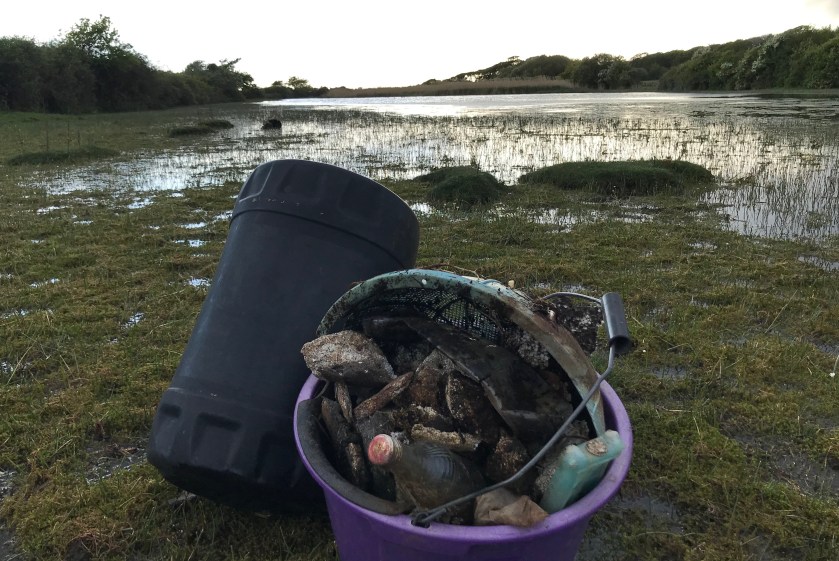

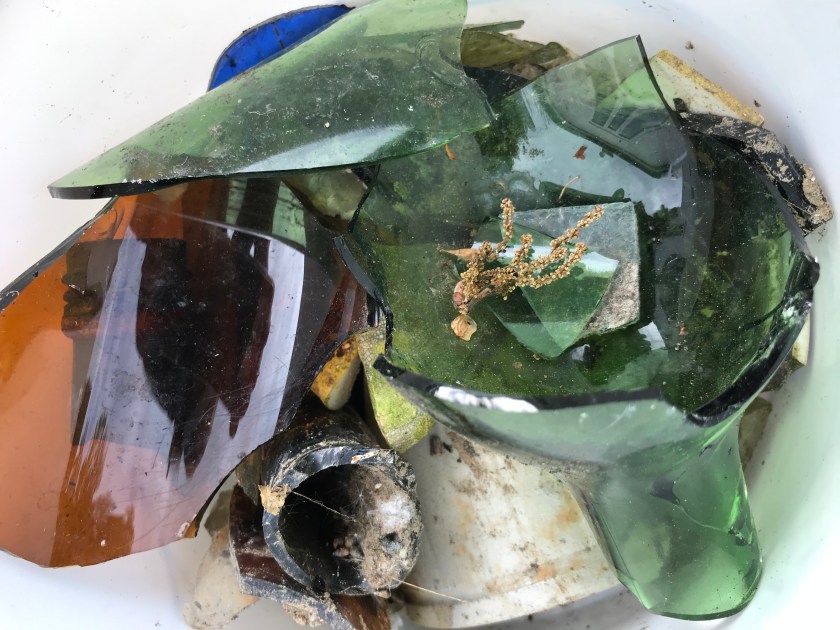
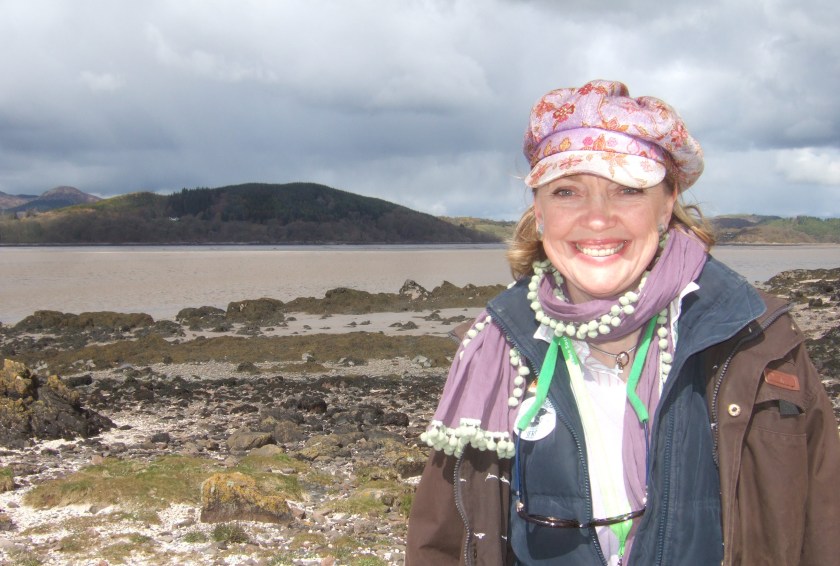


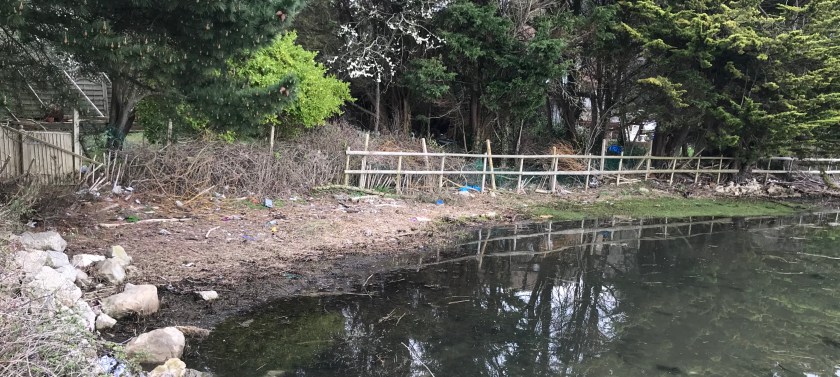
 In an attempt to turn the tide on pollution I am making a concerted effort to record how long I spend collecting litter and how may items are collected in the categories: plastic bottles, glass bottles, general rubbish and drink tins but find myself dragging other items such as road signs out of ditches.




 Sophie Neville