‘Why is it called Swallows and Amazons?’ and ‘Is Swallows and Amazons a true story?’ happen to be some of the frequent questions typed into the Google search engine. Some of the answers can be found in the radio play ‘Voyage of the Swallow’ starring Richard Briers as Arthur Ransome and Susannah York as his Russian wife, Evgenia.
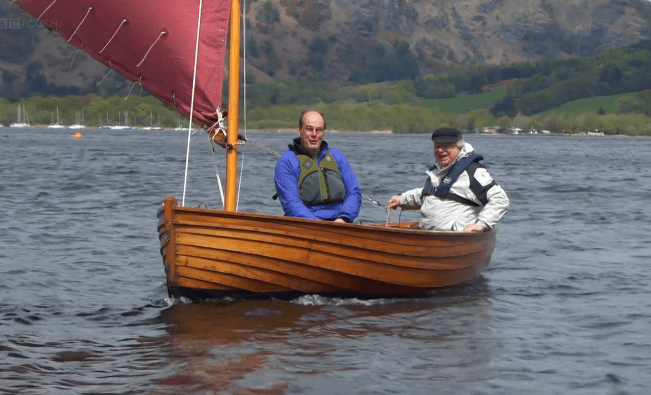
Martin Neville looking remarkable like Richard Briers aboard MV Tern on Windermere
‘What kind of boat is in Swallows and Amazons?’ is another question, and ‘Was Tom Cruise filming in the Lake District?
‘The boat now known as Swallow I was owned by the Collingwood Family when they lived at Lane Head above Coniston Water in the early twentieth century . Dora and Barbara Collingwood taught Arthur Ransome to sail in her when he came to stay with them in the summer holidays. Swallow II was purchased by Dora’s husband Ernest Altouyan along with a similar dinghy they called Mavis. Both boats were brought up on a lorry from Barrow-in-Furness. The interesting question is how the Mavis became known as Amazon in the books. Did Ransome give her a new name because Evgenia, described as a ‘tall, jolly girl’ nearly six foot tall, had struck him as being Amazonian in nature?
Please leave any questions you might have in the Comments below.
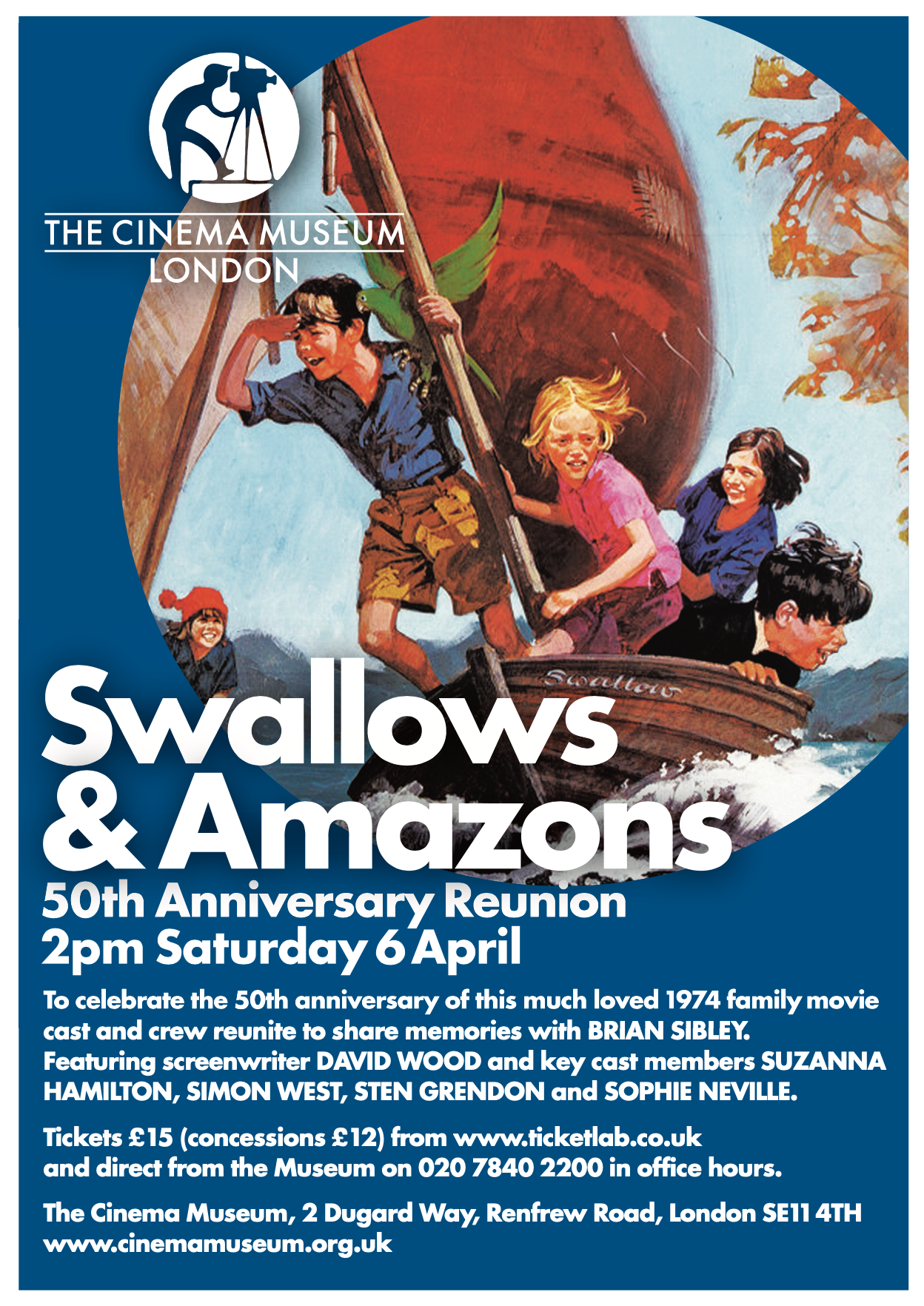
On Saturday 6th April at 2.00pm there will be a 50th Anniversary screening of the original film ‘Swallows and Amazons’ followed by a Q&A with cast and crew hosted by Brian Sibley and the screenwriter, David Wood at the Cinema Museum in London. More info and link to ticket sales here.
On Saturday 29th & Sunday 30th June 2024 a Swallows and Amazons Festival is being held at Windermere Jetty Museum near Bowness-on-Windermere in Cumbria hosted by Lakeland Arts and The Arthur Ransome Society. We are hoping that members of the cast and crew will be able to come and share their stories, including Kerry Darbishire (below) who still lives in Cumbria. Now a poet, she appeared in the opening scenes as Vicky’s nurse.
Kerry Darbishire who played Vicky’s nurse in ‘Swallows and Amazons'(1974)
The Arthur Ransome Society is bringing Swallow and Amazon, the dinghies used in the film which they now own, along with Titmouse from ‘Coot Club’. The steamboats Osprey and Lady Elizabeth that appeared in the Rio scene of the 1974 film will be at Windermere Jetty. Hopefully the original Amazon owned by the Altounyan family, and Arthur Ransome’s own dinghy Coch-y-Bonddhu that he used as the model for Scarab will be there with the RNSA dinghies that played Swallow and Amazon in the 2016 movie. There may well be trips on MV Tern and the Lakeside and Haverthwaite Railway.
Sophie Neville with Titmouse – now beautifully renovated
Saturday 13th July – A screening of Swallows and Amazons (1974) at the Riverside Cinema in Woodbridge, Suffolk.
People who read the paperback on ‘The Making of Swallows and Amazons’ ask how I could remember what happened on each day in such detail, but I had the diaries I’d kept on location and was able to rewatch the film on my laptop, studying the detail.
Aged twelve, I was a little older than Simon West who played Captain John, so I was able to recall more. He now reckons that having my mother on location with me must have helped as we would have discussed each day at the time and would have naturally chatted about shared experiences. She also took hundreds of behind the scenes photos, along with home movie footage captured on her cine camera.
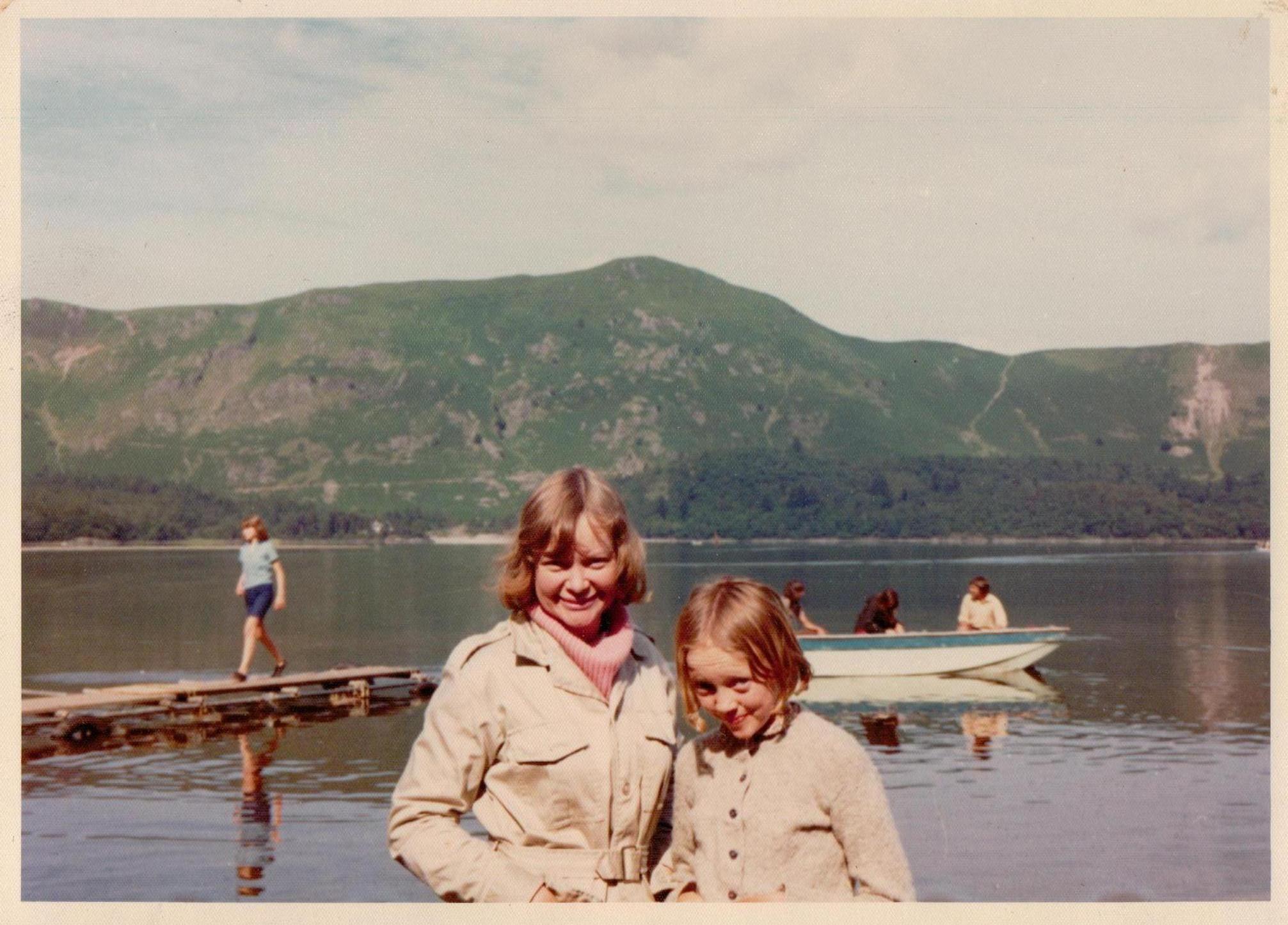
Daphne Neville with Sophie Neville while filming ‘Swallows and Amazons’ in Cumbria. Kit Seymour is walking along the jetty in the background.
Fans of the DVDs write in from all over the world offering encouragement: “I was able to catch up on Swallows and Amazons Forever! I’ve only been waiting a lot of decades to watch this. It was fabulous and you embodied Titty. I now need to re-read Ransome’s book and yours.” Suzie Eisfelder, Melbourne, Australia
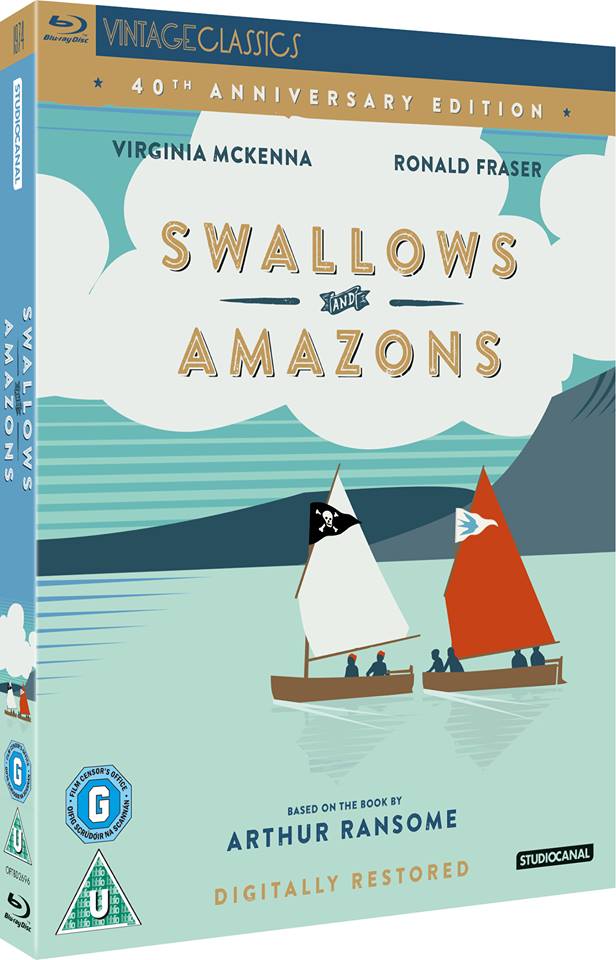
Once screened in cinemas with ‘The Sting’ and ‘The Great Gatsby’, ‘Swallows and Amazons’ (1974) has been labelled a Vintage Classic. The good thing about this is that the DVD includes an interesting Extras package. Here is one of the original reviews:
The classic film Swallows and Amazons – currently streaming on Amazon – was made fifty years ago, and yet it still fascinates viewers. Here are a few interesting questions and points raised by Arthur Ransome enthusiasts that I ought to include in the next edition of my book written to accompany the remastered DVDs. It’s now out as an audiobook.
Roy Haslam wrote: ‘Must be a wonderful feeling to be connected to Swallows and Amazons that is loved by millions.’
I replied saying it could be overwhelming, but his comment made me think: If you could chose any movie to appear in what would it be? The amazing thing about the 1974 version of Swallows and Amazons was that we made it entirely on location. There were no computer graphics. There was no studio work until we reached the post-sync stage. We simply lived out the pages of the book.
Radio Times 1979 when ‘Swallows and Amazons’ was first broadcast five years after it was released in cinemas
Mike Clay thought, ‘for you children it must have been a confusing mixture of great excitement, frustration and boredom!’
It was in someways, but I would not say I was frustrated by anything more than falling behind at school. Missing the summer term put me in the second stream for Maths.
Hilary Dodd wrote: ‘I worked at the Warterhead Hotel at the time they were making Swallows and Amazons and the lead actors stayed there. Virginia McKenna, Brenda Bruce, Ronald Fraser, if memory serves. I was in charge of taking their order for dinner and generally making sure that they had everything they wanted in the restaurant. Miss McKenna was charming and treated all of us with courtesy, respect and politeness. The film company threw a big party at the end of filming for the locals as a thank you for the hospitality they received. We all worked incredibly hard but it was an exciting experience.’
‘Swallows and Amazons’ (1974) screened on Talking Pictures TV on 30th December 2021
David Thomson says he was sixteen at the time and a film extra in the Bowness scenes. ‘One member of the crew used the name Pierse Jessop when chatting up pretty girls in Ambleside.’ He was around on set but not a member of the film crew. As I remember, he provided the mobile loos.
A local lady told everyone she played Dame Virginia McKenna in the long-shots. I miss-spelt her name Toni Turner. It was Joni Turner. This idea could have been mooted as a possibility, but in the end there was no need for a double. Joni worked on set as Suzanna’s stand-in for a few days and is wearing Mrs Walker’s cardigan in one behind-the-scenes shot so she might have worked as a stand-in for Virginia McKenna, enabling the lighting cameraman to set up before the actors arrived on set.
Mike wrote that, “re-reading the stories virtually taught me to handle a dinghy. My thanks go to Arthur Ransome!”
Roger Sturge added, “Roger Altounyan taught my parents to sail in Mavis aka Amazon on Coniston Water in 1936.” He would have been aged about fourteen. “They always said while they were learning, Arthur Ransome would sail round them, but I’m not sure of the veracity of that… My first of many childhood adventures sailing on Coniston was in Amazon as a one year-old.”
…. a review of the DVD by Kieron Tyler who later observes, ‘it is also amusing watching… John (Simon West) bossing his younger brother and sisters about’, which is true! He read the wind, while we just sat in the boat waiting for orders.
Noel Flay Cass of The Arthur Ransome Group: ‘To put it in sailing terms, it can be very easy to think that you are a good sailor, or that sailing is easy, when the wind and tide are with you. It’s worth remembering that it might not seem so when you are always tacking against an ebb.’
Jennifer Bailey writes: ‘For the record, my daughter loves that you call out “Kill, kill!” approaching the houseboat. She finds Titty gratifyingly bloodthirsty.’
Neil Jeffery ‘Living on the coast in Cornwall as a child, I fell in love with the lakes first through your film and then the books! As a young child I so wanted a friend like Titty.’ He added, ‘I always escape back in time every year or so, most often with Swallows & Amazons. All classics, and probably led to my first career as a Deck Officer in Merchant Navy.’
You can watch the film trailer on Amazon Prime
The 1974 film was described as, ‘An escapade that brims over with laughter.’
‘I certainly think ‘Swallows and Amazons’ is top-of-the-crop of those made in 1973/74. The others haven’t stayed in the public mind anywhere near as long. I think ‘Swallows and Amazons'(1974) fully deserves the appellation ‘Timeless Classic’.’ Daivd Butters ‘You don’t realise how much thought and hard work goes into filming even a short sequence. I love the story about the sheep!’
I’m often greeted as a long-lost friend. It’s because characters in the stories have become friends to many.
Sekhmet of the Terven KPSS wrote that as a child, ‘I was so convinced that the Swallows and Amazons were all real people that I wrote to them to ask if I could go sailing with them. My mum kindly wrote me a postcard back from them. I recognised her handwriting, but it was still a lovely thing to do.’
One good thing about the film is that it helps us understand more about the book of Swallows and Amazons and subsequent novels in the series. Jon Blanchard writes, ‘I am just reading Picts and Martyrs noticing it is the only book where the Amazons appear without the Swallows. Then I wondered why the Amazons, unlike the Ds and Swallows, do not appear in a book on their own. And I came up with an answer. Nancy and Peggy are only seen through the eyes of the others. We get to see through the eyes of Titty, Roger and Dorothea and know their thoughts. We also see into the minds of Dick and occasionally John, although they are less interested in other people. But we do not get into the minds of Susan and the Amazons. Everyone looks up to Nancy and Peggy is her sidekick, so they would not work as the centre of consciousness in a whole book. All the others have doubts and anxieties however much they long for adventure, but Nancy never. There would not be any tension.
This is a transcript of the notes I made to prepare for it:
It’s fifty years since ‘Swallows and Amazons’ was filmed on location in the Lake District, can I ask: how did you go about getting the role of Titty?
The extraordinary thing was that, as a normal schoolgirl, I didn’t do a thing. A letter arrived out of the blue inviting me for an interview. Forty years later, when I put an extract of my ebook on ‘The Secrets of Filming Swallows and Amazons’ up on Goodreads, one reviewer wrote that it was ‘a good idea for a novel but a bit far-fetched.’ They didn’t realise that my story was true.
The prospect of risking film finance on six unknown children must have been daunting. Claude Whatham the film director, knew both me and Sten Grendon (who played Roger) as he had cast us in the first BBC adaptation of Laurie Lee’s memoir Cider With Rosie, back in 1971. He’d given me the part of Eileen Brown because I could play the piano well enough to accompany Laurie Lee on violin in the parochial church concert. I stumbled through ‘Oh Danny Boy’ at an agonising pace but did exactly what I was told. You can still buy the DVD.
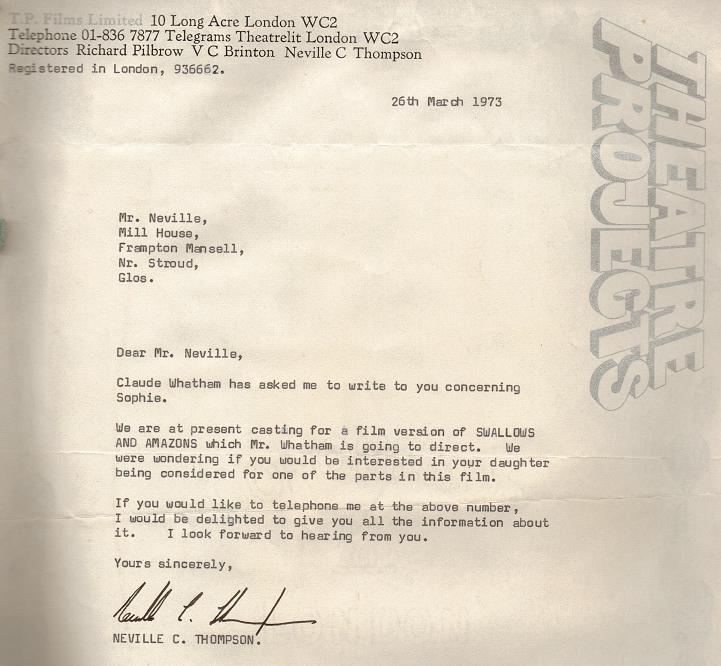
After my first audition for the part of Titty, a group of us were taken on a sailing weekend to see how confident we were in boats but I was never asked to read for the part as you might expect. There was no film test. It all happened very fast. The letter was sent on 30th March. By 14th May 1973, we were shooting the first scene with Dame Virginia McKenna playing my mother.
Dame Virginia McKenna as Mother with Sophie Neville as Titty Walker
Tell us about your time on the set and the recording of the movie. The ninety- minute feature film was shot on 35mm almost entirely on location in the Lake District where we were based for seven weeks. The first set was a railway carriage, which was nice and warm. It was soon a twelve-foot dinghy out on Coniston Water when I wore nothing more than a thin yellow dress and a pair of navy blue elasticated knickers. The experience was usually chilly, and involved a great deal of waiting around, but we survived.
Sophie Neville with Suzanna Hamilton
I’ve got to ask this, what was it like to work with Virginia McKenna? Dame Virginia was charming and brought us together as a family, helping me to concentrate on the story. I had a few scenes alone with her on Peel Island when Titty, who is pretending to be Robinson Crusoe, persuades her to play Man Friday. It was unexpectedly embarrassing because I lost a milk tooth halfway through one sequence and grew self-conscious about opening my mouth. I coped better when handling her boat. I’m longing to be invited on a chat show when they gather together all the film actors who’ve played Robinson Crusoe. I’m pretty sure that I’m the only woman who has embodied the character in a movie.
Sophie Neville as Titty
I’m curious, were you able to sail before getting the part or did you have to learn? I grew up by a lake and had crewed for my father so I was used to small boats, but it was Simon West and Kit Seymour who were the brilliant sailors. Their skill shines through and made the film great. Some of the maneuvers were quite scary.
Filming Swallows and Amazons (1974) from a camera pontoon
No one asked if I could row a boat and yet Titty rows in three crucial scenes. It’s more difficult than you might think when you have a Panavision camera onboard or are effectively towing the camera boat. We now have a modern dinghy which we sail on the Solent, with a little more attention to safety.
Nina Nannar interviewing Sophie Neville for ITV News at Ten
If I remember rightly there weren’t a lot of life jackets in the movie. Was health and safety not such a concern then? The story is set in 1929, so none of us wore life jackets in vision. We could swim but the water was freezing and our wooden boat lacked buoyancy of any kind. My father, who was an experienced sailor, was not happy with the safety aspects and nearly took me home. We’d been fine while sailing free but nearly collided with the Lakeland steamer while Dad was dressed as a film extra, looking down on us from the deck. He insisted on a safety officer after that.
Are you still a sailor or do you feel that part of your life is over? The Arthur Ransome Society has just acquired both Swallow and Amazon, the clinker-built sailing dinghies used in the film, which are being restored for members to sail. I’m very much looking forward to taking them out on Windermere. I am also a member of the Nancy Blackett Trust who keep the first yacht that Arthur Ransome bought with his royalties from ‘Swallows and Amazons’. I’ve sailed her on the Orwell, on the Solent where I live, and through the inland waterways of the Netherlands. You too can join the trust and imagine yourself as one of the characters in Ransome’s books ‘We Didn’t Mean To Go To Sea’ and ‘Secret Water’ in which his yacht is cast at the Goblin. It’s wonderful reading those novels when you are on board.
I can’t help but wonder, how did your acting career help in your writing career? It helps when writing dialogue – and film scripts.
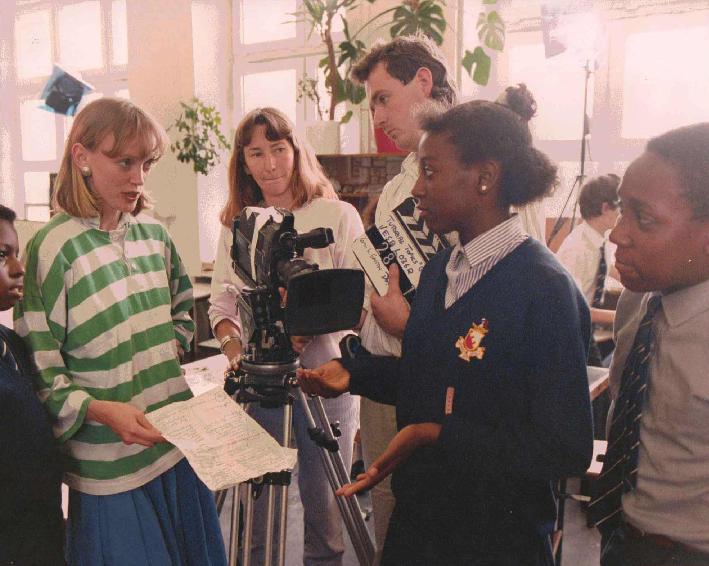
Sophie Neville directing a sequence with BBC cameraman Lorraine Smith
Why the change from acting to writing? As soon as I graduated from university, I went into television production at the BBC in London, where I began writing my first piece for Nicholas Parsons in 1982. I went on to write or edit about seven programmes that I produced when working for BBC Education. I only began writing books and articles in 1999 after turning professional as a wildlife artist. This was useful as I’ve been able to draw on my stock of illustrations including decorative maps, which always look good at the beginning of a book.
You wrote a book, which I am reviewing for the magazine, called The Making of Swallows and Amazons. What was it like revisiting your past in this way?I began writing that particular memoir as a blog using the diaries and scrapbooks that we’d kept on location as children. I was aided by other members of the cast, fans of the film and members of both The Arthur Ransome Society and Arthur Ransome Group on Facebook who helped me with historic detail. Once published, additional stories floated down from Cumbria, which was exciting. It’s now in its second edition and is out as an audiobook. I’ve been gathering information for a third edition and a book about the making of ‘Coot Club’ and ‘The Big Six’, a serial made by the BBC that I worked on behind the camera in 1983. The first three chapters have already been included in the DVD Extras package.
What does a writing day look like for you? I usually wake early, sit up in bed and write for two or three hours before the emails pour in. If possible, I’ll keep writing until lunchtime, but the admin of life tends to encroach on my time.
Let’s get personal, maybe a silly question for a sailor but on holiday do you prefer sea or mountain and why?Ah, you must read my book ‘Ride the Wings of Morning’. I enjoy summer sailing but prefer riding horses through the hills.
If you could go anywhere in the world to write a book where would it be and why? I’ve written most of my books in South Africa where the climate agrees with me. It’s easier to concentrate in the wild.
Sophie Neville at Camp Davidson in the Waterberg
What’s your favourite meal?I’m a Celt – 57% Scottish with a bit of Danish blood. You’ll find me at the seafood bar ordering gravlax followed by a rare steak – preferably from stock reared on the moor.
Do you prefer keyboard or notebook and pen?I work with a notebook and pencil to start with, then bash away at my laptop, which is not good for the posture.
The original diary ~ Funnily Enough by Sophie Neville
Last question, which one of your books do you recommend to Mom’s Favorite Reads readers?I recommend ‘Funnily Enough’, based on a diary I kept about my family and the tame otters we kept. It’s light and amusing but says something about love and friendship. I hope it will inspire others to keep a journal or begin sketching. You’ll find an audiobook and a kindle copy illustrated in colour. I hope it proves a blessing.
You can read more about Wendy H Jones and contact her via her website here
You can find information on where to buy Sophie’s books on this website here
This question is often typed into search engines. Arthur Ransome was living at Low Ludderburn above Windermere when he wrote ‘Swallows and Amazons’ in 1929, setting it on ‘The great lake in the north’. Like me, he undoubtedly did a bit of wondering, and was inspired by many of the locations that can be seen from Windermere, envisaging the island Blake Holme as a model for ‘Wild Cat Island’ and Silver Holme as ‘Cormorant Island’ nearby.
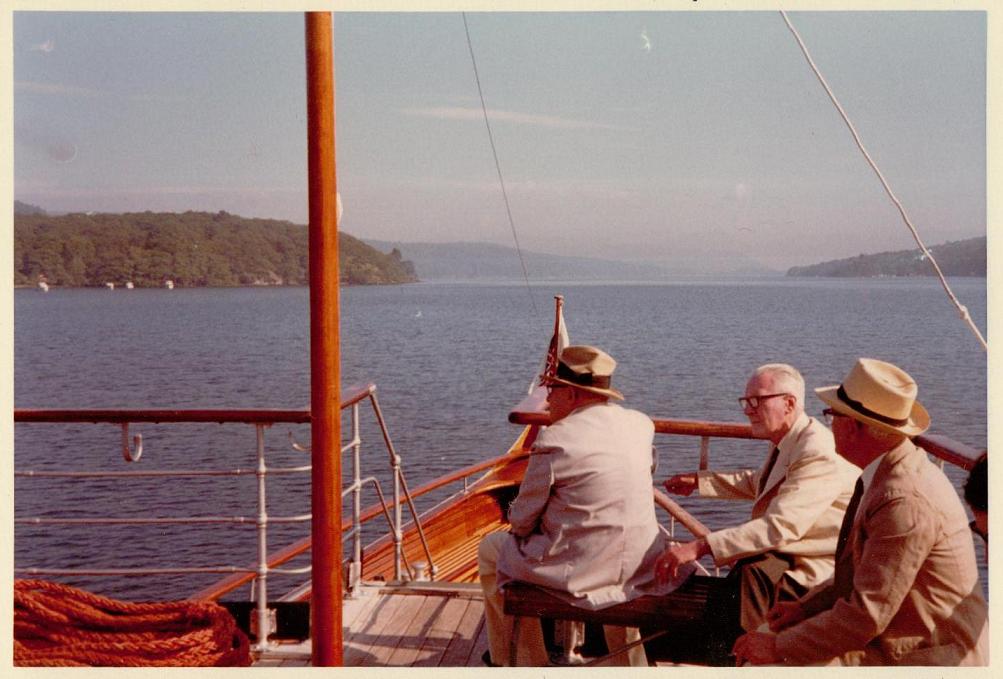
Martin Neville aboard MV Tern on Windermere
The ‘native shipping’ on Windermere was brought to life in the 1974 film when the Swallows narrowly miss hitting the MV Tern.
MV Tern on Windermere was built in 1890 with a steam engine, converted to diesel in the 1950s, and is still operating today.
On the deck of the MV Tern on Windermere in 1973 ~ photo: Martin Neville
It was a tricky sequence to shoot and since Swallow lost her wind in the lee of the steamer she only just managed to turn in time.
You can read more about this near disaster in the diary I kept here
My father’s view of Swallow attached to the camera pontoon from his position on MV Tern ~ photo: Martin Neville
The other big scene was shot at Bowness-on-Windermere, referred to as Rio in the story.
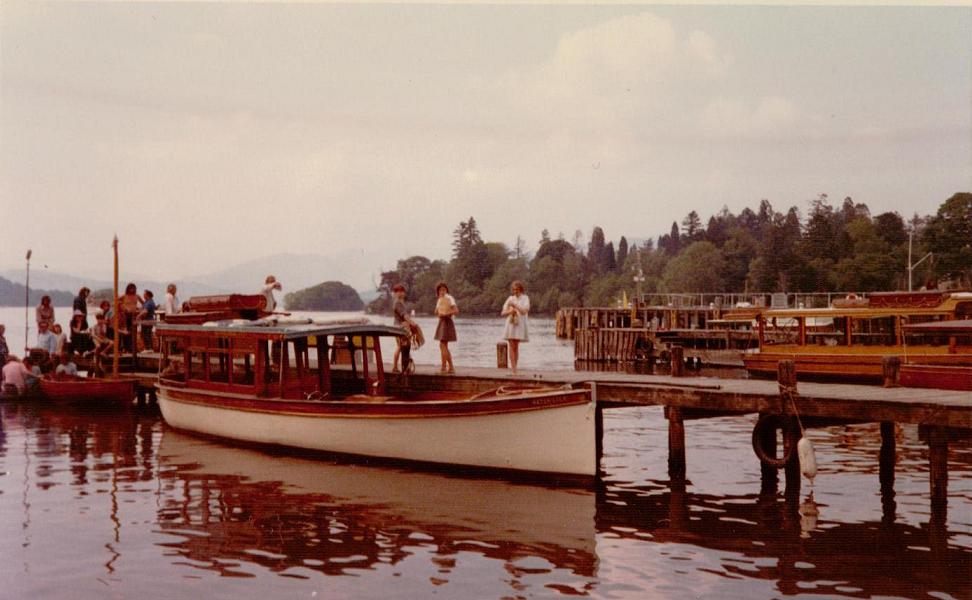
Rio – or Bowness-on-Windermere in 1973
Steamboats such as Osprey and the Lady Elizabeth, who is currently residing at Windermere Jetty museum, appeared in the background.
The film crew of ‘Swallows and Amazons’ wait with Swallow and Stephen Grendon at the end of the jetty while Simon West, Suzanna Hamilton and Sophie Neville line up by the launch
Had we arrived in Rio? Arthur Ransome confirmed this in a letter to a young reader:
When the movie was made in the summer of 1973 the original green boat sheds, featured in Ransome’s sequel ‘Swallowdale’ were captured on film.
Is that the steam launch Osprey moored to the jetty?
Kit Seymour who played Nancy was watching the filming. You can just see the original bandstand with period cars parked in the background.
The bandstand and shelter on Glebe Road were also caught on celluloid, along with the traditional Windermere skiffs. You can see more photos of the filming on this website here.
The Price children, Perry Neville, Jane Grendon, Tamzin Neville and Pandora Doyle in their 1929 costumes on the shore of Lake Windermere at Bowness in 1973
The Swallows in Woodland Road, Windermere in 1973
After buying rope for their lighthouse tree in Woodland Road, the Swallows walk down Church Street past the Stags Head Hotel.
John, Susan and Titty walking down to the jetty
Other scenes were shot nearby, with the film opening on a steam train running along the River Leven on Lakeside and Haverthwaite Railway. You can add details about the locations yourself by contributing to the website Reelstreets which logs film locations in the United Kingdom.
Talking to the engine driver on the first day of filming ‘Swallows and Amazons’ in 1973 (Photo: Daphne Neville)
When Richard Pilbrow, the film producer asked Mrs Ransome to point out more, she claimed the Peak at Darrien could be found on Windermere. She may have been thinking of a headland at Waterhead but in the end the opening titles shot was taken from Friar’s Crag on Derwentwater with the Borrowdale Fells in the background. The secret is that the 1974 film ‘Swallows and Amazons’ was also shot on Coniston Water, Elterwater and a lily pond near Skelworth Fold.
The Kirkstone Foot Hotel, Ambleside in 1973
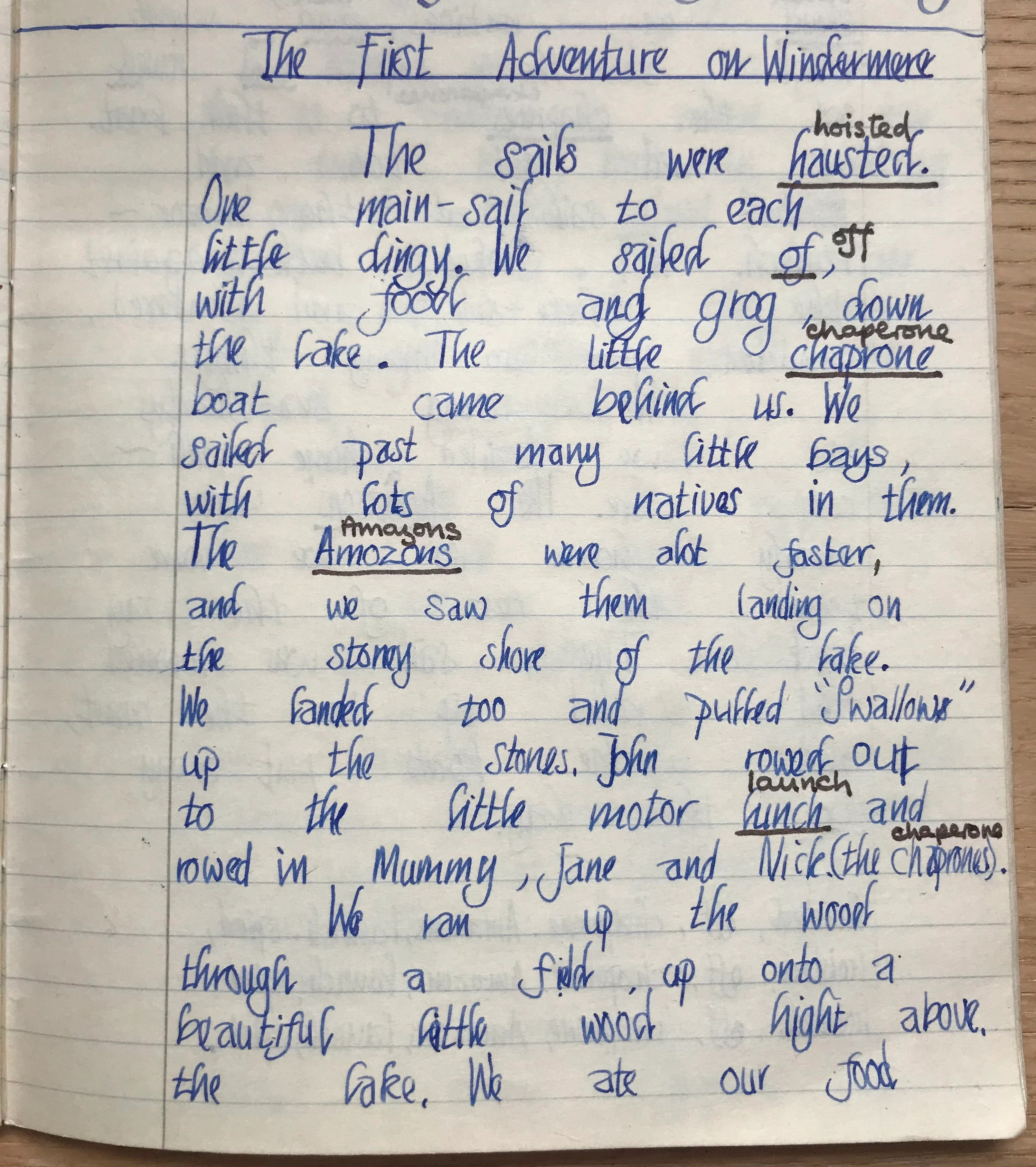
In real life, Richard based his production office at the Kirkstone Foot Hotel near Ambleside at the northern tip Windermere and it was from here that we practiced sailing Swallow and Amazon in May 1973. Here is a description written by my twelve-year-old self:
Preparing for filming Swallows and Amazons by sailing on Windermere
Virginia McKenna, who starred in the film as Mrs Walker, was accommodated at the Langdale Chase Hotel on the lake. The wrap party was held there to the great excitement of children in the cast. You can see the view on the hotel website here.
Dame Virginia McKenna on Windermere in 1973 – photo: Philip Hatfield
The 40th Anniversary DVD includes an Extras package on the locations and you can read more in ‘The Making of Swallows and Amazons’, available online in different editions here or direct from The Lutterworth Press.
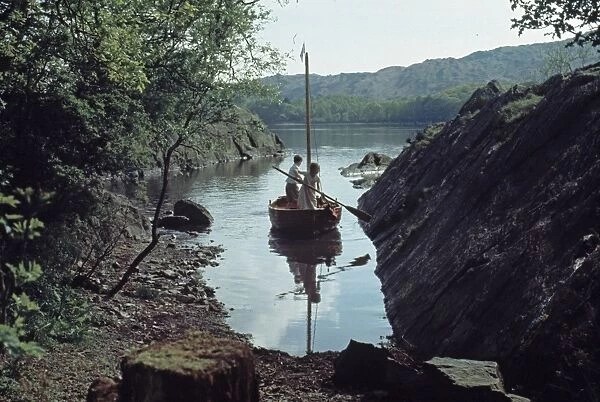
The original movie ‘Swallows and Amazons'(1974) was filmed mainly on Peel Island on Coniston Water in the southern Lake District. It is here that you find the Secret Harbour described in Arthur Ransome’s books. He explained, ‘no island on Windermere has a harbour quite so good.’
Simon West, Sophie Neville, Suzanna Hamilton and Sten Grendon in Secret Harbour
The BBC Television adaptation of ‘Swallows and Amazons’ made in black and white in 1963, starring Susan George as ‘Kitty’, was also shot at Secret Harbour. The director said he wanted to dynamite some of the rocks, which did not go down well with the Ransomes.
The entrance to Secret Harbour can’t easily be seen from the shore, which of course is what makes it so secret. With the right vessel, you can go there yourself, but it has not been possible to camp or light a fire there since the property was bequeathed to the National Trust in 1932.
StudioCanal have recently made this photo of Captain John available as a print from their website where you will also find the photo of Secret Harbour above.
You can attempt to swim to what is known in the books as Wild Cat Island, but only if you are hardy and used to cold water. I could hardly manage a few strokes.
Falcon with Amazon in Secret Harbour: photo Geraint Lewis
The appearance of the natural harbour changes dramatically depending on the level of the lake. Rocks are revealed as water levels drop. The inlet can attract a number of canoeists but if you arrive early, you should be able to explore the island for yourself.
Sophie Neville (Titty) with Simon West (John) looking down into Secret Harbour
See if you can find the steep rocky cliffs of ‘Wild Cat Island’. Does this shot, above, appear in the original film?
The rocks at the end of Peel Island where the Collingwood family traditionally had picnics
We filmed the ‘Not a breath of wind’ scene on this lookout point to the right of the photo above.
The Swallows on Wild Cat Island
See if you can find this tree that Titty tried to sleep in.
‘Up a tree for fear of ravenous beasts’ ~ photo: Daphne Neville
The shot of Nancy and Peggy surrendering to the Swallows was taken from the lake showing the mossy rocks to the western side of the island.
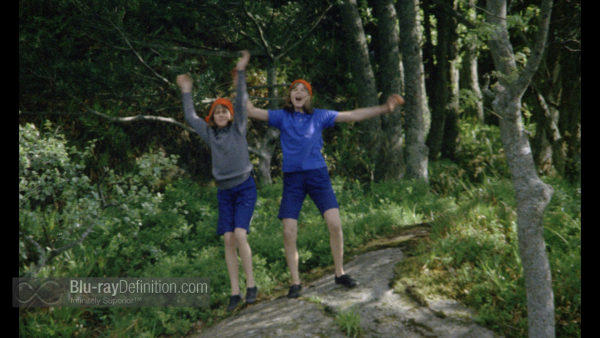
Lesley Bennett and Kit Seymour as the Amazon pirates dancing with rage on Peel Island
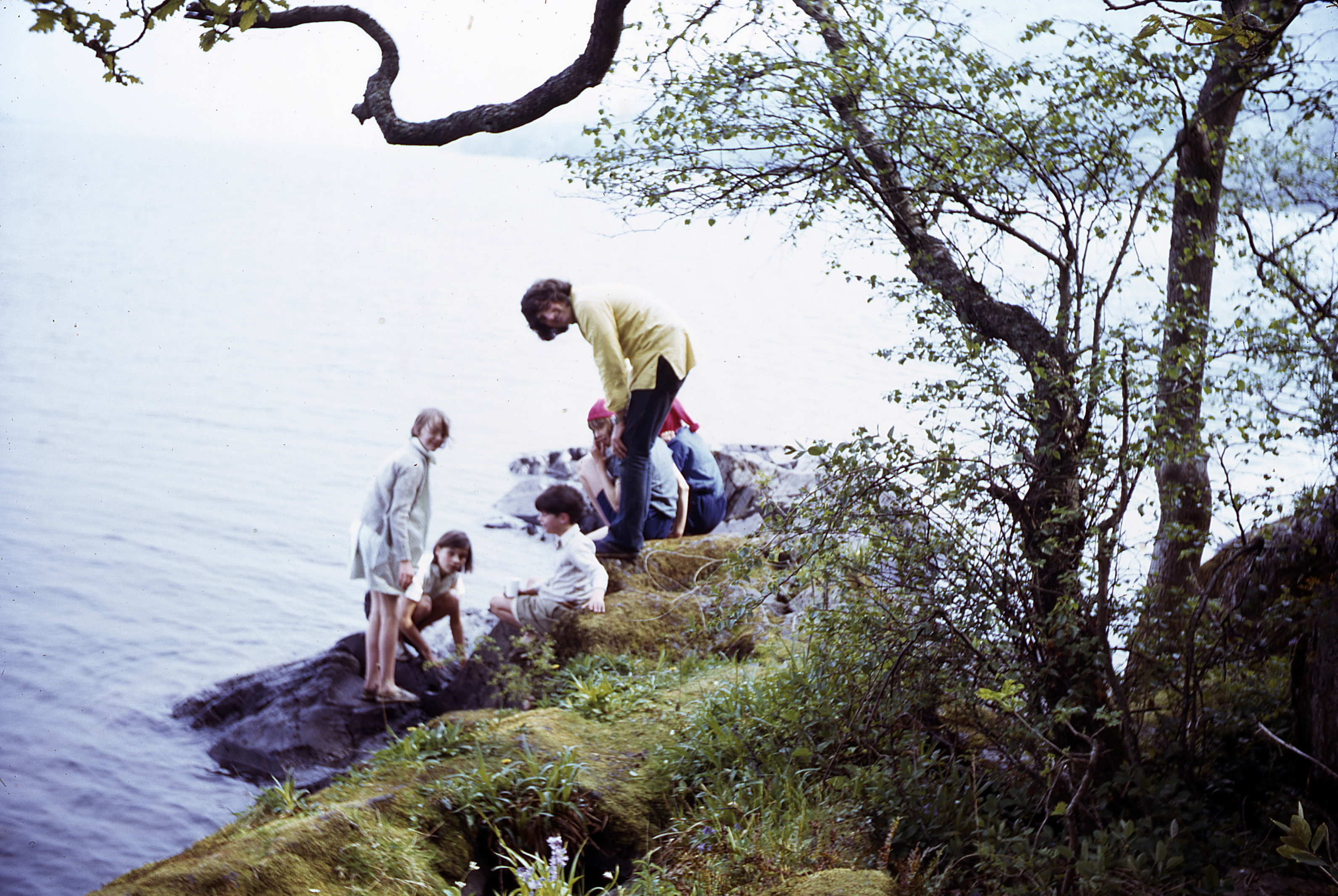
We discovered rocks on the eastern side were easier for collecting water and gutting perch for supper. This shot shows us behind-the-scenes.
Sophie Neville, Suzanna Hamilton, Stephen Grendon, Lesley Bennett and Kit Seymour with David Blagden on Peel Island Coniston
This is the scene that was improvised after Susan showed Roger how to fill the kettle.
The landing place today looks very different to what you see on the film as the shingle beach built up by our art department has all-but washed away.
Simon West as Captain John rowing towards the Landing Place
Claude Whatham and David Bracknell with Swallows, Amazon and the 35mm Panavision camera at the Landing Place on Peel Island – photo Richard Pilbrow.
Arthur Ransome may have had in mind the beach at Low Peel Near on the mainland opposite the island, which would match his illustrations. This is where Houseboat Bay was set in the 2016 adaptation of ‘Swallows and Amazons’. Sponsored by Yorkshire Film, they used Plumpton Rocks in North Yorkshire for the campsite as it has interesting rock formations. You can read more about the locations they used on Visit England’s website here.
The camp site featured in the original film can be found in the middle of Peel Island. The secret here is that a couple more trees were ‘planted’ so that the tents could be strung up in line with descriptions in the book. As children we never knew this but I worked it out on a later visit.
Sophie Neville playing Robinson Crusoe in the movie Swallows and Amazons (1974)
You can see the pine tree next to Captain Nancy is listing to one side in this shot.
One secret was that the night scenes set at the camp site were shot inside Mrs Batty’s barn at Bank Ground Farm.
Sophie Neville as Titty
The art department cleverly set up tents there and lit a real fire.
In 1973 there were no tall pines on Peel Island. A huge effort was made to take a lighthouse tree there, but the scenes ended up being shot on Friar’s Crag on the mainland above Derwentwater.
It was here that the ship’s lantern was hoisted up the tree.
A different location again was used for the lighthouse tree when the Swallows first spot the Amazons as the houseboat needed to be seen beyond them.
Simon West, Suzanna Hamilton, Sophie Neville and Stephen Grendon as the Swallows at the Lookout Point on Wild Cat Island
The secret is that this tree was no more than a log planted by the prop men. You only ever see its base.
The island first spied by the Swallows is Rampsholm on Derwentwater with the Borrowdale Fells rising behind it. It makes an iconic shot for the opening titles..
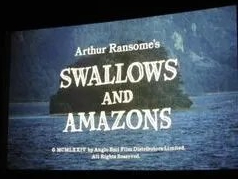
‘Swallows and Amazons’ 1974
You can also see it in the background of scenes shot near Cormorant Island.
Amazon moored near Cormorant Island on Derwentwater with Rampsholm in the distance
Rampsholm was portrayed as Wild Cat Island in the 2016 film adaptation of Swallows and Amazons produced by Nick Barton. You can see the photos and find out about the locations used on the National Trust website here
Arthur Ransome was also inspired by Blake Holme on Windermere, which he would sail past in Swallow II. It is a small island near the shore where the 1963 BBC drama was filmed but by 1973 it was felt to be too close to the caravan park on the mainland.
The Coniston Launch Company have information on how to visit Peel Island here. Remember that is it located quite far from Coniston and that you can’t camp on the island.
The Gondola on Coniston Water today, re-built and restored by the National Trust and powered by steam.
How old were you when you first read Arthur Ransome’s books? Did you have a favourite storyline or character?
My father devoured the Swallows and Amazons books as they were published in the 1930s. I was a slow reader but must have started the series aged about ten or eleven as I’d read seven of the twelve by the time we arrived in the Lake District to make the film in 1973. I enjoyed the practical aspects of the books and most readily identified with Mate Susan, although I counted all the characters my friends. Ransome published thirty other books. Some are heavy going, but I enjoyed his autobiography.
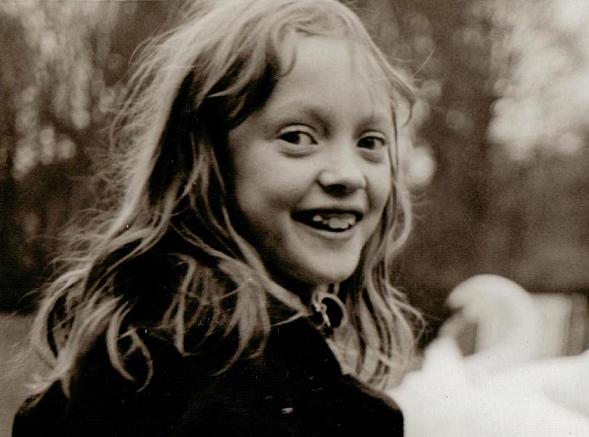
Sophie Neville as a child ~ photo: Martin Neville
Have you re-read the books since your childhood? If so, how has your perception of the books and the characters, in particular Titty, changed?
I’ve re-read most of the books in the Swallows and Amazons series and gain something new each time I read Swallows and Amazons, recently appreciating how important Titty’s imagination was to progressing the story. Her ideas take the plot forward. I ended up writing an article on how Swallows and Amazons can be seen as an allegory to missionary work undertaken by Arthur Ransome’s great aunts, one of whom received a Boxer arrow in her bonnet for her efforts in China.
Simon West and Sophie Neville on Peel Island in 1973
Do you think playing Titty influenced your own personality? If so, how?
Titty helped me to look beyond the saucepans and concentrate on creative endeavors rather than getting bogged down by management and administration. Acting in the film instilled in me a work ethic, responsibility and striving for excellence. Looking back, the part was a huge burden to lay on the shoulders of a twelve-year-old but it was worth it. The film has had an enduring quality and is still broadcast today. I find constant interest when I’m in social or sporting situations. For me, it has truly been a case of ‘Swallows and Amazons Forever!’
Sophie Neville as Titty and Stephen Grendon as Roger rowing to Cormorant Island
Do you remember what you wanted to be before you became an actress? Did a writing career ever interest you as a child?
I acted professionally from the age of ten until I was twenty-one, going into television production at the BBC before I became a writer. I’ve also worked as a safari guide, wildlife artist and – thanks to Titty – as a cartographer. You can see a few maps I drew on my website here.
I’ve undertaken quite a bit of charity work, fundraising and acting as webmaster for The Waterberg Trust. I can’t remember having strong career ambitions as a child but knew art to be my strongest subject. I have a visual brain that flits about. Keeping a diary and constant letter writing has helped me develop my writing and has given me a huge quantity of material to draw upon.
Suzanna Hamilton with Sophie Neville as Titty busy writing the ship’s log
What led/inspired you to become a producer?
Claude Whatham was a ground-breaking director who inspired all those around him, but directing became a viable option at Opera Camp, annual amateur productions we took part in over our summer holidays as teenagers. I began directing plays at university and developed a burning desire to direct for television, always ‘looking for the shot.’ By producing documentaries, I got to direct and put them together, editing voice-overs into a narrative arc. I would now like to adapt my own stories for film, so have Final Draft software on my laptop and Witness Films Ltd registered as a UK company, but although I have a couple of ideas out to tender, I’ve been concentrating on polishing my historical novels.
Director Claude Whatham with his cast of Swallows in 1973
I’ve read that before filming Swallows and Amazons, you were in a production of Cider with Rosie. Was playing Titty anything like your experience of playing Eileen Brown?
Claude Whatham directed bother Cider With Rosie (1971) and Swallows and Amazons (1974) so the experience was similar. I also appeared in a Weetabix commercial he made in the Cotswolds. All three productions were set in roughly the same period, but Titty’s costumes, designed by Emma Porteous, were easiest to wear. Cider With Rosie was the most daunting production as I had to play the piano, which required three days of intensive practice. Titty only had to draw, write and row a boat, which was much more my thing.
Titty working on the chart
Working with Virginia McKenna was amazing. Hugely inspirational and one of our most iconic British film actresses, she taught me a great deal – and still does.
Virginia McKenna playing Mother in Swallows and Amazons
What were your favourite and least favourite parts of the filming process?
We loved eating iced buns on set but hated hanging around in the cold. There was a lot of waiting for clouds to pass in the Lake District where I spent days clad in nothing but a thin cotton dress and enormous pair of navy blue gym knickers. I became more interested in the technical aspects of filming rather than acting, which for us children was more a case of ‘Let’s pretend.’
Claude Whatham showing the 16mm camera to Simon West and Sophie Neville. Sue Merry and Denis Lewiston can be seen behind us.
What were your first impressions of the Lake District? Had you ever been to the Lake District before filming Swallows and Amazons?
My parents had taken me to the Lake District as a three-year-old and loved going themselves, so it was a treasured destination in my family. I was dazzled by the lakes and mountains. Holly Howe (Bank Ground Farm) above Coniston Water is a very special place. I love gazing up into the Langdales and walking up into the fells. We were members of the Steam Boat Association, something I have written about in my book,Funnily Enough and I returned over Lockdown to appear in BBC Antiques Roadshow when Swallows and Amazons was profiled.
Sophie Neville aged three in the Lake District
How detailed was the diary you wrote during the filming? Had you ever thought about turning your notes into a book before you were persuaded to write The Secrets of Filming Swallows and Amazons?
I’ve put every page of my diary kept whilst making Swallows and Amazons on my blog at Sophieneville.net/swallowsandamazons My mother kept them, nagging me to write them up for years. Finding the time was difficult but I got there in time for the 40th Anniversary of the film’s release when StudioCanal brought out a DVD with an Extras package we appeared in.
What was the writing process like? eg. challenges
The challenge with adapting a diary is to eliminate inevitable repetition but something extraordinary or disastrous happened everyday whilst filming Swallows and Amazons. With so much filmed afloat or on islands, it was an incredibly difficult production to work on and made a story in itself. I enjoyed finally bringing the book to life and interacting with readers who so kindly sent in reviews and comments. Some love hearing what we all went on to do after the film. One reader did not want to know, but I included this as there were many interesting links and coincidences, especially since I worked on the BBC serialisation of Coot Club and The Big Six.
and favourite moments?
It is very exciting when the first paperbacks arrive. Every author enjoys unpacking that box.
The first edition of The Making of Swallows and Amazons
What is the most surprising thing you’ve learned as a writer?
I never guessed how many times I would need to re-work my books. Each one is read though and edited repeatedly, on and on until it flows well and reads flawlessly. Recording the audiobooks has opened up a whole new world. I narrated them myself, which was far more complicated than I imagined. It’s difficult to digest the fact that I am on Spotify and the audiobookstore. Funnily Enough is selling well on audible.
Do you have any events lined up to promote the book?
Yes, I list the events on my website sophieneville.net/events I’m hoping to be signing copies at the Royal Thames Yacht Club in April and Southampton International Boat Show in September.
I often give illustrated talks on how Swallows and Amazons was made and Q&As at cinema screenings. I’ve begun running workshops on photographing books at literary conferences, which is proving popular.
Giving a talk on how sailing sequences are filmed
Could you tell me a little bit about your other books?
Merry Christmas EveryoneandWrite Wellare anthologies to which I have contributed a chapter. I have written Forewords to four books, including the Czech version of Swallowdale by Arthur Ransome, and Swallows, Amazons and Coots by Julian Lovelock. I have a couple of non-fiction books waiting in the wings including The Secrets of Filming Coot Club. The first three chapters have already been included in DVD extras for the remastered version of the DVD.
Swallows And Amazons Forever! (Coot Club & The Big Six) SPECIAL EDITION [DVD]
Are you currently writing anything, either to do with Arthur Ransome or entirely separate?
I often write articles for magazines, which have connections to Swallows and Amazons, and have completed two historical novels, which are set in East Africa.
Finally, could you tell me about your other pursuits such as your litter picking, art and the combination of the two? Have art and conservation always interested you?
I have always been passionate about wildlife conservation, often giving talks about otters since they are the key indicator species we have been active in protecting as a family. I am taking part in the Race for Reading by litter picking whilst walking the coast to raise funds for the UK literacy charity SchoolReaders. I sometimes make collages out of the rubbish to attract attention to the composition of sea plastic. You can see examples of this and my paintings on Instagram @Sophienevilleauthor
David Wood, the award-winning playwright who adapted ‘Swallows and Amazons’ for the big screen in the early 1970s, wrote to say, “A fan recently reminded me that SWALLOWS, the film, will be celebrating its 50th birthday next year! Hard to believe, but true!”
He’s right. The Royal Gala that launched the film was held at the ABC in Shaftesbury Avenue on 4th April 1974. I still have the dress I wore and found a copy of the programme signed by other children in the cast. You can see photos in post I wrote about it here.
“I couldn’t attend the premiere,” David said, “I was rehearsing in Manchester!” This was a pity as it would have been amazing to watch the first film he’d written on the big screen with members of the cast present.
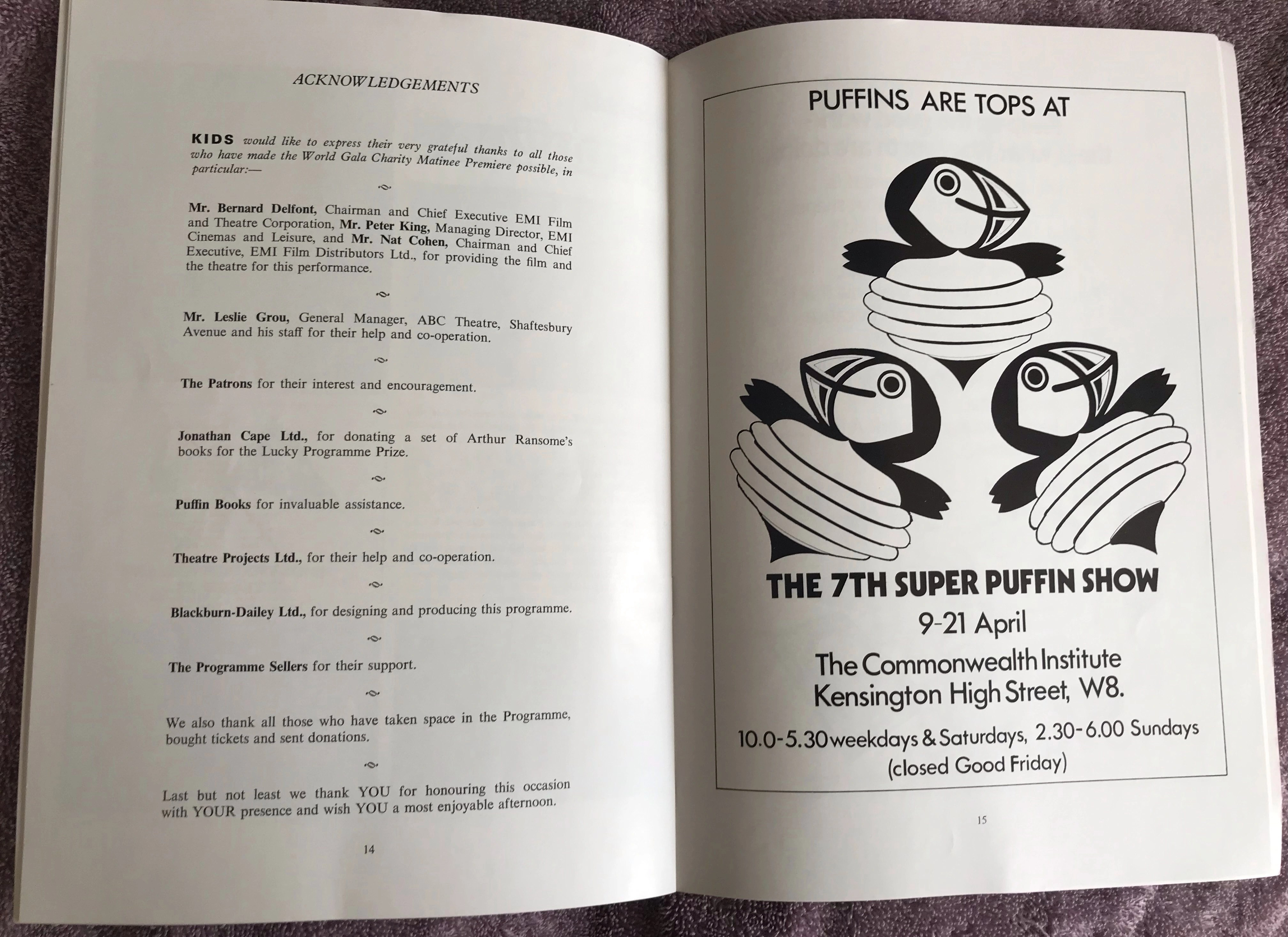
A signed programme from the premiere of ‘Swallows and Amazons’ held on 4th April 1974
The event was followed by the publisher Kaye Webb’s Puffin Show at The Commonwealth Institute in Kensington High Street where the dinghy Swallow was on display from 9-21st April. I remember going along to meet readers. One of them wrote to me years later, thrilled that she’d won a new copy of the book. You can read her letter and find the Puffin Post article in an earlier post here.
Kaye Webb’s Puffin Club Show – April 1974
“Do you think anyone will do anything to celebrate the anniversary? Are there any producers or distribution companies that might be approached? I am in touch with Richard Pilbrow, in America. I might drop him an email… Let me know if you think we ought to try to do something… a special screening, perhaps?”
When I suggested a few News presenters who might be interested in becoming involved, David replied saying:
“John Sergeant and I were at Oxford together, and performed in revue and cabaret….I directed him in a musical!
“Libby Purves interviewed me a few years ago at The Story Museum, Oxford. I was on Midweek twice too….”
“Have never met Ben Fogle, but years ago I knew his mother, Julia Foster. Her first husband was Lionel Morton, pop singer and Play School presenter, who played Owl for me in the first London production of THE OWL AND THE PUSSYCAT WENT TO SEE……in 1969!!!!!!”
“I was delighted that Virginia McKenna got her Damehood! Well deserved.”
This year marks the 50th Anniversary of making the film in the Lake District. I explained that I had been invited to give a talk to members of the Royal Thames Yacht Club in Kensington in April, hoping her could join me.
“I will put your April 18th talk in the diary – not sure yet if I will be free to come! But would appreciate you asking if I could attend. Last time I was there I gave a magic show for the members’ children!! About 50 years ago….just like the film!”
“The plans sound exciting. I wonder if the Arthur Ransome Society, to whom I gave a talk not long ago, might be interested in arranging something…”
They are. The idea is to put on an event at Windermere Jetty Museum in July 2024, under the auspices of Lakeland Arts. The Arthur Ransome Society are hoping to have both Swallow and Amazon there.
David then wrote to say: “The Cinema Museum, a rather wonderful institution in the Kennington area of South London, have pencilled Saturday April 6th 2024 for two screenings of SWALLOWS, to celebrate fifty years.” We have been invited to give Q&As and sign copies of our books. “Martin Humphries, who runs the Cinema Museum, organised a similar event about IF…., when I did a Q&A after the screening.”
This year is also the 50th Anniversary of the Lakeside and Haverthwaite Steam Railway where we spent the very first day of filming on 14th May 1973.
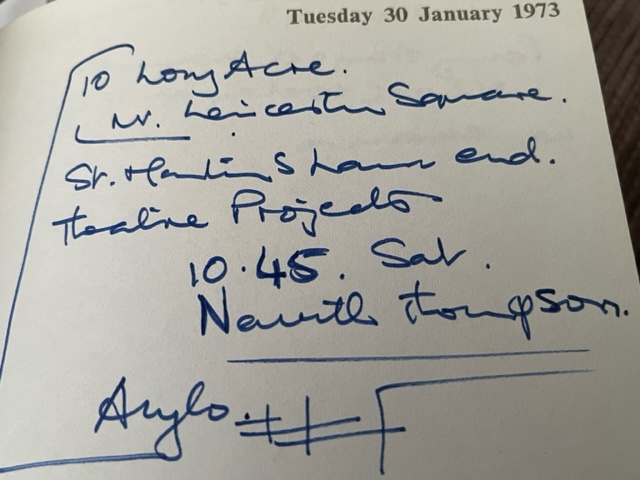
Fifty years ago this day, auditions were being held at 10 Long Acre near Leicester Square in London for parts in the original film of Arthur Ransome’s book ‘Swallows and Amazons’ produced by Richard Pilbrow of Theatre Projects with the help of Neville C Thompsom and financed by Anglo EMI Films. It was to star Dame Virginia McKenna, but the leading roles were all for children under the age of thirteen who needed to be able to row and sail.
Richard Pilbrow and Neville C Thompson in the Lake District in 1973
I recently received a Tweet from the award-winning author Wendy Clarke who wrote: ‘Funnily enough (many, many years ago) I auditioned for the film role of Titty Walker… I would have been 12 then. I didn’t belong to a sailing club and couldn’t sail! Amazed I got the audition!’
When I asked if she could tell me more, she replied: ‘I have next to no memory of the day so wouldn’t have very much to say about it! I’m seeing my mum tomorrow and have asked her to bring her 1973 diary!’ Here it is:
Wendy Clarke’s mother, Joy Matthews, kept a diary every day of her life
‘This is where I went for the audition apparently. Was that the same place as you?’
It was! I remember the actual room.
Wendy explained that her mother, Joy Matthews, ‘has written a diary every day since I can remember (even if it’s just to say what the weather was like). Over the years it’s been very useful. She is now 91. I think this was the photo we sent!’
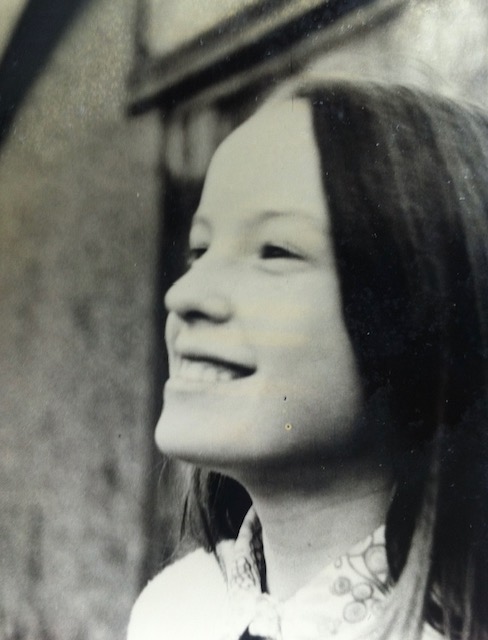
Wendy Clarke, aged 12, who auditioned for a part
‘I’ve just been reading your post and laughing at the escapades during the shooting of S&A. Can I really picture myself in your shoes… if I’m honest, no! I would have been too much of a scary cat. Especially when the mast broke!‘
A friend of mine also auditioned for ‘Swallows and Amazons’ but she couldn’t remember any details. Simon West, who ended up being cast as Captain John, told me that he met Richard and Neville for a first audition at his sailing club. His sister, Ginny, who was keen on acting, spotted a notice, but his father was amazed when he said he would also like to be considered for a role in ‘Swallows and Amazons’. Aged eleven, he was a little young for the part of John, but he was bright, practical with a passion for sailing. Kit Seymour and Lesley Bennett, who would eventually play the Amazons, also heard about the opportunity at their respective sailing clubs. Richard Pilbrow was very keen to find children who could sail and were able to swim well.
Kay Frances Ecclestone wrote to say she saw a, “poster in my sailing club. If it was in 1973, I’d have been 12 or 13 & had been sailing since I was 9 & just started helming in races.” This was at “Pagham Yacht Club which was where my family sailed… I didn’t (audition) although I seriously thought about it, but I didn’t want my long hair bobbed! I can remember clearly being at the Club noticeboard and excitedly reading the poster. I loved all the Arthur Ransome books and spent my first ever sailing prize that year (which was a book voucher) on buying the final in the series of Puffin paperbacks that I didn’t have. I have no idea why my Mum didn’t point out that my hair would grow back!” She is still racing her Scorpion dinghy today. “The original Puffins (with some replacement Puffins as the original fell apart from constant reading) in my AR book collection.”
Wendy wrote: ‘Second interview… so I couldn’t have done too badly! (Probably still hadn’t mentioned the small matter of not being able to sail)… I may not have got the part but least I got to go to Madame Tussauds and the Planetarium!’
My parents only received a letter asking if I would like to be considered for a part on 26th March 1973. It was addressed to my father who was on an export mission to South Africa and the envelope lay unopened in our hall for a while. Luckily it was printed with the Theatre Projects logo and Mum did open it.
Wendy returned to Theatre Projects’s offices in Long Acre for a third interview on 7th April. She was doing well:
I’d broken up from school for the Easter holidays on Tuesday 3rd April. On Sunday 8th April we collected Dad from Heathrow, drove straight to Longacre for a 11.00am. Leicester Square and walked through China Town. I remember Claude looking rather intense as he asked me questions. He wanted to know what my favourite television progamme was. He didn’t ask me to read, which was just as well as I would have been hopeless. Did he ask if I could row or sail? I might have told him that I could swim well, as I’d just gained a bronze life saving medal, one of my few achievements to date.
I too was taken to Madam Tausauds when the ticket took you to the neighbouring Planetarium as a double bill and remember walking thorough China Town.
Unknown to me, Mrs Ransome had wanted all the Swallows to have blonde hair and was insistent that ‘an English rose’ to played Titty. Wendy had dark hair as a child. I was fair. Mum described my scraggly hair as ‘dark blonde’.
I had one other advantage. I’d worked for Claude Whatham in 1971 when he had cast me as Eileen Brown in the first BBC adaptation of Laurie Lee’s book ‘Cider With Rosie’, set in the 1920s. We later found out that Claude liked working with actors like Brenda Bruce who he had employed on previous occasions. I’m not sure when he joined the production of ‘Swallows and Amazon’ but it could have been late in the day as he was the second director taken on board.
Sophie Neville with Claude Whatham
We were told that 1,800 children had been considered for the six parts in ‘Swallows and Amazons’. Most of them had been members of sailing clubs. Claude had not wanted to visit stage schools but Suzanna Hamilton, who was cast as Mate Susan, had been going to the Anna Scher after school Theatre Club in Islington, which he may have visited. I had first met him at a drama club in Stroud in Gloucestershire in 1971.
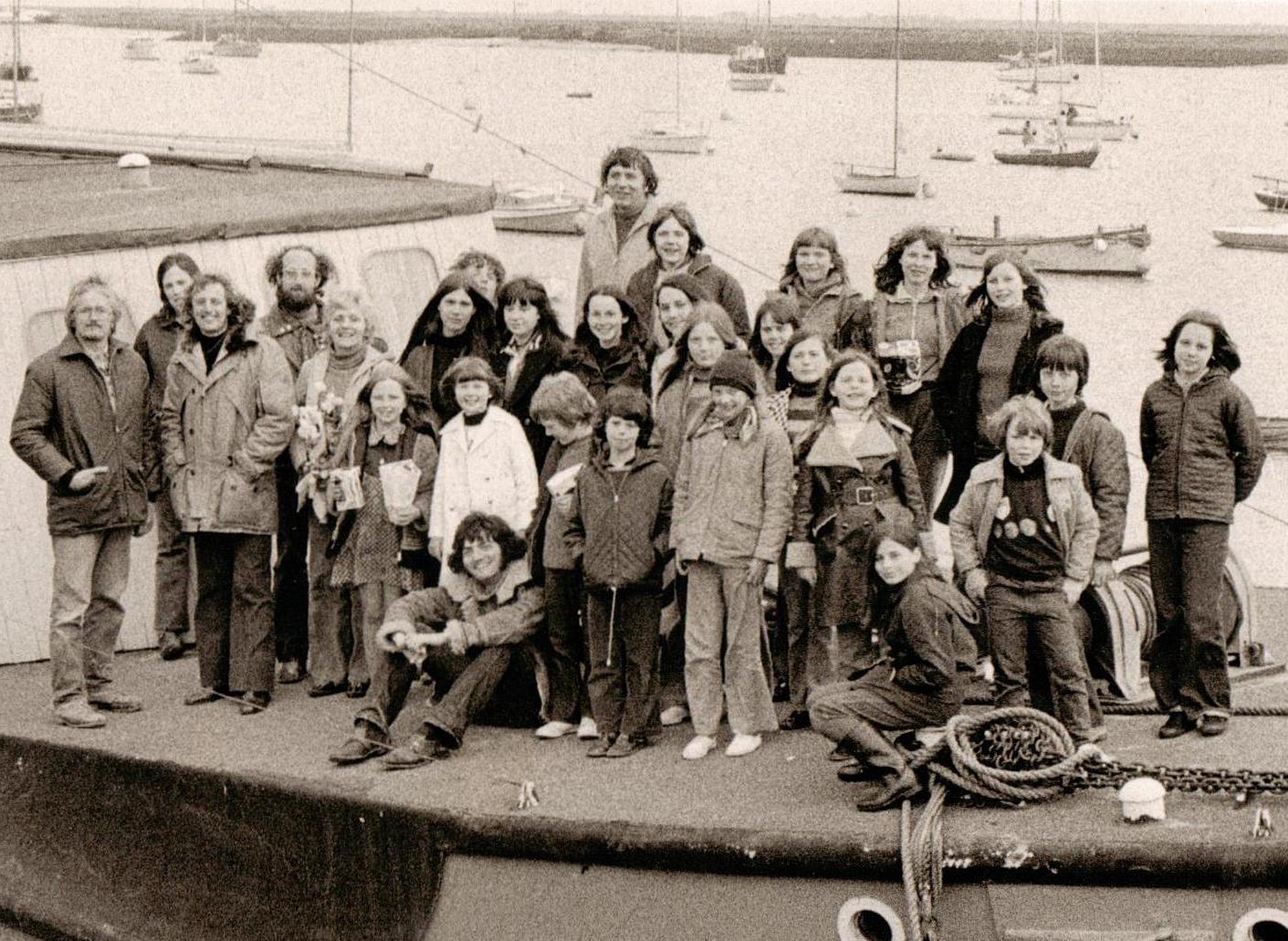
Our final audition was held afloat, when about twenty children spent a couple of days on a scout boat at Burnham-on-Crouch in Essex. Looking at Mum’s diary this must have been from Wednesday 18th to Good Friday, 20th April. Richard and Claude wanted to see how confident we all were on the water. We were taken dinghy sailing in wet and windy conditions. I remember Kit and her twin sister Alison Seymour facing the waves without a qualm. Richard bought his children Abigail and Fred along and I knew Sten Grendon who had also been in ‘Cider With Rosie’. We might have travelled to Essex together. The five girls up for the part of Titty all shared a cabin. I thought I was too old, too tall and too gangly. We were not aware of a screen test but Richard’s assistant Molly took super 8 cine footage.
Meanwhile, Wendy Clarke had been taken to Cumbria by her parents: ‘We’d gone to the Lake District to get a feel for it. Hadn’t heard anything about interview so Mum rang and, as she so very succinctly put, ‘that’s that’. That made me laugh.’
I noticed they had been to see the waterfall where we eventually shot a scene on the way to visit the charcoal burners.
Wendy wrote: ‘That May, mentioned in Mum’s diary extract, was my very first time in the Lake District. It was only years later, in my forties, that I visited again and fell in love with it. Maybe I’m destined to sail that boat after all! So lovely to ‘meet’ you (even though I probably hated you at the time for taking my part (which I would have been rubbish at anyway!) x
‘My husband has just said, ‘why did you not tell me any of this?’ I was probably just relieved I didn’t have to get in a boat!In later life I discovered I was better at novel writing than acting!’
She added: ‘I’ve just found something else that links us. We both entered our books into the Flash Fiction Novel Opening Competition. My debut psychological thriller What She Saw, which was set in the Lake District, won it in 2017!’ I had a story shortlisted in 2022, which was encouraging.
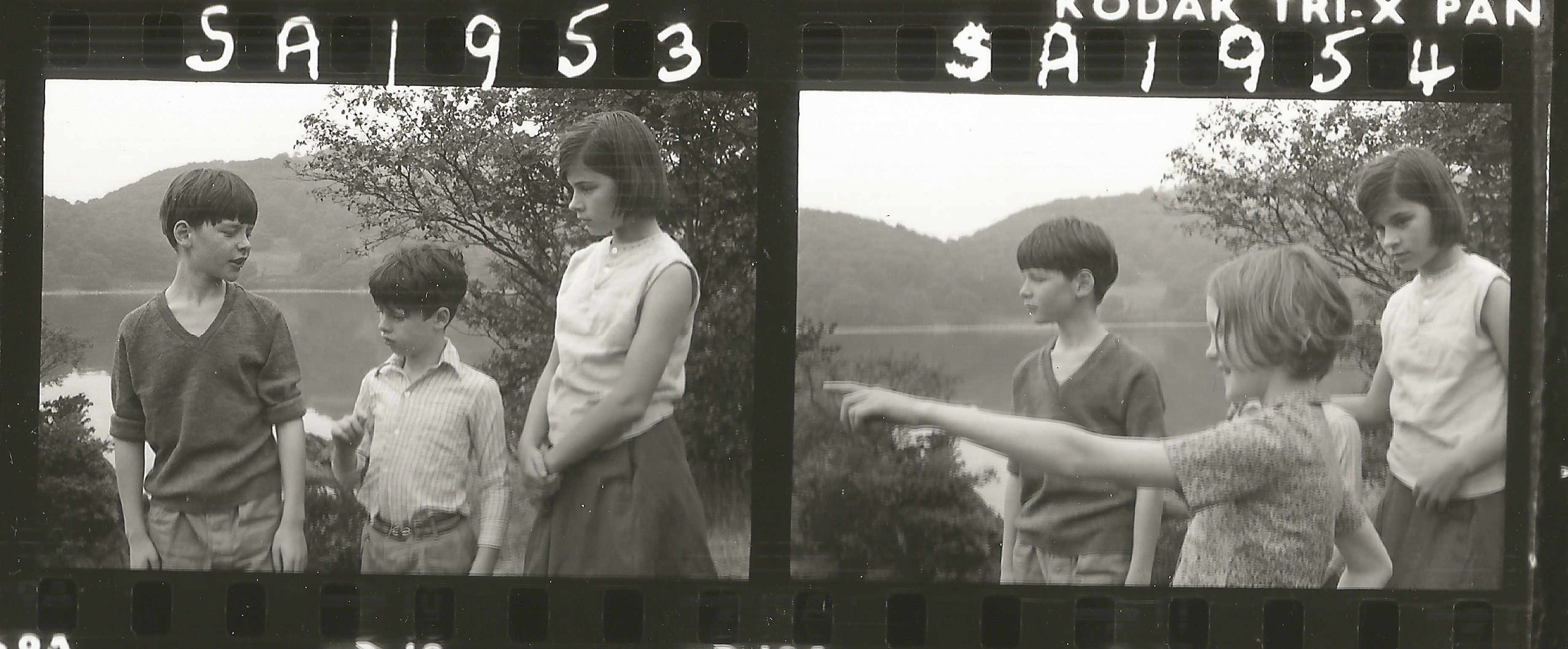
Claude Whatham with the children he eventually cast as the Swallows
I would love to hear from others who auditioned all those years ago – do email me or leave a comment below. I have written a little more about the gaining the part from my perspective on an earlier post here.
I retuned to boarding school for the summer term on Tuesday 1st May, was collected on 10th May and was whisked off to the Lake District on Friday 11th May. Filming began on Monday 14th May – only a few weeks after my first interview. Everything had happened very fast.
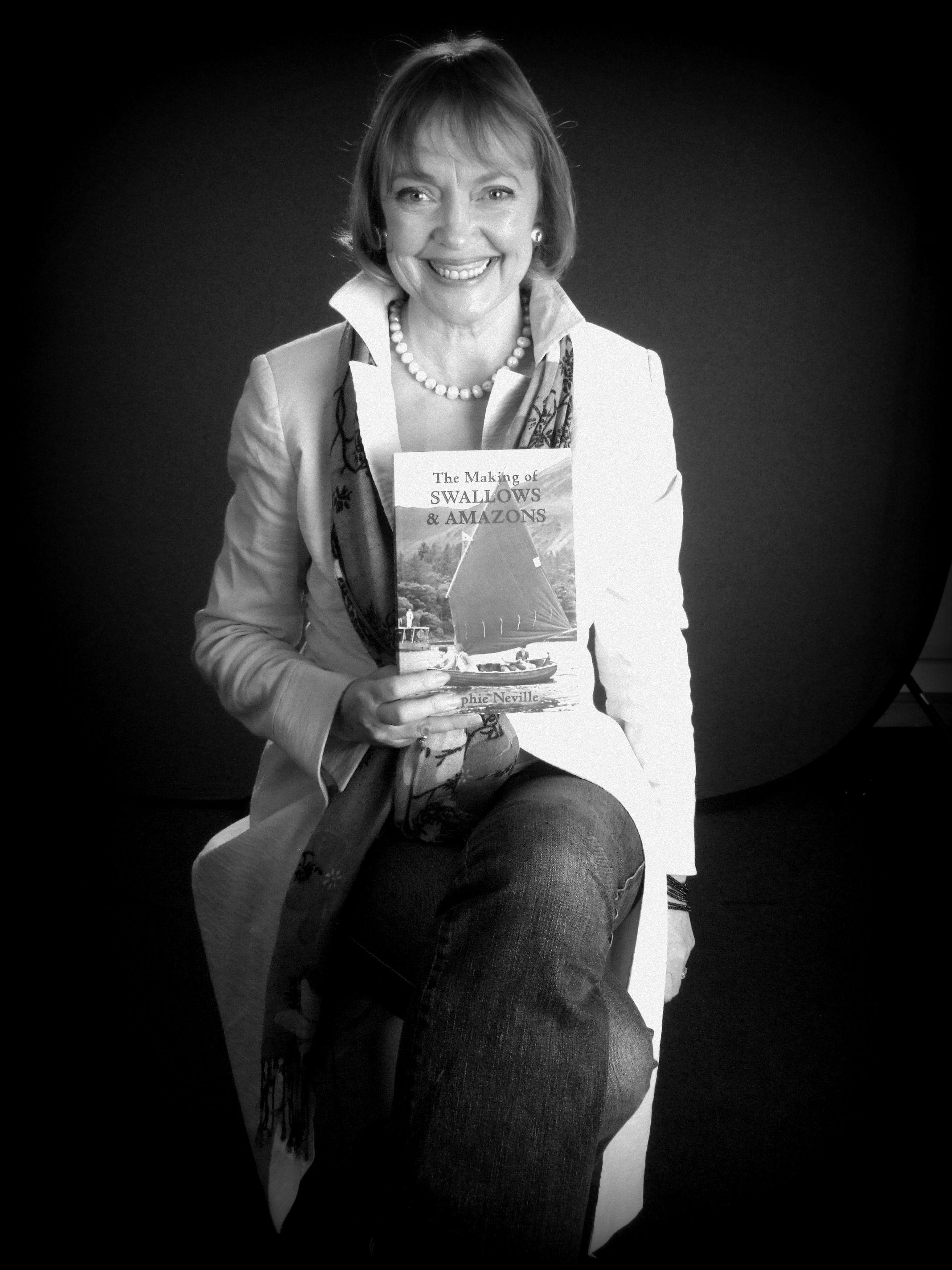
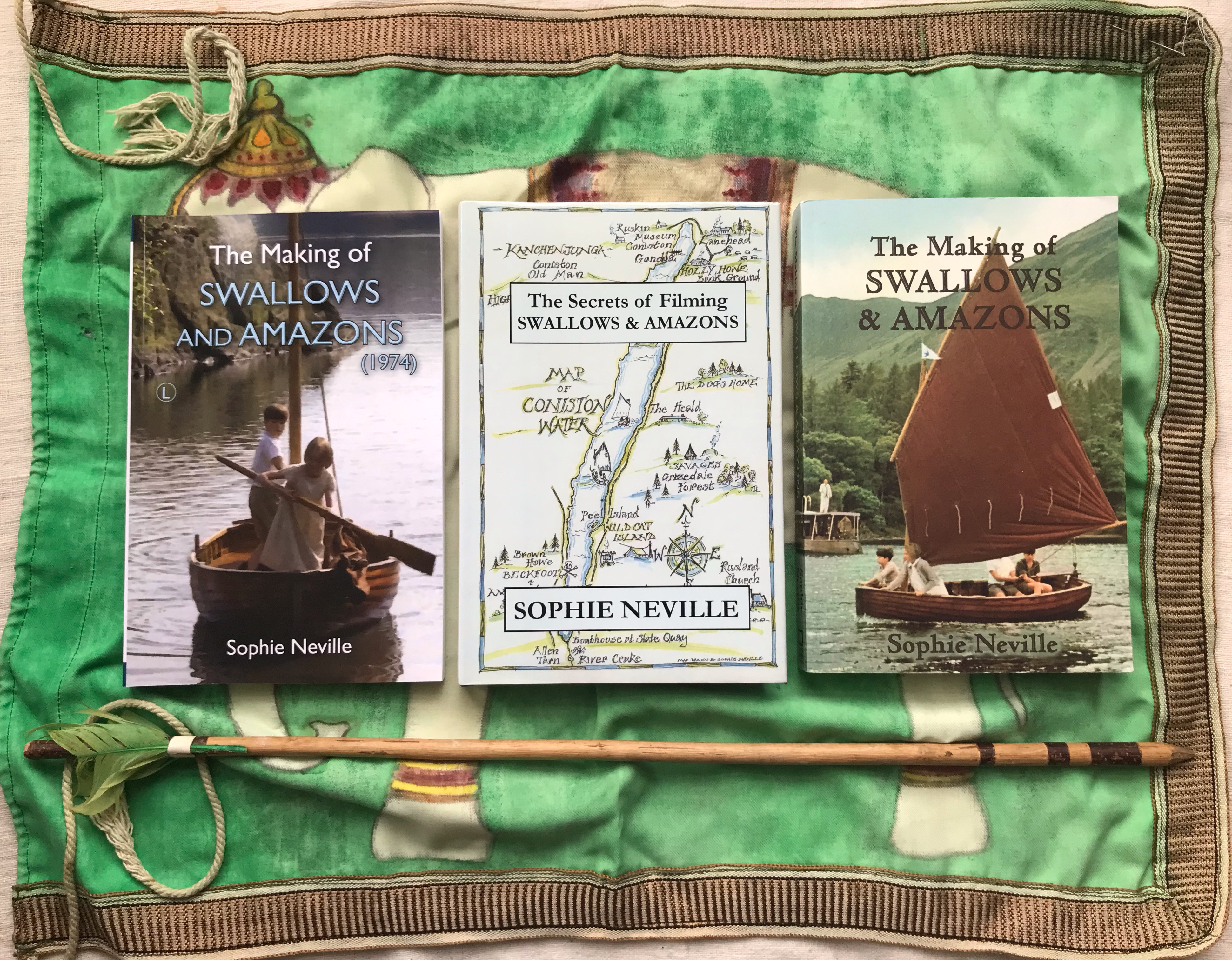
Different editions of ‘The Making of Swallows and Amazons (1974) by Sophie Neville’
I’ve been asked to give talks on ‘The Making of Swallows and Amazons’, which I detail on my Events page. You can find different editions of my books listed here with an audiobook, narrated by me, Sophie Neville, available on all the usual platforms.
Virginia McKenna in ‘Swallows and Amazons’ (1974) immortalized by the film poster artist Arnaldo Putzu (c) StudioCanal
I was so thrilled to read that Virginia McKenna has been awarded a DBE for services to wildlife conservation and to wild animal welfare in the New Year Honours. When I last spoke to her, she was working tirelessly for the Born Free Foundation that she co-founded with her son Will Travers OBE.
I first met Dame Virginia in 1973 when she agreed to star in the first big screen adaptation of ‘Swallows and Amazons’, produced by Richard Pilbrow, directed by Claude Whatham and released by EMI Films in 1974.
Dame Virginia McKenna at the Langdale Chase Hotel on Windermere in 1973 – photo: Philip Hatfield
She played the part of my mother, Mary Walker. The movie was shot entirely on location in the Lake District where Arthur Ransome set his classic series of children’s books.
Dame Virginia McKenna at Bank Ground Farm in 1973 ~ photo: Daphne Neville (c)
The film has been broadcast on British television more than any other but it is when you watch it on the big screen that you can appreciate what made Virginia McKenna such a great star. Her face conveys a thousand tiny emotions that sweep you into a long-forgotten time when children were able to run free.
Dame Virginia McKenna on location at Bank Ground in Cumbria ~ photo: Daphne Neville (c)
Dame Virginia had originally been scheduled to come up to Cumbria for the first ten days of the seven-week shoot but, since wet weather closed in, she was obliged to return when the sun came out for the famous scene when Roger tacks up the field at Holly Howe to receive ‘despatches’ in the form of the cryptic telegram BETTER DROWNED THAN DUFFERS IF NOT DUFFERS WONT DROWN.
Dame Virginia McKenna with Ronnie Cogan ~ photo:Daphne Neville (c)
Dame Virginia enjoyed the discipline and focus of concentration on set and helped centre us from the start. If you watch other movies made at the time, such as ‘The Railway Children’ (1970), most of the adult actresses are wearing wigs with a district nineteen-seventies feel to their costume and make-up. ‘Swallows and Amazons’ owes its timeless appeal to the fact that Virginia simply had had lovely thick hair scooped into a bun and wore her original 1929 garments with grace.
Sophie Neville as Titty in 1973 – photo: Daphne Neville (c)
I played Titty Walker who inveigled her mother into playing Man Friday to her Robinson Crusoe when she came to visit Wild Cat Island. The sequences were shot on Peel Island on Coniston Water where Ransome was taken as a boy by his own parents and met the Collingwood family in the 1890’s. He later became a good friend of Dora Collingwood whose five children became the inspiration for the story ‘Swallows and Amazons’. Her third daughter, the dreamer, was nicknamed Titty.
Dame Virginia McKenna and Sophie Neville on Peel Island ~ photo: Daphne Neville (c)
It can not have been easy for Virginia to act with me, a child of twelve, while frying pemmican in butter on a camp fire. I was self-conscious about having lost an eye-tooth the night before and had rather a sore mouth and she later had to row from the island with a 35mm Panavision camera in her boat.
What I’d forgotten until recently was that Bill Travers watched the filming that day on Peel Island. He’d been a hero of mine ever since he played George Adamson in ‘Born Free’ and Gavin Maxwell in ‘Ring of Bright Water’ opposite Virginia. Their film, ‘An Elephant Called Slowly’, was released as a double bill with ‘Swallows and Amazons’.
You can see a few more behind-the-scenes photos here and I’ve written more about being Robinson Crusoe here.
‘They were very savage savages’ ~ Virginia McKenna with Sophie Neville ~ photo: Daphne Neville (c)
Looking back, I realise how fortunate we were to be able to play out the scenes from the iconic book in the actual locations, such as Bank Ground Farm where the Collingwood children had stayed one holiday as children, so they could visit their grandparents who lived at Tent Lodge next door and were too unwell to have them in the house.
Sten Grendon, Simon West, Virginia McKenna, Suzanna Hamilton and Sophie Neville at Bank Ground Farm, in 1973 ~ photo: Daphne Neville (c)
We were not so keen on the publicity photographs taken for the film even though Virginia tried to make it fun. Right from the the very first day of filming, she worked hard to bring us together as a cast, playing games such as ‘Consequences’ to help us laugh and relax, while concentrating on the task of bringing the book to life.
Suzanna Hamilton Sten Grendon, Sophie Neville, Dame Virginia McKenna and Simon West – photo Daphne Neville (c)
In 1980, I went to work for Ginny and her husband Bill Travers, as a housekeeper for a few months. She needed domestic help while she was appearing with Yule Brynner in ‘The King and I’ at the London Palladium, for which she won an Olivier Award for Best Actress in a musical. I looked after her youngest son, Dan, who later worked as a safety officer and consultant on the 2016 film of ‘Swallows and Amazons’. I met him at the cast and crew screening in Leicester Square.
Dan Travers and Sophie Neville in 2016
Ginny and I kept in touch. She was ever-supportive, encouraging me to keep raising funds for anti-poaching in South Africa, where she had been evacuated as a child during WWII.
It was only when I heard her speak at the Kempsford Literary Festival in the Cotswolds that I learnt that other ships in her convoy to Cape Town had been torpedoed and sunk crossing the Bay of Biscay. By some miracle, her ship had been delayed in Liverpool but she described finding the flotsam left by the ships that had been hit.
Having written a number of books herself, Ginny encouraged me to write, urging me to keep focused on one thing.
Her letters and cards also inspired me to keep raising funds for wildlife conservation in Africa.
A Christmas card design by Sophie Neville
In turn, I supported the Born Free Foundation, printing them greeting cards, donating a Christmas card design for their catalogue and a picture that was auctioned at the Big Cat Open Day in Kent.
Sophie Neville with Virginia McKenna in about 2001 – photo Daphne Neville (c)
In 2014, StudioCanal invited us both to appear in the DVD Extras package for the 40th anniversary DVD of ‘Swallows and Amazons’ (1974). While we were waiting for the crew, she told me that she’d appeared in more than thirty movies. I know she’s made a few more since then.
You can watch her interview here:
Interview with Virginia Mckenna
I released the first edition of ‘The Making of Swallows and Amazons’ for which Virginia graciously provided a quote. You can read the first few pages in the preview of the ebook, entitled ‘The Secrets of Filming Swallows and Amazons 1974’here
To hear Virginia and her son Will Travers talking about receiving her DBE, please click here for BBC Sounds
Virginia McKenna as Man FridaySophie Neville as Robinson CrusoeDame Virginia McKenna as Mary Walker in ‘Swallows and Amazons’ (1974) – copyright StudioCanal (c)
~ ‘The Secrets of Filming Swallows & Amazons 1974’~










































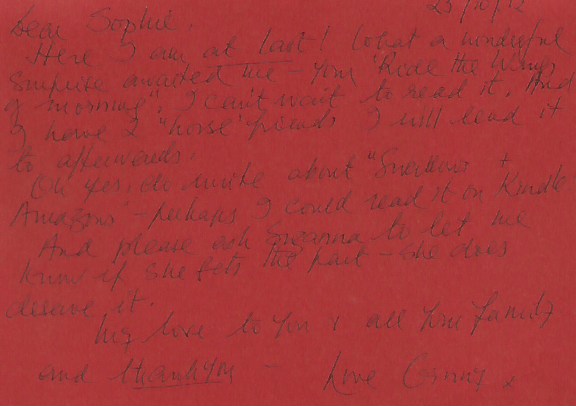
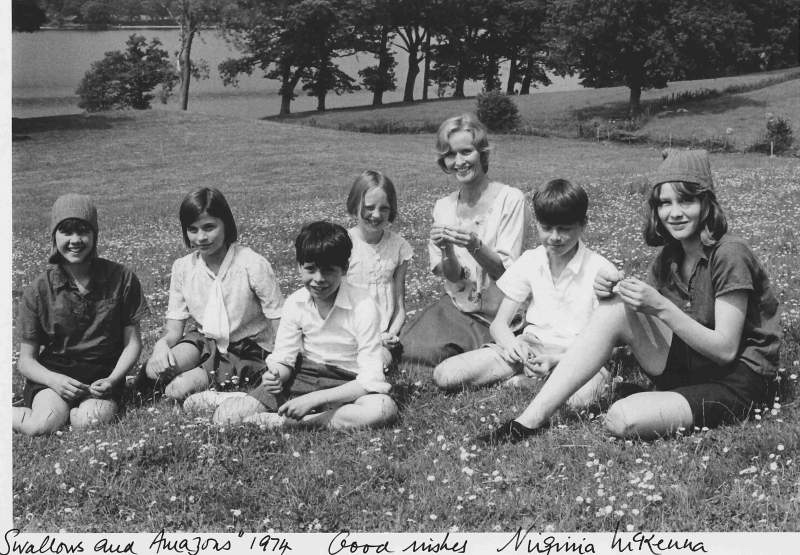
 Her letters and cards also inspired me to keep raising funds for wildlife conservation in Africa.


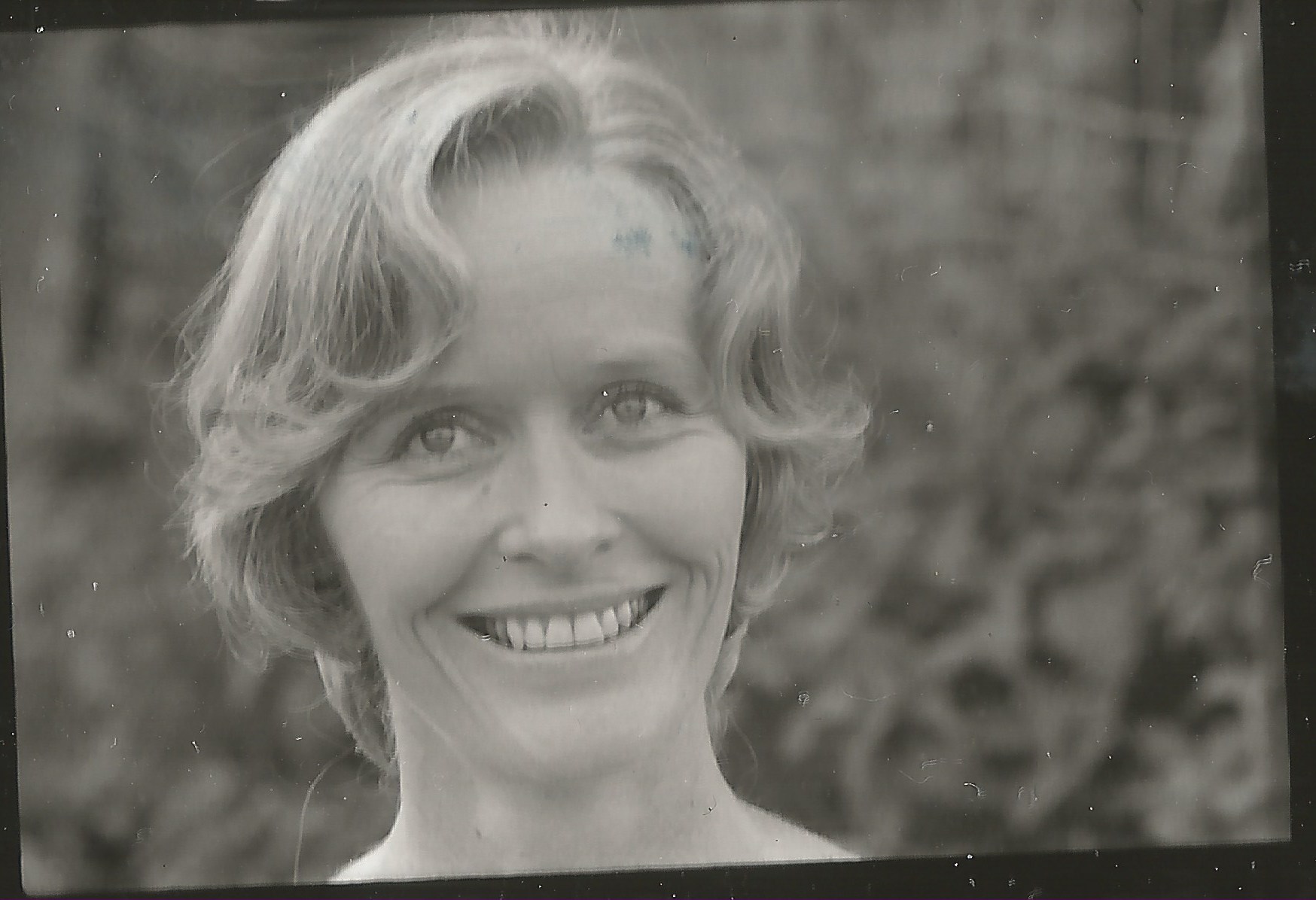
 Sophie Neville