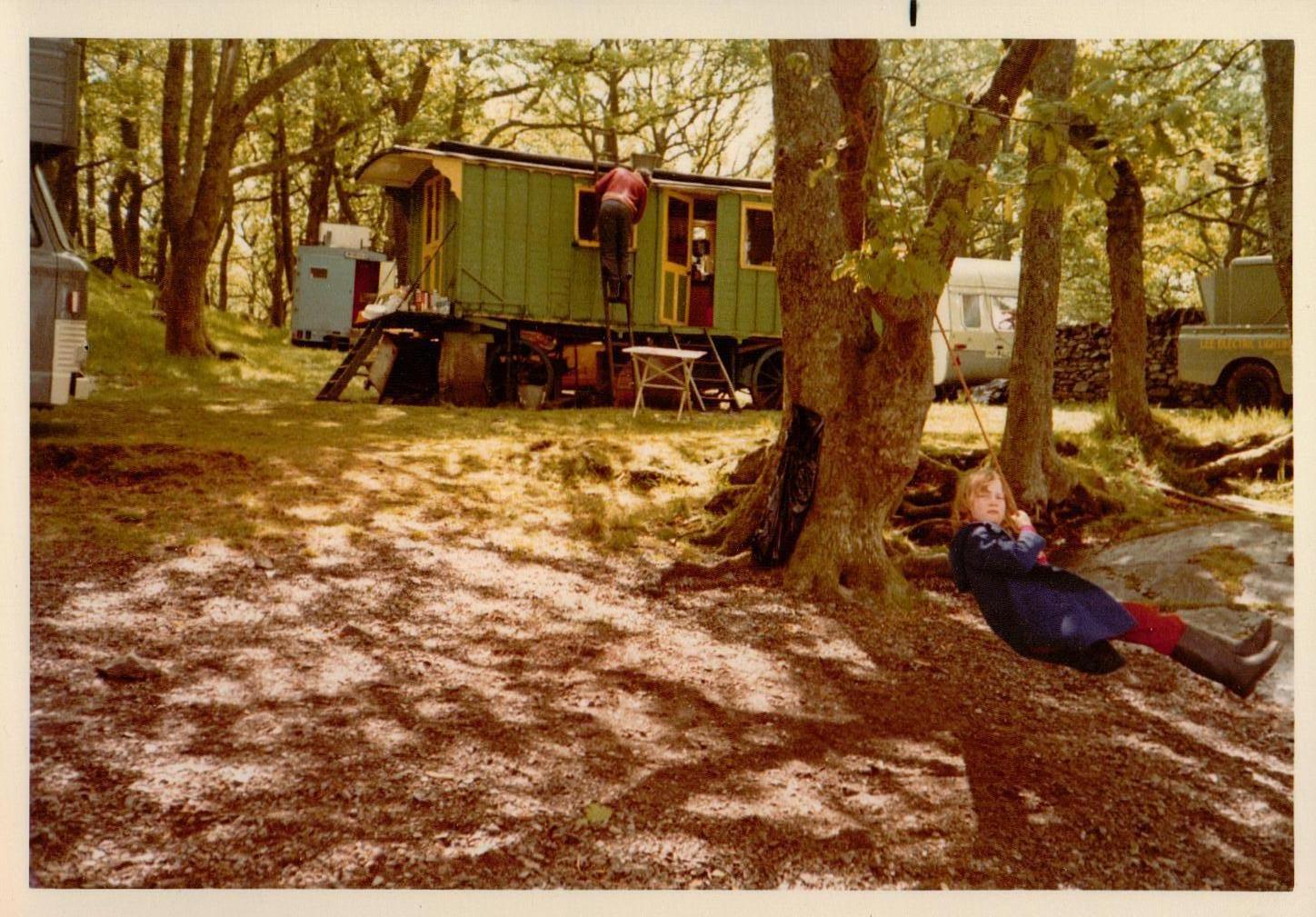
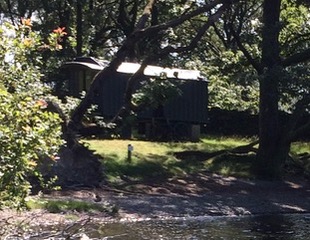
Readers often ask me about the green wooden caravan parked in the woodland opposite Peel Island where our unit vehicles were based when we made the original film of ‘Swallows and Amazons’ in the early 1970s.
My little sister on the swing at the unit base opposite Peel Island ~ photo: Martin Neville
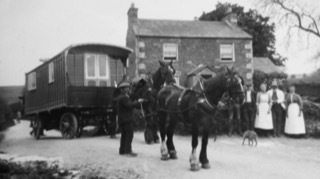
It is actually a postal surveyor’s van bought in Halifax by the Smithson family in 1913 and pulled by two horses to Coniston Water. John Smithson, now in his nineties, provided this photo:
Once it was in Coniston, John’s niece’s family the Bowmans, and his friend Charles Rothwell joined the venture, but the caravan was eventually left with Charles Rothwell’s descendants. It has been maintained, visited and used for holidays by members of his family ever since. They turned up during the May half-term whilst we were filming in 1973.
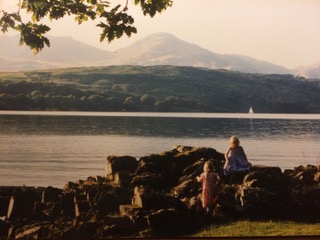
“I was one of those ‘gypsies’, aged 9 at the time,” writes Sarah Bennet. “We were about as surprised to see you as you were to see us – I remember driving into the field and unexpectedly there was a red double decker bus in front of us! I also remember playing with your younger sisters on the promontory rock by the jetty whilst filming was going on.”
My father was given a short-back-and-sides haircut outside the caravan so he could appear in the film that was set in 1929 when Ransome wrote the book. You can see different angles of of the wooden exterior here after shots of the film crew our on the lake:
The green caravan is currently cherished and used by the 5th generation of Charles Rothwell’s family. “Unfortunately, the National Trust (‘landlords’ since 1932, long after the Caravan was placed in the field) have now given notice of terminating our licence to be there. If we cannot successfully challenge this, we will have to ‘remove’ the Caravan by January 31st 2025. Since the wheels rotted long ago, and it is resting on breeze blocks, this actually means its complete destruction.”
By Coniston Water in 1913
Since the wooden caravan has been positioned on the banks of Coniston Water for more than one hundred years, it must have been known to Arthur Ransome when he wrote Swallows and Amazons in 1929. “It is right opposite Peel Island and was then brightly painted in red and gold.” The trees would have been young at the time. “So he must have seen it, and it must have been part of the vision for his books.” It is still used for the sort of adventure holidays that he promoted – camping, boating, camp-fire cooking, exploring the woods and hills.
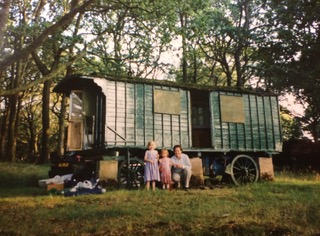
The green postal surveyor’s van today
Could members of The Arthur Ransome Society and those who love heritage features of the area appeal to the National Trust and ask for the licence to be extended?
The date 1913 is corroborated by a note from Agnes, Charles Smithson’s niece. She spent a holiday at the caravan as a child in 1913 and mentions sleeping in red felt tents ‘on mattresses filled with bracken’ saying that that the caravan was originally painted green, yellow and purple. In 1928, Agnes married George Bowman. She said that by then the caravan was in a bad state but that “G. mended it all up marvellously”, so it might have been repainted then.
The Arthur Ransome Society has been able to reunite Swallow and Amazon for the fiftieth Anniversary of the 1974 film and to preserve them for future generations. Come to see them both – and even sail Amazon – at Windermere Jetty museum in Cumbria on 29th and 30th June when John Sergeant will be hosting a Q&A with the cast and crew.
Celebrating 50th Anniversary of the movie ‘Swallows and Amazons’ in 2024
The challenge is on to fully restore Swallow so that families can set her sails and live out the pages of Arthur Ransome’s iconic books today.
Sophie Neville when president of The Arthur Ransome Society
At the age of twelve, I was cast as Able Seaman Titty when the original film Swallows and Amazons was made on location in the Lake District in the summer of 1973. Dame Virginia McKenna played my mother and the six of us children had fun making Ronald Fraser walk the plank. Now hailed as a classic sailing film, I’m assured it has been broadcast on British television more times than any other movie and is currently streaming on Amazon.com and Netflix Europe.
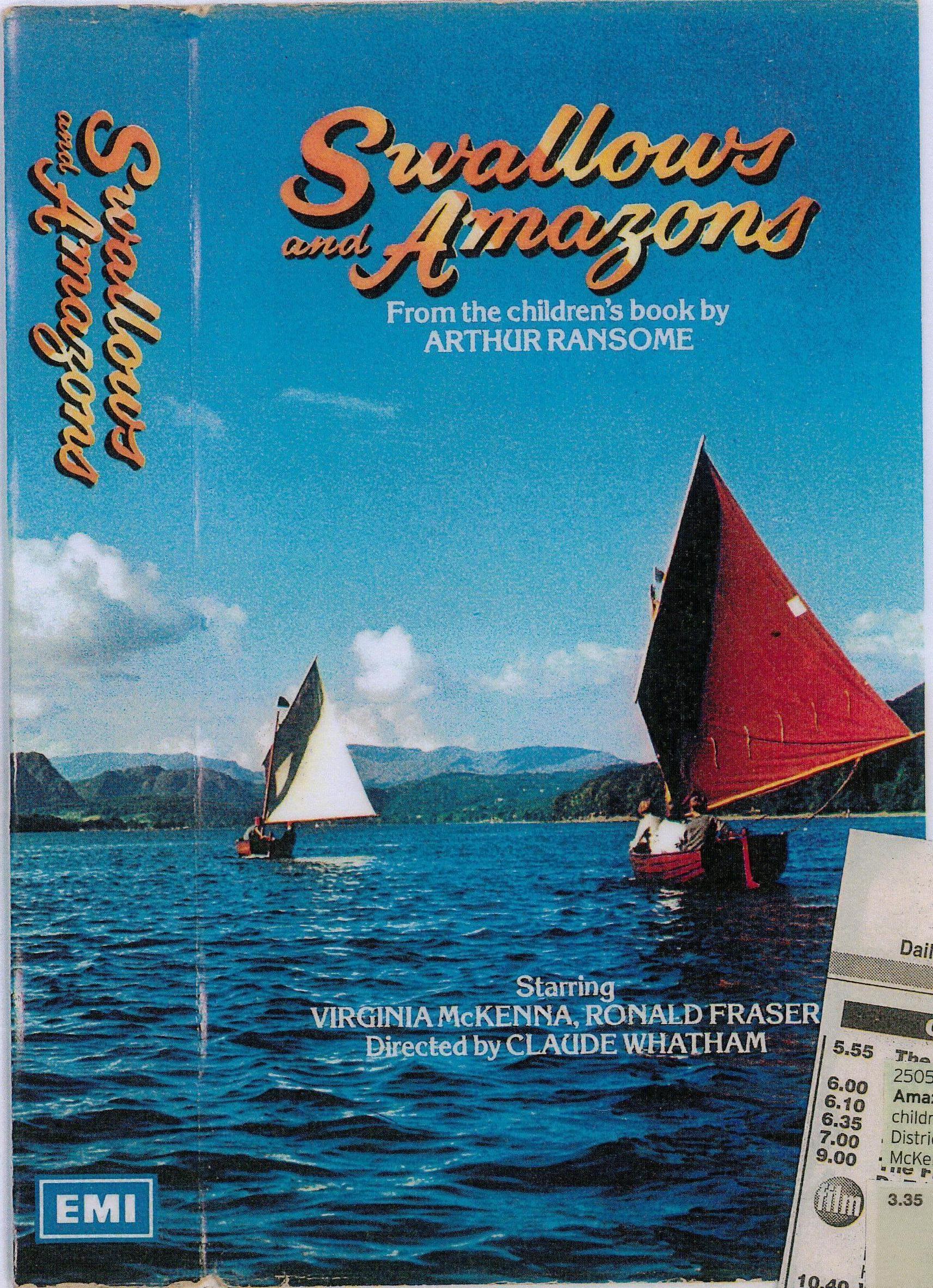
The cover of the original VHS version of ‘Swallows and Amazons’
One secret is that the film was made on four different lakes – Coniston Water, Windermere, Elterwater, Derwentwater – and a smelly lily pond. We were able to use Bank Ground Farm as Holly Howe and Brown Howe as Beckfoot, home to the Amazon pirates who careened their dinghy on the lake shore in the company of a 45-man film crew from Pinewood Studios.
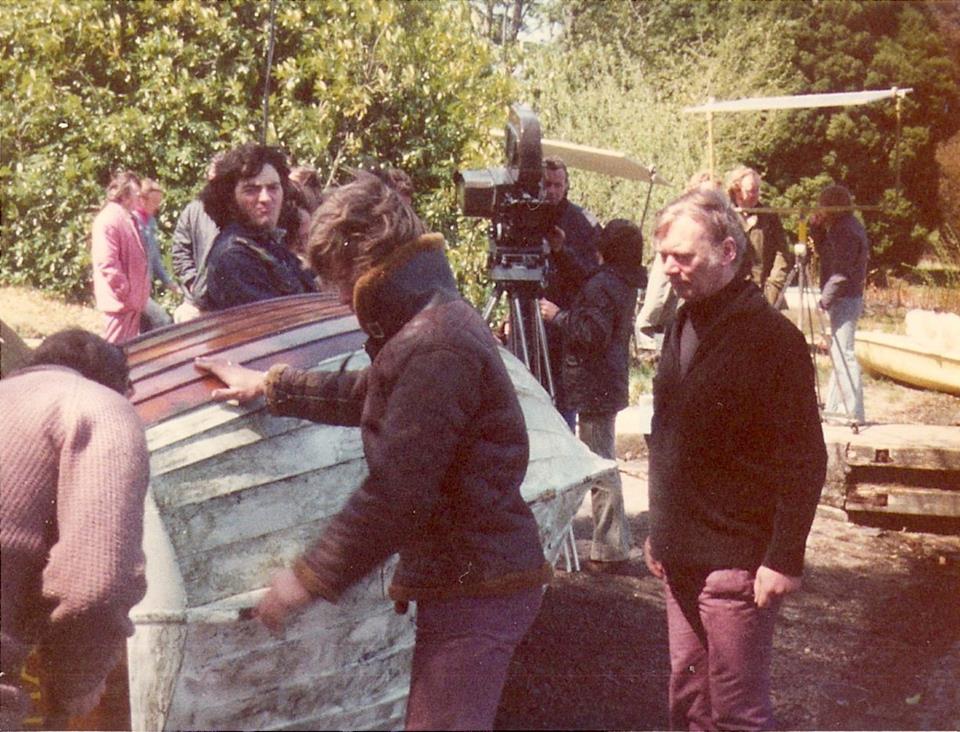
David Blagden, David Cadwallader, and David Bracknell looking at the Amazon’s bottom with DPO Denis Lewiston in the background with the Panasonic
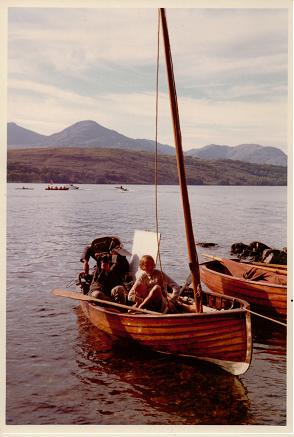
Careening the Amazon at Brown Howe, Coniston Water – photo: Daphne Neville
We were only given a couple of days to get used to handling Swallow and Amazon before filming began. Although happy out on the water, the director, Claude Whatham, knew little about boats. To make up for this, we had instruction from a sailing director in the form of a good-looking actor called David Blagden who presented a television programme called Plain Sailing. He’d recently raced crossed the Atlantic in a nineteen foot yacht called Willing Griffin but was unfamiliar with blustery Lakeland winds and did not know how to break down a script. Simon West, aged eleven, who played Captain John, ended up explaining to Claude how to get a decent shot while I tried not to shiver. My costume was designed by Emma Porteous of James Bond fame but consisted of nothing more than a short yellow dress and an enormous pair of navy-blue gym knickers.
Amazon, flying the Jolly Roger, with her seamed white lugsail and heavy centerboard is a lovely boat to sail. Although vital to the story, no one took into account that I needed to take her, on my own, from Secret Harbour on Wild Cat Island and drop her anchor off Cormorant Island. I was given a grey cardigan to wear but had not been asked if I could row. Having grown up handling a Thames skiff, I managed to use the leading lights we’d set up to negotiate the narrow channel and threatening rocks in one take. I repeated the action with Dennis Lewiston, the lighting-cameraman, and his 35mm Panavision camera in the stern but grew so tired that I needed to be carried ashore by a frogman acting as our safety officer.
Sophie Neville in The Amazon with DOP Denis Lewiston, his 16mm camera and a reflector board ~ photo: Martin Neville
Sophie Neville having captured the Amazon, with the lighting cameraman and 35mm Panavision Camera in her stern. Swallow is moored alongside – photo: Martin Neville
Titty later anchors Amazon off Cormorant Island on Derwentwater, but the shot of her wrapped in the sail, sleeping aboard, was taken in Mrs Batty’s blacked-out barn at Bank Ground, with the boat rocking on a cradle made by the unit carpenter. This was for a night scene when Titty is disturbed by burglars hiding a heavy trunk that turns out to contain Captain Flint’s treasure. When the action was repeated out on Derwentwater near One Tree Island, I got soaked. Rain had collected in the furled sails.
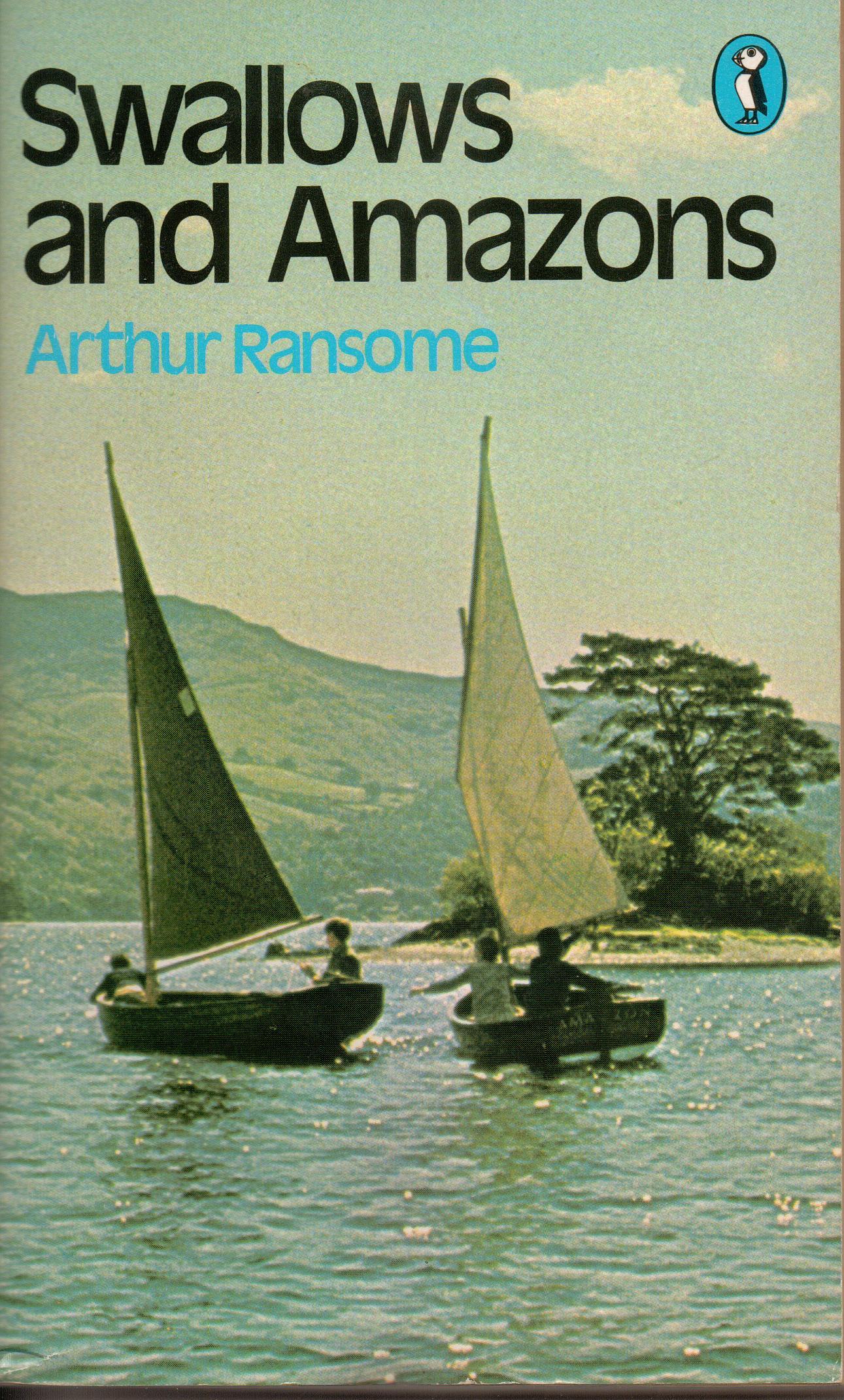
My one regret is that we didn’t follow the book when sailing the Amazon back to Wild Cat Island. The wind was up and Claude Whatham needed Captain John to sail Swallow ahead of the Amazon which is the faster boat. I originally took the tiller, as Titty is urged to in the story, but had trouble with the rudder. Mate Susan, played by Suzanna Hamilton, is at the helm on the cover of the Puffin paperback brought out to accompany the film, whilst I am fending off.
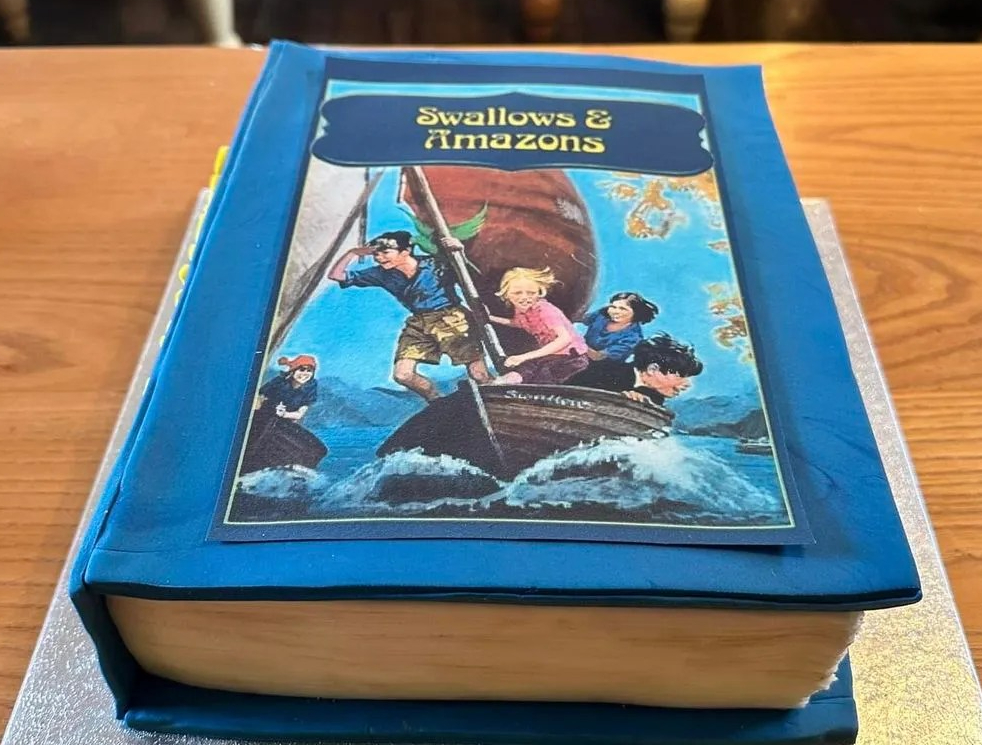
One of the film stills taken from the pontoon was used on the cover of the Puffin edition of ‘Swallows and Amazons’ brought out in 1974 to accompany the film.
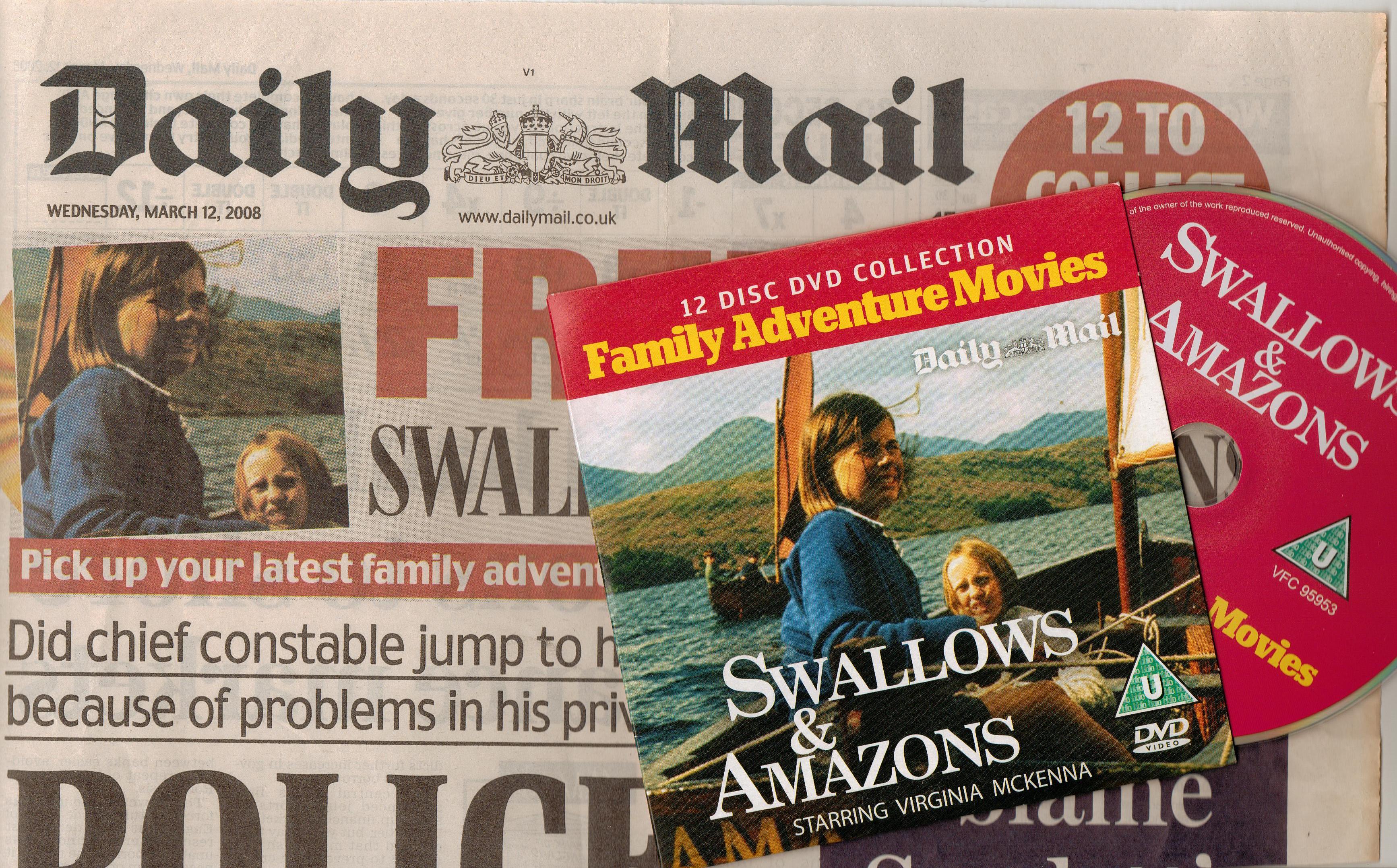
The second part of the scene was shot on Coniston Water, with the Amazon Pirates, Nancy and Peggy ‘dancing with rage’ on Peel Island. A shot of this was used on the cover of a hardback and a DVD distributed by the Daily Mail.
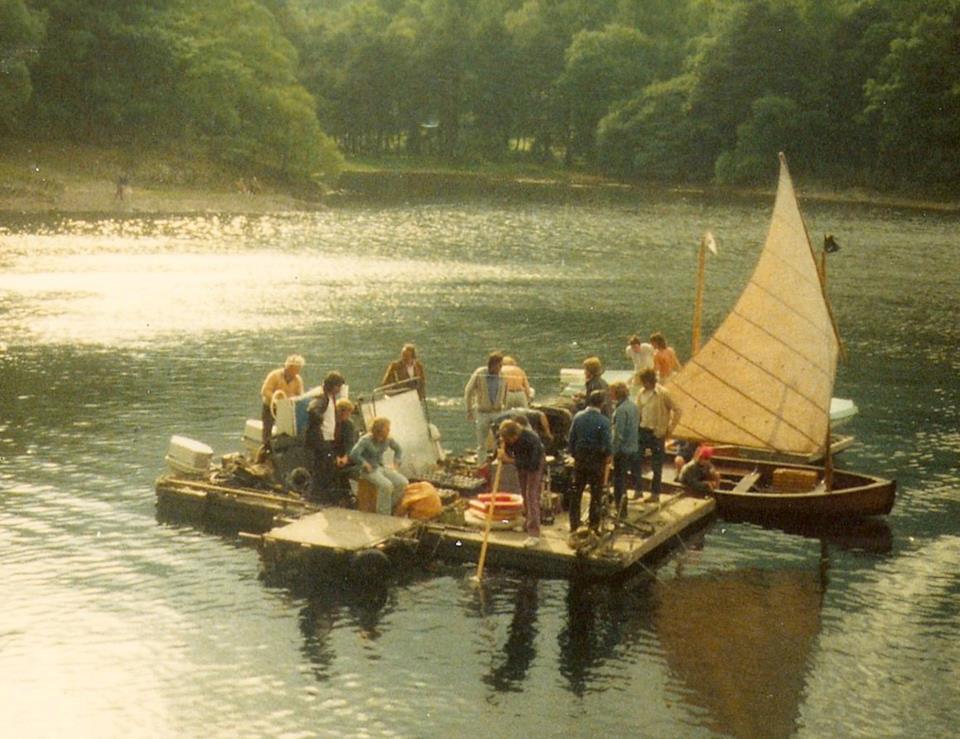
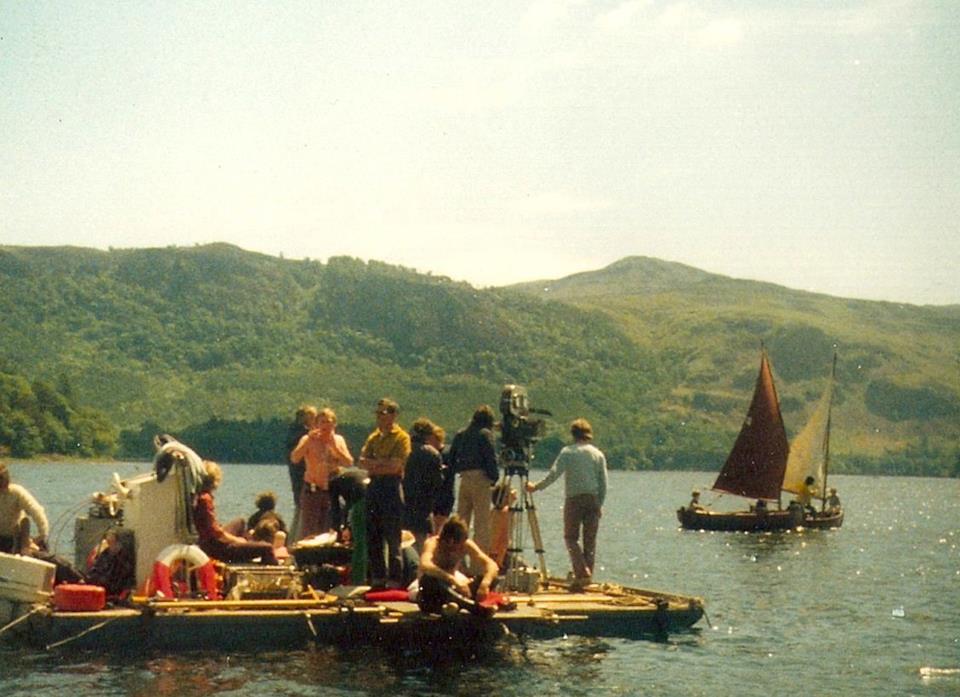
Not many sailing films have been made and it was unusual for a movie to feature so many scenes set in two small dinghies. Mike Turk, whose family had been boat building for centuries, and Nick Newby of Nicol End Marine near Keswick, took up the challenge of adapting a cross-shaped pontoon to act as a mobile camera mount so that our dialogue could be recorded. This extraordinary vessel had two outboards but wasn’t easy to handle. The dinghies were wired to it with underwater cables but tended to pull away. Swallow’s mast broke the first time she was rigged, but the idea eventually worked and only Sten Grendon, playing Roger, fell in.
Amazon rigged up to the camera pontoon – photo: Richard Pilbrow
Somehow David Cadwallader, the grip looking after the camera equipment, managed to keep the horizon horizontal using no more than a spirit level on the tripod. Shadows were lifted from our faces by using reflector boards and, since the whole movie was post-synced at Elstree Studios, the audience can hear what we say.
Richard Pilbrow and his film crew on the camera pontoon with Eddie Collins operating the 16mm camera. Simon West and Stephen Grendon sail Swallow. Suzanna Hamilton is climbing aboard the Amazon with Sophie Neville
Filming Swallow and Amazon from the camera pontoon – photo: Daphne Neville
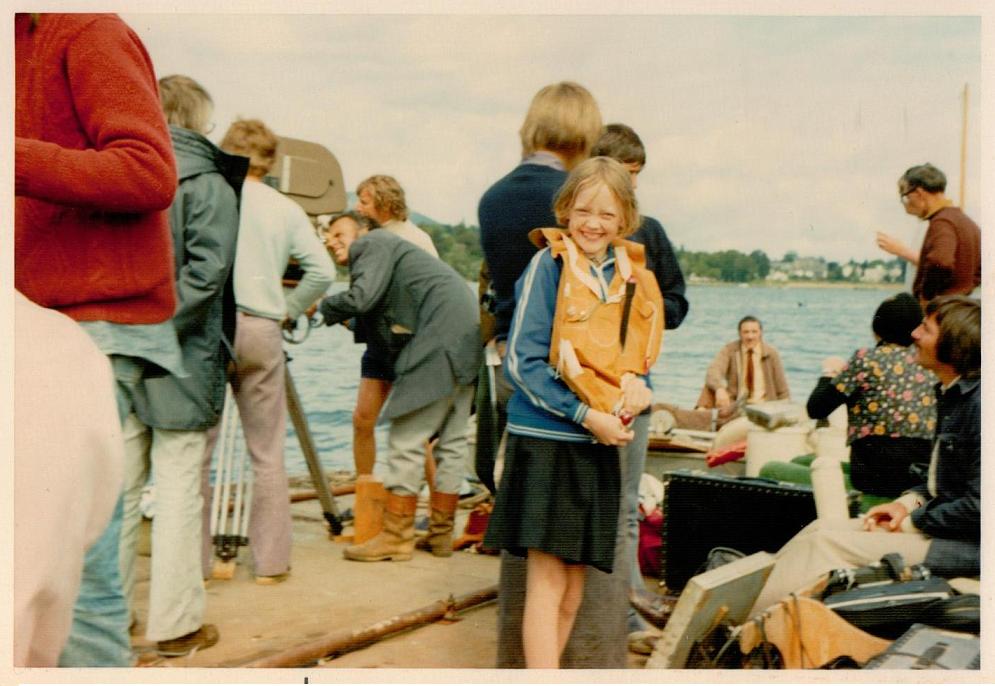
The pontoon on Derwentwater with Richard Pilbrow, Bobby Sitwell, Denis Lewiston, Claude Whatham, David Cadwalader and Sophie Neville aged 12 playing Titty. Eddie Collins looks on ~ photo: Daphne Neville
Sophie Neville on the camera pontoon on Derwentwater – photo: Daphne Neville
The first Amazon, a chunky sea-going fourteen-footer with a standing lugsail purchased in Barrow-in-Furness by the Altounyan family in 1928, was originally called Mavis. After being restored, she was renamed Amazon in line with Ransome’s books but remains too leaky to take out. She now resides in the John Ruskin Museum at Coniston where she can be visited like a great aunt.
None of us children knew that the Amazon we sailed had been used in the 1963 BBC adaptation of Swallows and Amazons made in black and white with Susan George playing ‘Kitty’ as Titty was renamed. Looking at the photographs, it would have been good if Amazon’s hull had been painted black but her varnished planks are a nod to the 1970s when everyone was busy stripping pine.
By 2003, she was owned by the White family who I met when they brought Amazon from Kent to Cumbria to feature in Countryfile and an episode of Big Screen Britain. Ben Fogle met their twin daughters on Peel Island, looking very much like Nancy and Peggy in damp bathing costumes having been swimming in Coniston Water. It has been extremely generous of them to pass such a precious boat on to The Arthur Ransome Society.
Amazon will soon be available to hire at Hunter’s Yard, Ludham
Amazon at Hunters Yard – photo: Marc Grimston
Amazon is currently being kept at Hunter’s Yard near Ludham where you can apply to sail her on the Norfolk Broads, along with the Titmouse and the Teasle, (a cabin cruiser called Lullaby) and a punt called the Dreadnaught featured in the 1984 BBC adaptation of Coot Club. Swallow is also there under restoration, needing a new keel.
Amazon being restored at Hunter’s Yard, Ludham
Amazon at Hunters Yard – photo: Marc Grimston
The plan is for both Swallow and Amazon to be on display at Windermere Jetty in Cumbria for the weekend of 29th & 30th June 2024. We hope some of the steamboats used to dress the Rio scenes set at Bowness-on-Windermere such as Osprey and George Pattinson’s launch Lady Elizabeth can be in attendance. Windermere Jetty is currently restoring the steam launch Esperance used by Ransome as his model for Captain Flint’s houseboat, and you can find the fourteen-foot RNSA dinghies used in the 2016 movie of Swallows and Amazons moored in the wet dock.
In 2021, everyone at Windermere Jetty gasped when Rupert Maas valued Swallow highly on BBC’s Antiques Roadshow, but the true worth of both Swallow and Amazon is akin to Captain Flint’s hidden treasure: instead of gold ingots his trunk contained precious memories of friendship and adventure. They no doubt kept him on course when the storms of life blew in and gave him plenty to write about. Just as Arthur Ransome’s books grant us solace, my prayer is that many will be able to grab the chance of sailing the little boats that take us into the stories immortalised on film so long ago.
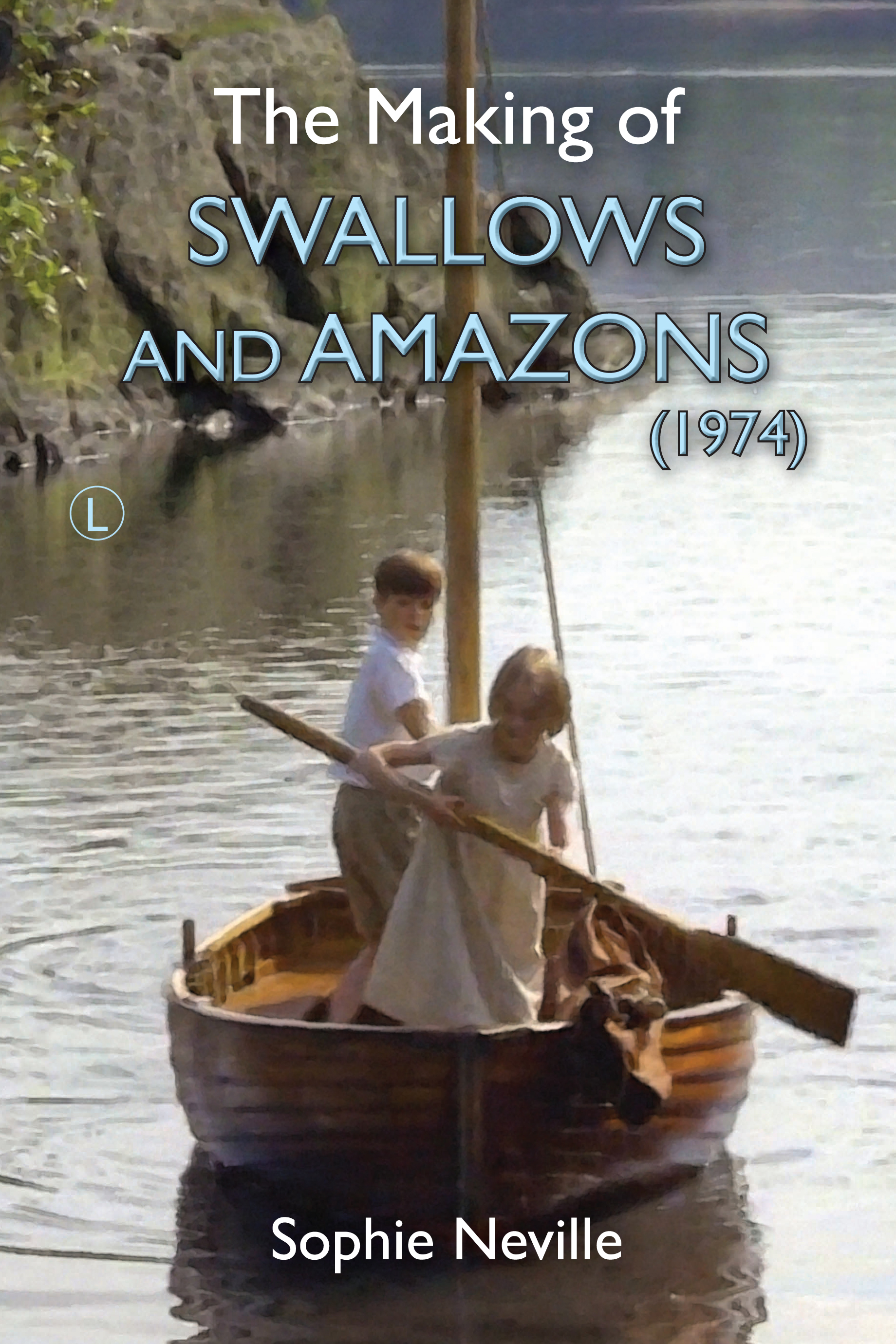
You can read more of Sophie Neville’s memories in The Making of Swallows and Amazons’, published by the Lutterworth Press and now available as an audiobook narrated by the author
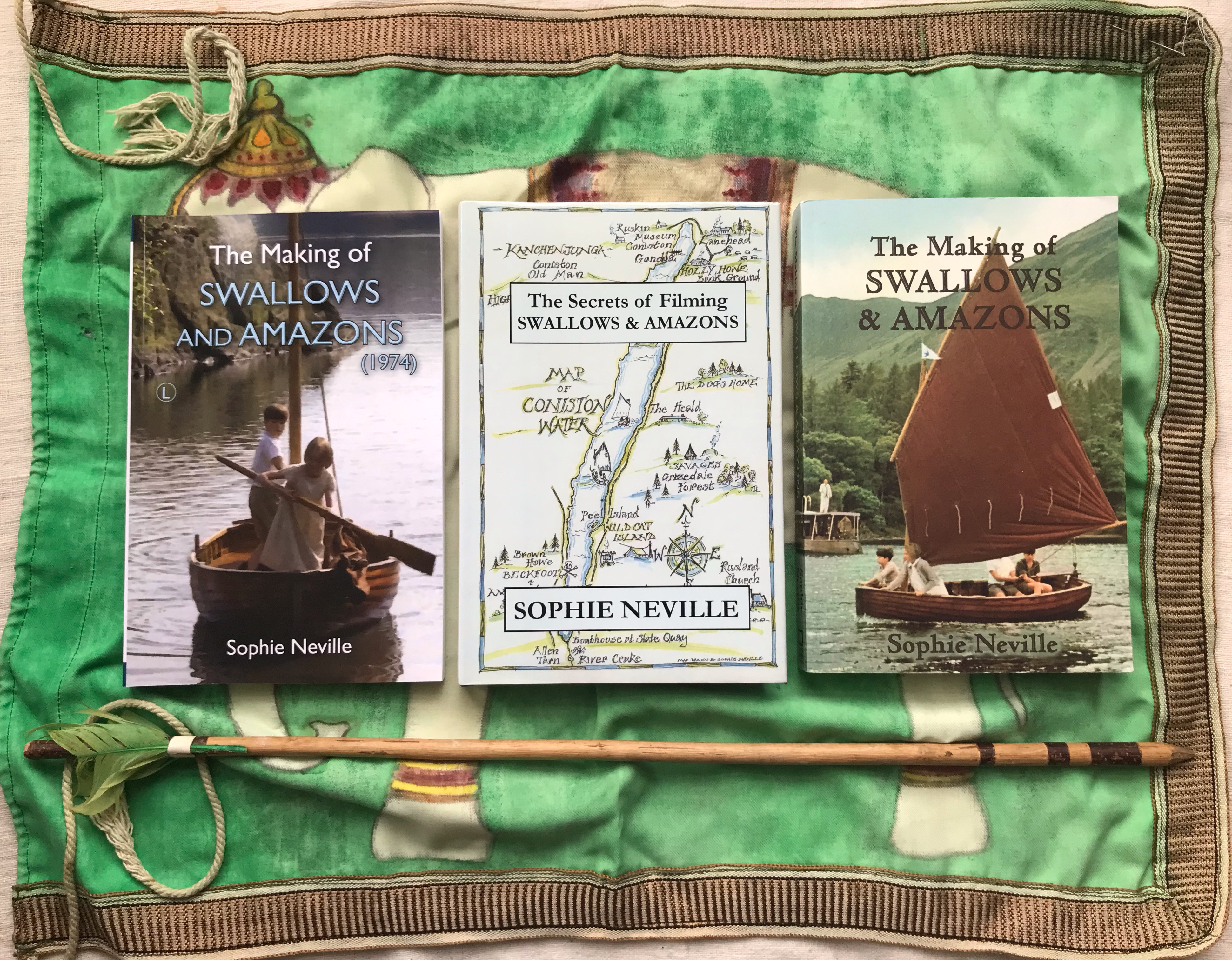
Different editions of ‘The Making of Swallows and Amazons (1974) by Sophie Neville’
Thanks go to all those who have looked after and lovingly restored the inspirational boats that appear in the adaptations of Arthur Ransome’s books. If you would like to help by making a donation towards the restoration, the link is:
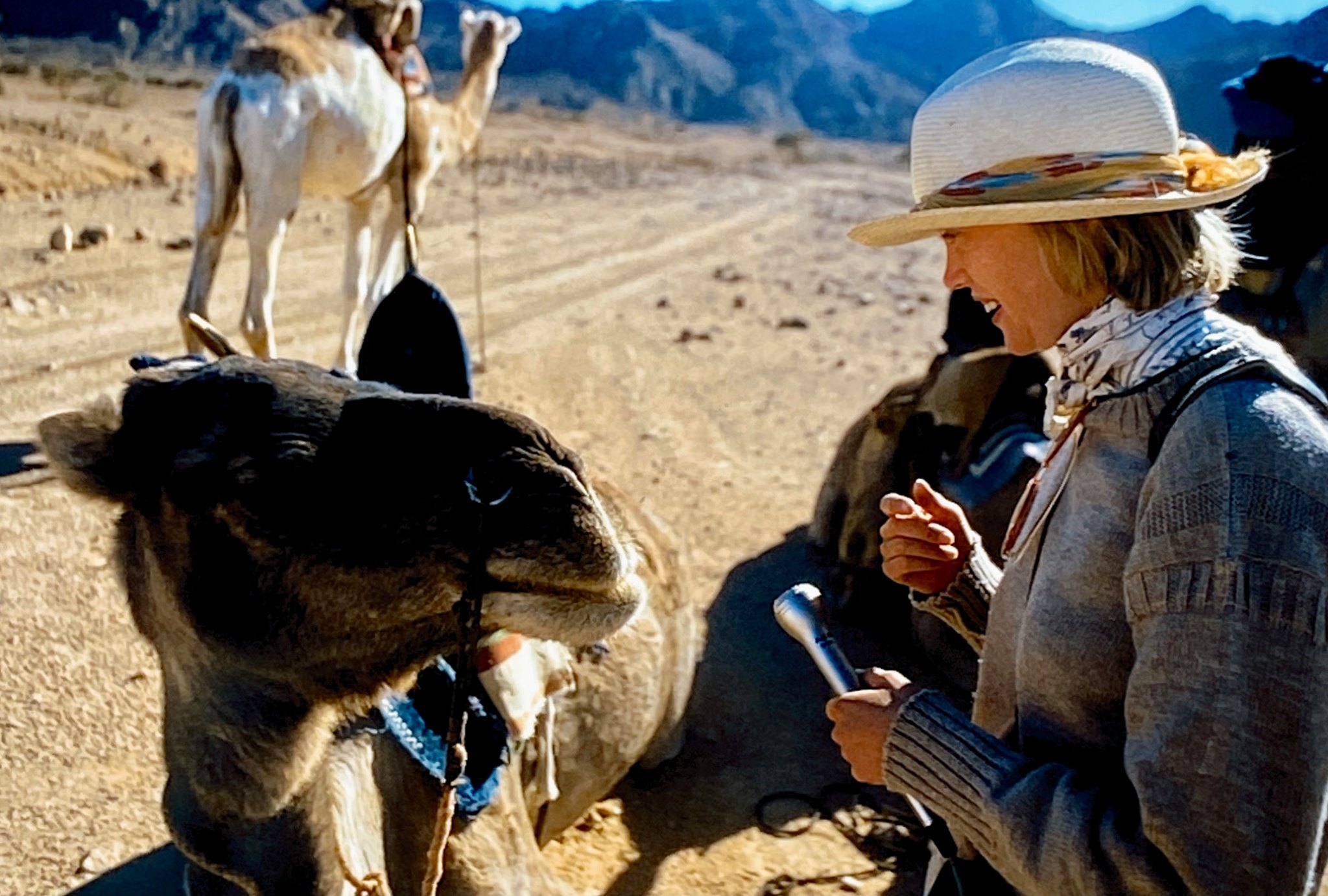
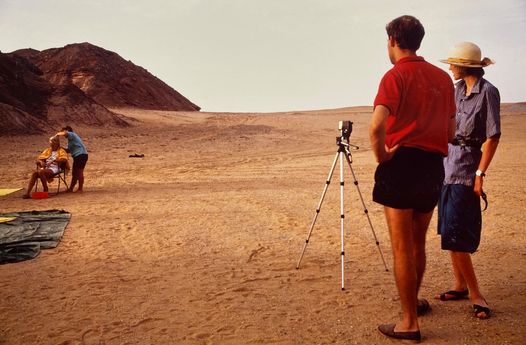
People often ask how making the original film of ‘Swallows and Amazons’ influenced my life. What struck me when I last saw the 1974 film trailer on Amazon Prime was that it begins with Titty saying, ‘The endless trek, through the Sahara Desert…’ In 1985, I did just that, crossing the Sahara on an expedition led by Charlie Mayhew, now CEO of the charity TUSK. I made my first documentary on the aid projects we worked on when we eventually reached Kenya. Had uttering those lines when I was little influenced my decision to drive from London to Johannesburg?
Sophie Neville on an endless trek, crossing the Sahara Desert – photo James Lindsay
People who know Arthur Ransome’s books are able to point out where the original film of Swallows and Amazons made mistakes. Janet Mearns noted that the Swallows ‘certainly didn’t take enamel mugs’ camping, ‘because they took extra in case of breakages.’ I had never noticed!
Andrew Clayton pointed out that, ‘Someone (Hugh Brogan?) Said that John was the lad he wanted to be. Titty, while based on an original person, carries some of his dreams and literary interests.’
Making a film while crossing the Sahara Desert in 1985
Peter Wright, former chairman of The Arthur Ransome Society, noticed that I sang ‘Adieu and Farewell’ instead of ‘Farewell and Adieu to you fair Spanish Ladies’ as the Swallows sailed from the jetty below Holly Howe. I now realize this mistake may have been due to the influence of ‘The Sound of Music’, which was the first movie I ever saw in the cinema. Captivated by the big screen at the age of four, I must have had the lyrics – ‘So long, farewell, auf Wiedersehen, adieu, Adieu, adieu, to yieu and yieu and yieu,’ imprinted on my brain.
I didn’t sing very well, but one of the secrets to the integrity of the film was that there was no vanity. None of us sought to further ourselves. Self promotion was an unknown concept. We had no personal agenda. We were not there for the money or any reason other than to live out the life portrayed in the books. All of us spurned the publicity and still find it surreal.
Someone also said how much they would have loved to live through a scene from ‘Swallows and Amazons’. We were fortunate enough to live through an abridged version of the book, which is what my parents hoped. It must have been one reason why my headmistress let me take a term off school to appear in the film.
Sophie Neville writing letters from Africa with the author Rebecca Hunter
Since then I went on to lead a ‘Swallows and Amazons’ style life, exploring unchartered territory, which isn’t always easy, I was touched when a fan of the books wrote:
‘Arthur Ransome has helped me through some very difficult times – when you are at your wits end to know what to do or where to turn, it is so refreshing to return to the Lake, or Norfolk, to a peace and tranquillity where you can forget your problems and just enjoy the adventures of the Swallows, Amazons, D’s, Coots, wherever you happen to be.’
Sophie Neville in a vehicle that we submerged in Moremi. The shoes were later stolen in Mosambique, the Toyota in Johannesburg ~ photo: Rebecca Hunter
Nigel H Seymour wrote, ‘…every-time I put the ‘Swallow’s and Amazon’s film on, I’m transported into another dimension and another time. it’s so very refreshingly simple and innocent, it radiates with a romanticism and happiness which has sadly been lost now for ever, but luckily we have the film and we still have ‘You’….. to keep the memory alive!’
The audiobook of The Making of Swallows and Amazons (1974
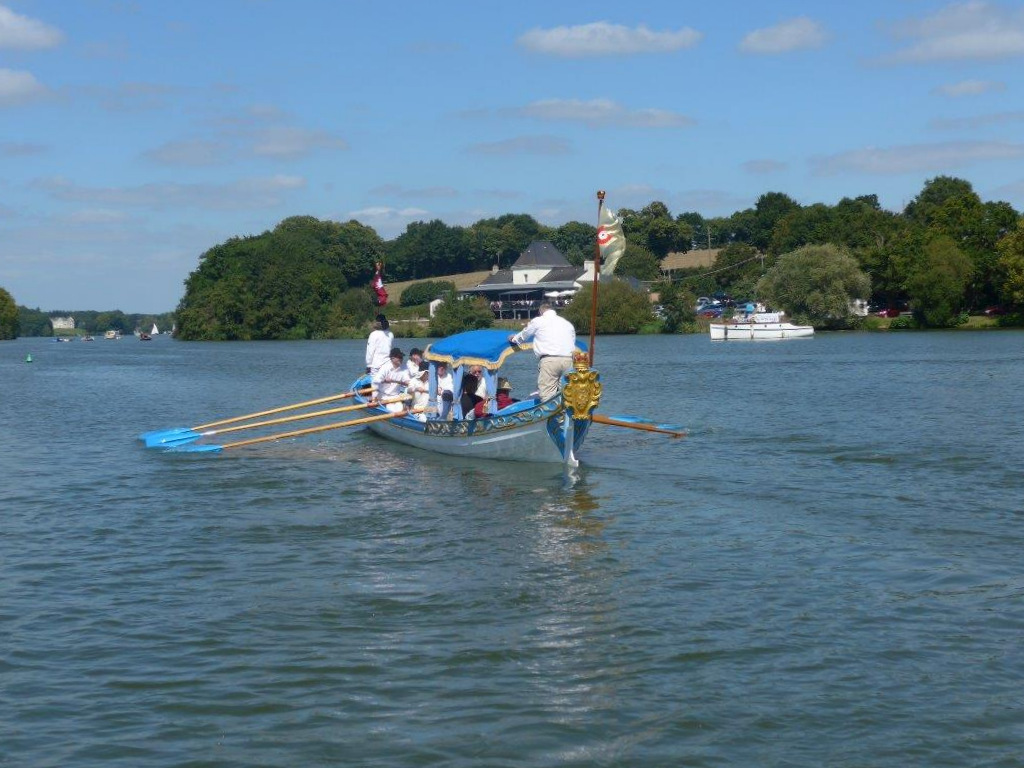
You know what it’s like; you never see photos of yourself on holiday until someone else sends them to you. Here I am, rowing in the bow of the Drapers’ shallop. By some miracle we seem to be together, in that our blades are barely visible.
The most challenging task for me is raising my oar in salute, as we did here for our landlady:
The long oars are heavy. The only way I can raise mine is by putting one end under my foot.
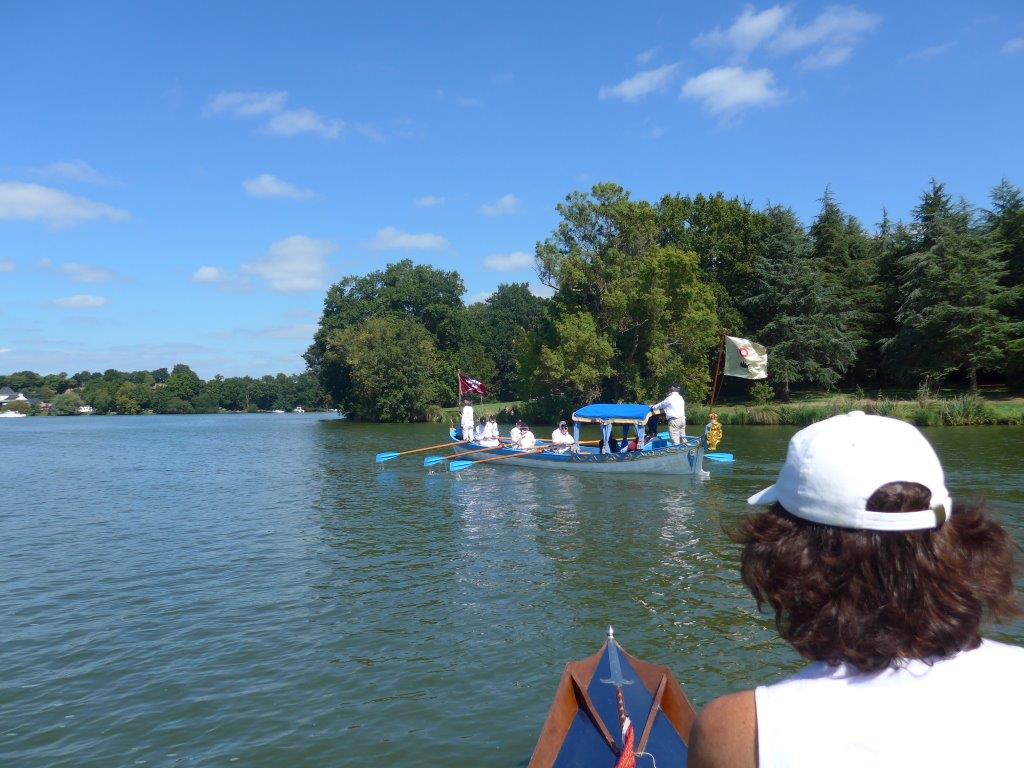
My fellow rowing club member who took these shots from the water explained that his camera unexpectedly went into an ‘Impressive Art’ setting. Although this looks like a painting, it was for real, taken out on the water from a sandolo.
As you can imagine, the whole trip took quite a bit of organising, but it was worth it. This shot was also taken on art mode.
While some of us worked really rather hard on our holiday, others enjoyed the river from a different perspective.
Next week, on Wednesday 24th and Thursday 25th September, The Draper’s Shallop will be taking part in Countryside Live at Lee Valley in the London Borough of Hackney, when children from the inner city of London will get a chance to pull an oar and experience what it feels like to travel on the river as Queen Mary once did. I’m volunteering on the Thursday.
On Saturday 27th September, she will be competing in London’s river marathon along with 300 other crews. The course of the The Great River Race starts at London Docklands, with vessels rowing up the River Thames under all the great bridges of the capital to Ham House in Richmond, passing under Kew Bridge at about 3.00pm. Let me know if you spot her!
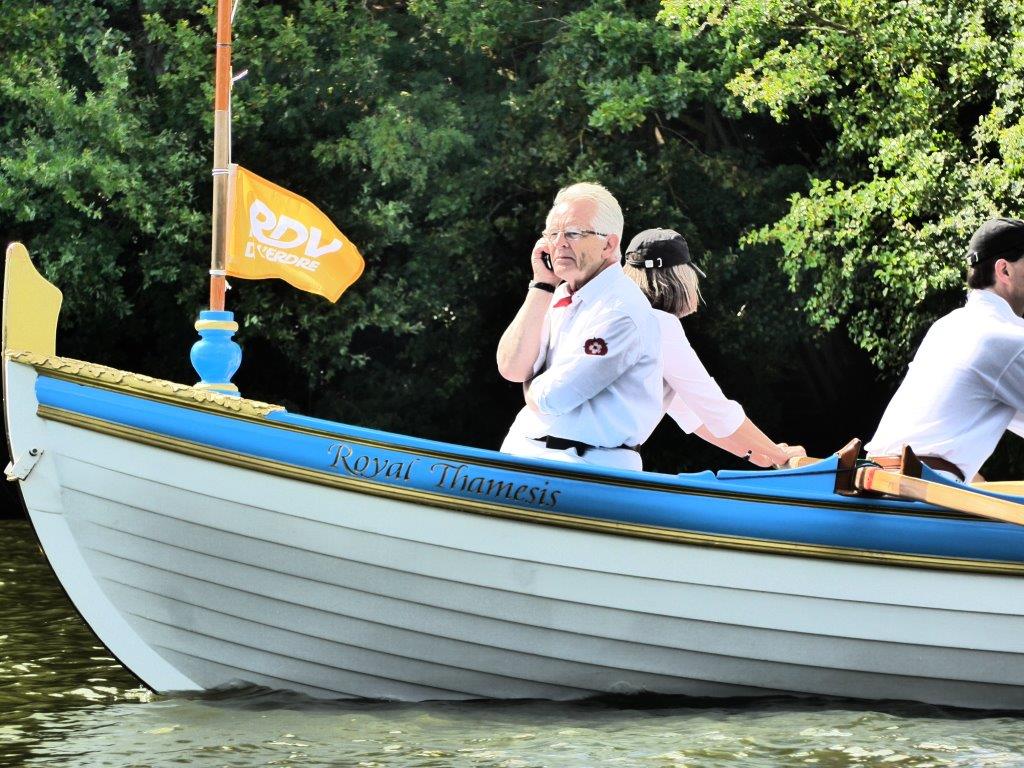
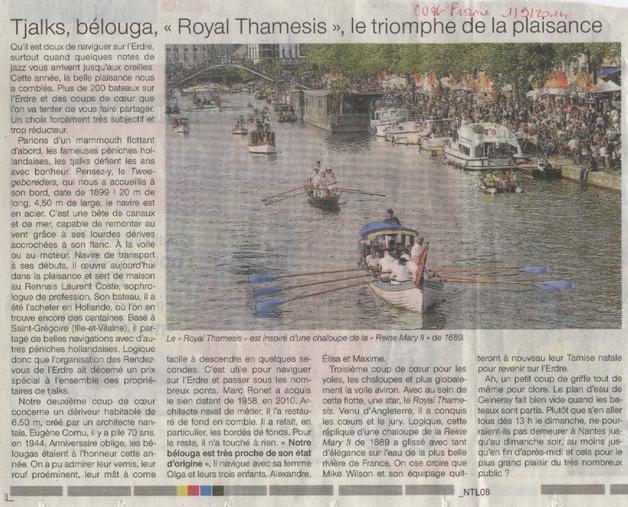
A newspaper report has just arrived from Nantes in France, where we arrived on 30th August in our shallop, the Royal Thamesisand Serena, a sandolo belonging to our rowing club, City Barge. As I explained in my previous post, we’d been asked to lead a procession of historic boats into the city as feature of their jazz festival – an activity holiday with a difference.
I’ve also been sent these photographs of the sandolo, showing our standing up oarsmen being applauded by the crowds.
The traditional French rowing boats taking part such as Fille de la Loire, were also admired by thousands.
Although a couple of gondolas took part, accompanying us some way down the River Erdre, I don’t remember seeing them in Nantes.
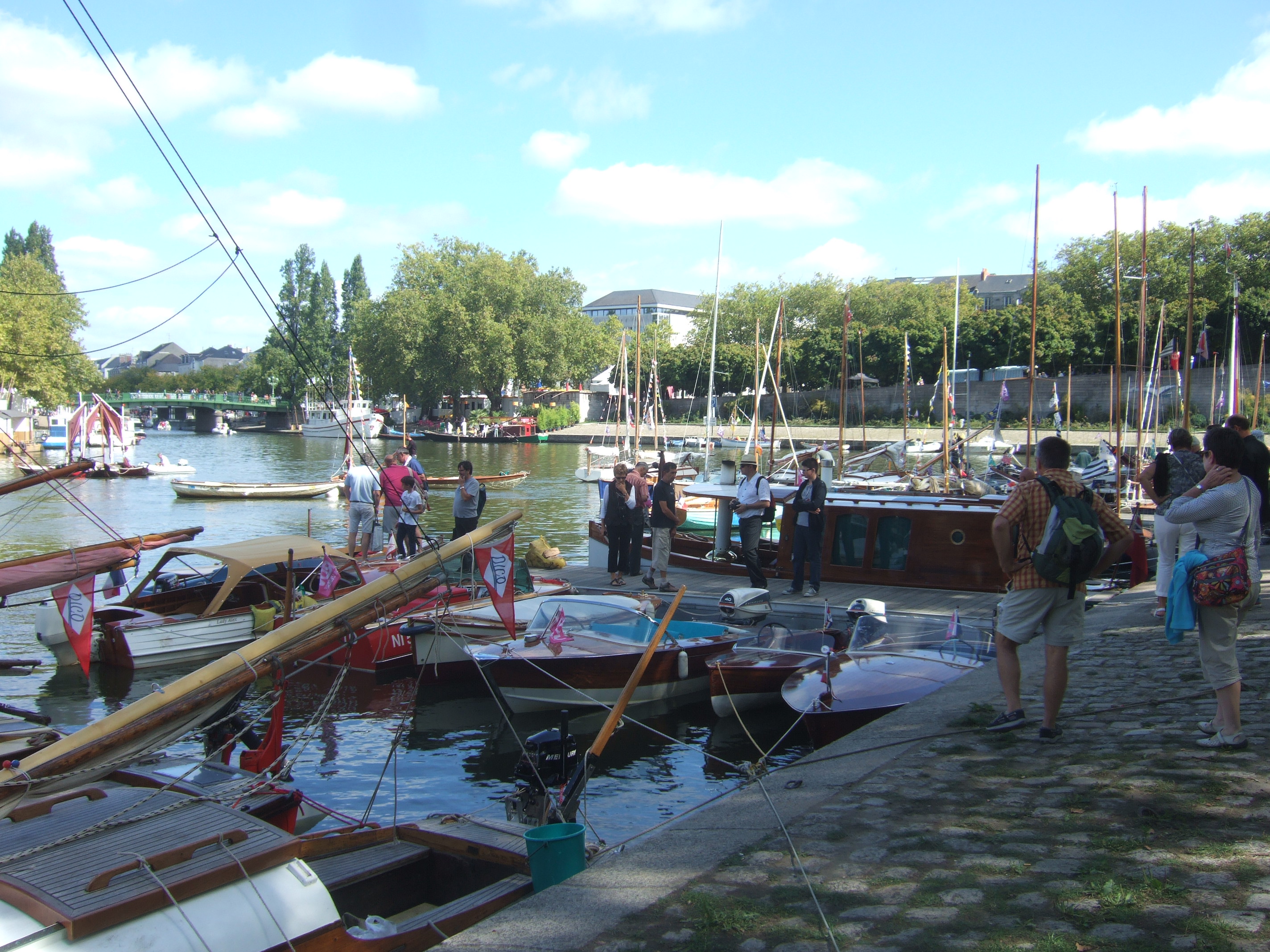
The 240 vessels taking part ranged from sleek period motorboats to a barge once used to transport cattle, which was now taking jazz musicians downriver.
I loved seeing the steam boats or bateaux vapeur, including Ursula who was flying the flag of the SBA or British Steam Boat Association we once belonged to as a family.
After mooring up in the basin at Nantes,
the Mayor of the city treated us all to the most fabulous reception at the Hotel de Ville.
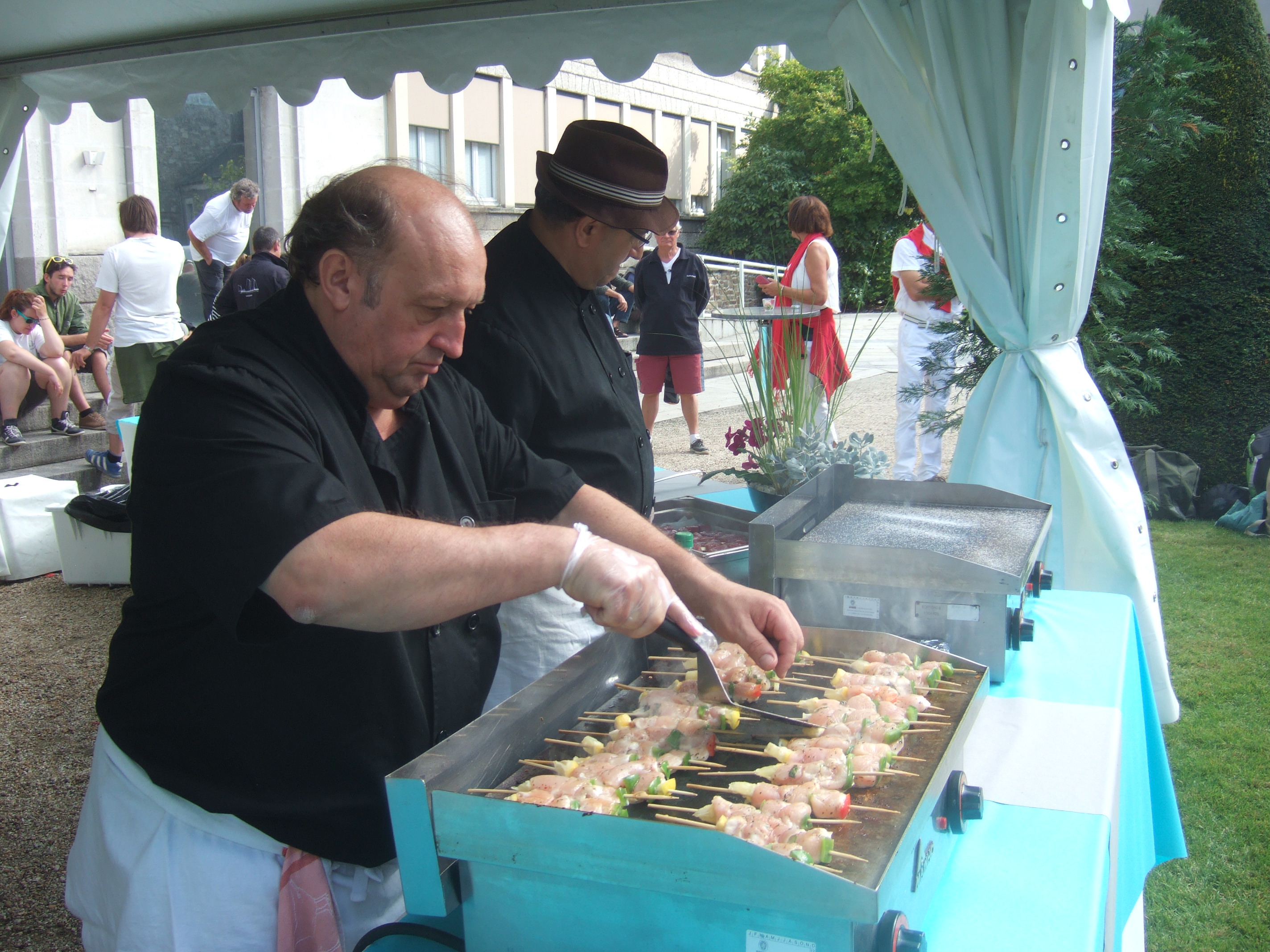
We found that a feast awaited us. Hungry sailors and oarsmen were rewarded for their efforts with a variety of delicious things to eat and local wines.
A few years ago, on a wet but beautiful day in Cumbria, we set off on a quest to find some of the locations used in Richard Pilbrow’s 1974 film of ‘Swallows and Amazons’.
To my delight our journey started with a drive down through the streets of Rio (Bowness) and along the east shore of Windermere to the Lakeside and Haverthwaite Railway Station at the southern end of the lake (or Antarctica as Titty labelled the region). It was here that we spent our very first day filming ‘Swallows and Amazons’ in May 1973. I had not been there since.
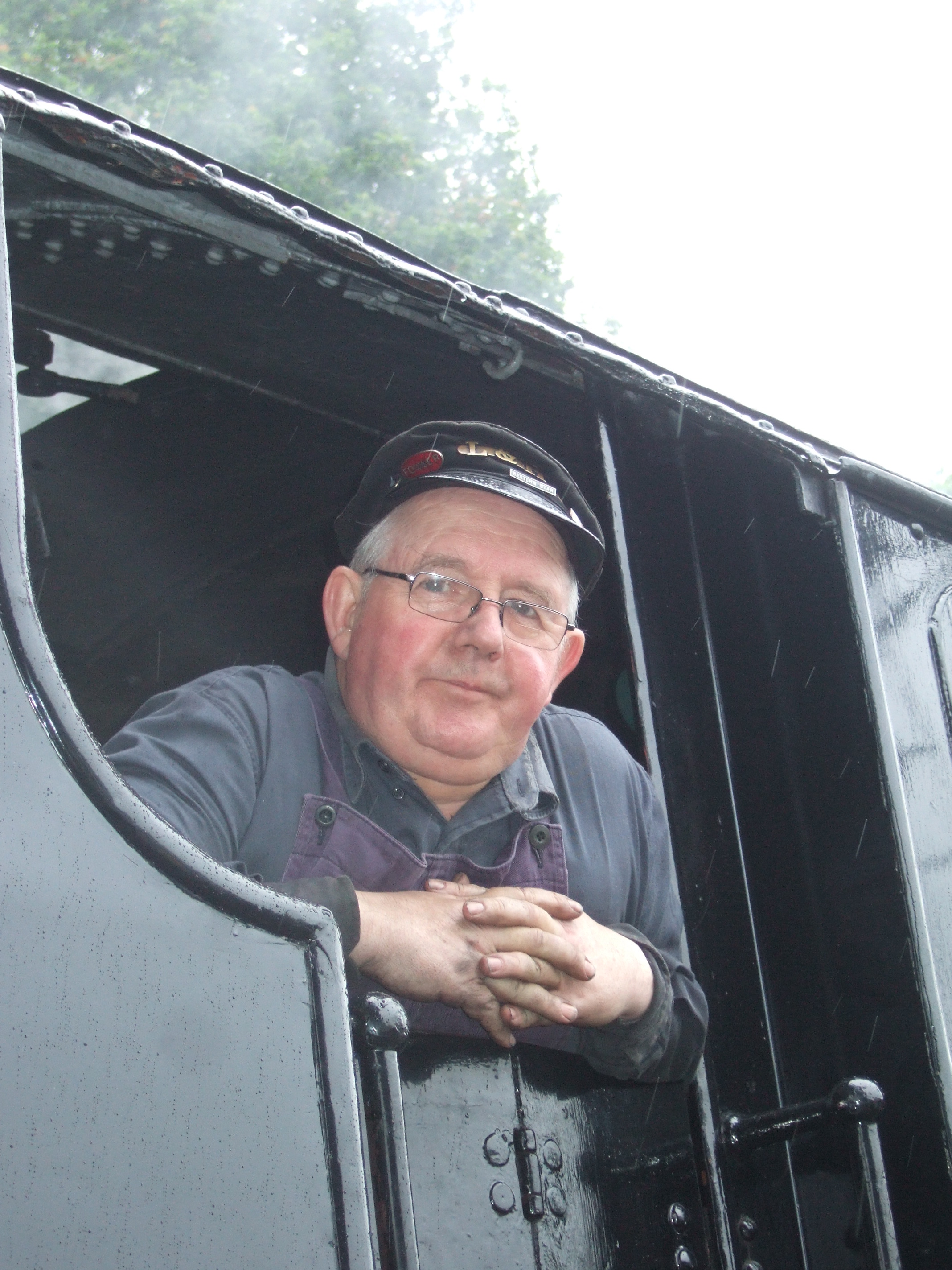
We had a chat to the train driver who explained that they now run six journeys a day. From Haverthwaite, the steam locomotives run alongside the River Leven to Lakeside Station. From here you can take a native steamer back up to Rio (the Bowness pier) or to the Far North (Ambleside, which is the town at the head of the lake where we lived whilst filming in that long distant summer when I was twelve years old.)
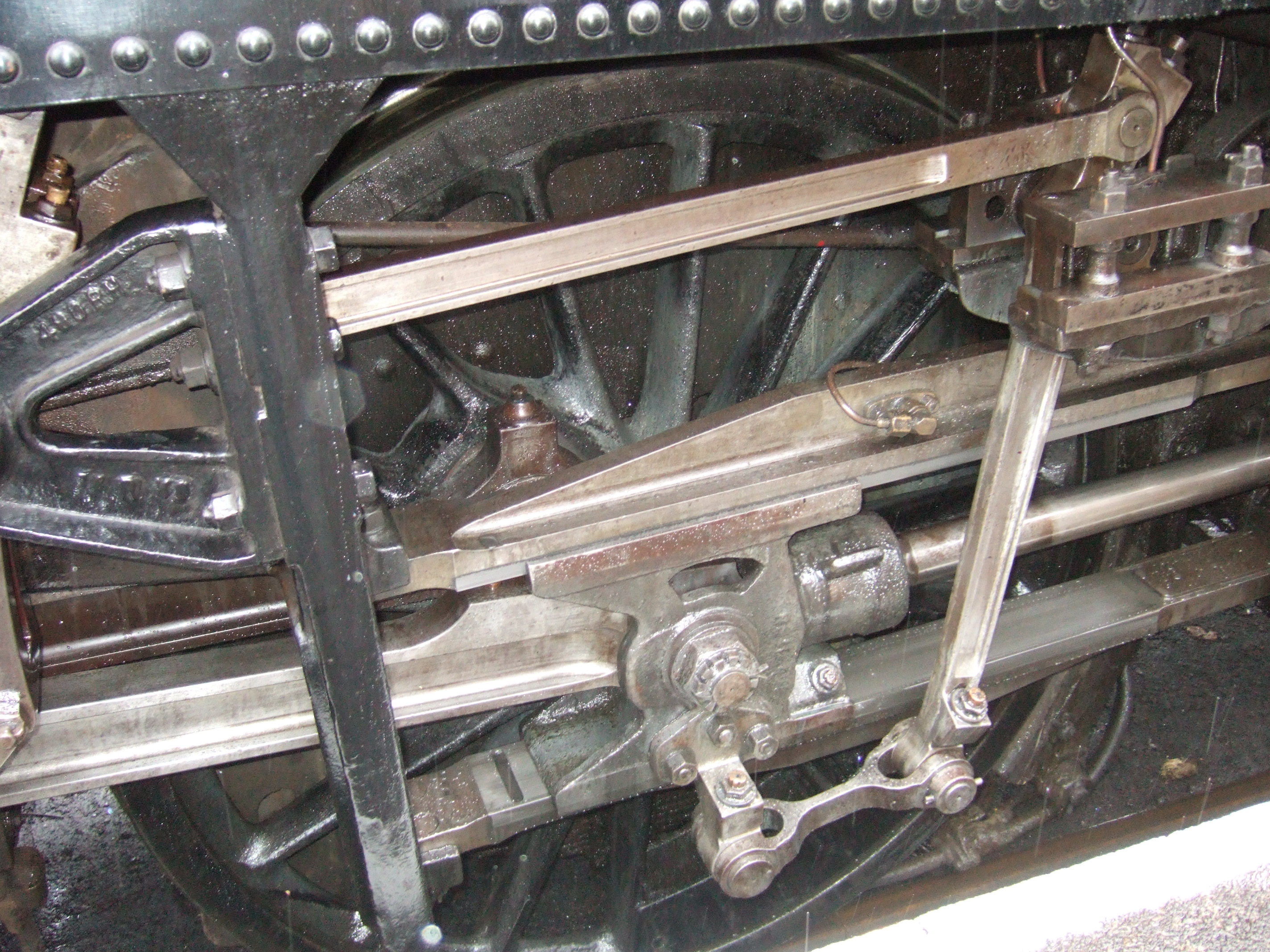
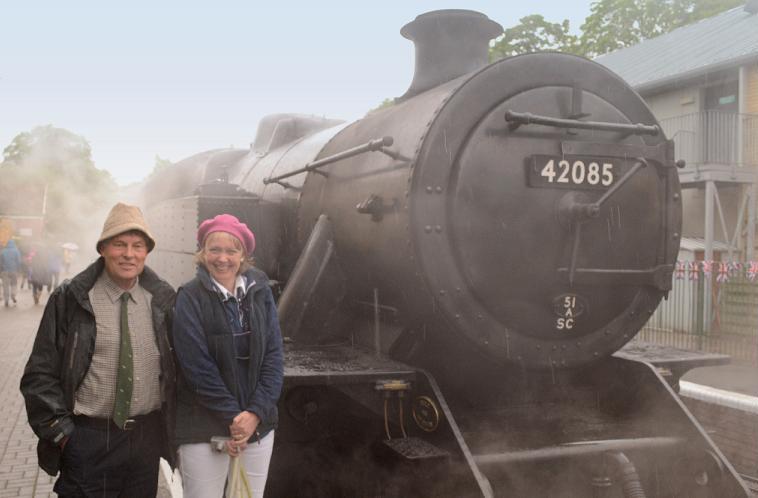
Whilst we used engine number 2073 in the movie, this steam locomotive 42085 was built in 1951. It uses about two tons of coal a day but it utterly magnificent. The driver probably uses rather a lot of steam oil too. It’s a smell I relish, familiar since childhood days spent on steamboats. I remember it from the SBA steamboat rally held on Windermere in 1991, which I describe in Funnily Enough.
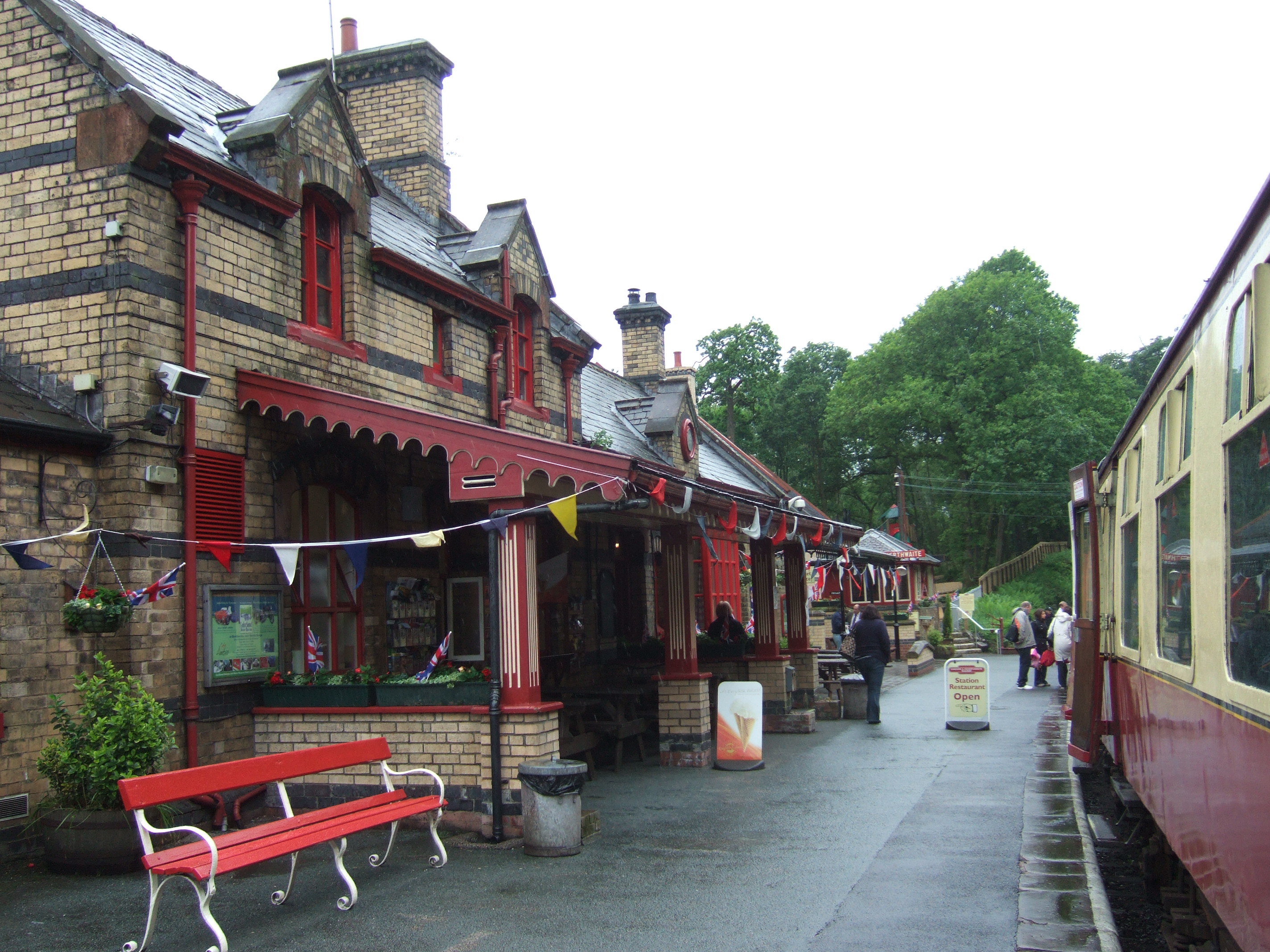
Curiously, Haverthwaite Railway Station looked cleaner and shinier than when we used it as a film location in 1973. I can only suppose it was still in the process of being restored back then, when Simon Holland our set designer cluttered it up with push bikes and luggage trolleys. Much to our surprise, the yellow taxi we were transported in during the filming was actually driven along the platform.
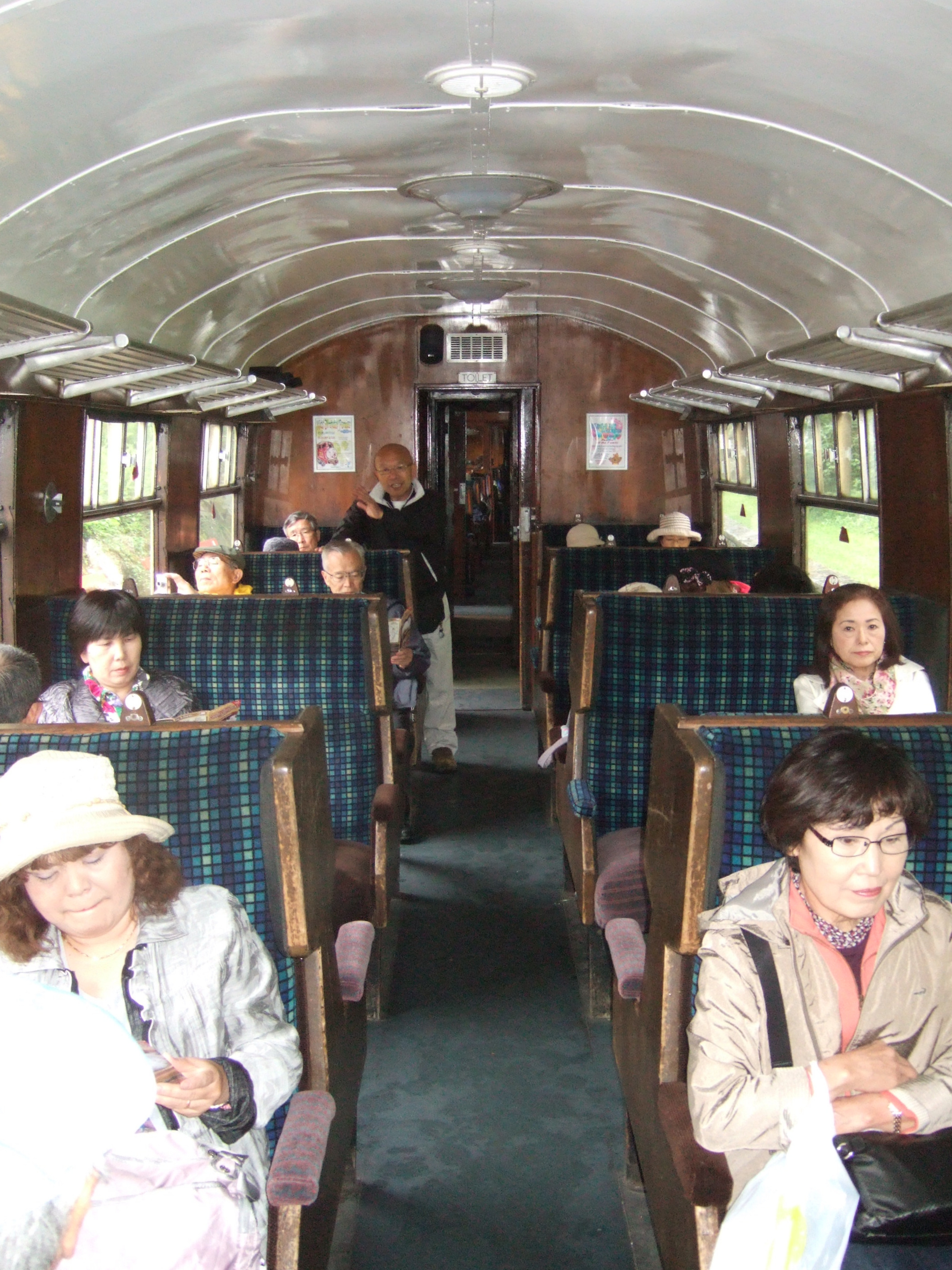
We climbed aboard the train and I explored, as Titty would have done, discovering people seated inside from far distant lands.
David Wood’s screenplay for the film of Swallows and Amazons, directed by Claude Whatham, opens to find the Walker family cooped up in a railway carriage compartment as they travel north for their holidays.
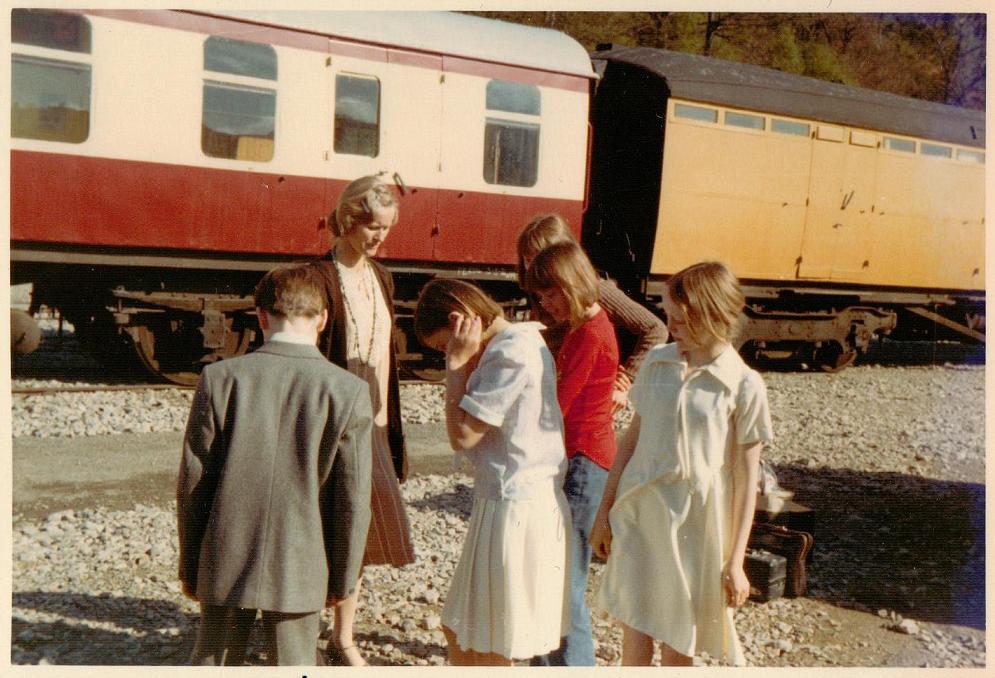
Viginia McKenna at the Haverthwaite Railway Station in Cumbria soon after it re-opened in May 1973. Simon West, Suzanna Hamilton, Lesley Bennet, Kit Seymour and Sophie Neville are with her. The carridge with compartments is in the background ~ photo: Daphne Neville
We saw this distinctive carriage in a siding as we steamed down the valley. Funnily enough when I reached home, later the next day, I came across a photograph on the internet I had never seen before. It was of Virginia McKenna, playing Mrs Walker, reading a magazine inside the compartment. Strangely it turned up when I Googled my own name – Sophie Neville.
Virginia McKenna playing Mary Walker, mother of the Swallows in the EMI feature film of ‘Swallows and Amazons’ made in 1973
The train is not included in Arthur Ransome’s book of Swallows and Amazons, written in 1929, but he does feature locomotives in his later novels, notably Pigeon Post. I clearly remember filming the BBC adaptation of Coot Club at what must have been The Poppy Line, a steam railway in north Norfolk when Henry Dimbley, playing Tom Dudgeon, jumped aboard the moving train and met Dick and Dorothea.
Peter Walker of Mountain Goat with Sophie Neville at Lakeside Station, Windermere.
I jumped off the train at the Lakeside Station to meet up with Peter Walker of Mountain Goat. Peter has carefully researched and put together a Swallows and Amazons tour, exploring ‘High Greenland’, the ‘Forest’ and ‘High Hills’ to discover the places where Arthur Ransome lived. We set off in search of the places where he fished, wrote, and drank beer. It was fascinating – and proved an excellent way to spend a day in the Lake District despite the rain.
You can read more about the locations used in the original film of ‘Swallows and Amazons'(1974) in the paperback ‘The Making of Swallows and Amazons’ available from libraries, bookshops or online here.
There is also a similar ebook, entitled ‘The Secrets of Filming Swallows & Amazons (1974)’ available from all ebook distributors including Amazon




















 Sophie Neville