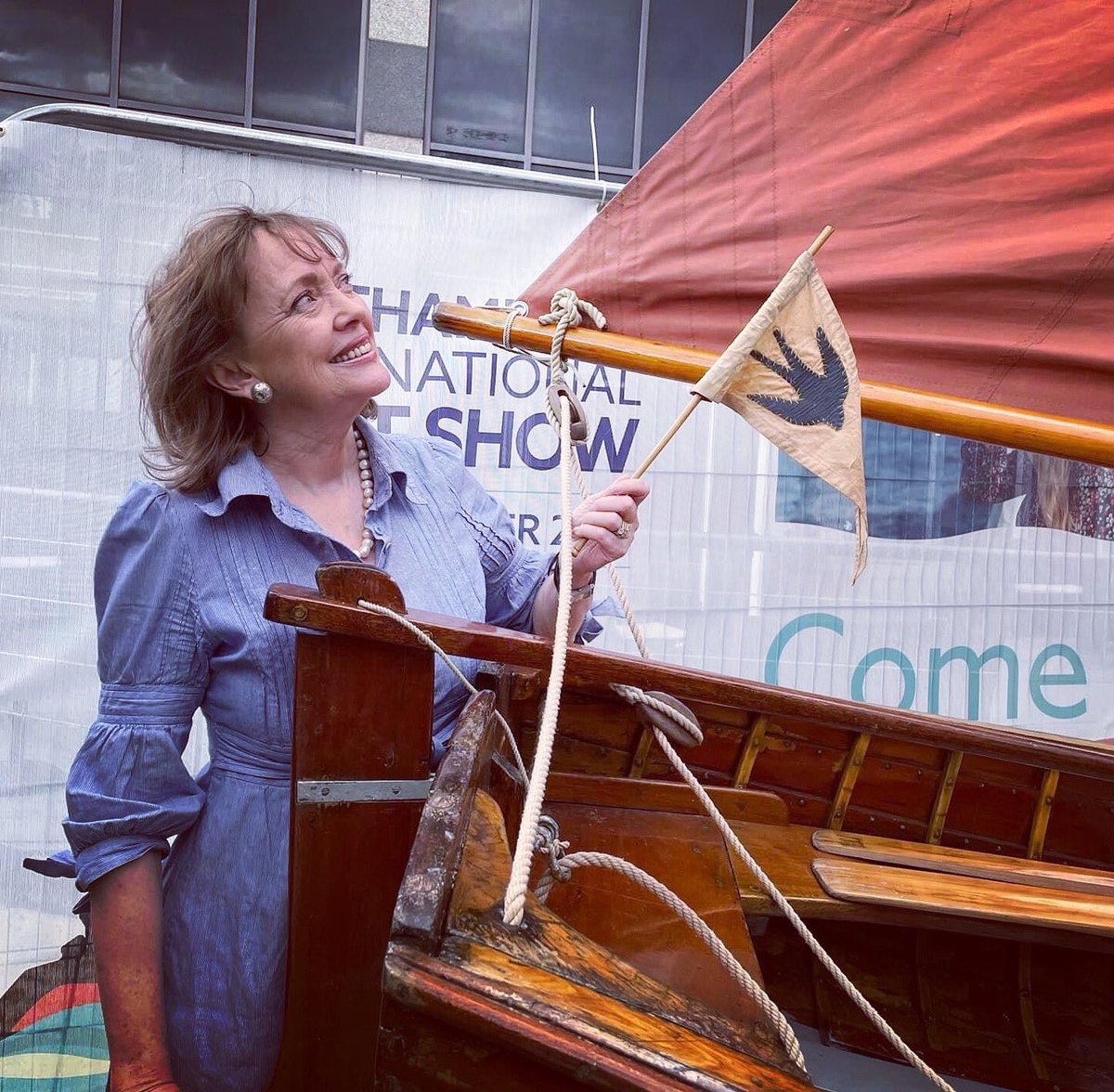
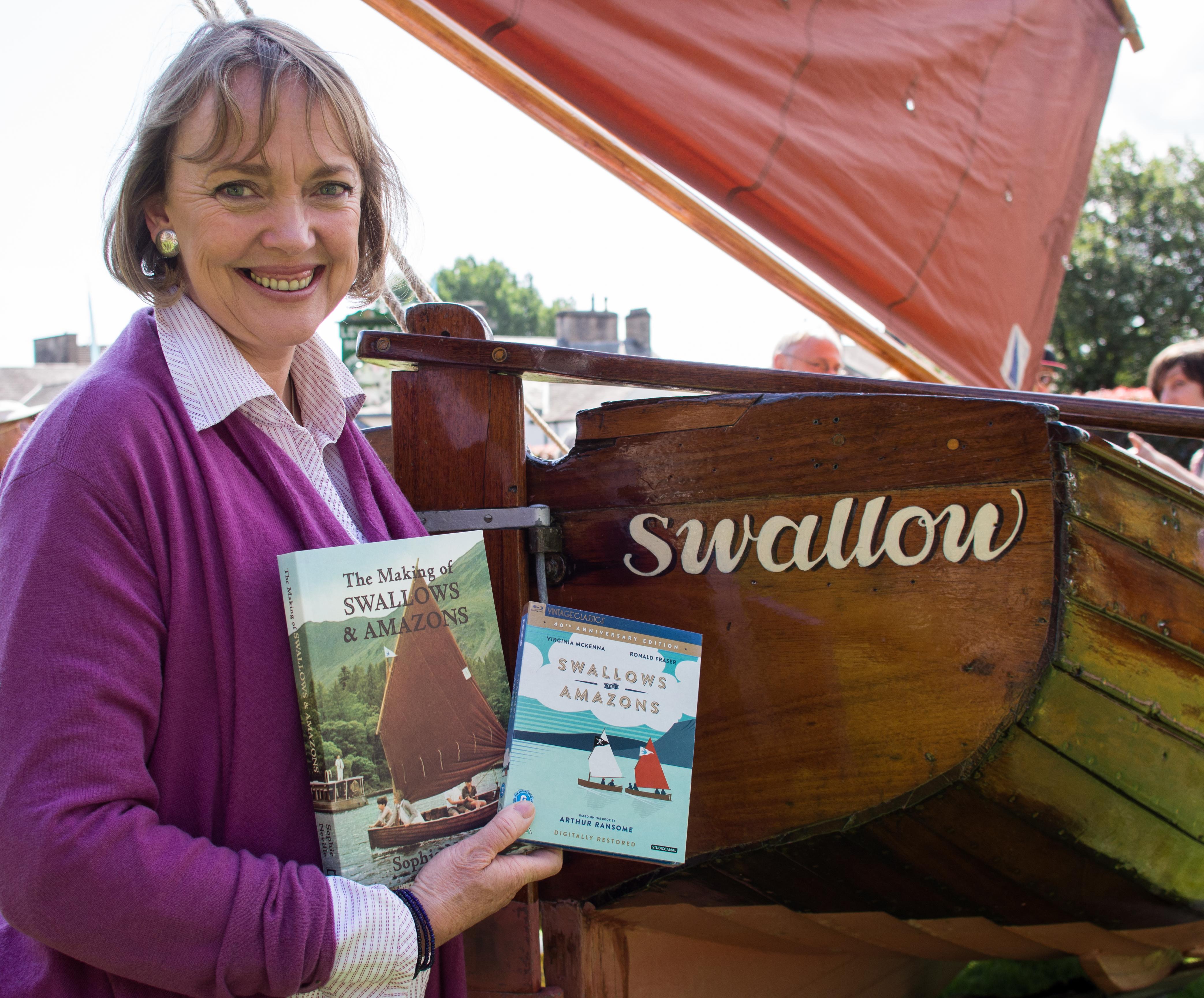
In 2022, Swallow, the dinghy that starred in the original film Swallows and Amazons was on display at the Southampton International Boat Show, greeting families as they arrive.
Sophie Neville who once played Titty Walker with her good little ship
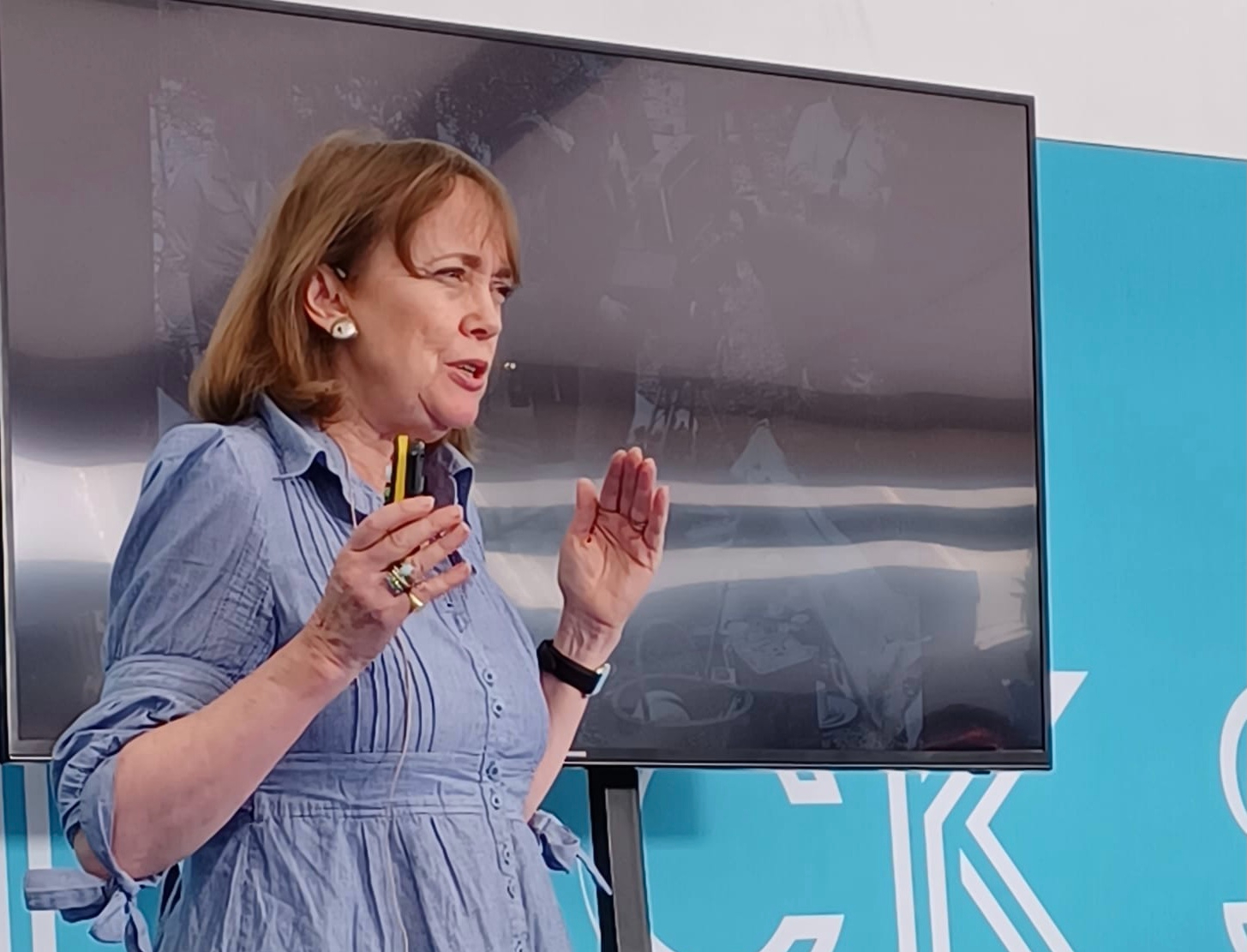
Sophie Neville gave talks on filming afloat and the movie was made on location in the Lake District fifty years ago.
Over 103,000 people visit the show. Although busy, it did not feel crowded. There is a lot to see and do.
Sophie Neville speaking on the Foredeck Stage at #SIBS22
What is most memorable about the making of ‘Swallows and Amazons’ for you?
I love exploring the places Arthur Ransome features in his stories. We were privileged to live out the pages of the book on location in the Lake District, but sailing in nothing but a short cotton dress and a pair of navy blue gym knickers was decidedly chilly – we earned our passage.
Would you consider Susan to be an influence on Titty within the story?
Susan made camping on the island possible. Suzanna Hamilton, the remarkable British actress who played Susan in the original film of ‘Swallows and Amazons’, became our rock without becoming prim or losing the joy and excitement of adventure. She went on to play leading roles in a number of major movies including ‘Out of Africa’ opposite Meryl Streep and ‘1984’ with John Hurt and Richard Burton. She is still working on cutting edge productions and recently had a guest appearance in ‘Eastenders’.
Time Out – April 1974
Is there anything you think should always be included in different versions of ‘Swallows and Amazons’?
You must feature the green parrot! It’s vital to enter the world of a 9-12 year old child, capturing the trepidation. It would be interesting to adapt Arthur Ransome’s books without featuring adults, or only including them as shadowy facilitators.
How did you feel about playing a part where you were able to be the cunning and playful younger sister?
In real life, I was the elder of three sisters so took on the roles of both John and Susan. Playing Titty felt something of a release. I was freed from the responsibility of taking the helm.
Titty is well-read and bright, creative and imaginative but I wouldn’t call her cunning. She longs to be alone on the island to experience what it was like to be Robinson Crusoe, which is why she volunteers to stay behind to light the candles, but is that a cunning plot? She is an innocent.
What was your favourite line in Swallows and Amazons?
Titty’s lines are challenging and can only be uttered with humour and an acceleration of charm. I rather enjoyed, ‘X marks the spot where we ate six missionaries’, although I don’t think it can be found in the book. ‘Thank you so much for letting us see your lovely serpent’ would probably be disallowed these days.
Did you have a favourite scene?
Finding the lighthouse tree was a short sequence that worked well. We shot it on the banks of Derwentwater towards the end of the filming. But I most enjoyed our day with the charcoal burners. They were wonderful.
What did you enjoy most about filming in the Lake District?
We loved High Force, the waterfall, and exploring the mossy woodlands. Secret Harbour on Peel Island is very special, as is One Tree Island where we found the treasure.
Do you feel that you and your character influenced children?
Even now, nearly 48 years after the film was released, I receive correspondence from people telling me how the original film of ‘Swallows and Amazons’ influenced their lives or helped carry them through a tough patch. It is always wonderful to hear how Titty has inspired others.
Maurice Thomas who used to live in Cockermouth wrote: ‘My mum and my Auntie Gladys took me to see this little children’s flick in 1974/5 as it was a double bill with ‘The Railway Children‘. I remember ‘The Railway Children‘ reasonably fondly, but ‘Swallows & Amazons‘ had me utterly mesmerised.’
If you were to give any advice to actors wanting to perform in ‘Swallows and Amazons’ what would it be?
Visit the locations. Go to Bank Ground Farm and run, fast, down the field to dip your hands in the lake as Arthur Ransome did as a child. Capture that feeling and carry it with you as you sing out the lines.
And be prepared for the impact the story will have. It could follow you all your life.
No regrets! It’s not too late to register for the Race for Reading.
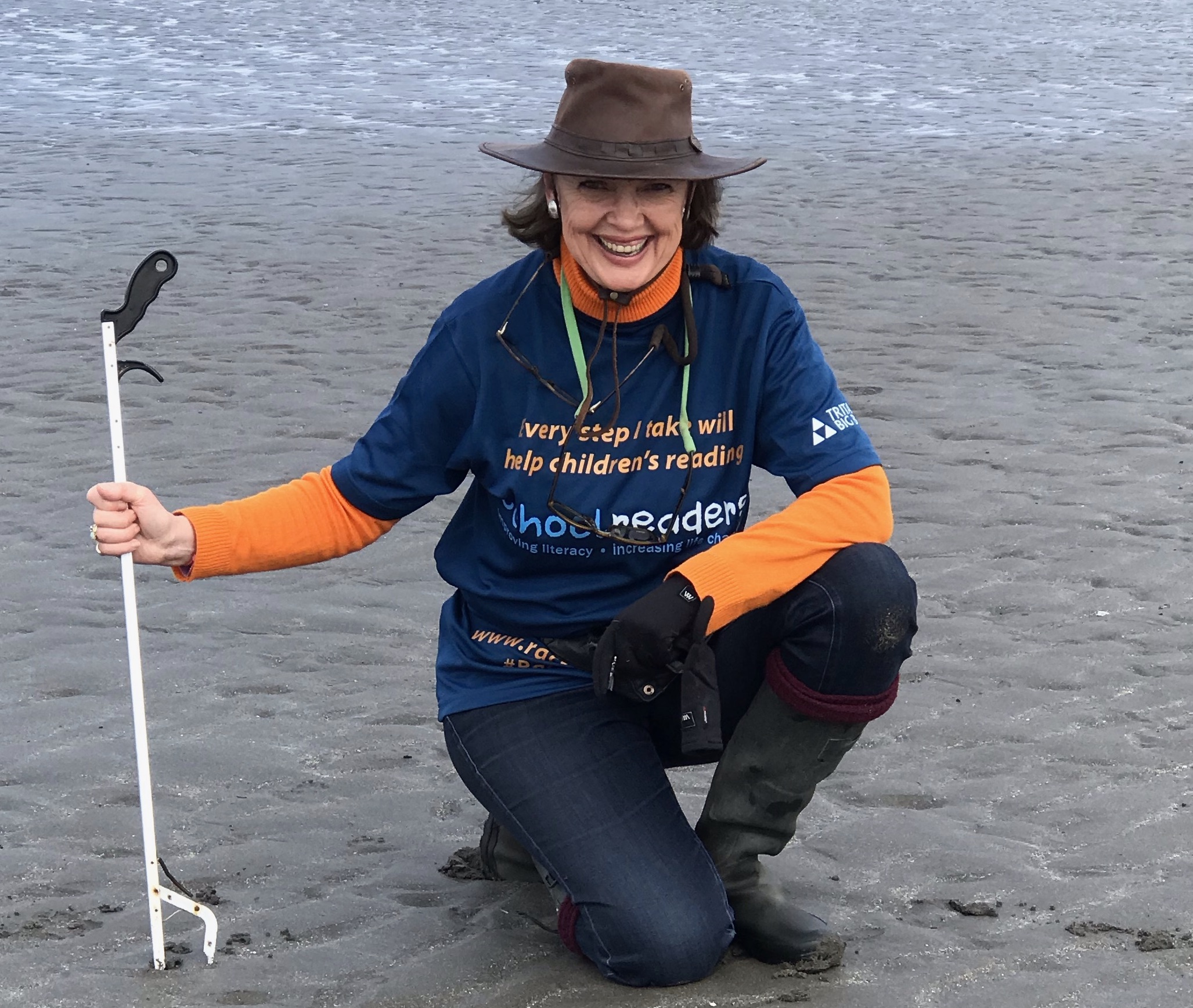
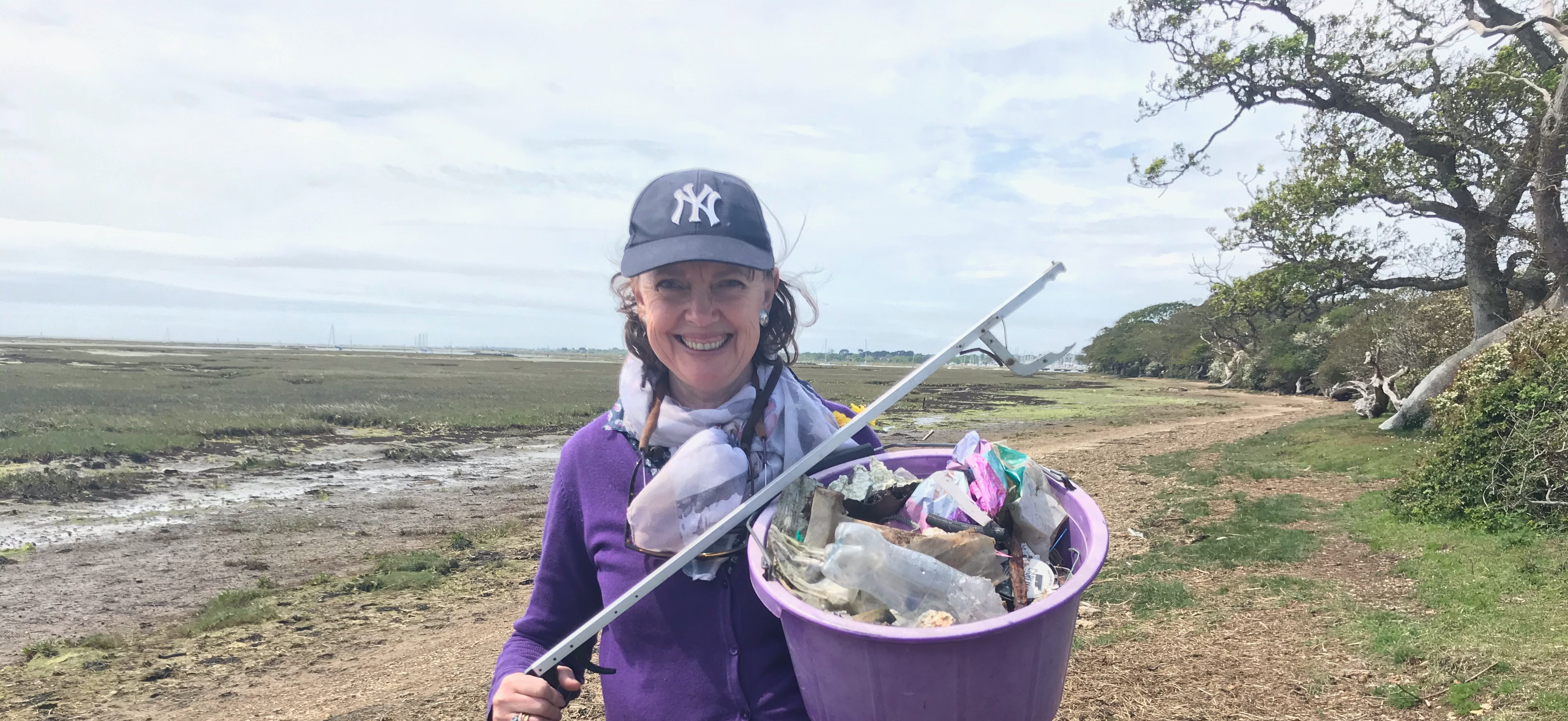
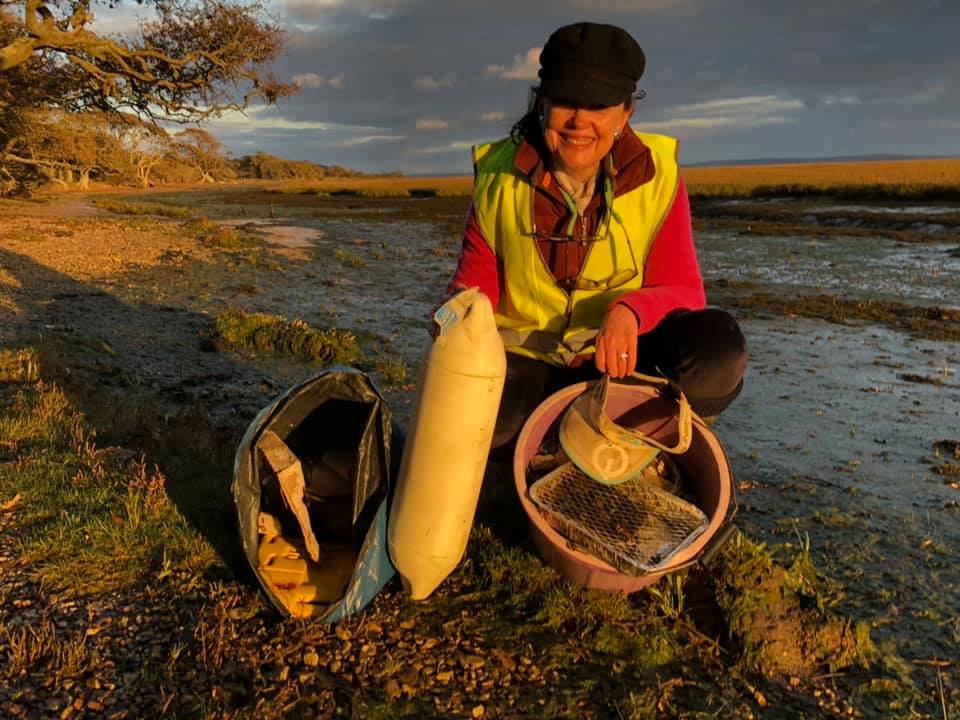
I’ve been going slowly but nothing is stopping me. My quest is to collect litter and marine plastic as I walk along the coast of the UK to raise funds for the charity Schoolreaders.
As you can see on my earlier posts, I’ve been using the alphabet as a theme.
N is for Nothing changes unless we take action
Day 14 – Another nice walk along the estuary into the small town of Newport collecting numerous wrappers and a noxious nappy dropped by numbskulls.
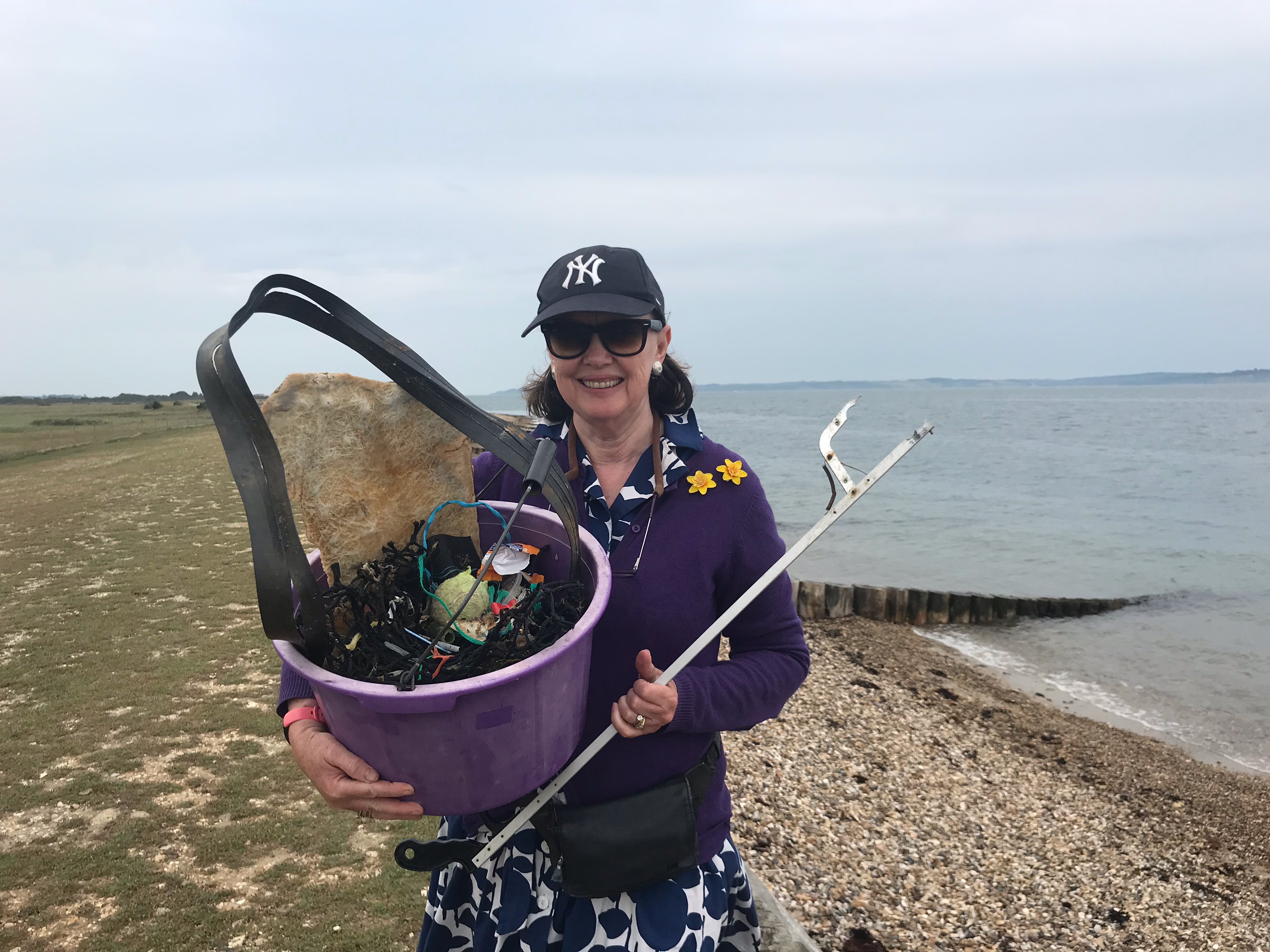
I walk another 3km later, cleaning the high tide line along the beach finding, amongst the rope and fishing line, a spoon, a sock and five poo bags. Why dog owners use tennis balls is a mystery. They contain lead and can choke large dogs.
Old tennis balls and shredded fishing net
O is for Obviously old things get outdated or ousted and litter becomes an ordinary occurrence rather than an outrage.
Day 15 – I only cover 2 kms following the coastal path to a lifeboat station but collect three old socks, a pair of knickers and half a bucket of litter. I later search the tide line for flotsam and mainly find dog poo bags and obsolete fishing line while covering another 3.5kms.
P is for Plastic –
Day 16 – I plod past a harbour collecting picnic litter, pondering on the fact I’ve probably covered 2 kms. Later I pace the tide line for 3.7kms returning with a heavy bucketful of party rubbish: plastic packaging, plastic bottles, plastic cutlery, plastic cups, plastic straws and 6-pack plastic that litters the coast. I find plenty of plastic cotton bud stalks, panty liners and packets of condoms along the shore – an indication of sewage entering the sea. PVC rope and polystyrene discarded by the fishing industry is common.
Plastic, polystyrene and PVC
Patience is needed. PPE, party poppers, plasters and ear plugs fill me with fury. I prefer picking up paddles, pegs, paintbrushes, pens and pencils since there’s a possibility they were simply lost. There’s a litter-picking prize for finding pairs of pants.
Day 17 –
Q is for quayside
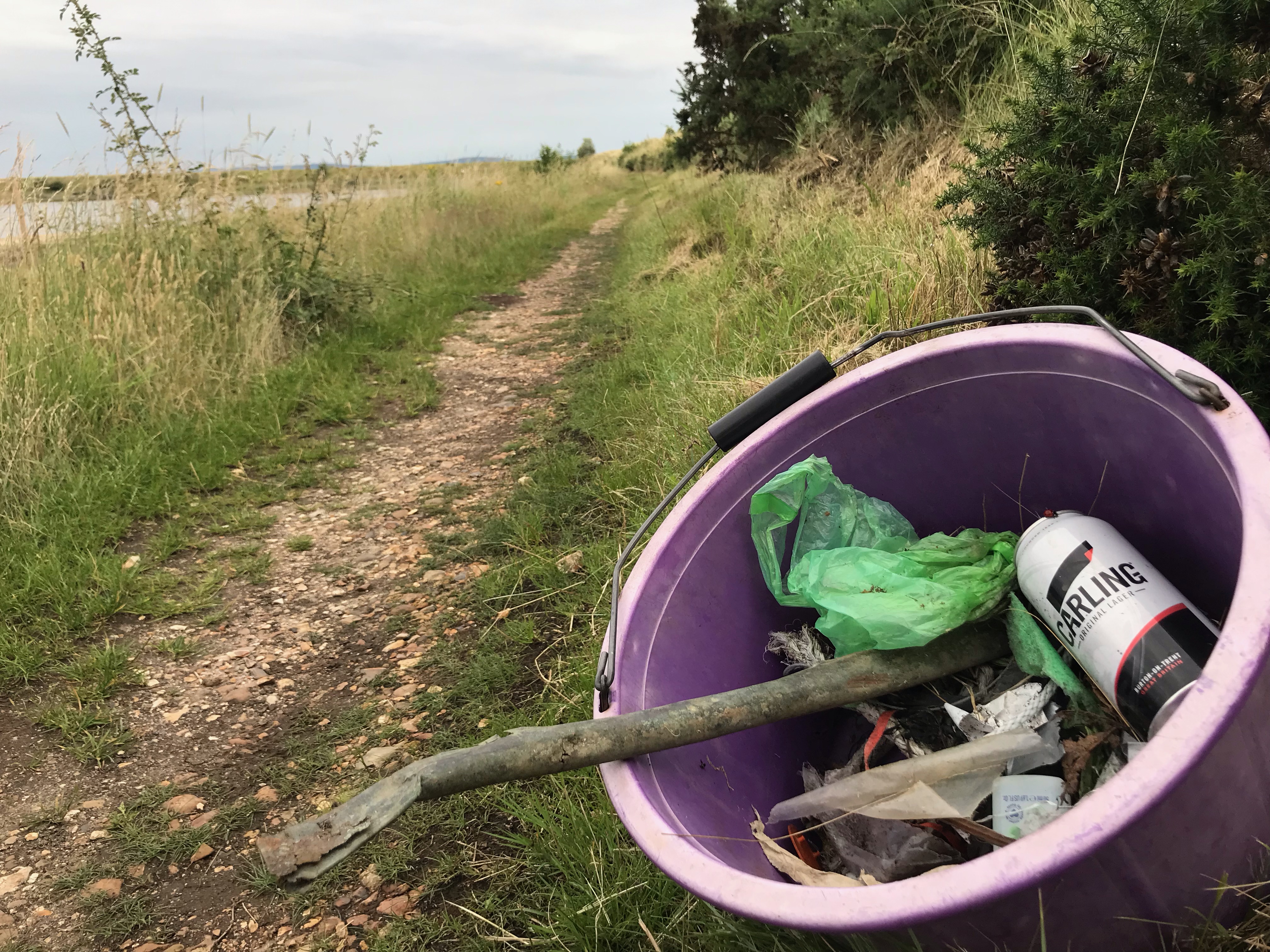
but as that is now clean, I walk up the estuary into a quaint market town. It’s quiet but I find a lot of wrappers, covering 3.9kms as I collect a bucketful of litter. The skate park posed quite a challenge. The drains there wash straight into the estuary.
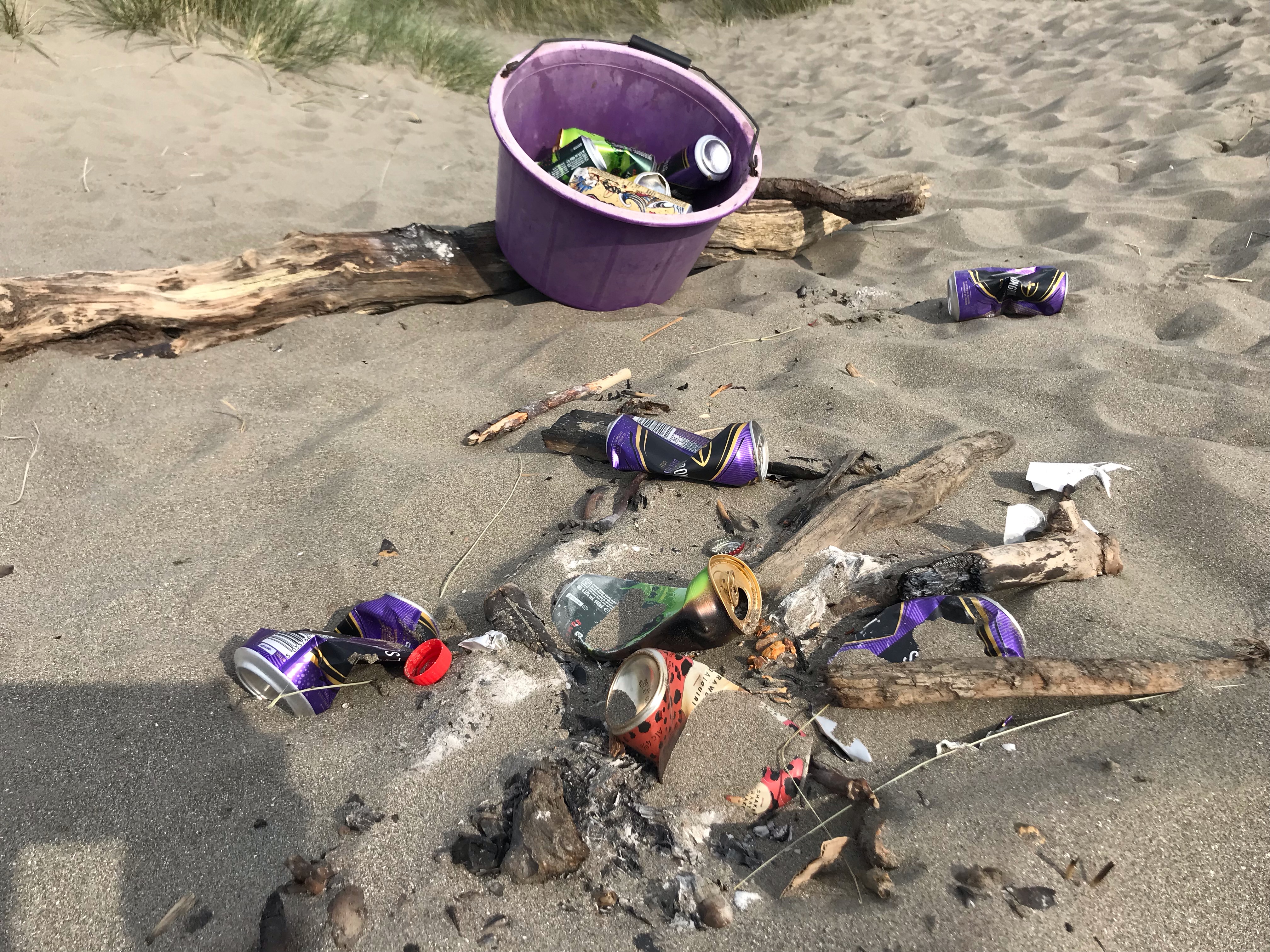
After lunch, I set out across the sand dunes finding a quantity of drink cans and glass bottles left by camp fires. The 20 bottles are heavy to lug back.
filling my bucket with picnic litter
I’ve learnt a lot since collecting litter. You see what’s happening from the underside of society. Alcohol containers are often discarded from high vehicles , rural drug taking is rife and fishing vessels are shredding nets at sea. The arterial roads of Britain are strewn with rat-infested litter loaded with human DNA. It’s surprising we are not threatened by a more serious pandemic.
Day 18 –
R is for re-cycling on the Race for Reading
I have been putting bottles or clean drink cans in the recycling bins but most coastal plastic needs to go to landfill. I scan the mudflats for ancient litter including heinous broken glass covering about 2.5km.
Day 19 –
S is for Sunshine
Silvery skies lift my spirit as I searchthe seashore for seven kilometers without seeing much flotsam. We seem to be making progress. If people see no rubbish they are less likely to drop litter.
Day 20 –
T is for tidying
I retrace my tracks traversing three kilometers to town coming across little litter. Two more kilometers with the dog and I’m tired but happy. Another two kilometers in the evening take us to a running total of 55 miles covered litter-picking so far. Logging my progress with the Race for Reading has been motivational.
Sophie Neville on Schoolreaders Race for Reading 2022 – photo by Caspar aged 7
If you would like to sponsor me on the Race for Reading 2022, I have a Justgiving page here and there are alternative ways of donating to the charity here.
Each donation will be matched by my company, and then again by SchoolReaders matched funding, so if you can donate £5 it will be magnified to £20.
Every small amount is an encouragement and will make a difference, enabling slow readers to catch up at school and gain a love for books.
I’m walking along the coast on a sponsored beach-clean, using the alphabet as my theme.
The aim is to raise funds for the charity Schoolreaders who aim to ensure every child in the UK can read fluently by the age of eleven. Shockingly, 25% fall behind. It jeopardizes their future.
Could you take part in the Race for Reading too?
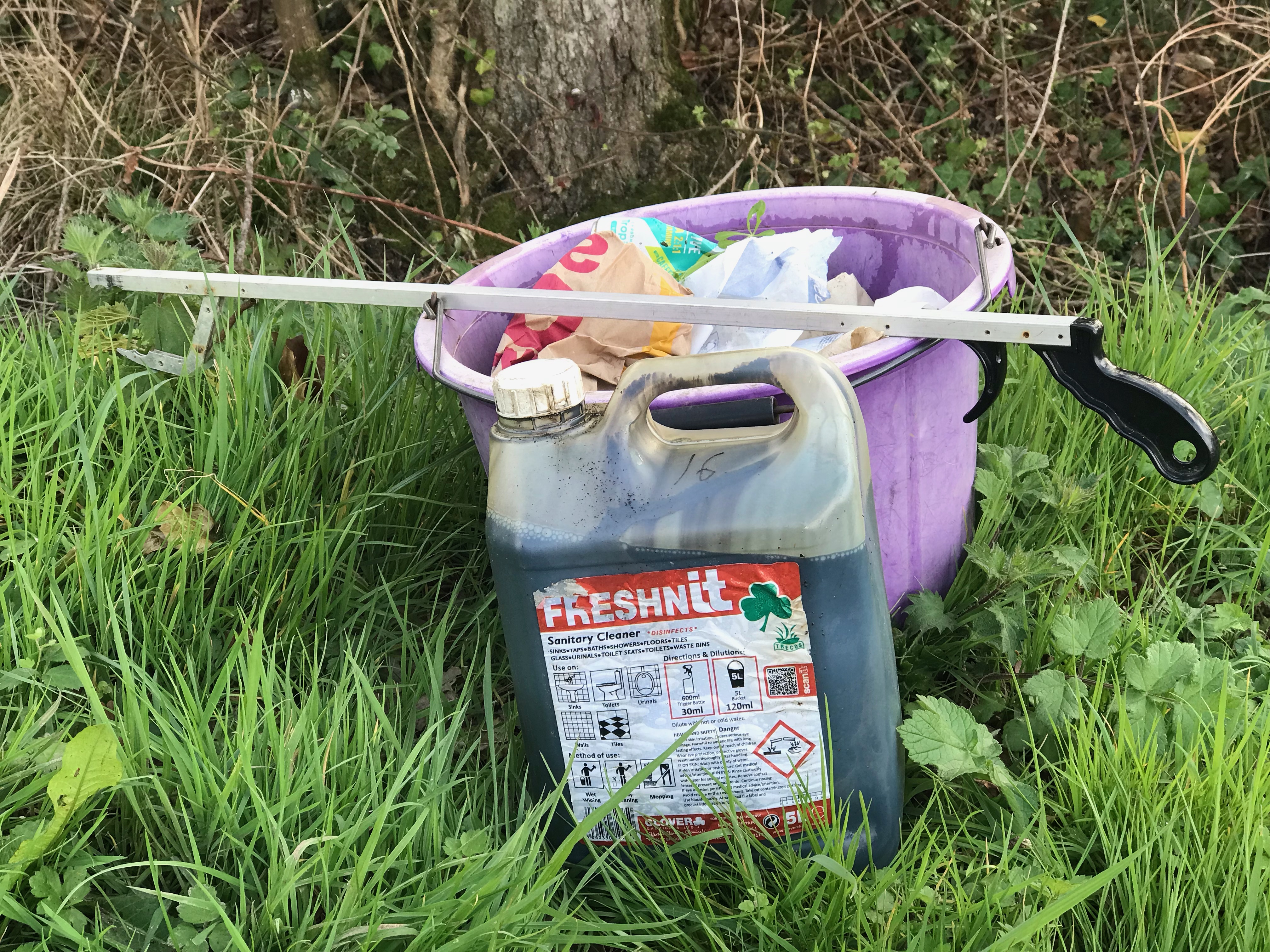
Day 7 – H is Hard work – Ihead out along hedgerows just above the high tide’s reach to harvest horrific litter that could wash into the sea. I cover 2.1km and only collect 35 pieces but haul three discarded containers of chemicals that were chucked into the river.
One of three chemical containers chucked into the nature reserve
Day 8 – I is for I have to do something. Imagine our coastlines covered in rubbish. It’s impossible to ignore wanton trash. I’ve found three intact fluorescent light bulbs washed up before now.
Ice cream left for the fairies
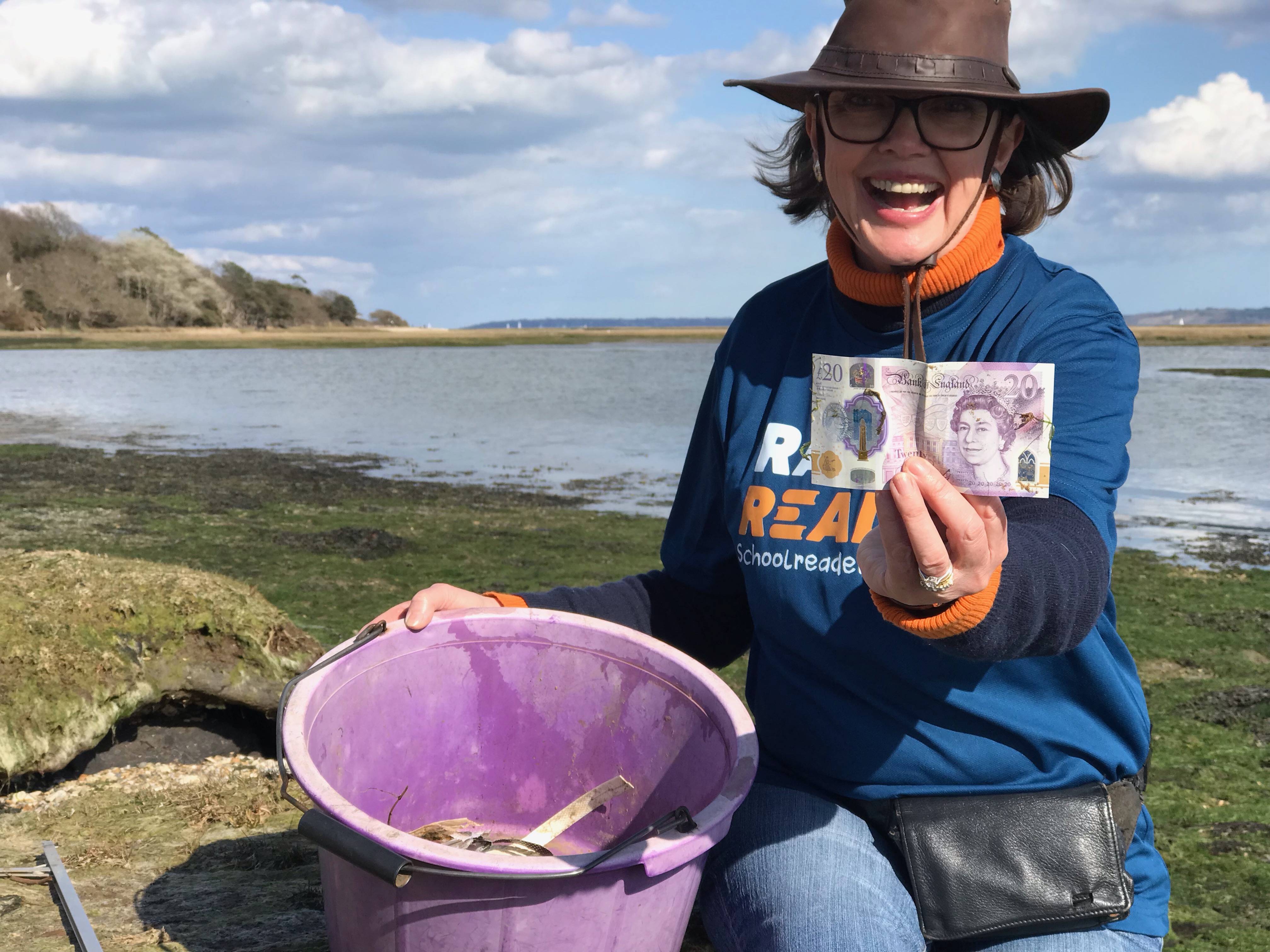
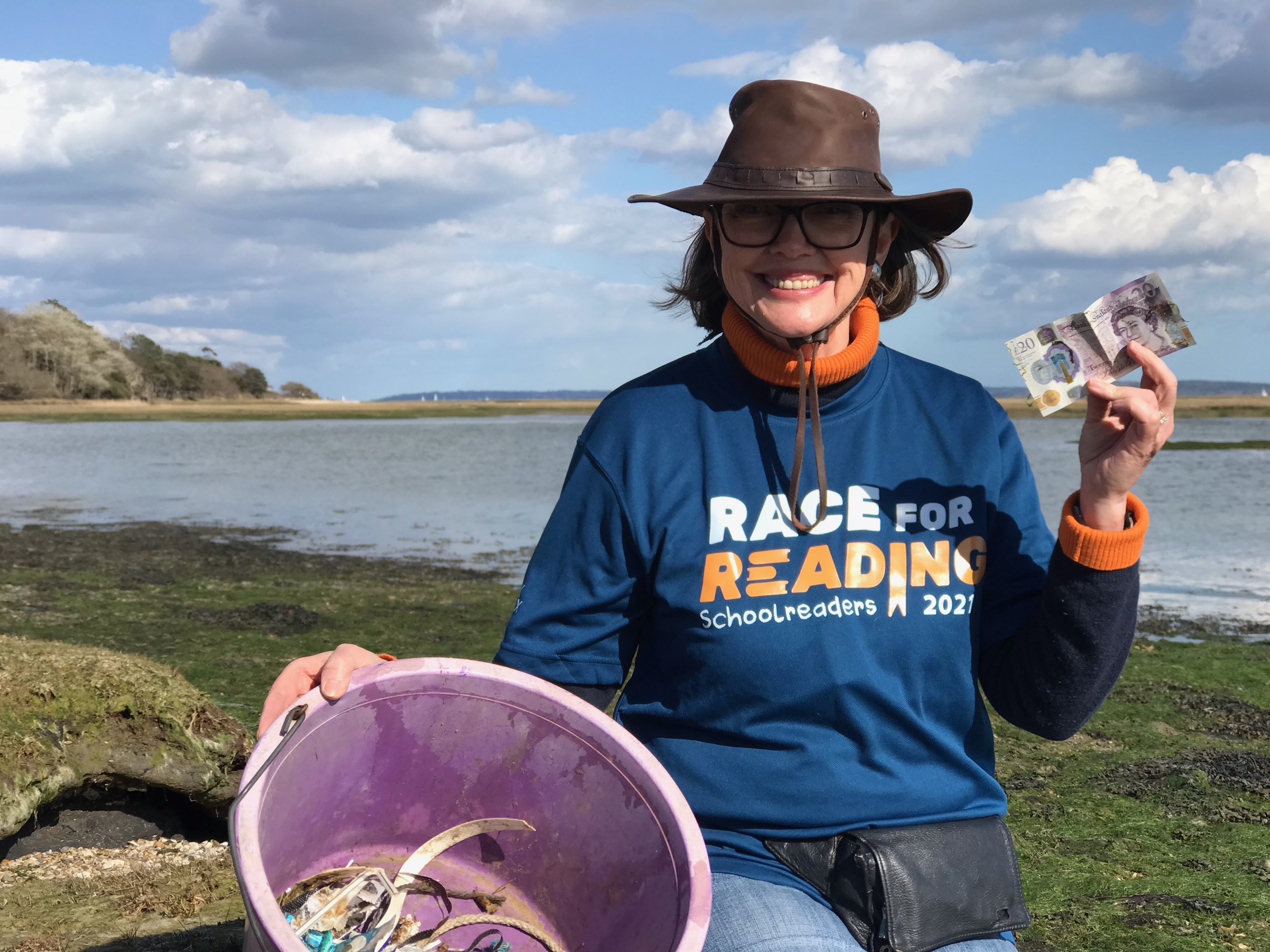
We go down to the foreshore to see what recent storms have brought in. When I first moved to the Solent eighteen years ago it was multi-coloured with bottle tops. Volunteers have slowly cleared it but the sea coughs up unwanted plastic on every tide. As we collect flotsam, a £20 note floats up to us!
Day 9 – J is for Just pick it up –
We need to keep picking up litter before it is blown into the sea and this nature reserve
I cross a causeway over a tidal river where drivers obviously chuck rubbish while waiting for the level-crossing to open on the far side. Having a litter-picker makes the job easier and safer. I collect a bagful and continue into town, putting litter straight into council bins. Despite plenty of these, I find a significant amount of cellophane on the quay about to be blown into the harbour. I cover 3.5km collecting litter over 90 minutes.
The Co-op carrier bag is compostable, the plastic pollution is not
Day 10 – K is for keep fit – and keep going. We arrive in Pembrokeshire for a family holiday. I’m tired after the journey but walk about two miles in 90 minutes, collecting a carrier bag full of coastal litter.
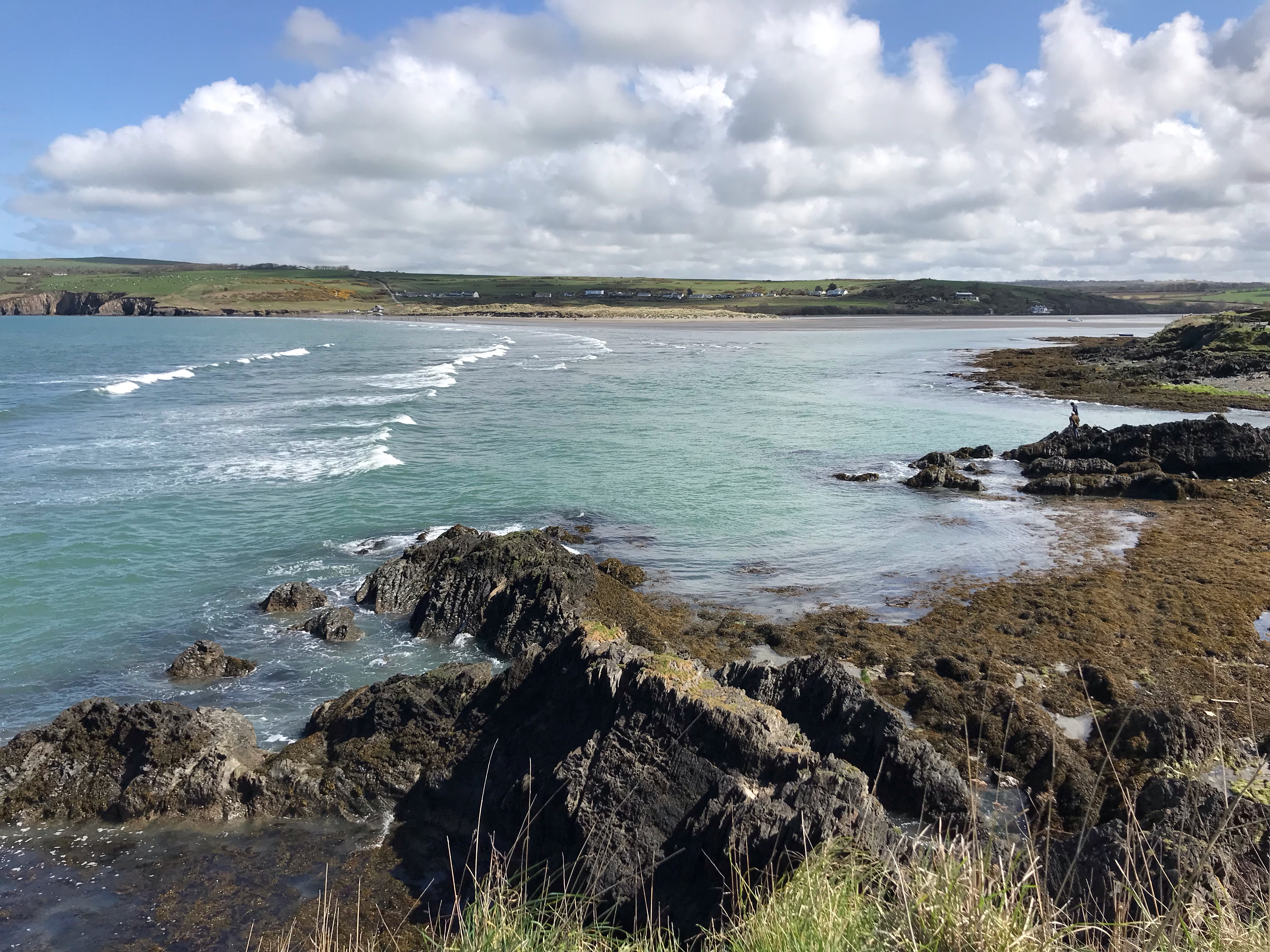
Day 11 – L is for Litter – loitering in the tide wrack of Wales, but I’m joined by friends from The Dog House which is fun. We walk 5 kms along a sandy beach where the smallest dog is rather good at finding litter.
Joined in my quest by The Dog House
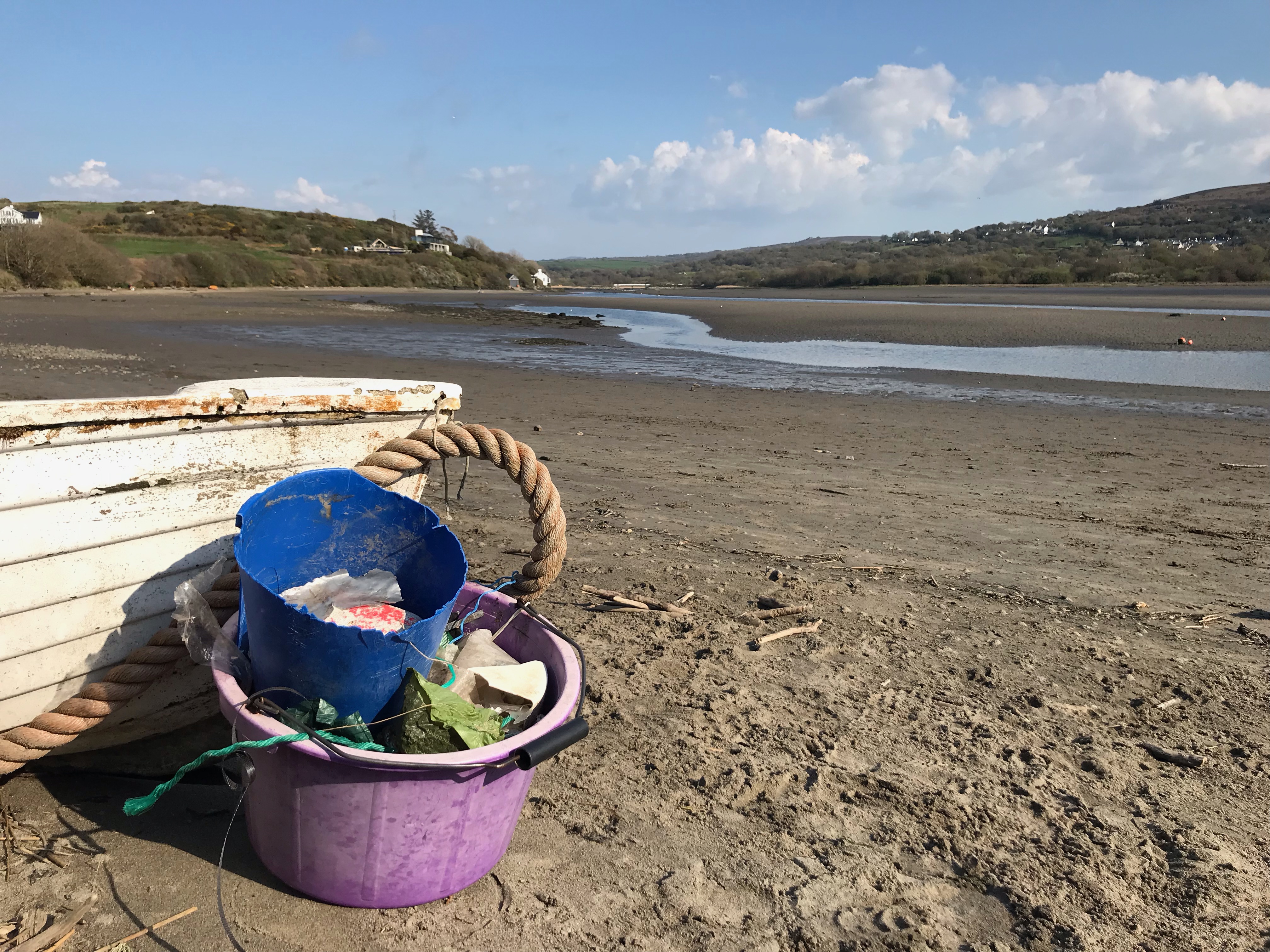
Day 12 – M is for mission to rid the cost of plastic pollution. I walk up an estuary for only 2kms but collect a bucketful of PVC rope and plastic wrappers. I repeat the same distance at low tide when the landscape looks quite different.
Would you like to join the challenge? It’s not too late.
The charity SchoolReaders are still looking for runners, swimmers, riders and walkers keen to take part in their Race for Reading.
Run, walk, cycle, swim, ride, wheel, litter-pick
Every pound raised in sponsorship makes a difference and provides more children with vital reading help. They send out T shirts to those who reach £100 in donations along with a R4R 2022 medal to everyone who has raised over £15 and a gold medal to those who have raised over £1,000.
My company will match any sponsorship I personally raise, so any money given via my Justgiving page will be doubled.
Thanks to my very kind supporters I’ve raised £355 so far, which will be doubled to make £710! This will be enough to ensure twenty volunteers are able to listen to children read and give them a love of books, improving their life chances.
Sophie Neville cleaning the mudflats of PVC rope and old fishing line.
And, I’ve stopped litter from threatening wildlife and polluting our seas. For a full list of things I’ve found washed up on the Solent over the years, please click here
Thanks go to Schoolreaders who change the life stories of so many children.
We’re asking you to step up for children’s literacy!
Over the next 80 days, supporters around the world will run, cycle, swim, row and walk to raise funds for the national charity Schoolreaders. They are encouraging litter-pickers to join their virtual race.
Spring Clean the coastline with Keep Britain Tidy
As an ambassador for Keep Britian Tidy, I have been litter-picking as I walk along the coast, cleaning beaches and shorelines of the United Kingdom on the Great British Spring Clean from 25th March to 10th April. I’m happy to extend this until 19th June 2022 when Schoolreaders virtual race ends.
Last year, a total of over 34,000 miles was covered by the registered participants. I kept a tally of miles walked while litter picking, clocking up 32 miles. My distance covered was not very impressive – but collecting flotsam takes time and my bucket can get heavy.
Litter collected whilst walking along the Solent shore
Somewhere I have a tally of the amount of rubbish collected. I certainly took a lot of photos. I’m hoping friends will join me this year as I’m aiming to walk a lot further.
I’m not sure if I will find anything that relates to books or reading but it is possible.
I quite often find reading glasses when I’m litter picking
If you would like to support children’s reading in the UK there are many ways you can do so:
You can sign up to become a Schoolreaders volunteer– they ask for a commitment of one academic year to provide the children with consistency.
You can set up a regular donation for as little as £5 by clicking here
Funds raised will provide weekly one-to-one reading support sessions from Schoolreaders volunteers across the country. We are hoping to be able to help over 2,500 children who may have fallen behind with their reading during Lockdown.
I grew up with boats in the garden. My father owned eight at one time, including two coracles and a vintage river launch called Ottor that he renovated himself.
Martin Neville with friends on the Norfolk Broads
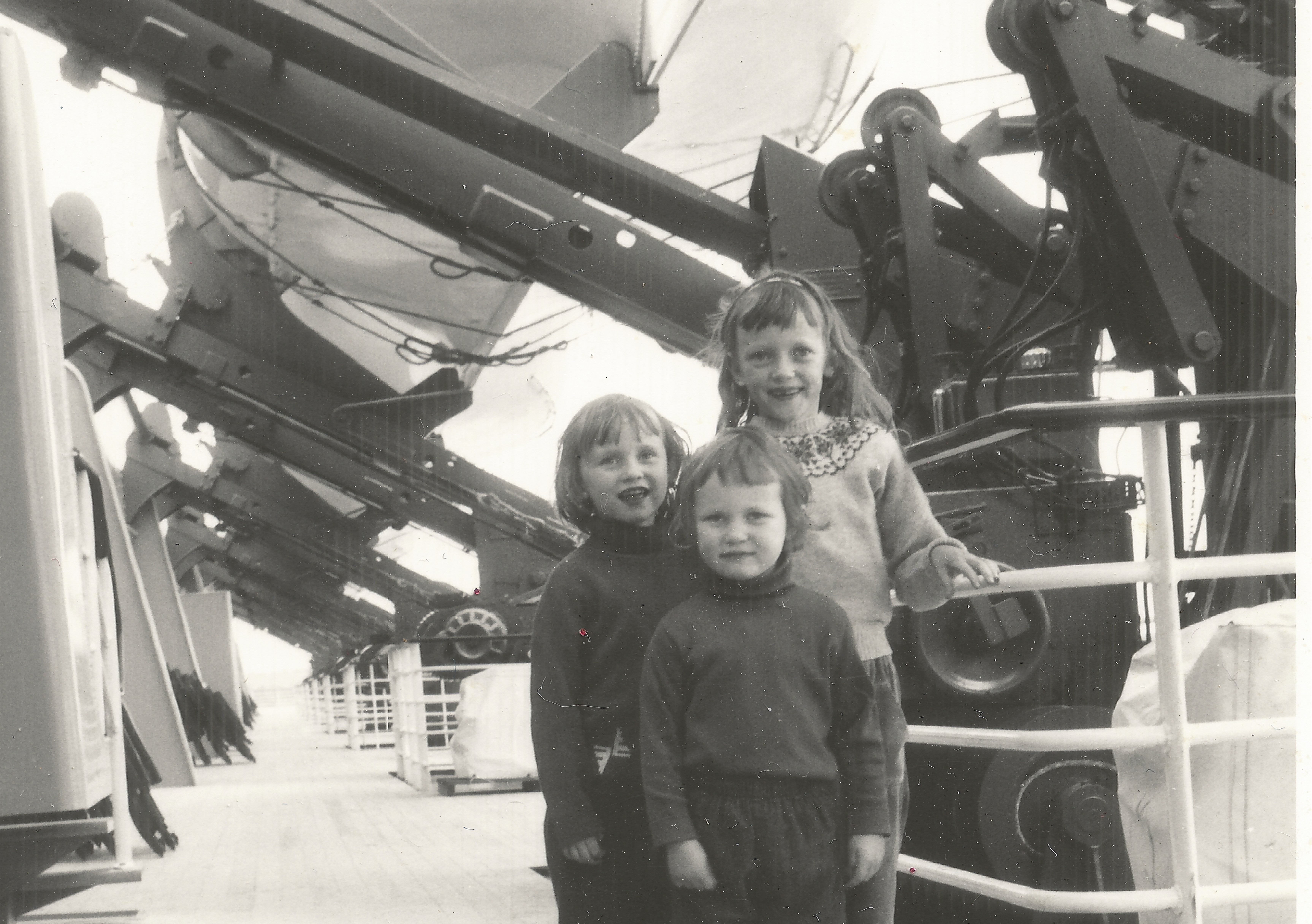
As a young man, while setting up a team to develop the fibreglass hull, Dad raced on the Solent, volunteered on a tall ship, and wrangled an Atlantic crossing on the maiden return voyage of the QE2, taking us children around the liner when it reached Southampton.
Sophie Neville with her younger sisters aboard the QEII in 1969
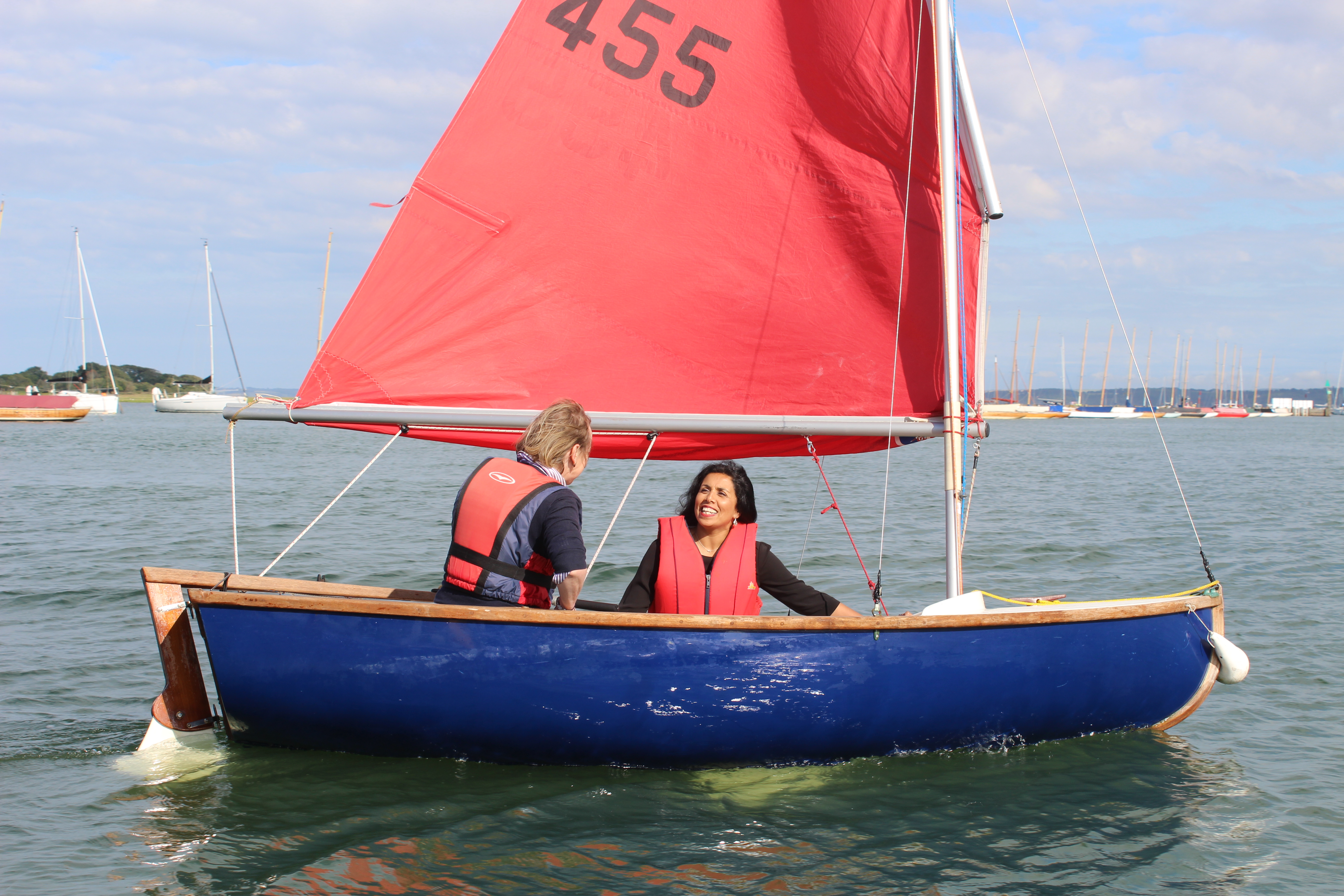
I learnt to sail dinghies at Newport Bay in Pembrokeshire, later making my own sail for a Thames skiff so that I could take it down the lake where I grew up in Gloucestershire.
My father wanted a Mirror dinghy, but since they were beyond his budget we had a dubious one-design with a ? on its sail.
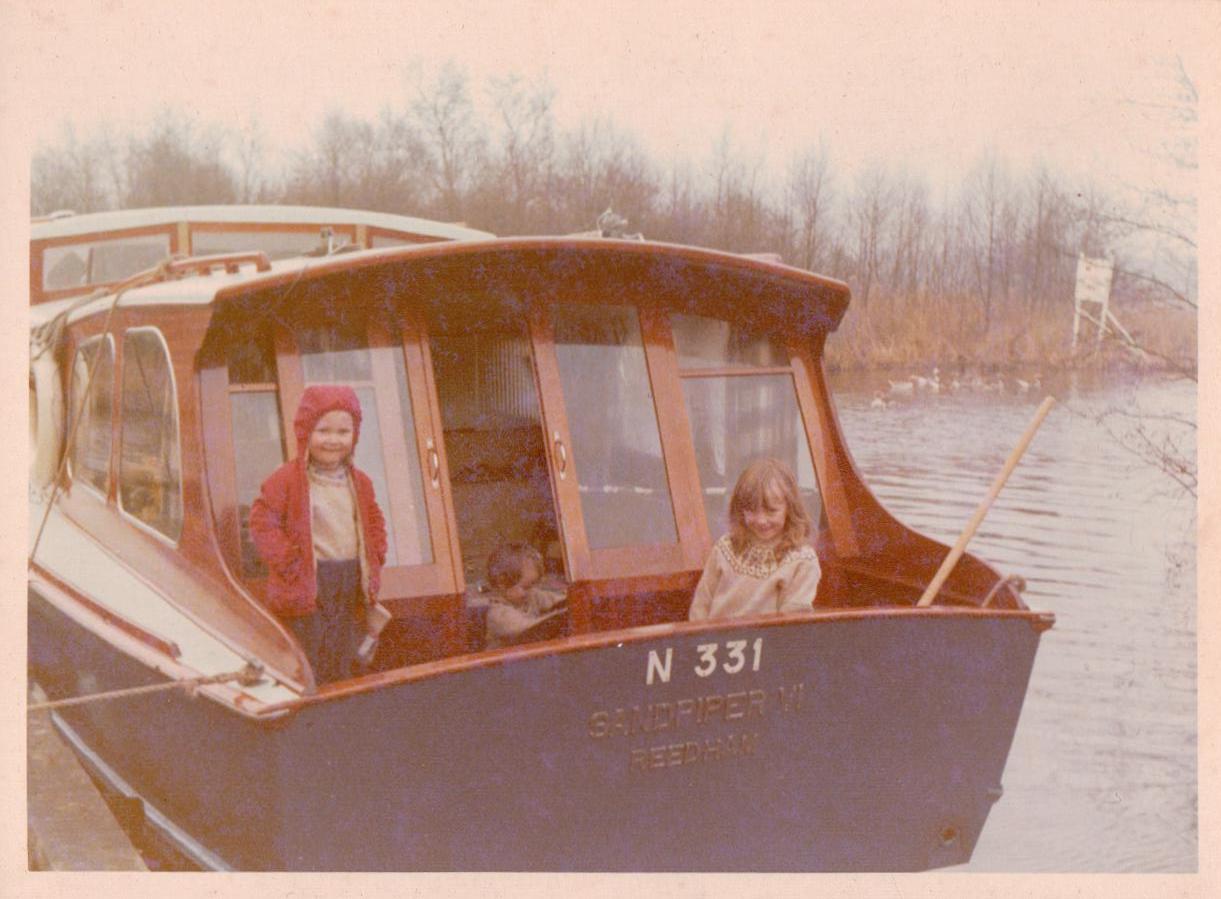
A family holiday in a Hullabaloo boat on the Broads – off season
Dad bought one of the first Toppers, which seemed quite daring at the time. It had no halyards. Its arrival caused much excitement. Called Earwig, the fibreglass hull was portable but proved precarious, soaking the crew as waves sloshed over her orange deck. I wasn’t much good at withstanding the cold and grew to loath setting off with wet feet.
Sophie Neville as Titty and Sten Grendon as Roger rowing to Cormorant Island
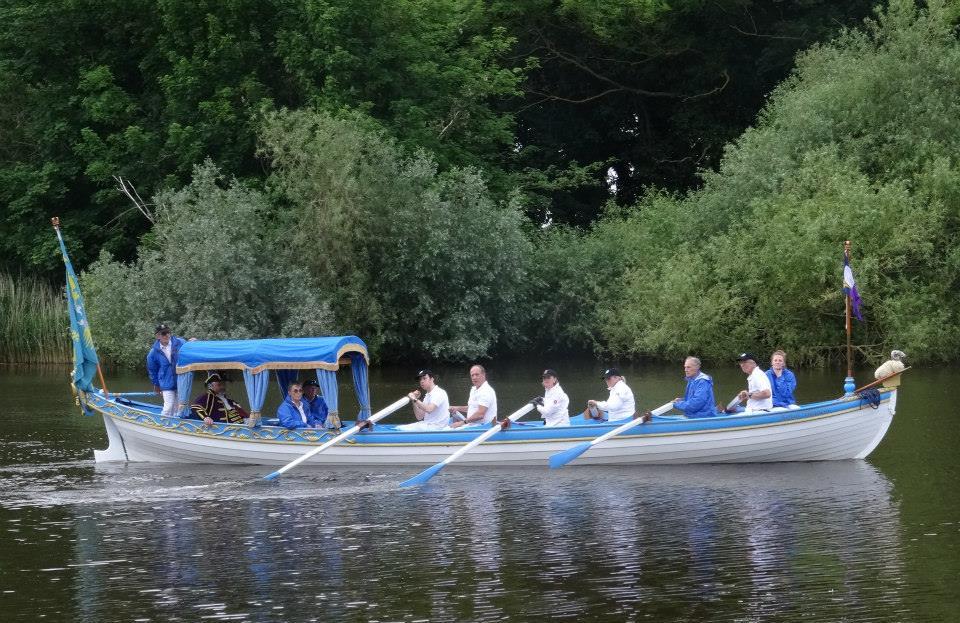
Playing Titty in original film of ‘Swallows and Amazons’ involved quite a bit of rowing, which I kept up first as a member of the Collingwood Ladies Four at Durham University and later on the crew of The Drapers’ Shallop, a ceremonial barge that can be spotted on the Thames and River Lea, the Dart or Poole Harbour.
Rowing the Drapers’ shallop down to Runnymede
My dedication to fixed thwart rowing enabled me to take part in a Jubilee Pageant for The Queen at Henley, transport a copy of the Magna Carta to Windsor, and man an oar of the royal barge Gloriana in the Boat Race flotilla at Putney a year when Cambridge won.
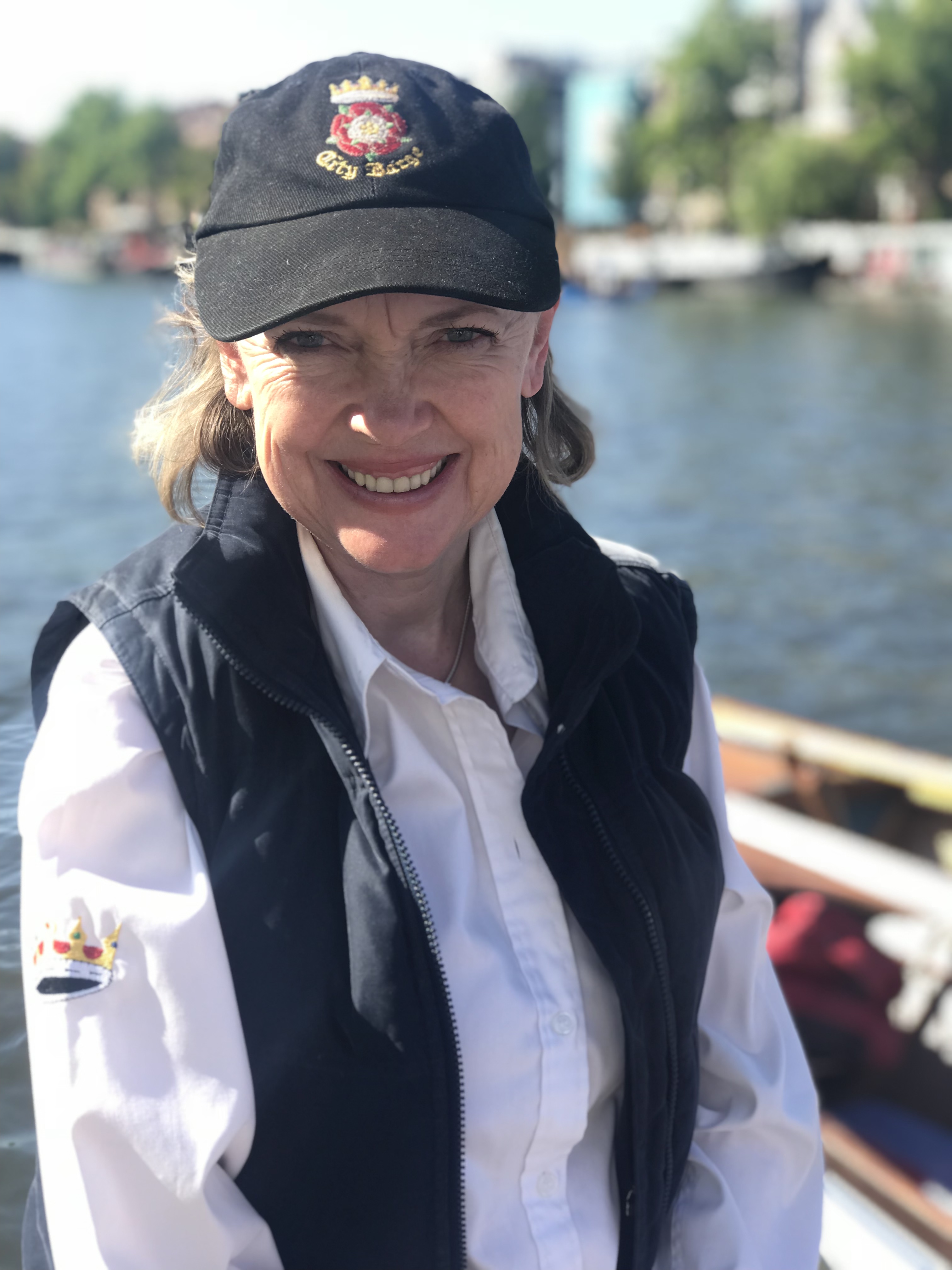
Sophie Neville rowing in black cap on the River Thames at Putney
Belonging to the rowing club,City Barge, enabled me to take part in the Voga Longa in Venice – a 35km marathon – with the gold medalist Ed Coode as stroke. I later rowed a sandalo down the Amstel into Amsterdam standing to row Venetian-style, getting used to the idea of using a forcola in windy weather.
In the bows of a sandalo on the River Amstel in Amsterdam
We navigated the shallop down a tributary of the Loire in Brittany, leading a procession of two hundred and forty traditional boats into Nantes for the Rendez-vous de l’Erdre. I was asked to take the helm on the way back, great Dutch barges bearing down on us.
With the presenter and crew of France 3 news
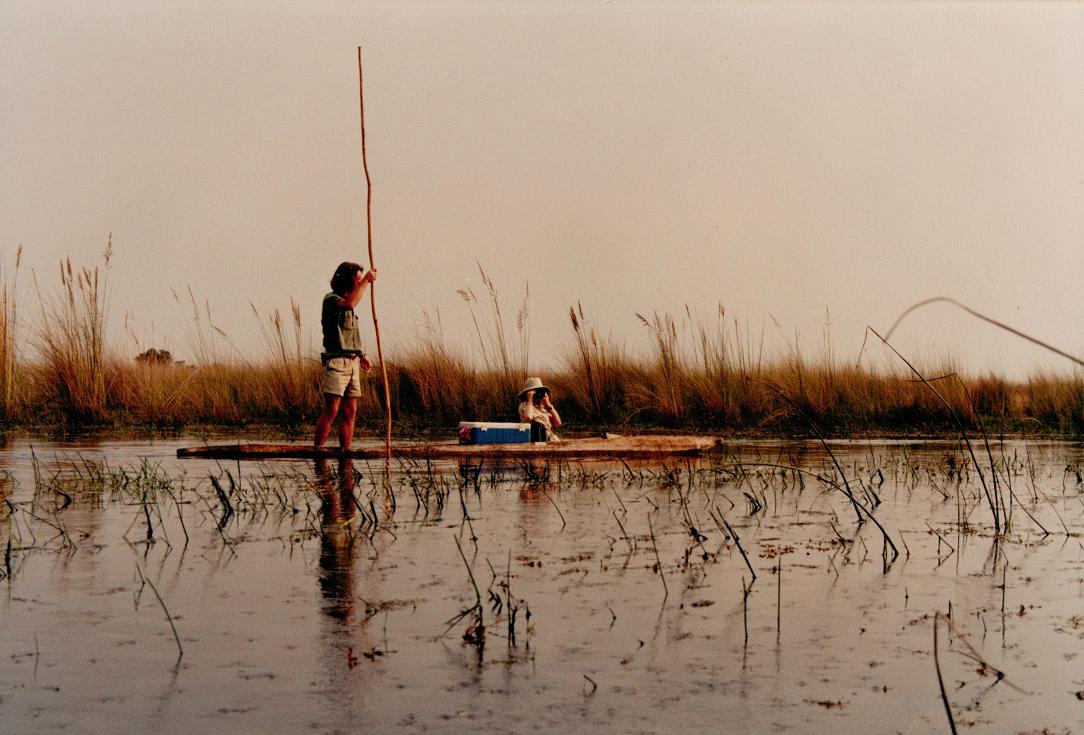
One of my favourite vessels is a two-man canvas canoe my sister found on a rubbish dump. I nearly drowned after getting stuck in a kayak and prefer an open dugout or fibreglass equivalent. These have taken me on adventures in Papua New Guinea, across Lake Malawi and through the Okavango Delta in Botswana.
Bird watching on the Boro River – Sophie Neville with Jez Lye
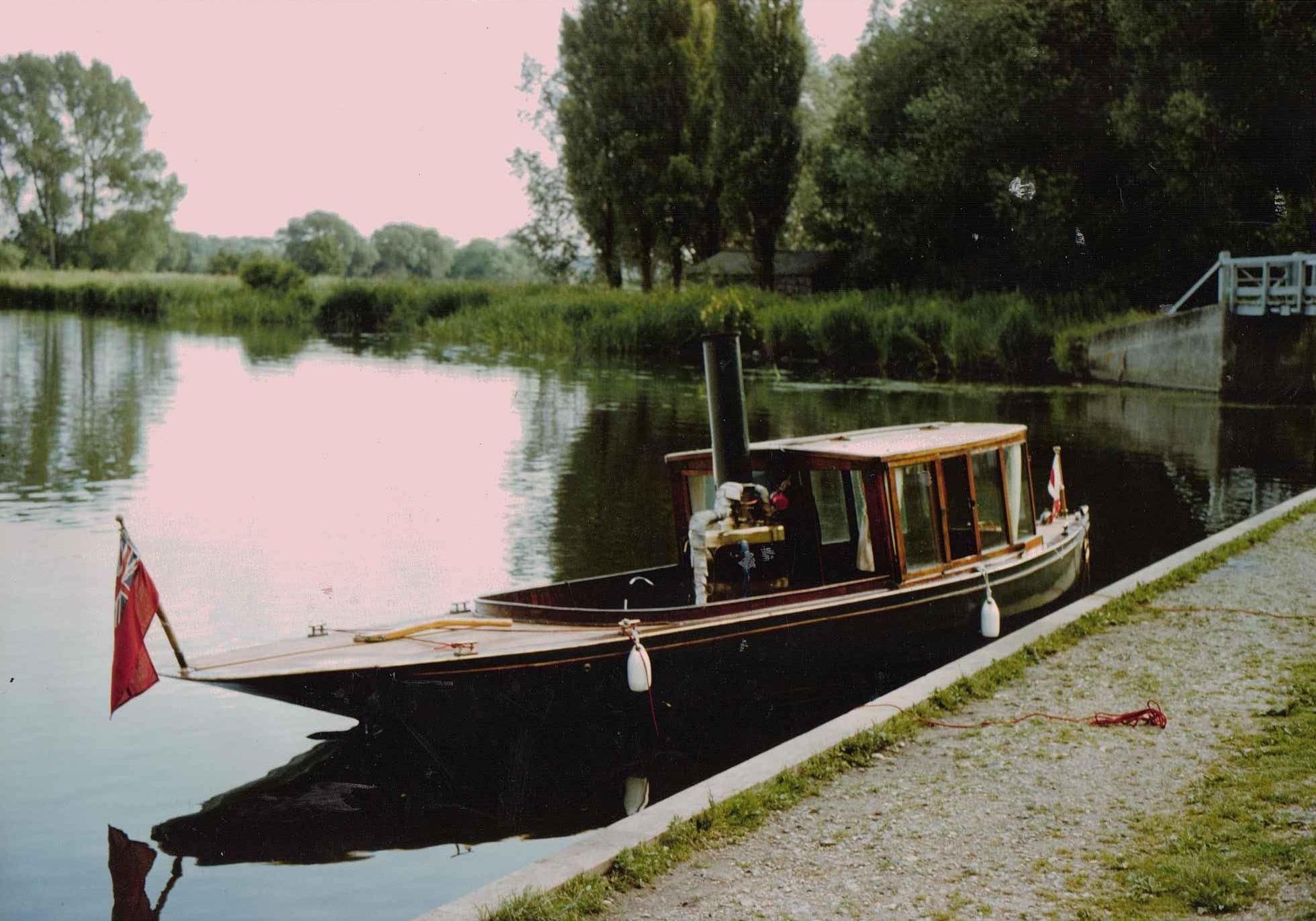
Back in 1978, I helped my father, Martin Neville, to restore a 1901 steamboat called Daffodil, which they kept near Oxford at Port Meadow on the Thames.
SL Daffodil on the River Thames
We would steam down to Henley each year for the royal regatta or upstream towards Letchlade. You can read about how we renovated here here.
We took a Humber Yawl that Dad built to take part in a Steam Boat Association rally on Windermere and pay homage to launches used in the film ‘Swallows and Amazons’ kept by George Pattinson at the Steam Boat Museum, now known as Windermere Jetty.
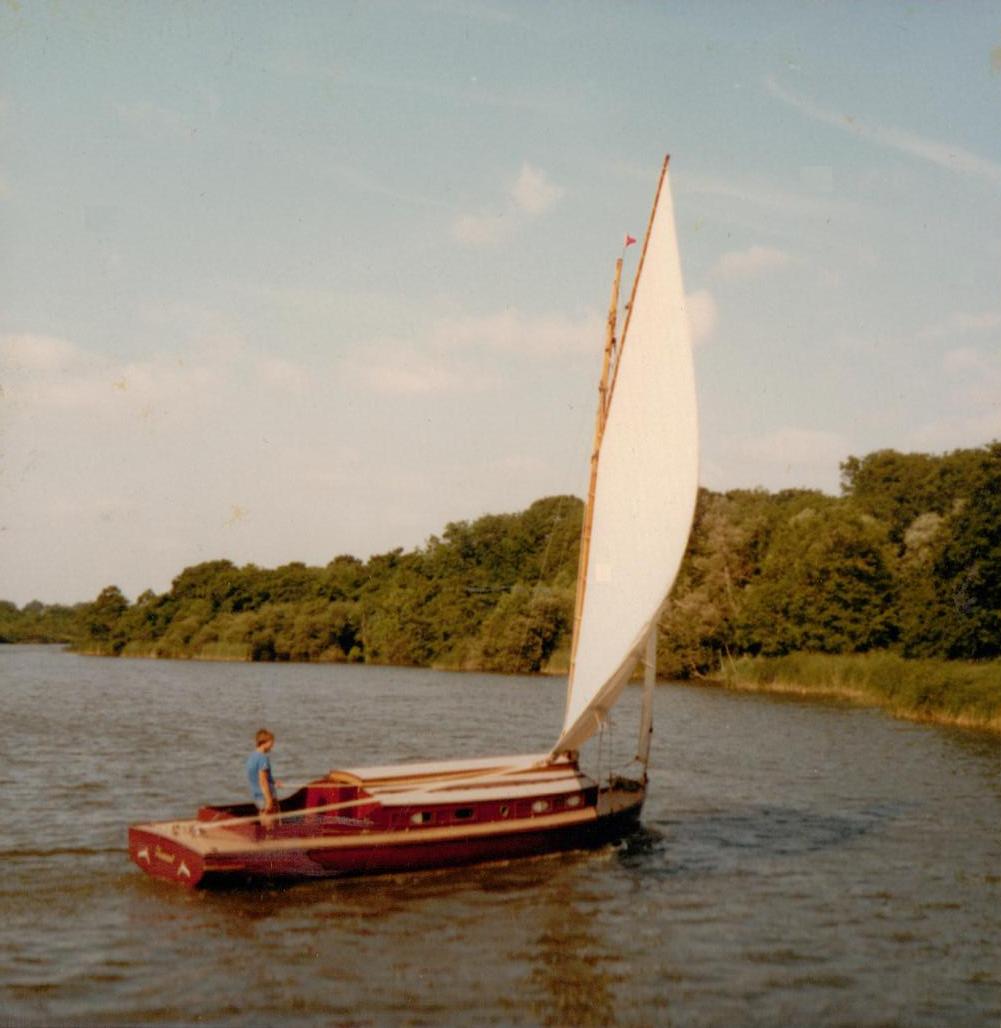
Lullaby undersail, playing the Teasel on the broads
I a lot of time on the water while filming the 1984 BBC adaptation of ‘Coot Club’ and ‘The Big Six’ when we spent three months filming on the Norfolk Broads. The series starred a yacht called Lullaby from Hunter’s Yard, which you can now hire for holidays.
I went away from my wedding in a punt, Dad polling while I sat with my new husband, holding an umbrella while a rainbow appeared over the water.
At the Brewery Arts Cinema in Kendal for the launch of ‘The Making of Swallows and Amazons’ and the 40th Anniversary DVD
While serving as President of The Arthur Ransome Society, I gave twelve Q&As at cinemas. Members of SailRansome have often come along with the little clinker-built dinghy used as Swallow, which I helped purchase when she came up for auction in 2010.
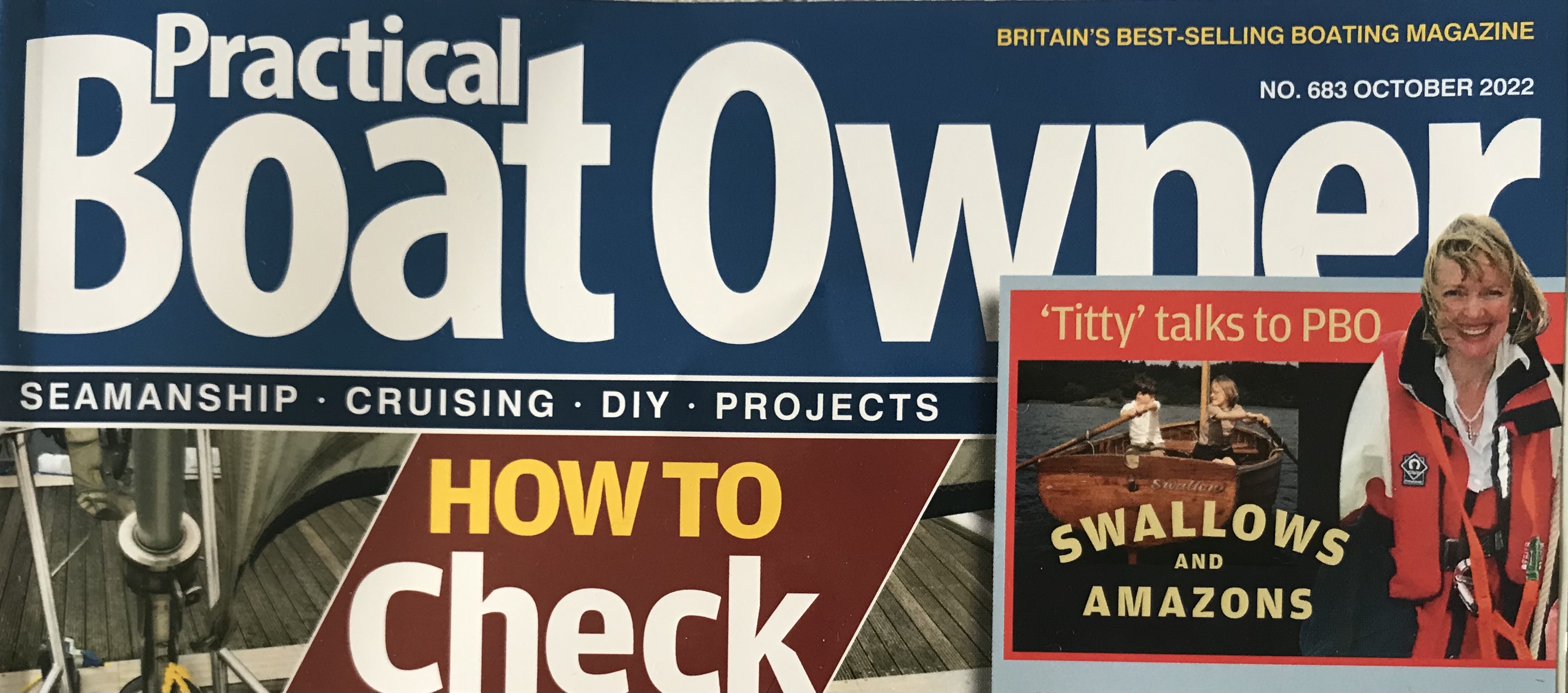
I am often asked to write articles about my life afloat, and have spoken at literary festivals, on BBC Radio and on ITV News when I nearly capsized.
On ITV News at Ten with Nina Nannar
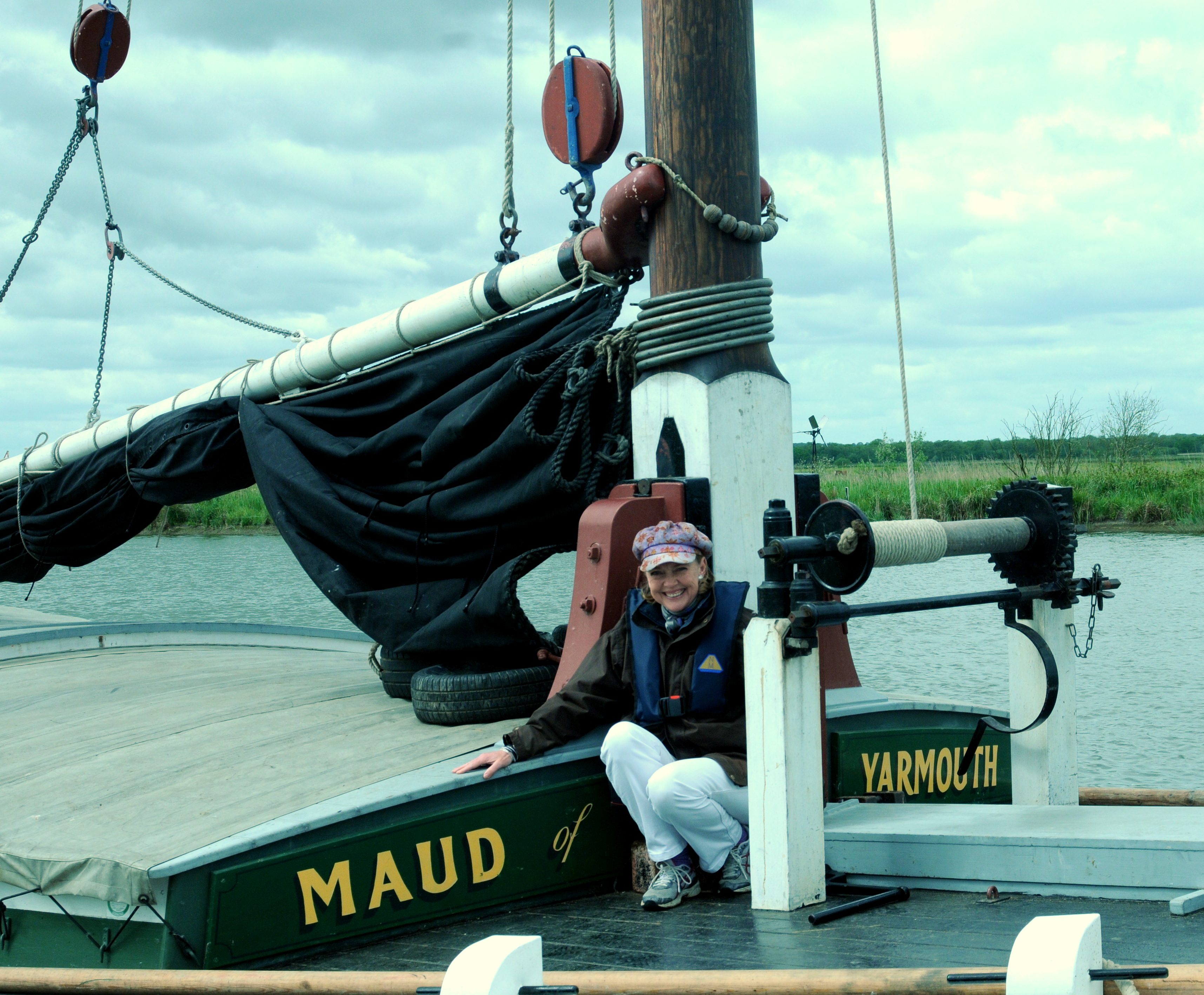
It is with The Arthur Ransome Society that I have been able to sail an historic wherry down the Norfolk Broads, take an old German ferry to Lundy Island and cruise down Coniston Water on SL Gondola.
Aboard Wherry Maud – photo Diana Dicker
As a member of the Nancy Blackett Trust, I’ve sailed on the Orwell, in the Solent and through the inland waterways of the Netherlands, visiting Middleburg.
~Nancy Blackett in the Netherlands~
I enjoyed crossing the Veersemere to Zierikzee in the wake of my own forefathers.
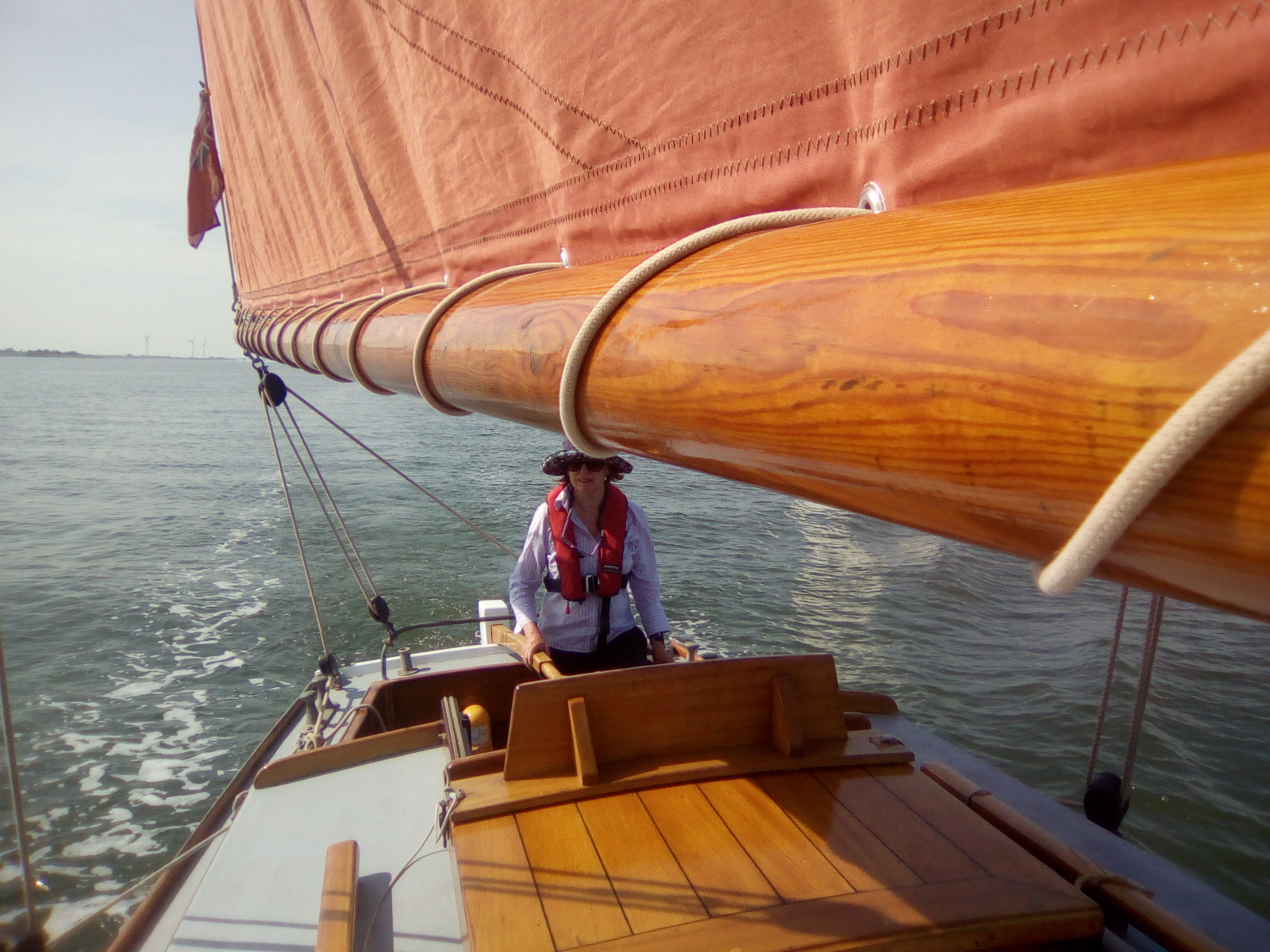
Over the years, I’ve grabbed the chance to sail yachts to Salcombe, up the coast of Norway and through the Mediterranean but I still love taking out a small boat in the Lake District or on the Norfolk Broads.
At Wroxham on the Norfolk Broads
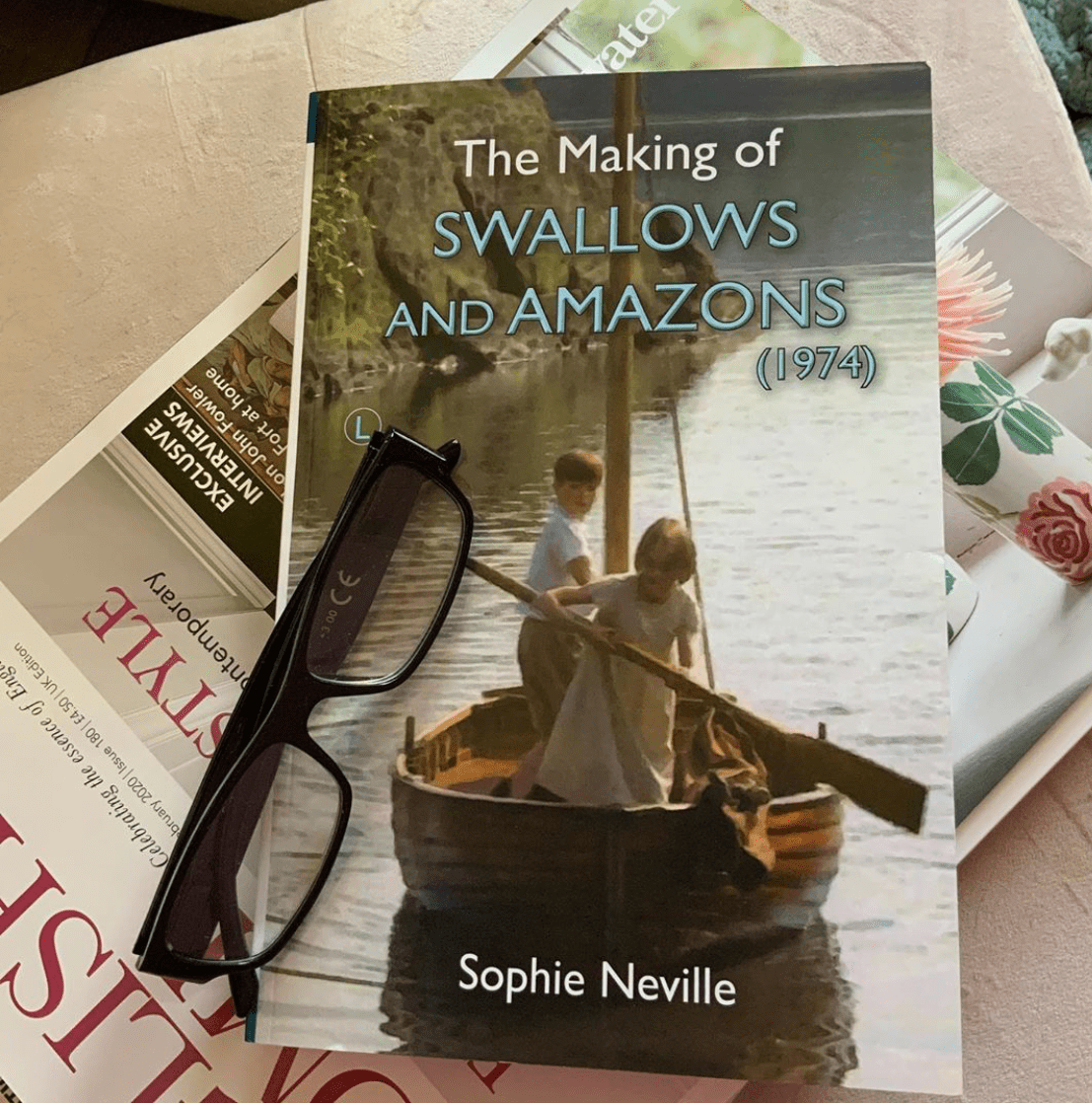
You can read more in ‘The Making of Swallows and Amazons’ available on line.
2021, and we thought we would be coming out of Lockdown but life remained restricted.
Litter Art made from sea plastic I’ve collected
Walking the Solent Way – in search of plastic pollution washed up on the shore
Winter walks along the coast litter-picking
Becoming a Patron of the charity ‘Covid Reflections’
Speaking on BBC Radio Cumbria’s Saturday morning Breakfast Show
Appearing on BBC Antiques Roadshow with ‘Swallows and Amazons’ movie memorabilia including a hazel bow and arrow.
Marc Allum and Sophie Neville on BBC Antiques Roadshow
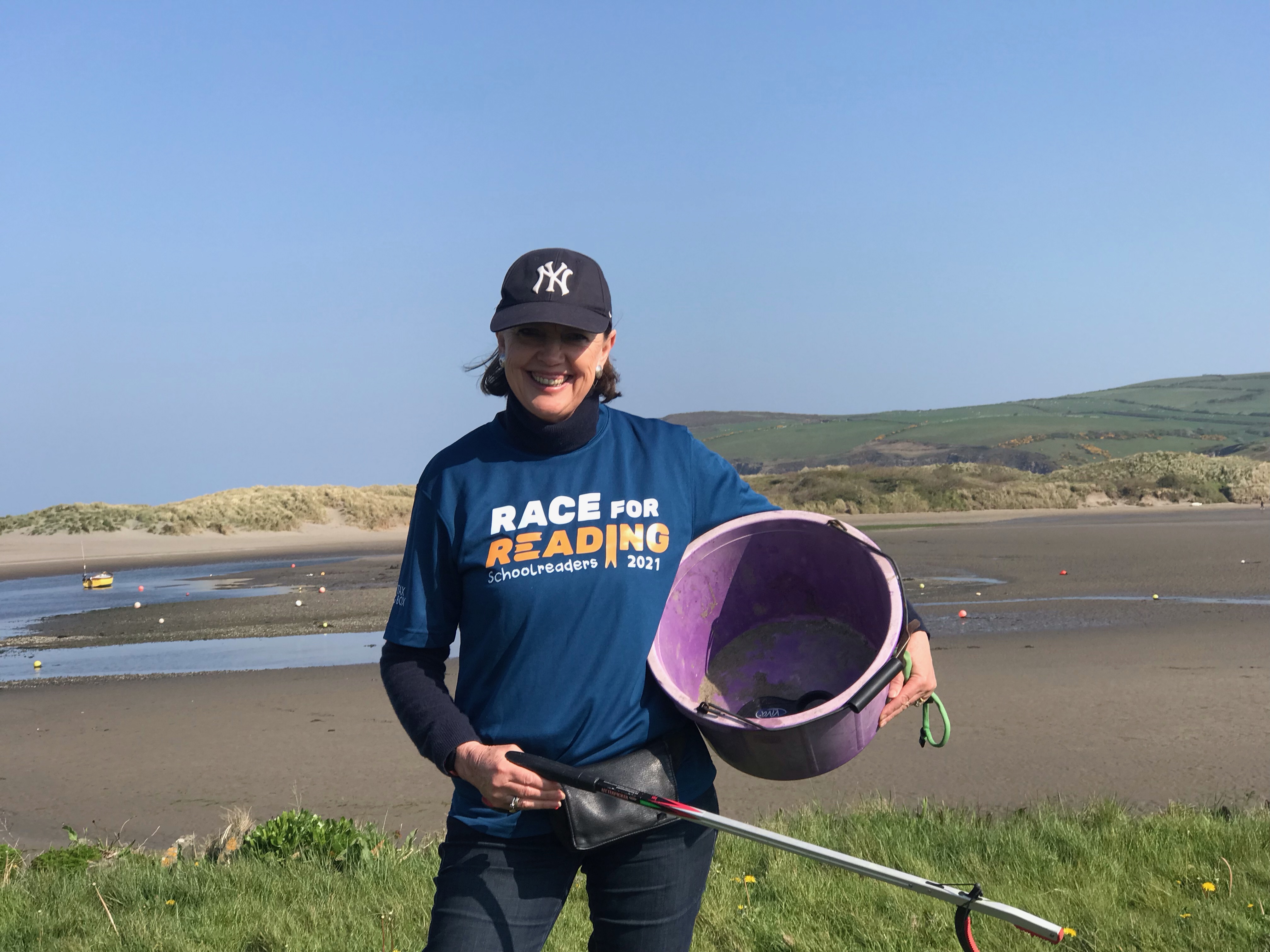
Taking Part in School Readers ‘Race for Reading’ challenge 2021, collecting litter on a section of the Welsh coastline
Collecting sea plastic whilst walking along the south coast of England
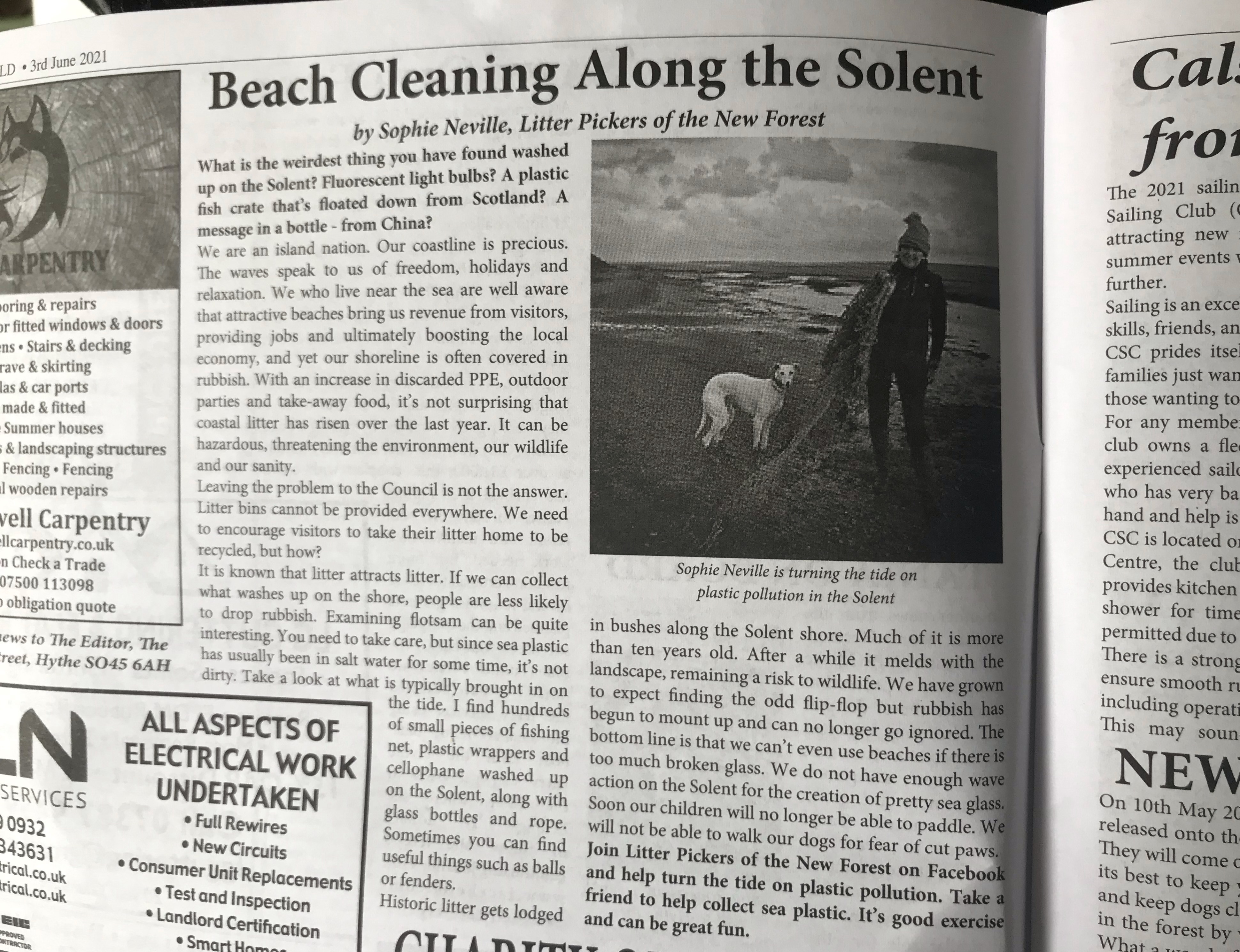
Writing articles for The Herald to encourage people to beach-clean
Representing Litter Pickers of the New Forest
Interviewed by JJ Walsh in Japan for a podcast on beach cleaning and meeting the head of Eco-Bricks UK who took some of my fishing net finds for a talk.
Having my unpublished novels placed in a number of literary awards:
Two historical novels Long-listed by Retreat West, 2021
Semi-Finalist in ACFW Genesis novel writing contest in the USA, 2021
Page Turner Finalist, 2021
Reaching the finals of the 2021 Eyelands Book Awards for an unpublished historical novel
Long-listed by Roadmap’s Write Start Competition in the USA, 2021
Longlisted for Adventures in Fiction New Voices, Flash 500 first page competition and The Eludia Awards in the USA.
Mounting my sketchbook drawings on Instagram – here’s one that got away (the aspect ratio didn’t fit)
My sketchbook paintings
A few sporting achievements:
Worcestershire Archery Society’s prize for Lady’s Most Hits
First Lady’s Gold at the West Berks Archery Society
Best Lady’s Gold at Meriden
Lady’s Championship Trophy for highest score Worcestershire Archery Society
Celebrating the first wedding after Lockdown lifted
Visiting the Yarmouth and the Needles
Sailing to the Isle of Wight while Lockdown was eased
Giving a talk at ‘The Late Summer Festival of Romantic Books and Writing’
Contributing to a handbook for Christian Writers entitled ‘Write Well’ published by Instant Apostle
Riding across the wild areas of Sicily
Riding up Mouth Etna in Sicily
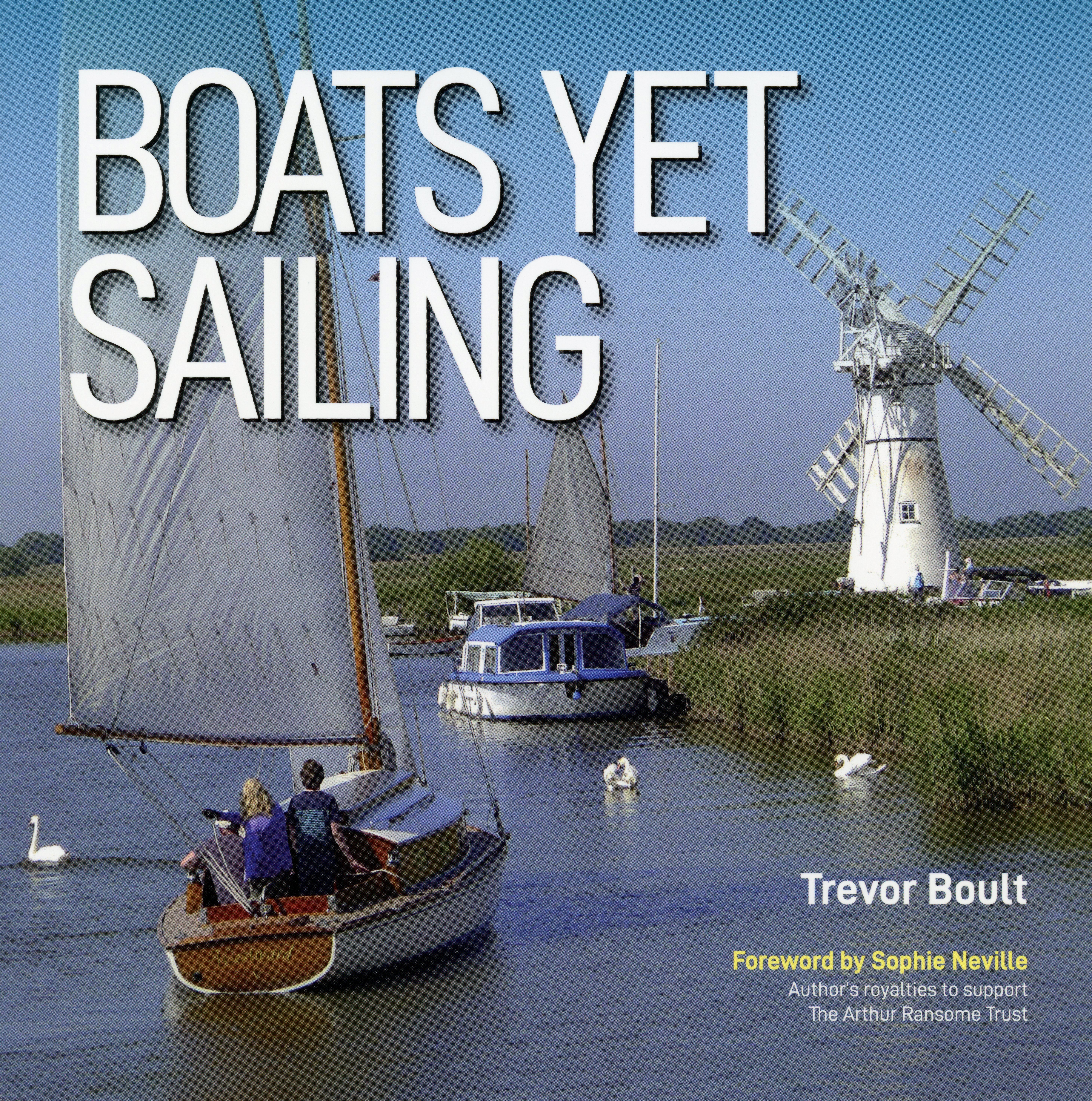
Writing a Foreword to ‘Boats Yet Sailing’ by Trevor Boult
Finding a bid of £251 on a signed first edition paperback of ‘The Making of Swallows and Amazons’ in an auction in aid of BBC Children in Need
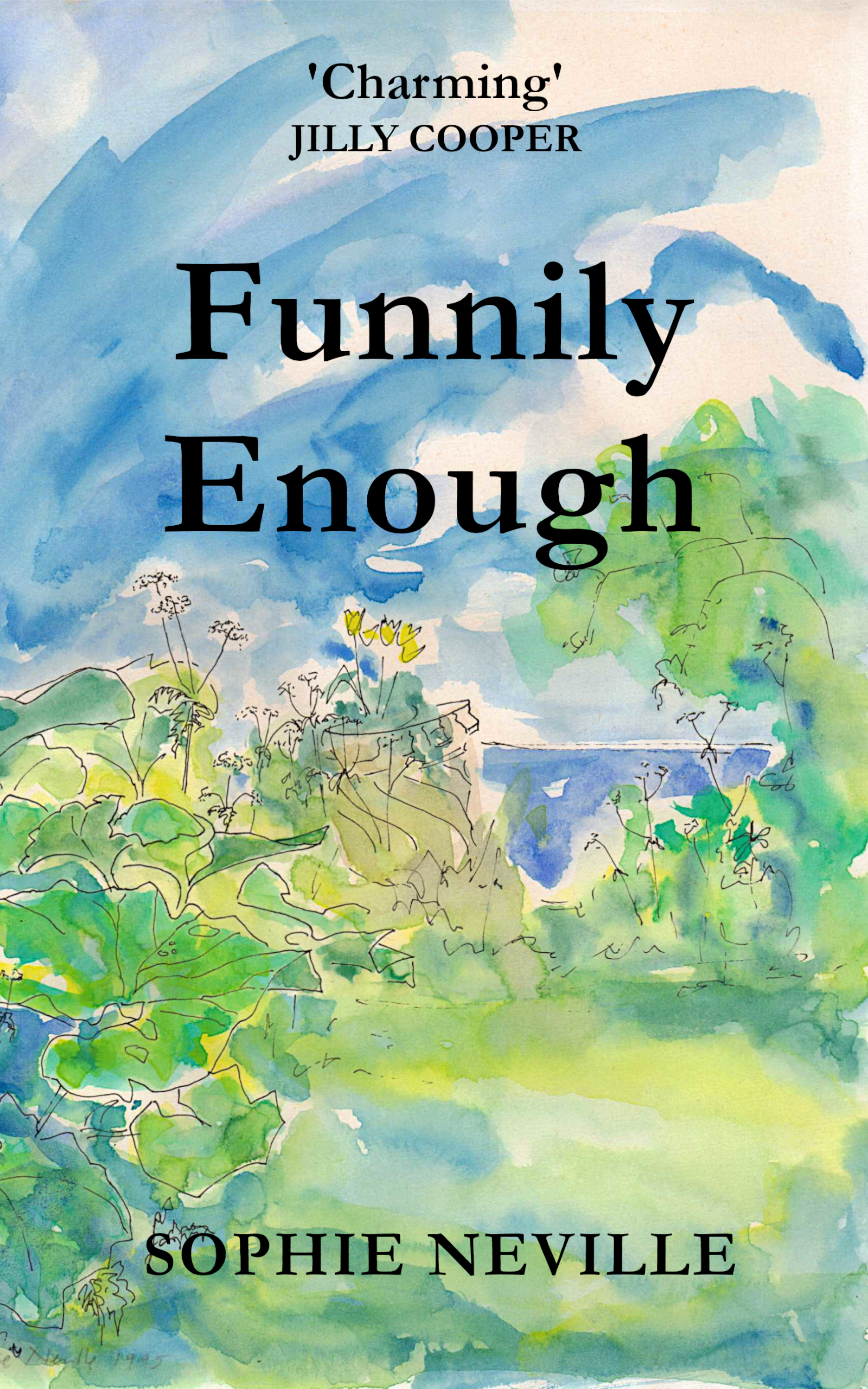
Bringing out a second edition of ‘Funnily Enough’ with added illustrations
Being able to go to restaurants with my family – if only for one birthday lunch
Raising funds for welfare projects in the Waterberg, South Africa
Fighting period poverty in rural South Africa
And helping to rebuild the church that burnt down
Being interviewed about my dog, Flint
I was honoured to be awarded ‘New Forest Litter Picker of the Year’
You can see photos of flotsam on an earlier post here
Very many thanks to all my readers who have reviewed my books
An online book review on the Waterstone’s site
Reviews have appeared on Amazon for ‘The Making of Swallows and Amazons’ and on Goodreads here.
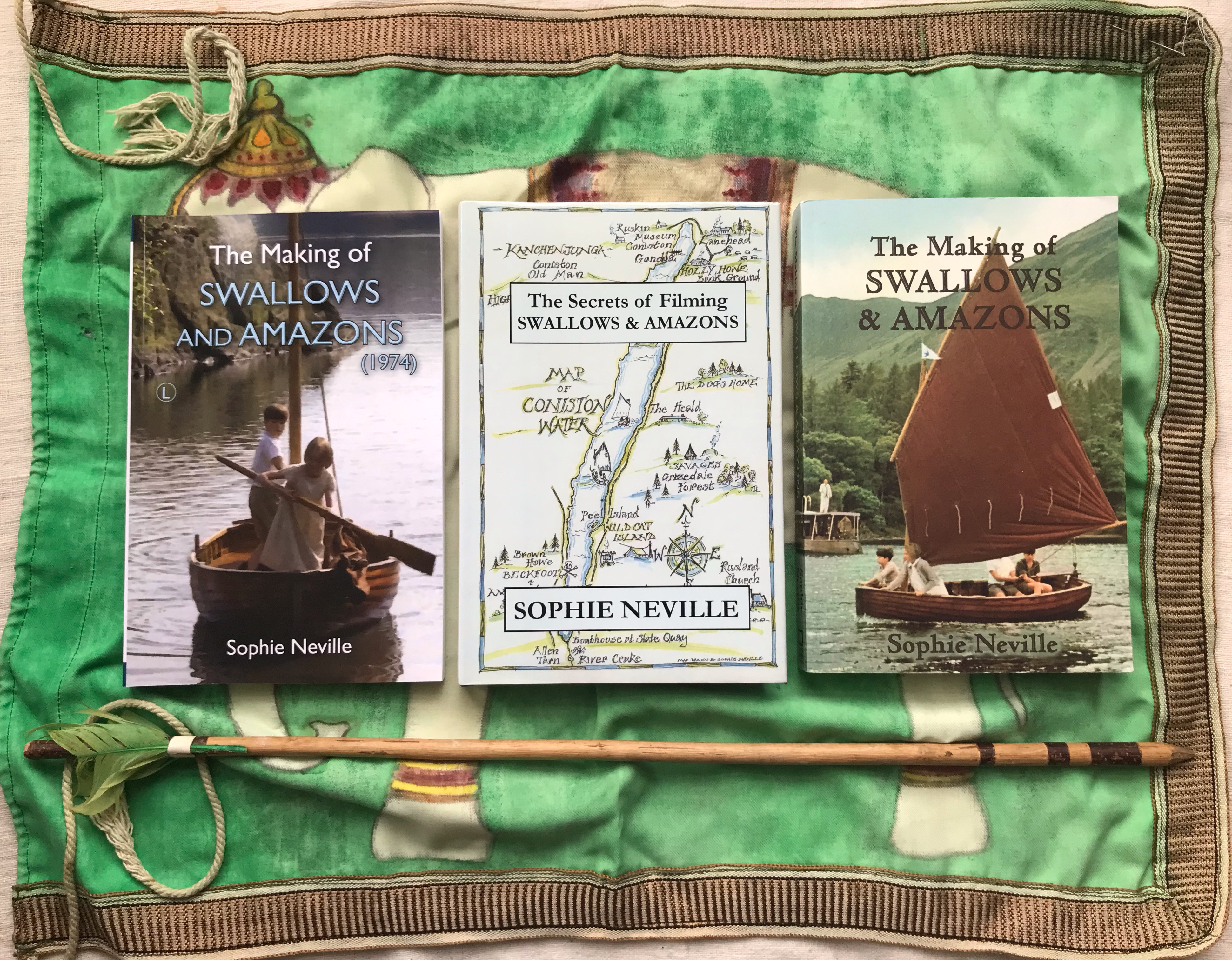
Different editions of ‘The Making of Swallows and Amazons (1974) by Sophie Neville’
You can watch the interview on BBC Antiques Roadshow here:
In November 2021, an anonymous donor bid £251 for a signed first edition of ‘The Making of Swallows and Amazons’. The money raised went directly to BBC Children in Need.
Books listed in the category Auto Biography/Biography
Nearly eight hundred newly published books had been donated to the Children in Read charity auction organised by Paddy Heron, which raised a total of £24,888.
‘Funnily Enough’ an illustrated diary by Sophie Neville
Rare copies of my first edition paperback of ‘The Making of Swallows and Amazons’ are often priced highly on Amazon, but when the bidding went above £75, I promised to include a signed first edition hardback of my memoir ‘Funnily Enough’, which includes a brief section on appearing in the film.
When the bidding went above £101, I promised to add my third illustrated memoir about Swallows and Amazons style adventures in Africa, written in letter form.
‘Ride the Wings of Morning’ by Sophie Neville
However, £251 is so very generous that I am off to my archive store to see if I can find a hand-painted map to include in the package.
Map showing the film locations around Windermere
I drew three different maps showing our film locations in the Lake District and reproduced them in different colour-ways, using one on the cover of my original ebook entitled ‘The Secrets of Filming Swallows and Amazons (1974)’, which is still available on Kindle and any of the ebook outlets.
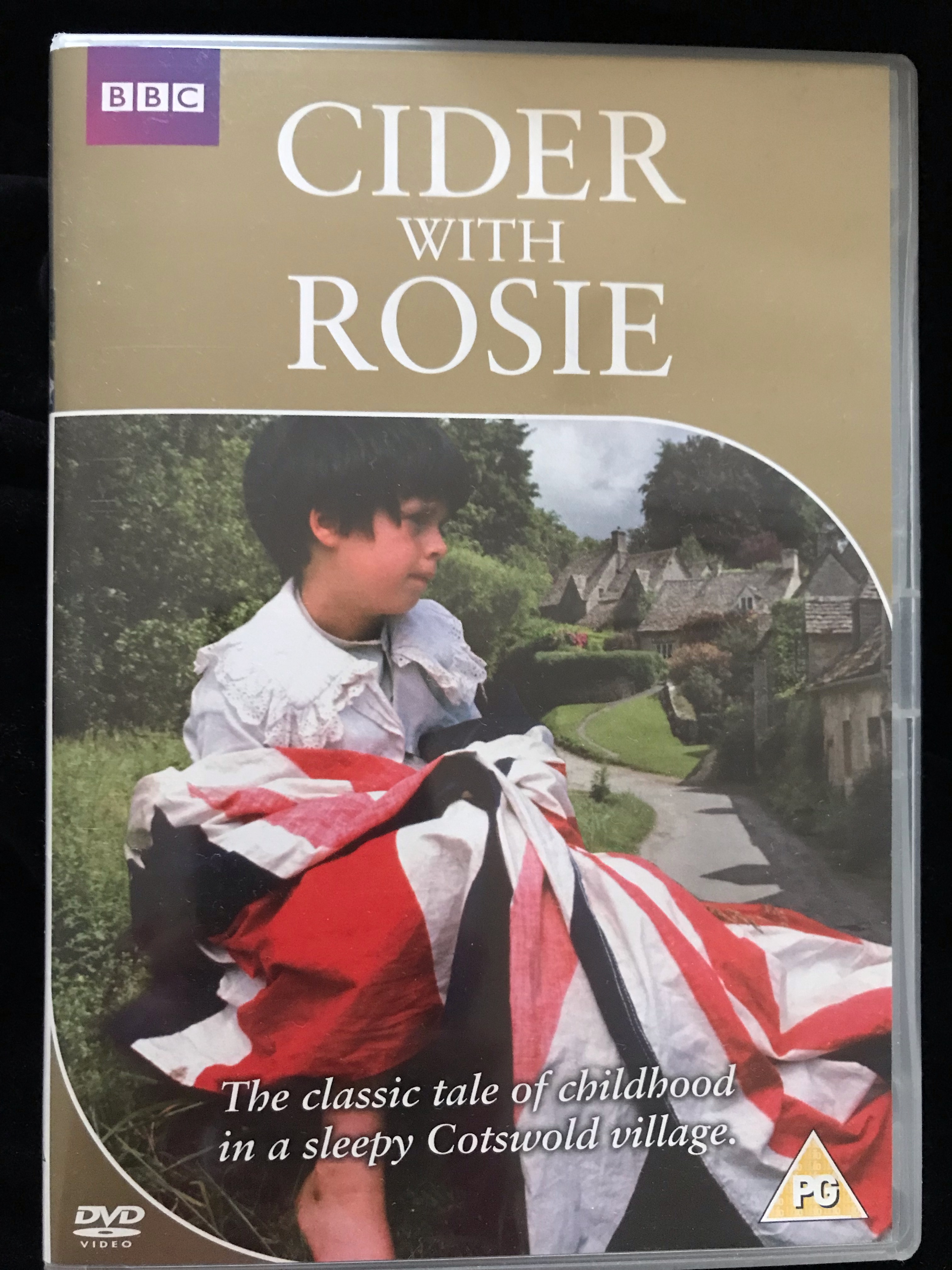
Christmas Day 2021 marked the 50th Anniversary of the first BBC adaptation of Laurie Lee’s evocative book ‘Cider With Rosie‘, a story that tells of growing up in rural Gloucestershire before the combustion engine destroyed rural life as it had been led for centuries.
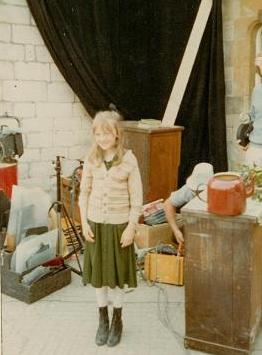
Sophie Neville playing Eileen Brown
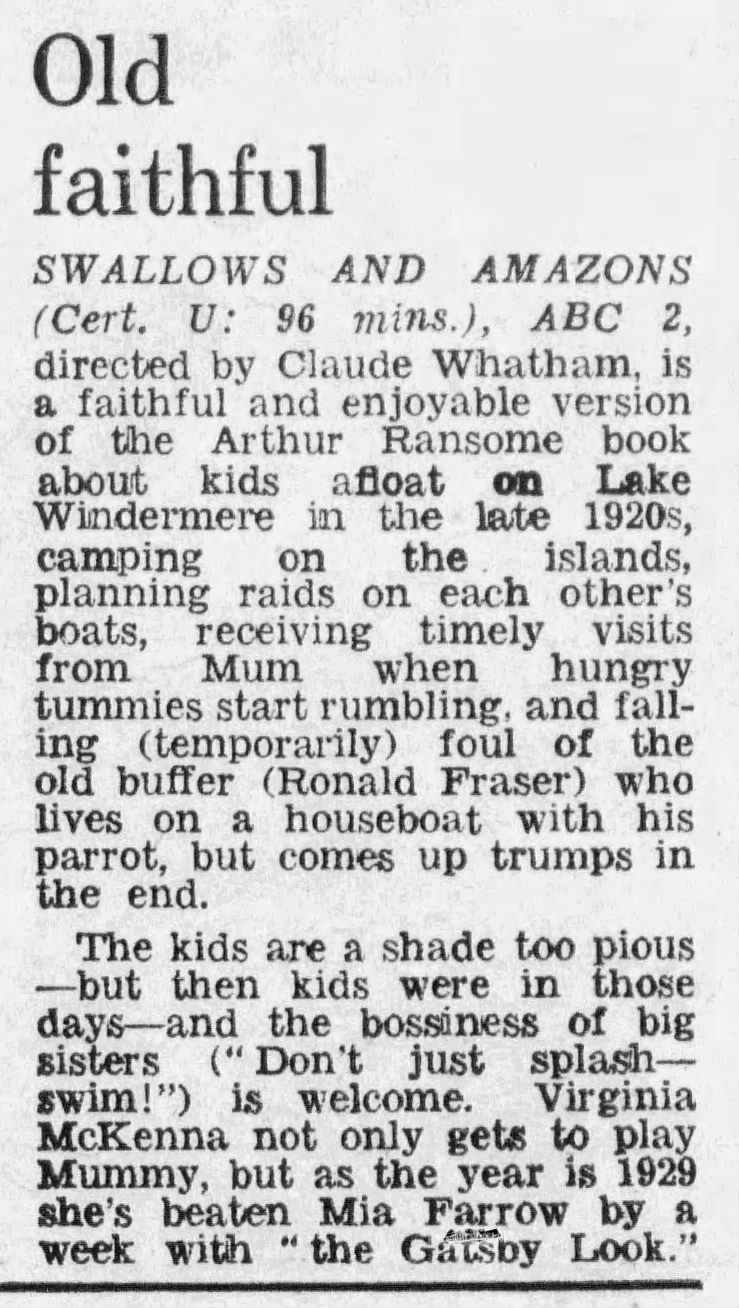
First published in 1969, the memoir sold six million copies. The 1971 BBC play was screened in the UK, France, West Germany and Japan, becoming regarded as an avant garde, ground-breaking drama that received four BAFTA nominations – Best Script: Hugh Whitemore Best Actress: Rosemary Leach, who played Mrs Lee Best Design: Eileen Diss Best Drama Production: Claude Whatham
And I was in it, as a girl, playing the part of an urchin who could play the piano called Miss Eileen Brown. We were able to use the original village school in Slad as the location for both the classrooms and parochial Christmas concert. I can almost smell the chalk and dusty books mixed with hairspray used by the crew to limit unwanted reflections or dirty-up anything that looked smart and new.
As we ran out into the school yard, which was tiny, the director, Claude Whatham asked if any of us knew any skipping chants. No one said anything. I had been to a village school nearby and knew loads but was too shy to chant them. What a regret.
We used Laurie Lee’s village school in Slad as a location
It was June 1971. We had glorious weather. Prolific wildflowers made the drama special. I remember a bunch of buttercups standing in a classroom window. My scenes were set in 1925, when Laurie Lee was aged about eleven. I was used to having my hair tied in bunches but not up in hair ribbons. It felt strange. I wasn’t very happy about my dress, which was itchy and didn’t fit well. The costume designer assured me that Eileen would have only possessed one dress in real life. I was well aware that it would have been a hand-me-down, as were the boots.
Sophie Neville with Claude Whatham in Slad, 1971
The classroom scenes demanded little of me, I simply sat next to ‘Laurie Lee’ and reacted to the violence exhibited by the teacher. My challenge was that I had to play the accompaniment to ‘Oh Danny Boy’ on the piano. Laurie Lee had to play the violin but the boy playing him was given a double. I had to practice six hours a day, for three days, to get it right. In the end the director said, “Do you think you could play a little faster?”
“These are crotchets,” I said. “They don’t go any faster.”
The result is agonizing but authentic and brought tears to Rosemary Leach’s eyes. The author, Laurie Lee, who still had a cottage in Slad at the time, told my mother that Eileen Brown was the first girl he fell in love with, which was daunting but all this entailed was having to smile.
Sophie Neville with Philip Hawkes as Laurie Lee
My mother appeared in dream sequence, aged 34, looking beautiful in a neatly starched uniform, playing a housemaid when Mrs Lee remembered working with lovely things in a great house. Laurie Lee appeared as himself wearing tweeds – right at the end.
Two years later, in 1973, Claude cast Sten Grendon, who played Little Laurie Lee, as Roger Walker in the Theatre Projects/EMI movie ‘Swallows & Amazons’. He chose me to play his elder sister, Titty.
Sten Grendon with Claude Whatham
The actors John Franklyn-Robbins and Mike Pratt also appeared in both dramas. I didn’t remember this until I looked up the credits on IMDb years later. In 1983, I worked with Rosemary Leach in Norfolk on the BBC adaptation of ‘Coot Club’, when she played Mrs Barrable. I met up with the designer Michael Howells who had a small part as one of Laurie Lee’s elder half-brothers. Both have sadly died. All these amazing actors have sadly passed away, but were captured on film at their most vital.
The film score of Swallows and Amazons (1974) was composed by Wilfred Josephs who also wrote the haunting theme music for Cider with Rosie (1971). You can listen to it here:
This item presented by Paul Martin includes a clip of a black and white BBC documentary made with Lauri Lee in 1960 outside the school where we shot the drama. According to his biographer, he said of Rosie, ‘She was someone, she was no one, she was anyone.’