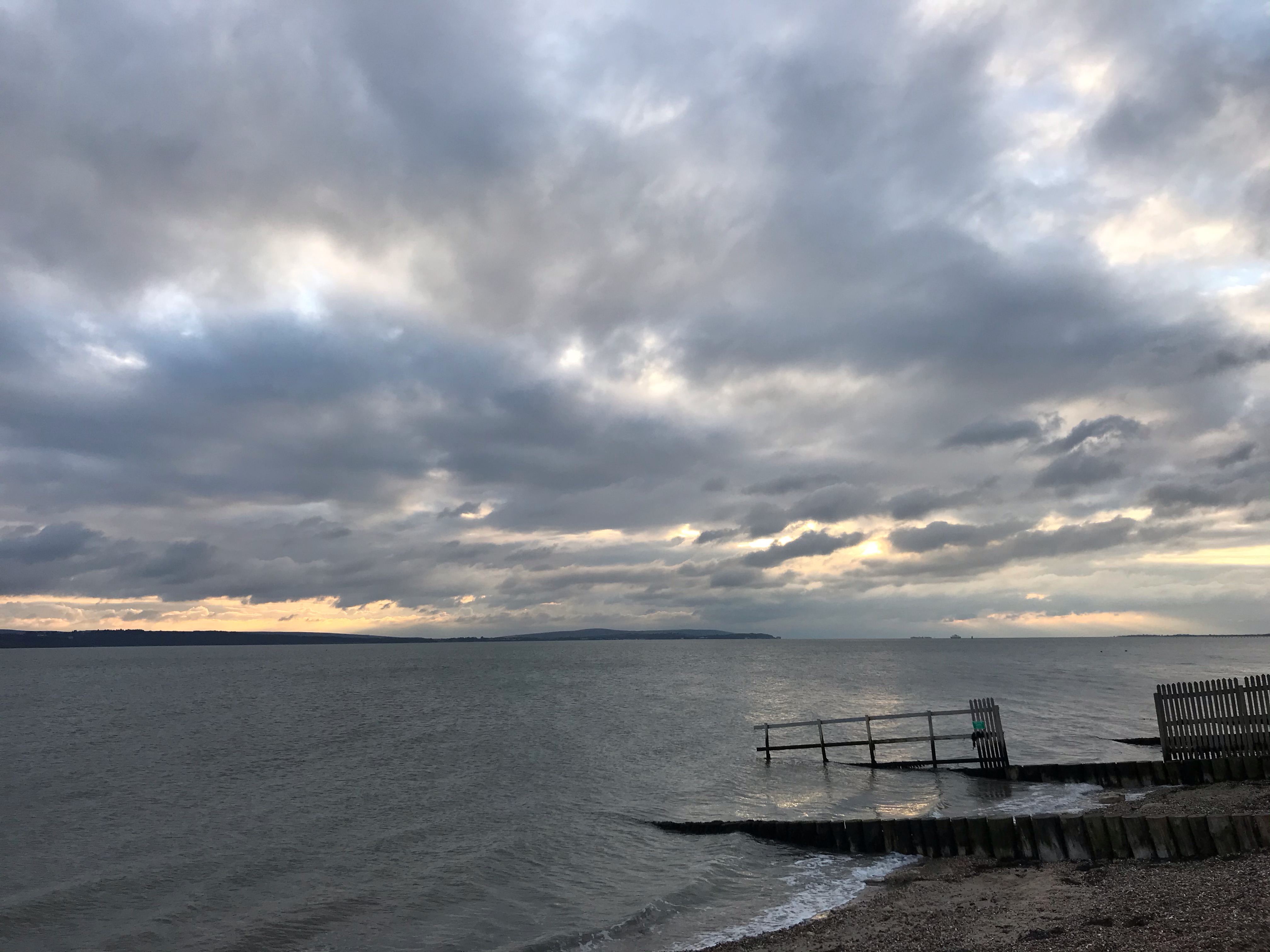
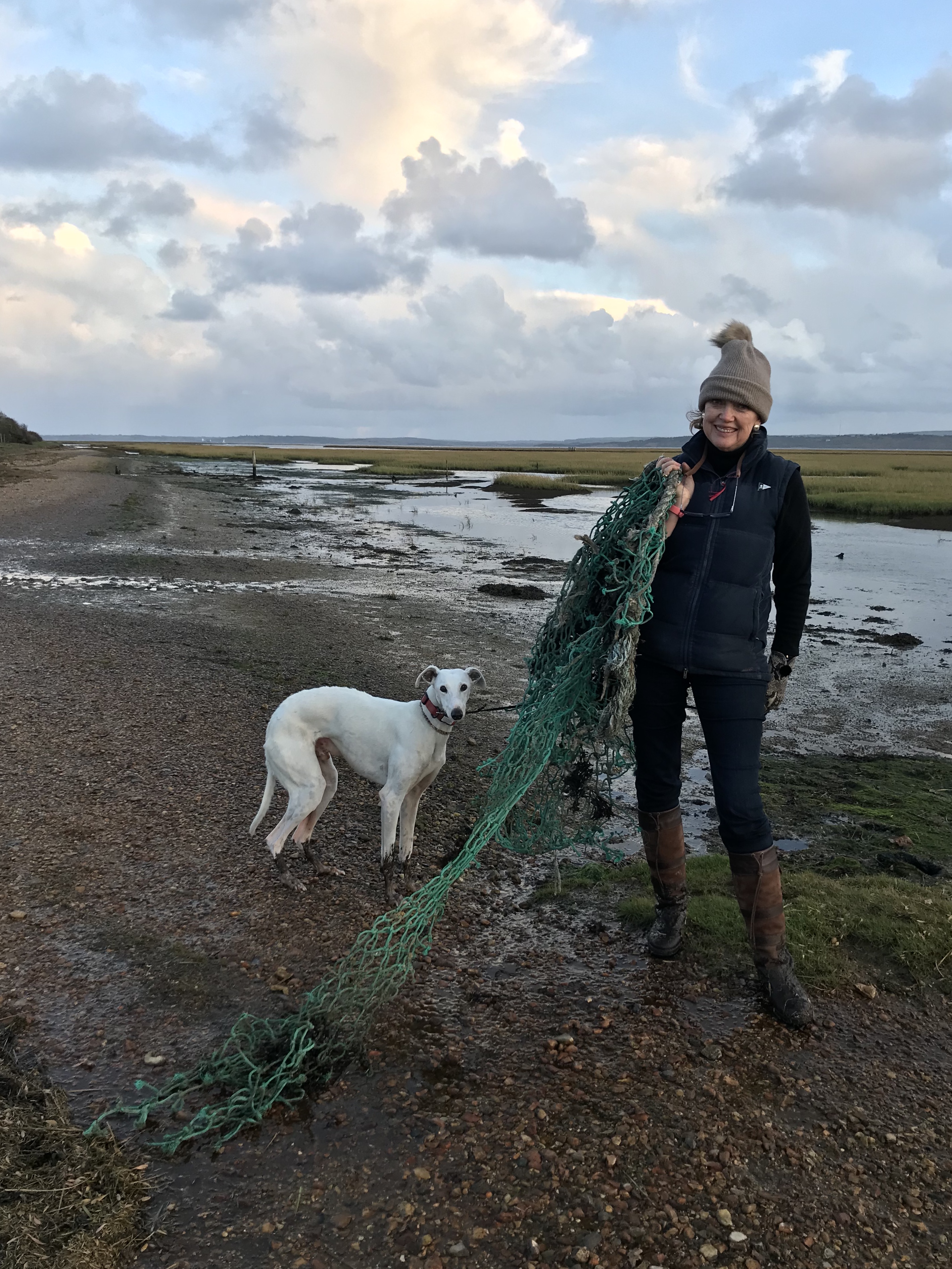
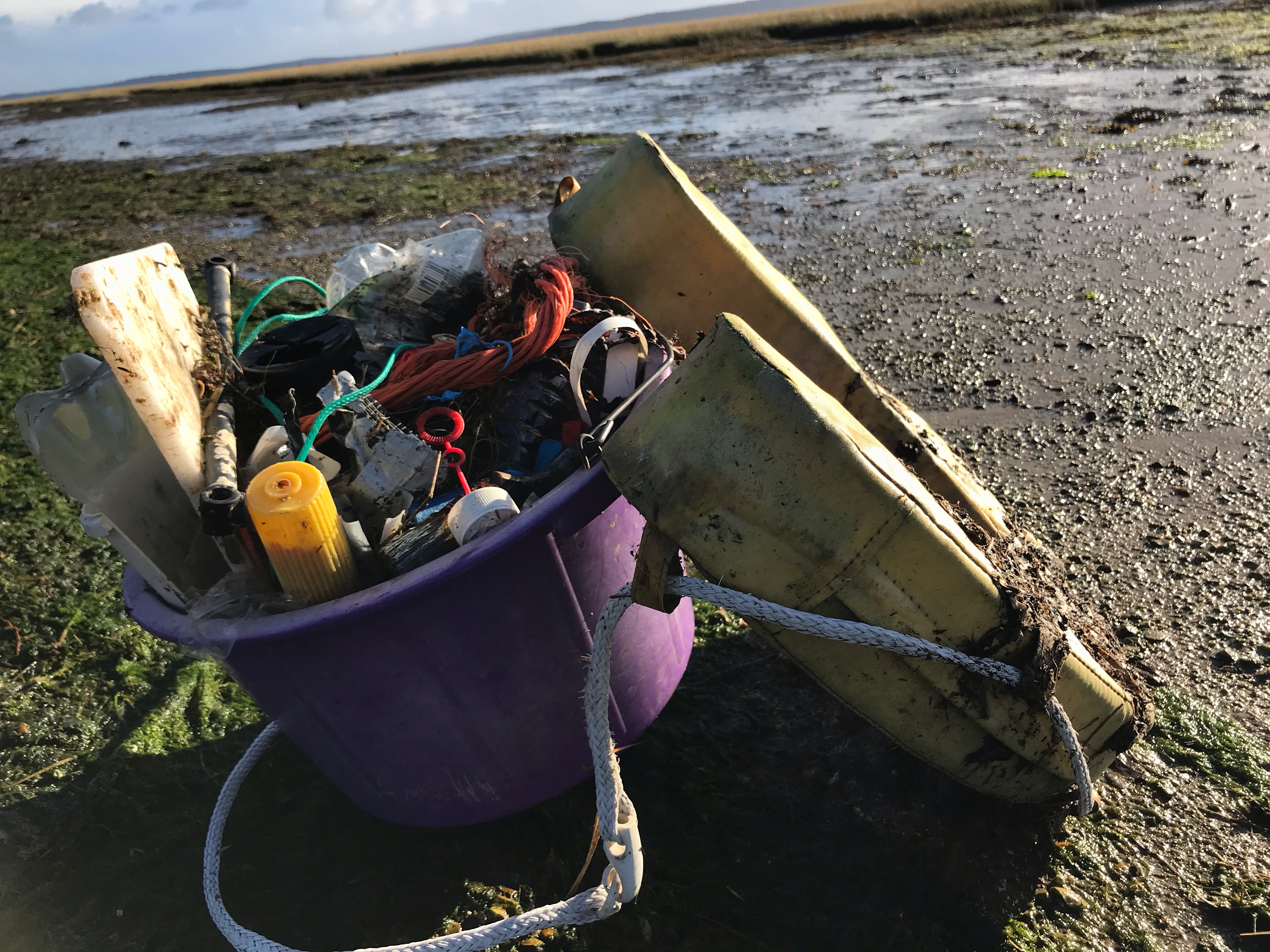
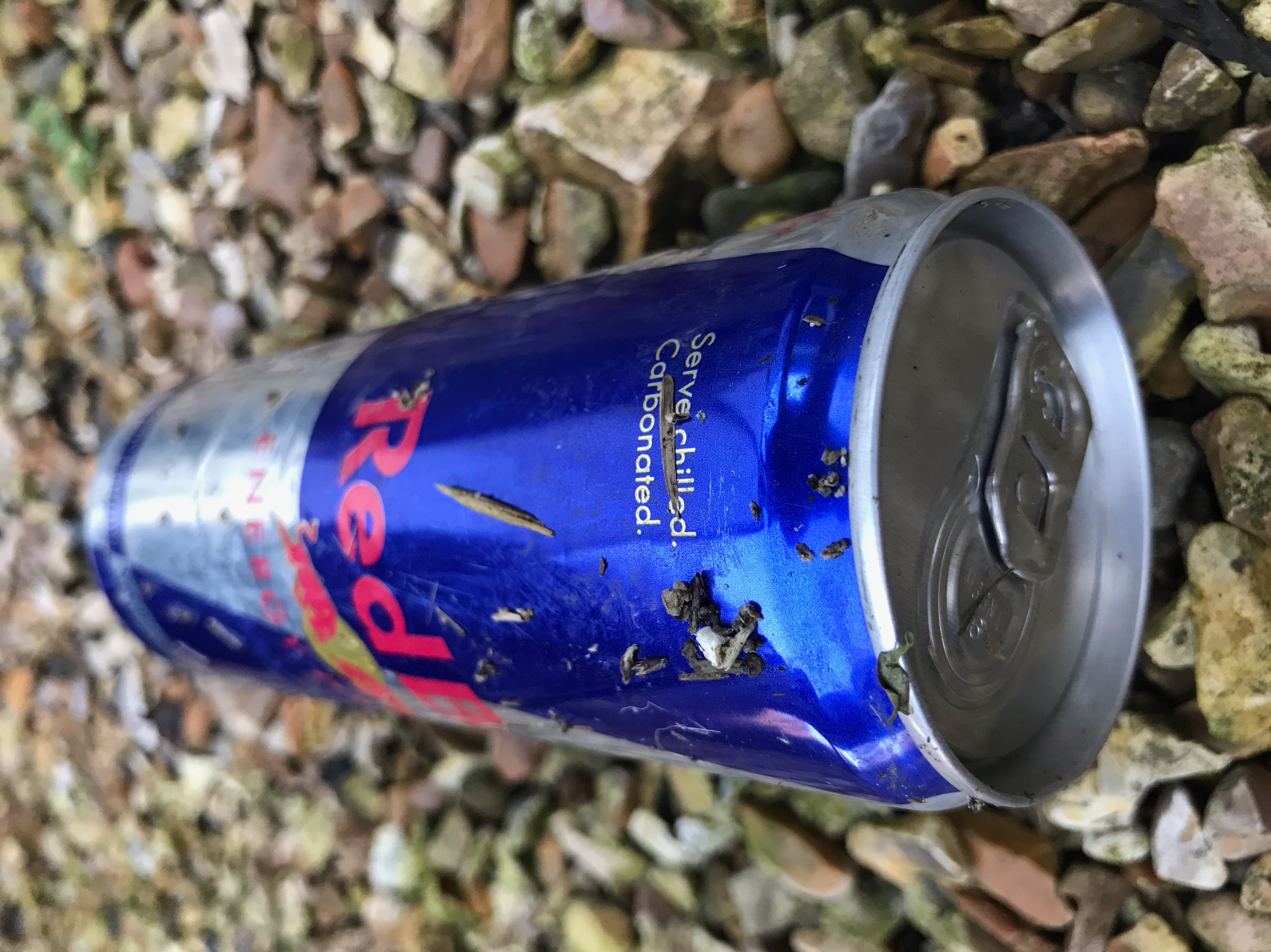
‘I didn’t see any rubbish on the beach,’ I was told by a walker as I extracted plastic bottles and tins from the ditch leading down to the sea. I was glad. I’d cleaned it just before New Year. But, once by the sea, I found a Christmas tree and collected half a bucketful of small pieces of PVC rope and elderly plastic that had been washed up on the shore.
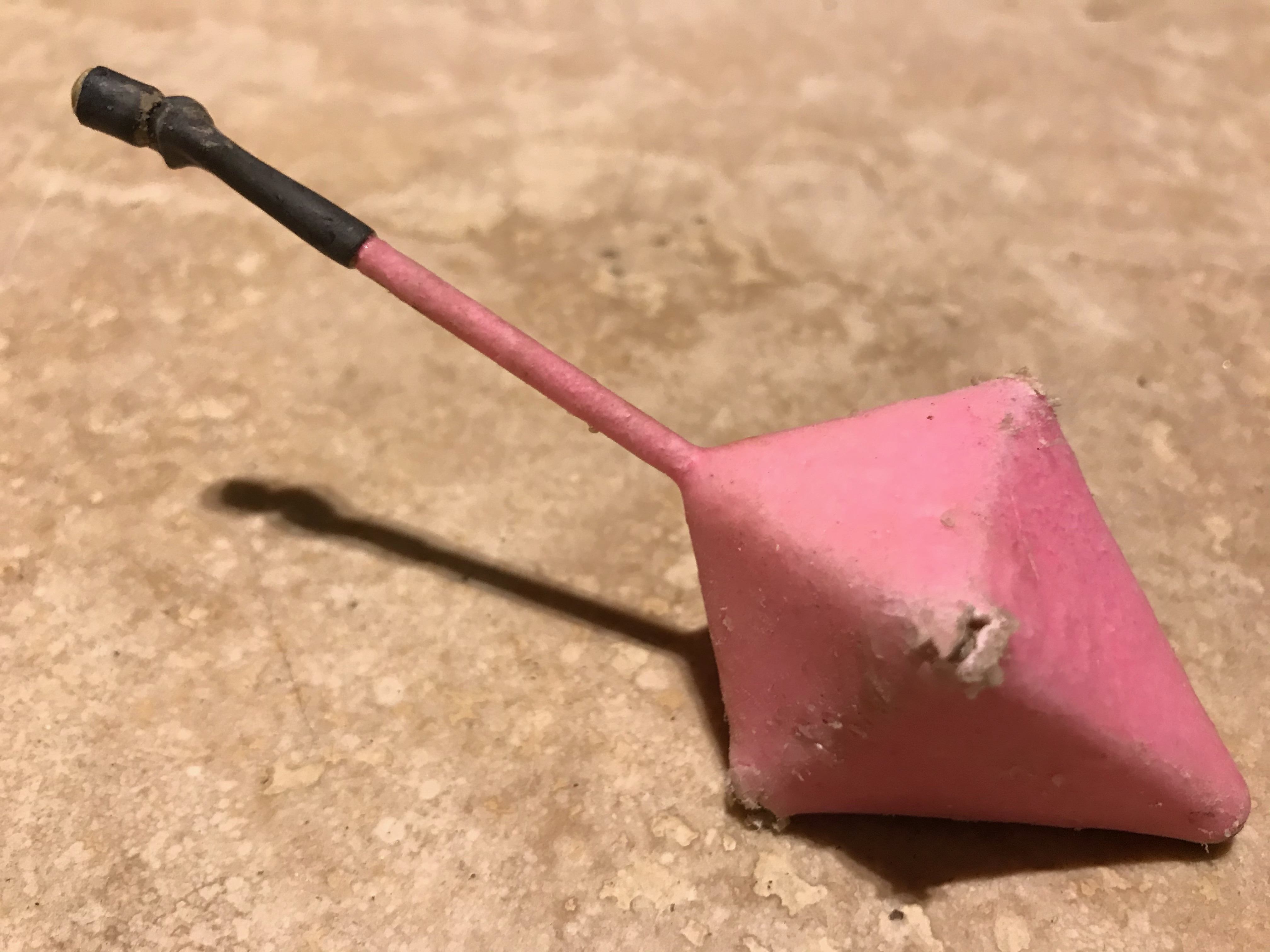
Since this is an isolated beach, it shows how much plastic is floating around the Solent. Someone might like their plumb line returned.
While a few things are clearly dropped by mistake,
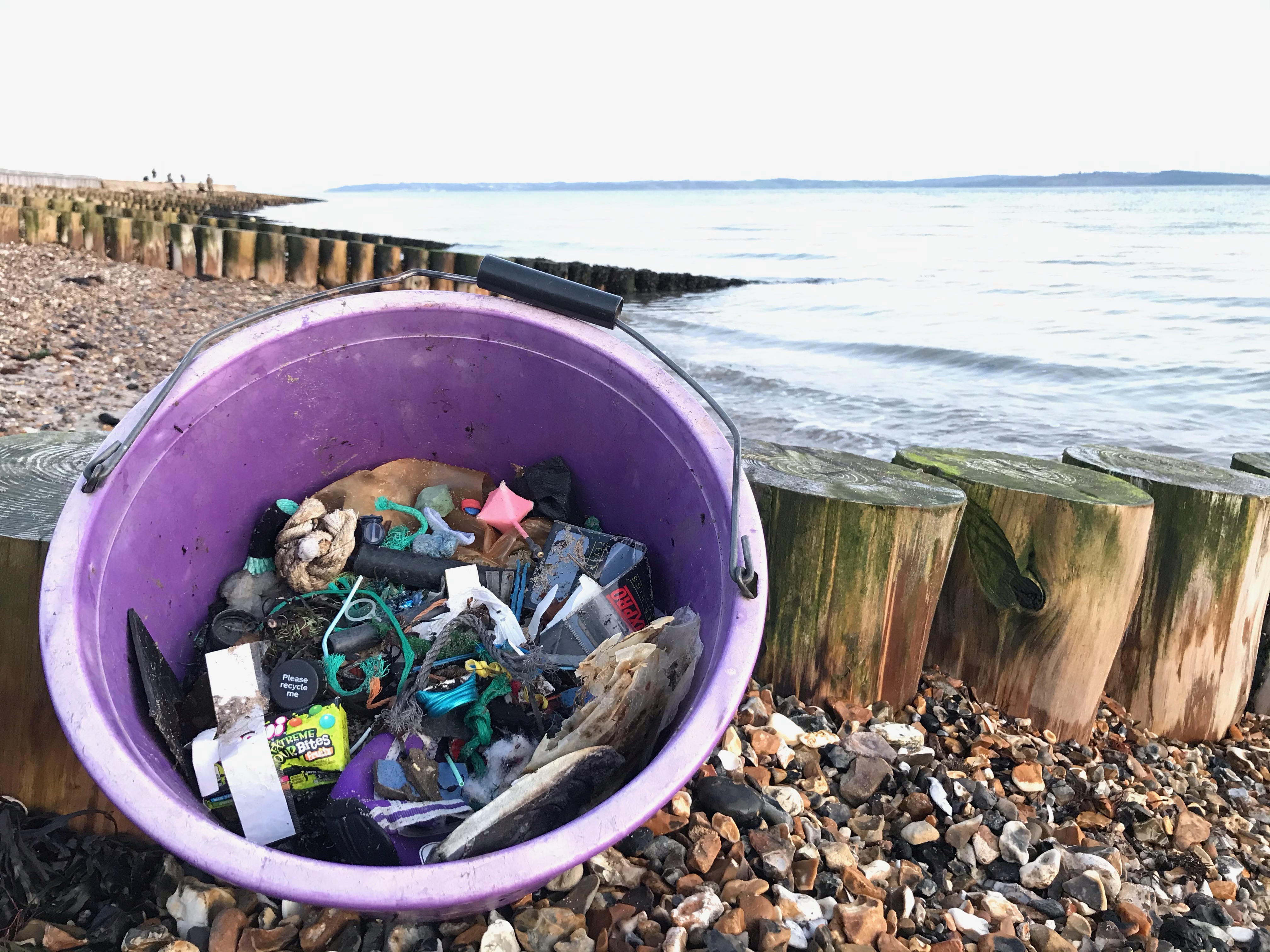
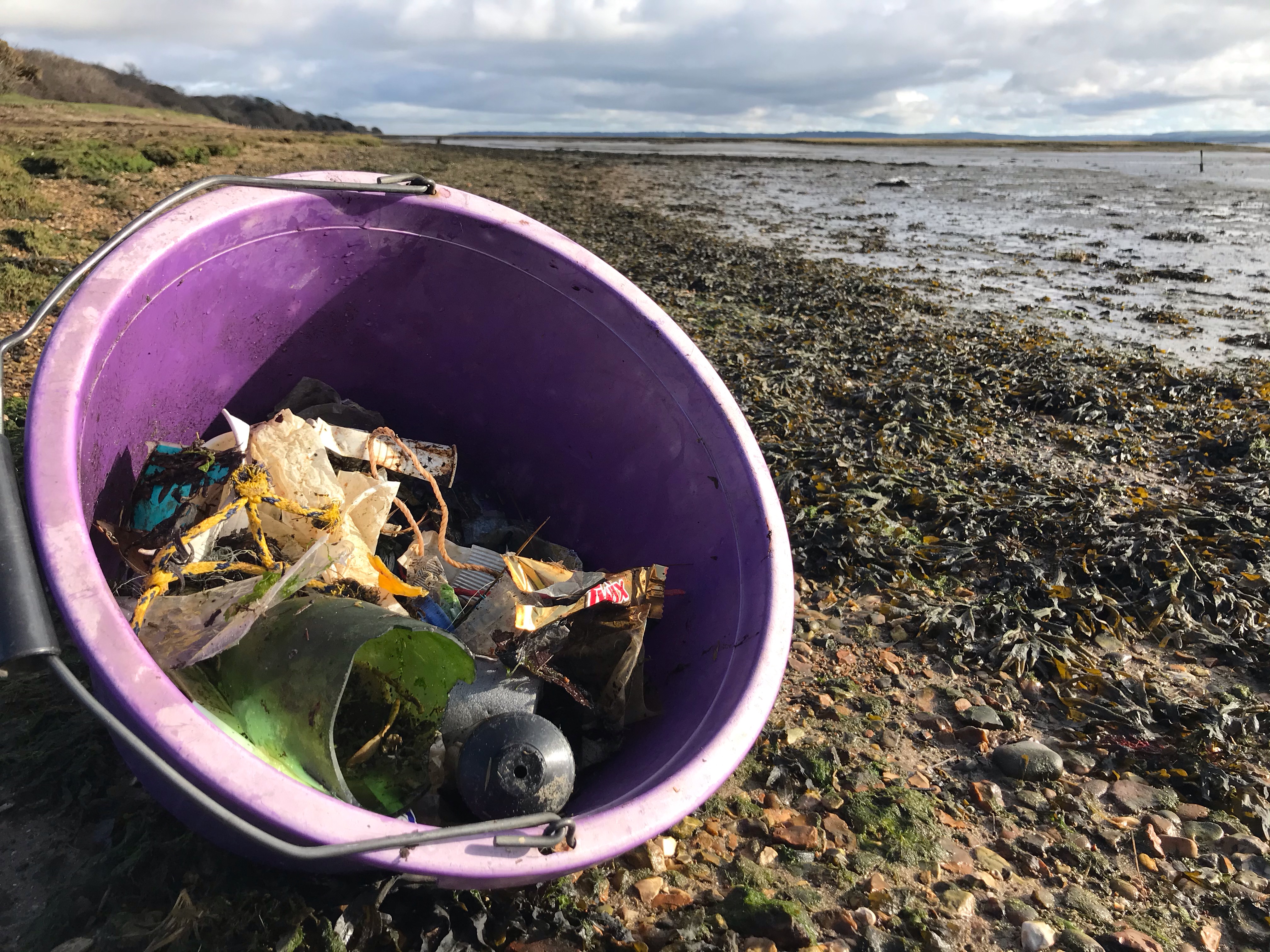
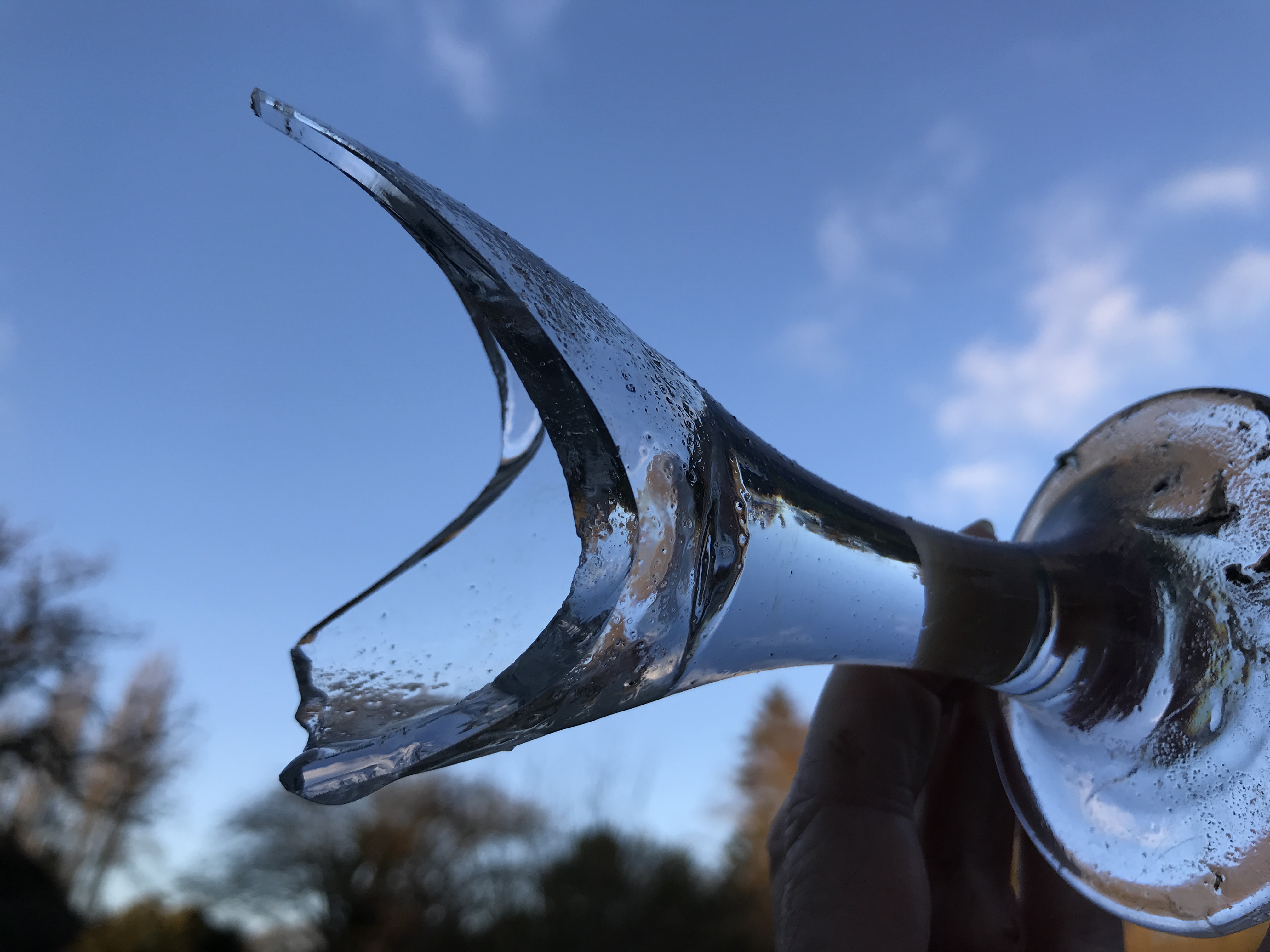
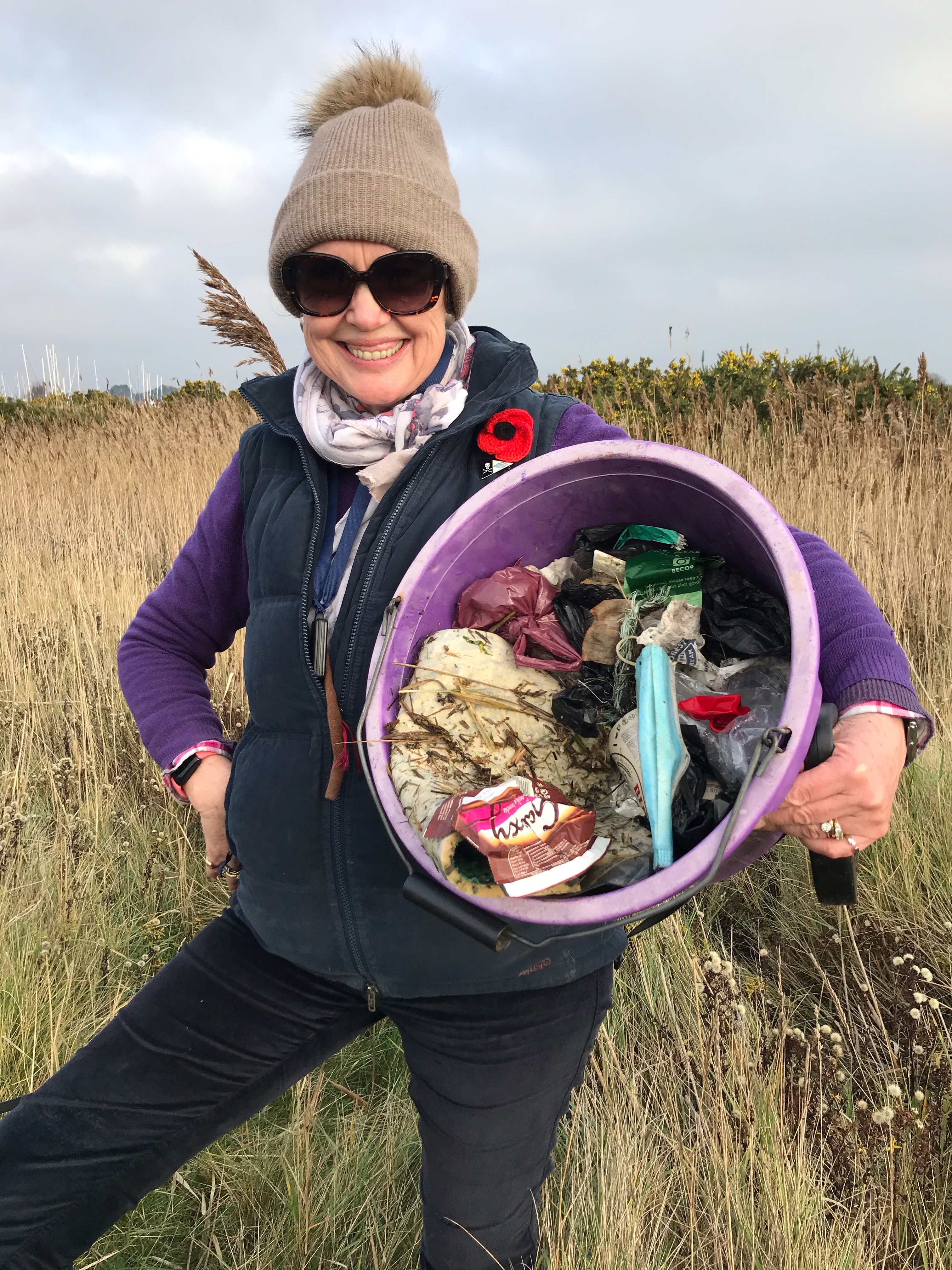
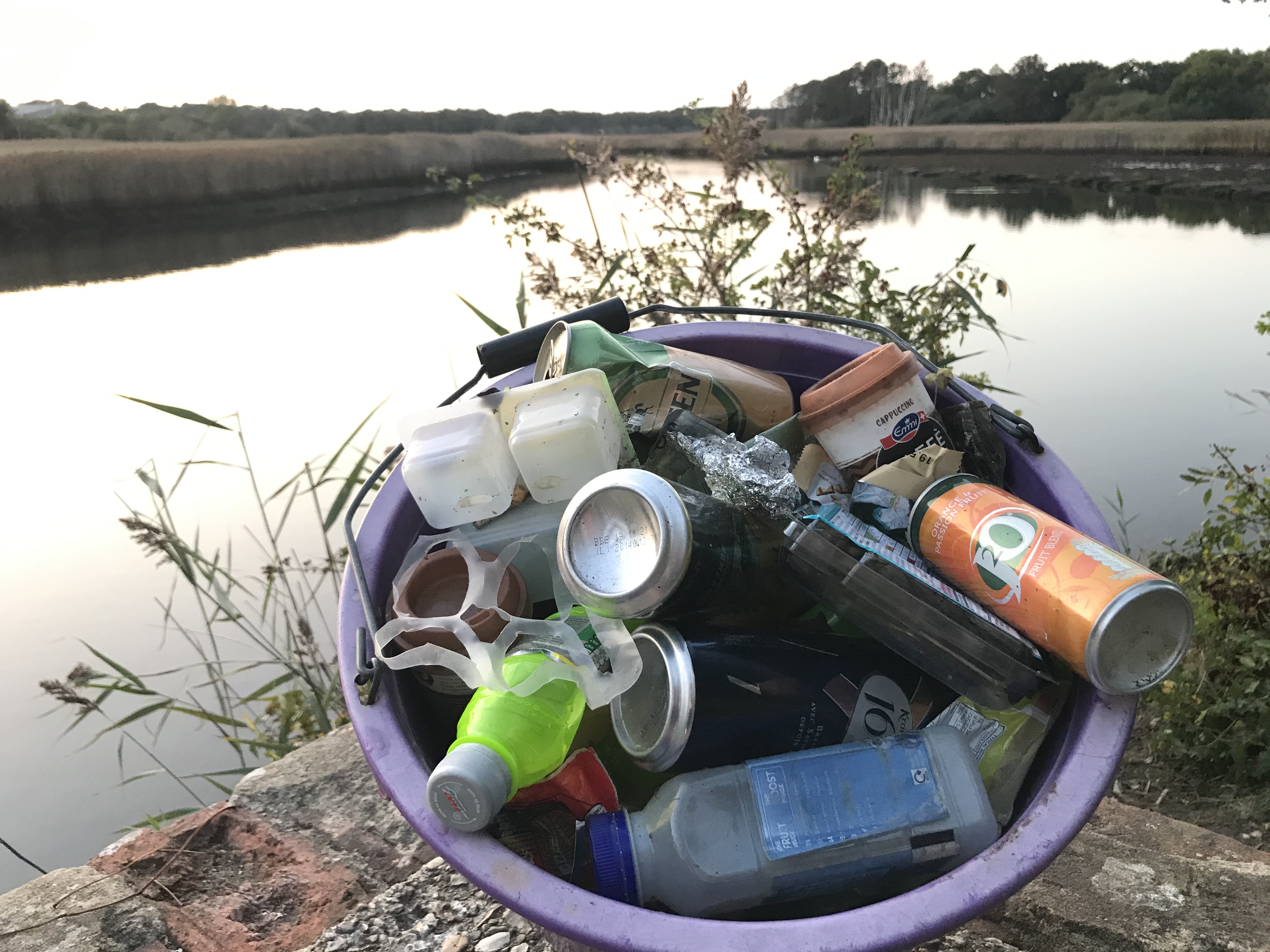
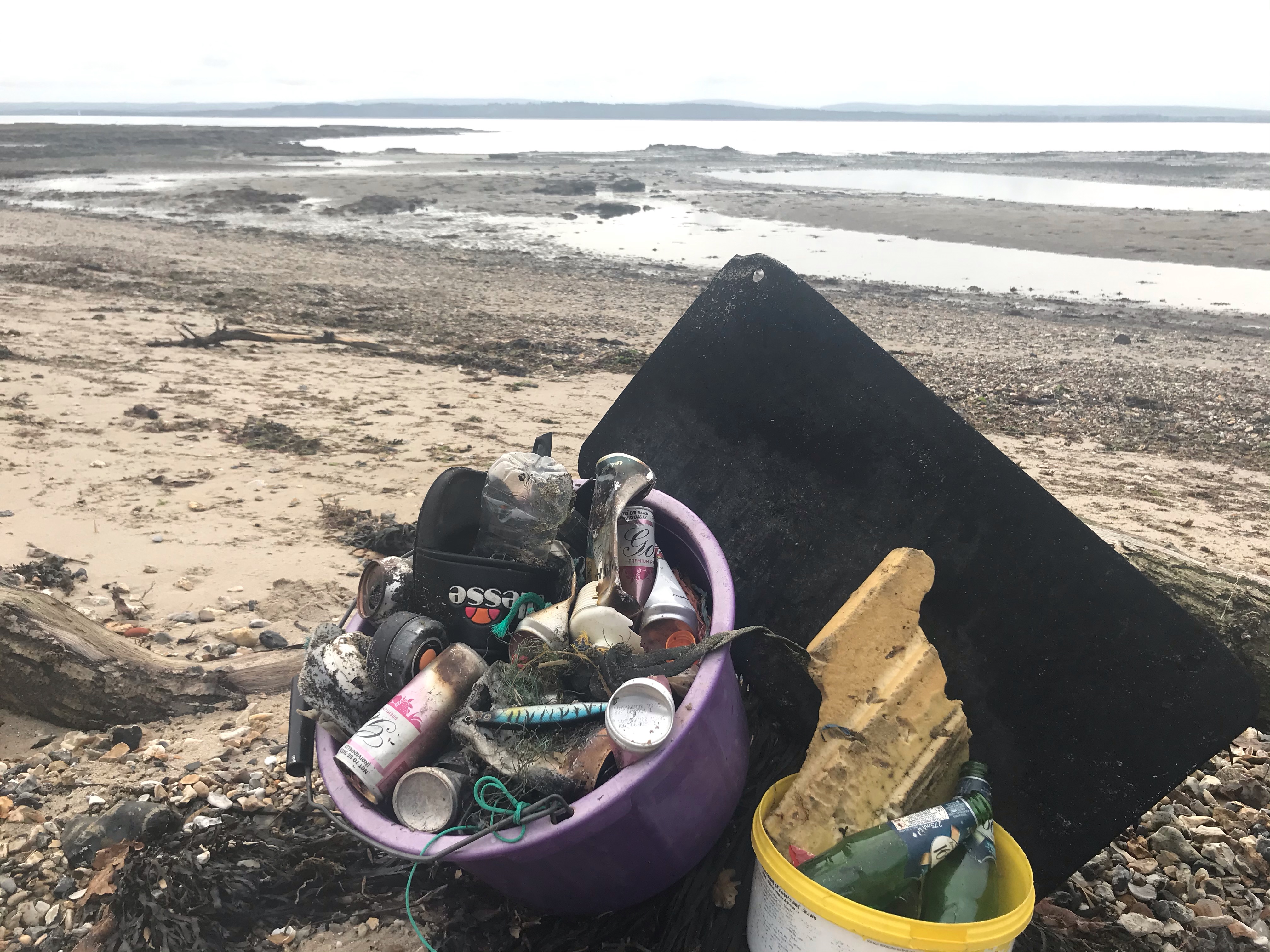
the amount of litter and ageing plastic on public beaches remains unacceptable. I cannot walk by without collecting it. It takes a good hour to fill each of these buckets, which contain bags of dog poo and dangerous broken glass. They can end up weighing 4Kgs each.
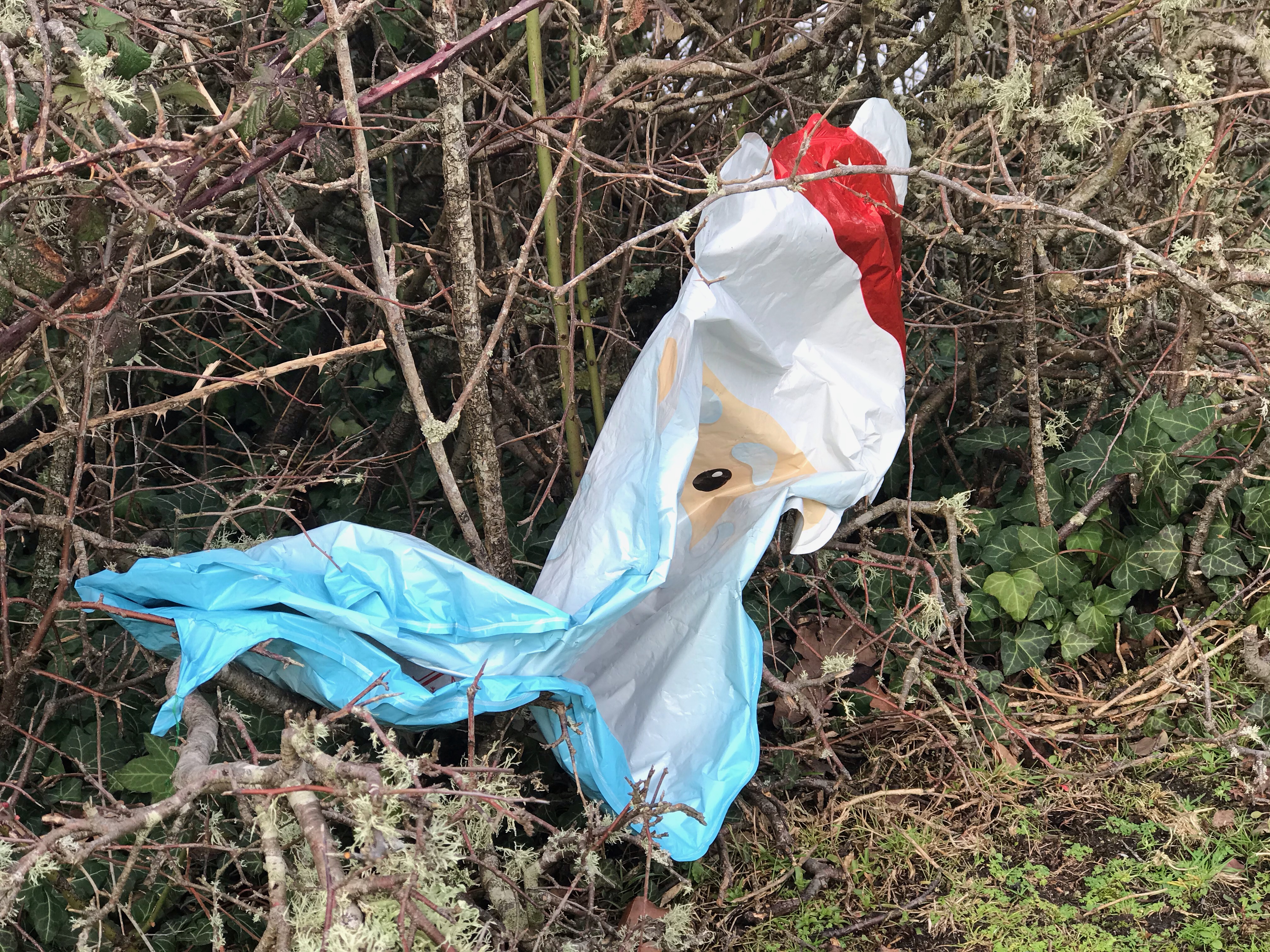
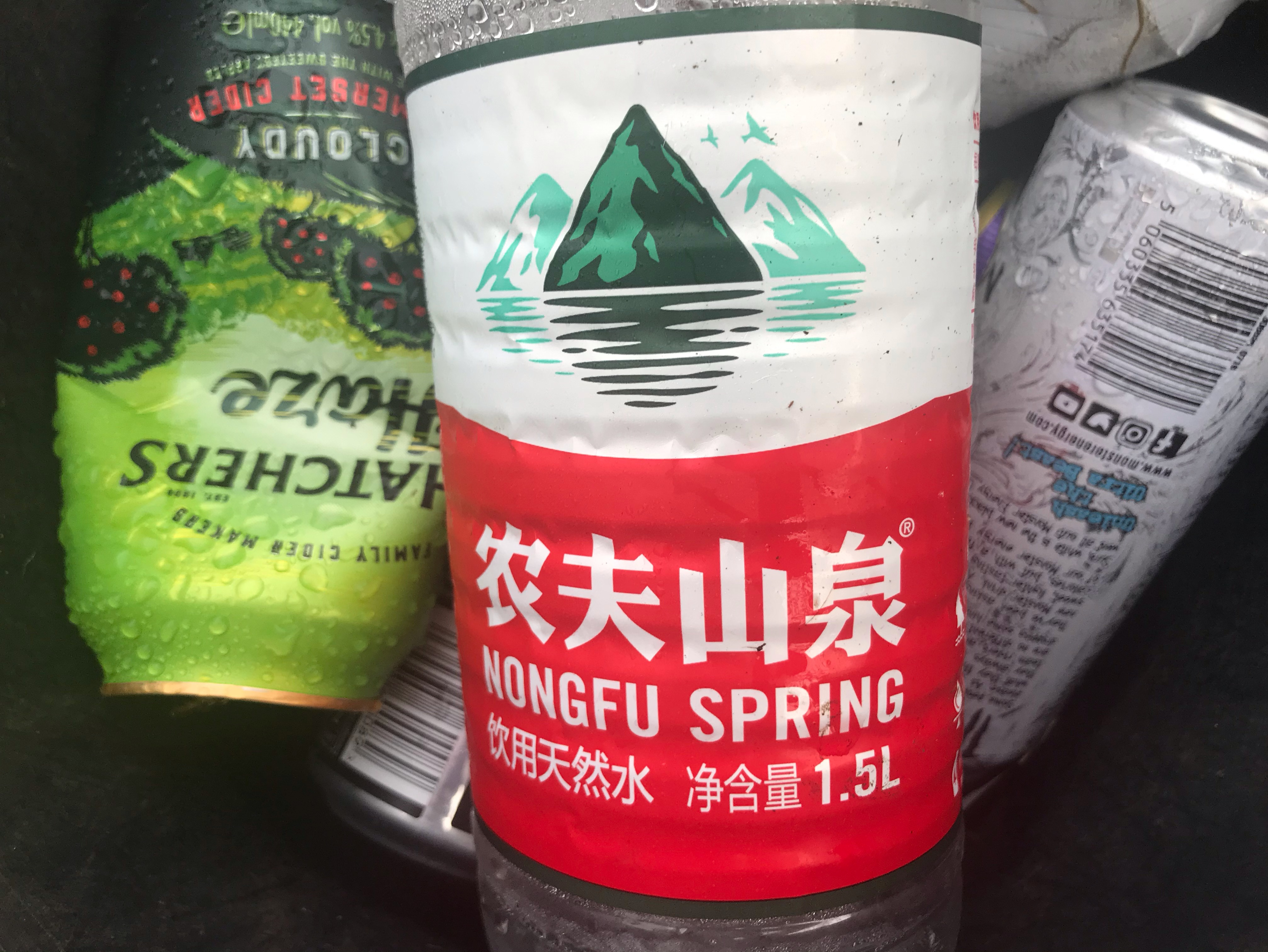
What are helium balloons doing to the environment? I find one a day.
‘There’s no rubbish on the beach,’ I’m assured by walkers, the next week. I agree that it looks okay. It should be fine. I’ve cleared it a hundred times.
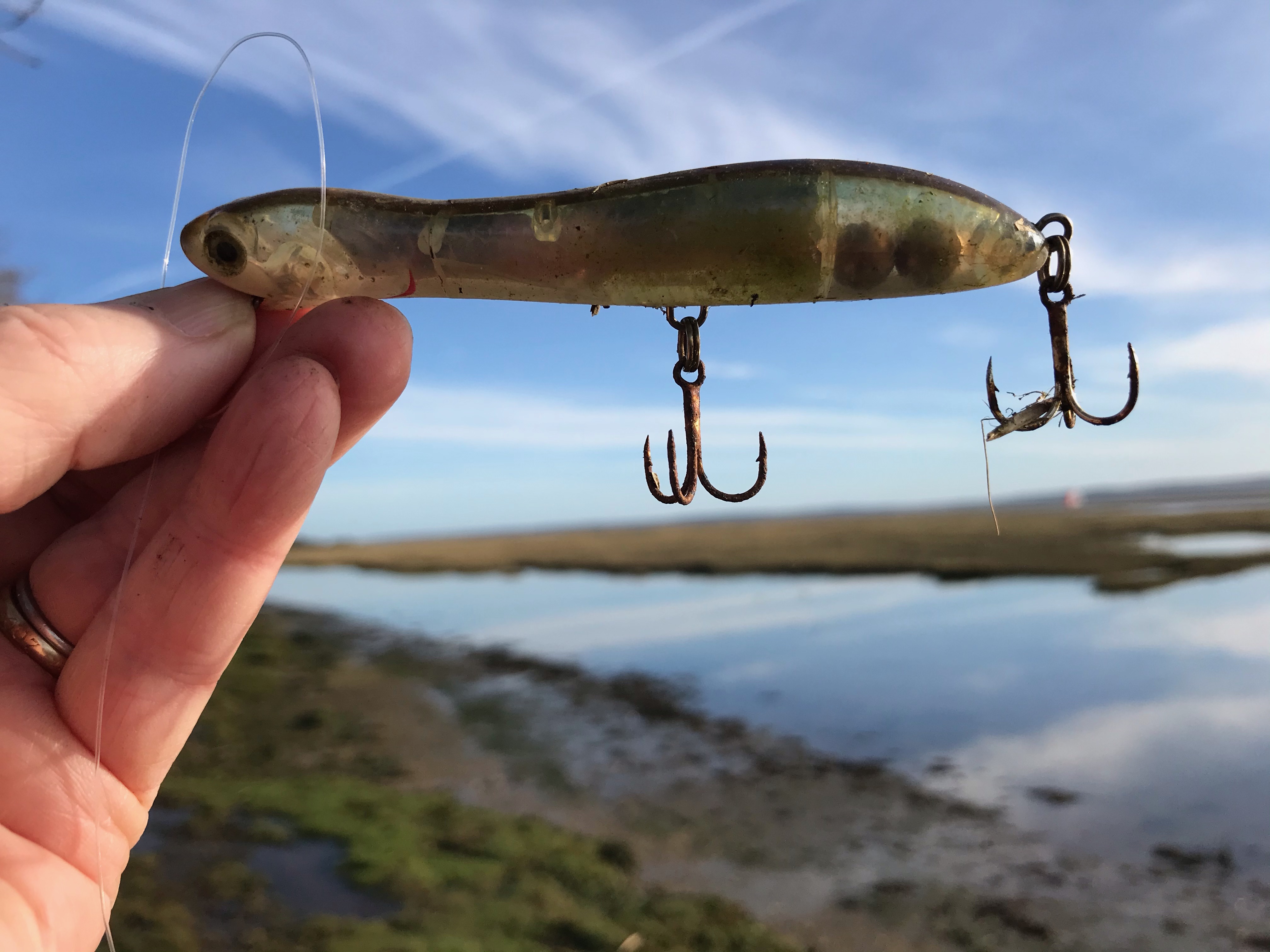
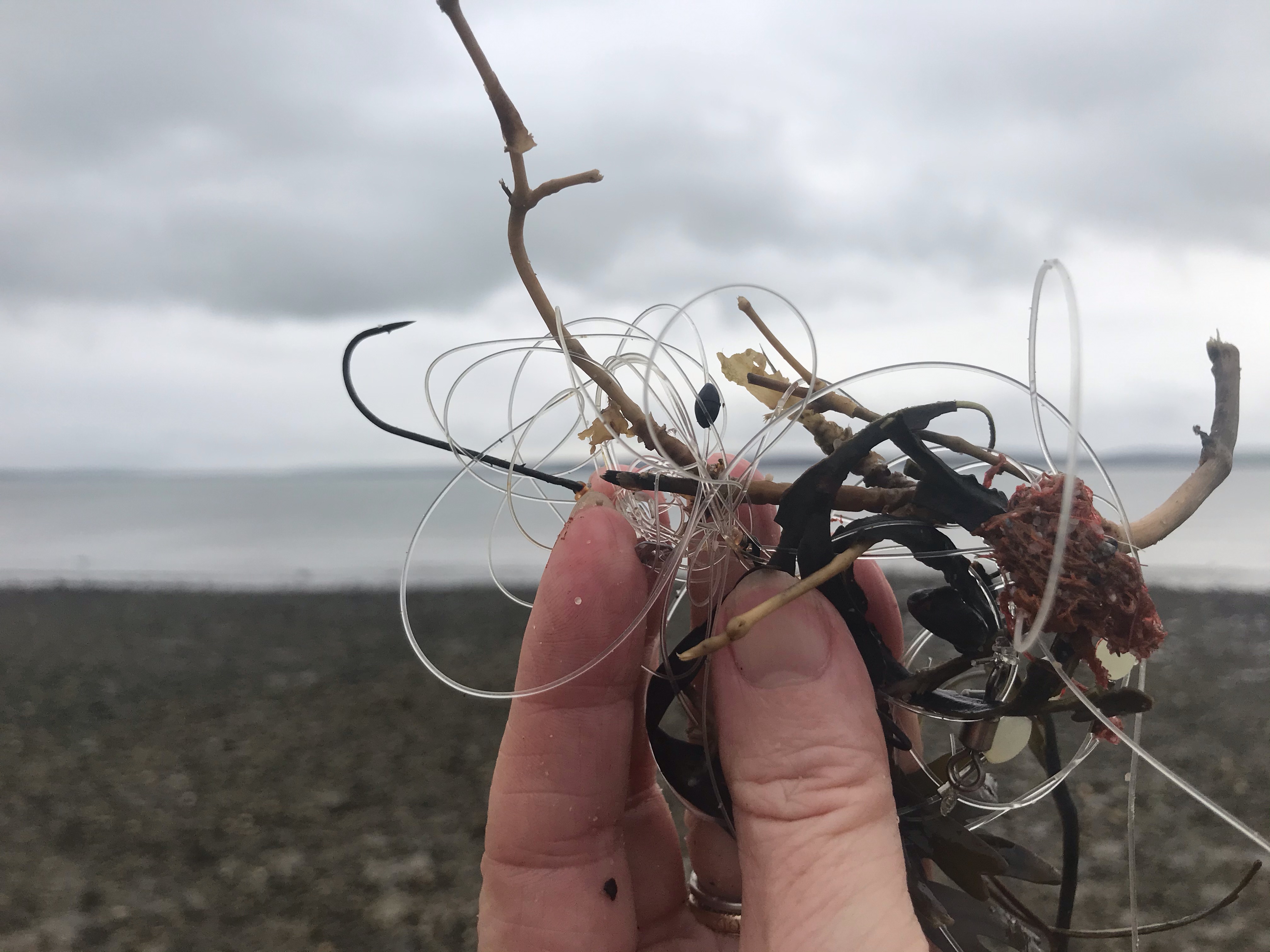
But, almost immediately, I find bottle ring and other items dangerous to wildlife. Then I come across fishing line, the fish hooks bound up in weed.
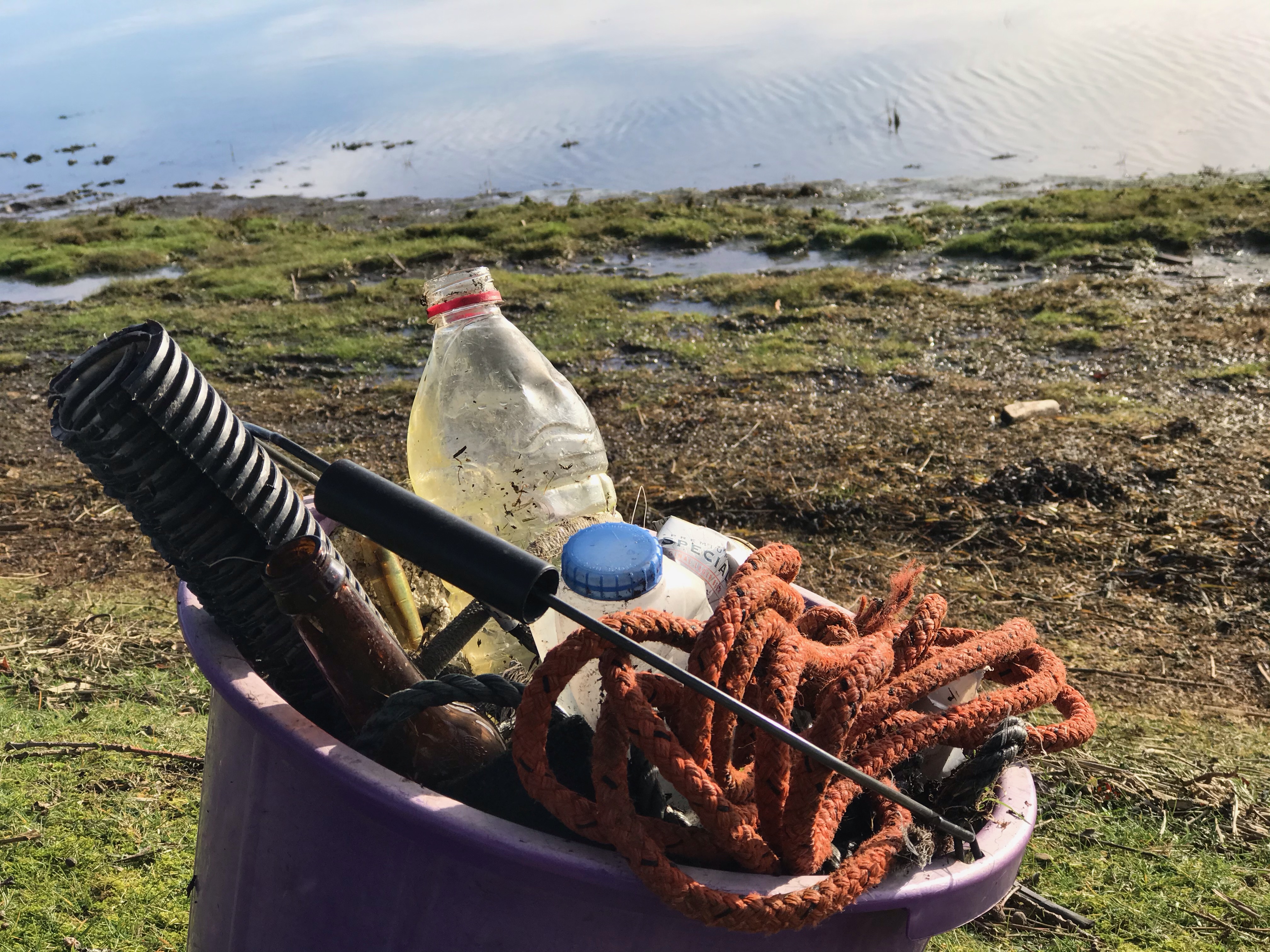
By the time I reach the end of the beach, I have filled my bucket, finding evidence of nitrous oxide canisters chucked into fires. The ghost rope alone could have caused havoc to shipping.
About this much plastic and glass washes up on a half-mile stretch of the Solent every twenty-four hours. It is not always easy to see it, but it’s there.
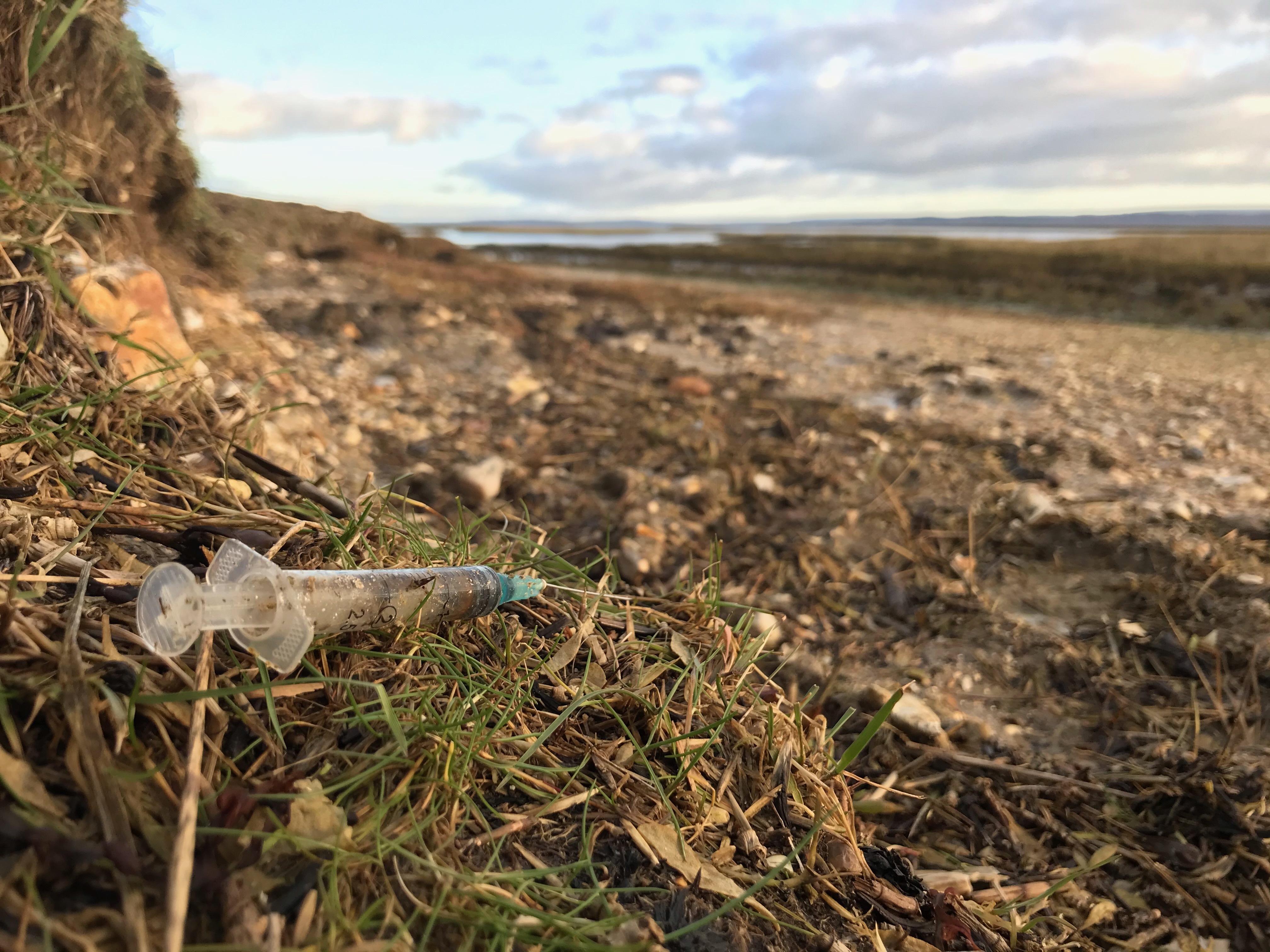
‘There is no litter,’ I’m told on approaching the foreshore with my dog-walking neighbour. We keep looking anyway. My friend spots this:
Before long, I had a filled my bucket. Again. Perhaps it’s only when you begin litter picking yourself that you appreciate how bad the problem is. Do join us!
And yet, we didn’t retrieve everything. Can you see what I see?
A guest post written by Stephen Sykes of Hill Top, Ealinghearth, Haverthwaite:
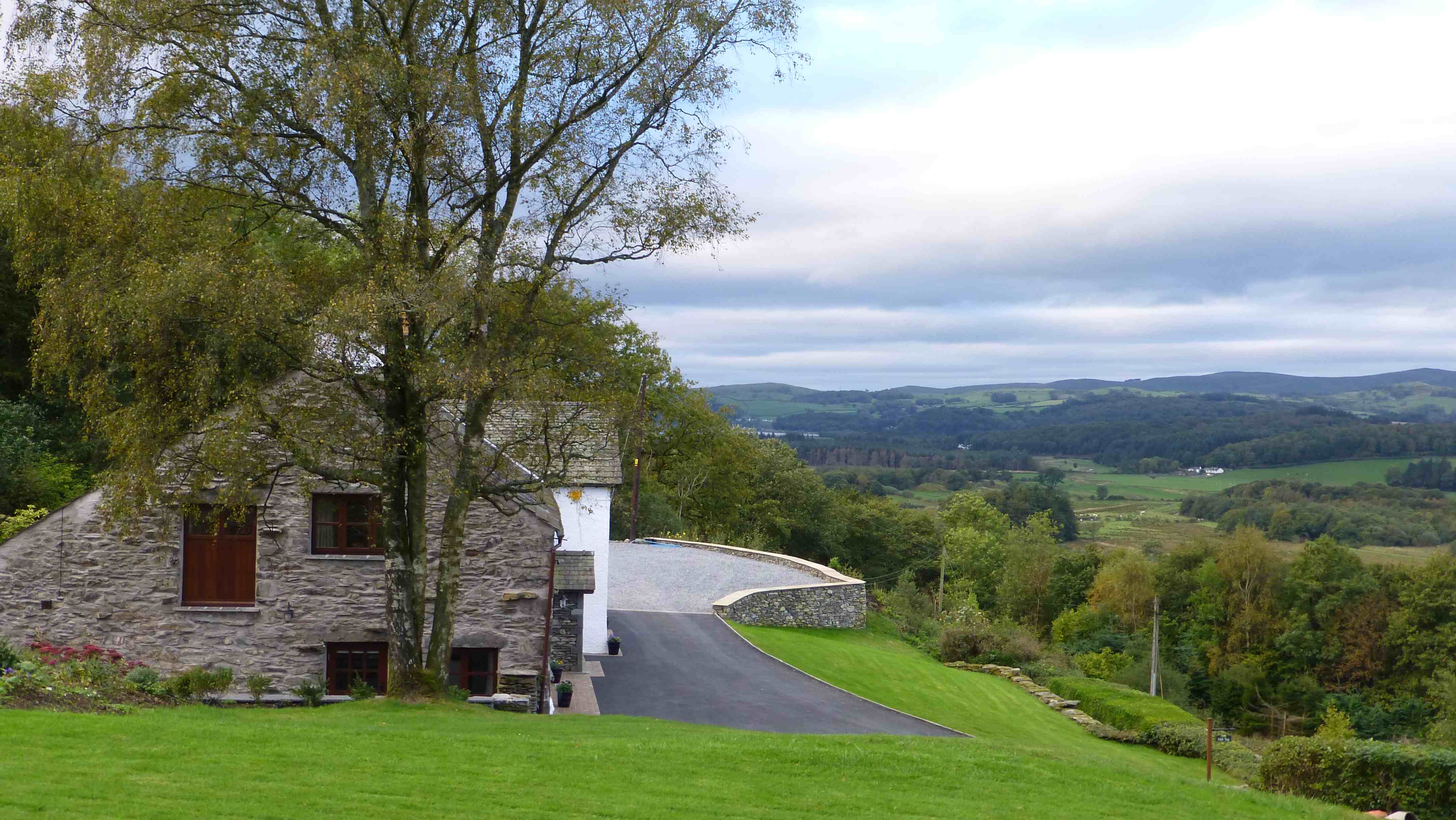
There are two farmhouses in the Lake District both called Hill Top and both once owned by famous children’s authors – and just a few miles apart. One, of course was Beatrix Potter’s, and the other was the last home of Arthur Ransome, which my wife and I purchased in 2012.
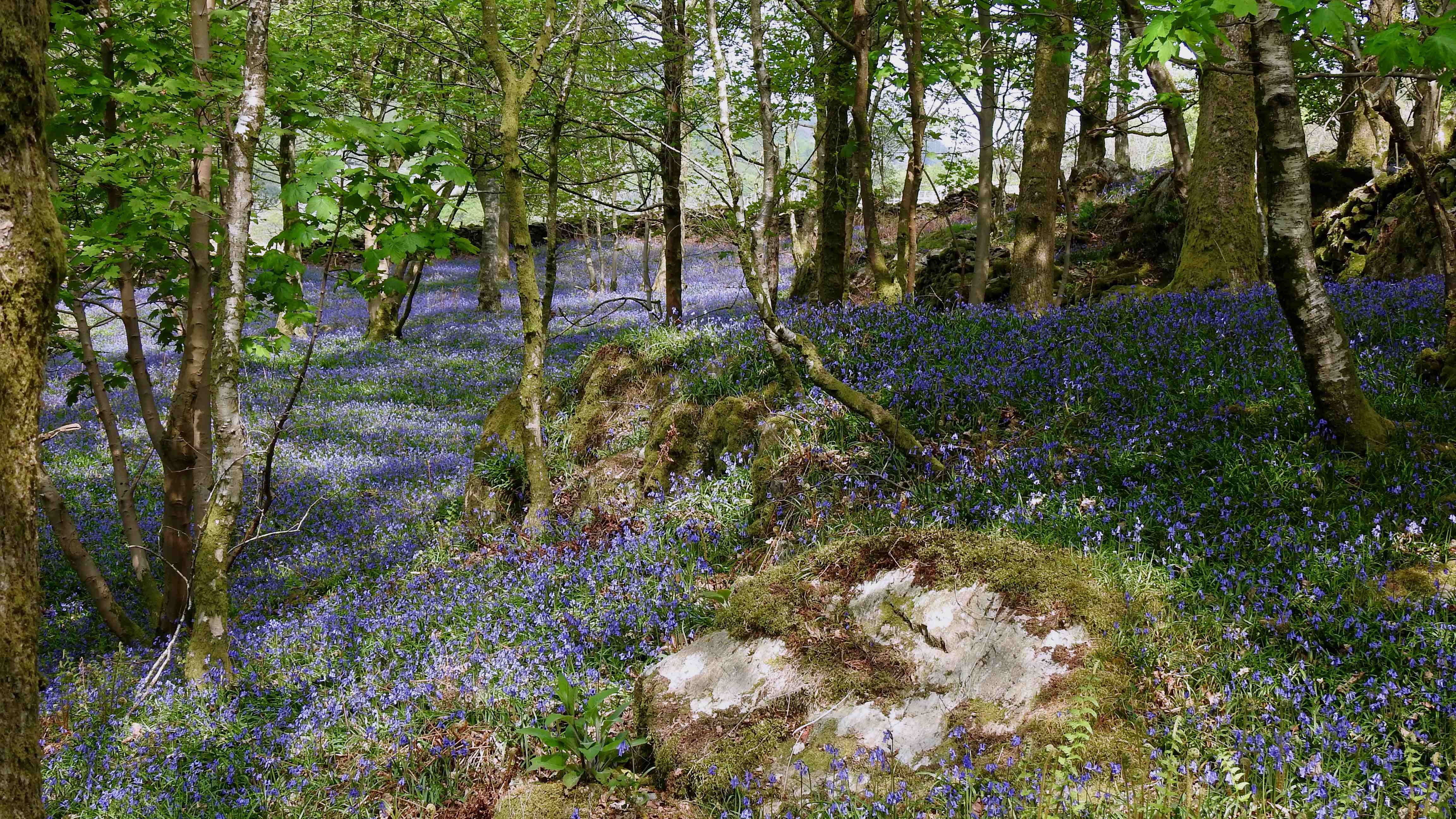
More recently we acquired the adjacent wonderful ancient woodland of some seven and a half acres. With its precipitous rock faces, mighty oaks, gigantic gnarled yews and dazzling carpets of bluebells in the springtime, Backhouse Brow (as it is known) entirely fulfils The Woodland Trust’s epithet: “home to myth and legend, where folk tales began”.
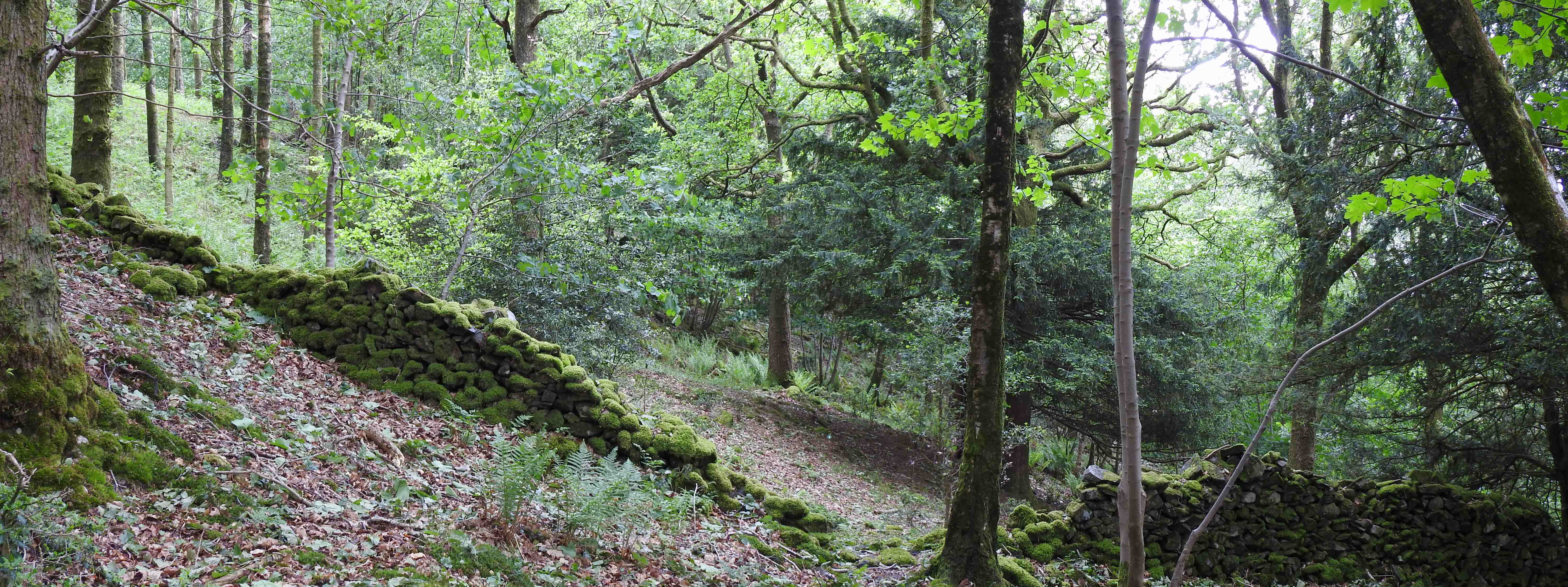
There are the evocative remains of long-gone human activities too. Coppiced sycamores evidence a traditional form of woodland management historically used in the area to satisfy the insatiable demand for charcoal required to service the long-ago thriving iron industry in Backbarrow, just a half-mile away over the hillside. And within Backhouse Brow can be found numerous archaeological remains left by the charcoal burners and their activities, once a common sight in this area of South Lakeland. Long-disused trackways still clearly make their way up and across the woodland. Levelled spaces – knowns as pitsteads or platforms – for creating kilns or piles to burn charcoal are still in evidence.
Circular stone base of a charcolburners’s hut
Ancient walls in various states of decay both encompass the woodland and subdivide it. And most evocatively of all, there are the more personal remnants of the lives of the charcoal burners themselves. In addition to a much-rusted shovel or two, can be found the tumble-down remains of a circular low stone wall upon which charcoal burners would have erected a shelter, much as Ransome describes in Swallows and Amazons:
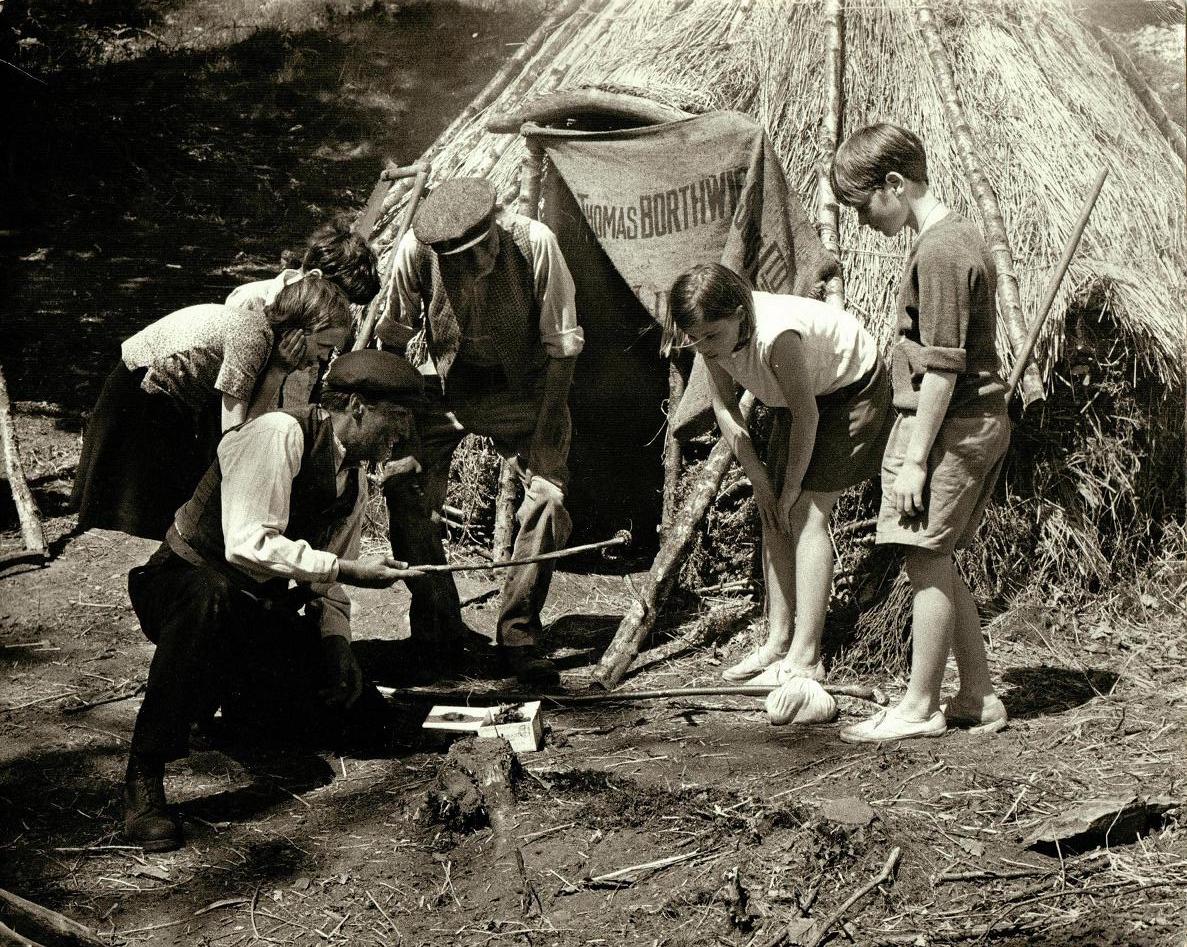
At the edge of the wood, not far from the smoking mound, there was a hut shaped like a round tent, but made not of canvas but of larch poles set up on end and all sloping together so that the longer poles crossed each other at the top. On the side of it nearest to the mound there was a doorway covered with a hanging flap made of an old sack.
Meeting the charcoal burners’s adder – a scene from the film ‘Swallows and Amazons’ (1974) StudioCanal
And indeed only a modest distance from our circular stone base, but at a somewhat higher level, lies the still identifiably levelled ground of a pitstead where a charcoal pile may well once have been tended by the men whose hut lay below. A strategic placing not only high above, but in a position which ensured that smoke was generally carried well away by the prevailing south-westerlies.
Stone hearth near Ealingshearth
Quite separately, in a glade some distance away, there are also the isolated remains of a rather fine stone hearth, presumably used for charcoal burners’ more domestic chores.
So, with extensive coppicing, trackways, pitsteads, the circular stone remnants of a hut and a hearth of particular note, and all adjacent to Hill Top – indeed, all now within Hill Top’s grounds – begs the question: was Ransome aware of any of this? Whilst he would have certainly seen the coppiced trees, probably not the archaeological remains. Despite the central involvement of charcoal burners in his story, he makes only the most fleeting occasional mention of the woodland in his later diaries and there is no mention of his having entered. Nevertheless, it’s rather fitting that in his final years he should have found himself in immediate proximity to this iconic historic activity about which he wrote some three decades earlier in his most famous fictional work.
The Ransomes owned Hill Top from 1960 until 1968 when Evgenia sold the property the year after Arthur died. In fact, following their arrival for the summer in 1963, they never returned to London – Hill Top finally having been supplied with electricity.
You can read more about charcoal burning in the Lake District in relation to ‘Swallows and Amazons’ here.
To read about filming the charcoal burner’s scene in the original film of ‘Swallows and Amazons’ (1974) please click here.
To rent the converted barn at one end of the farmhouse, which now comprises luxury self-catering holiday accommodation for two couples, please click here
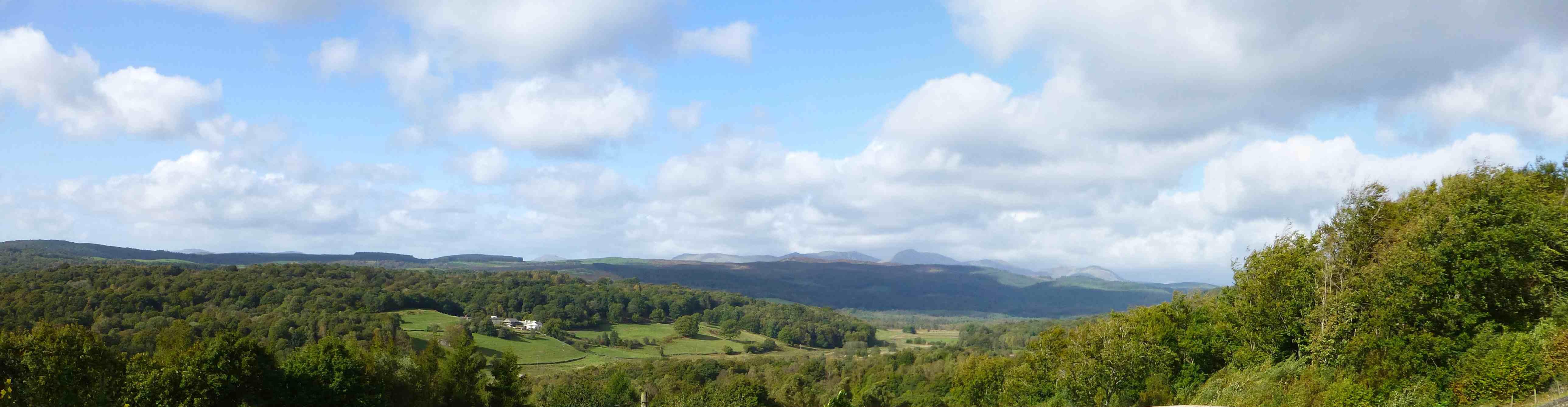
Sophie Neville visited Hill Top with members of The Arthur Ransome Society who admired the astonishing views across Cumbria. “It occurred to me that the fireplace and low stone walls of the charcoal burners’ wigwam, once abandoned, may have made up the basis of the igloo built by the Swallows and Amazons in Winter Holiday, which has a fireplace.”
Hill Top farm, near Ealinshearth where Arthur Ransome lived with his wife Evgenia
The year 2020 began for me in Portugal. I was recovering from a broken arm and disappointed to have to cancel my annual charity ride through southern Africa. However, a lovely girl flew over from the Waterberg in South Africa to work for me and we had fun designing gifts, using the illustrations from ‘The Making of Swallows and Amazons’.
Mugs printed with maps used to illustrate Sophie Neville’s books
When news of the Coronavirus broke out, we launched an appeal to help families in rural South Africa, which proved a huge success.
Carefully monitored by a qualified nursing sister, and with the help of volunteers from St John’s Church, food packages are still being distributed to needy families, feeding about 150 people a month. Read the latest news here.
Nursing Sister Grace Ismail reporting back from rural South Africa
Tests were unavailable in March, but I might have had a light version of Covid-19 whist we were working on this fund-raising campaign. I certainly lost my sense of smell and developed a weird blister/rash on one hand and foot after spending ten days in bed with fatigue.
Sophie Neville reading Lockdown Tales while self-isolating in the garden
My talks, planned for the summer, were cancelled but I read a story for Lockdown Tales, produced by Wildbeast for BBC Radio Suffolk and made available on BBC Sounds. I took part in an online reading of ‘The Picts and the Martyrs’ by Arthur Ransome, recording a chapter at home.
As literary conferences went online, I led a workshop on photographing books for instagram, when we were joined by the award-winning author Claire Wade.
While devising exotic recipes for my next book, I began baking cakes for the first time in my life, adding cardamon and cloves.
We rolled up a circle in the lawn to make a Lockdown vegetable garden so the children could see how different plants developed. Our dancing carrots became a hit on Instagram.
I photographed one of my husband’s artichokes, winning the Create! competition, organised by the literacy charity SchoolReaders and judged anonymously by Harry Cory Wright.
The prize-winning photograph of an artichoke
I was Highly Commended for a collage made out of sea plastic I’d collected when beach cleaning, awarded by Emma Bridgewater. The winning entries were exhibited at the Wilson Stephens and Jones Gallery in Notting Hill.
SchoolReaders invited me to become an author supporter of their work instilling a love for books in the next generation, along with other authors including Joanna Trollop and Sophie Kinsella. We are encouraging people to make a gift in their will.
I began loading illustrations and some of my sketches onto instagram. Do follow this here.
Hailed as ‘the feel-good film of lockdown’,’Swallows and Amazons'(1974) was broadcast on BBC 2 in both April and August and screened in Australia.
Radio Times billed Swallows & Amazons as ‘Film of the Day’
I was invited to talk about the movie memorabilia in a socially isolated edition of BBC Antiques Roadshow at Windermere Jetty, broadcast in March 2021.
Writer Marc Allum with Sophie Neville at Windermere Jetty in Cumbria
It was wonderful to be able to spend a few days in the Lake District, where Arthur Ransome’s first draft of ‘Swallows and Amazons’ is on display.
Sophie Neville with Arthur Ransome’s first draft of ‘Swallows and Amazons’ at Windermere Jetty
A signed First Edition hardback copy of ‘The Secrets of Filming Swallows and Amazons (1974)’ was auctioned online, raising an astonishing £201 for BBC Children in Need, exceeding bids for signed copies of books by bestselling authors such as Bernard Cornwall, Jeffery Archer and Adam Kay.
Lakeland Arts organised an online event to celebrate the 90th Anniversary of the publication of ‘Swallows and Amazons’, selling tickets for an evening ‘In Conversation with Sophie Neville, which you can listen to here.
Kett’s Books invited me to speak on Zoom for their ‘Books at Lunchtime’
The greatest days of this unusual year were spent on the Solent, litter picking with my extended family, who came to live with us through lockdown. Although some dreams were grounded, we had time to go for long walks and were able to explore the South Coast where we live.
Reviews and photos from readers are always appreciated, especially on Goodreads and Amazon.
After Christmas, I heard that a historical novel I am currently working on was awarded 3rd prize in the Association of Christian Writers’ novel competition and was shortlisted for the Eyeland’s Book Awards, who have offered me a writer’s residency in Crete.
As we entered Tier 3, I was recognised as ‘Beach Picker of the Year’ by Litter Pickers of the New Forest, a high accolade that marked the end of a quiet but busy year.
‘Beach Picker of the Year’ – Sophie Neville and her dog Flint on the Solent.
I gained three pounds and didn’t get to the hairdressers for eighteen months, but looked forward to a future with no need to wear face-masks. You can find my post on finding elderly litter here
This winter we took it upon ourselves as a family to dig these abandoned buoy anchors out of the mud.
We extracted four, all of which were so heavy it was near impossible to carry them away. There has been less litter but the storms bring in all sorts of things.
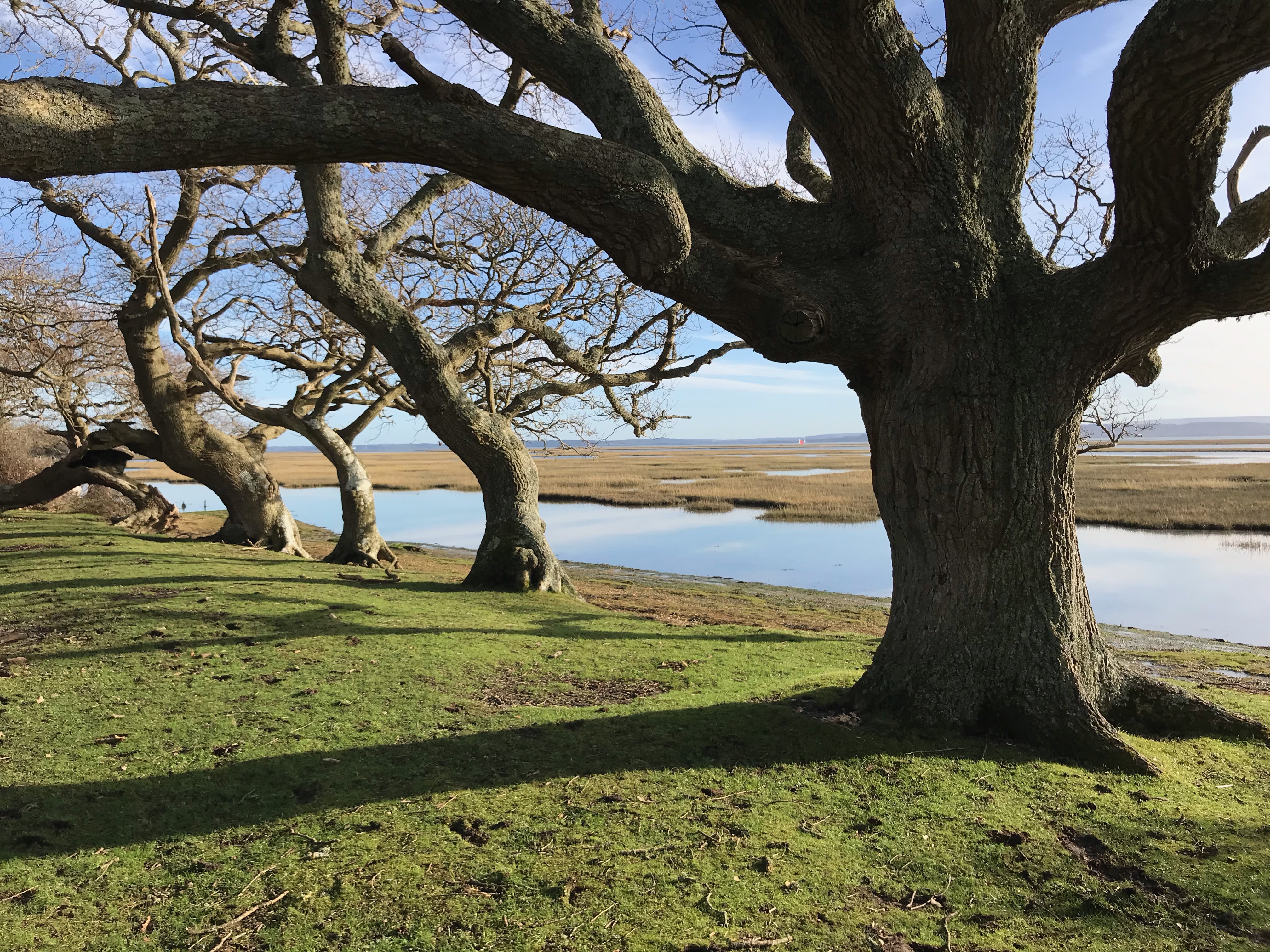
Plastic pollution has been unremitting but it is good to be making a contribution. It is such a beautiful area, so important to wildlife.
Some of the items are dangerous.
Others have travelled a long way, possibly dropped off ships.
Most pieces are small, some tiny, others revolting. It is satisfying to go out after a storm.
It is then that a lot of PVC rope comes in. It can do a great deal of damage.
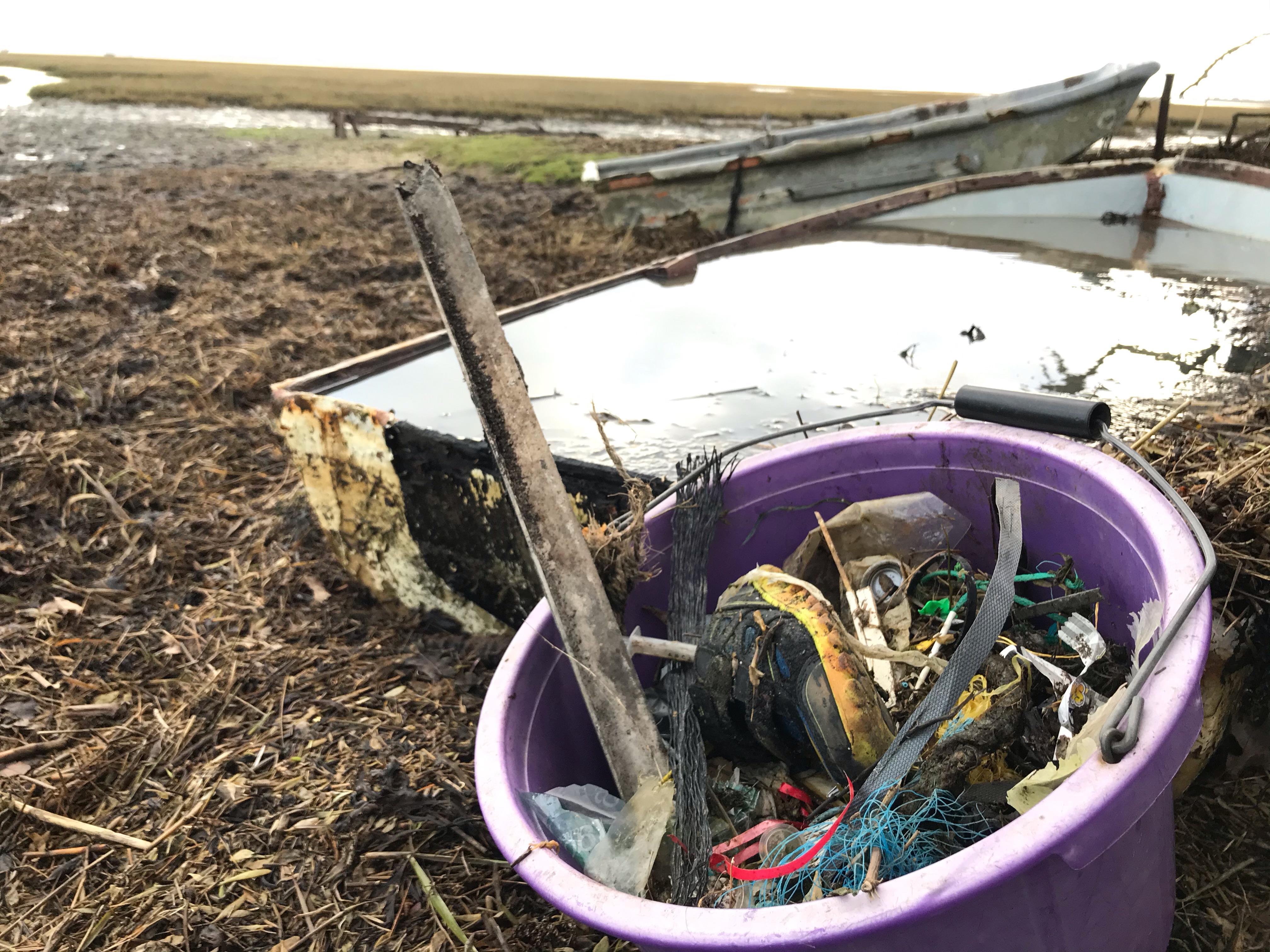
I use a bucket as bags flap in the wind and there are often sharp pieces of glass.
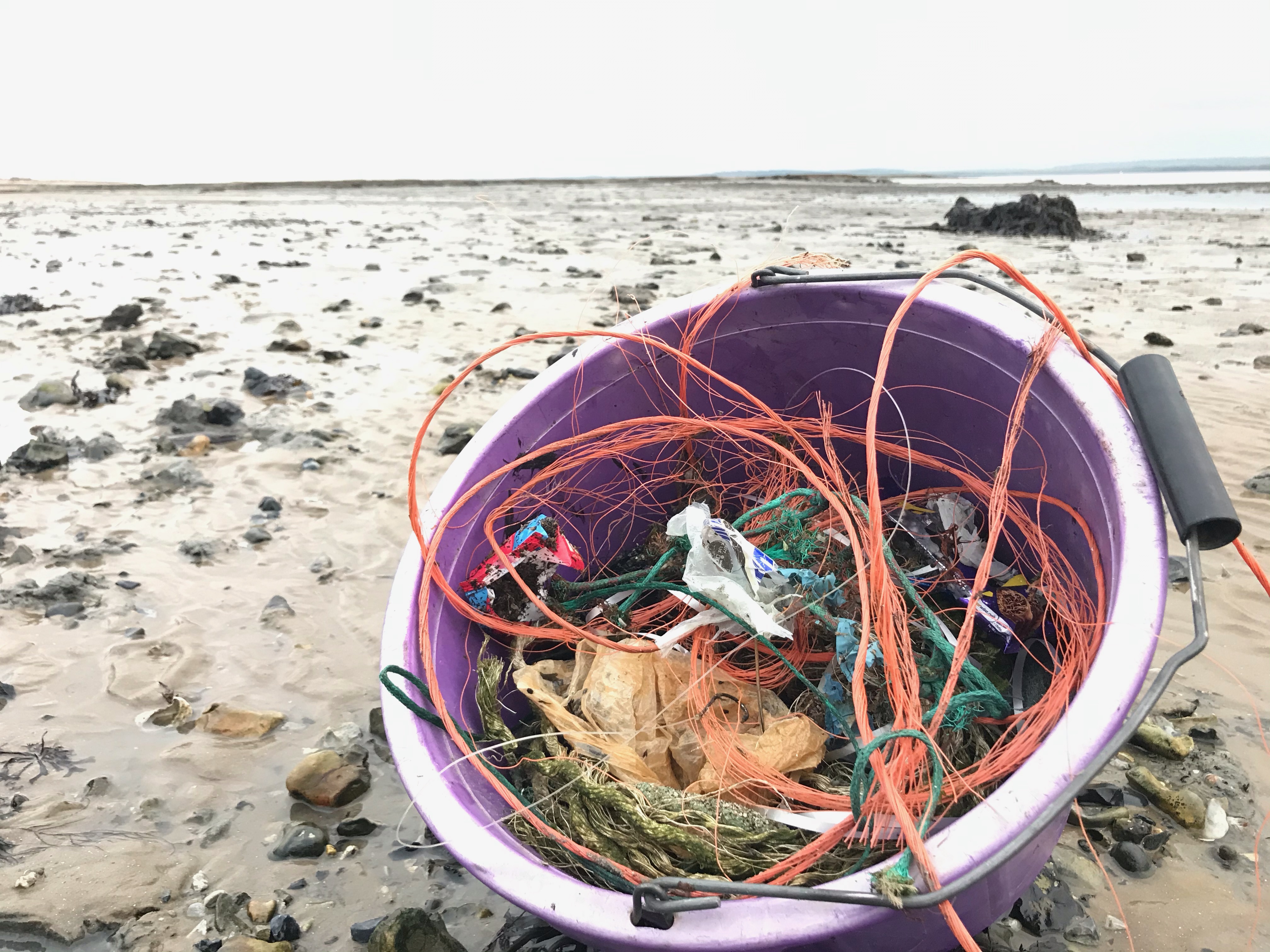
They can weigh 4kgs when full. This one contained a lot of old fishing line.
I often find unopened drinks or packets of food.
Almost every day there is a helium ballon and a mask to pick up or extract.
It’s as if the sea is spitting them out.
We sometimes come across amusing pieces, often toys or balls of some kind.
The best thing about collecting plastic pollution is that it gets us out there.
For a full list of things we’ve found washed up on the Solent – click here
I am thrilled to announce that I have been awarded a certificate as ‘Beach Picker of the Year’ by Litter Pickers of the New Forest, who presented me with a very good bottle of wine. The sea thanked my sons and three year-old helpers by presenting them with a jar of instant coffee and a baseball.
Sophie Neville on the Solent
The good thing about winter beach cleans is that, instead of picnic litter, you are in with a chance of finding interesting things washed up on the shore. Along with a Tescos’ ‘bag-for-life’, that we filled with pieces of rope, bottles and part of a lobster pot, I found an unopened can of larger, a decent ball and a pristine jar of Nescafe Gold, fully sealed although dated 19/5/19. It must have been floating about in the Solent for some time.
The storms tend to bring in a lot of old plastic. This fishermen’s litter (below) accumulated in the lee of the causeway, out of the wind, but in a nature reserve where otters can be found.
There was a lot to gather. I need to return for more.
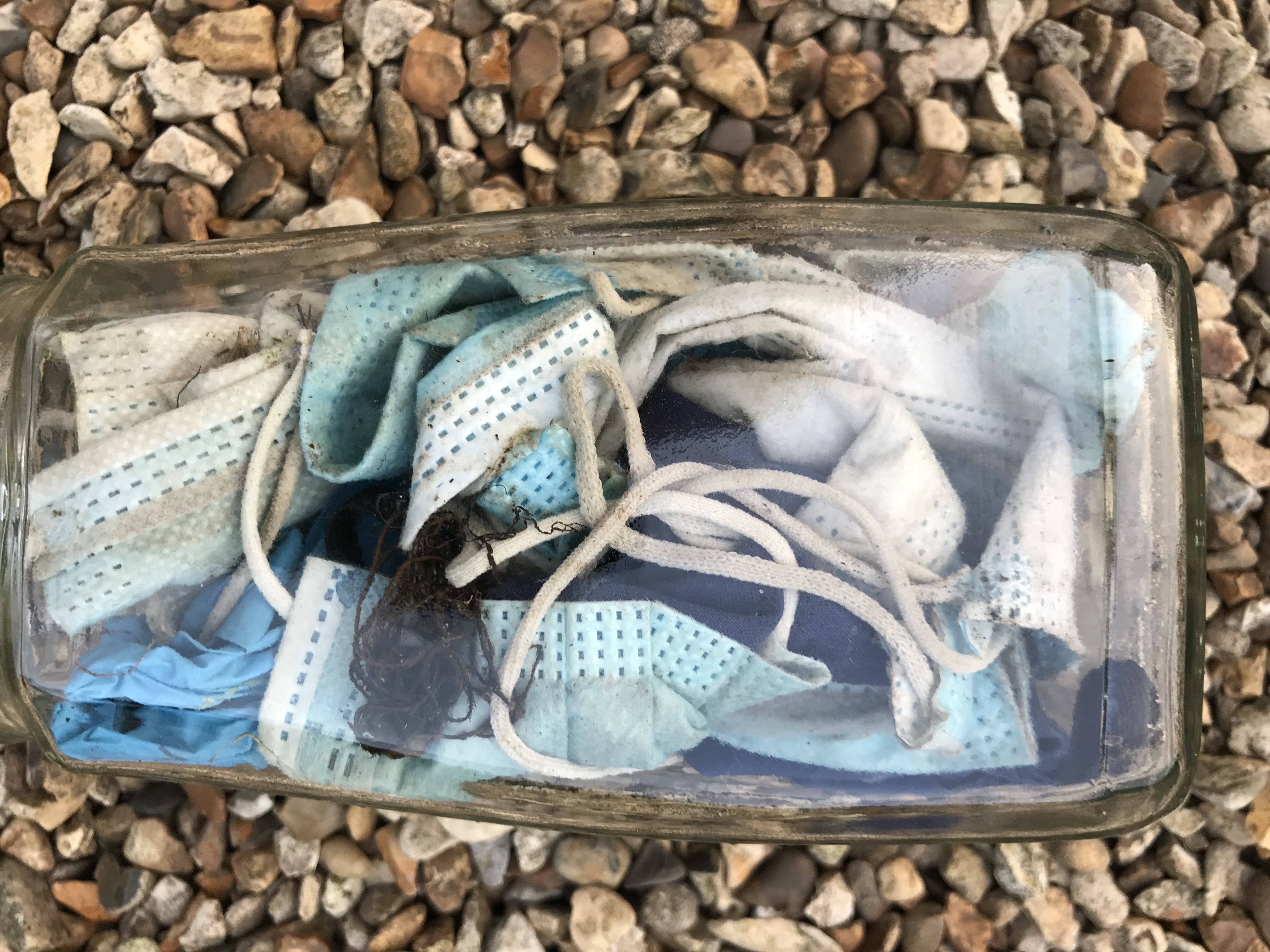
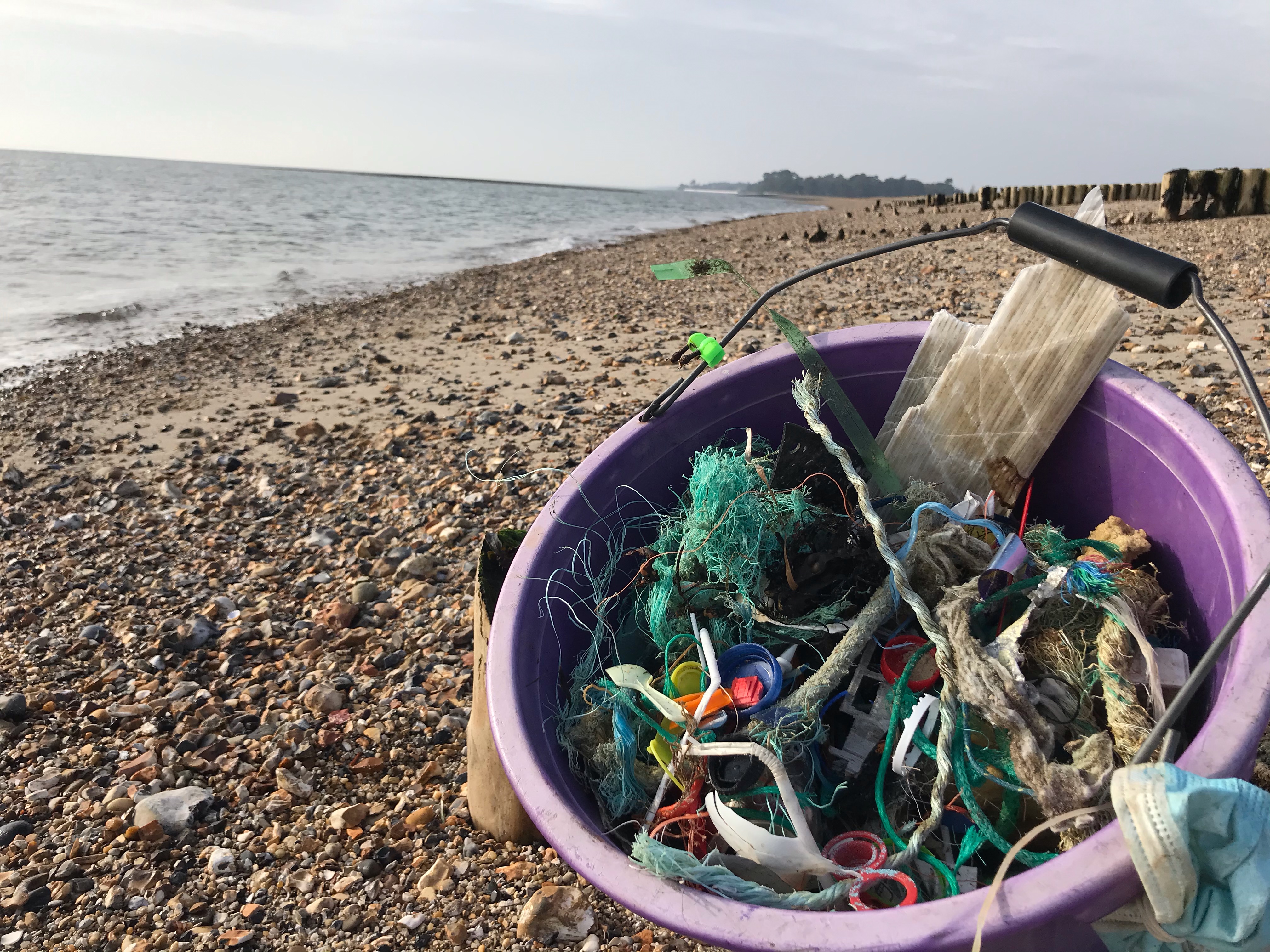
PPE is getting everywhere. I’ve been stuffing the masks I find in a jar. I’ve also been picking up aged polystyrene, tampon applicators and tangled PVC rope.
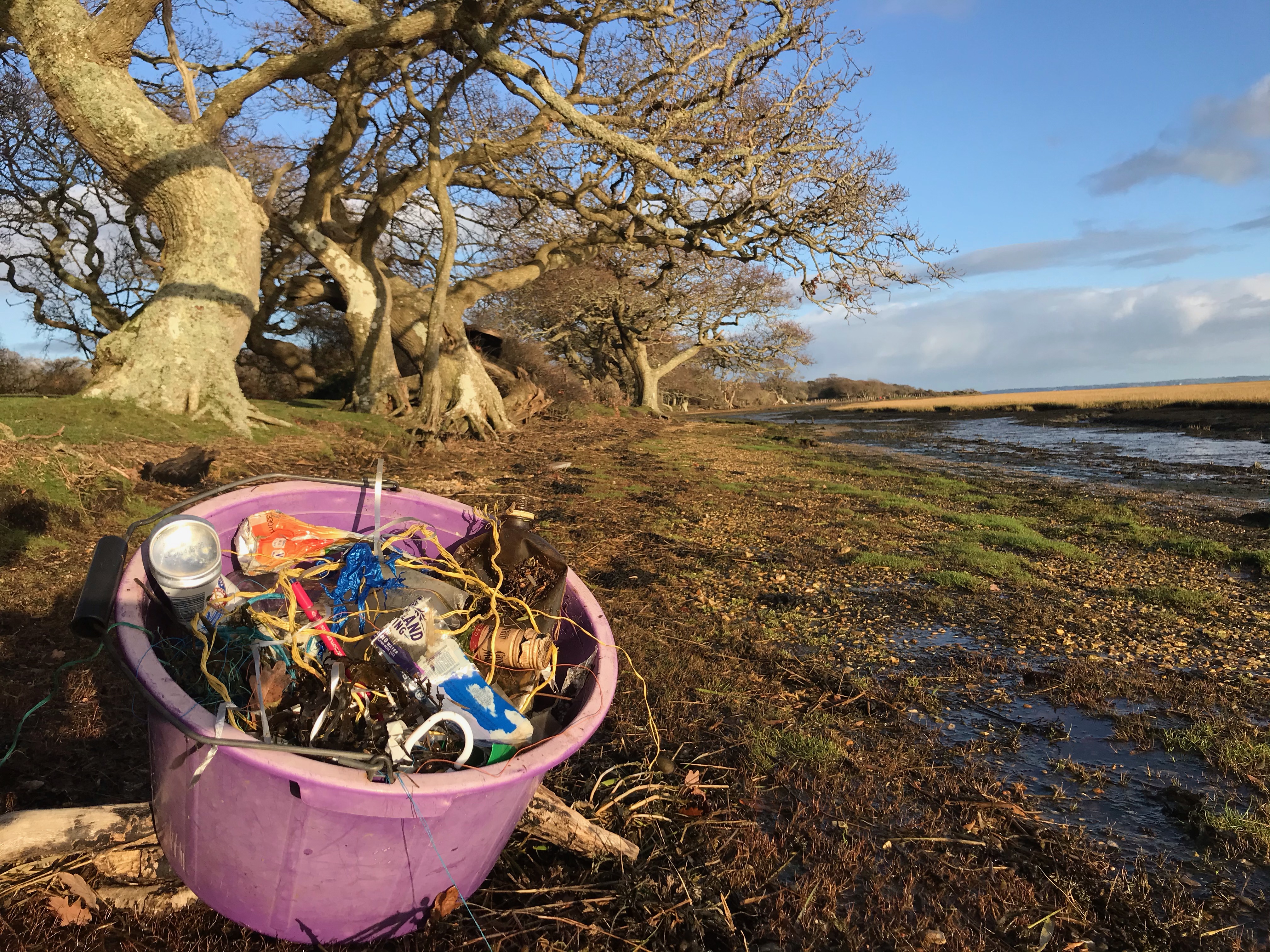
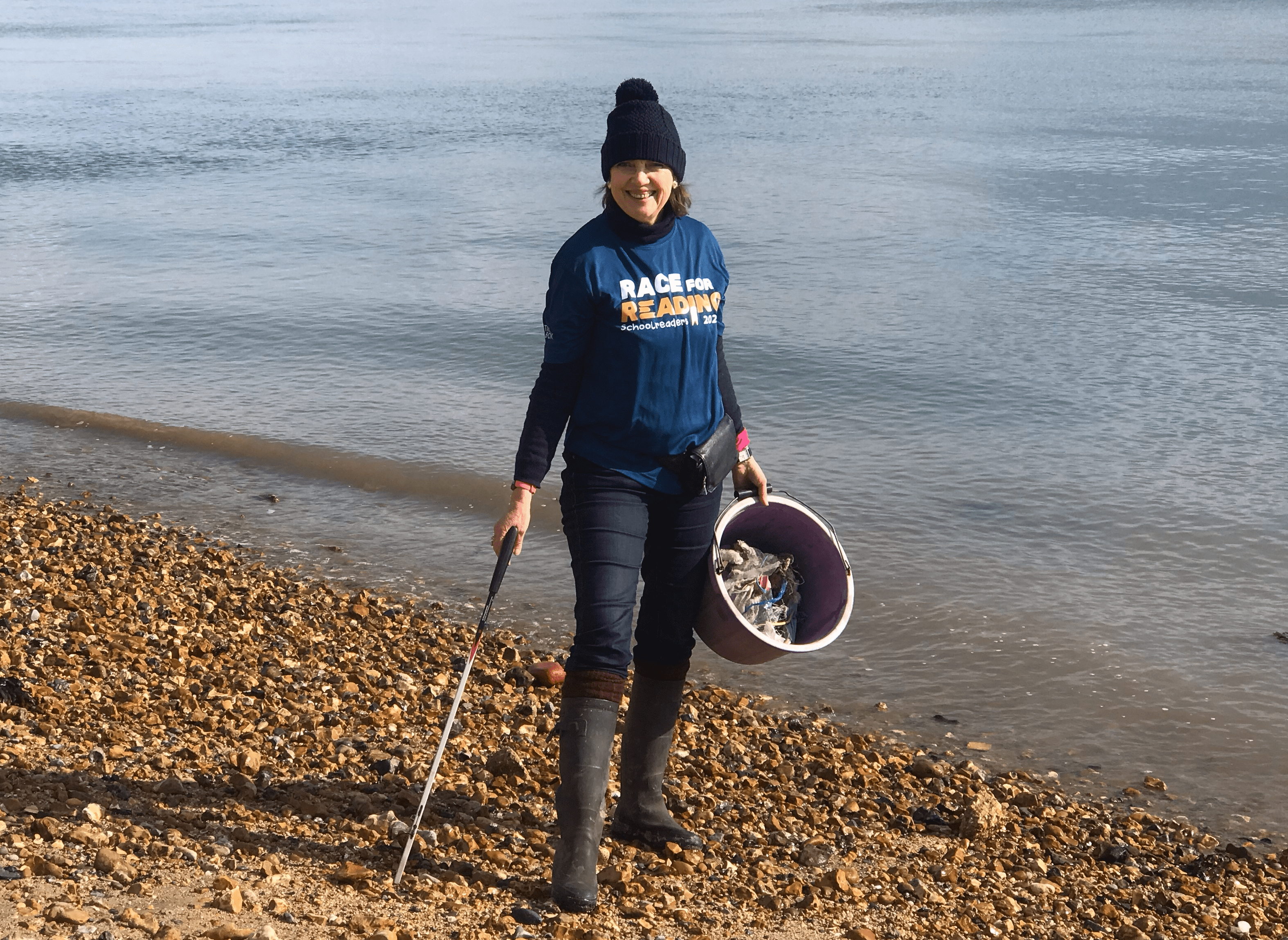
I sometimes use a counter to record how many items I pick up. This purple bucketload (below) contained 140 items but can take more than 260, as many pieces of sea plastic are small. It usually ends up weighing between 3 and 4 Kgs.
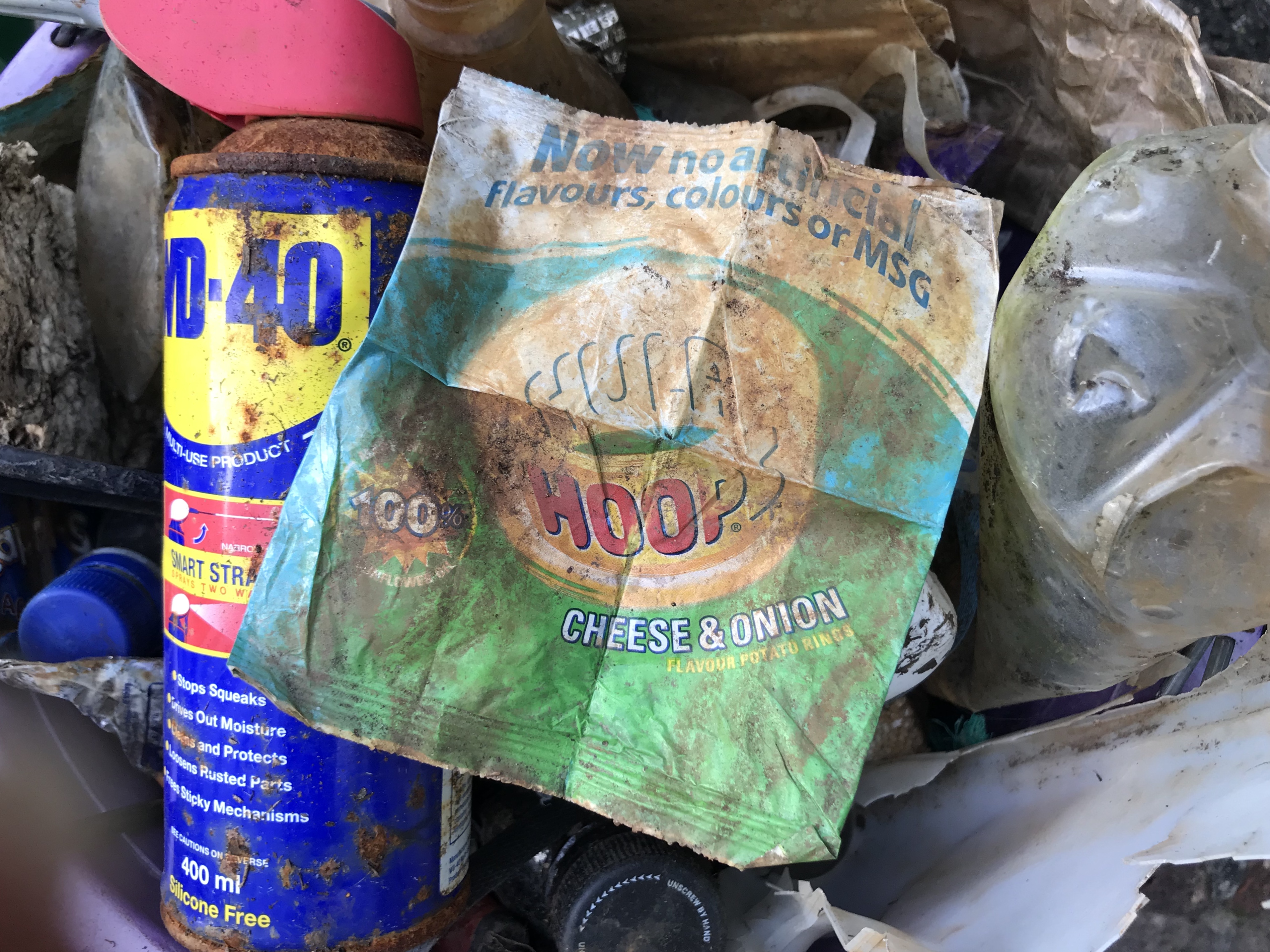
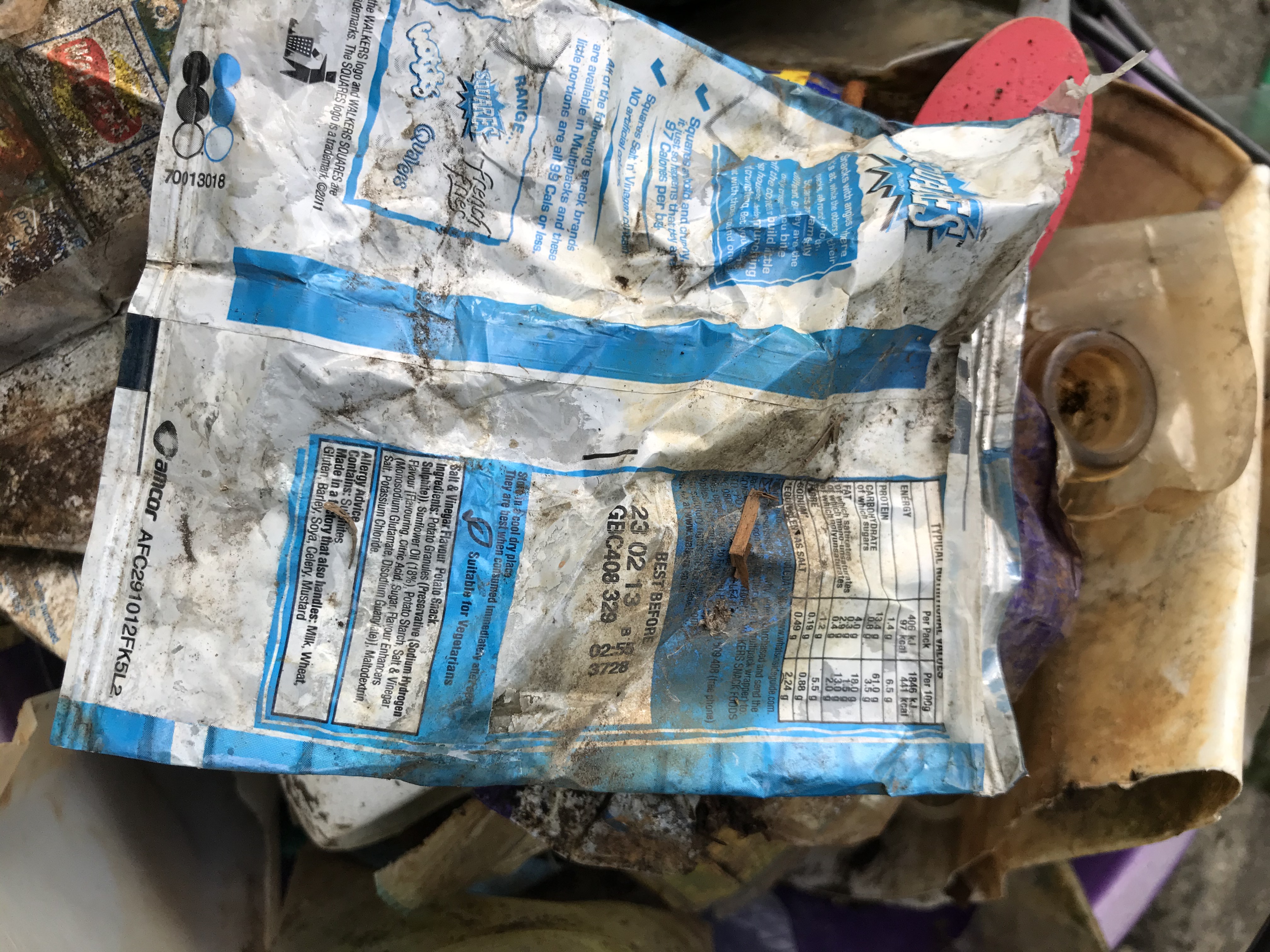
How long will will it take for all this to disintegrate? It’s interesting to date elderly rubbish. Crisp packets can easily last 40 years.
These ones were only aged about 8, which was a bit disappointing.
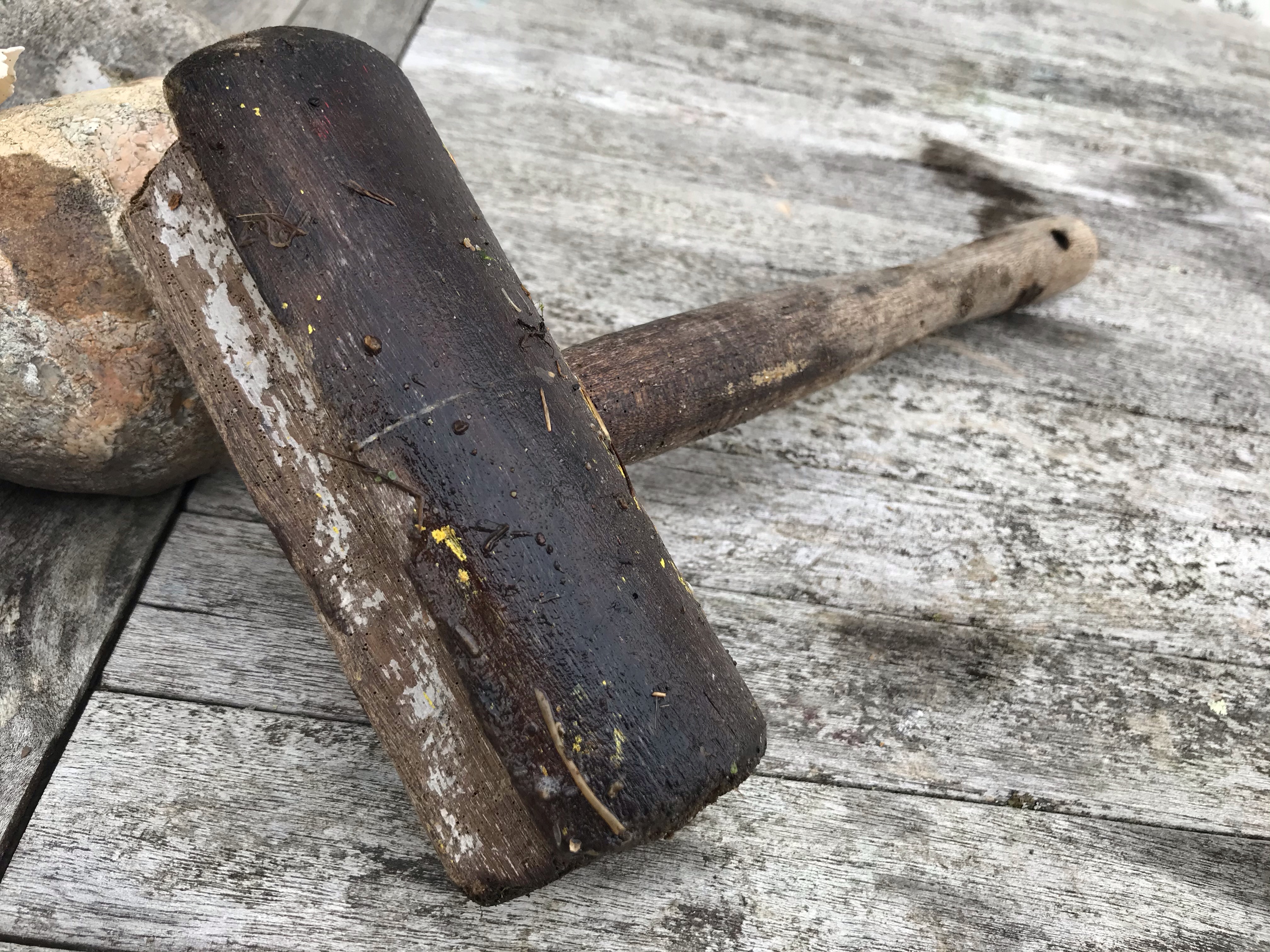
Odd things turn up. This mallet was made with a groove along the top, which I understand is used by riggers. It looks as if it came from a fairground.
After the gales this November, I found an undamaged fluorescent light bulb washed up on the Solent. This is my third. I gather these contain mercury. Is it British? Has it been flung off a ship?
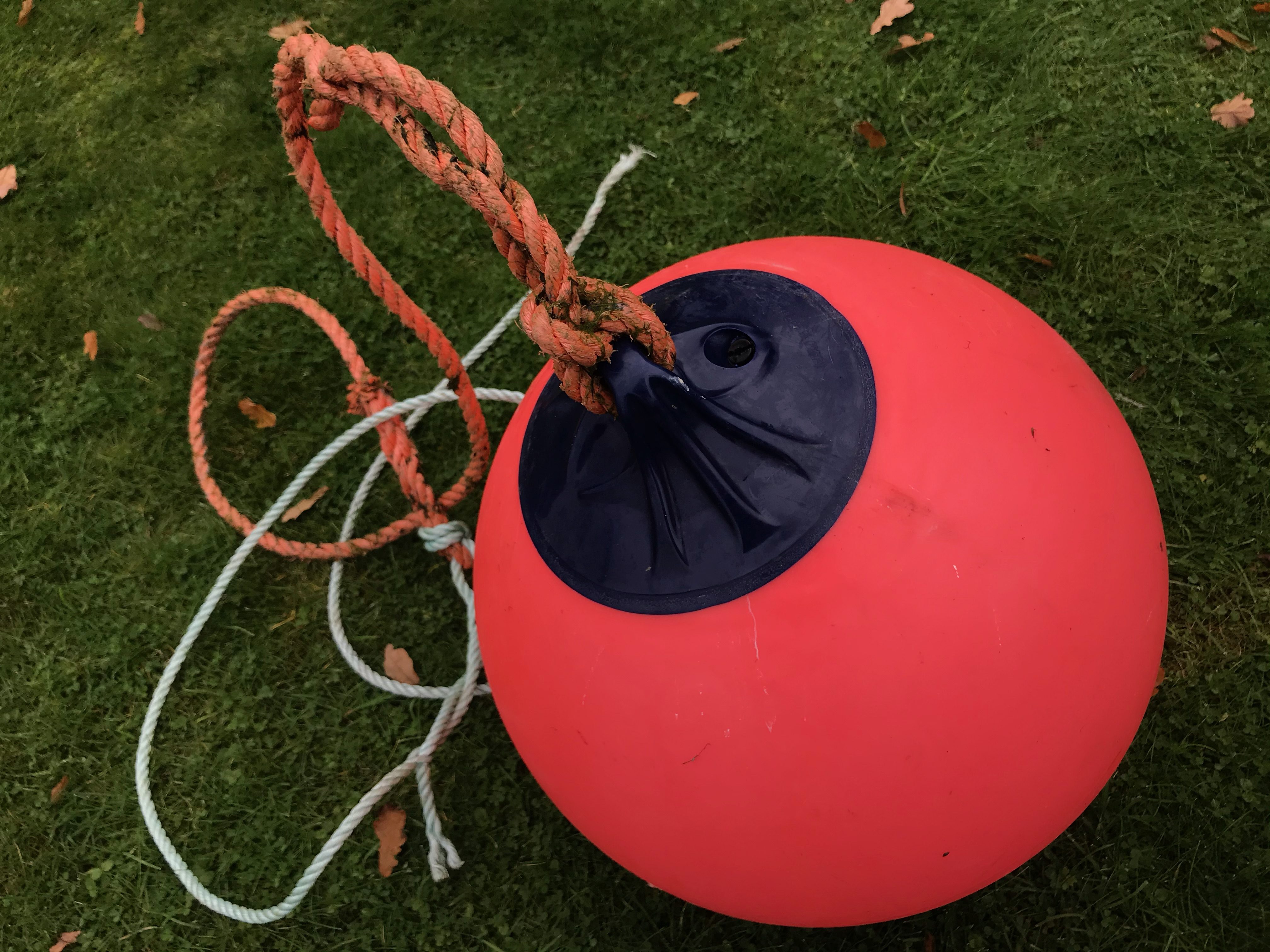
By contrast, this large lobster pot buoy obviously belongs to someone. It’s been registered as missing on Facebook but with no response.
The important thing is to keep going, collecting a little but regularly:
It’s then that your eye catches small pieces like fishing line – which we nearly missed –
This is one of three fishy lures collected recently.
It’s good to record just how much plastic pollution accumulates over time. I found about 3 Kgs of rope and micro plastics after scouring this remote beach that I had cleared a month before.
This pollution is being retrieved from ecologically sensitive areas within the New Forest National Park and British seas. Sadly, all this now has to go into landfill – apart from the ball and sealed jar of coffee. It was just what we needed at home.
Sophie Neville collecting plastic pollution from Solent shores.
To see some of the things we found beach cleaning in September, please click here
Lakeland Arts, based at the Windermere Jetty Museum, ask how the original film of ‘Swallows and Amazons’ was made on location in the Lake District in 1973 –
You can find out more in the illustrated paperback, suitable for all age of readers, entitled ‘The Making of Swallows and Amazons’, which makes a good Christmas present when combined with the 40th Anniversary DVD with DVD extras.
Simon West, Suzanna Hamilton and Sophie Neville filming ‘Swallows and Amazons’ (1974)
In the summer of 1973, I was transported to the shores of Windermere, ‘The Great Lake in the North’ to appear as ‘Titty Walker’ in the classic movie of ‘Swallows and Amazons’, starring Virginia McKenna and Ronald Fraser.
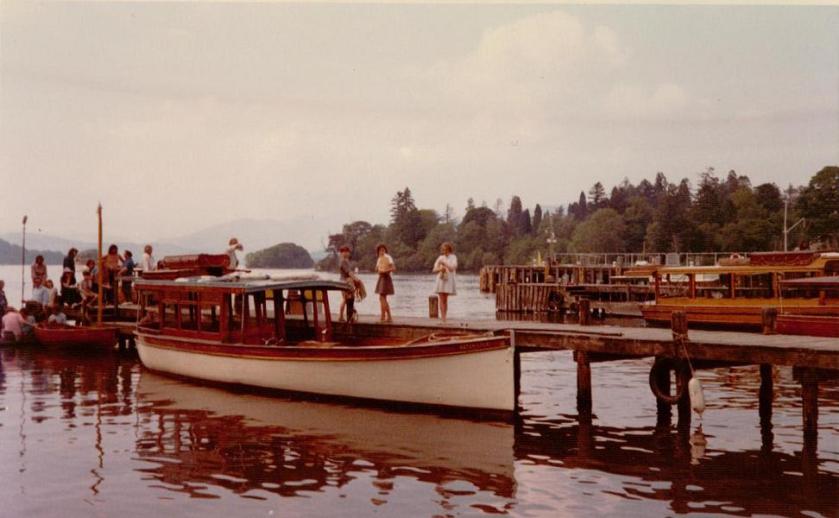
The Swallows approach the jetty in Rio. Which launch is moored outside the boat sheds?
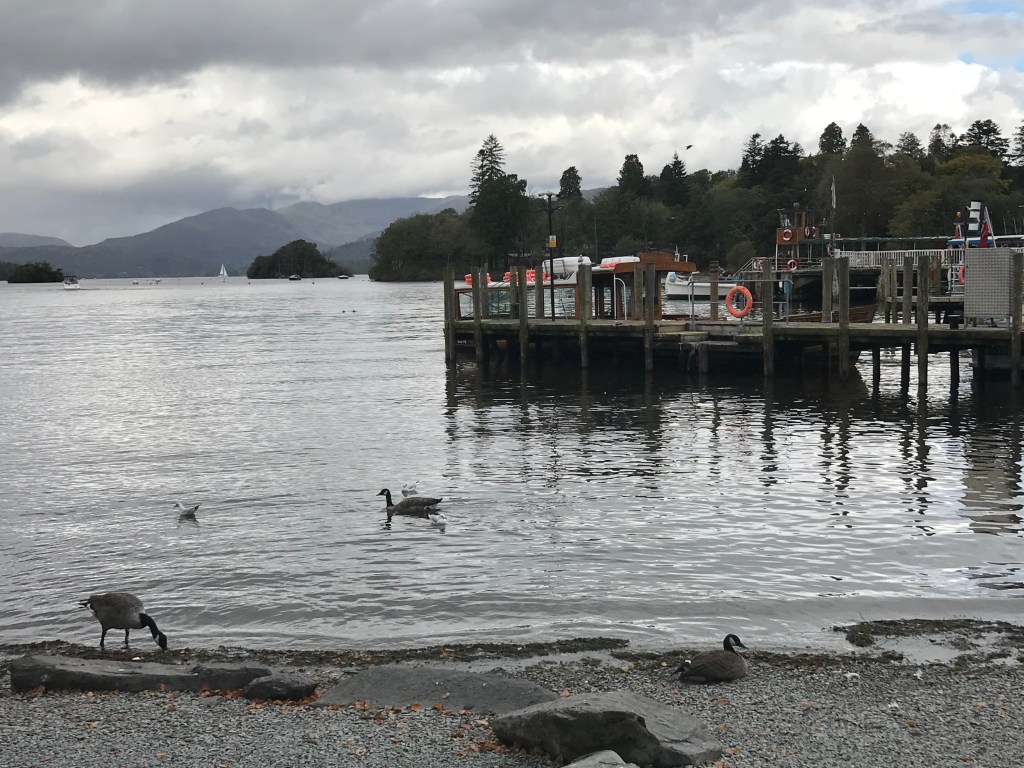
We were fortunate enough to film the scenes set in Rio at Bowness-on-Windermere before the original green boat sheds were demolished in favor of an amusement arcade.
Rio – or Bowness-on-Windermere in 1973 – with SL Elizabeth ~ photo: Martin Neville
George Pattinson brought along his steamboat the Lady Elizabeth, which you can see here beyond the Windermere skiffs pulled up on the shore.
George Pattinson in his steam launch Elisabeth ~ photo: Martin Neville
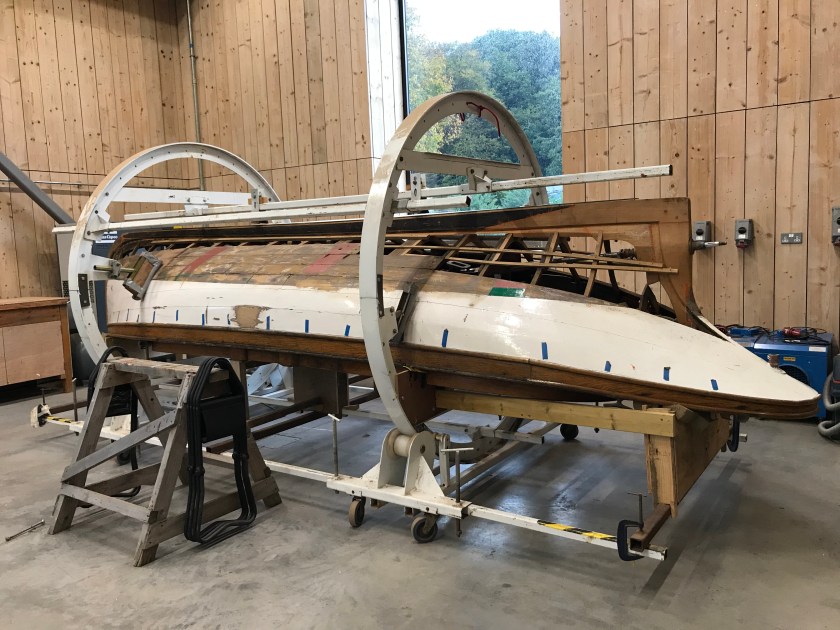
George’s personal collection made up the basis of the Steamboat Museum now rebuilt and known as Windermere Jetty, where we found the Lady Elizabeth under full restoration.
Eighteen foot long, she was built in New York State in about 1900 and brought to England, so was likely on Windermere in 1929 when Arthur Ransome wrote ‘Swallows and Amazons’. She sank off Cockshott Point beyond Bowness, but Mr Pattinson salvaged and renovated her in 1955. You can read more here.
The Lady Elizabeth under restoration at Windermere Jetty
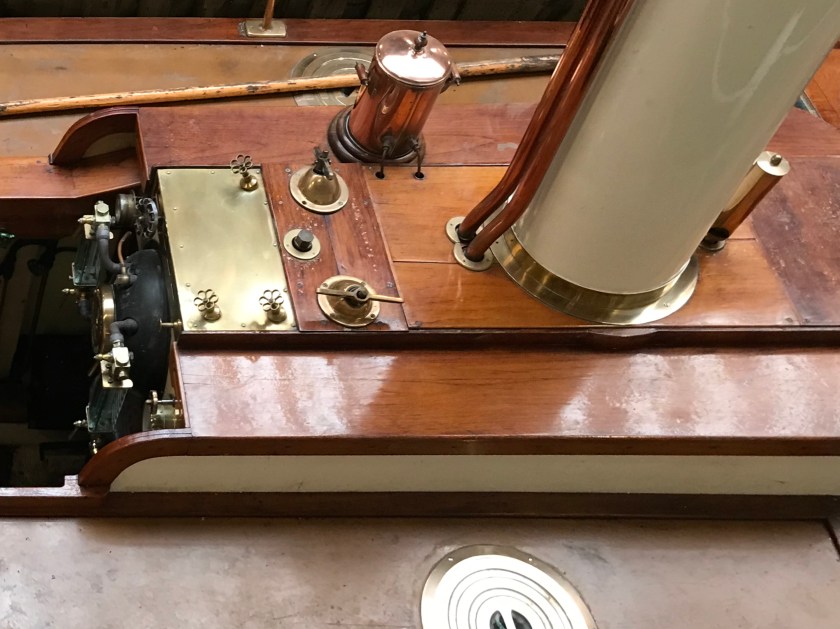
Other exhibits included the exquisite steam launch Osprey, in fine fettle with her copper steam kettle kept brightly polished. I knew her from taking part in a Steam Boat Association rally on Windermere in 1991.
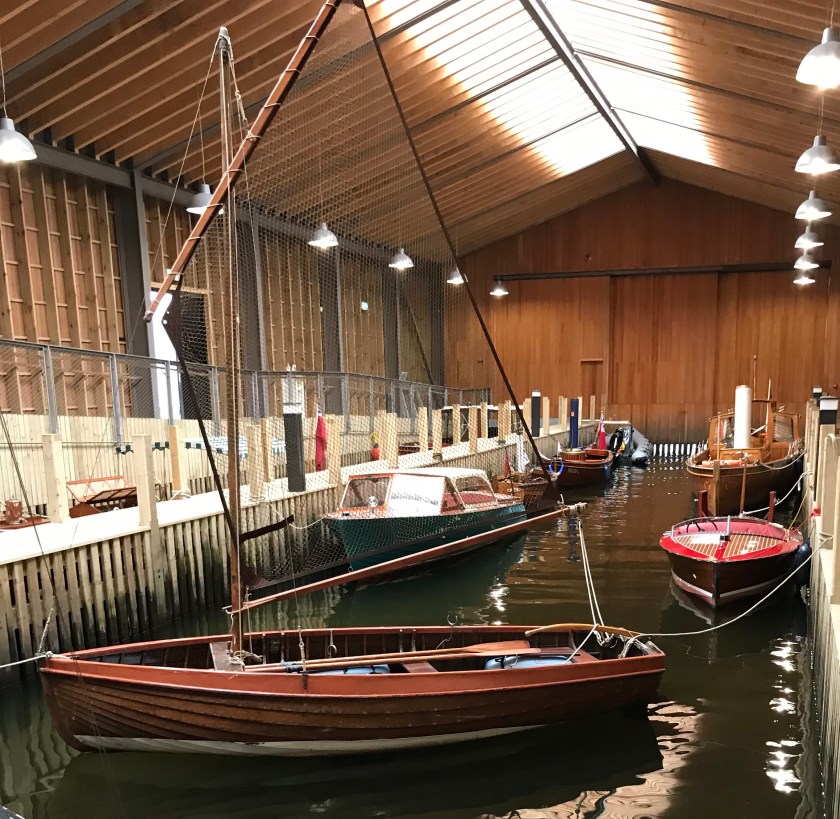
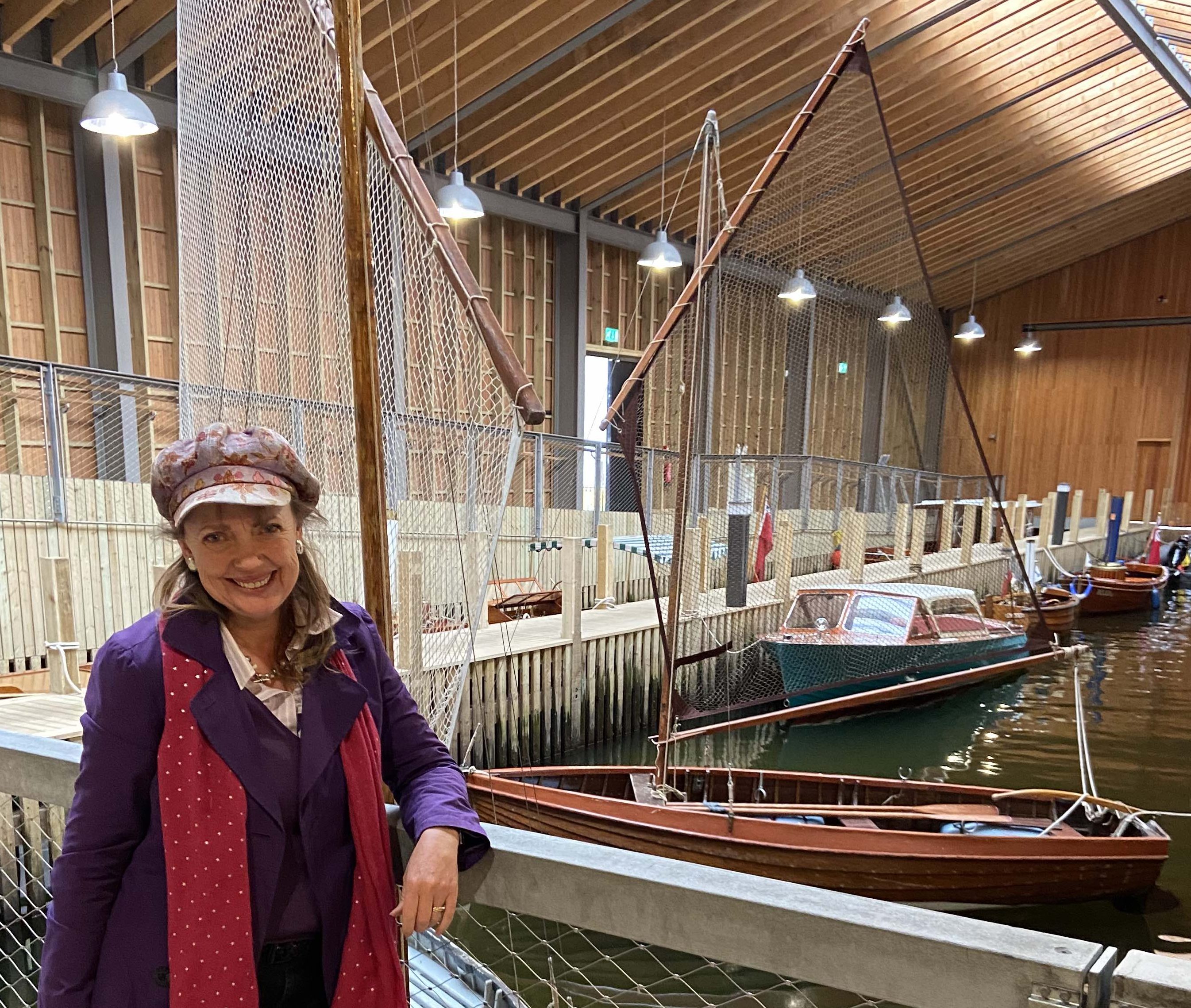
The RNSA dinghies used to play Swallow and Amazon in the 2016 movie can also be seen in the wet dock at Windermere Jetty.
Look up, and you can spy a green beetle on an old burgee.
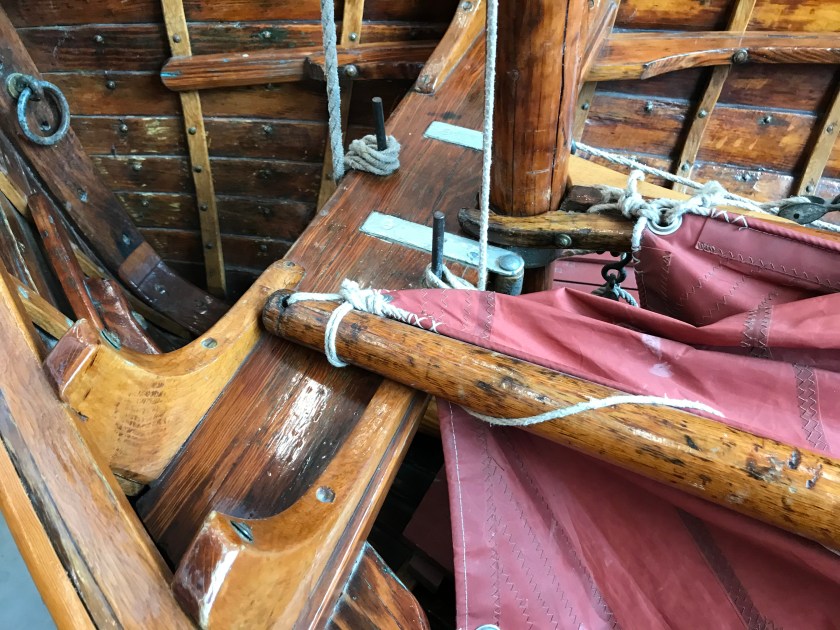
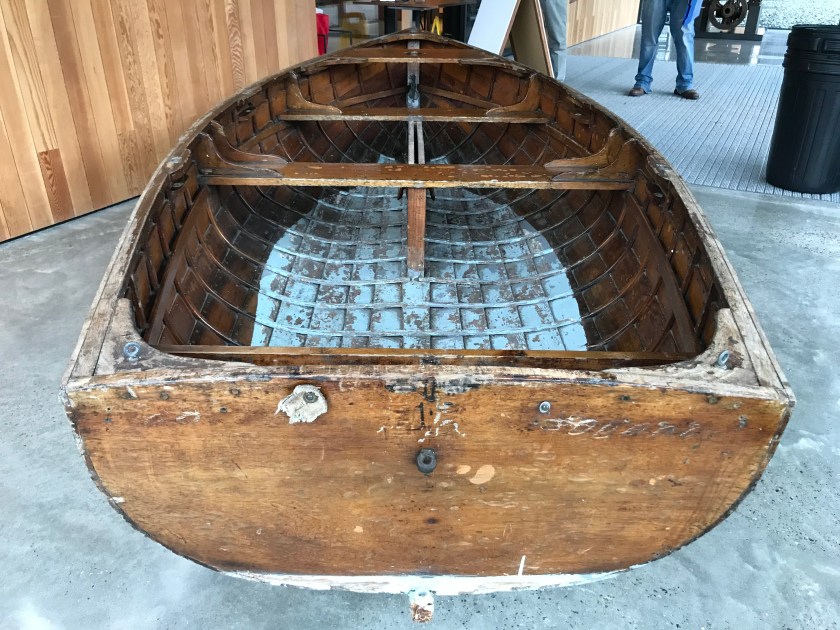
Arthur Ransome’s dinghy Conch-y-bonddhu, known as Scarab in his books, is on display with Beatrix Potter’s rough, flat-bottomed rowing boat (the pointed bows of which can be seen here hanging on the wall to the right).
The museum has many other treasures including the hull of the oldest yacht in existence in the Lake District.
Every one of the forty boats exhibited has a story to tell. You can find out more about visiting Windermere Jetty on their website here.
The Windermere skiffs can still be seen up the road in Bowness where you can begin to look for locations used in the original film.
If you don’t already have a copy you can read about ‘The Making of Swallows and Amazons (1974)’ here. This includes maps and chapters on how to find the film locations.
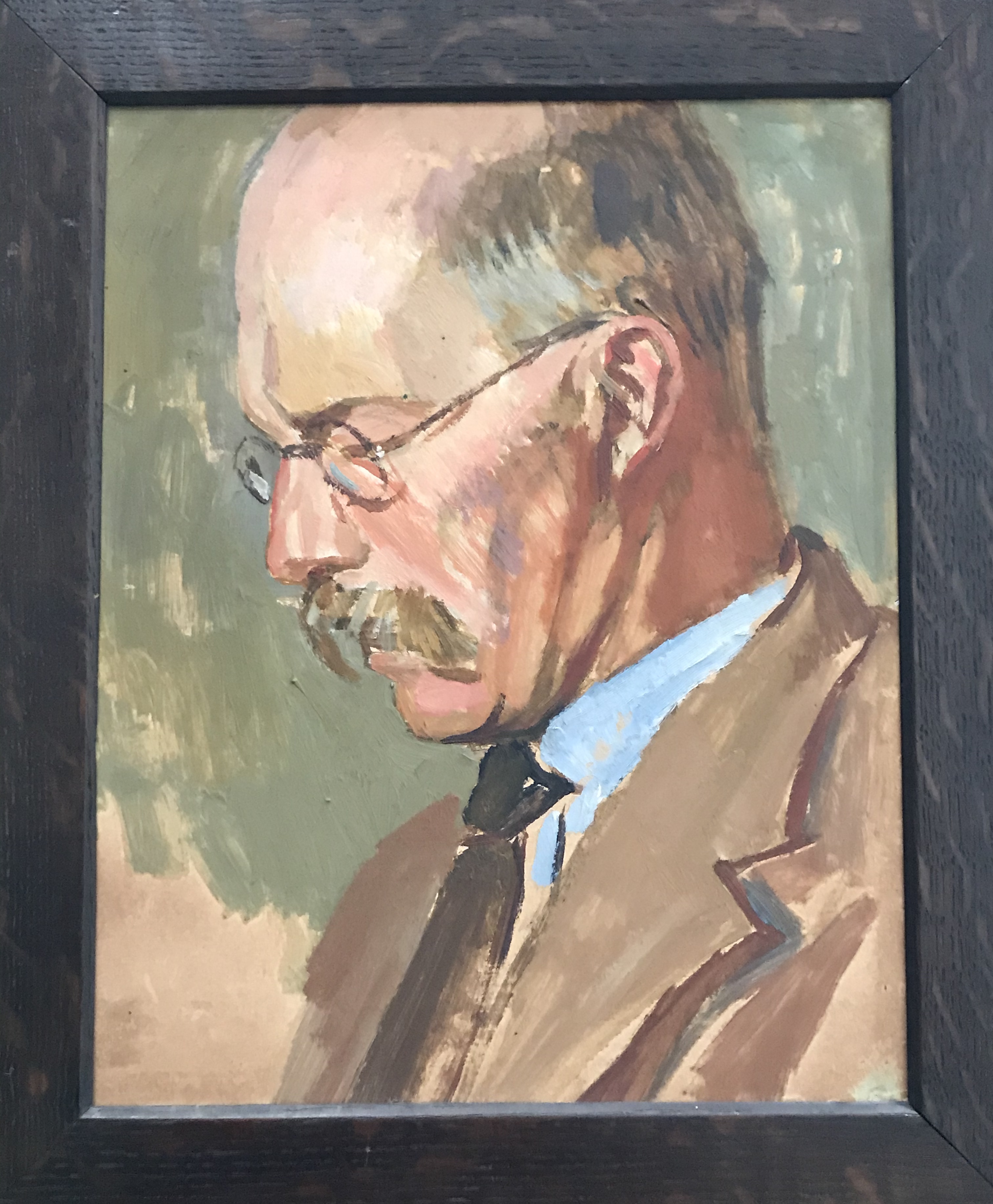
After a career as a foreign correspondent, which took him to Russia, Egypt and China, Arthur Ransome wrote ‘Swallows and Amazons’ in the hills above Windermere in 1929.
Arthur Ransome portrayed by Dora Collingwood, wife of Dr Ernest Altounyan, on display at the museum
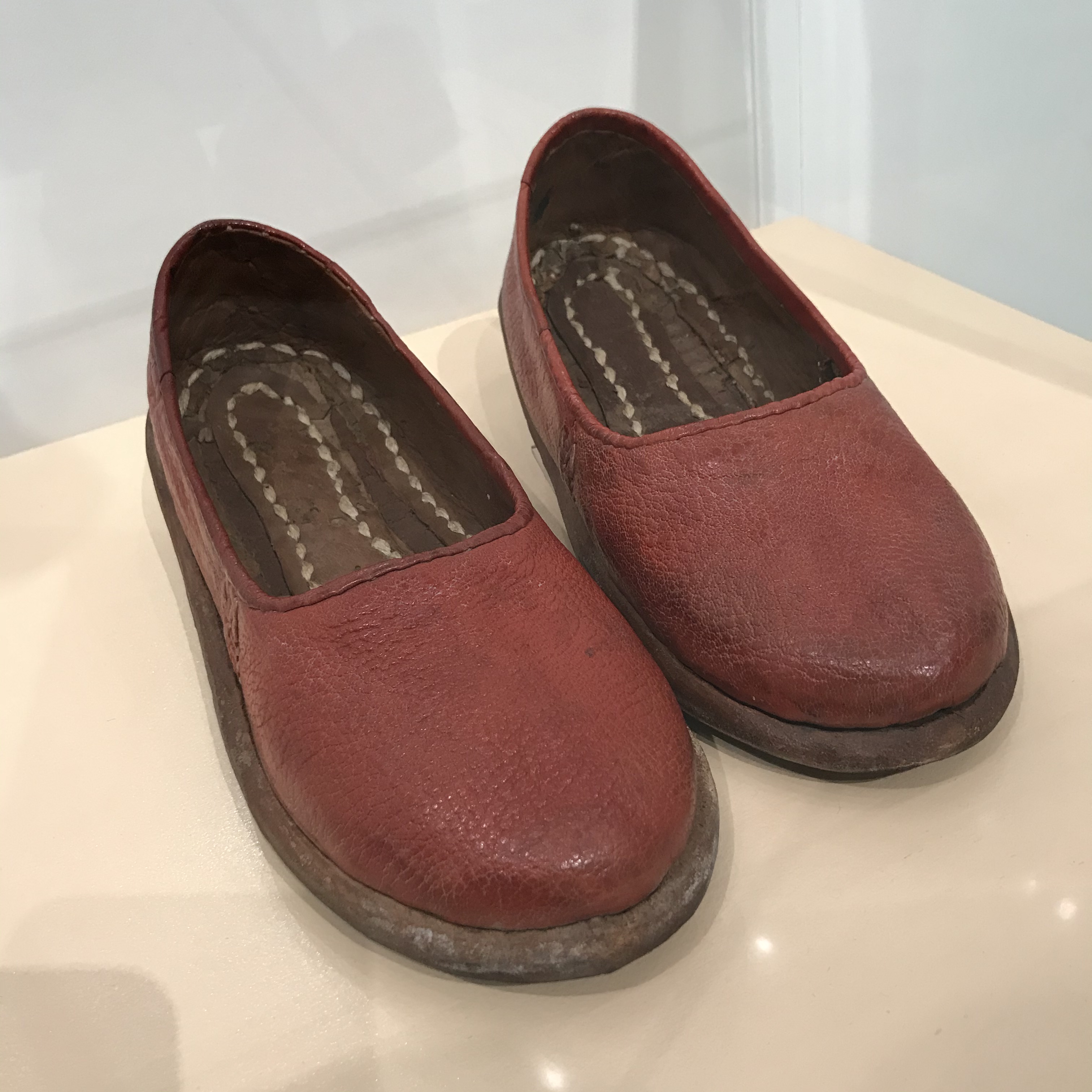
He was inspired partly by his own childhood holidays in the Lake District and partly by the Altounyan children who brought him a pair of red slippers for his birthday to thank him for enabling them to learn to sail on Coniston Water where their grandparents lived.
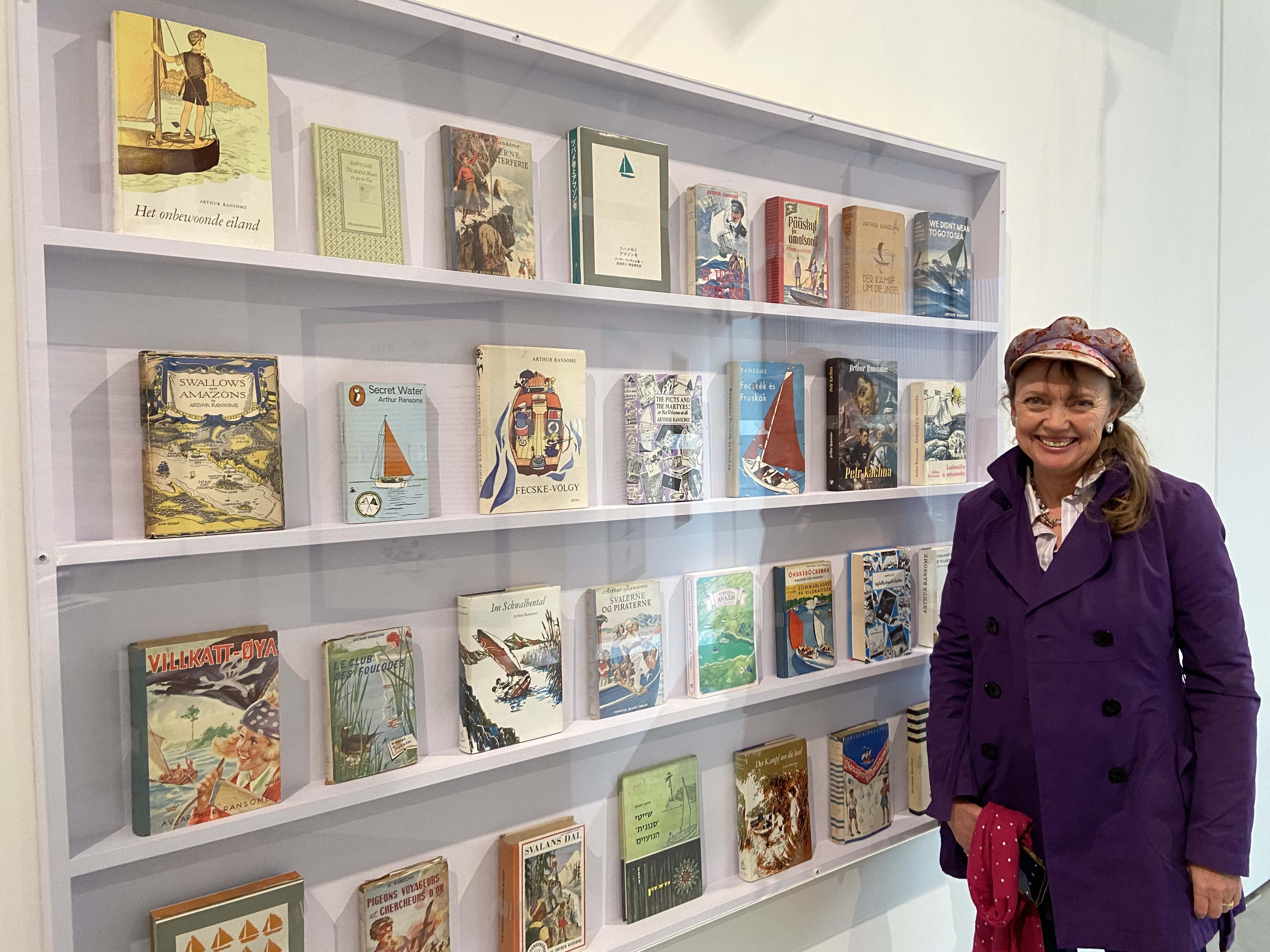
The first edition came out on 21st July 1930, with no illustrations apart from Spurrier’s map on the end papers. The illustrated hardback published by Jonathan Cape came out on 1st December 1930, in time for Christmas. It was followed by another eleven (and one unfinished) book in a series that was to be translated and published all over the world.
Sophie Neville with a collection of Arthur Ransome books on display
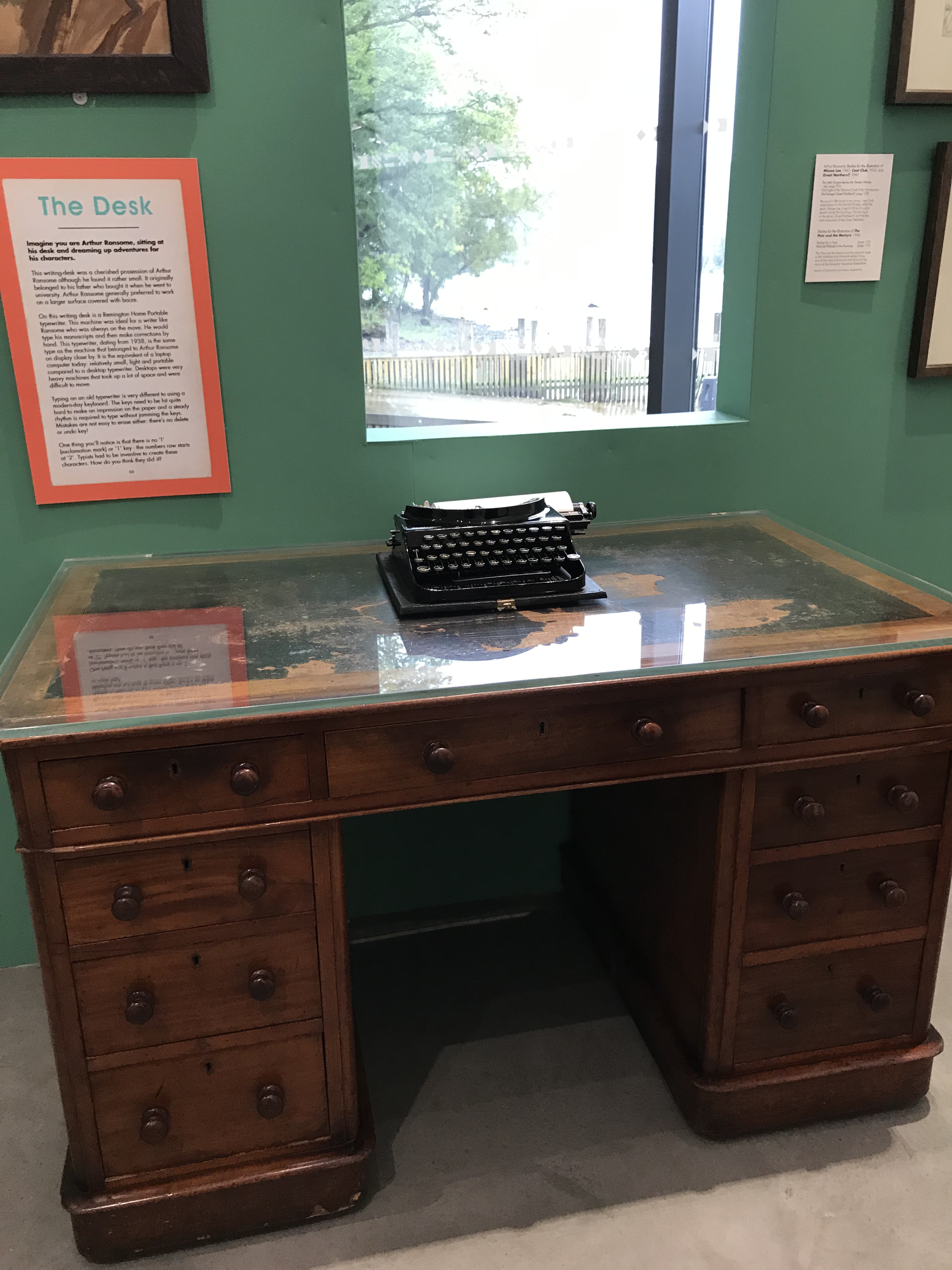
I paid homage to copies at the Windermere Jetty museum where you can find Arthur Ransome’s desk and typewriter on display with a view looking out over the lake.
Arthur Ransome’s desk and typewriter set under a view of Windermere
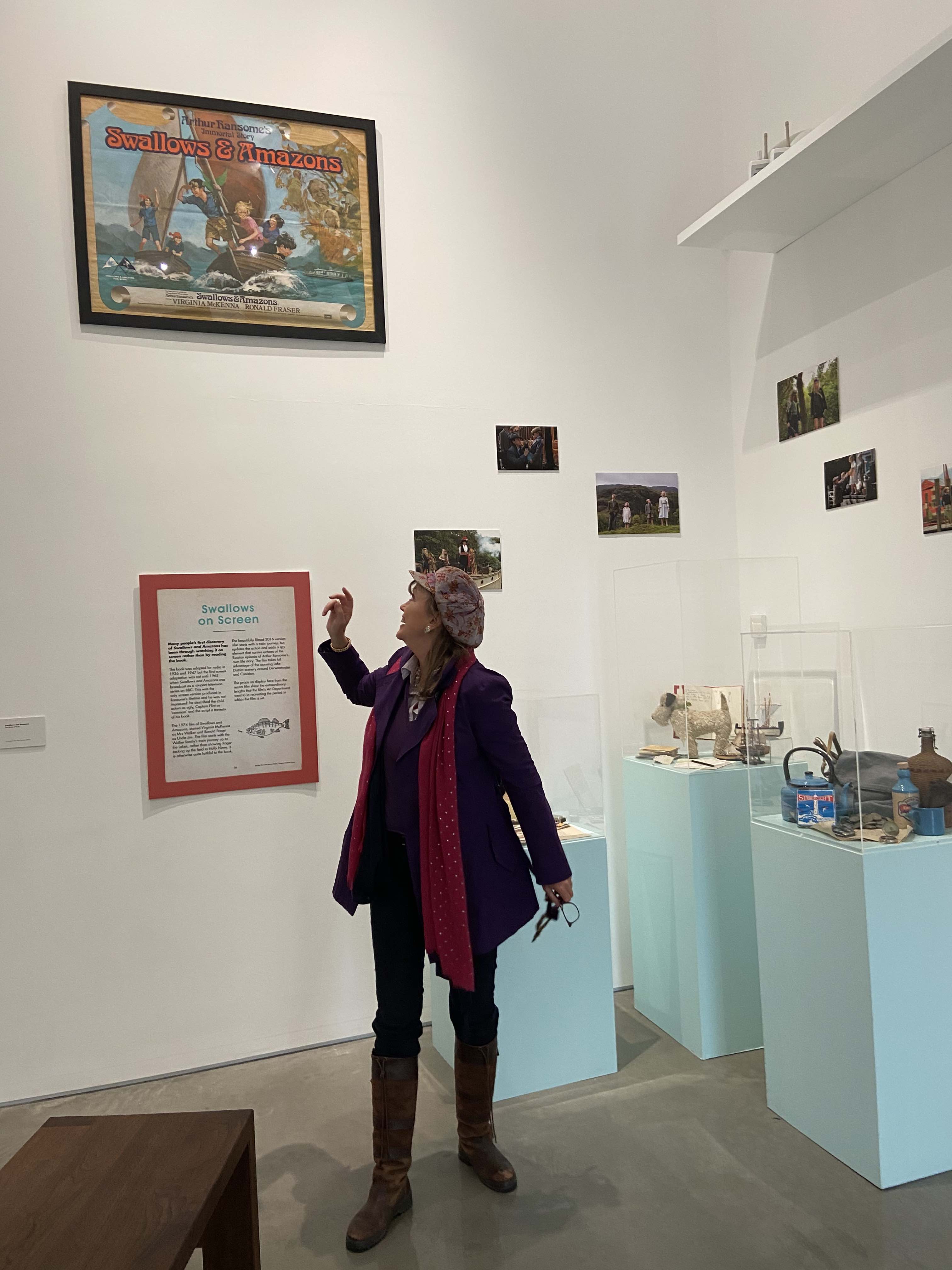
Boats, props and film stills from the 2016 film of ‘Swallows and Amazons’ are on display, along with a poster of the 1974 movie, depicting Titty in a pink blouse.
Sophie Neville spotting the ‘Swallows and Amazons'(1974) movie poster at Windermere Jetty museum
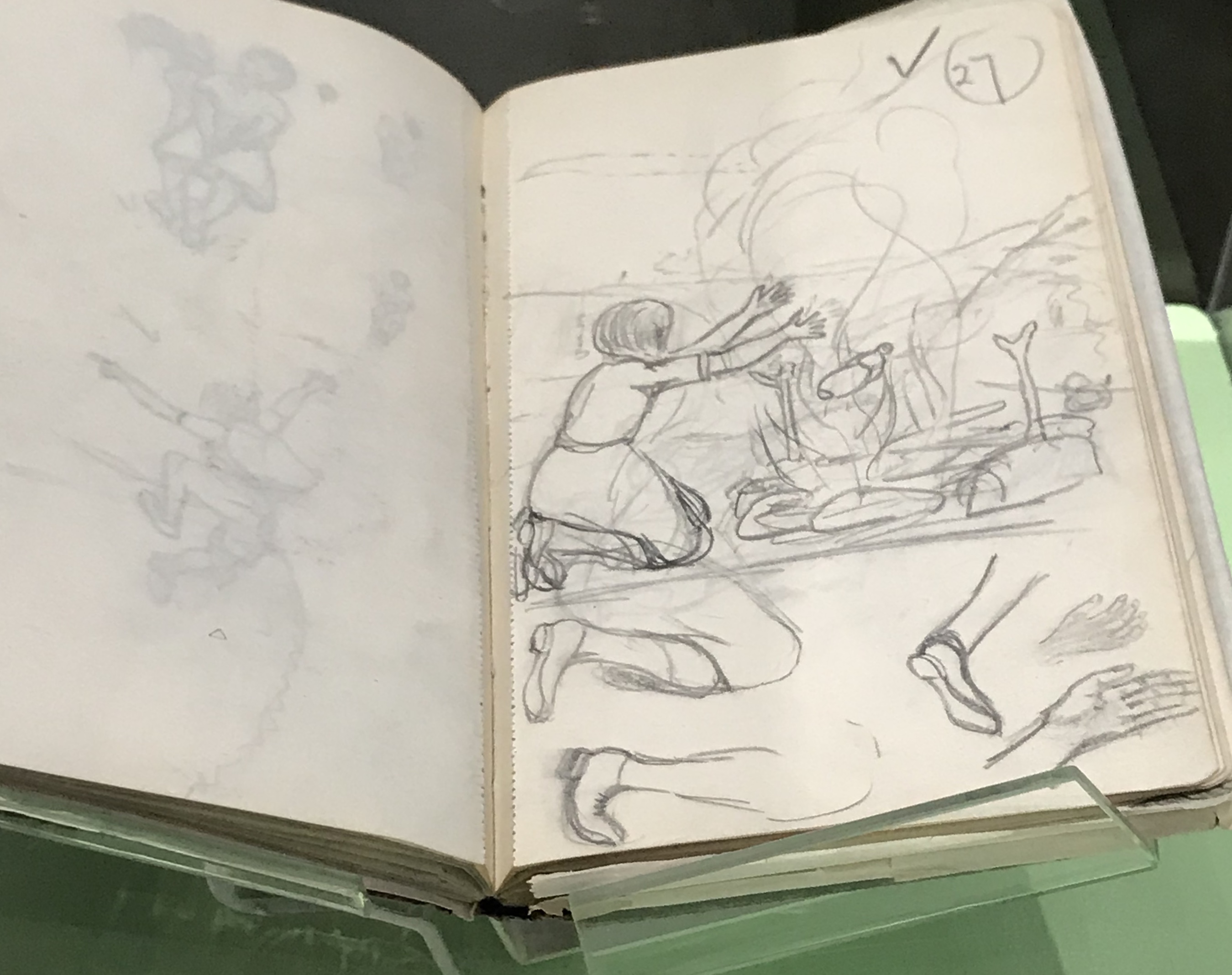
I was fascinated to find sketches of Titty in Arthur Ransome’s notebook.
Arthur Ransome’s original sketches of Titty
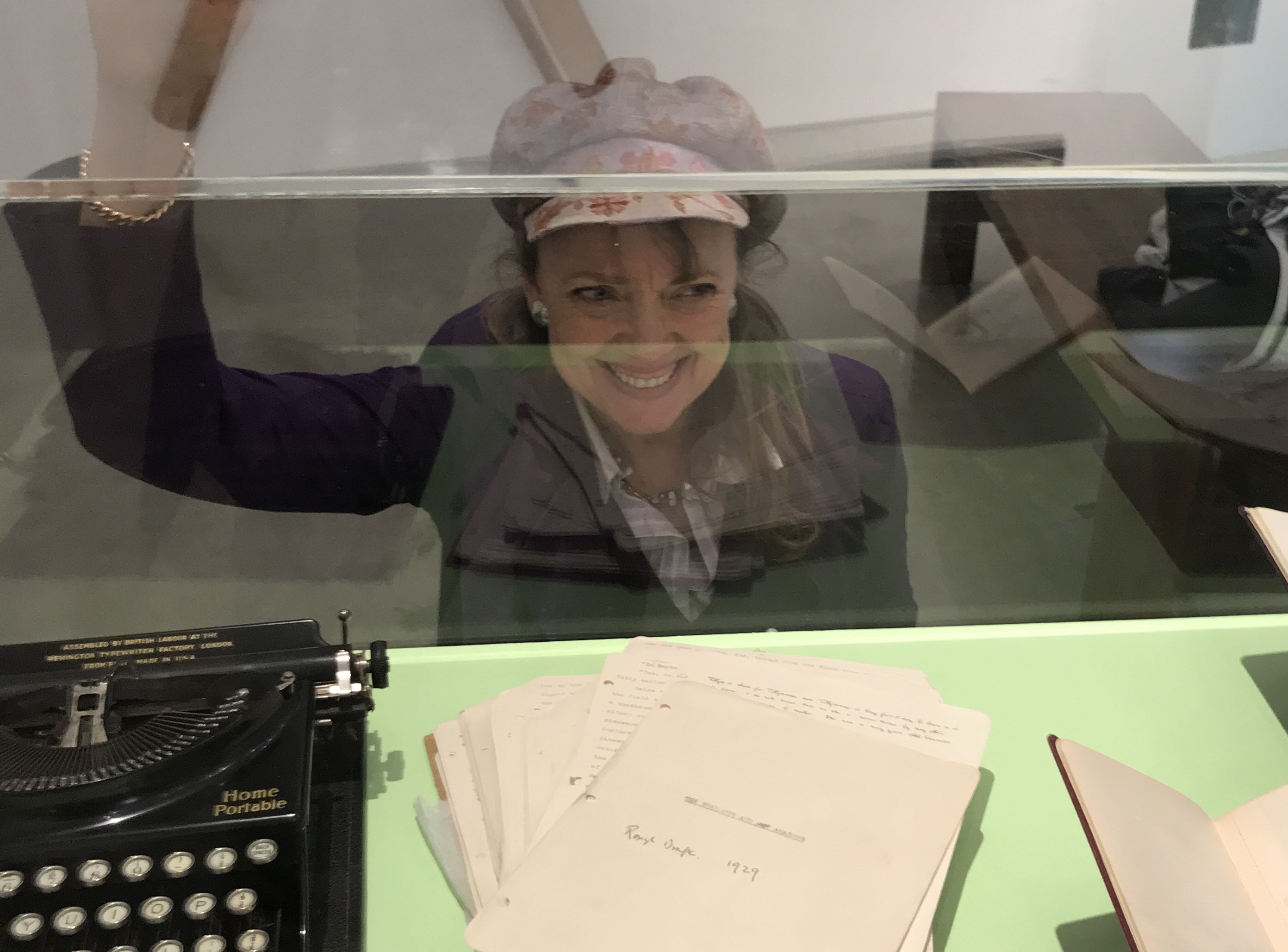
A number of Ransome’s original illustrations were on display and I came across the first draft of ‘Swallows and Amazons’ in a glass case.
Sophie Neville with Arthur Ransome’s typewriter and the original draft of ‘Swallows and Amazons’
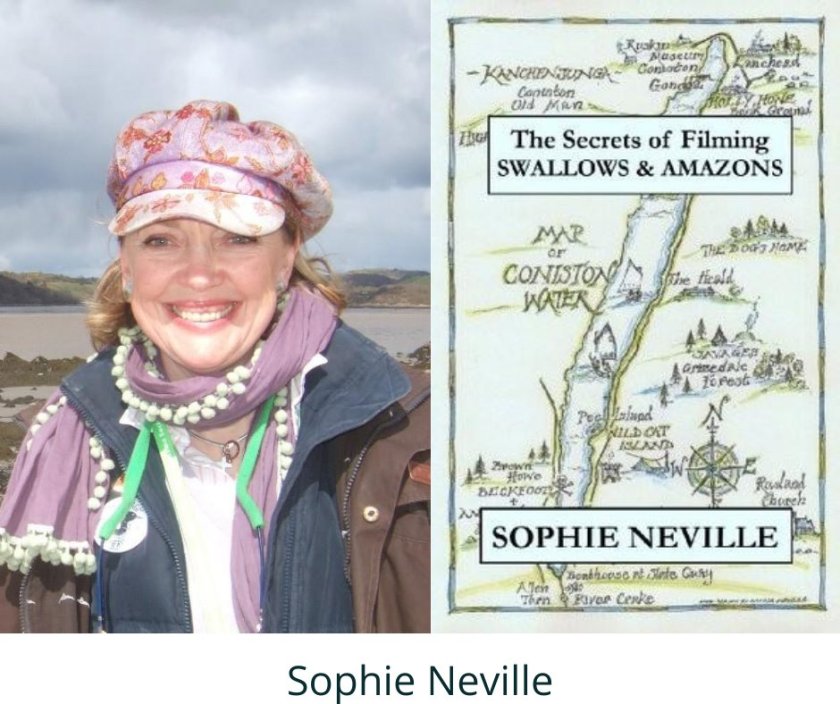
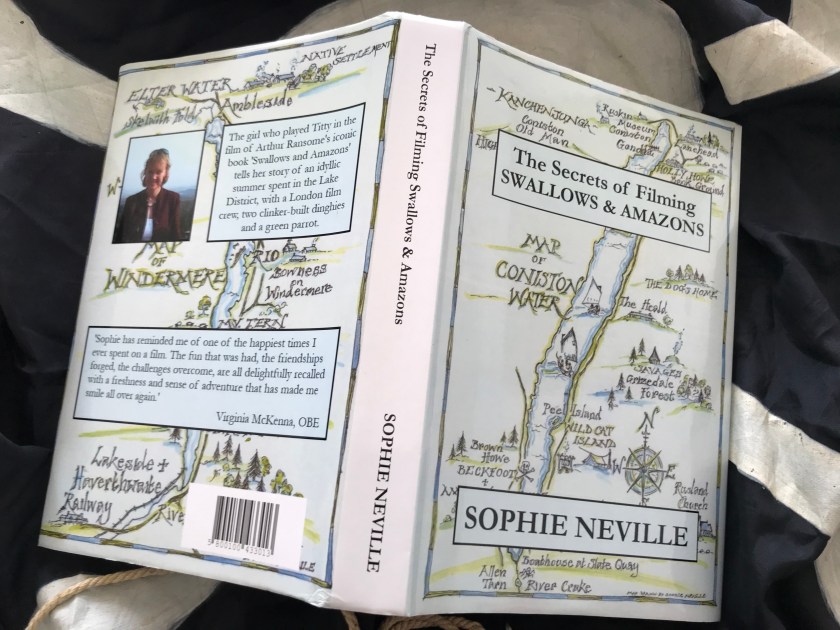
You can read about the making of ‘Swallows and Amazons’ (1974) in this illustrated book by Sophie Neville available online:
‘The Girl Who Got out of Zanzibar’ originally won a place on Eyelands’ Three Rock Writer’s Residency in Crete in September 2019, where Sophie worked on the first 20,000 words. It went on to win third prize in the Association of Christian Writers’ novel competition 2020, when the judge, Tony Collins, described it as: ‘a treat: full of atmosphere, detail, vivid characters, and a love for the island and its culture. I liked the fact that the narrator is a young black girl, which I find refreshing, and the relish with which the food was described is delightful. The underlying theme of FGM (and its place in a patriarchal society, the practice perpetuated by grandmothers) is a dark thread, well sustained, which both horrifies and compels.’
The sequel ‘The Man Who Got Out of Japan’ won the Eyelands Book Award for an unpublished historical novel in 2019. An awards ceremony in Athens is planned for April 2021.
Bidding mounted steadily for a hardback first edition copy of ‘The Secrets of Filming Swallows and Amazons (1974)’, signed by the author.
After 64 bids and it sold for £201
– I am quite blown away. Very many thanks to all our supporters –
100% of the money will be donated to BBC Children in Need – under the auspices of ‘Children in Read’ via the Jumblebee auction site where this illustrated book was listed under the categories of both ‘Autobiography’ and ‘Film & Television’.
To read a free sample of the first section of the 2nd edition – available as an ebook – click here – then click on ‘Look inside’.
To see more on the second edition of the ebook – click here
‘highly amusing and thoroughly enjoyable’ David Butters
Since the bidding ran so high, I will include a signed copy of the 2nd edition, entitled ‘The Making of Swallows and Amazons (1974)’, published by The Lutterworth Press. This contains colour plates with more photos and additional stories that flowed down from the Lake District after the first edition came out.
I’m also including a hardback First Edition of my memoir ‘Funnily Enough’, which has a few pages on ‘Swallows and Amazons’ and a signed copy of ‘Ride the Wings of Morning’, which has noting about the making of ‘Swallows and Amazons’ but is all about living out the adventurous outdoor lifestyle advocated by Arthur Ransome, so there are four books in the bundle.
Although surpassed by Phillip Pullman and JK Rowling, I gained far more than authors such as Bernard Cornwall, Jeffery Archer, Sophie Kinsella and Maggie O’Farrell.
Being a filmography, ‘The Secrets of Filming Swallows & Amazons’ sat alongside the bestsellers, ‘Killing Eve’ by Luke Jennings and ‘Kay’s Anatomy’ by Adam Kay, which you can see by clicking here.
This auction of books has already raised £21,841 for BBC Children in Need, which is fantastic. It closed on Friday 13th November at 11.00pm.
If you need to know more about the auction, please contact Paddy Heron at Children in Read: childreninread@yahoo.com
This is the 7th Authors’ & Illustrators’ Auction in support of the 2021 BBC Children in Need Appeal. Charity Ref: 802052





































 Sophie Neville