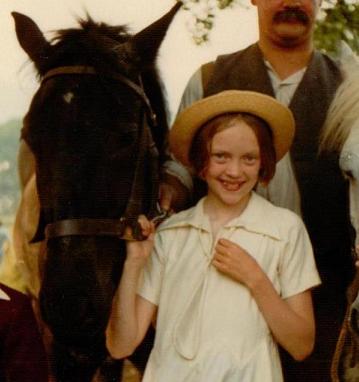
‘What is the film of Swallows and Amazons about?’ Nigel H Seymour’s review of the 1974 movie made on location in the Lake District


The Eternal Swallows and Amazons by Nigel H Seymour

I recall being contacted by a friend who had just passed his driving test, and wished to spend a lazy day in the Lake District where he’d insisted on hiring a rowing boat in Bowness on Windermere in order to ‘enjoy the beauty of the lake’. While heading out from the jetty towards the ‘Lily of the valley’ island in rather a clumsy fashion, I was asked. ‘Who do you want to be, the Swallows or the Amazons?’

At a later date I was given the book ‘Swallows and Amazons’ written by Arthur Ransome together with a video and an original vinyl of the music soundtrack. Turning the pages of the 1930 novel was like opening a door to several other worlds for suddenly the lakes swept in like the most refreshing breeze that kindled an inner passion for hills, mountains, lakes, sleepy streams and mists, early morning stillness on the water and sailing adventures.

Watching the film for the first time was a turning point in my rather dull experience of being at school in the north west of England with its drab corridors, gray walls and endless smoking chimneys out to the horizon.

Within a very short time I too have taken a seat on a train en route to the Lake District in 1929 that had a family travelling together in one of those wonderful old carriages consisting of four children and their mother who were to spend a holiday together in a beautiful farmhouse nestling in the trees by the lake.

 For some reason William Wordsworth’s immortal words ran through my mind: ‘Beside the lake beneath the trees fluttering and dancing in the breeze.’

The story touches on many human aspects that we all learn to accept as a part of our evolvement into adulthood and which today seems to have got lost in the quest for an increasingly fast world understanding and a computer generated experience.

The joy of the family arriving at the farmhouse and standing there looking out over the glorious Lakeland towards their dream island where it’s hoped they will be able to embark on a camping holiday after receiving permission from their absent father.

The four children, John Susan Titty and Roger Walker, all displayed an individual aspect of evolvement, with Titty engrossed in the book ‘Robinson Crusoe’, using her vivid imagination to create the island realm and keeping a hand written diary, while John seemed to be moving towards a Naval leaning by spending his time learning the basics of Morse code, boat handling and navigation. Young Boy Roger enjoys stuffing himself with anything he can possibly eat, appears to be showing signs of enjoying the great outdoors, and wants more adventure. Susan comes across as the mother figure who thinks about the younger siblings and what they all will be eating while on their adventures.

The story unfolds as the children receive the go ahead in a telegram from their father to sail over to their island to camp in a borrowed dinghy called ‘Swallow’. A burgee is sewn up to fly from the mast depicting a swallow. This news is received with unadulterated delight by the children who immediately begin the preparations.

The lake and mountainous surroundings featured in the film begin to open up as the children undertake their journey to discover sailing rivals in Nancy and Peggy Blackett who live in one of the houses bordering the lake and own a dinghy named ‘Amazon’ that sports a ‘pirate’ burgee. 

Initial rivalry erupts between the Walkers and Blacketts, which results in eventual harmony as the two sides join forces to capture a common enemy who just happens to be the Blacketts’ ‘Uncle Jim’ who owns a houseboat on the lake and is busy writing a book. 

The Swallows and Amazons decide to host an expedition to capture Jim (‘Captain Flint’) and the houseboat, and, to determine who should be the leader, they make an attempt at capturing each other’s boats. 

This requires sailing at night and some pretty shady manoeuvres, which are grievously frowned upon when discovered by the Walkers’ mother when she made a journey to the island to check up on the children and found Titty on her own. John has to confront his mother and explain his reasons to sail in the dark.  She reluctantly accepts his explanations but with a proviso that no further actions of this sort will occur again for the remainder of the holiday.

Titty won the day by seizing an opportunity to capture the Amazon boat while the Blackett’s were on Wild Cat Island, making the Walkers the winners. This leads up to the finale where there is a sea battle as the Swallows and Amazons launch an assault on Captain Flint and the houseboat when he is captured and made to walk the plank. The end of the film sees Titty gifted with Flint’s pet parrot who seemed to have taken quite a shine to her, and everyone resolves to be kindred spirits for ever!

After watching this film my mind was transported to the lakes and sharing the beautiful sunny days, crispy clear water and blue skies with the backdrop of the mountains the wooden jetties and a sailing journey into Bowness for supplies. I could sense myself seated in the lugsail rig and feeling the tug on the main sail as the boat crept closer to the wind before going about and heading away onto another tack.

I was carried with the family into that other realm and other time where innocence and responsibility were coming to the fore, where family values were held dear and independence was something young people strove to achieve within the simplicity of their everyday existence. For the brothers and sisters to go camping on a small island in the middle of a lake away from any overseeing adult, and to arrived there by sailing over in a borrowed boat, leaves little to the imagination.

There was a sense of adventure with the children, and a wanting to show they could be responsible and look after themselves, something in today’s society we have to a degree lost touch with. That immortal sense of adventure within a landscape never changes, except within its own light that we know and love today as the Lake District.

This film is a journey into another dimension and another world steeped with love and belonging, adventure and moral understanding, which is shared between a family and accepted.

The characters are bought to life almost as if they are an infinite, integral part of the immortality of the story, each giving that picturesque understanding the viewer finds impossible to explain.

After watching this film one arrives back in real time with a resounding bang! We wonder why such a simple story can create such an iconic understanding, why watching this film can make you feel happy, totally complete and yearning to return again and savour that wonderful, eternal landscape we have all learned to grow and love as The Lakes.

Do think of leaving a review of this film on the International Movie Base site. The link for ‘Swallows and Amazons'(1974) is: https://www.imdb.com/title/tt0072233/

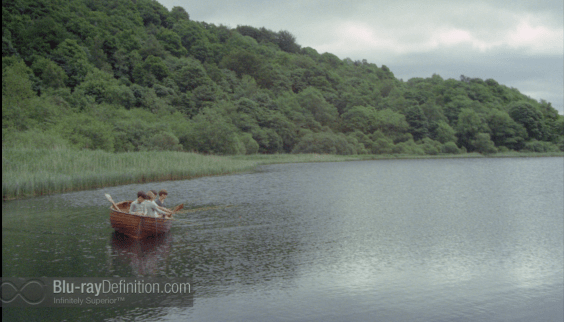
Swallow, the dinghy that starred in ‘Swallows and Amazons’ (1974)

Sten Grendon as Roger and Sophie Neville as Titty rowing Swallow
(c)StudioCanal

BBC Antiques Roadshow featured Swallow, the dinghy used in the original feature film of Swallows and Amazons in their first episode at Windermere Jetty repeated recently on BBC One. You can read about how she was valued by Rupert Maas on an earlier post on this blog here.

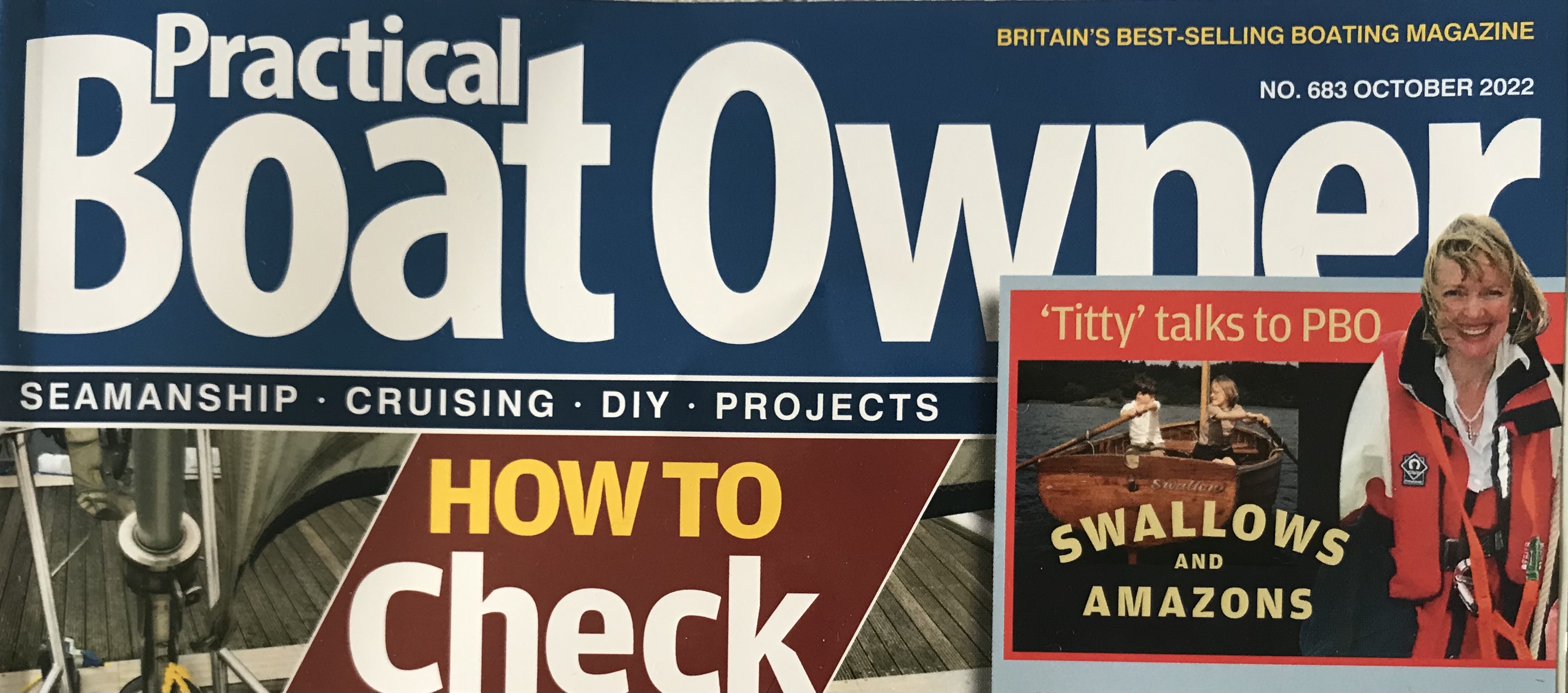
I wrote a little more about her history in an article for Practical Boat Owner, Britain’s most popular sailing magazine. The story opens in 2010, when I nearly bought her myself:

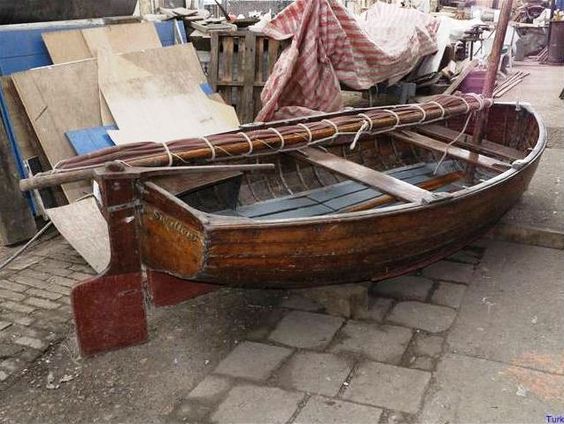
Swallow is coming up for auction,’ my father said, sending me the details of a clinker-built sailing dinghy stored in Mike Turk’s warehouse in Twickenham. It was the Spring of 2010. I took one look at the online photographs and wept.

Swallow stored in Twickenham

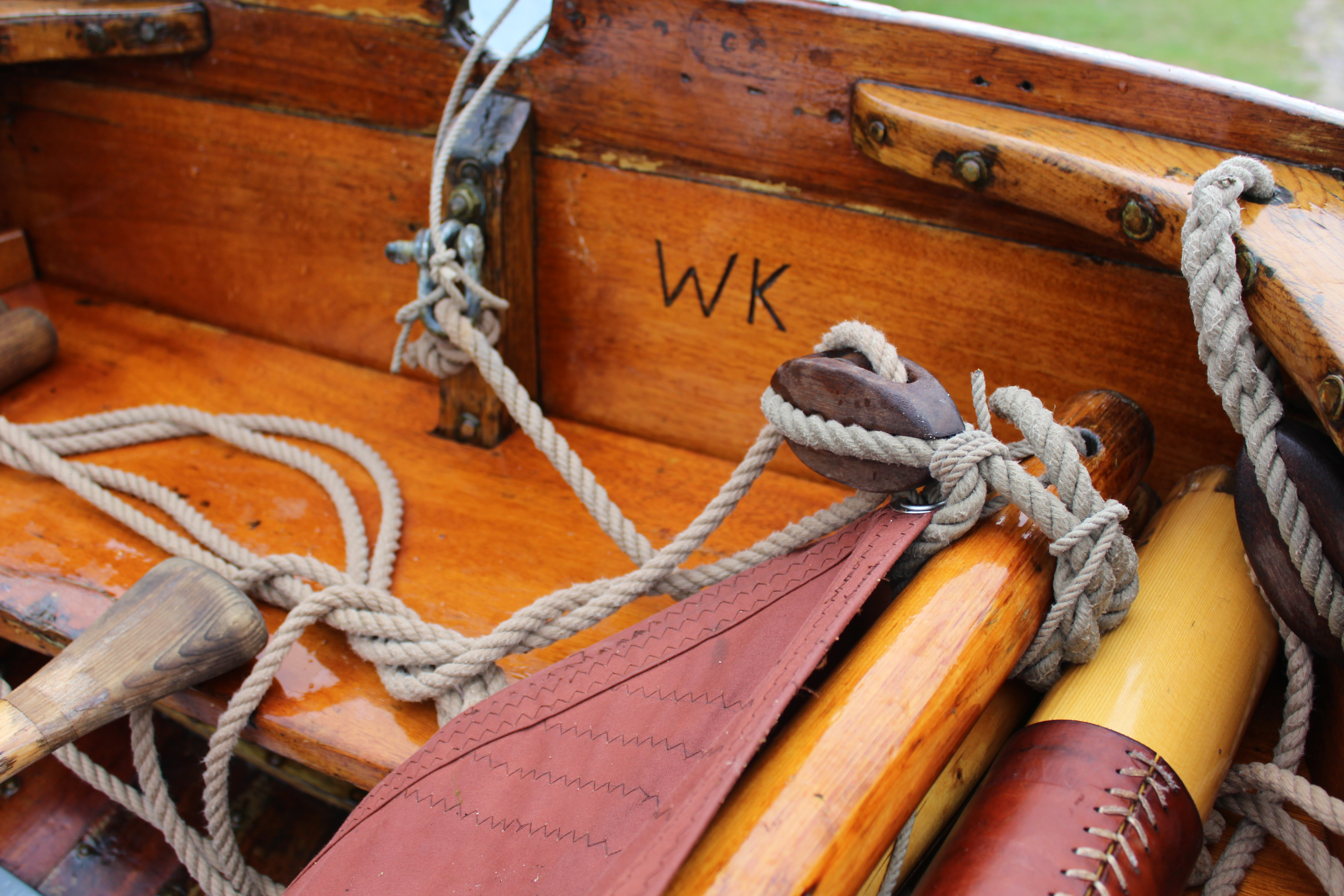
The letters WK were carved on her transom. It was the twelve-foot, all-purpose, run-around vessel originally owned by William King of Burnham-on-Sea that had been purchased by Richard Pilbrow in 1973 to feature as Swallow in the original feature film of Arthur Ransome’s classic novel Swallows and Amazons.

Swallow built by William King of Burnham-on-Crouch

I knew the little ship intimately. She looked a bit dried out but my husband thought we ought to buy her. I had played the part of Able-seaman Titty, the nine year-old girl who Ransome so cleverly made into the heroine of the story when she grabbed a chance to capture the Amazon, which enabled the Swallows to win the war set to determine ‘who should be the flag-ship’. In mooring her prize overnight near Cormorant Island, Titty witnessed Captain Flint’s stolen treasure chest being buried and was eventually able to rescue it. She was rewarded by the gift of a green parrot.

‘Did you know how to sail before playing Titty in Swallows and Amazons?’ people often asked. The truth was that I had crewed for my father in a similar dinghy and felt confident in a boat but could not have coped single-handed.

Sophie Neville aged about ten sailing in the Cotswolds

However, I had grown up living by a lake in the Cotswolds where we had a Thames skiff, which I often took out. This was important as Titty does quite a bit of rowing in the film. She and Roger become galley-slaves rowing back from the charcoal burners’, they row out to Cormorant Island and she takes the Amazon out of Secret Harbour. This I accomplished alone, in one take, later rowing some distance from Peel Island with the lighting cameraman and his 35mm Panavision Camera onboard. No one had thought about the implications of this when we first tried out the two boats on Windermere but, being aged twelve, rather than nine, I just about coped and grew adept at launching Swallow and moving about in her. As the book was written in 1929, we did not wear life-jackets.

Swallow with Simon West and Suzanna Hamilton (c) StudioCanal

Arthur Ransome described Swallow as being thirteen-foot long with a keel, rather than a centre board. In the illustrations she is painted white, a common way of protecting wood in the 1930s. I am pretty sure that Richard Pilbrow, the producer of the movie, bought the rowing boat we used when we where in Burnham-on-Crouch to audition for the parts in March 1973. She was varnished but had been given and forward thwart, mast, red-brown sail and balanced lug-sail as described in the books.

Simon West who played Captain John, aged only eleven, was a capable sailor with an understanding of the wind that enabled him to cope with gusty Lakeland conditions. Swallow had no buoyancy. In the scenes when we first sail to the island she was laden with camping gear, including heavy canvas tents, the lighthouse tree lantern and a shallow basket of kitchen utensils I shifted every time we went about.

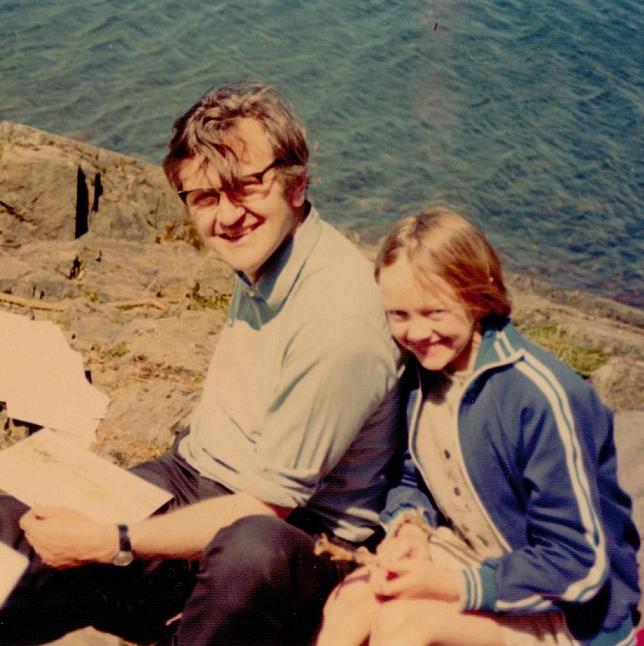
My father Martin Neville on the shore of Coniston Water

My father was an experienced sailor, used to racing yachts having frequently crossed the Solent in his own clinker-built dinghy as a boy. He was looking after us children when he agreed to appear in costume as a ‘native’ aboard the MV Tern on Windermere, which bares down on the Swallows in the story. He watched, terrified, as we sailed towards it. The Victorian steamer only had a notch throttle and an inexperienced skipper. Dad realised that Claude Whatham, the film director, had not anticipated the fact that we would lose our wind in the lee of the passenger ferry. He gave Simon a cue over the radio that was far too late. We only just went about in time, being pushed away from the larger vessel by the bow wave. Watch the film trailer and you can see how very close we got. I was about to reach out and feebly fend off.

Dad spoke sternly to the producer that afternoon, pointing out that we could have all gone down. Sten Grendon, who played the Boy Roger, was only aged eight and could hardly swim. I could have become entangled in the camping gear. My father tested the old BOAC life jackets we wore for rehearsals and to travel out to film locations. They failed to inflate. He nearly took me off the production.

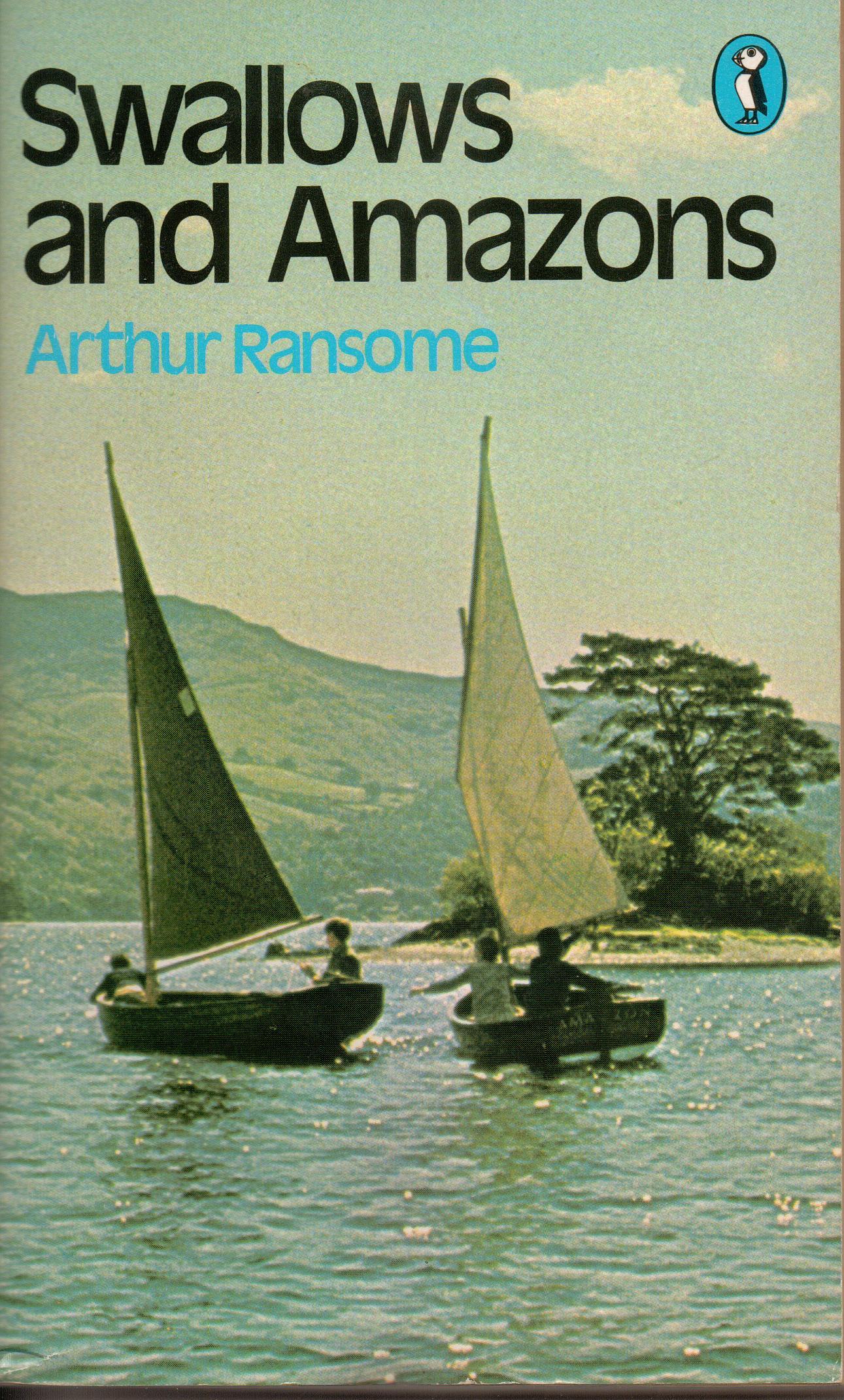
Swallow and Amazon on the Puffin cover

Another tricky scene to film was when John, Susan and Roger set off from the Landing Place on Wild Cat Island leaving Titty to guard the camp and light the lanterns as they hoped to capture the Amazon and sail home after dark. I had push them off, grabbing the telescope at the last minute. Since Swallow’s mast was liable to catch in tree branches, I needed to wade out and give her a hard, one-handed shove. I slipped on a rock and fell up to my waste in water. Knowing it would be difficult to set up the shot a second time, I struggled to my feet and waved them off, dripping wet. By this time John had the mainsheet out as far as the knot and stood to grab the boom to avoid a Chinese gybe as Swallow was hit by a fresh gust of wind as he cleared the headland at the northern end of the island and sped northwards toward Coniston Old Man.

Simon West and Suzanna Hamilton at the helm of Swallow with Stephen Grendon in the bows, while Sophie Neville looks on from Peel Island.

Having spent nearly seven weeks filming in the Lake District, the film was post-synced at Elstree studios. We arrived to sing out our lines to find Swallow there. She had been set in a tank so that the sounds of sailing could be captured. It is something you tend to take for granted as a viewer while it draws you into the experience.

I last saw Swallow looking dejected outside the studio and was worried about what had become of her. Although she was offered to someone who had advised on the film, she was kept safely at Mike Turk’s prop hire company. Richard Pilbrow was hoping to make another film in the series.

Swallow at
Swallow at Mike Turk’s store in London

When Mike retired, many boats that had featured in movies came up for auction. I knew Swallow would be costly and in need of renovation. After fans of the film and members of The Arthur Ransome Society contacted me, we clubbed together to make a bid. In the end about eighty members of a hastily formed group called SailRansome spent approximately £5,700 on the purchase.

I contacted Nick Barton of Harbour Pictures, the film producer who was gaining the rights to make a new movie, hoping we could be able to re-coup costs by renting her back to him. Nick came up to Coniston Water to watch me re-launch Swallow in April 2011, sloshing brandy wine on her bow in true Ransome style. I helped him to raise finance for the new film, which was made in the summer of 2015 and released in 2016, starring Kelly Macdonald as Mrs Walker, Rafe Spall as Captain Flint and Andrew Scott as a Russian spy. In the end, he decided to use fourteen-foot RNSAs dinghies for Swallow and Amazon as they satisfied the film insurance company who demanded that two identical dinghies were used for Swallow.

This article was first published in Practical Boat Owner magazine

Joining SailRansome was pivotal for me as I was asked by the Nancy Blackett Trust and The Arthur Ransome Society to give a series of talks on how the old film, and the BBC serialization of ‘Coot Club’ and ‘The Big Six’ was made. I ended up speaking at a number of literary festivals, on BBC Radio and even ITV’s News at Ten, promoting the societies and urging people to help get young people out on the water. I ended up taking Swallow out on Ullswater, the Orwell and River Alde, remembering how difficult she is to turn, but enjoying her speed. She ended up being featured on BBC Antiques Roadshow when I brought movie memorabilia up to Windermere Jetty museum for two episodes first screened in 2021.

Sophie Neville with Swallow on Coniston Water
Sophie Neville after re-launching Swallow on Coniston Water in 2011

Next summer, you should be able to sail Swallow or Amazon yourself, in the company of an experienced skipper, by contacting Hunter’s Yard near Ludham on the Norfolk Broads. They also rent out Titmouse and yacht who played the Teasel in the BBC adaptation of ‘Coot Club’. As you can see from this clip, Swallow was in need of restoration when first acquired by Sailransome. She now needs a new keep. I have news of her restoration on this website here.

You can read more on the Arthur Ransome website here.

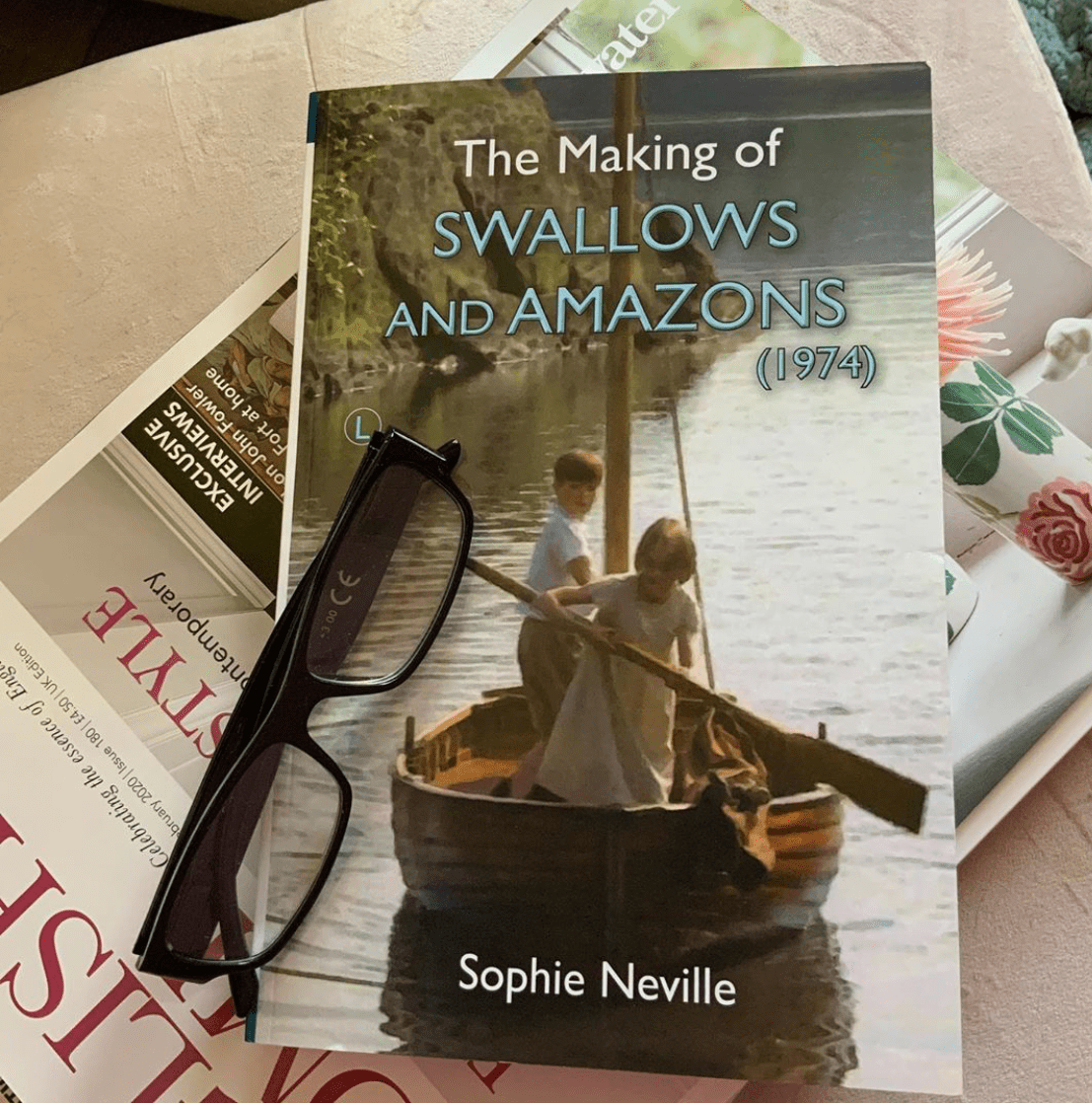
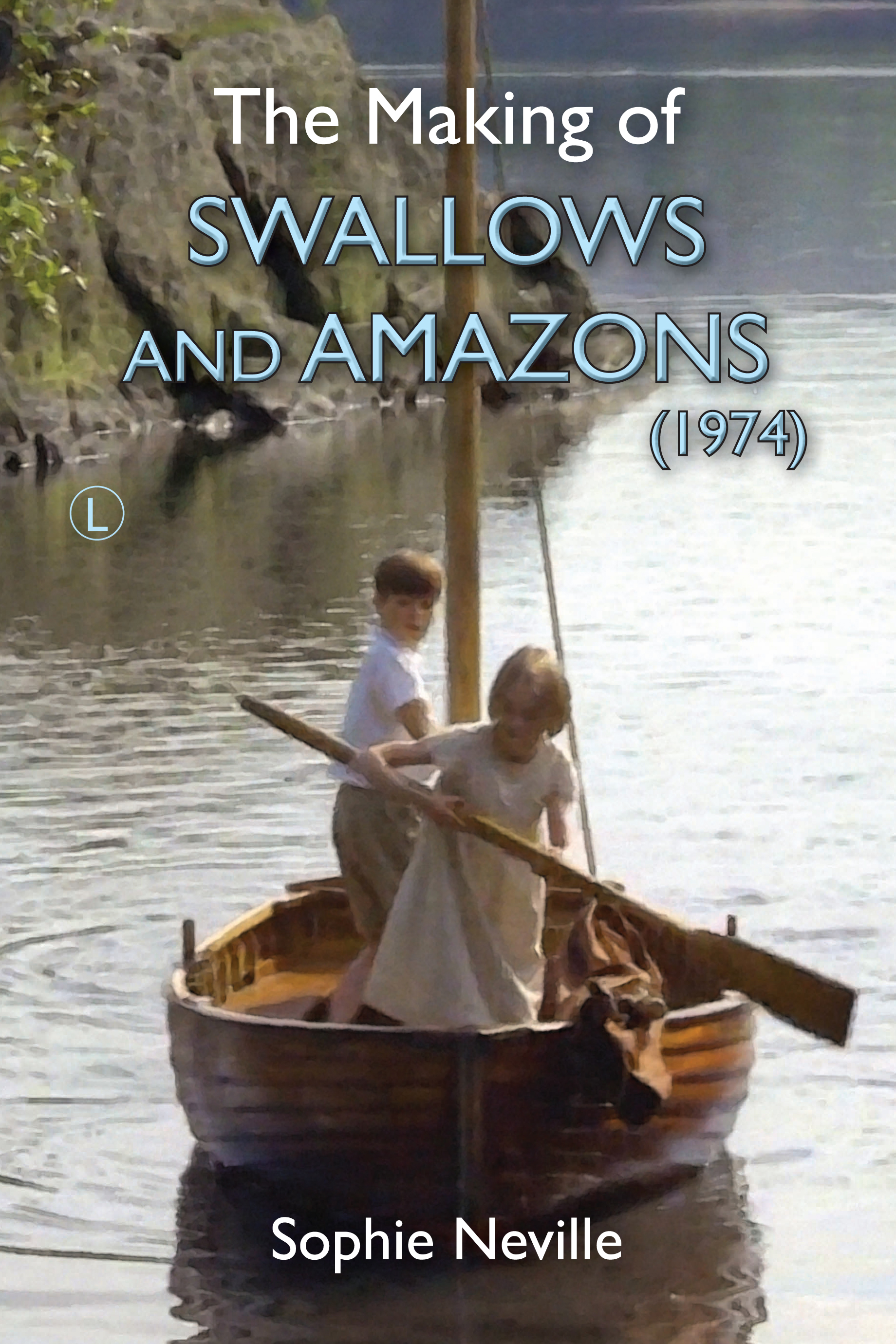
You can read more about the adventures we had making the original film in ‘The Making of Swallows and Amazons (1974)‘ by Sophie Neville, published by the Lutterworth Press, available from libraries, online retailers and to order from all good bookshops including Waterstones.

An article by Sophie Neville first published in Practical Boat Owner. A subscription to this bestselling UK magazine makes a great Christmas present.

Authors who mention the 1974 film of ‘Swallows and Amazons’

People often write to say how much they have enjoyed the original film ‘Swallows and Amazons’ (U) produced by Richard Pilbrow in 1974, which is currently streaming on Amazon Prime. Being suitable for all ages, it is often screened at outdoor festivals and is on Netflix in Europe.

‘Is it a good movie?’ people enquire of Google.

Helen Fielding mentions the DVD of Swallows & Amazons 1974 in the first edition of ‘Bridget Jones: Mad about the Boy’ claiming it to be more edifying for her children to watch than ‘Beverley Hills Chihuahua 2‘.

Dame Margaret Drabble told Claude Whatham, the director, how much she loved Titty in his film of Swallows and Amzons, which was a huge compliment.

Sophie Neville as Titty in 1973

Elspeth Huxley CBE – author of thirty books including The Flame Trees of Thika – loved the 1974 film of Swallows and Amazons, reviewing it for The Tatler magazine under her married name, Elspeth Grant.

Simon West, Sophie Neville and Suzanna Hamilton appearing in The Tatler

There is special interest from a number of authors –

Wendy Clarke, who has set some of her psychological thrillers in the Lake District auditioned for the part if Titty in 1973. You can read her story on another post here.

When Catherine Lamont from Australia wrote on Facebook to say, “Just read a 2020 book mentioning ‘Swallows and Amazons’ (someone spotted in a bookshelf belonging to one of the main characters): The Enigma Game, by Elizabeth Wein” the author hrself, Elizabeth Wein, wrote in to say, “Not just in The Enigma Game – I namedropped Swallows & Amazons in my novel Code Name Verity, too! It was given to me by my grandmother’s best friend when I was seven and was one of my favorites. My own children, who never actually read it, were huge fans of the film”.

Christine Stevenson said that she was introduced to Swallows and Amazons by ‘The Unlikely Voyage of Jack de Crow’ by AJ Mackinnon about his journey from Shropshire to the Black Sea in a Mirror dinghy.

According to Kathryn Hughs in The Mail on Sunday BOOKS section, Robert Twigger ‘grew up in the 1970s obsessed with Swallows and Amazons’. He’s written 36 Islands: In Search of the Hidden Wonders of The Lake District… And a Few Other Things Too. It was well reviewed by Country Life.

Mail on Sunday - A homage to Swallows, Amazons and a girl with a rather rude name!

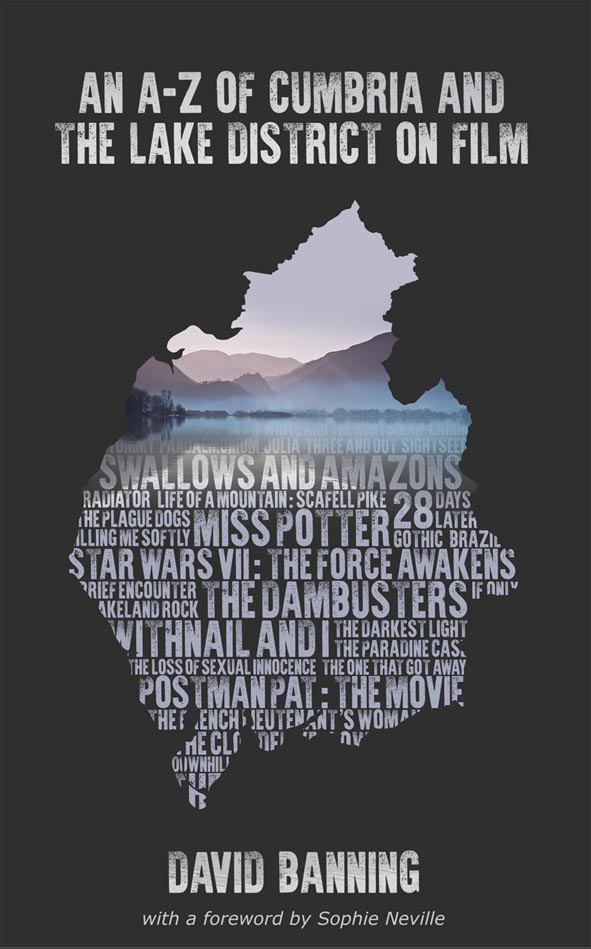
The arts curator David Banning profiled the 1974 movie of Swallows and Amazons in his book on films made in Cumbria and the Lake District, which you can see here.

Trevor Boult, who writes books on ships and sailing, is a great fan. He kindly donated the royalties from his most recent book Boats Yet Sailing to The Arthur Ransome Trust. You can order a copy direct from the publisher here.

For a list of well known people who love the Swallows and Amazons books, please click here

Do you know of any other authors who have written about the film? Please leave any information in the comments section, below.

Wilfred Joesph’s title music for ‘Swallows and Amazons'(1974)

You can read the first section about how the film was made back in 1973, for free, on the Amazon preview of the ebook here:

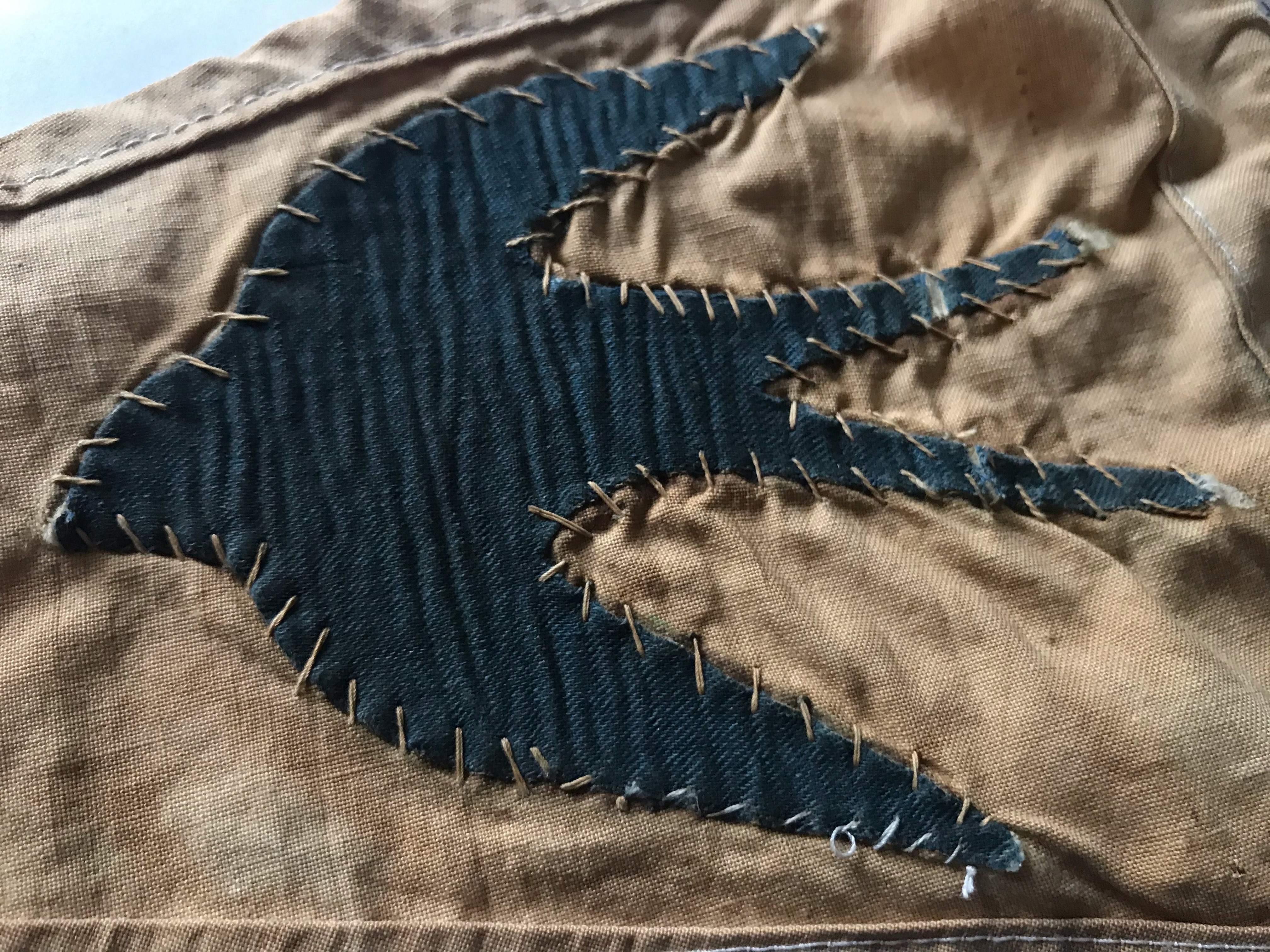
Swallow’s flag and the bamboo fishing rods featured in the 1974 movie ‘Swallows and Amazons’

The flag Titty made for Swallow in the original film ‘Swallows and Amazons’ (1974)

Were some of these stitches mine after all?

A few weeks ago, BBC Antiques Roadshow featured some of the flags from the original movie ‘Swallows and Amazons'(1974) in which I played Titty Walker. These film props had been sent to me by the producer Richard Pilbrow who now lives in Connecticut. I take them with me if I’m ever asked to give a Q&A or talk about ‘The Making of Swallows and Amazons’. Film fans enjoy taking selfies with them.

I explained that they were made on location in 1973, possibly by the Art Director, Simon Holland, who enjoyed painting. Equally, they may have been made by the Set Decorator Ian Whittaker, who went on to win an Oscar and nominations for several more. Bob Hedges who was in charge of the action props was also adept at making props in the days when health and safety regulations were more relaxed.

In the story, Titty decides to make a new flag for the Swallow. I was keen on sewing as a child, and was thrilled to be given a needle and thread to stitch a blue swallow on the flag myself in a scene with Virginia McKenna, who played Mrs Walker, shot at Holly Howe (Bank Ground Farm) above Coniston Water in the Lake District. Rather a modern reel of cotton was caught in vision.

Virginia McKenna, as Mary Walker with Sophie Neville playing her daughter Titty Walker busy stitching Swallow’s new flag in preparation for the voyage to the island (c)StudioCanal

It was not until I returned from recording Antiques Roadshow at Windermere Jetty and had the flag on my desk that I noticed some of the stitches are different from others. It looks as if the small, white stitching on one wing could have been my own. As a child, I had thought the larger stitches rather clumsy but am sure they looked appropriate in vision. It would be worth far more if it was known to have been made by Ian Whittaker. He won an Oscar and was nominated for his work on a number of other films.

Ian Whittaker with the Art Director Simon Holland

‘Properly’, as Titty would say, the bird should be flying towards the mast, although I am assured that Arthur Ransome did once draw a diving swallow on one flag. In his book, the swallow was sewn into the cloth rather that plonked on top of fabric browned by tea but our flag has lasted for 48 years.

Property Master Bob Hedges keeping the perch alive

After Antiques Roadshow was broadcast, a lady who grew up in Bowness on Windermere, wrote to say, ‘It may be of interest that we still have the fishing rods that were used in the film. They belonged to my father Leslie Borwick and were lent to the film crew. They are rather worse for wear but still treasured as I was a big fan of the books when I was young. Unfortunately I was living abroad when the film was made so have no memories of it.’

Leslie Borwick on Windermere

Leslie Borwick, was a keen fisherman who took his daughter out to catch perch. She said that the bamboo rods are quite fragile but one has a wooden reel, which is interesting.

Ronald Bousfield fishing at about the time ‘Swallows and Amazons’ was written

“My mother’s side of the family were very keen fishermen. Their surname was Bousefield and there is a fly called “Bousefield’s Fancy”(Frank Bousefield)”

You can read the original post about filming the fishing scene on Elterwater here

A clip of Swallow’s flag being valued on BBC Antiques Roadshow can be watched on BBC iPlayer.

The whole story of the making of Swallows and Amazons (1974) can be read here:

Memories of making ‘Swallows and Amazons’ (1974): part six

Sophie Neville playing Titty Walker in the 1974 movie

‘Titty from Swallows and Amazons’ often gets typed into the Goggle search engine but when I attempt to use it as a ‘tag’ a message pops up saying: ‘Sorry, you are not allowed to assign the provided terms.’ I can only conclude that Google lacks literary enlightenment but the BBC were happy for me to talk about Titty on BBC Antiques Roadshow recently.

Sophie Neville on BBC Antiques Roadshow

‘Memory picks and choses,’ as Arthur Ransome said in his autobiography (p.33) but those who love his novels often wonder what would have happened to the characters when they grew up. It dawned on me that this might be one reason why people are interested to know what we all did with our lives. I played Titty Walker in Richard Pilbrow’s 1974 movie of ‘Swallows and Amazons’. In 1962, the film actress Susan George played the same character in the black and white BBC television serial of ‘Swallows and Amazons’ with her hair in pigtails. She was called Kitty, apparently with Arthur Ransome’s approval. BBC Films decided to call the Able seaman ‘Tatty’ in the 2016 movie ‘Swallows and Amazons’, when she was brilliantly played by Teddy-Rose Malleson-Allen who went on to star in ‘Four Kids and It'(2020).

The character was inspired by a real little girl, Titty Altounyan, who stayed at Bank Ground Farm (or Holly Howe) when visiting her grandparents who lived above Coniston Water. In 1939, Miss Joyce Cartmell acquired a signed note from Arthur Ransome explaining that, ‘Titty is short for Tittymouse which is what she was called when she was a baby. Nobody ever calls her anything but Titty now’. It appears that Ransome was also asked for a photograph of himself, to which he responded, ‘Too ugly’.

Edward Thomas (1878-1917) described Arthur Ransome as ‘exuberant, rash and intelligent.’ In 1973, I can only assume the film director Claude Whatham was looking for the same spirit in us children. It was certainly captured by Wilfred Joseph’s nautical film score.

What constantly impacts me is the number of people who write in to say how much they wanted  Titty to become their best friend. In many ways the characters from Ransome’s books become friends for life. You can easily gain others who have the same outlook on life by joining The Arthur Ransome Society, who offer activities and grants for young people as well as adults with a literary bent. You too can stay at Bank Ground Farm and run down the field to dip your hands in the lake.

Staying at Bank Ground Farm – ‘Holly Howe’ with TARS

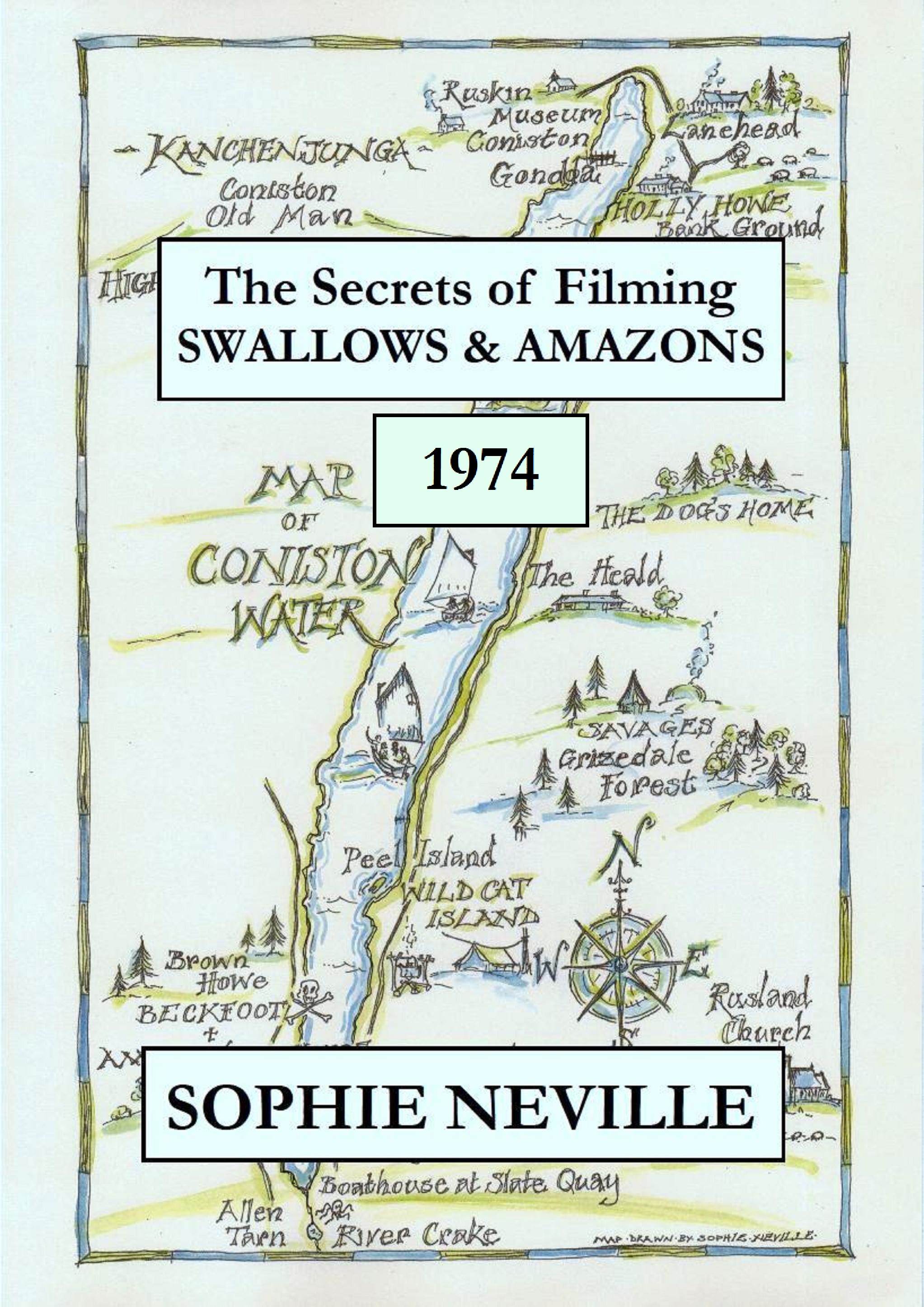
You can read more about making the movie in the multi-media ebook entitled ‘The Secrets of Filming Swallows and Amazons’.

And in the illustrated paperback on ‘The Making of Swallows and Amazons’ by Sophie Neville available online and from the Nancy Blackett Trust


Points to add to the 3rd edition of ‘The Secrets of Making Swallows and Amazons’ (1974): Part five

Imdb, the International movie data base, list Billy Mayerl’s composition ‘Marigold’ as being included in the original film of ‘Swallows and Amazons’. This intrigued me. I looked up the music as I couldn’t think where it had been featured. Listen to the original version and see if you can recognise it:

The famous variety and radio entertainer Billy Mayerl playing ‘Marigold’ and other melodies

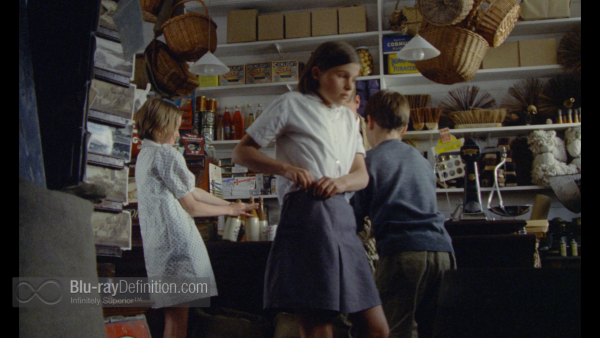
It was ‘played’ on the radio in the chandlery in Rio, laid over the scene when the film was dubbed at Elstree Studios. We didn’t hear it when we were in the actual shop.

Sophie Neville, Suzanna Hamilton and Simon West inside the chandlery

The Swallows bought ‘grog’ (ginger beer) and rope for the lighthouse tree. Postcards and wicker shopping baskets hung in the chandlery, which had weighing scales on the counter.

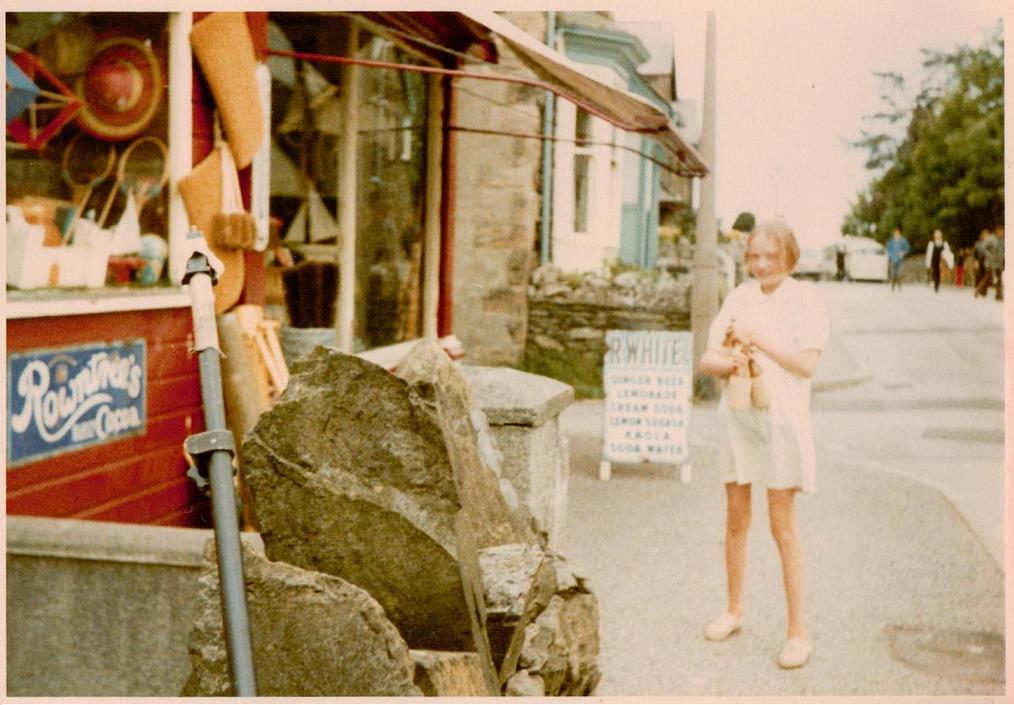
The general Store in Rio
Sophie Neville in Rio with four bottles of grog ~ photo: Daphne Neville

This shot was taken during the filming on the corner of Woodland Road, Bowness-on-Windermere during the filming in June 1973. I wonder who the people in the background were – possibly members of the film crew. The man in the blue top looks like Gareth Tandy the third assistant director who would have been asking passing traffic to wait while filming was in progress. The building looked like this in 2012 but I need a more up to date photo.

Once Tom Kirkbride’s cobbler’s shop, later Mr Cropper’s sweet shop selling rainbow sherbet, Andy Dyker’s Fine Furnishings, a hairdressing salon and now a wood-burning stove showroom

Jenny Maconchy wrote in to say, “It may be of interest that we still have the bamboo fishing rods that were used in the film. They belonged to my father Leslie Borwick and lent to the film crew. They are rather worse for wear but still treasured as I was a big fan of the books when I was young. Unfortunately I was living abroad when the film was made so have no memories of it.”

The Swallows fishing for perch on Elterwater (c) StudioCanal

As a boy, Arthur Ransome had his own perch rod with a colored float to use at Nibthwaite. Towards the end of the filming, Claude Whatham gave Simon West a similar fishing rod, which Ronnie Fraser taught him to use on Derwentwater.

Ronald Fraser behind-the-scenes on Swallows and Amazons (1974)
A member of the Arthur Ransome Group wrote, "I did not realise that the Lakeside Railway had only just re-opened in time for the filming. Of course, although Lakeside Station does get a mention in one of the books, it was the Windermere Station where the Swallows always travelled to. Although Lakeside Station would have been far more convenient from Beckfoot,the Great Aunt always insisted on Windermere as it meant less changes for her. Incidentally both Lake Windermere and Coniston Water had rail connections years ago (which is the likely route for the slate from Slater Bob’s mine although this is not mentioned being outside the scope of a childrens’ story).
With Virginia McKenna at the Haverwaite Railway Station
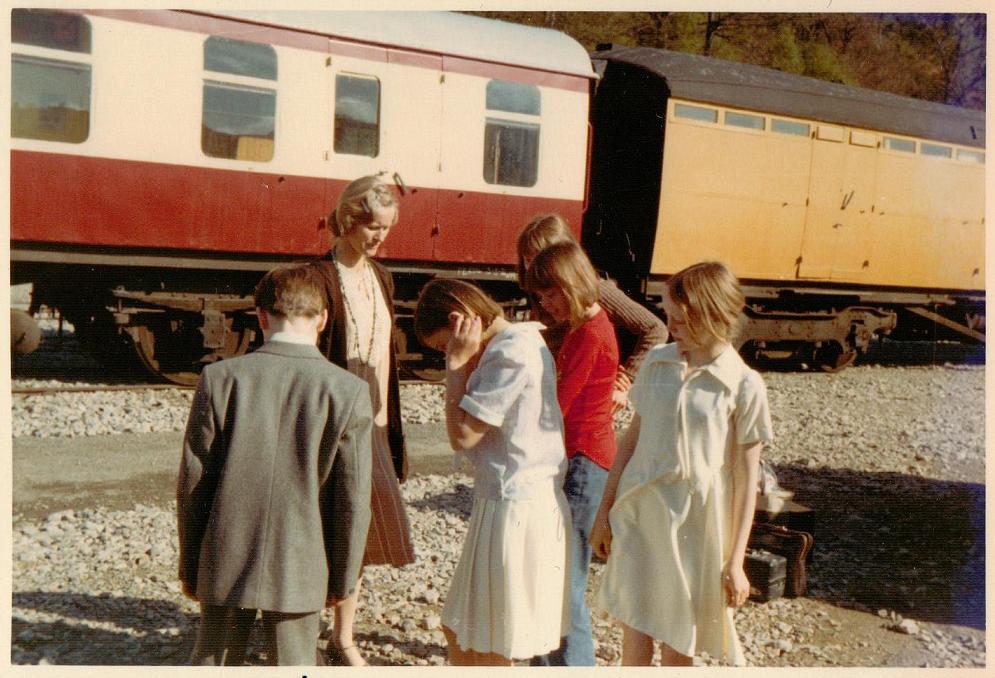
Viginia McKenna at the Haverthwaite Railway Station in Cumbria soon after it re-opened in May 1973. Simon West, Suzanna Hamilton, Lesley Bennet and Sophie Neville are with her. The carriage with compartments is in the background ~ photo: Daphne Neville

“‘Swallows and Amazons'(1974) was instrumental in helping me through a very stressful period of my life, and writing was a great healer for me. The results of my efforts are in the The Arthur Ransome Society library : ‘Prospectors Afloat’ and ‘Coots in the North’ a completion of the short portion which was published. I will be obtaining ‘The making of Swallows and Amazons’ and no doubt many more of your other publications in due course.” Charles H Ball

The Swallows at the Lighthouse tree Lookout point
Simon West, Suzanna Hamilton, Sophie Neville and Stephen Grendon as the Swallows on Wild Cat Island

I’ve just read that in Zulu folklore, the swallow is known as Inkonjany – the one who points the way to summer. “The swallow, and other birds like it, is regarded by our people as a symbol of effort and hard work as well as of unity, because you will see these birds gather together in large groups as they come and go. The name Inkonjany means the little pointer, and it comes from the verb komba, which means to point out something. It was said that if you saw a lot of swallows in the sky, it meant that the summer and the harvest would be very good.” I felt this applied quite well to the Walker family migrating north for their summer holiday and working hard as being the best crew they could be.

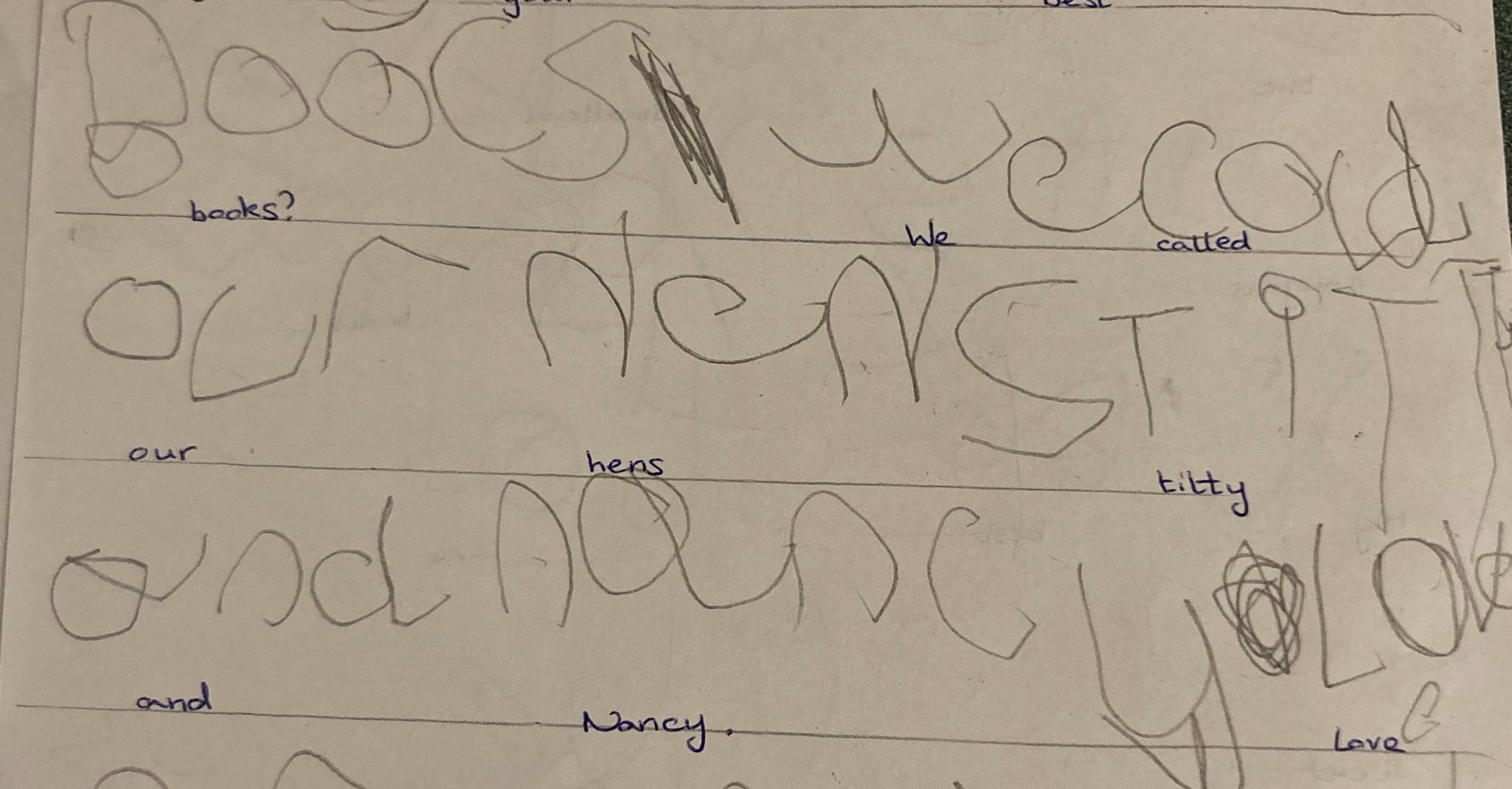
One of the film fans has called her hens Titty and Nancy. I’m sure Mrs Jackson would approve. Do use the comments box below to write in with any connections you have to ‘Swallows and Amazons’ and the original film.

You can read more in ‘The Making of Swallows and Amazons’ available from libraries, bookshops or direct from the publisher . The Nancy Blackett Trust have signed copies and it can be purchased online here:

There is also a similar multi-media ebook entitled, ‘The Secrets of Filming Swallows and Amazons'(1974). You can see inside the first section for free here

Swallow appeared on BBC Antiques Roadshow at Windermere Jetty with a movie poster from the original film of Swallows and Amazons (1974)

When Lakeland Arts declared that Antiques Roadshow was coming to Windermere Jetty, I sent the BBC a photograph of some of the props used in the 1974 film of ‘Swallows and Amazons’.

Swallow’s burgee made in 1973 for the original film of ‘Swallows and Amazons'(1974)

I was hoping their expert on movie memorabilia might be interested in the film posters, but couldn’t think that a hand-whittled hazel bow and arrow could be worth much.

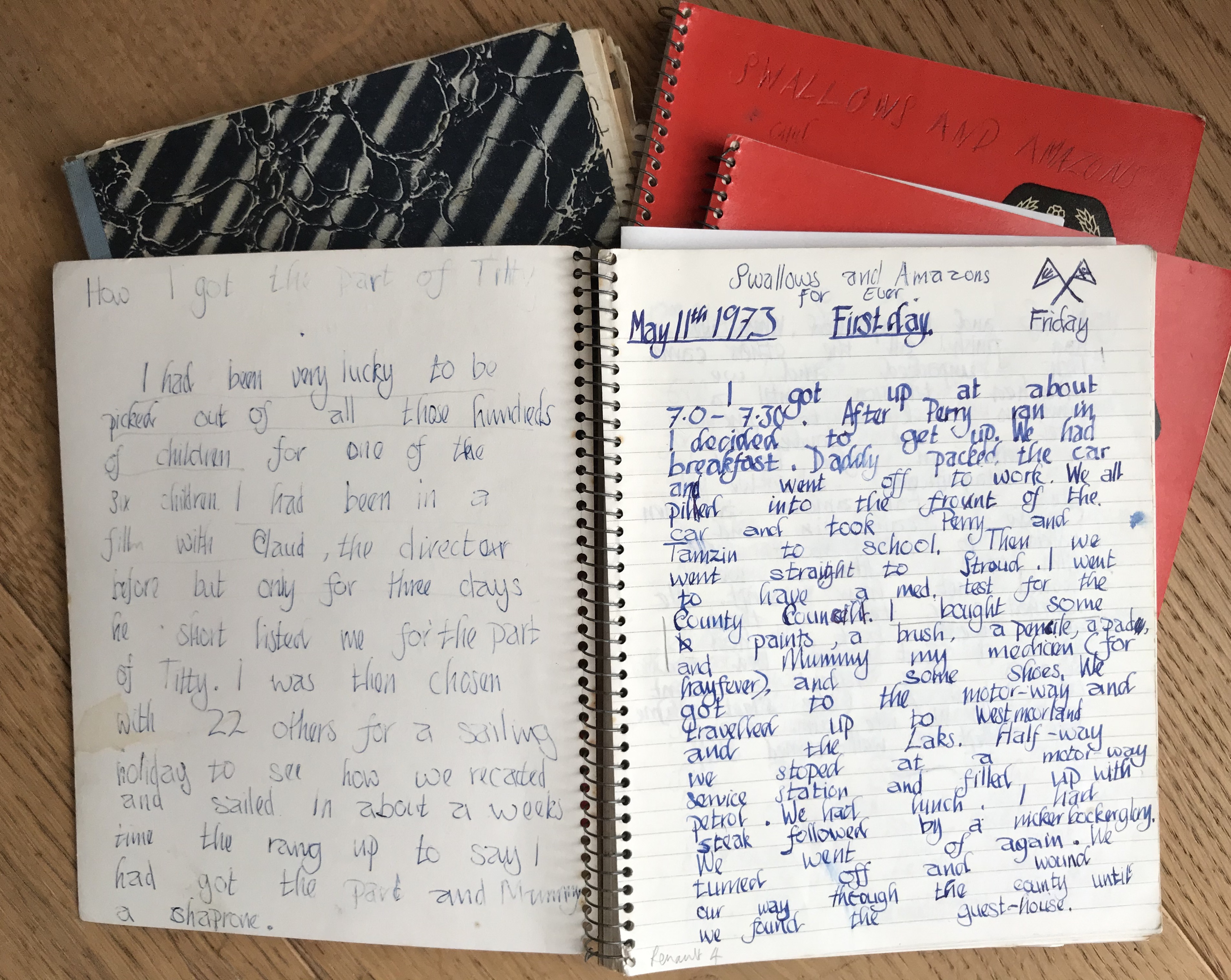
Diaries kept on location in 1974, which form the basis of ‘The Making of Swallows and Amazons’

I was keen to talk about the scrapbooks and diaries that I’d kept on location and thought they might want to use photos my father took of George Pattinson whose collection of boats formed the basis of the original Windermere Steamboat Museum. He brought along his 1900 steam launch Lady Elizabeth to Bowness-on-Windermere when we shot the Rio scenes in the summer of 1973 . She was being restored at the museum.

George Pattinson in his steam launch Lady Elisabeth in 1973 ~ photo: Martin Neville

I also suggested they featured Swallow the dinghy we used in the film. A group of us clubbed together in 2010 to purchase her when she came up for auction.

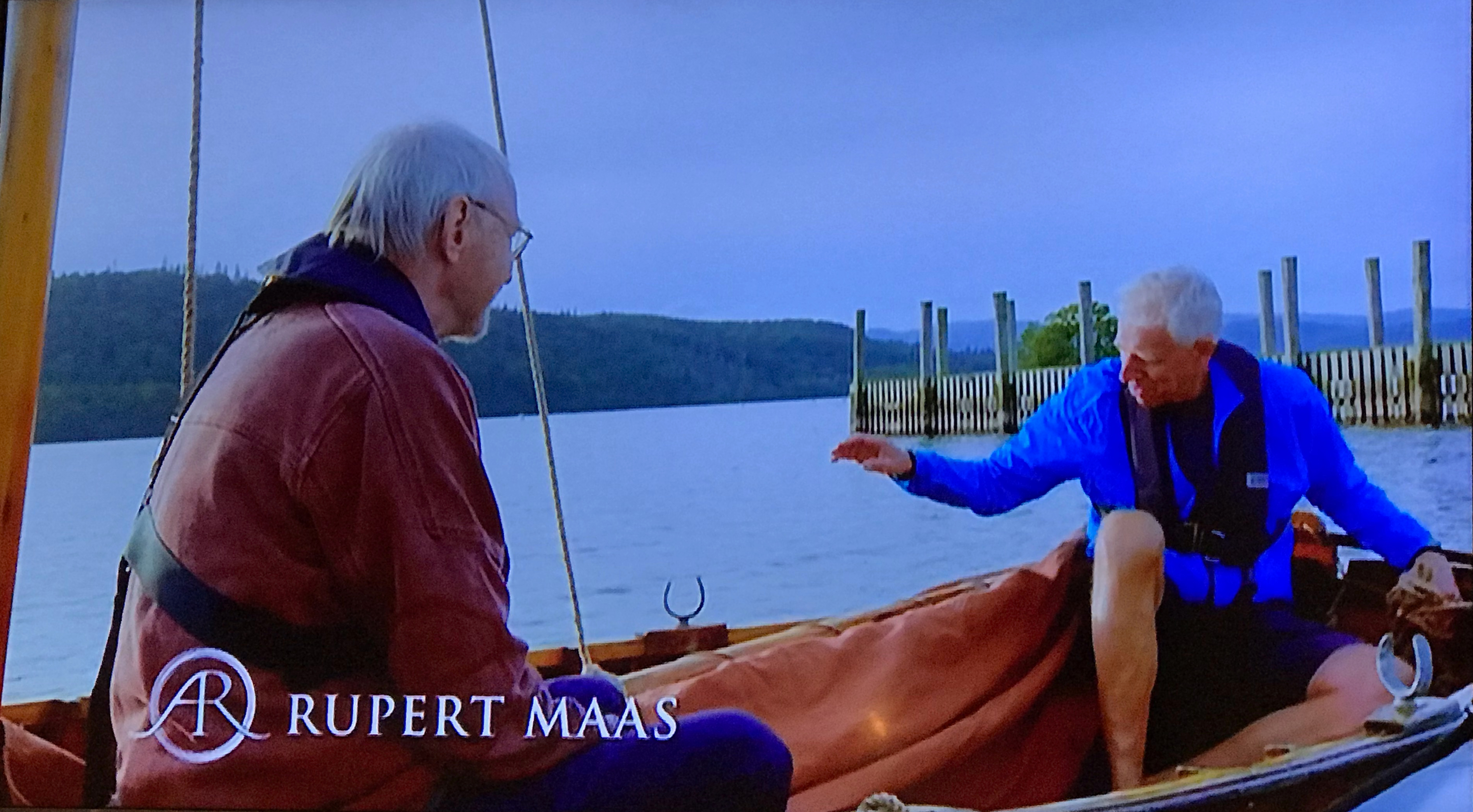
She was valued by Rupert Maas who is a great fan of Arthur Ransome’s books and watched the film himself as a boy. He liked the fact she hadn’t been over-restored. I didn’t know her ribs were made of elm.

The best photograph of Swallow under sail was used on the cover or the first edition of my book about making the 1974 film:

This first edition is now selling for ridiculous amounts on Amazon, but please email me if you’d like a signed copy. I have a few left.

You can order a copy of the 2nd edition online here

If you enjoy ebooks, ‘The Secrets of Filming Swallows and Amazons’ has links to behind-the-scenes home movie footage. It is available for £2.99 here

The billing from the Radio Times lists the other interesting items on the show. You can watch the episode, mostly shot on a lovely sunny day, on BBC iPlayer. Further details are reported here.

If you would like to find out about sailing ‘Swallow’ yourself, please contact Sail Ransome.

I might appear in the second of the two episodes broadcast from Windemere Jetty – the one shot in rain.

When the BBC rang inviting me to come up, it was clear that I was the antique they wanted to see. The first thing they asked me was my date of birth. This turned out to be due to Covid-19 restrictions but the director did, later, ask if she could call me Titty.

BBC Antiques RoadShow at Windermere Jetty in Cumbria

Filming was already in progress when we arrived at the museum. It was a typical day in late September, pouring with rain.

There was a great deal of impressive camera and lighting equipment in evidence but a number of marquees had been erected to keep everyone dry.

We were introduced to the designer, who whisked off various items I’d brought with me to display, and Marc Allum, antiques expert, author and long-time contributor to the Roadshow. He’s tough. It wasn’t freezing but the weather was far from warm.

BBC Antiques Roadshow Expert Marc Allum

Once at the water’s edge I met Debbie, the director who was surprised by the length of my hair. I explained it had grown during lockdown having not been cut for a year.

My position was marked by small sticks in exactly the same manner as during the filming of ‘Swallows and Amazons’ when I was aged twelve. Camera tape would not stick to the slate shingle.

A measuring rod was used to ensure we remained two meters apart, even whilst on camera, before I was asked to take up the bow and arrow I had helped whittle on location long ago.

Expert Marc Allum setting on a display of movie memorabilia with Sophie Neville

The display included Swallow’s burgee. I did ask for the flags to be crossed, but the significance of this was lost on the design team. You will have to write in and explain the importance.

When it came to being given an estimate for the value of what my husband calls ‘my junk’, I was truly amazed, especially since I nearly chucked half of it away in a fit of de-cluttering.

I am sworn to secrecy, so you’ll need to watch the show to find out how much my collection of movie memorabilia is meant to be worth. It should be broadcast on Sunday 21st February 2021 – but will I be on? I know they will feature Swallow this week but my item could either be featured in a different episode or hit the cutting-room floor.

We talked about the film premiere and influence the Swallows and Amazons books have had in encouraging children to get out into the wild.  As I walked around the museum afterwards, I found the Lady Elizabeth being restored, which you can see in a previous post here.

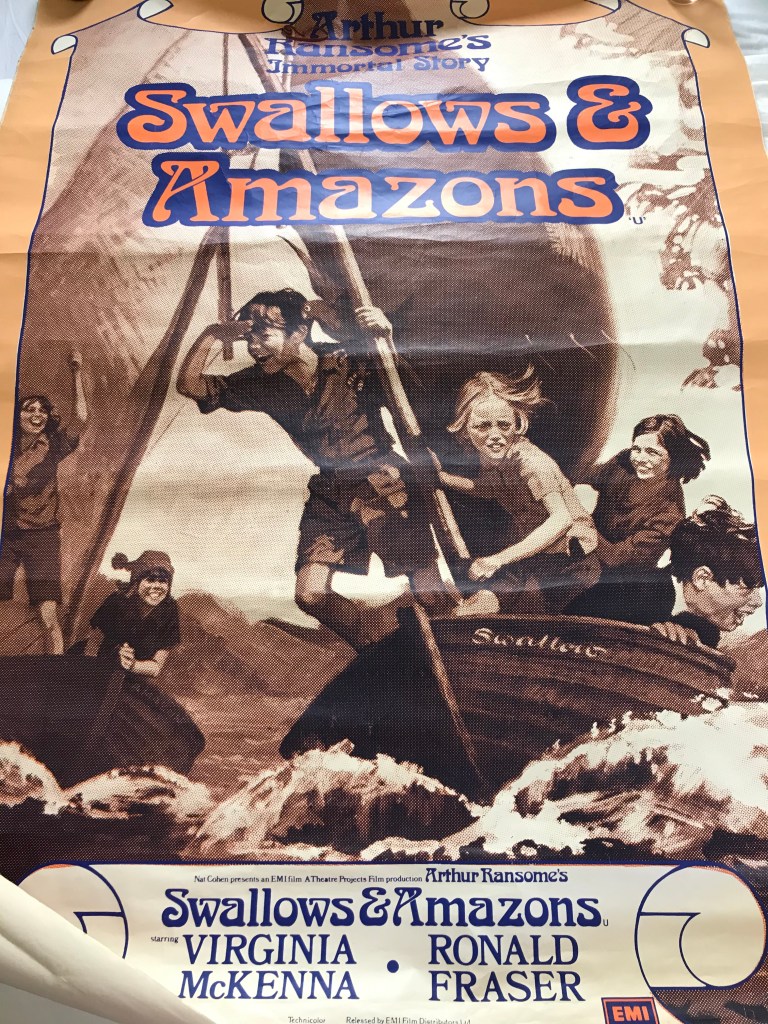
There is already a movie poster at the Windermere Jetty museum. I dug out a large, sepia poster designed for cinemas that has not been seen since 1974 but the BBC were not able to feature these for copyright reasons. Since receiving a valuation, I am getting it framed. You can read more about the artist, Arnaldo Putzu on this website here.

Quotes for the 3rd edition of ‘The Secrets of Filming Swallows and Amazons (1974)’

Movies are made for watching. In the end, they belong to those who love them and it is wonderful to hear of the impact they have had on people’s lives.

The screenwriter Caleb Ranson wrote: “You’ve no idea how thrilling this is for me to hear from you. Swallows & Amazons was a life changing cinema visit for me, set me off on my path writing/producing TV/films. I played the soundtrack album every night for years. And I love your book BTW, bought it when it first came out.”

Paddy Heron of Children in Read describes the movie Swallows and Amazons(1974) as “a national treasure of a film.”

Nigel Seymour wrote to say, “that the original film has an ambience which cannot be calculated.  It sits in time, yet it is as fresh as if it was made yesterday!” An international musician today, Nigel believes, “It possesses a simplicity of life we’ve lost, so watching it is a refreshing reminder of great days… a journey into another dimension and another world steeped with love and belonging, adventure and moral understanding, which is shared between a family and accepted. The characters are brought to life almost as if they are an infinite, integral part of the immortality of the story, each giving that picturesque understanding the viewer finds impossible to explain. After watching this film one arrives back in real time with a resounding bang! We wonder why such a simple story can create such an iconic understanding. Why watching this film can make you feel happy, totally complete and yearning to return again and savour that wonderful, eternal landscape we have all learned to grow  and love as the Lakes.”

Tracy Kenny from Ketts Books wrote: “Swallows and Amazons is a firm family favourite in our house and for a while there, your movie was the only film my eldest would watch!”

The author Catherine Randall said: “I lived and breathed Swallow & Amazons including your film. Knew nearly all the words!”

The fan letters continue to arrive. Each one treasured.

Nigel Young writes: “‘Swallows and Amazons’ is one of those films which sets itself  in that timeless space no one can quite fathom or understand, almost verging on ‘Immortality’.  I’m sure no one at the time working on it ever thought the film would achieve the cult status it seems to enjoy today. You are possibly smiling when you read this, but it’s a true reflection of a film, which is more than a film and touches on those beautiful innocent moments and times which have been lost forever.”

Charles H Ball wrote: “‘Swallows and Amazons’ was instrumental in helping me through a very stressful period of my life… I will be obtaining ‘The making of Swallows and Amazons’ and no doubt many more of your other publications in due course. “

C.H.B. left a review of ‘The Secrets of Filming Swallows and Amazons’ writing: ‘the feelings of anybody who would have loved to have had the opportunity of actually taking part in the film are summed up by Nancy Blackett when the D’s are explaining how they managed to get to the North Pole a day earlier than planned. ‘And you two came by yourselves and got here through that blizzard?’ said Nancy. ‘However did you find the Pole?’ ‘The blizzard helped really,’ said Dorothea. ‘We were sailing,’ said Dick………..’And we’ve gone and opened the stores,’ said Dorothea. ‘And eaten some of them. You see we lost our food when the sledge turned over and the mast broke…’ ‘Capsized!’ cried Nancy. ‘Mast gone by the board! Oh. you lucky, lucky beasts!’ Some of us will forever envy the lucky children who had the opportunity of a lifetime.

I hope to include all these quotes in the 3rd edition of ‘The Secrets of Filming Swallows and Amazons’, to be brought out for the 50th Anniversary of the films release in April 2024. Do leave a comment below or write in, letting us know what the film meant to you or how it effected your life.

Sophie Neville being interviewed on ‘The Making of Swallows and Amazons’

Lakeland Arts, based at the Windermere Jetty Museum, ask how the original film of ‘Swallows and Amazons’ was made on location in the Lake District in 1973 –

You can find out more in the illustrated paperback, suitable for all age of readers, entitled ‘The Making of Swallows and Amazons’, which makes a good Christmas present when combined with the 40th Anniversary DVD with DVD extras.

90th Anniversary of the publication of ‘Swallows and Amazons’ was celebrated at Windermere Jetty museum

Lakeland Arts celebrated the 90th anniversary of the publication of ‘Swallows and Amazons’ with an online event accessible for anyone in the world.

After a career as a foreign correspondent, which took him to Russia, Egypt and China, Arthur Ransome wrote ‘Swallows and Amazons’ in the hills above Windermere in 1929.

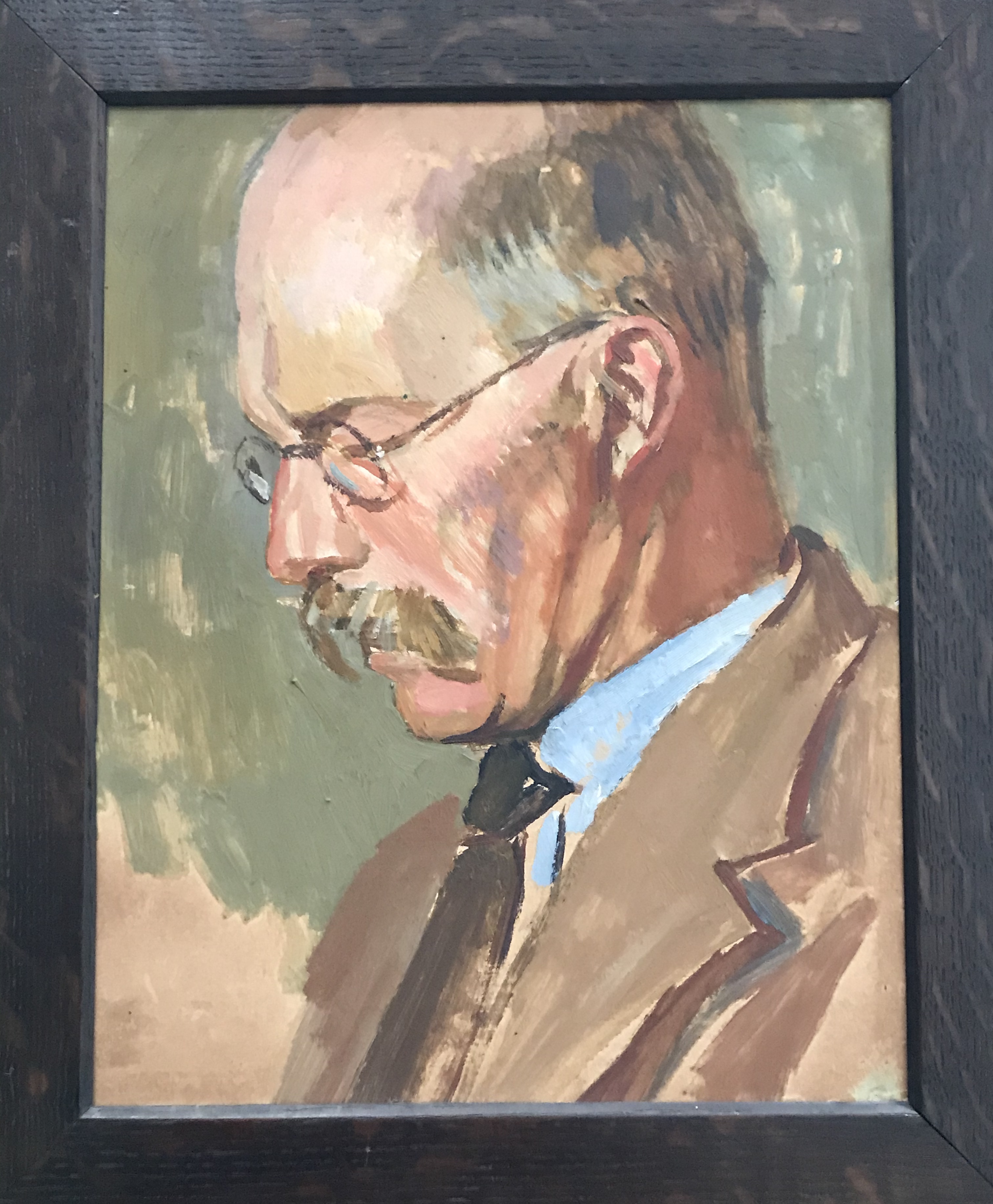
Arthur Ransome portrayed by Dora Collingwood, wife of Dr Ernest Altounyan, on display at the museum

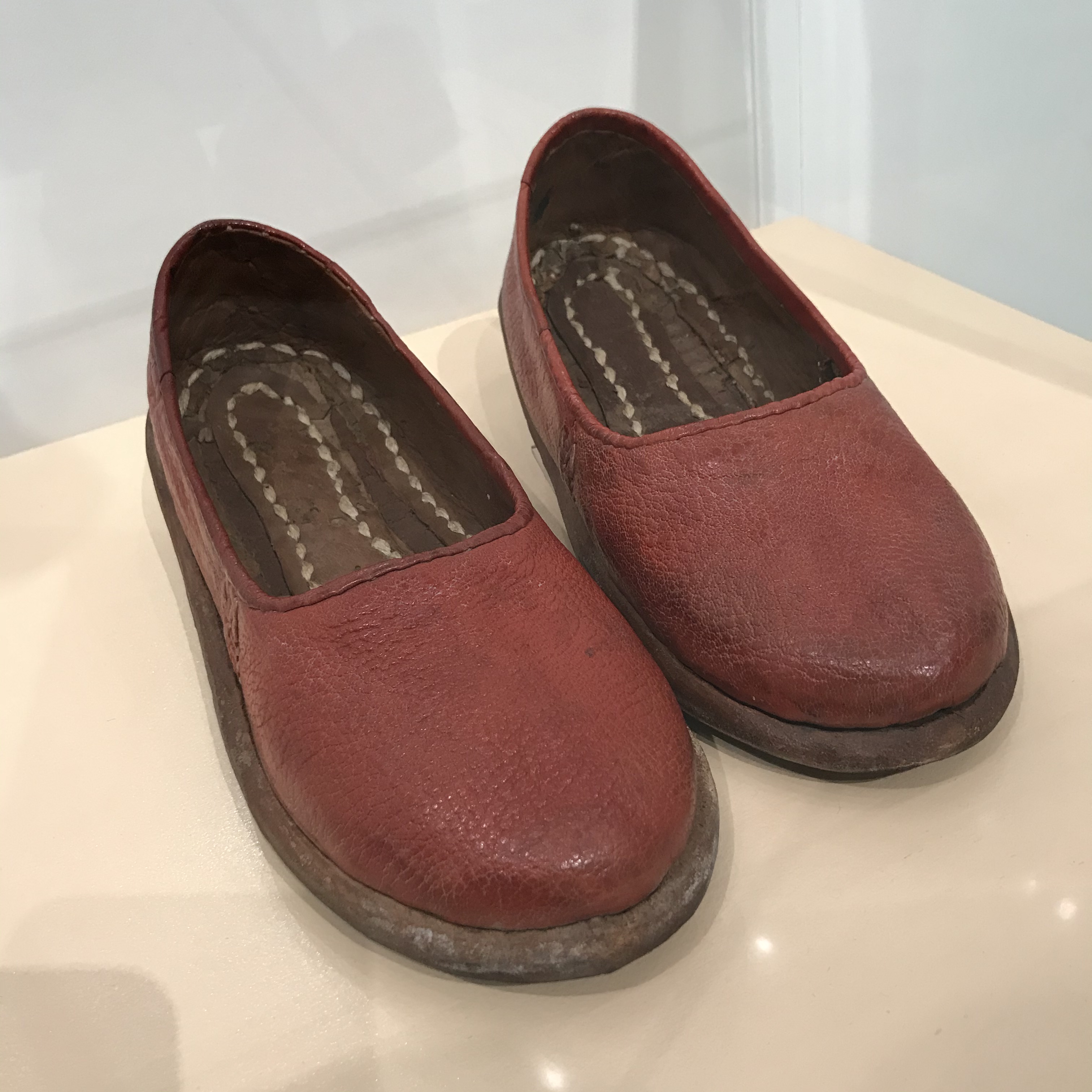
He was inspired partly by his own childhood holidays in the Lake District and partly by the Altounyan children who brought him a pair of red slippers for his birthday to thank him for enabling them to learn to sail on Coniston Water where their grandparents lived.

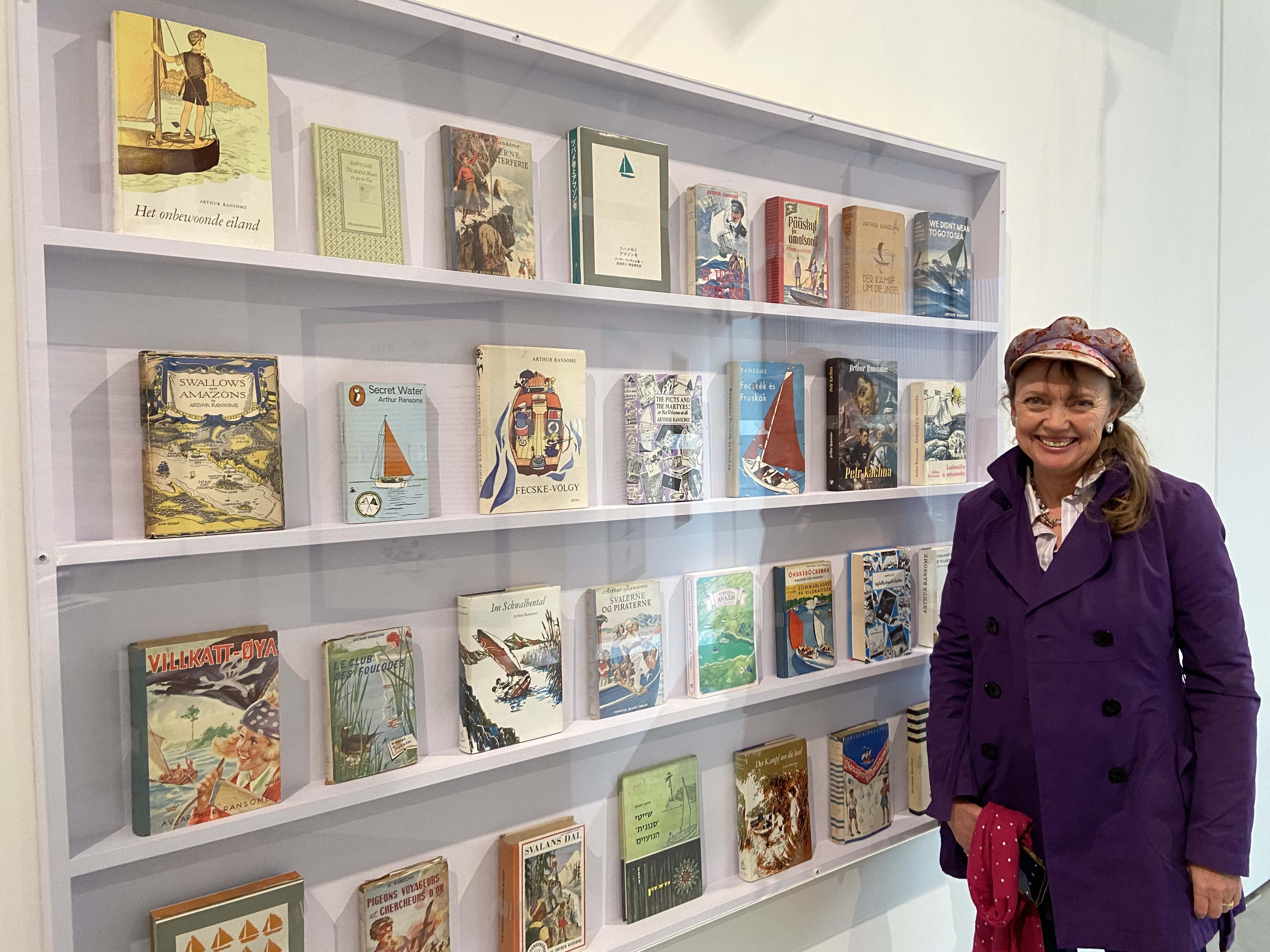
The first edition came out on 21st July 1930, with no illustrations apart from Spurrier’s map on the end papers. The illustrated hardback published by Jonathan Cape came out on 1st December 1930, in time for Christmas. It was followed by another eleven (and one unfinished) book in a series that was to be translated and published all over the world.

Sophie Neville with a collection of Arthur Ransome books on display

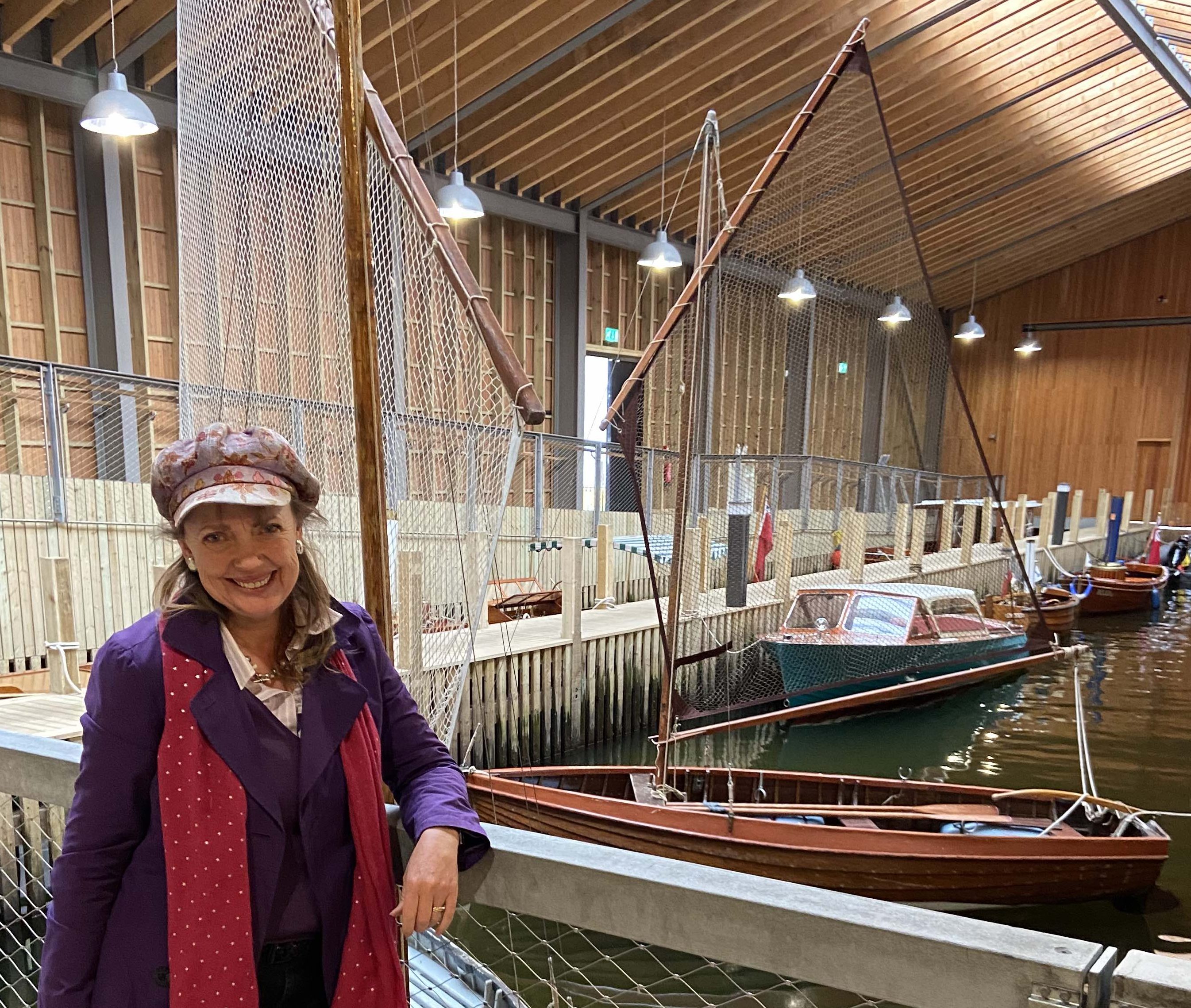
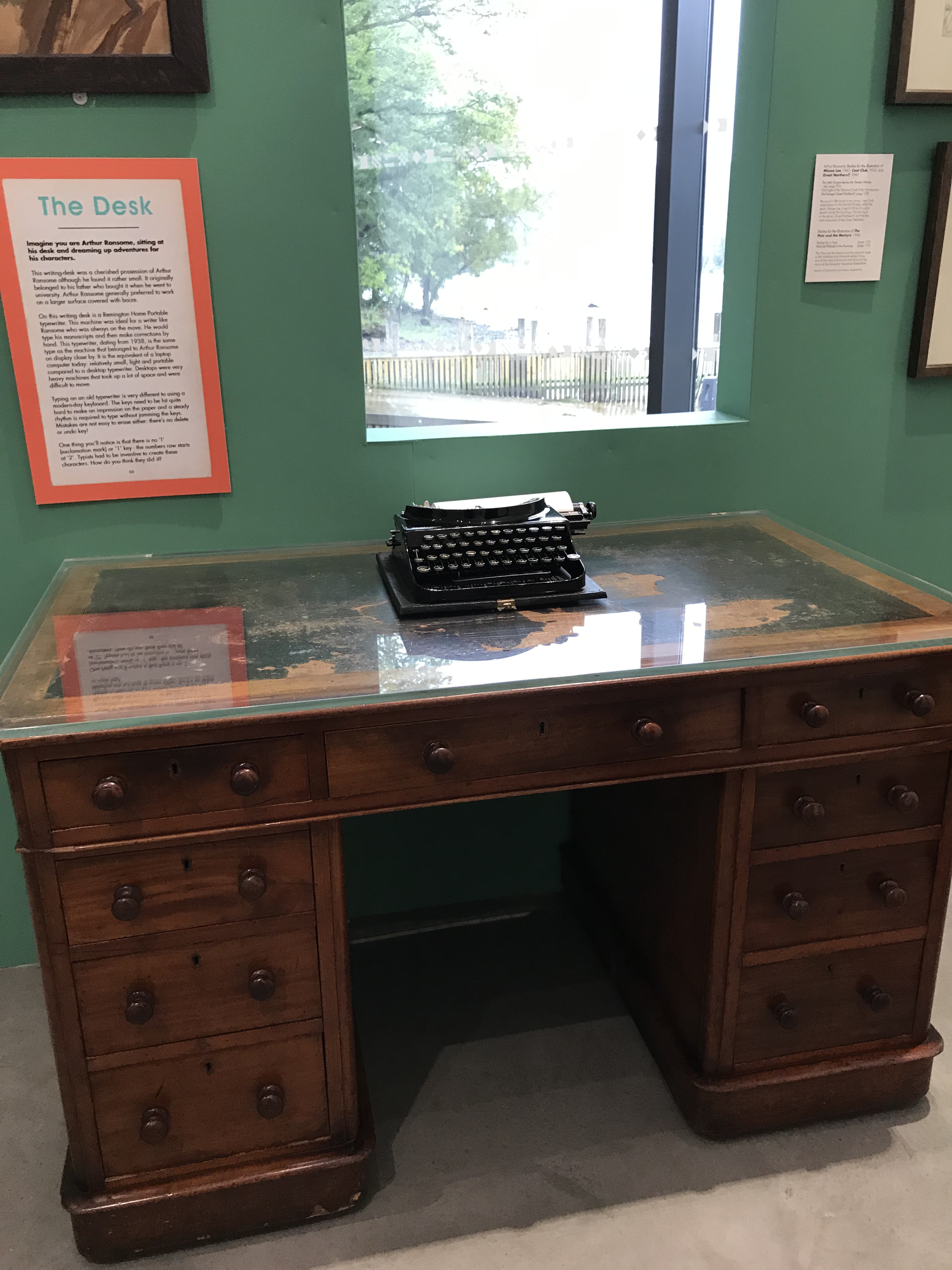
I paid homage to copies at the Windermere Jetty museum where you can find Arthur Ransome’s desk and typewriter on display with a view looking out over the lake.

Arthur Ransome’s desk and typewriter set under a view of Windermere

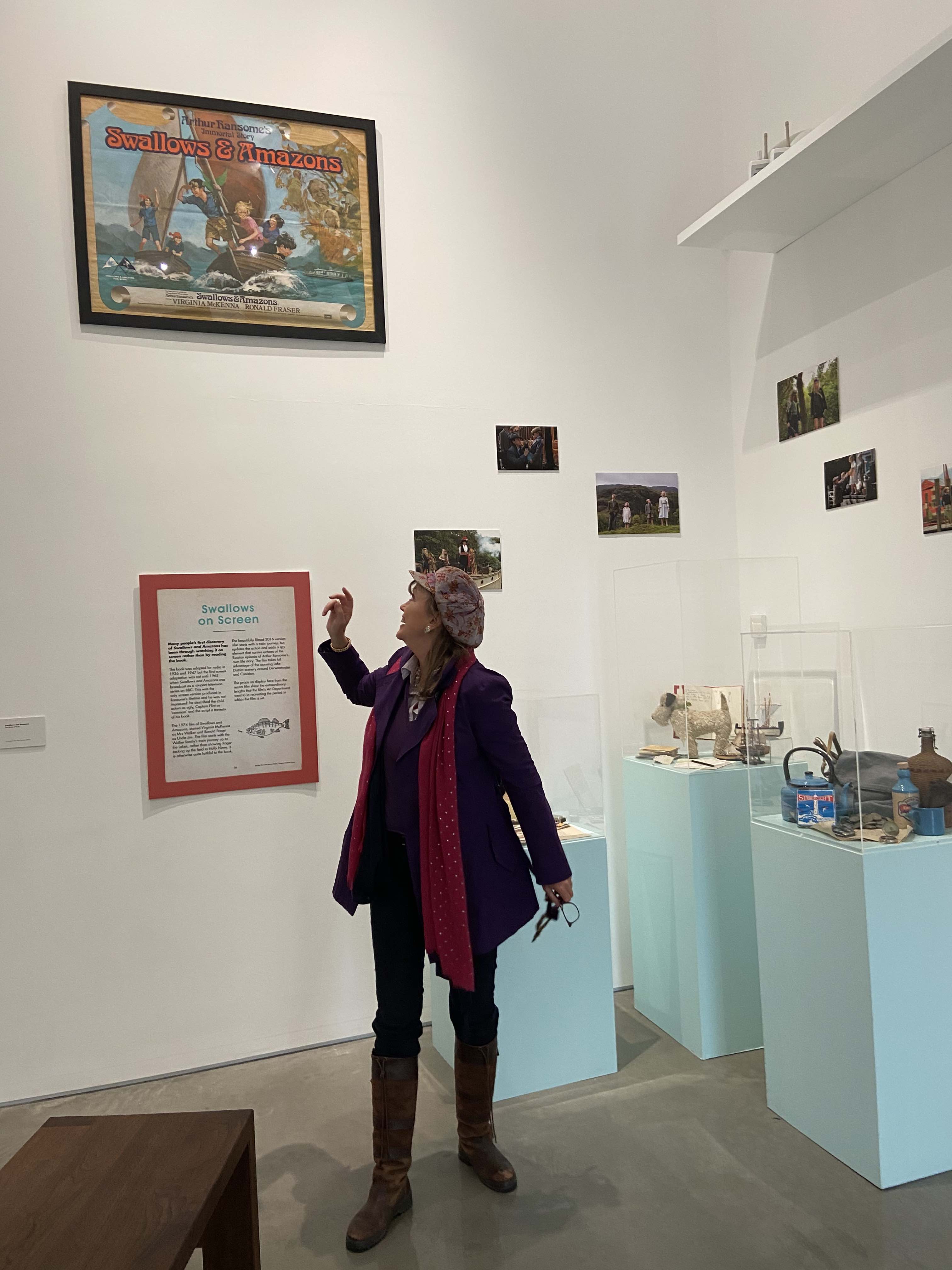
Boats, props and film stills from the 2016 film of ‘Swallows and Amazons’ are on display, along with a poster of the 1974 movie, depicting Titty in a pink blouse.

Sophie Neville spotting the ‘Swallows and Amazons'(1974) movie poster at Windermere Jetty museum

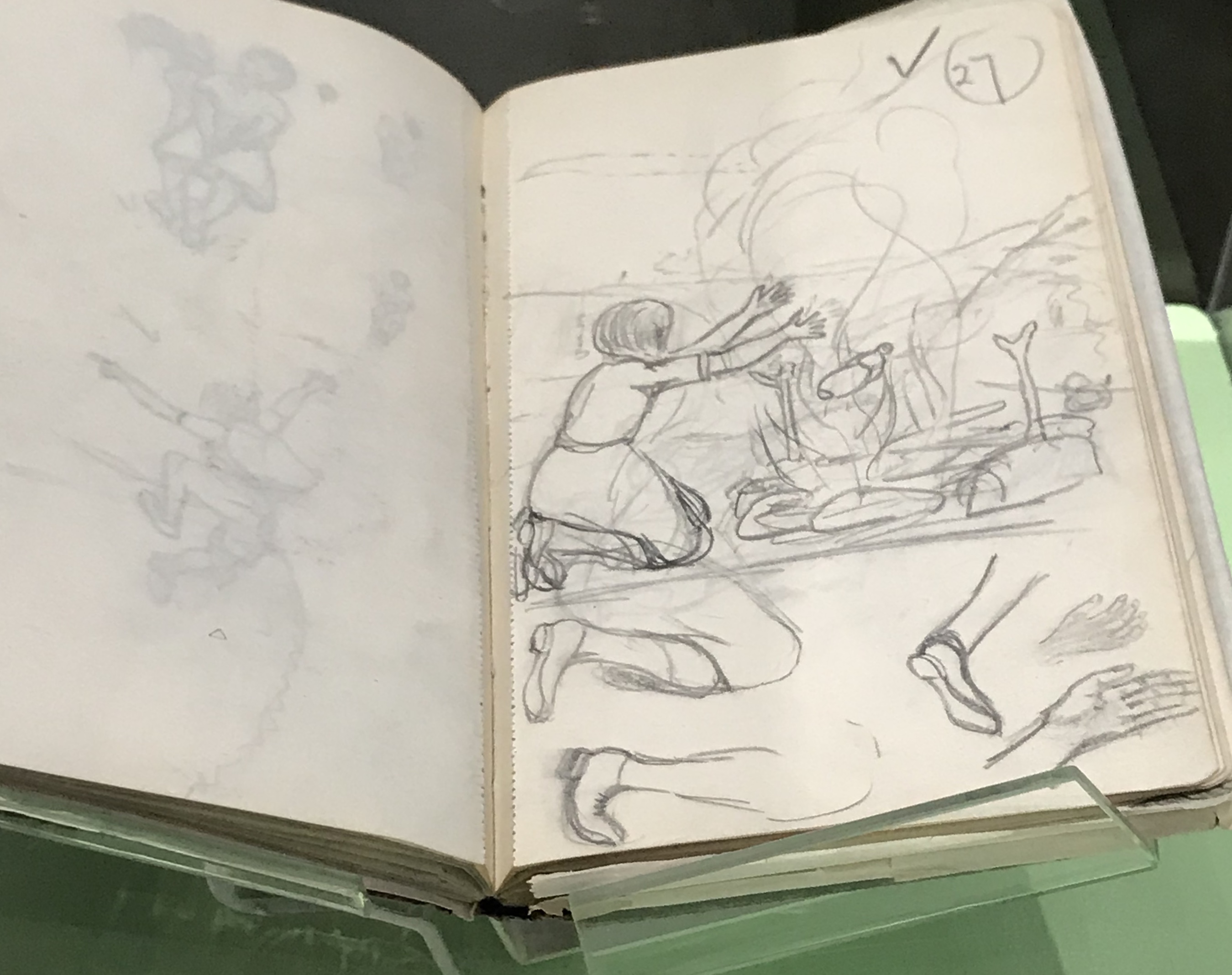
I was fascinated to find sketches of Titty in Arthur Ransome’s notebook.

Arthur Ransome’s original sketches of Titty

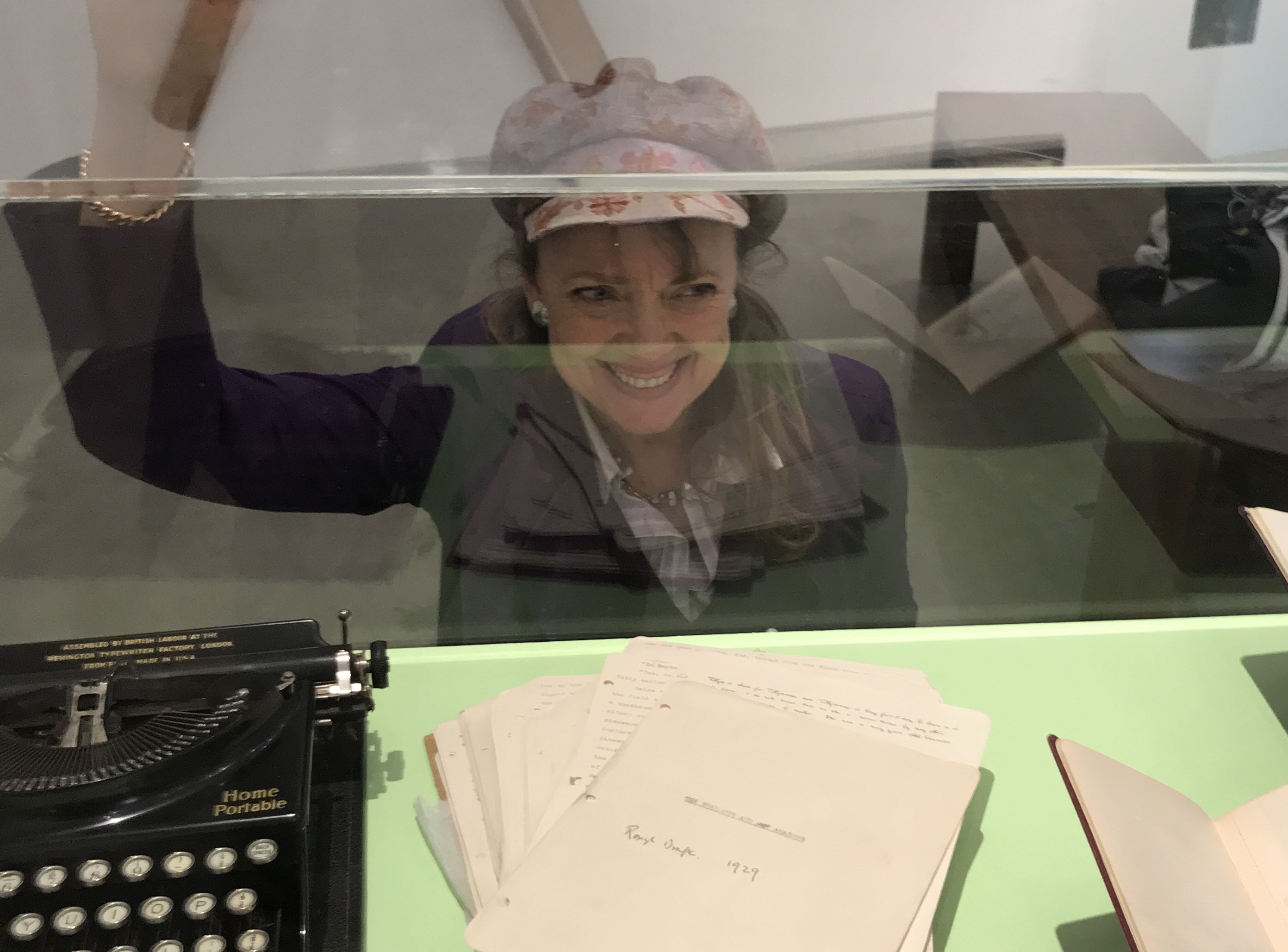
A number of Ransome’s original illustrations were on display and I came across the first draft of ‘Swallows and Amazons’ in a glass case.


Sophie Neville with Arthur Ransome’s typewriter and the original draft of ‘Swallows and Amazons’

You can read about the making of ‘Swallows and Amazons’ (1974) in this illustrated book by Sophie Neville available online: