‘Why is it called Swallows and Amazons?’ and ‘Is Swallows and Amazons a true story?’ happen to be some of the frequent questions typed into the Google search engine. Some of the answers can be found in the radio play ‘Voyage of the Swallow’ starring Richard Briers as Arthur Ransome and Susannah York as his Russian wife, Evgenia.
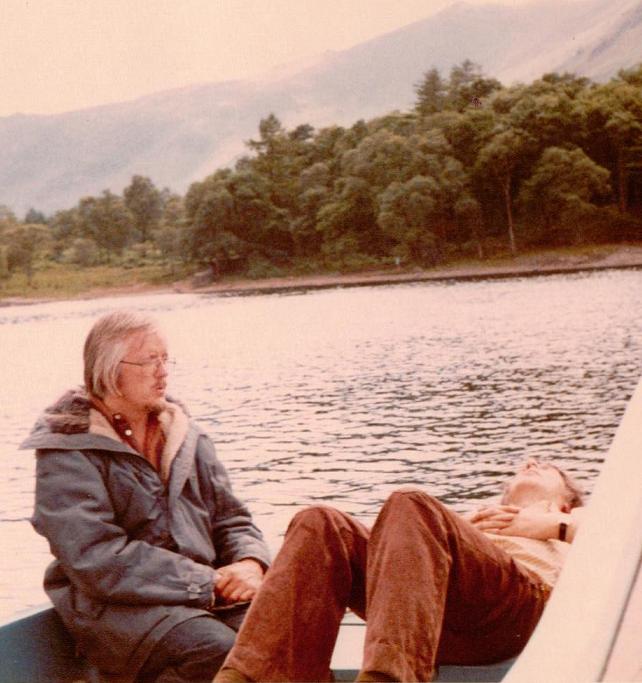
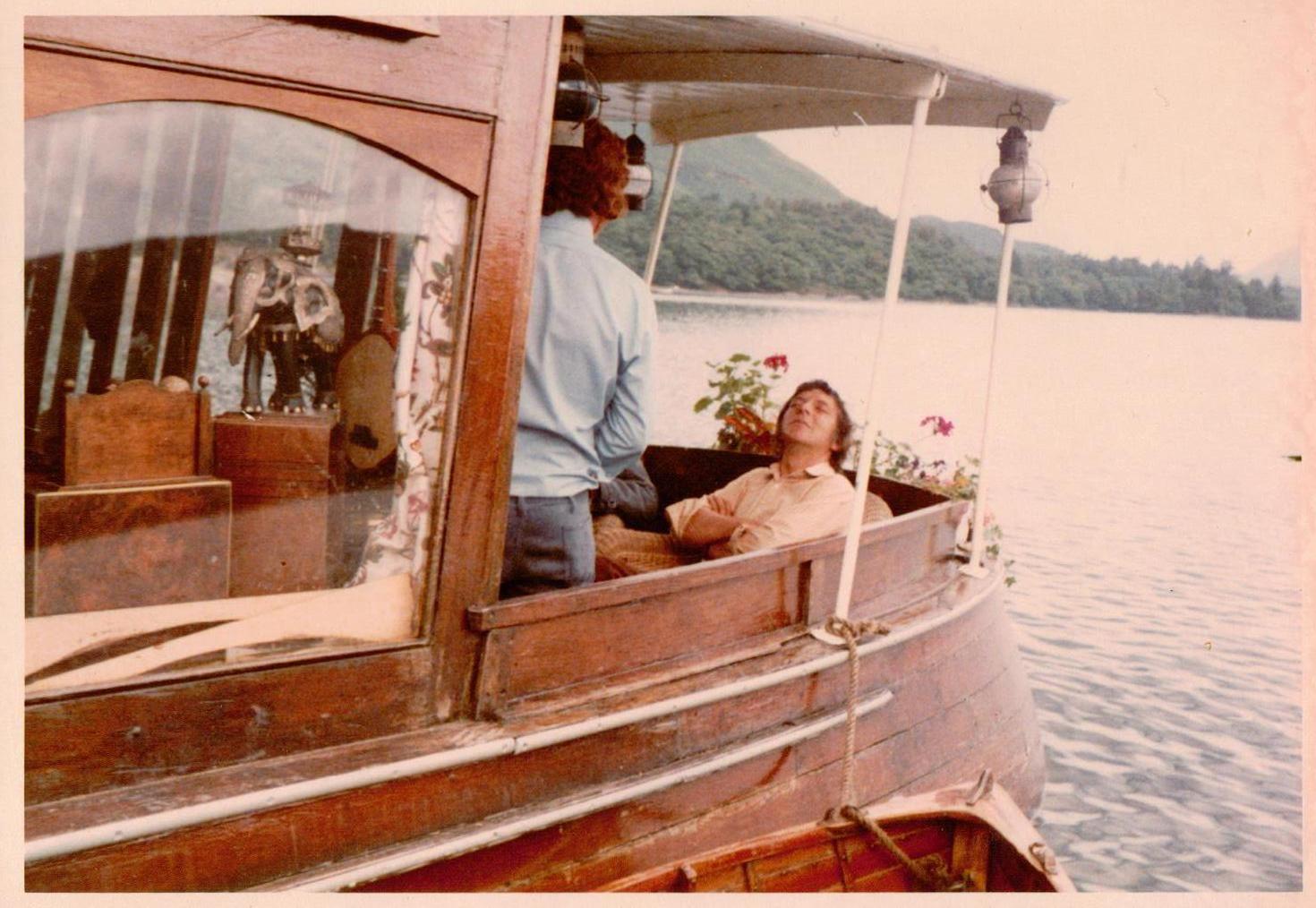
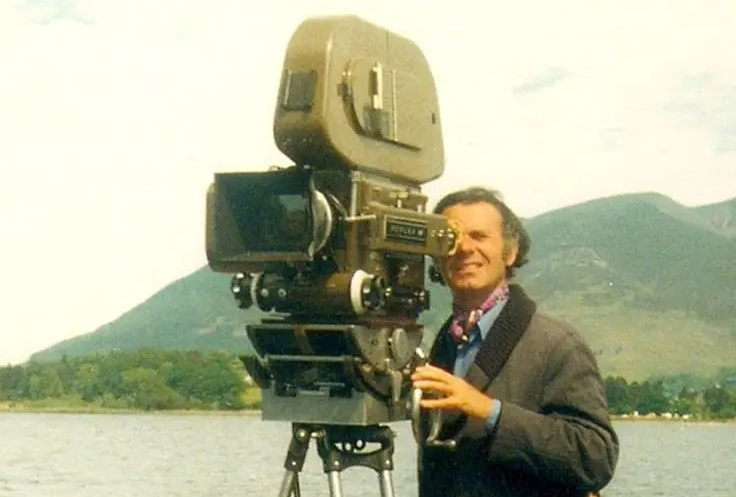
Martin Neville looking remarkable like Richard Briers aboard MV Tern on Windermere
‘What kind of boat is in Swallows and Amazons?’ is another question, and ‘Was Tom Cruise filming in the Lake District?
‘The boat now known as Swallow I was owned by the Collingwood Family when they lived at Lane Head above Coniston Water in the early twentieth century . Dora and Barbara Collingwood taught Arthur Ransome to sail in her when he came to stay with them in the summer holidays. Swallow II was purchased by Dora’s husband Ernest Altouyan along with a similar dinghy they called Mavis. Both boats were brought up on a lorry from Barrow-in-Furness. The interesting question is how the Mavis became known as Amazon in the books. Did Ransome give her a new name because Evgenia, described as a ‘tall, jolly girl’ nearly six foot tall, had struck him as being Amazonian in nature?
Please leave any questions you might have in the Comments below.
Richard Pilbrow produced the original movie ‘Swallows and Amazons’ (1974) in which I appeared in a as a girl. I’m told that it has been broadcast on television more times than any other British movie and has been an inspiration to many.
Arnaldo Putzu’s poster for the EMI film Swallows and Amazons (1974)
Back in the early 1970s, Richard was busy producing iconic West End musicals such as ‘A Funny Thing Happened On The Way to The Forum’ when he was inspired to make a film adaptation of Arthur Ransome’s novel while taking a break in the Lake District.
Richard Pilbrow on location with his colleague Neville Thompson ~ photo:Daphne Neville
He said the most difficult task he ever took on was persuading Mrs Ransome to grant him the rights. Arthur Ransome had famously disliked a BBC adaptation and passionately did not want a ‘Disneyfication’ of the book based on his own childhood memories.
Richard said that raising the film finance was relatively easy. Nat Cohen of EMI Films happened to be looking for a classic story akin to ‘The Railway Children’, which had been a box office success. He’d never heard of ‘Swallows and Amazons’ but an assistant in his office was wildly enthusiastic and Richard secured a budget of £250,000 to make a ninety minute movie entirely on location in the Lake District.
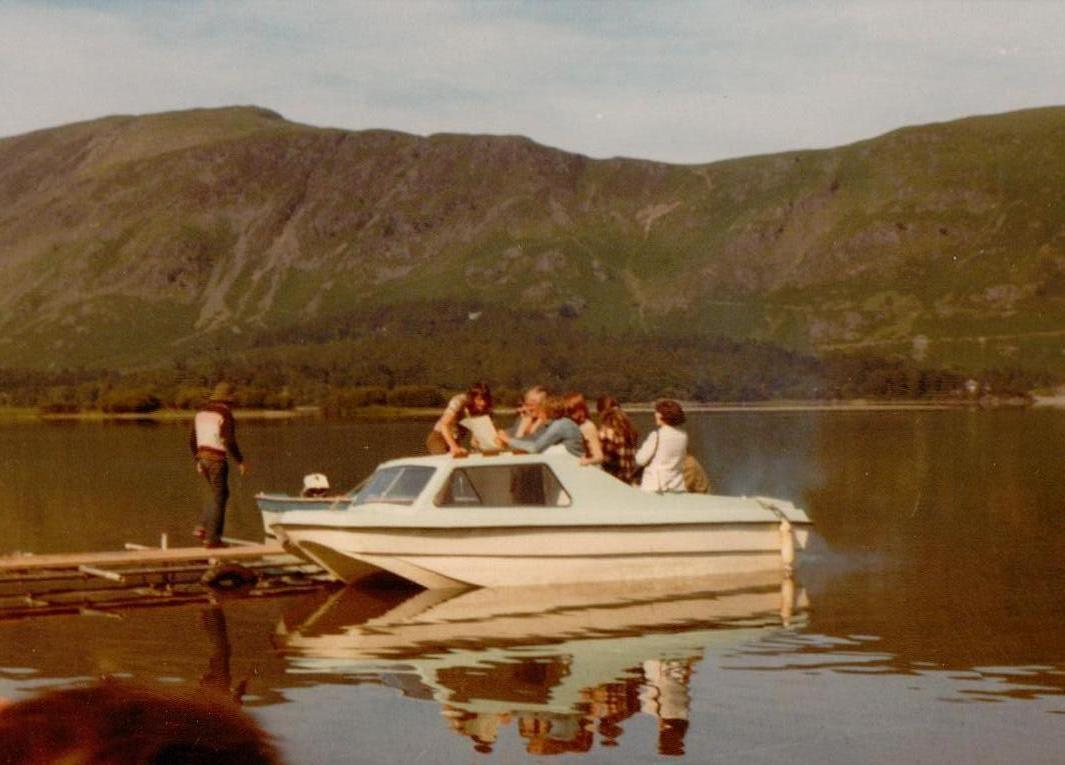
Producer Richard Pilbrow and Director Claude Whatham discussing the script in the Capri on Derwentwater. Molly Pilbrow is in the boat with them ~ photo: Daphne Neville
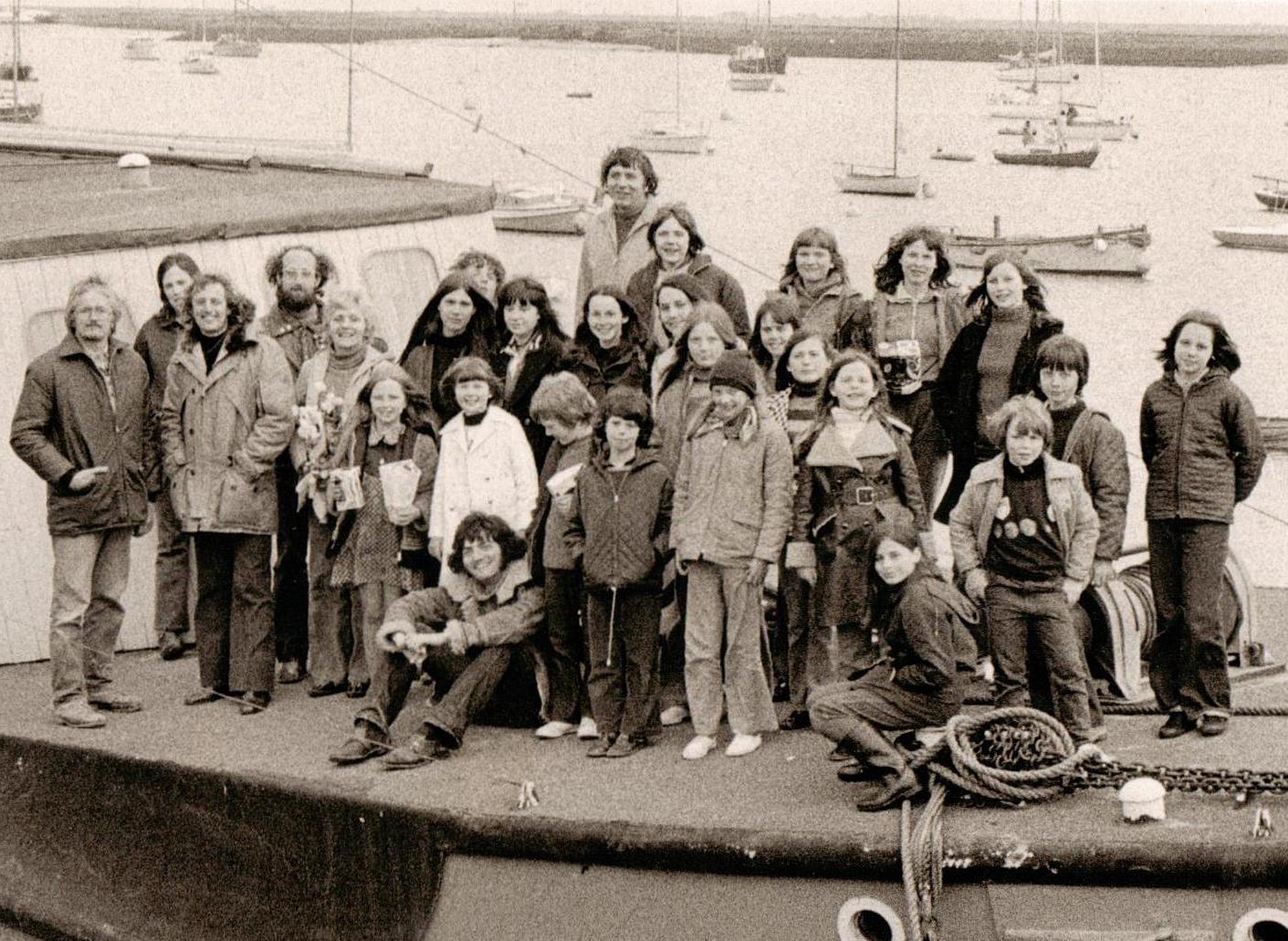
Richard loved being out on the water and took Mrs Ransome to find authentic locations. Being determined that the six children playing the Swallows and the Amazons should be able to sail well, he advertised in yacht clubs and interviewed about 1200 candidates. I met the director at the Theatre Project offices in Shaftesbury Avenue. Those short-listed were taken on a sailing weekend in Burnham-on-Crouch to see how they coped afloat.
Richard Pilbrow, Claude Watham, Fred Pilbrow, Sophie Neville, Suzanna Hamilton
Mrs Ransome kept a close eye on the script, insisting that the part of Titty was played by ‘an English rose’, which must be why I was cast as the heroine.
Sophie Neville as Titty Walker in the ITV trailer for the movie of ‘Swallows and Amazons’ when it was first shown on television in 1977
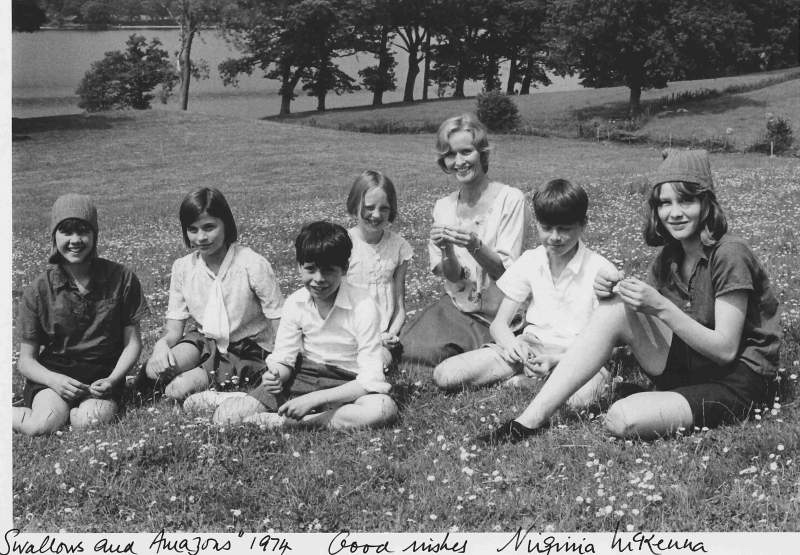
My mother came up to look after us six children who played the Swallows and Amazons. We landed on Wild Cat Island and began playing out the characters that sprung from the pages of the book.
Daphne Neville and Richard Pilbrow on Peel Island on Coniston Water in 1973
Claude Whatham was actually the second director appointed to work on the film. He had only made one other feature – ‘That’ll Be The Day’, starring David Essex and Ringo Starr, but he was an outdoorsy person and got on well with Richard who gave him a free rein. They embraced the 1929 period and the idea of somehow capturing childhood innocence.
Producer Richard Pilbrow with Director Claude Whatham in their wet weather gear at The Secret Harbour on Peel Island, Coniston Water
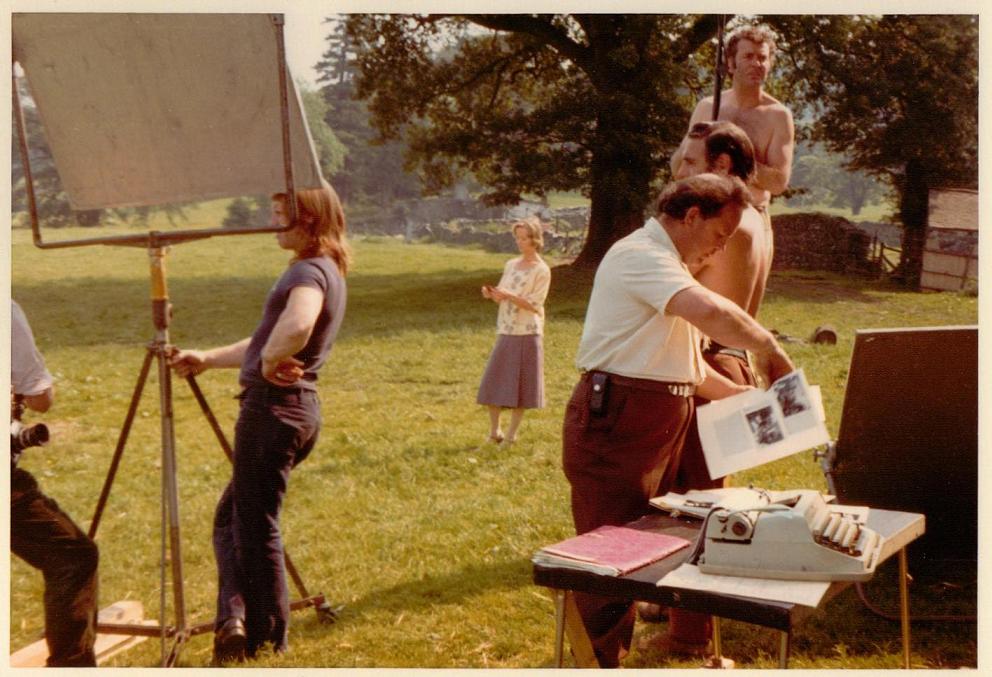
Unpredictable Lakeland weather and working out on the water could make scheduling and logistics a nightmare but Richard had the support of an excellent production team working under Neville Thompson who also organised the post-production work at Elstree Studios where the film was post-synced.
Producer Richard Pilbrow and Production Associate Neville C Thompson on Derwentwater
Neville was passionate about film making, becoming known as ‘the last gentleman producer.’ Although gregarious at times, he was a quiet man who had begun working as a location manager for Mike Newell and became a production manager for Ken Russell.
Neville C Thompson, the Associate Producer relaxing on set – to be fare this shot may well have been taken on Sunday 24th July 1973, by Daphne Neville
Neville was diagnosed with Lukemia at the age of 47 but lived another twenty years, ending his days in Woodbridge in Suffolk. you can find his impressive list of production credits here
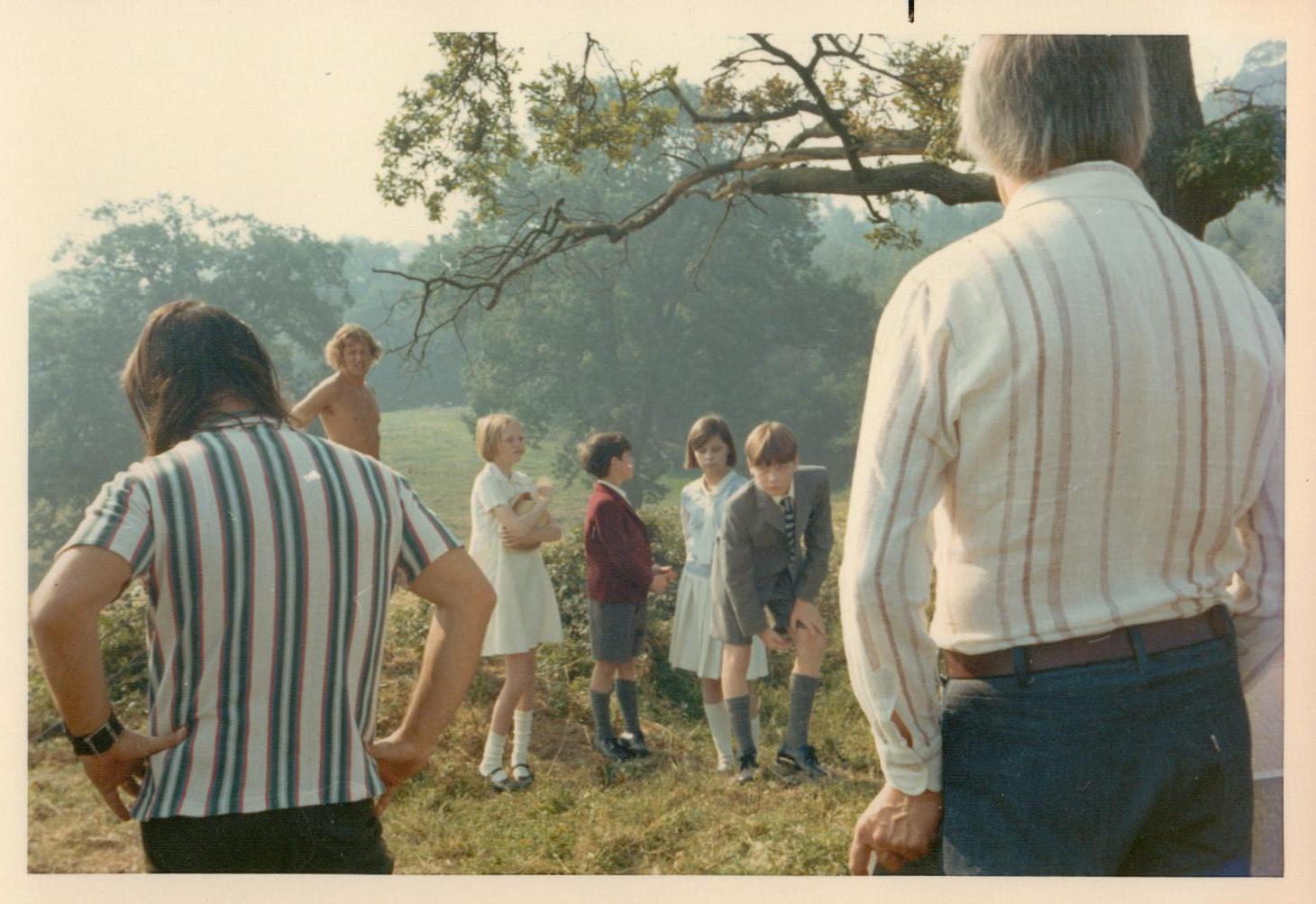
Director Claude Whatham with Sophie Neville, Stephen Grendon, Suzanna Hamilton and Simon West. Producer Richard Pilbow looks on ~ photo: Daphne Neville
The Pilbrows spent their family holidays on the Isle of Coll, so it was not surprising that Richard wanted to make ‘Great Northern?’ as a sequel even though Mrs Ransome wasn’t keen.
Henry Dimbleby and Rosemary Leach in ‘Coot Club’ and ‘The Big Six’
Sadly it was too difficult in the mid-1970s to raise money for filming and Richard never produced another movie. He sold the rights to adapt ‘Coot Club’ and ‘The Big Six’ to the BBC, and I saw him in Norwich in 1983 when I was setting up the drama series with Joe Waters.
When Richard heard that I was giving talks on ‘The Making of Swallows and Amazons (1974)’ he kindly sent me Swallow’s original burgee and Captain Flint’s white elephant flag, along with a Jolly Roger – all handmade props used in the original film.
We last met up in Covent Garden when he came to London to receive an honour from the Central School of Dramatic Art where he had originally studied Stage Management and Technical Theatre Studies.
Sophie Neville with Suzanna Hamilton
He later wrote to thank me for collecting information on how the film of ‘Swallows and Amazons’ was and writing about the impact it had. He loved hearing about our Q&As at cinemas and admired StudioCanal’s remastered DVD. ‘They really did a beautiful job—a very subtle enhancement.’
Simon West, Sophie Neville, Suzanna Hamilton and Sten Grendon in Secret Harbour
I sent Richard and his family on safari to the Waterberg in South Africa, where he ended up riding a horse past grazing rhinos. He is survived by his three children, grandchildren and his wife Molly who worked as his assistant on ‘Swallows and Amazons’.
Sophie Neville in Swallow
Richard’s obituary in the Telegraph can be found here
The momentous story of his life and work is recorded in his memoir ‘A Theatre Project’ available online here.
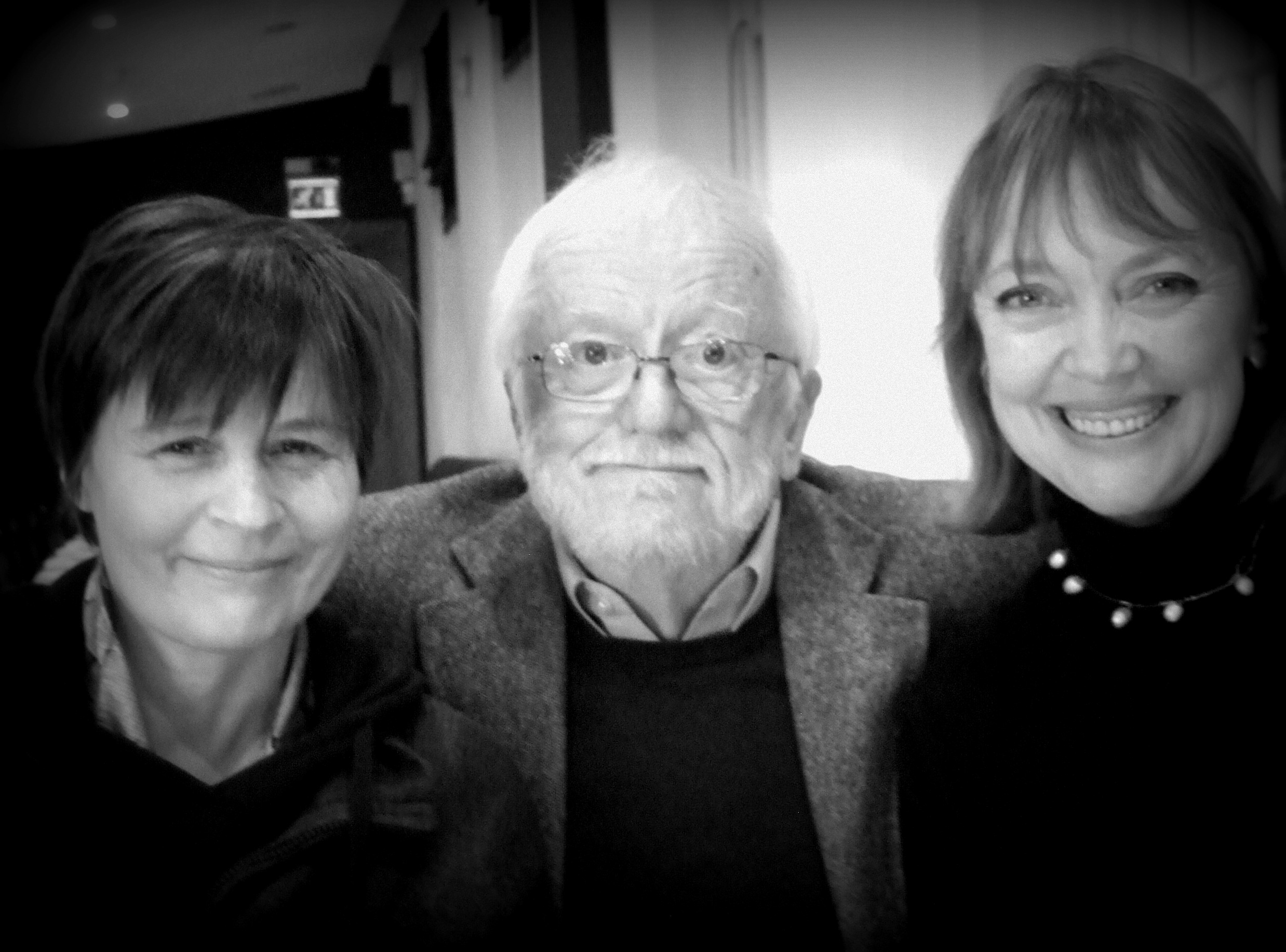
Suzanna Hamilton, Richard Pilbrow and Sophie Neville
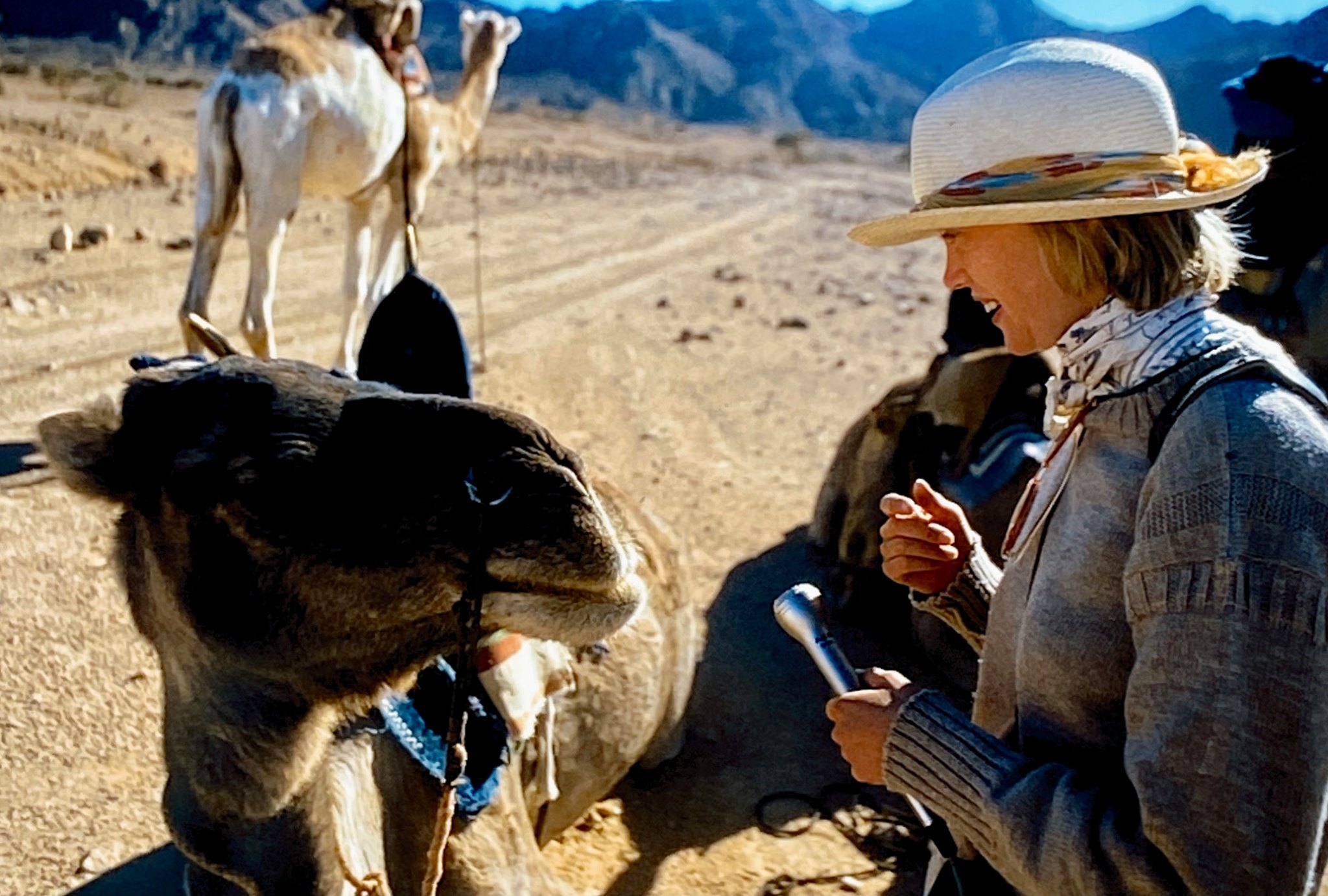
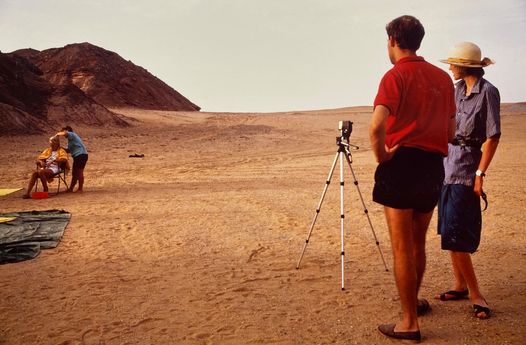
People often ask how making the original film of ‘Swallows and Amazons’ influenced my life. What struck me when I last saw the 1974 film trailer on Amazon Prime was that it begins with Titty saying, ‘The endless trek, through the Sahara Desert…’ In 1985, I did just that, crossing the Sahara on an expedition led by Charlie Mayhew, now CEO of the charity TUSK. I made my first documentary on the aid projects we worked on when we eventually reached Kenya. Had uttering those lines when I was little influenced my decision to drive from London to Johannesburg?
Sophie Neville on an endless trek, crossing the Sahara Desert – photo James Lindsay
People who know Arthur Ransome’s books are able to point out where the original film of Swallows and Amazons made mistakes. Janet Mearns noted that the Swallows ‘certainly didn’t take enamel mugs’ camping, ‘because they took extra in case of breakages.’ I had never noticed!
Andrew Clayton pointed out that, ‘Someone (Hugh Brogan?) Said that John was the lad he wanted to be. Titty, while based on an original person, carries some of his dreams and literary interests.’
Making a film while crossing the Sahara Desert in 1985
Peter Wright, former chairman of The Arthur Ransome Society, noticed that I sang ‘Adieu and Farewell’ instead of ‘Farewell and Adieu to you fair Spanish Ladies’ as the Swallows sailed from the jetty below Holly Howe. I now realize this mistake may have been due to the influence of ‘The Sound of Music’, which was the first movie I ever saw in the cinema. Captivated by the big screen at the age of four, I must have had the lyrics – ‘So long, farewell, auf Wiedersehen, adieu, Adieu, adieu, to yieu and yieu and yieu,’ imprinted on my brain.
I didn’t sing very well, but one of the secrets to the integrity of the film was that there was no vanity. None of us sought to further ourselves. Self promotion was an unknown concept. We had no personal agenda. We were not there for the money or any reason other than to live out the life portrayed in the books. All of us spurned the publicity and still find it surreal.
Someone also said how much they would have loved to live through a scene from ‘Swallows and Amazons’. We were fortunate enough to live through an abridged version of the book, which is what my parents hoped. It must have been one reason why my headmistress let me take a term off school to appear in the film.
Sophie Neville writing letters from Africa with the author Rebecca Hunter
Since then I went on to lead a ‘Swallows and Amazons’ style life, exploring unchartered territory, which isn’t always easy, I was touched when a fan of the books wrote:
‘Arthur Ransome has helped me through some very difficult times – when you are at your wits end to know what to do or where to turn, it is so refreshing to return to the Lake, or Norfolk, to a peace and tranquillity where you can forget your problems and just enjoy the adventures of the Swallows, Amazons, D’s, Coots, wherever you happen to be.’
Sophie Neville in a vehicle that we submerged in Moremi. The shoes were later stolen in Mosambique, the Toyota in Johannesburg ~ photo: Rebecca Hunter
Nigel H Seymour wrote, ‘…every-time I put the ‘Swallow’s and Amazon’s film on, I’m transported into another dimension and another time. it’s so very refreshingly simple and innocent, it radiates with a romanticism and happiness which has sadly been lost now for ever, but luckily we have the film and we still have ‘You’….. to keep the memory alive!’
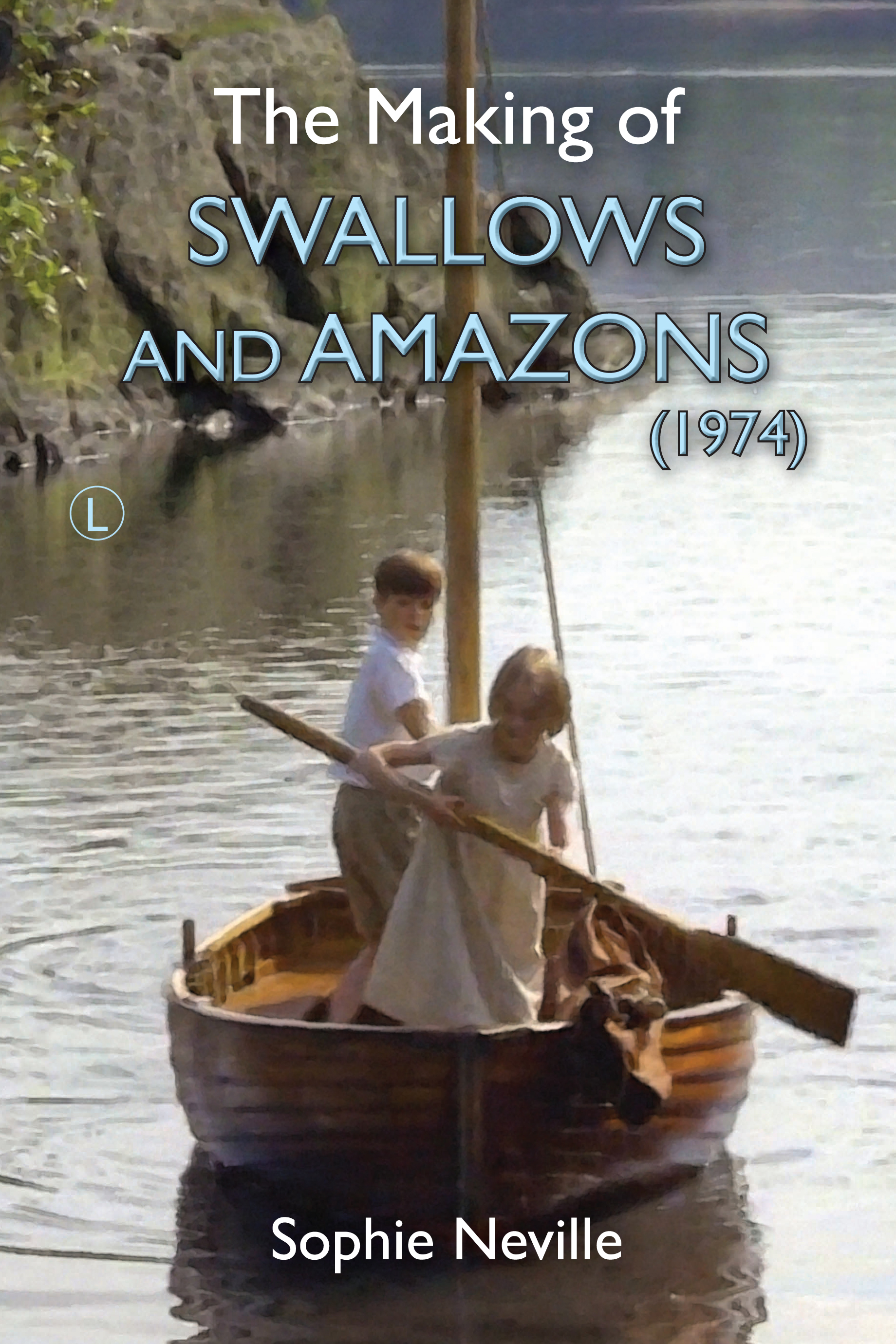
The audiobook of The Making of Swallows and Amazons (1974
David Wood OBE shares an insight into filming one of the most outrageous British films of all time.
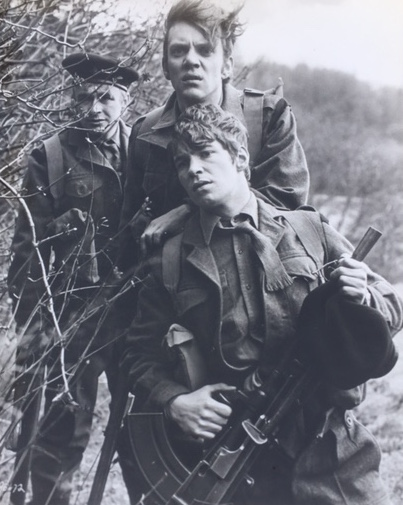
Filming If…. is the first written memoir about the cult classic film with rather a short title directed by the talented Lindsay Anderson in 1968. David Wood co-starred as one of the three public school boys, alongside Malcolm McDowell (Mick) and Richard Warwick (Wallace), who led a revolution against authority. This was regarded by many as a metaphor for the social and political situation in the UK.
If…. celebrates its 50th anniversary this year. The book contains David’s memories of the personalities involved, the day-to-day challenges, and the reception given to the avant garde film, which won the Palme d’Or at Cannes. David Wood reflects the brilliance of Lindsay Anderson and his team. With a foreword by Malcolm McDowell and an afterword by George Perry.
Filming If…. has been highly endorsed and enjoyed by many:
“…What a brilliant thing you have done, recalling what it was like beingdirected by the great Lindsay Anderson, and being part of this hugelyimportant film and its dazzling cast.” – Joanna Lumley OBE
“David Wood has written a wonderfully evocative insider’s view of the shooting of one of the best British films ever made.” – Sir Alan Parker
“If…. is a classic movie – I was at the première in 1968 and we all sensed itthen… I’ve a feeling this book’s going to be something of a classic, too.” – Gyles Brandreth
“What are you waiting for? David Wood’s gentle memoir of the film and itslegacy is required, one-sitting reading.” – Total Film Magazine
David Wood went on to write or adapt a huge number of plays, musicals, television programmes and feature films. The first screenplay he wrote was for ‘Swallows and Amazons’ (1974). He wrote to me with stories of working with the audacious Mrs Ransome, which I posted on this website here.
David’s movie ‘Back Home’ won a gold award at the New York Film and Television Festival in 1991. He went on to receive enormous acclaim in the West End, winning an Olivier Award in 2013 for his stage adaptation of ‘Good Night Mr Tom’, and the JM Barrie lifetime achievement award for his contribution to children’s arts in 2017. You can find his website here.
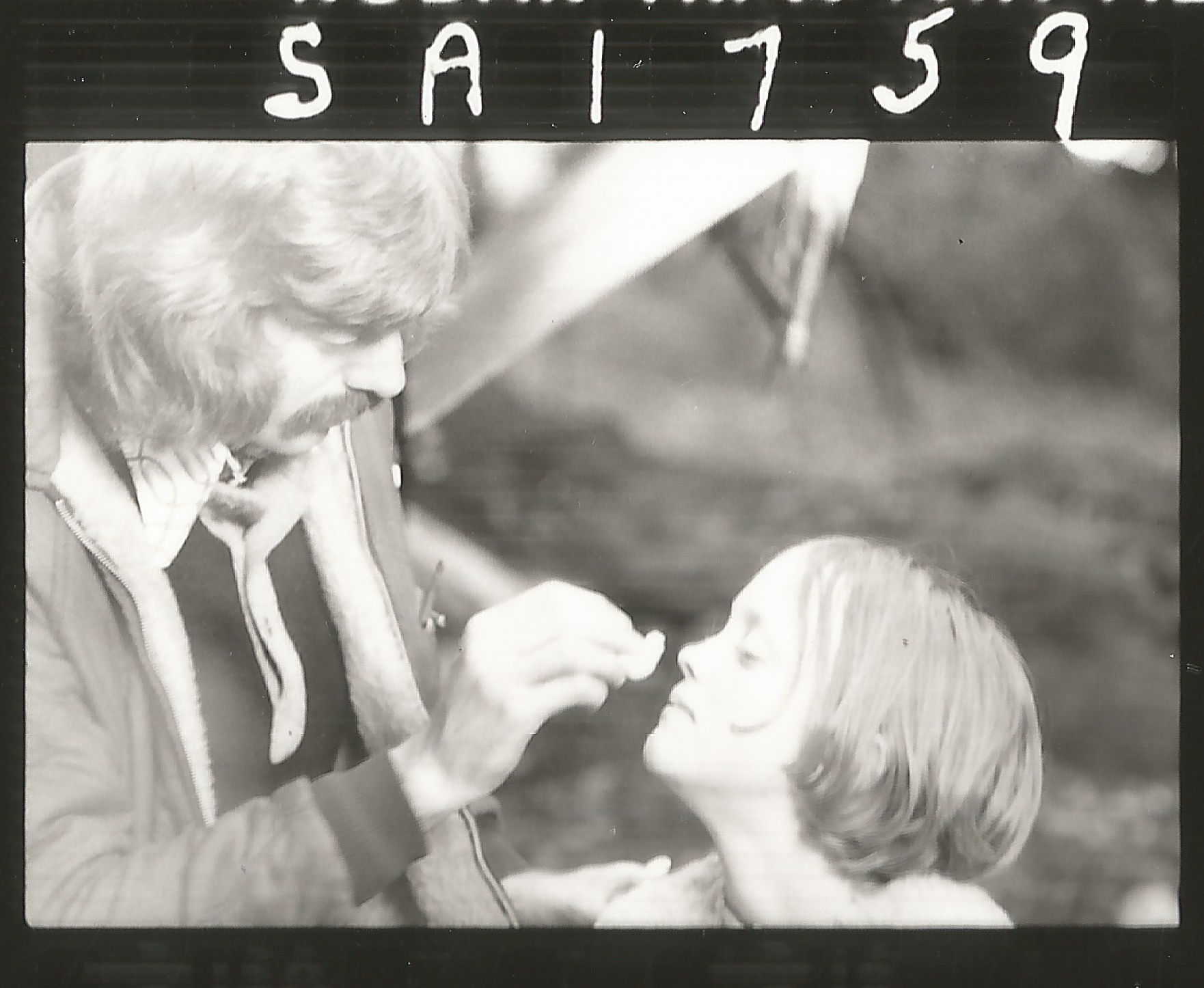
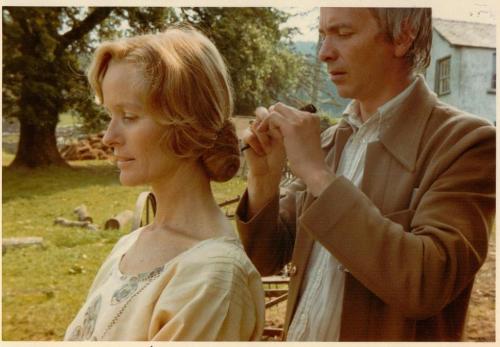
Sophie Neville being made up for the part of Titty by Peter Robb-King in 1973
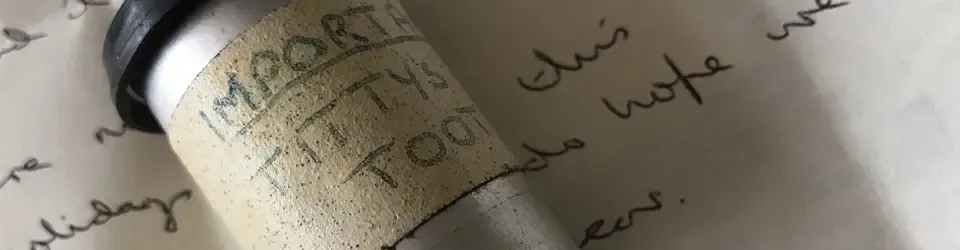
Peter Robb-King, the Make-up Designer on ‘Swallows and Amazons'(1974) rang up to say he had my milk-tooth that had fallen out half-way through a scene with Virginia McKenna. ‘It’s in a metal film canister, which I’d taken to a dentist to try and get a replacement.’
He said that although not his first movie, ‘Swallows and Amazons’ was his first film when he was in charge of Make-Up design. ‘I hoped initially to work at the BBC but was turned down for being a man.’ It just happened that he went on a supernumerary training scheme for feature film make-up in 1968, starting on ‘The Avengers’.
He said the highlight of his career would be impossible to pin point, but he worked on some iconic movies including The Rocky Horror Picture Show, Legend with Tom Cruise and some of the Star Wars, Batman and Indiana Jones pictures. At one time he rescued a parrot while making an Indiana Jones film in Sri Lanka. ‘Three ring-necked parakeet chicks were thrown out of their nest by a crow and rescued by the animal handler. One was adopted by Stephen Spielburg, another by the production manager, while Peter and his wife brought up the third, which lived with them for twenty-five years.
Ronald Fraser as Captain Flint with Daphne Neville and Sophie Neville playing Titty Walker on Derwentwater in 1973
Peter knew Ronnie Fraser’s addiction to alcohol would be difficult for the crew to deal with but managed to get him in and out of the make-up caravan.
‘He wasn’t alone at the time. There were a number of screen actors at the time who you’d think would never be able to say a line but they’d end up word-perfect.’ He didn’t recall any difficult moments with Ronnie. Peter reckoned that one of the reasons why they didn’t make a sequel could have been Ronnie’s problem. ‘He may have damaged his own career. It’s difficult for the other actors.’ He thought it sad that there was never a sequel.
Ronald Fraser, Peter Robb-King (make-up) and Ian Whitaker (set dresser) on the houseboat in 1973
Peter told me that, ‘Denis Lewiston (the director of photography on ‘Swallows and Amazons’) was scared of green. He didn’t like photographing the colour green, which everyone thought hysterical since we were filming in the Lake District.’
Dennis Lewiston, director of Photography on ‘Swallows and Amazons’ ~photo:Richard Pilbrow
Denis Lewiston, the brilliant cinematographer, has died but he was around to approve the remastered version of the BluRay and DVD of ‘Swallows and Amazons’ in 2014. After a long and fulfilling career he will be remembered fondly and admired for the numerous films he made, seeking excellence with every sequence.
To see some of the shots Denis set up for the film of ‘Swallows & Amazons'(1974), please click here for the BFI site. Peter assured me that a recent industry survey of children’s films rated ‘Swallows and Amazons’ (1974) as one of the best ever.
Peter Robb-King was one of the few people to formally retire from the film industry. ‘It’s very rare. Many people don’t retire. They just stop working.’ His daughter sent him a picture of him making me up on the set of Swallows and Amazons. ‘I remember what I looked like then, so it was interesting.’
How old were you when you first read Arthur Ransome’s books? Did you have a favourite storyline or character?
My father devoured the Swallows and Amazons books as they were published in the 1930s. I was a slow reader but must have started the series aged about ten or eleven as I’d read seven of the twelve by the time we arrived in the Lake District to make the film in 1973. I enjoyed the practical aspects of the books and most readily identified with Mate Susan, although I counted all the characters my friends. Ransome published thirty other books. Some are heavy going, but I enjoyed his autobiography.
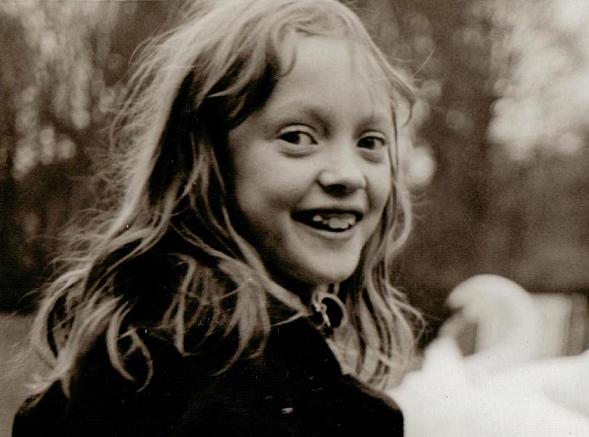
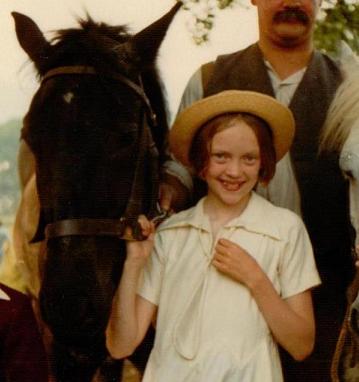
Sophie Neville as a child ~ photo: Martin Neville
Have you re-read the books since your childhood? If so, how has your perception of the books and the characters, in particular Titty, changed?
I’ve re-read most of the books in the Swallows and Amazons series and gain something new each time I read Swallows and Amazons, recently appreciating how important Titty’s imagination was to progressing the story. Her ideas take the plot forward. I ended up writing an article on how Swallows and Amazons can be seen as an allegory to missionary work undertaken by Arthur Ransome’s great aunts, one of whom received a Boxer arrow in her bonnet for her efforts in China.
Simon West and Sophie Neville on Peel Island in 1973
Do you think playing Titty influenced your own personality? If so, how?
Titty helped me to look beyond the saucepans and concentrate on creative endeavors rather than getting bogged down by management and administration. Acting in the film instilled in me a work ethic, responsibility and striving for excellence. Looking back, the part was a huge burden to lay on the shoulders of a twelve-year-old but it was worth it. The film has had an enduring quality and is still broadcast today. I find constant interest when I’m in social or sporting situations. For me, it has truly been a case of ‘Swallows and Amazons Forever!’
Sophie Neville as Titty and Stephen Grendon as Roger rowing to Cormorant Island
Do you remember what you wanted to be before you became an actress? Did a writing career ever interest you as a child?
I acted professionally from the age of ten until I was twenty-one, going into television production at the BBC before I became a writer. I’ve also worked as a safari guide, wildlife artist and – thanks to Titty – as a cartographer. You can see a few maps I drew on my website here.
I’ve undertaken quite a bit of charity work, fundraising and acting as webmaster for The Waterberg Trust. I can’t remember having strong career ambitions as a child but knew art to be my strongest subject. I have a visual brain that flits about. Keeping a diary and constant letter writing has helped me develop my writing and has given me a huge quantity of material to draw upon.
Suzanna Hamilton with Sophie Neville as Titty busy writing the ship’s log
What led/inspired you to become a producer?
Claude Whatham was a ground-breaking director who inspired all those around him, but directing became a viable option at Opera Camp, annual amateur productions we took part in over our summer holidays as teenagers. I began directing plays at university and developed a burning desire to direct for television, always ‘looking for the shot.’ By producing documentaries, I got to direct and put them together, editing voice-overs into a narrative arc. I would now like to adapt my own stories for film, so have Final Draft software on my laptop and Witness Films Ltd registered as a UK company, but although I have a couple of ideas out to tender, I’ve been concentrating on polishing my historical novels.
Director Claude Whatham with his cast of Swallows in 1973
I’ve read that before filming Swallows and Amazons, you were in a production of Cider with Rosie. Was playing Titty anything like your experience of playing Eileen Brown?
Claude Whatham directed bother Cider With Rosie (1971) and Swallows and Amazons (1974) so the experience was similar. I also appeared in a Weetabix commercial he made in the Cotswolds. All three productions were set in roughly the same period, but Titty’s costumes, designed by Emma Porteous, were easiest to wear. Cider With Rosie was the most daunting production as I had to play the piano, which required three days of intensive practice. Titty only had to draw, write and row a boat, which was much more my thing.
Titty working on the chart
Working with Virginia McKenna was amazing. Hugely inspirational and one of our most iconic British film actresses, she taught me a great deal – and still does.
Virginia McKenna playing Mother in Swallows and Amazons
What were your favourite and least favourite parts of the filming process?
We loved eating iced buns on set but hated hanging around in the cold. There was a lot of waiting for clouds to pass in the Lake District where I spent days clad in nothing but a thin cotton dress and enormous pair of navy blue gym knickers. I became more interested in the technical aspects of filming rather than acting, which for us children was more a case of ‘Let’s pretend.’
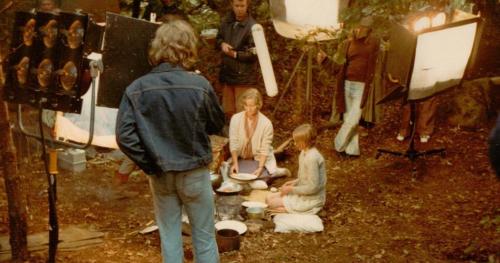
Claude Whatham showing the 16mm camera to Simon West and Sophie Neville. Sue Merry and Denis Lewiston can be seen behind us.
What were your first impressions of the Lake District? Had you ever been to the Lake District before filming Swallows and Amazons?
My parents had taken me to the Lake District as a three-year-old and loved going themselves, so it was a treasured destination in my family. I was dazzled by the lakes and mountains. Holly Howe (Bank Ground Farm) above Coniston Water is a very special place. I love gazing up into the Langdales and walking up into the fells. We were members of the Steam Boat Association, something I have written about in my book,Funnily Enough and I returned over Lockdown to appear in BBC Antiques Roadshow when Swallows and Amazons was profiled.
Sophie Neville aged three in the Lake District
How detailed was the diary you wrote during the filming? Had you ever thought about turning your notes into a book before you were persuaded to write The Secrets of Filming Swallows and Amazons?
I’ve put every page of my diary kept whilst making Swallows and Amazons on my blog at Sophieneville.net/swallowsandamazons My mother kept them, nagging me to write them up for years. Finding the time was difficult but I got there in time for the 40th Anniversary of the film’s release when StudioCanal brought out a DVD with an Extras package we appeared in.
What was the writing process like? eg. challenges
The challenge with adapting a diary is to eliminate inevitable repetition but something extraordinary or disastrous happened everyday whilst filming Swallows and Amazons. With so much filmed afloat or on islands, it was an incredibly difficult production to work on and made a story in itself. I enjoyed finally bringing the book to life and interacting with readers who so kindly sent in reviews and comments. Some love hearing what we all went on to do after the film. One reader did not want to know, but I included this as there were many interesting links and coincidences, especially since I worked on the BBC serialisation of Coot Club and The Big Six.
and favourite moments?
It is very exciting when the first paperbacks arrive. Every author enjoys unpacking that box.
The first edition of The Making of Swallows and Amazons
What is the most surprising thing you’ve learned as a writer?
I never guessed how many times I would need to re-work my books. Each one is read though and edited repeatedly, on and on until it flows well and reads flawlessly. Recording the audiobooks has opened up a whole new world. I narrated them myself, which was far more complicated than I imagined. It’s difficult to digest the fact that I am on Spotify and the audiobookstore. Funnily Enough is selling well on audible.
Do you have any events lined up to promote the book?
Yes, I list the events on my website sophieneville.net/events I’m hoping to be signing copies at the Royal Thames Yacht Club in April and Southampton International Boat Show in September.
I often give illustrated talks on how Swallows and Amazons was made and Q&As at cinema screenings. I’ve begun running workshops on photographing books at literary conferences, which is proving popular.
Giving a talk on how sailing sequences are filmed
Could you tell me a little bit about your other books?
Merry Christmas EveryoneandWrite Wellare anthologies to which I have contributed a chapter. I have written Forewords to four books, including the Czech version of Swallowdale by Arthur Ransome, and Swallows, Amazons and Coots by Julian Lovelock. I have a couple of non-fiction books waiting in the wings including The Secrets of Filming Coot Club. The first three chapters have already been included in DVD extras for the remastered version of the DVD.
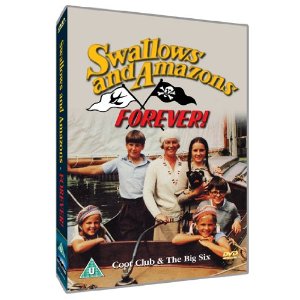
Swallows And Amazons Forever! (Coot Club & The Big Six) SPECIAL EDITION [DVD]
Are you currently writing anything, either to do with Arthur Ransome or entirely separate?
I often write articles for magazines, which have connections to Swallows and Amazons, and have completed two historical novels, which are set in East Africa.
Finally, could you tell me about your other pursuits such as your litter picking, art and the combination of the two? Have art and conservation always interested you?
I have always been passionate about wildlife conservation, often giving talks about otters since they are the key indicator species we have been active in protecting as a family. I am taking part in the Race for Reading by litter picking whilst walking the coast to raise funds for the UK literacy charity SchoolReaders. I sometimes make collages out of the rubbish to attract attention to the composition of sea plastic. You can see examples of this and my paintings on Instagram @Sophienevilleauthor
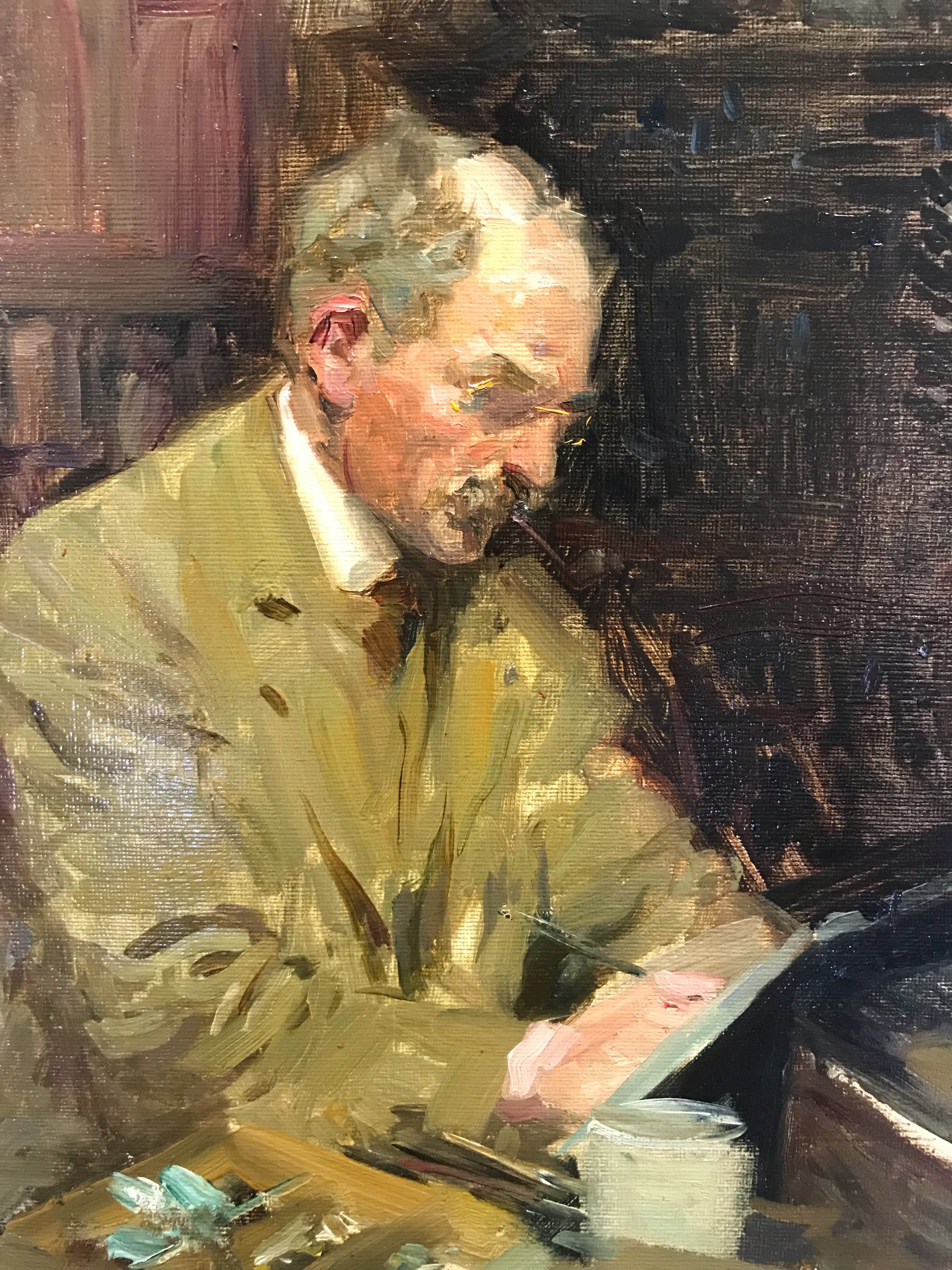
An unsigned portrait by Cyrus Cuneo executed at the Langham Sketching Club c.1914
Arthur Ransome and the painter Cyrus Cuneo were both members of the Langham Sketching Club in London. An unsigned portrait of a balding, moustached gentleman, has come to light that is believed to be a sketch of Ransome dated between 1912 and 1914. He is wearing a round glasses, a stiff white collar and sandy-coloured jacket, painting at a desk in front of dark bookcases. You can just see a hint of the pipe in his mouth.
In 2021, Rosebery’s Auctions in London listed this 45.5cm x 30cm oil-on-board painting in their catalogue as ‘a portrait of the artist’ Cyrus Cuneo, but he was dark, clean-shaven and heavy shouldered, having been a professional boxer, as depicted below. When this was pointed out, Rosebery’s replied that it was, ‘just a self-portrait of an artist at the Langham.’ The setting is backed up by a label on the reverse, but the painting is unsigned.
Cyrus Cincinnato Cuneo, special artist of the Illustrated London News, pictured at work.
The painting is similar to the portrait Dora Altounyan painted of Arthur Ransome in early 1932, which was bequeathed by Evgenia Ransome to Abbot Hall museum in Kendal, now curated by Lakeland Arts. He is wearing exactly the same kind of jacket, but has hair the same colour, with a shorter haircut.
In photographs taken before the First World War, Ransome’s hair looks fuller and darker but could, presumably, have been lathered with pomade. He is wearing the pince-nez glasses and holding the same design of pipe in the photo used on the cover of Hugh Brogan’s The Life of Arthur Ransome taken in 1907 when he was twenty-five and kept by his daughter, Tabitha.
Ransome aged 25 in about 1909
He had lost a lot of hair by the time he was photographed skipping down a lane with Tabitha, in 1917 as can be seen in this and another archive shot kept at the Brotherton Library in Leeds.
(c) Leeds digital
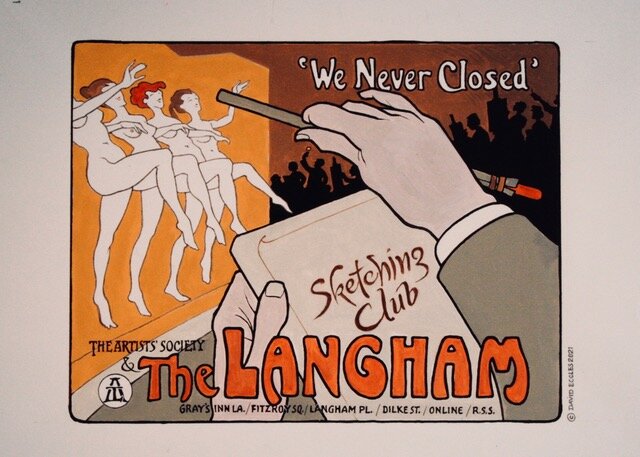
The Langham Sketching Club was set up at a stable yard in Gray’s Inn Lane in 1823 as ‘there was a need for a society where professional men could develop life drawing, improve work standards and meet in the company of like-minded artists’. It moved to 1 Langham Chambers, All Souls Place, London WI in 1938 and was henceforth known as The Langham, not to be confused with the Langham hotel.
JP Gulich’s painting of the Langham at about the time Ransome was sketching there, shown here by permission of the Langham Sketching Club
Artists met for two hours every Friday evening in the winter to sketch, take dinner and chat. Members still gather today, bringing food for a candlelit dinner. Ladies were not incorporated until 2018 but there are now as many women as men. They meet on Wednesday evenings in The Upper Hall at St Columba’s in Pont Street.
The Langham only closed after being bombed in WWII – but went online during Lockdown (c) David Eccles 2021
Cyrus Cuneo, who studied art in Paris under Whistler, joined ‘The Langham’, as it is known, about 1903 and became Chairman in 1908. His son, the artist Terence Cuneo, was born in 1907. Cyrus sadly died of blood poisoning in 1916 after getting scratched by a hat pin at a dance, but his wife and biographer, Nellie Cuneo described ‘some gay, mad times’. Fellow members included the equine artist Alfred Munnings and Arthur Ransome. A reference in early 1914 states: ‘About this time Cyrus gave up doing the two hour sketches at the Langham Sketch Club, and started doing portraits of the members at work. Afterwards some of these were sold to sitters, who included Arthur Ransome.’
Arthur Ransome? At what age? The ears and cheeks are particularly characteristic. Photo(c)Sophie Neville
How well does this painting compare with a photographic portrait dated 1932? The eyebrows look right.
In Bohemia in London, published in 1907, Arthur Ransome writes: ‘Another famous artists’ club is the Langham Sketch Club, whose rooms are close behind the Queen’s Hall. Artists meet there regularly, and draw and make pictures all in a room together, with a time limit set for the performance. At intervals they exhibit the harvest of their evenings on the walls. They also have merry parties, for men only, when the doors are opened by fantastical figures, and scratch entertainments go on all the time, and there are songs and jovial recitations. Nights are as merry as any, and the rooms are full of celebrated men, and men about to be celebrated; for the club does not tolerate bunglers.’ (In the Studios p.81)
Steven Spurrier’s illustration for Swallows and Amazons, a version of which was used on the cover when it was first published by Jonathan Cape in 1930
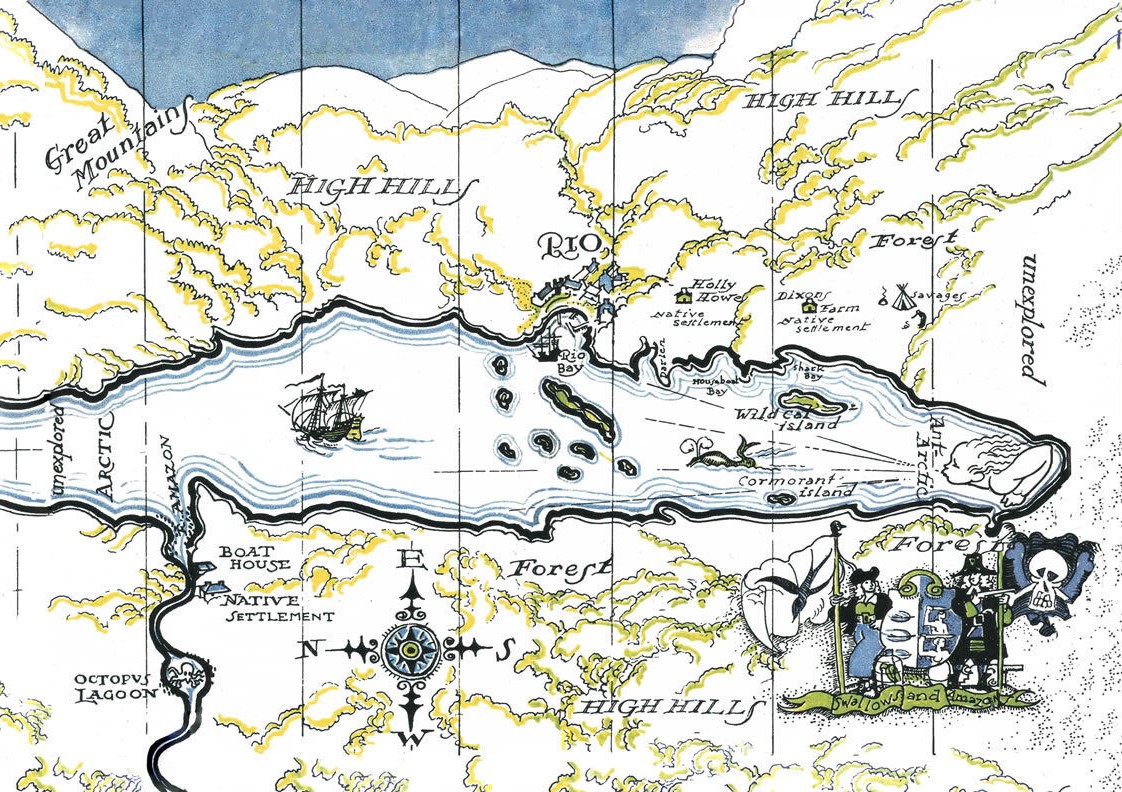
The artist Steven Spurrier, who drew the iconic map of Ransome’s ‘Great Lake in the North’ used on the dust jacket of the first editions of Swallows and Amazons, joined the club in 1906. He sketched groups sitting at different levels, on an assortment of furniture, as they drew. Some are balding and mustached, pipe smoking gentlemen, sketching under electric light. Most are wearing a jacket with a collar and tie. One could almost be Ransome.
Steven Spurrier RA, RBA,ROI (1878-1961) worked in charcoal or ink and wash, capturing the informal atmosphere. Did Ransome ever meet him at the club? He so loathed his illustrations commissioned by Jonathan Cape that, apart from the map, they were never used. Clifford Webb took on the challenge before Ransome produced his own line drawings and maps for Peter Duck, as if they had been drawn by his characters.
Nellie Tenison Cuneo illustrated a large number of books including The Girl Crusoes: A Story of the South Seas by Mrs Herbert Strang. Take one look at her paintings of girls with boats inside and you can imagine the impact they would have on Titty’s character.
Illustrations by Nell Cuneo
Carole Cuneo, President of the Cuneo Society, recognised the portrait. ‘Yes, definitely by Cyrus, from the Langham Sketch Club, and definitely of Arthur Ransome.’ Although, as quoted above, her grandmother claimed, ‘some of these (portraits) were sold to sitters, who included Arthur Ransome’ one can only presume that he did not buy this one. Could there be another?
Carole first knew this picture in the 1950’s. It hung on the wall of her father, Terence Cuneo’s studio at Ember Lane in East Molesey, London, until after his death in 1996, when she inherited it. Carole clearly remembers Terence saying it was a portrait of Arthur Ransome. She had sold it, with other paintings to Sim Fine Art in about 2011, when it was sold again before turning up at Rosebery’s auction. It was purchased for £480, just under the estimated price, by the editor of the Cuneo Society Journal. Carole has provided him with a written statement to record the painting’s provenance for the future. He contacted me to find out about other portraits of Ransome and I was able to see the framed painting at his house in 2021. This shows an open box of paints and a vessel that could have held water. Magnus Smith of The Arthur Ransome Society points out that whilst Arthur Ransome’s pencil sketches and pen and ink drawings are well known, did he ever use paints?
Sophie Neville with the portrait by Cyrus Cuneo
Cyrus Cuneo, who exhibited at the Royal Academy, Royal Institute of Oil Painters and Glasgow Institute of Fine Art, was a distinguished illustrator and figurist, originating from America. If this is a hither-to unknown portrait of Arthur Ransome, it is an important discovery that will be of interest to the Arthur Ransome Trust, Lakeland Arts and members of The Arthur Ransome Society worldwide.
Ref: ‘Cyrus’ Ransome’ by David Bennett, Cuneo Society Journal Vol 5 Number 2
You can read more about Cyrus Cuneo here and about the history of the Langham Sketching Club here.
Terence Cueno’s art studio can bee seen in this film but I couldn’t spot the portrait of Ransome.
The prolific artist Terence Cuneo, Cyrus’s son
First published in Mixed Moss 2022, the Journal of The Arthur Ransome Society
Virginia McKenna in ‘Swallows and Amazons’ (1974) immortalized by the film poster artist Arnaldo Putzu (c) StudioCanal
I was so thrilled to read that Virginia McKenna has been awarded a DBE for services to wildlife conservation and to wild animal welfare in the New Year Honours. When I last spoke to her, she was working tirelessly for the Born Free Foundation that she co-founded with her son Will Travers OBE.
I first met Dame Virginia in 1973 when she agreed to star in the first big screen adaptation of ‘Swallows and Amazons’, produced by Richard Pilbrow, directed by Claude Whatham and released by EMI Films in 1974.
Dame Virginia McKenna at the Langdale Chase Hotel on Windermere in 1973 – photo: Philip Hatfield
She played the part of my mother, Mary Walker. The movie was shot entirely on location in the Lake District where Arthur Ransome set his classic series of children’s books.
Dame Virginia McKenna at Bank Ground Farm in 1973 ~ photo: Daphne Neville (c)
The film has been broadcast on British television more than any other but it is when you watch it on the big screen that you can appreciate what made Virginia McKenna such a great star. Her face conveys a thousand tiny emotions that sweep you into a long-forgotten time when children were able to run free.
Dame Virginia McKenna on location at Bank Ground in Cumbria ~ photo: Daphne Neville (c)
Dame Virginia had originally been scheduled to come up to Cumbria for the first ten days of the seven-week shoot but, since wet weather closed in, she was obliged to return when the sun came out for the famous scene when Roger tacks up the field at Holly Howe to receive ‘despatches’ in the form of the cryptic telegram BETTER DROWNED THAN DUFFERS IF NOT DUFFERS WONT DROWN.
Dame Virginia McKenna with Ronnie Cogan ~ photo:Daphne Neville (c)
Dame Virginia enjoyed the discipline and focus of concentration on set and helped centre us from the start. If you watch other movies made at the time, such as ‘The Railway Children’ (1970), most of the adult actresses are wearing wigs with a district nineteen-seventies feel to their costume and make-up. ‘Swallows and Amazons’ owes its timeless appeal to the fact that Virginia simply had had lovely thick hair scooped into a bun and wore her original 1929 garments with grace.
Sophie Neville as Titty in 1973 – photo: Daphne Neville (c)
I played Titty Walker who inveigled her mother into playing Man Friday to her Robinson Crusoe when she came to visit Wild Cat Island. The sequences were shot on Peel Island on Coniston Water where Ransome was taken as a boy by his own parents and met the Collingwood family in the 1890’s. He later became a good friend of Dora Collingwood whose five children became the inspiration for the story ‘Swallows and Amazons’. Her third daughter, the dreamer, was nicknamed Titty.
Dame Virginia McKenna and Sophie Neville on Peel Island ~ photo: Daphne Neville (c)
It can not have been easy for Virginia to act with me, a child of twelve, while frying pemmican in butter on a camp fire. I was self-conscious about having lost an eye-tooth the night before and had rather a sore mouth and she later had to row from the island with a 35mm Panavision camera in her boat.
What I’d forgotten until recently was that Bill Travers watched the filming that day on Peel Island. He’d been a hero of mine ever since he played George Adamson in ‘Born Free’ and Gavin Maxwell in ‘Ring of Bright Water’ opposite Virginia. Their film, ‘An Elephant Called Slowly’, was released as a double bill with ‘Swallows and Amazons’.
You can see a few more behind-the-scenes photos here and I’ve written more about being Robinson Crusoe here.
‘They were very savage savages’ ~ Virginia McKenna with Sophie Neville ~ photo: Daphne Neville (c)
Looking back, I realise how fortunate we were to be able to play out the scenes from the iconic book in the actual locations, such as Bank Ground Farm where the Collingwood children had stayed one holiday as children, so they could visit their grandparents who lived at Tent Lodge next door and were too unwell to have them in the house.
Sten Grendon, Simon West, Virginia McKenna, Suzanna Hamilton and Sophie Neville at Bank Ground Farm, in 1973 ~ photo: Daphne Neville (c)
We were not so keen on the publicity photographs taken for the film even though Virginia tried to make it fun. Right from the the very first day of filming, she worked hard to bring us together as a cast, playing games such as ‘Consequences’ to help us laugh and relax, while concentrating on the task of bringing the book to life.
Suzanna Hamilton Sten Grendon, Sophie Neville, Dame Virginia McKenna and Simon West – photo Daphne Neville (c)
In 1980, I went to work for Ginny and her husband Bill Travers, as a housekeeper for a few months. She needed domestic help while she was appearing with Yule Brynner in ‘The King and I’ at the London Palladium, for which she won an Olivier Award for Best Actress in a musical. I looked after her youngest son, Dan, who later worked as a safety officer and consultant on the 2016 film of ‘Swallows and Amazons’. I met him at the cast and crew screening in Leicester Square.
Dan Travers and Sophie Neville in 2016
Ginny and I kept in touch. She was ever-supportive, encouraging me to keep raising funds for anti-poaching in South Africa, where she had been evacuated as a child during WWII.
It was only when I heard her speak at the Kempsford Literary Festival in the Cotswolds that I learnt that other ships in her convoy to Cape Town had been torpedoed and sunk crossing the Bay of Biscay. By some miracle, her ship had been delayed in Liverpool but she described finding the flotsam left by the ships that had been hit.
Having written a number of books herself, Ginny encouraged me to write, urging me to keep focused on one thing.
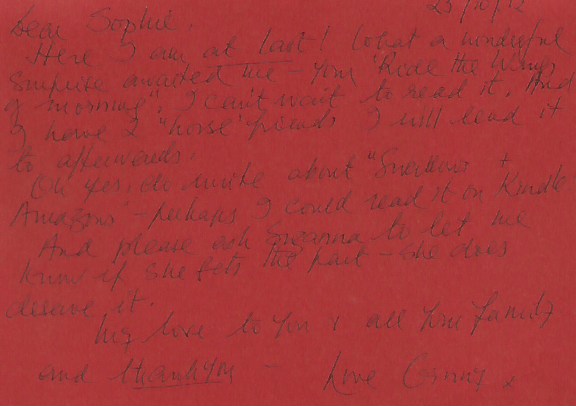
Her letters and cards also inspired me to keep raising funds for wildlife conservation in Africa.
A Christmas card design by Sophie Neville
In turn, I supported the Born Free Foundation, printing them greeting cards, donating a Christmas card design for their catalogue and a picture that was auctioned at the Big Cat Open Day in Kent.
Sophie Neville with Virginia McKenna in about 2001 – photo Daphne Neville (c)
In 2014, StudioCanal invited us both to appear in the DVD Extras package for the 40th anniversary DVD of ‘Swallows and Amazons’ (1974). While we were waiting for the crew, she told me that she’d appeared in more than thirty movies. I know she’s made a few more since then.
You can watch her interview here:
Interview with Virginia Mckenna
I released the first edition of ‘The Making of Swallows and Amazons’ for which Virginia graciously provided a quote. You can read the first few pages in the preview of the ebook, entitled ‘The Secrets of Filming Swallows and Amazons 1974’here
To hear Virginia and her son Will Travers talking about receiving her DBE, please click here for BBC Sounds
Virginia McKenna as Man FridaySophie Neville as Robinson CrusoeDame Virginia McKenna as Mary Walker in ‘Swallows and Amazons’ (1974) – copyright StudioCanal (c)
~ ‘The Secrets of Filming Swallows & Amazons 1974’~
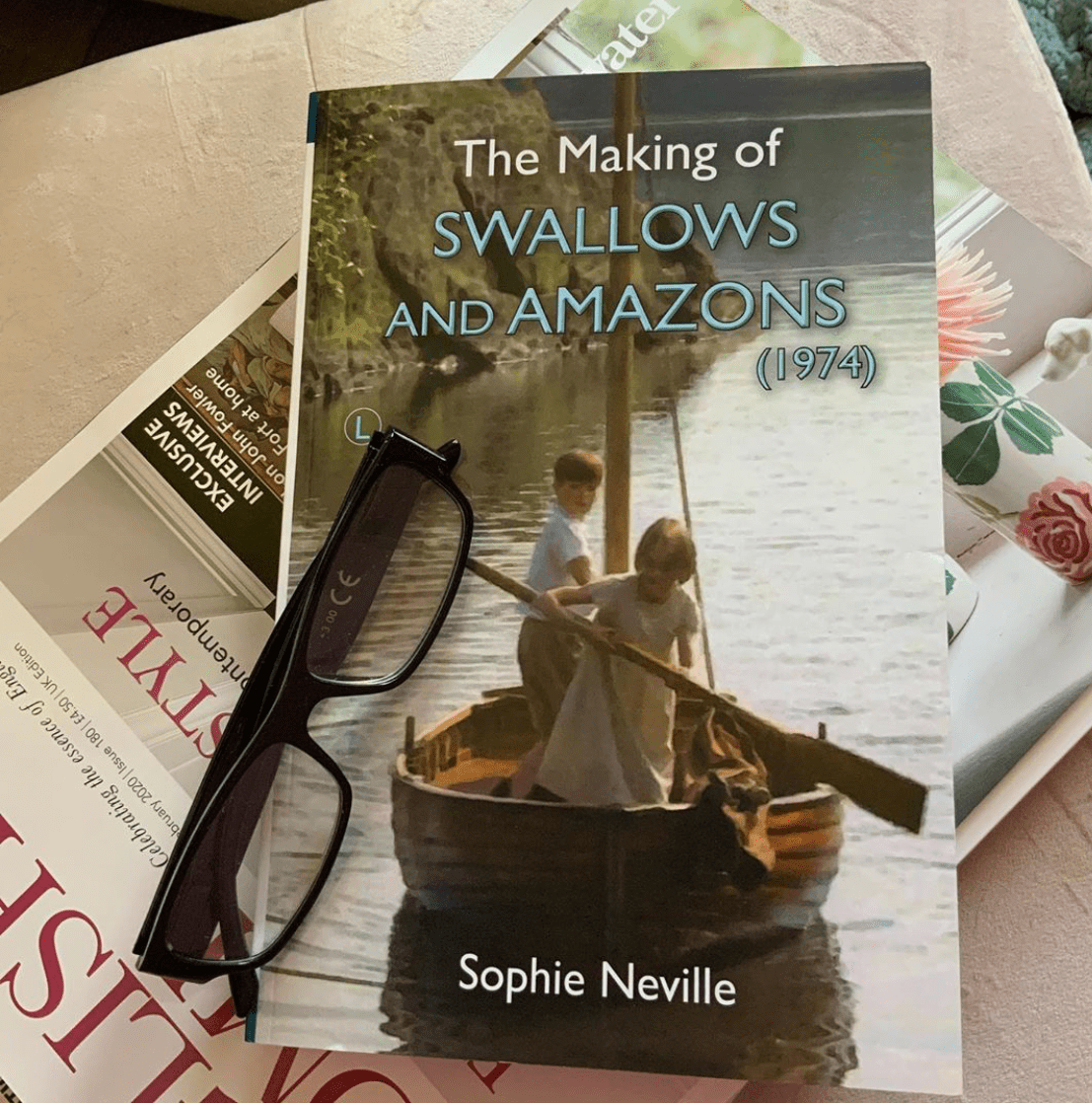
In the long hot summer of 2022, I spent three days in a sound-proofed booth at Monkeynut Studios near Romsey narrating the audiobook of my memoir on the adventures we had making the 1974 movie ‘Swallows and Amazons’, now published in paperback by The Lutterworth Press.
I found telling the story, with all the different voices, more difficult than I had imagined but the audiobook has been beautifully produced, with sound adding a different dimension to this filmography that resonates with the lives of so many.
I gather it will be available on Audible but they are very slow to add books.
I hope it will take you back to that long hot summer in 1929 when the Swallows first set sail and remind you of the early 1970s when we made the original film in the days before mobile phones or computers without CGI or green screens. We literally walked into the page of the books and sang out Arthur Ransome’s immortal lines as the wind took us up Coniston Water. I hope you enjoy it.
If you prefer holding a book in your hands the paperback is available from Waterstones and all online retailers.
Sten Grendon as Roger and Sophie Neville as Titty rowing Swallow (c)StudioCanal
BBC Antiques Roadshow featured Swallow, the dinghy used in the original feature film of Swallows and Amazons in their first episode at Windermere Jetty repeated recently on BBC One. You can read about how she was valued by Rupert Maas on an earlier post on this blog here.
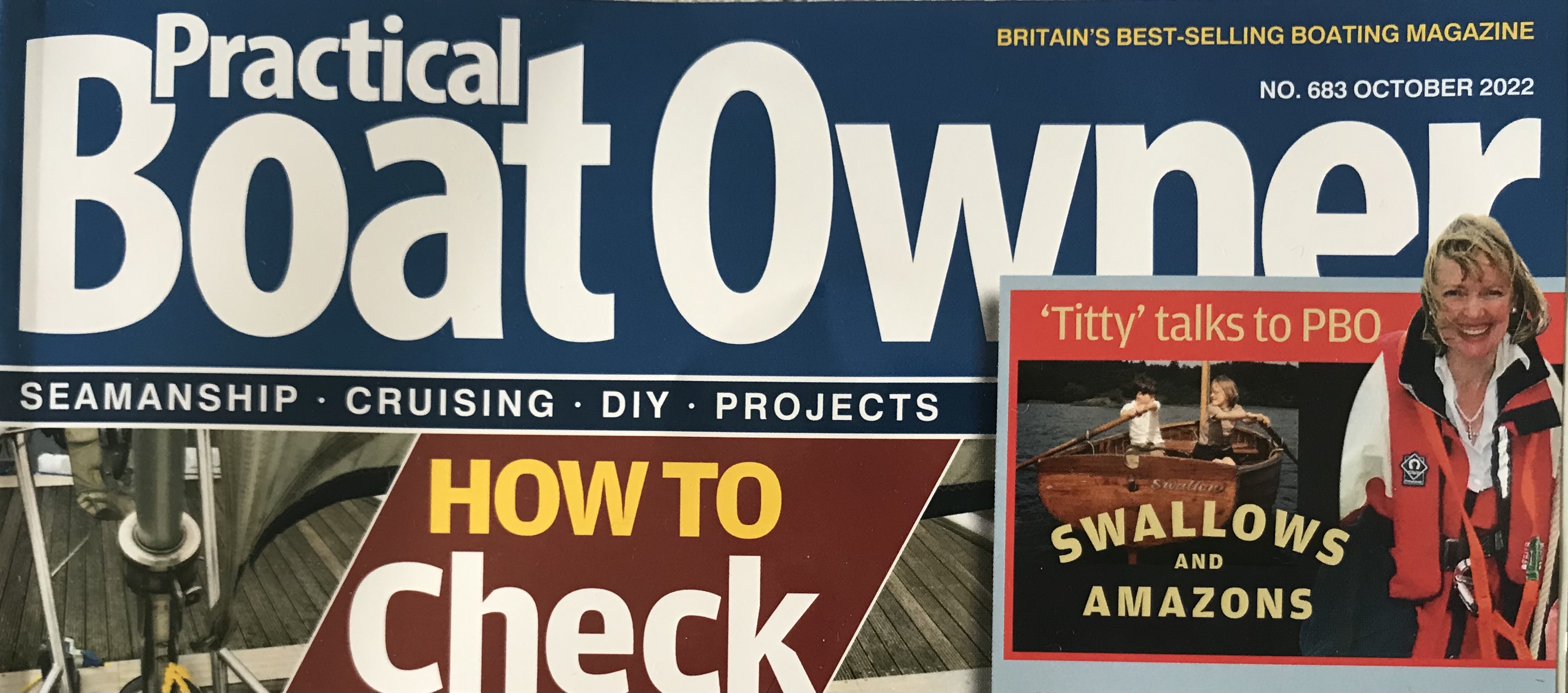
I wrote a little more about her history in an article for Practical Boat Owner, Britain’s most popular sailing magazine. The story opens in 2010, when I nearly bought her myself:
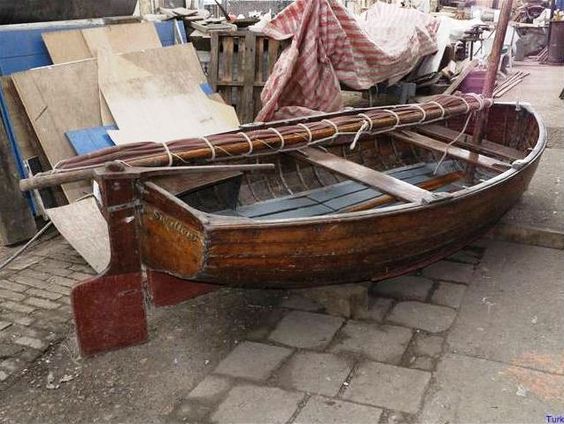
‘Swallow is coming up for auction,’ my father said, sending me the details of a clinker-built sailing dinghy stored in Mike Turk’s warehouse in Twickenham. It was the Spring of 2010. I took one look at the online photographs and wept.
Swallow stored in Twickenham
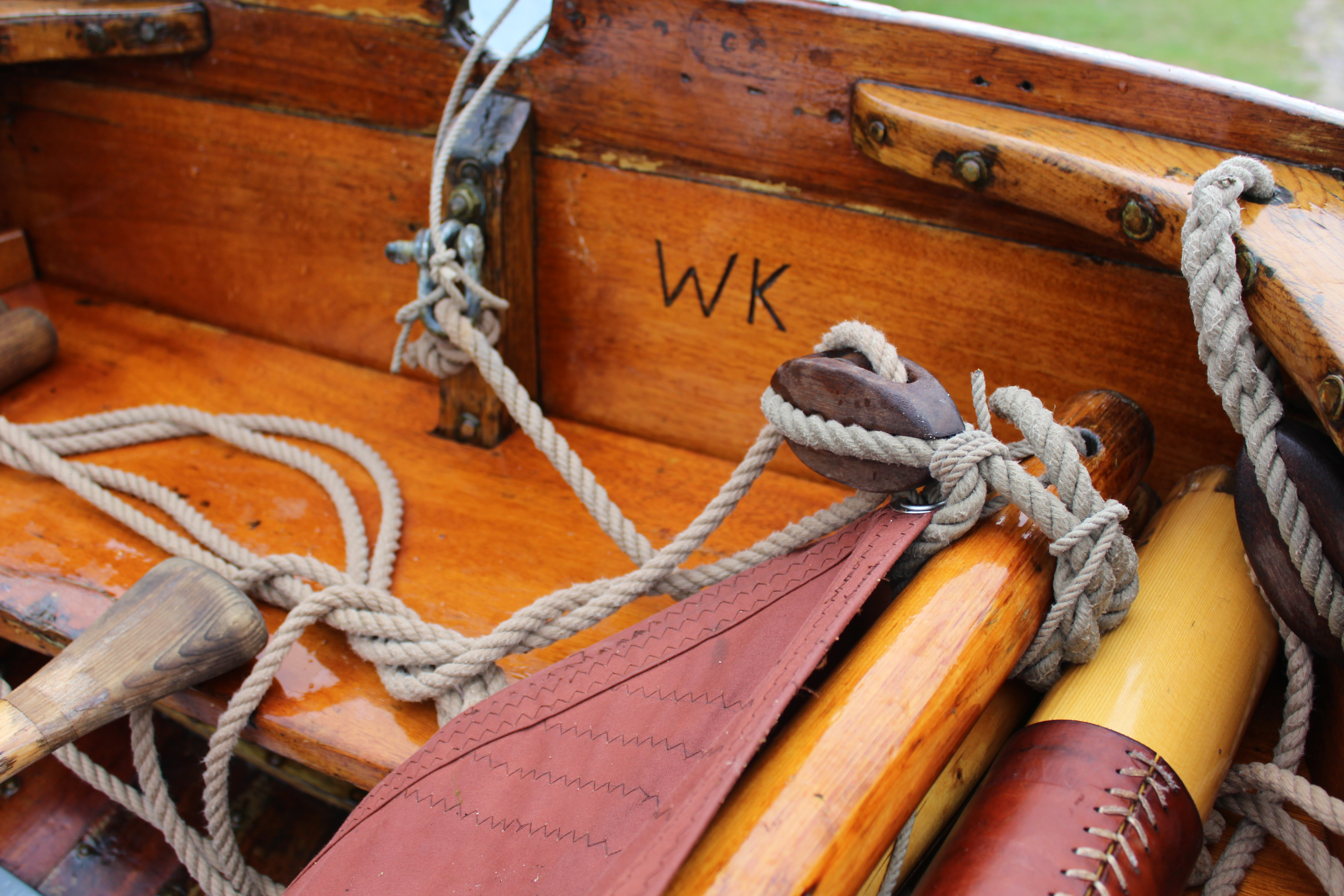
The letters WK were carved on her transom. It was the twelve-foot, all-purpose, run-around vessel originally owned by William King of Burnham-on-Sea that had been purchased by Richard Pilbrow in 1973 to feature as Swallow in the original feature film of Arthur Ransome’s classic novel Swallows and Amazons.
Swallow built by William King of Burnham-on-Crouch
I knew the little ship intimately. She looked a bit dried out but my husband thought we ought to buy her. I had played the part of Able-seaman Titty, the nine year-old girl who Ransome so cleverly made into the heroine of the story when she grabbed a chance to capture the Amazon, which enabled the Swallows to win the war set to determine ‘who should be the flag-ship’. In mooring her prize overnight near Cormorant Island, Titty witnessed Captain Flint’s stolen treasure chest being buried and was eventually able to rescue it. She was rewarded by the gift of a green parrot.
‘Did you know how to sail before playing Titty in Swallows and Amazons?’ people often asked. The truth was that I had crewed for my father in a similar dinghy and felt confident in a boat but could not have coped single-handed.
Sophie Neville aged about ten sailing in the Cotswolds
However, I had grown up living by a lake in the Cotswolds where we had a Thames skiff, which I often took out. This was important as Titty does quite a bit of rowing in the film. She and Roger become galley-slaves rowing back from the charcoal burners’, they row out to Cormorant Island and she takes the Amazon out of Secret Harbour. This I accomplished alone, in one take, later rowing some distance from Peel Island with the lighting cameraman and his 35mm Panavision Camera onboard. No one had thought about the implications of this when we first tried out the two boats on Windermere but, being aged twelve, rather than nine, I just about coped and grew adept at launching Swallow and moving about in her. As the book was written in 1929, we did not wear life-jackets.
Swallow with Simon West and Suzanna Hamilton (c) StudioCanal
Arthur Ransome described Swallow as being thirteen-foot long with a keel, rather than a centre board. In the illustrations she is painted white, a common way of protecting wood in the 1930s. I am pretty sure that Richard Pilbrow, the producer of the movie, bought the rowing boat we used when we where in Burnham-on-Crouch to audition for the parts in March 1973. She was varnished but had been given and forward thwart, mast, red-brown sail and balanced lug-sail as described in the books.
Simon West who played Captain John, aged only eleven, was a capable sailor with an understanding of the wind that enabled him to cope with gusty Lakeland conditions. Swallow had no buoyancy. In the scenes when we first sail to the island she was laden with camping gear, including heavy canvas tents, the lighthouse tree lantern and a shallow basket of kitchen utensils I shifted every time we went about.
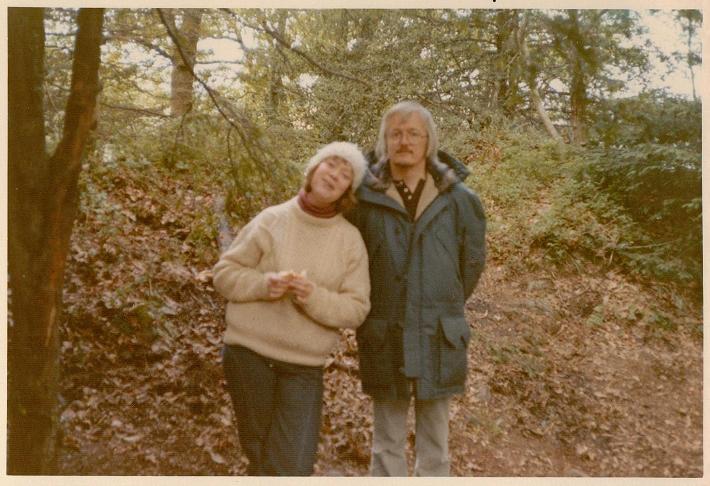
My father Martin Neville on the shore of Coniston Water
My father was an experienced sailor, used to racing yachts having frequently crossed the Solent in his own clinker-built dinghy as a boy. He was looking after us children when he agreed to appear in costume as a ‘native’ aboard the MV Tern on Windermere, which bares down on the Swallows in the story. He watched, terrified, as we sailed towards it. The Victorian steamer only had a notch throttle and an inexperienced skipper. Dad realised that Claude Whatham, the film director, had not anticipated the fact that we would lose our wind in the lee of the passenger ferry. He gave Simon a cue over the radio that was far too late. We only just went about in time, being pushed away from the larger vessel by the bow wave. Watch the film trailer and you can see how very close we got. I was about to reach out and feebly fend off.
Dad spoke sternly to the producer that afternoon, pointing out that we could have all gone down. Sten Grendon, who played the Boy Roger, was only aged eight and could hardly swim. I could have become entangled in the camping gear. My father tested the old BOAC life jackets we wore for rehearsals and to travel out to film locations. They failed to inflate. He nearly took me off the production.
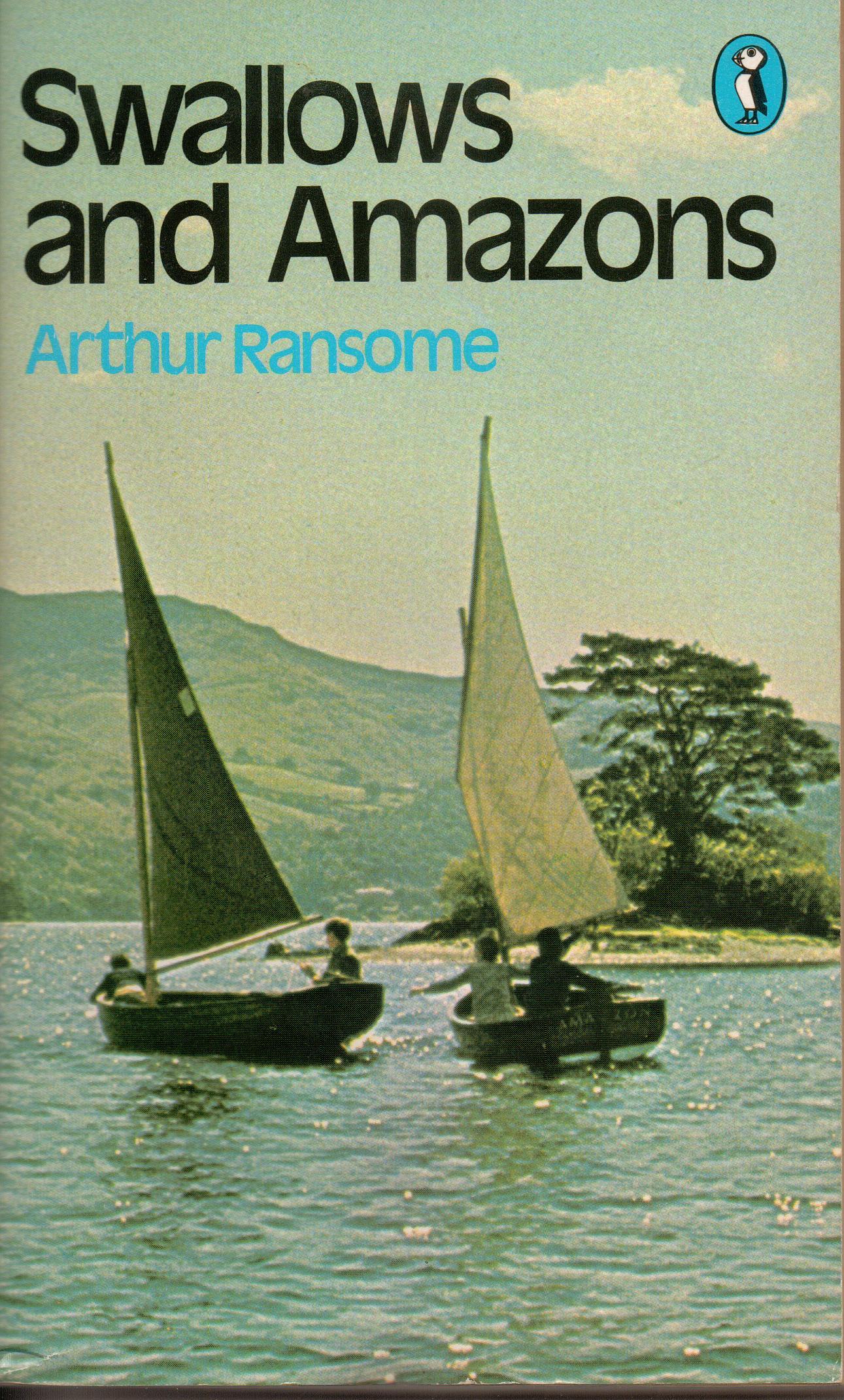
Swallow and Amazon on the Puffin cover
Another tricky scene to film was when John, Susan and Roger set off from the Landing Place on Wild Cat Island leaving Titty to guard the camp and light the lanterns as they hoped to capture the Amazon and sail home after dark. I had push them off, grabbing the telescope at the last minute. Since Swallow’s mast was liable to catch in tree branches, I needed to wade out and give her a hard, one-handed shove. I slipped on a rock and fell up to my waste in water. Knowing it would be difficult to set up the shot a second time, I struggled to my feet and waved them off, dripping wet. By this time John had the mainsheet out as far as the knot and stood to grab the boom to avoid a Chinese gybe as Swallow was hit by a fresh gust of wind as he cleared the headland at the northern end of the island and sped northwards toward Coniston Old Man.
Simon West and Suzanna Hamilton at the helm of Swallow with Stephen Grendon in the bows, while Sophie Neville looks on from Peel Island.
Having spent nearly seven weeks filming in the Lake District, the film was post-synced at Elstree studios. We arrived to sing out our lines to find Swallow there. She had been set in a tank so that the sounds of sailing could be captured. It is something you tend to take for granted as a viewer while it draws you into the experience.
I last saw Swallow looking dejected outside the studio and was worried about what had become of her. Although she was offered to someone who had advised on the film, she was kept safely at Mike Turk’s prop hire company. Richard Pilbrow was hoping to make another film in the series.
Swallow at Mike Turk’s store in London
When Mike retired, many boats that had featured in movies came up for auction. I knew Swallow would be costly and in need of renovation. After fans of the film and members of The Arthur Ransome Society contacted me, we clubbed together to make a bid. In the end about eighty members of a hastily formed group called SailRansome spent approximately £5,700 on the purchase.
I contacted Nick Barton of Harbour Pictures, the film producer who was gaining the rights to make a new movie, hoping we could be able to re-coup costs by renting her back to him. Nick came up to Coniston Water to watch me re-launch Swallow in April 2011, sloshing brandy wine on her bow in true Ransome style. I helped him to raise finance for the new film, which was made in the summer of 2015 and released in 2016, starring Kelly Macdonald as Mrs Walker, Rafe Spall as Captain Flint and Andrew Scott as a Russian spy. In the end, he decided to use fourteen-foot RNSAs dinghies for Swallow and Amazon as they satisfied the film insurance company who demanded that two identical dinghies were used for Swallow.
This article was first published in Practical Boat Owner magazine
Joining SailRansome was pivotal for me as I was asked by the Nancy Blackett Trust and The Arthur Ransome Society to give a series of talks on how the old film, and the BBC serialization of ‘Coot Club’ and ‘The Big Six’ was made. I ended up speaking at a number of literary festivals, on BBC Radio and even ITV’s News at Ten, promoting the societies and urging people to help get young people out on the water. I ended up taking Swallow out on Ullswater, the Orwell and River Alde, remembering how difficult she is to turn, but enjoying her speed. She ended up being featured on BBC Antiques Roadshow when I brought movie memorabilia up to Windermere Jetty museum for two episodes first screened in 2021.
Sophie Neville after re-launching Swallow on Coniston Water in 2011
Next summer, you should be able to sail Swallow or Amazon yourself, in the company of an experienced skipper, by contacting Hunter’s Yard near Ludham on the Norfolk Broads. They also rent out Titmouse and yacht who played the Teasel in the BBC adaptation of ‘Coot Club’. As you can see from this clip, Swallow was in need of restoration when first acquired by Sailransome. She now needs a new keep. I have news of her restoration on this website here.
You can read more on the Arthur Ransome website here.
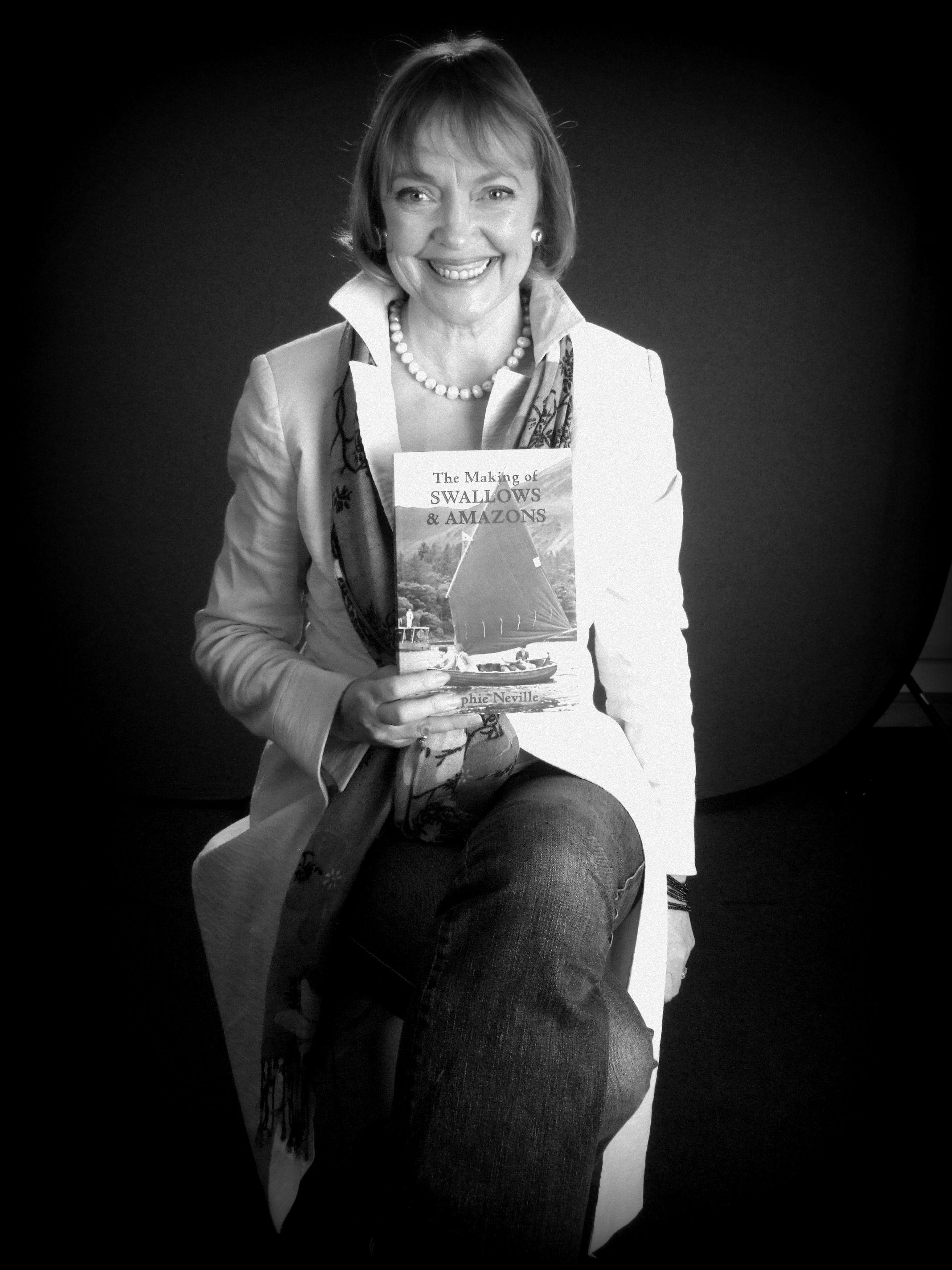
You can read more about the adventures we had making the original film in ‘The Making of Swallows and Amazons (1974)‘ by Sophie Neville, published by the Lutterworth Press, available from libraries, online retailers and to order from all good bookshops including Waterstones.


 Richard Pilbrow produced the original movie ‘Swallows and Amazons’ (1974) in which I appeared in a as a girl. I’m told that it has been broadcast on television more times than any other British movie and has been an inspiration to many.



























 Her letters and cards also inspired me to keep raising funds for wildlife conservation in Africa.










 Sophie Neville