– ‘He must be a retired Pirate’ but what of the chances of finding Rio Cinema?
The Cinema Museum, London – not that we paid these prices to enter
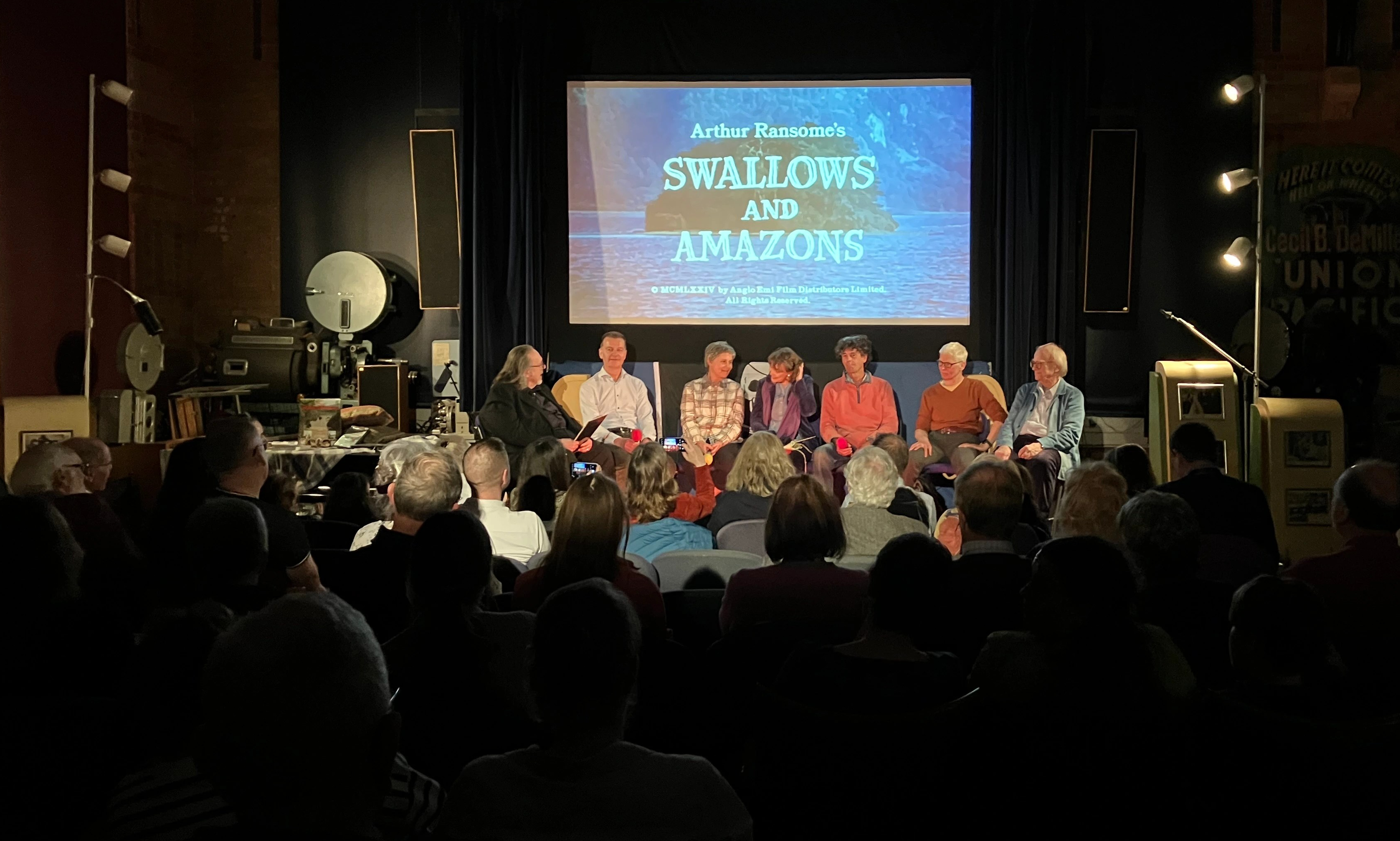
Keen fans of Claude Whatham’s original film ‘Swallows and Amazons’ gathered at the Cinema Museum in London for the 50th Anniversary celebrations hosted by the writer and broadcaster Brian Sibley.
After doors opened at 1.00pm, delicious food and drink was served in the main hall where Hugh Grant held his 50th Birthday party. Charlie Chaplin had been housed there as a child. It had been the chapel of the workhouse where his mother had been sent with her offspring.
A collection of movie memorabilia now lines the walls. It’s in incredible place.
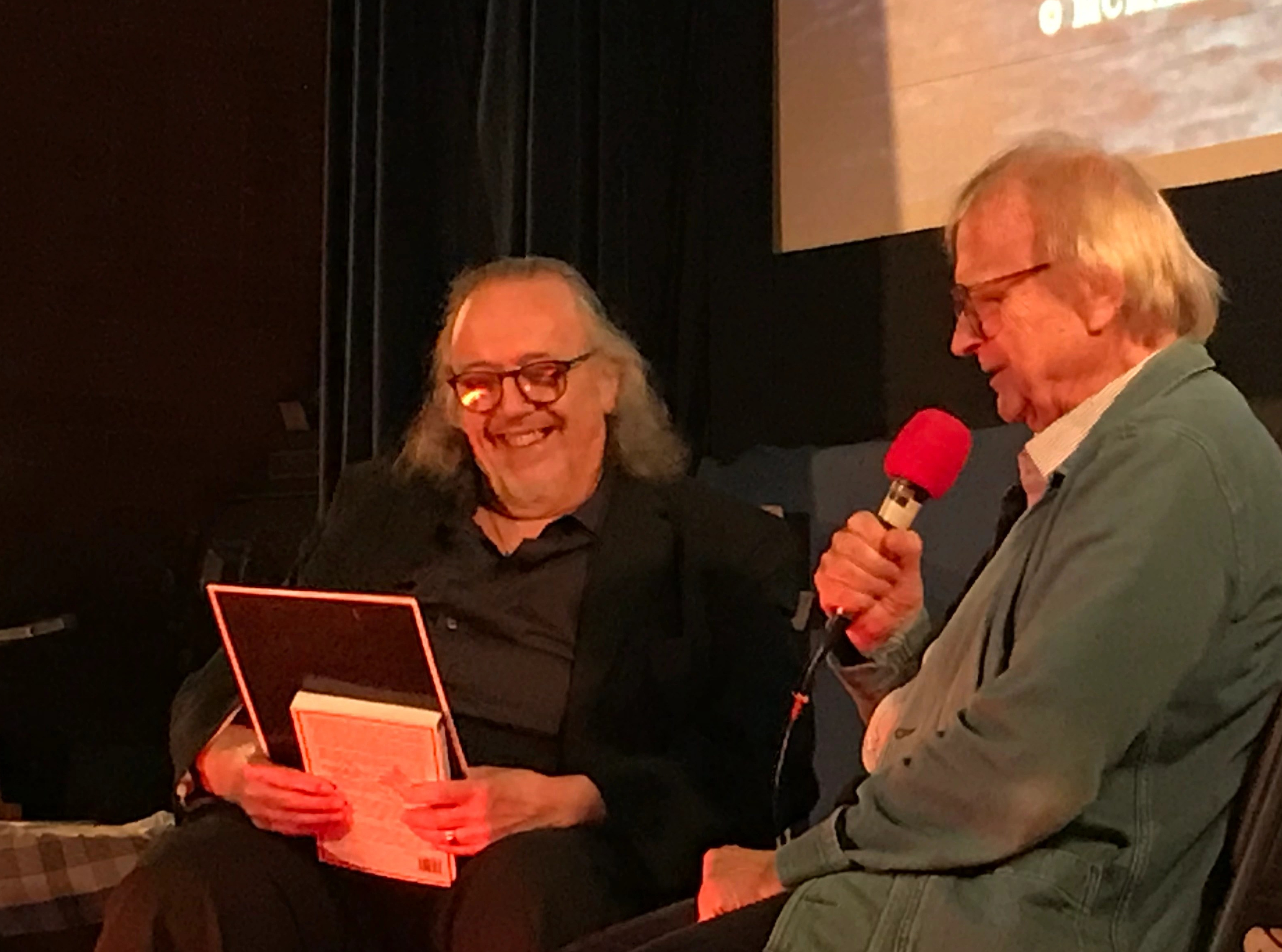
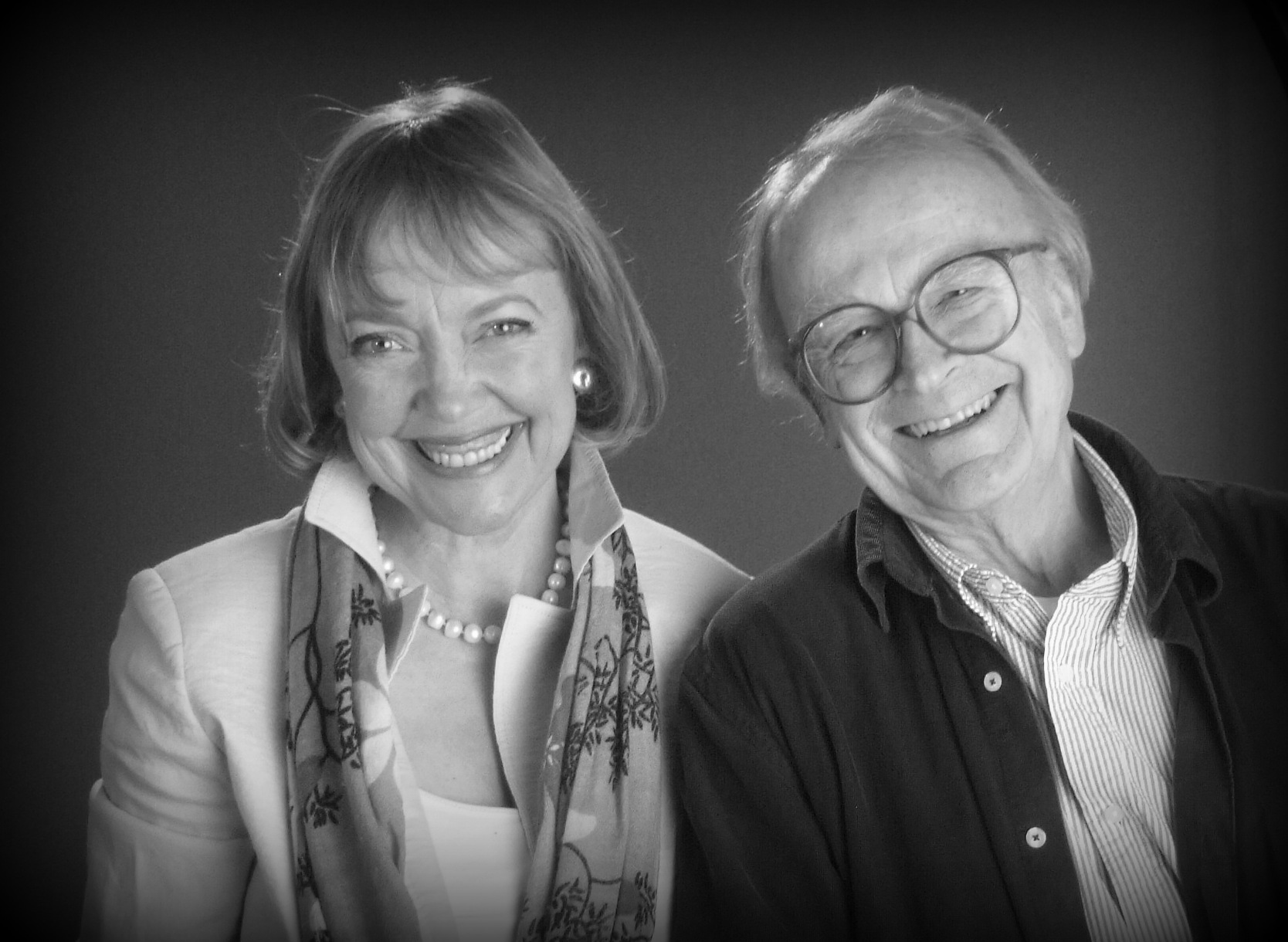
Writers Brian Sibley and David Wood OBE
‘He said, – “Yes.”‘
Brian Sibley interviewed David Wood OBE, who at the age of twenty-nine had adapted Arthur Ransome’s book into a 90 minute screenplay under the iron fist of the widowed Mrs Ransome. Born in Russia, she had been Leo Trotsky’s private secretary and was a pretty formidable old lady.
Sophie Neville, Suzanna Hamilton & Sten Grendon with David Wood and Claude Whatham in 1973
David told us that having taken the producer, Richard Pilbrow, and his associate Neville C Thompson around various Lake District locations, Evgenia Ransome declared she wanted the Swallows to all have blue eyes and blonde hair. I’d know that she wanted ‘And English rose’ to play Titty, but this was news to me.
Although David was well known for his starring role in the film ‘If….’ with Malcolm McDowell, ‘Swallows and Amazons’ was the first movie he wrote. He’s been too busy acting on stage to spend much time on location but entrusted the script changes to the director.
The film screening was heralded by a letter from Dame Virginia McKenna, which I was given the privilege of reading out.
Reading a letter of good wishes from Dame Virginia McKenna
‘It is almost impossible to believe that it is the 50th Anniversary of ‘Swallows and Amazons’. I am really sorry I cannot be with you but I am here in spirit.
For anyone who feels downhearted by the troubles in our present-day world, there can be no better cure than to be here this afternoon watching this delightful film set in such beautiful scenery.
In a few moments you will be transported to an earlier time and a different place. You cannot but enjoy this very special film.’
We then watched StudioCanal’s remastered version of the movie on the big screen. The Lakeland mountains looked magnificent and the detail amazing. Gareth Tandy, who had worked on the crew as Third Assistant Director said, ‘I’d totally forgotten that I played one of the robbers!
After an intermission, I chatted to Peter Robb-King the Make Up Designer and met up with Cedric James who’s been on the camera crew.
The cast of ‘Swallows and Amazons’ (1974) gathered for the 50th Anniversary – photo Lee Pressman of the Cinema Museum
‘They’ve got India-rubber necks.’
Brian Sibley then interviewed the cast on how we’d got the parts, what impact the film had on our lives and what we’d spent our earnings on.
Brian Sibley, Simon West, Suzanna Hamilton, Sophie Neville, Sten Grendon, Kit Seymour and David Wood – photo: Lee Pressman
The answers proved hilarious. It was lovely to hear from Jane Grendon, Sten’s mum, who had travelled from Gloucestershire to be our official chaperone. She pointed out how very hard we had worked all that time ago.
Neville C Thomason’s daughter-in-law spoke and I displayed the flags that Richard Pilbrow had sent from America before he sadly passed away at the age of 90.
Simon West, Suzanna Hamilton, Sophie Neville, Sten Grendon, Kit Seymour, Jane Grendon, Peter Robb-King and David Wood – photo: Lee Pressman
There was then time for fans to get books, cards and film posters signed in the age-old tradition. Many thanks go to Brian, Lee Pressman and other volunteers of the Cinema Museum who made it all possible. It was an amazing day. One young fan had come dressed as Titty with a green parrot on her shoulder, there were a few diminutive Amazons in red hats and Neville Thompson’s great granddaughters arrived in very smart pirate jackets.
Perry Neville, who appears briefly in the Rio scene, with Sophie Neville and David Middleton of The Arthur Ransome Society
The cast and crew met up at Windermere Jetty in Cumbria on 29th and 30th June 2024, when Swallow and Amazon, the boats featured in the film could be seen as well as Mavis, who still belongs to the Altounyan family, and Arthur Ransome’s dinghy used as the model for Scrab. You can find details of events on this website here.
The Cinema Museum in London – once a workhouse where Charlie Chaplin lived
This is a transcript of the notes I made to prepare for it:
It’s fifty years since ‘Swallows and Amazons’ was filmed on location in the Lake District, can I ask: how did you go about getting the role of Titty?
The extraordinary thing was that, as a normal schoolgirl, I didn’t do a thing. A letter arrived out of the blue inviting me for an interview. Forty years later, when I put an extract of my ebook on ‘The Secrets of Filming Swallows and Amazons’ up on Goodreads, one reviewer wrote that it was ‘a good idea for a novel but a bit far-fetched.’ They didn’t realise that my story was true.
The prospect of risking film finance on six unknown children must have been daunting. Claude Whatham the film director, knew both me and Sten Grendon (who played Roger) as he had cast us in the first BBC adaptation of Laurie Lee’s memoir Cider With Rosie, back in 1971. He’d given me the part of Eileen Brown because I could play the piano well enough to accompany Laurie Lee on violin in the parochial church concert. I stumbled through ‘Oh Danny Boy’ at an agonising pace but did exactly what I was told. You can still buy the DVD.
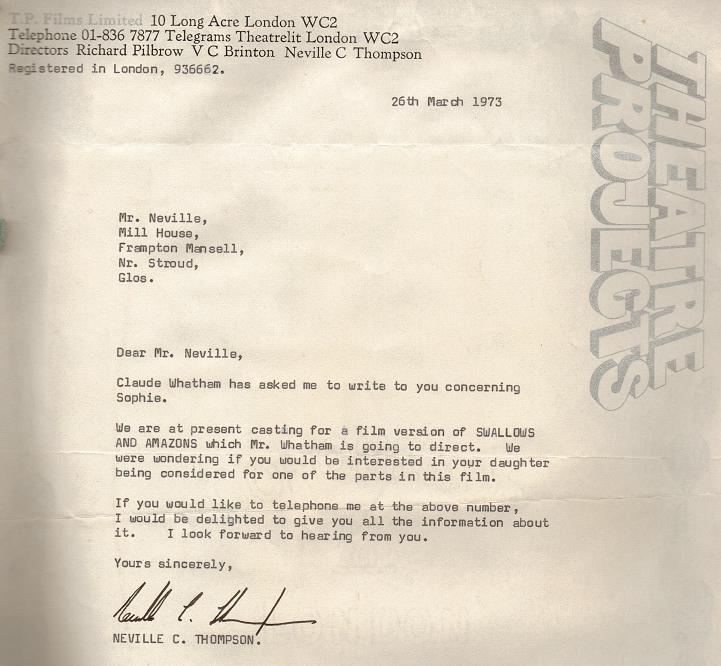
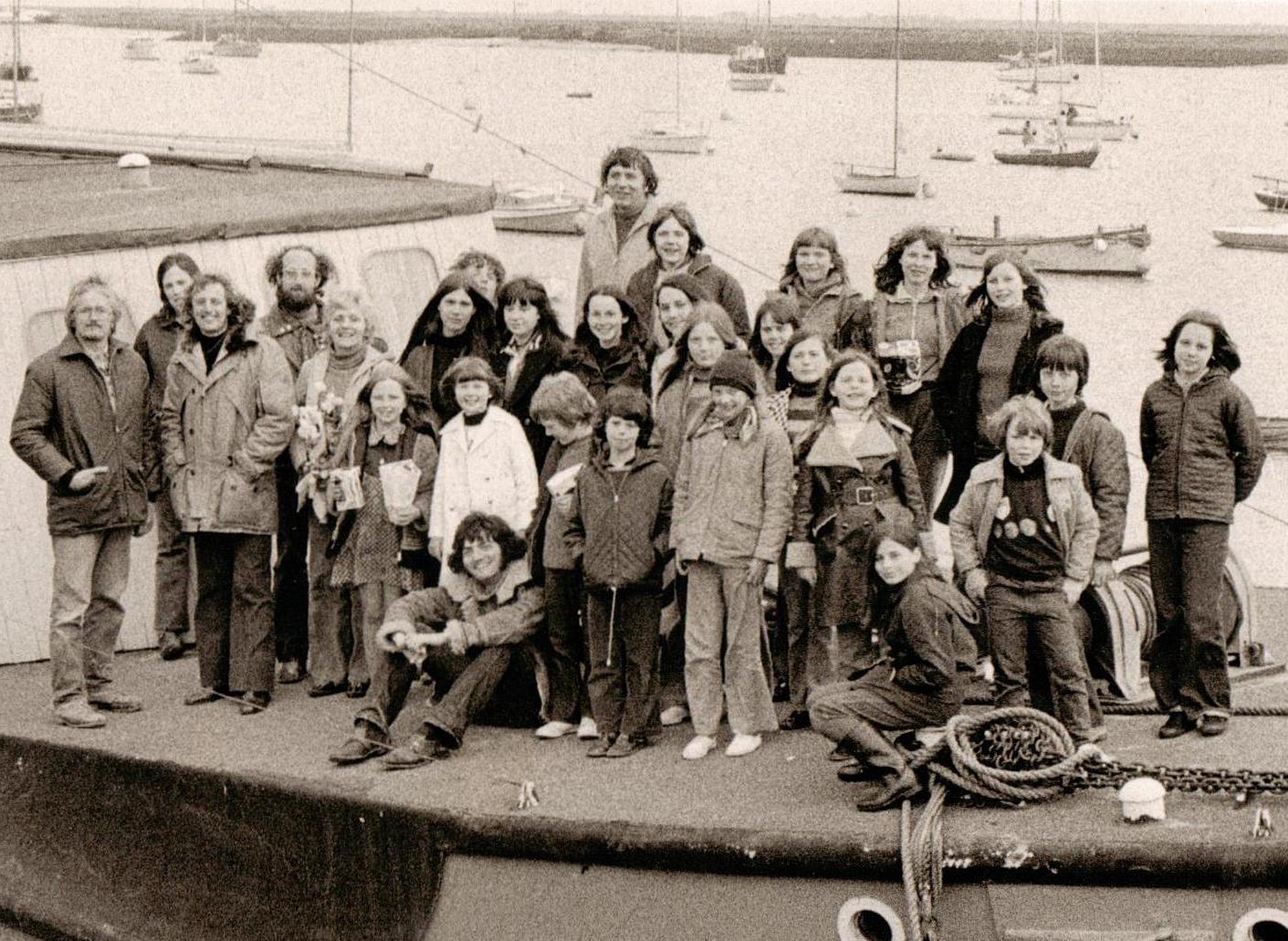
After my first audition for the part of Titty, a group of us were taken on a sailing weekend to see how confident we were in boats but I was never asked to read for the part as you might expect. There was no film test. It all happened very fast. The letter was sent on 30th March. By 14th May 1973, we were shooting the first scene with Dame Virginia McKenna playing my mother.
Dame Virginia McKenna as Mother with Sophie Neville as Titty Walker
Tell us about your time on the set and the recording of the movie. The ninety- minute feature film was shot on 35mm almost entirely on location in the Lake District where we were based for seven weeks. The first set was a railway carriage, which was nice and warm. It was soon a twelve-foot dinghy out on Coniston Water when I wore nothing more than a thin yellow dress and a pair of navy blue elasticated knickers. The experience was usually chilly, and involved a great deal of waiting around, but we survived.
Sophie Neville with Suzanna Hamilton
I’ve got to ask this, what was it like to work with Virginia McKenna? Dame Virginia was charming and brought us together as a family, helping me to concentrate on the story. I had a few scenes alone with her on Peel Island when Titty, who is pretending to be Robinson Crusoe, persuades her to play Man Friday. It was unexpectedly embarrassing because I lost a milk tooth halfway through one sequence and grew self-conscious about opening my mouth. I coped better when handling her boat. I’m longing to be invited on a chat show when they gather together all the film actors who’ve played Robinson Crusoe. I’m pretty sure that I’m the only woman who has embodied the character in a movie.
Sophie Neville as Titty
I’m curious, were you able to sail before getting the part or did you have to learn? I grew up by a lake and had crewed for my father so I was used to small boats, but it was Simon West and Kit Seymour who were the brilliant sailors. Their skill shines through and made the film great. Some of the maneuvers were quite scary.
Filming Swallows and Amazons (1974) from a camera pontoon
No one asked if I could row a boat and yet Titty rows in three crucial scenes. It’s more difficult than you might think when you have a Panavision camera onboard or are effectively towing the camera boat. We now have a modern dinghy which we sail on the Solent, with a little more attention to safety.
Nina Nannar interviewing Sophie Neville for ITV News at Ten
If I remember rightly there weren’t a lot of life jackets in the movie. Was health and safety not such a concern then? The story is set in 1929, so none of us wore life jackets in vision. We could swim but the water was freezing and our wooden boat lacked buoyancy of any kind. My father, who was an experienced sailor, was not happy with the safety aspects and nearly took me home. We’d been fine while sailing free but nearly collided with the Lakeland steamer while Dad was dressed as a film extra, looking down on us from the deck. He insisted on a safety officer after that.
Are you still a sailor or do you feel that part of your life is over? The Arthur Ransome Society has just acquired both Swallow and Amazon, the clinker-built sailing dinghies used in the film, which are being restored for members to sail. I’m very much looking forward to taking them out on Windermere. I am also a member of the Nancy Blackett Trust who keep the first yacht that Arthur Ransome bought with his royalties from ‘Swallows and Amazons’. I’ve sailed her on the Orwell, on the Solent where I live, and through the inland waterways of the Netherlands. You too can join the trust and imagine yourself as one of the characters in Ransome’s books ‘We Didn’t Mean To Go To Sea’ and ‘Secret Water’ in which his yacht is cast at the Goblin. It’s wonderful reading those novels when you are on board.
I can’t help but wonder, how did your acting career help in your writing career? It helps when writing dialogue – and film scripts.
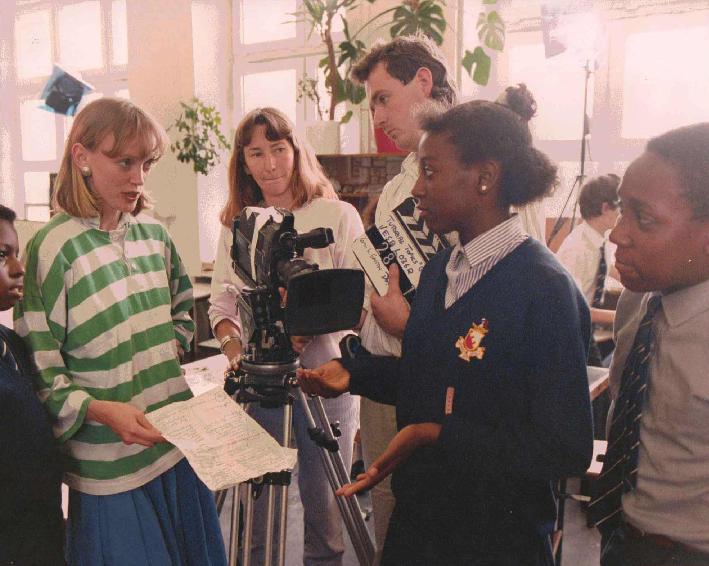
Sophie Neville directing a sequence with BBC cameraman Lorraine Smith
Why the change from acting to writing? As soon as I graduated from university, I went into television production at the BBC in London, where I began writing my first piece for Nicholas Parsons in 1982. I went on to write or edit about seven programmes that I produced when working for BBC Education. I only began writing books and articles in 1999 after turning professional as a wildlife artist. This was useful as I’ve been able to draw on my stock of illustrations including decorative maps, which always look good at the beginning of a book.
You wrote a book, which I am reviewing for the magazine, called The Making of Swallows and Amazons. What was it like revisiting your past in this way?I began writing that particular memoir as a blog using the diaries and scrapbooks that we’d kept on location as children. I was aided by other members of the cast, fans of the film and members of both The Arthur Ransome Society and Arthur Ransome Group on Facebook who helped me with historic detail. Once published, additional stories floated down from Cumbria, which was exciting. It’s now in its second edition and is out as an audiobook. I’ve been gathering information for a third edition and a book about the making of ‘Coot Club’ and ‘The Big Six’, a serial made by the BBC that I worked on behind the camera in 1983. The first three chapters have already been included in the DVD Extras package.
What does a writing day look like for you? I usually wake early, sit up in bed and write for two or three hours before the emails pour in. If possible, I’ll keep writing until lunchtime, but the admin of life tends to encroach on my time.
Let’s get personal, maybe a silly question for a sailor but on holiday do you prefer sea or mountain and why?Ah, you must read my book ‘Ride the Wings of Morning’. I enjoy summer sailing but prefer riding horses through the hills.
If you could go anywhere in the world to write a book where would it be and why? I’ve written most of my books in South Africa where the climate agrees with me. It’s easier to concentrate in the wild.
Sophie Neville at Camp Davidson in the Waterberg
What’s your favourite meal?I’m a Celt – 57% Scottish with a bit of Danish blood. You’ll find me at the seafood bar ordering gravlax followed by a rare steak – preferably from stock reared on the moor.
Do you prefer keyboard or notebook and pen?I work with a notebook and pencil to start with, then bash away at my laptop, which is not good for the posture.
The original diary ~ Funnily Enough by Sophie Neville
Last question, which one of your books do you recommend to Mom’s Favorite Reads readers?I recommend ‘Funnily Enough’, based on a diary I kept about my family and the tame otters we kept. It’s light and amusing but says something about love and friendship. I hope it will inspire others to keep a journal or begin sketching. You’ll find an audiobook and a kindle copy illustrated in colour. I hope it proves a blessing.
You can read more about Wendy H Jones and contact her via her website here
You can find information on where to buy Sophie’s books on this website here
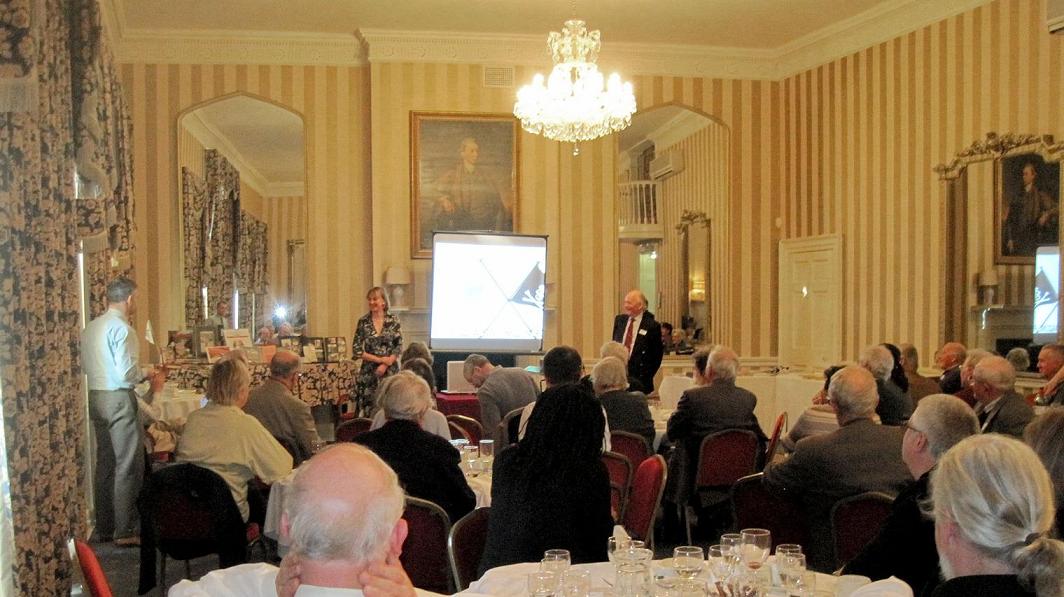
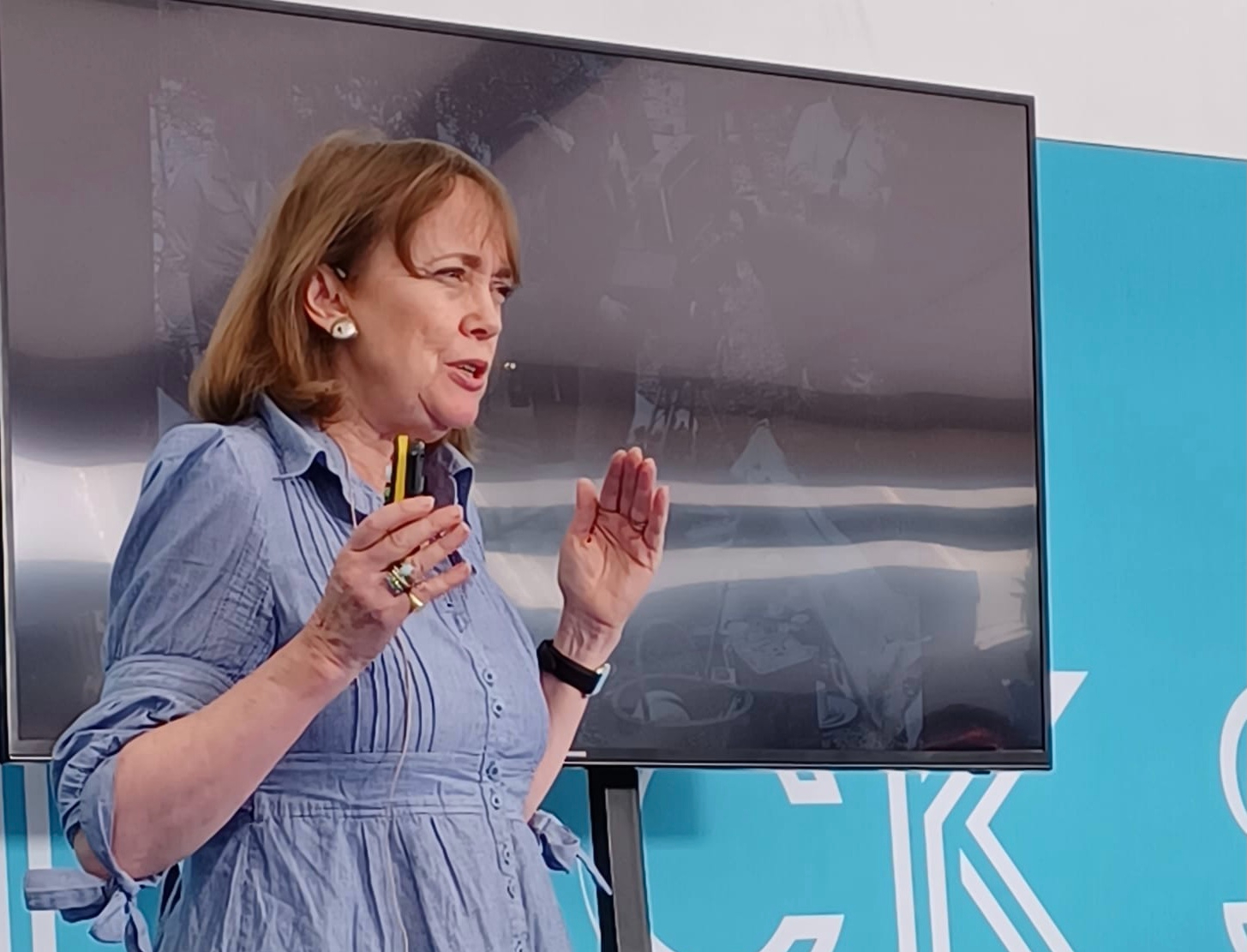
On Sunday 16th July 2023, Sophie is giving an online talk on photographing books at a Summer Festival of Books and Writing, detailed on Facebook here. Please add your own to the comments section, below.
Funnily Enough – the paperback has black and white illustrations
Book reviewers and writers need a huge variety of photographs to illustrate blog posts and social media stories. I run informal workshops at conferences to show writers what can be achieved quickly and easily. It’s fun and we’ve had some great results. Many were simple but worked well.
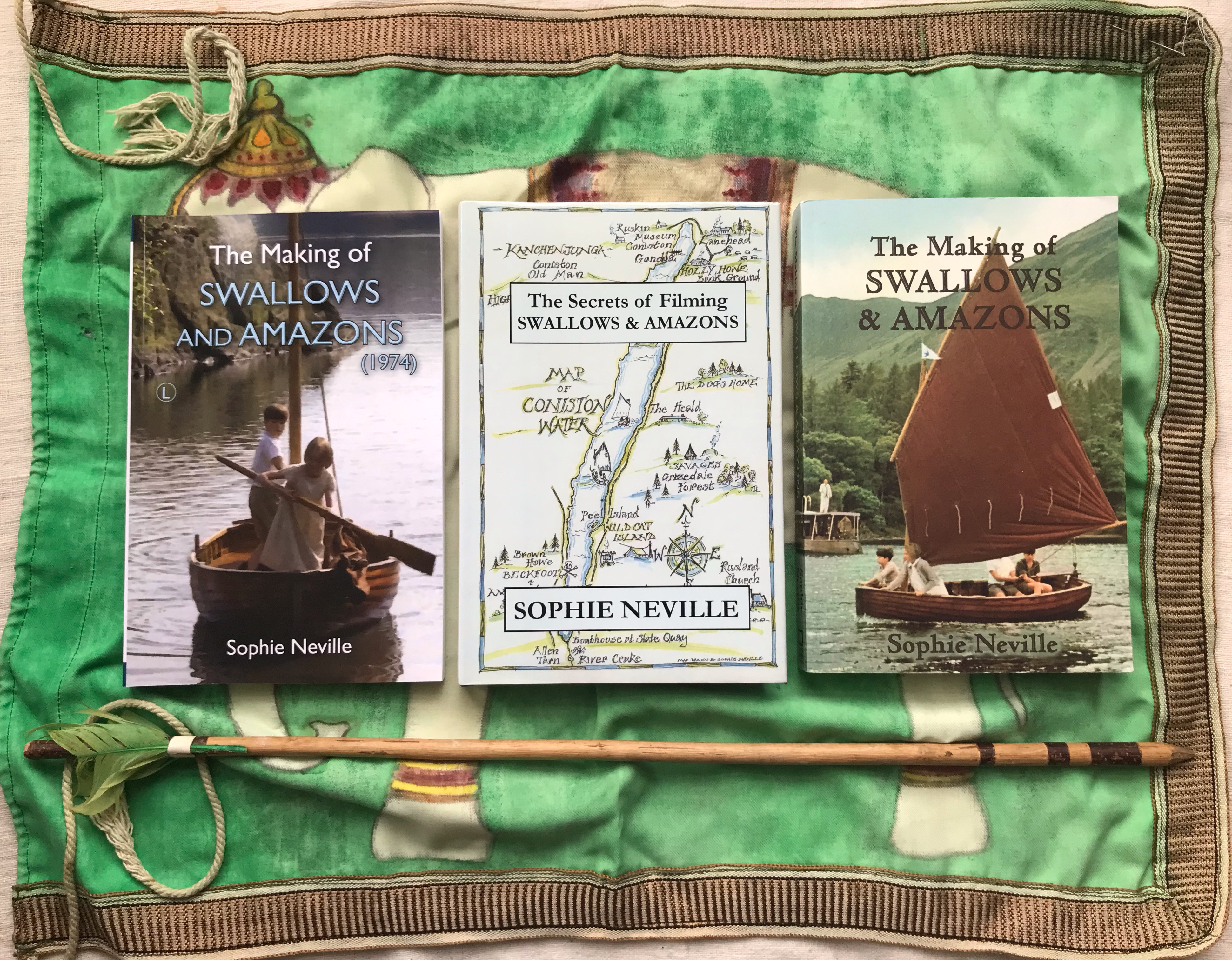
Different editions of ‘The Making of Swallows and Amazons (1974) by Sophie Neville’
I use a spotlight and various props while authors bring along their books and publications. I help them to dress a shot to inspire reading and we snap away with iPhones, taking shots for summer reading and ‘Ideas for Christmas’.
We feature ebooks on Kindle or open a magazine to showing articles.
Easy summer reading
Ten tips:
Always use a spotlight – a desk light will do, or wait for lovely outdoor light.
Think of who is going to read your book, where, when and why.
Chose a minor colour used on the cover for your background eg: gold or dark grey. A cashmere pashmina or plaid tablecloth can look good.
Only use 1, 3 or 5 props with a limited palette of colours. Don’t distract from the book.
Useful props include sunglasses and a straw hat with a few leaves to suggest summer reading, spectacles and comparison books with a steaming cup of coffee or glass of wine for winter, wrapping paper and ribbon to suggest giving a book as a present. Vintage black and white photos illustrate 20th Century historical fiction well.
Tap the screen on the spot you need in clear focus, such as the title.
Frame as closely as you dare. Try to feature the spine.
When you take portraits of people, animals or birds, compose images with one eye in the centre of the shot.
If you want a comic shot, cut your subject off at a shoulder joint.
Play around with the picture until you get it right. Discard any that aren’t perfect.
Take three aspects for each set up: square shots for Instagram, landscape shots for blog posts, Twitter or Facebook and portrait aspect for Facebook or Instagram Stories. Check out publishers’ photos for ideas.
An idea for an historical novel coming soon
Enjoy yourself. It should be quicker and easier than using Canva or computer generated images but that is fun and you can add graphics:
Sophie Neville won the Create! Prize for Photography in 2020.
Her memoirs include ‘Funnily Enough’ serialized in iBelieve magazine, ‘Ride the Wings of Morning’ and ‘The Making of Swallows and Amazons (1974)’ published by The Lutterworth Press. She is working on two novels set in East Africa, which have been winning writing awards.
How old were you when you first read Arthur Ransome’s books? Did you have a favourite storyline or character?
My father devoured the Swallows and Amazons books as they were published in the 1930s. I was a slow reader but must have started the series aged about ten or eleven as I’d read seven of the twelve by the time we arrived in the Lake District to make the film in 1973. I enjoyed the practical aspects of the books and most readily identified with Mate Susan, although I counted all the characters my friends. Ransome published thirty other books. Some are heavy going, but I enjoyed his autobiography.
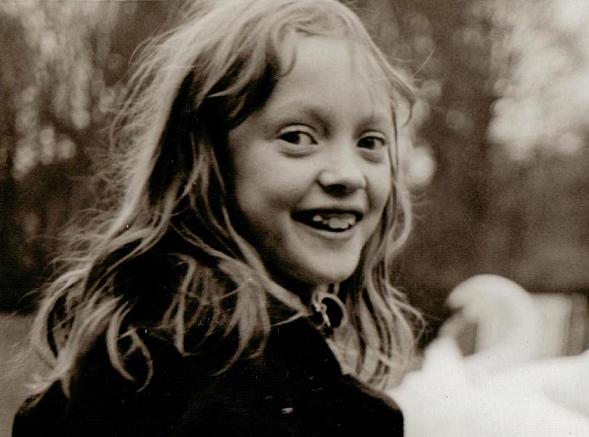
Sophie Neville as a child ~ photo: Martin Neville
Have you re-read the books since your childhood? If so, how has your perception of the books and the characters, in particular Titty, changed?
I’ve re-read most of the books in the Swallows and Amazons series and gain something new each time I read Swallows and Amazons, recently appreciating how important Titty’s imagination was to progressing the story. Her ideas take the plot forward. I ended up writing an article on how Swallows and Amazons can be seen as an allegory to missionary work undertaken by Arthur Ransome’s great aunts, one of whom received a Boxer arrow in her bonnet for her efforts in China.
Simon West and Sophie Neville on Peel Island in 1973
Do you think playing Titty influenced your own personality? If so, how?
Titty helped me to look beyond the saucepans and concentrate on creative endeavors rather than getting bogged down by management and administration. Acting in the film instilled in me a work ethic, responsibility and striving for excellence. Looking back, the part was a huge burden to lay on the shoulders of a twelve-year-old but it was worth it. The film has had an enduring quality and is still broadcast today. I find constant interest when I’m in social or sporting situations. For me, it has truly been a case of ‘Swallows and Amazons Forever!’
Sophie Neville as Titty and Stephen Grendon as Roger rowing to Cormorant Island
Do you remember what you wanted to be before you became an actress? Did a writing career ever interest you as a child?
I acted professionally from the age of ten until I was twenty-one, going into television production at the BBC before I became a writer. I’ve also worked as a safari guide, wildlife artist and – thanks to Titty – as a cartographer. You can see a few maps I drew on my website here.
I’ve undertaken quite a bit of charity work, fundraising and acting as webmaster for The Waterberg Trust. I can’t remember having strong career ambitions as a child but knew art to be my strongest subject. I have a visual brain that flits about. Keeping a diary and constant letter writing has helped me develop my writing and has given me a huge quantity of material to draw upon.
Suzanna Hamilton with Sophie Neville as Titty busy writing the ship’s log
What led/inspired you to become a producer?
Claude Whatham was a ground-breaking director who inspired all those around him, but directing became a viable option at Opera Camp, annual amateur productions we took part in over our summer holidays as teenagers. I began directing plays at university and developed a burning desire to direct for television, always ‘looking for the shot.’ By producing documentaries, I got to direct and put them together, editing voice-overs into a narrative arc. I would now like to adapt my own stories for film, so have Final Draft software on my laptop and Witness Films Ltd registered as a UK company, but although I have a couple of ideas out to tender, I’ve been concentrating on polishing my historical novels.
Director Claude Whatham with his cast of Swallows in 1973
I’ve read that before filming Swallows and Amazons, you were in a production of Cider with Rosie. Was playing Titty anything like your experience of playing Eileen Brown?
Claude Whatham directed bother Cider With Rosie (1971) and Swallows and Amazons (1974) so the experience was similar. I also appeared in a Weetabix commercial he made in the Cotswolds. All three productions were set in roughly the same period, but Titty’s costumes, designed by Emma Porteous, were easiest to wear. Cider With Rosie was the most daunting production as I had to play the piano, which required three days of intensive practice. Titty only had to draw, write and row a boat, which was much more my thing.
Titty working on the chart
Working with Virginia McKenna was amazing. Hugely inspirational and one of our most iconic British film actresses, she taught me a great deal – and still does.
Virginia McKenna playing Mother in Swallows and Amazons
What were your favourite and least favourite parts of the filming process?
We loved eating iced buns on set but hated hanging around in the cold. There was a lot of waiting for clouds to pass in the Lake District where I spent days clad in nothing but a thin cotton dress and enormous pair of navy blue gym knickers. I became more interested in the technical aspects of filming rather than acting, which for us children was more a case of ‘Let’s pretend.’
Claude Whatham showing the 16mm camera to Simon West and Sophie Neville. Sue Merry and Denis Lewiston can be seen behind us.
What were your first impressions of the Lake District? Had you ever been to the Lake District before filming Swallows and Amazons?
My parents had taken me to the Lake District as a three-year-old and loved going themselves, so it was a treasured destination in my family. I was dazzled by the lakes and mountains. Holly Howe (Bank Ground Farm) above Coniston Water is a very special place. I love gazing up into the Langdales and walking up into the fells. We were members of the Steam Boat Association, something I have written about in my book,Funnily Enough and I returned over Lockdown to appear in BBC Antiques Roadshow when Swallows and Amazons was profiled.
Sophie Neville aged three in the Lake District
How detailed was the diary you wrote during the filming? Had you ever thought about turning your notes into a book before you were persuaded to write The Secrets of Filming Swallows and Amazons?
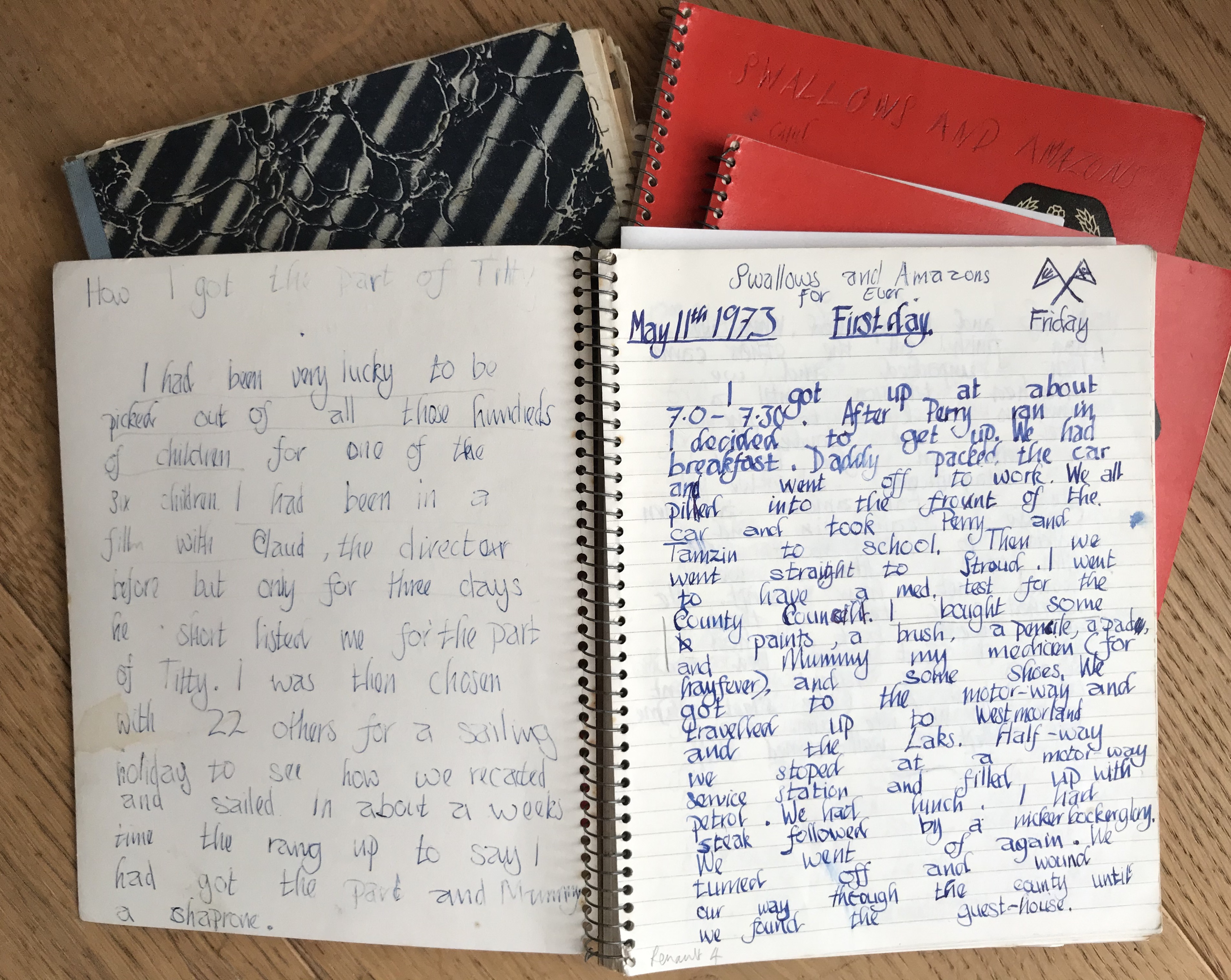
I’ve put every page of my diary kept whilst making Swallows and Amazons on my blog at Sophieneville.net/swallowsandamazons My mother kept them, nagging me to write them up for years. Finding the time was difficult but I got there in time for the 40th Anniversary of the film’s release when StudioCanal brought out a DVD with an Extras package we appeared in.
What was the writing process like? eg. challenges
The challenge with adapting a diary is to eliminate inevitable repetition but something extraordinary or disastrous happened everyday whilst filming Swallows and Amazons. With so much filmed afloat or on islands, it was an incredibly difficult production to work on and made a story in itself. I enjoyed finally bringing the book to life and interacting with readers who so kindly sent in reviews and comments. Some love hearing what we all went on to do after the film. One reader did not want to know, but I included this as there were many interesting links and coincidences, especially since I worked on the BBC serialisation of Coot Club and The Big Six.
and favourite moments?
It is very exciting when the first paperbacks arrive. Every author enjoys unpacking that box.
The first edition of The Making of Swallows and Amazons
What is the most surprising thing you’ve learned as a writer?
I never guessed how many times I would need to re-work my books. Each one is read though and edited repeatedly, on and on until it flows well and reads flawlessly. Recording the audiobooks has opened up a whole new world. I narrated them myself, which was far more complicated than I imagined. It’s difficult to digest the fact that I am on Spotify and the audiobookstore. Funnily Enough is selling well on audible.
Do you have any events lined up to promote the book?
Yes, I list the events on my website sophieneville.net/events I’m hoping to be signing copies at the Royal Thames Yacht Club in April and Southampton International Boat Show in September.
I often give illustrated talks on how Swallows and Amazons was made and Q&As at cinema screenings. I’ve begun running workshops on photographing books at literary conferences, which is proving popular.
Giving a talk on how sailing sequences are filmed
Could you tell me a little bit about your other books?
Merry Christmas EveryoneandWrite Wellare anthologies to which I have contributed a chapter. I have written Forewords to four books, including the Czech version of Swallowdale by Arthur Ransome, and Swallows, Amazons and Coots by Julian Lovelock. I have a couple of non-fiction books waiting in the wings including The Secrets of Filming Coot Club. The first three chapters have already been included in DVD extras for the remastered version of the DVD.
Swallows And Amazons Forever! (Coot Club & The Big Six) SPECIAL EDITION [DVD]
Are you currently writing anything, either to do with Arthur Ransome or entirely separate?
I often write articles for magazines, which have connections to Swallows and Amazons, and have completed two historical novels, which are set in East Africa.
Finally, could you tell me about your other pursuits such as your litter picking, art and the combination of the two? Have art and conservation always interested you?
I have always been passionate about wildlife conservation, often giving talks about otters since they are the key indicator species we have been active in protecting as a family. I am taking part in the Race for Reading by litter picking whilst walking the coast to raise funds for the UK literacy charity SchoolReaders. I sometimes make collages out of the rubbish to attract attention to the composition of sea plastic. You can see examples of this and my paintings on Instagram @Sophienevilleauthor
David Wood, the award-winning playwright who adapted ‘Swallows and Amazons’ for the big screen in the early 1970s, wrote to say, “A fan recently reminded me that SWALLOWS, the film, will be celebrating its 50th birthday next year! Hard to believe, but true!”
He’s right. The Royal Gala that launched the film was held at the ABC in Shaftesbury Avenue on 4th April 1974. I still have the dress I wore and found a copy of the programme signed by other children in the cast. You can see photos in post I wrote about it here.
“I couldn’t attend the premiere,” David said, “I was rehearsing in Manchester!” This was a pity as it would have been amazing to watch the first film he’d written on the big screen with members of the cast present.
A signed programme from the premiere of ‘Swallows and Amazons’ held on 4th April 1974
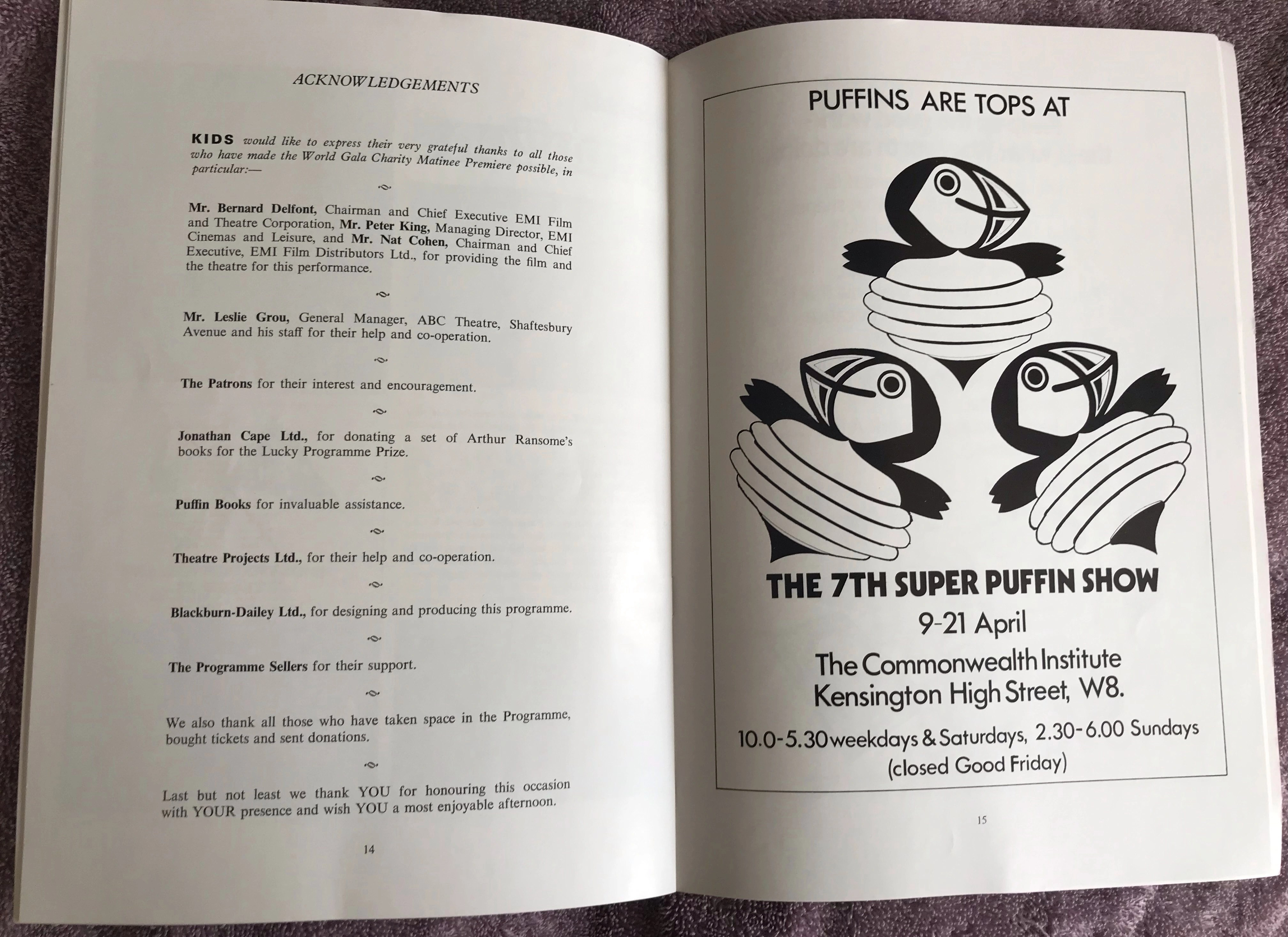
The event was followed by the publisher Kaye Webb’s Puffin Show at The Commonwealth Institute in Kensington High Street where the dinghy Swallow was on display from 9-21st April. I remember going along to meet readers. One of them wrote to me years later, thrilled that she’d won a new copy of the book. You can read her letter and find the Puffin Post article in an earlier post here.
Kaye Webb’s Puffin Club Show – April 1974
“Do you think anyone will do anything to celebrate the anniversary? Are there any producers or distribution companies that might be approached? I am in touch with Richard Pilbrow, in America. I might drop him an email… Let me know if you think we ought to try to do something… a special screening, perhaps?”
When I suggested a few News presenters who might be interested in becoming involved, David replied saying:
“John Sergeant and I were at Oxford together, and performed in revue and cabaret….I directed him in a musical!
“Libby Purves interviewed me a few years ago at The Story Museum, Oxford. I was on Midweek twice too….”
“Have never met Ben Fogle, but years ago I knew his mother, Julia Foster. Her first husband was Lionel Morton, pop singer and Play School presenter, who played Owl for me in the first London production of THE OWL AND THE PUSSYCAT WENT TO SEE……in 1969!!!!!!”
“I was delighted that Virginia McKenna got her Damehood! Well deserved.”
This year marks the 50th Anniversary of making the film in the Lake District. I explained that I had been invited to give a talk to members of the Royal Thames Yacht Club in Kensington in April, hoping her could join me.
“I will put your April 18th talk in the diary – not sure yet if I will be free to come! But would appreciate you asking if I could attend. Last time I was there I gave a magic show for the members’ children!! About 50 years ago….just like the film!”
“The plans sound exciting. I wonder if the Arthur Ransome Society, to whom I gave a talk not long ago, might be interested in arranging something…”
They are. The idea is to put on an event at Windermere Jetty Museum in July 2024, under the auspices of Lakeland Arts. The Arthur Ransome Society are hoping to have both Swallow and Amazon there.
David then wrote to say: “The Cinema Museum, a rather wonderful institution in the Kennington area of South London, have pencilled Saturday April 6th 2024 for two screenings of SWALLOWS, to celebrate fifty years.” We have been invited to give Q&As and sign copies of our books. “Martin Humphries, who runs the Cinema Museum, organised a similar event about IF…., when I did a Q&A after the screening.”
This year is also the 50th Anniversary of the Lakeside and Haverthwaite Steam Railway where we spent the very first day of filming on 14th May 1973.
This amused me. It was a non-fiction book, written because the extraordinary story was true. Of all the roles, in all the novels ever written, I was asked to play Titty in Swallows and Amazons, an EMI film made in 1973 for universal distribution.
The offer came out of the blue. Within a year, I, an ordinary schoolgirl, found my image on the front of daily newspapers and on film posters pasted on the walls of the London Underground. All this happened nearly fifty years ago and yet the publicity never ends.
Arthur Ransome, a haunted foreign correspondent, who escaped from Russia with Trotsky’s secretary, wrote Swallows and Amazons in 1929 while suffering from stomach pains so bad they prevented him from travelling. He said that the book wrote itself, but it is clear that he was self-medicating, grieving his own childhood, when he’d been longing to make friends and prove himself to his father who died when he was only thirteen.
Tweed-clad and continuously pipe-smoking, Ransome was oblivious to Lakeland weather. I acted out his almost-real fantasy in nothing but a thin cotton dress and a pair of enormous navy blue elasticated knickers. My book on ‘The Making of Swallows and Amazons’ is not a novel, not a fantasy. It is a true story. The movie is streaming on Amazon Prime where you can watch the trailer.
Why was I cast in the film? Why me? I had loved all the Arthur Ransome books I’d read in the Swallows and Amazons series, imagined myself exploring Wild Cat Island and the Great Lake in the North. Did I ever ask the Lord if I could live out the stories for myself?
The reality began in Stroud, at the Subscription Rooms. I put up my hand when someone asked if there was a ten year-old girl who could play the piano. They didn’t say, “play well.”
A young director called Claude Whatham, who lived in the Cotswold village of Camp, was looking for children to appear in the 1971 BBC adaptation of ‘Cider With Rosie’, based on Laurie Lee’s haunting memoir. He needed to find a little girl who had been to a village school near Stroud. I had attended Oakridge Parochial Church School when it was heated by pot-bellied stoves and the vicar told us Bible Stories.
I was chosen to play Eileen Brown, who shared a desk with Laurie Lee and accompanied him as he played Oh Danny Boy on his violin at the Christmas concert.
Sophie Neville in the 1971 BBC adaptation of ‘Cider with Rosie’, directed by Claude Whatham
My music arrived three days before filming began. It consisted of endless cords – a complicated accompaniment with no tune. To tackle the piece, I’d needed to practice for seven hours a day with the help of my long-suffering piano teacher from Far Oakridge.
Claude Whatham ~ photo: Daphne Neville
The director must have remembered me as a determined little girl because two years later a letter arrived, addressed to my father, only he was working in South Africa. My mother very nearly didn’t open it, however the words Theatre Projects were embossed on the envelope and she was intrigued.
But she did. We drove up from Gloucestershire to collect Dad from Heathrow and went straight to Long Acre near Leicester Square for an interview with Claude.
I was then invited to take part in a sailing audition at Burnham-on-Crouch in Essex – miles from the Cotswolds. The producer, Richard Pilbrow, was determined that any child chosen for a part knew how to sail. I had grown up beside one of the few lakes in Gloucestershire and knew how to row a Thames skiff. I’d added my own sail, made from a green dust sheet, but was no expert.
There were four other girls auditioning to play Titty. They were all smaller and prettier than me, with straight teeth. I didn’t think I was in with a chance.
The filming was to commence on 14th May 1973 and continue through the summer term. Our local authority – Gloucester County Council – needed my headmistress’ permission for me to miss five weeks of school.
Only, I didn’t go to school in Gloucestershire. I went to an Anglican convent in Berkshire. The nuns prayed about the proposition. They gave their permission – if I was chosen.
I didn’t think I was right to play Titty at all. I was three years too old and too tall. Ransome’s illustrations in the books portrayed girls with straight, dark hair. I didn’t know it but the character had been inspired by a real little girl called Titty Altounyan. I share her Scots, Irish and English heritage, but she was one quarter Armenian and had dark colouring.
However, unknown to us, Mrs Ransome had asked that ‘an English Rose’ should play Titty. Claude Whatham cast Sten Grendon, who had played Little Laurie Lee, as my younger brother Roger. Mrs Ransome – NB:the lady who once been Trotsky’s private secretary – was not happy that he had black hair. She nearly cancelled the film, but conceded when she saw him with a short-back-and-sides.
Sten Grendon as Roger and Sophie Neville as Titty rowing Swallow (c)StudioCanal
Sten claims we had the best parts. He grew up in the Whiteway Community and later went to school in Eastcombe. He now lives in France but still has family living in the Cotswolds. Back in 1973 his mother Jane, and my mother, Daphne, travelled up to the Lake District to look after us all.
Daphne Neville with Sten Grendon, Suzanna Hamilton, Sophie Neville, Jane Grendon and Simon West
In at the deep end. Whoomph! We literally had to swim for it. The water was icy, but we had plenty of support. I was able to embody my part because Suzanna Hamilton, who played my sister, was so brilliant. She anchored us, as did Simon West, who played John. He was only aged eleven but very bright and a confident sailor.
Stephen Grendon as Roger Walker with Suzanna Hamilton on location in 1973
Making the film was character-building stuff. While it was an inspiration and privilege to work under arc lamps with Virginia McKenna, it was often chilly and involved a lot of hanging around.
Stephen Grendon, Simon West, Virginia McKenna, Suzanna Hamilton and Sophie Neville, trying not to look as tall as she was in 1973 ~ photo: Daphne Neville
Virginia had four children of her own and brought us together as a team. While making things fun, she got us to focus and concentrate as we recorded the first scenes at Bank Ground Farm.
Virginia McKenna at Bank Ground Farm in 1973 ~ photo: Daphne Neville
Arthur Ransome had been inspired as a boy by two of his aunts who left for Peking to serve as missionaries. They must have had great adventures. One even received a Boxer arrow in her bonnet. The story of Swallows and Amazons is about a family of four children on holiday who embark on something of a missionary journey themselves when they are allowed to sail off in a dinghy called Swallow to explore an island on a lake. They are confronted by two local girls, the Amazons, who are behaving badly, as their Uncle Jim has retired to his houseboat so that he can concentrate on writing his memoirs.
There is a strong undercurrent of fatherless-ness. Ransome had lost his own father before he could prove himself. The Swallows, whose father is in the Navy, come alongside the Amazons, who have lost their father and are being ignored by their uncle. They unite, make friends and have a lot of fun, whilst relishing in their independence granted because they are not duffers.
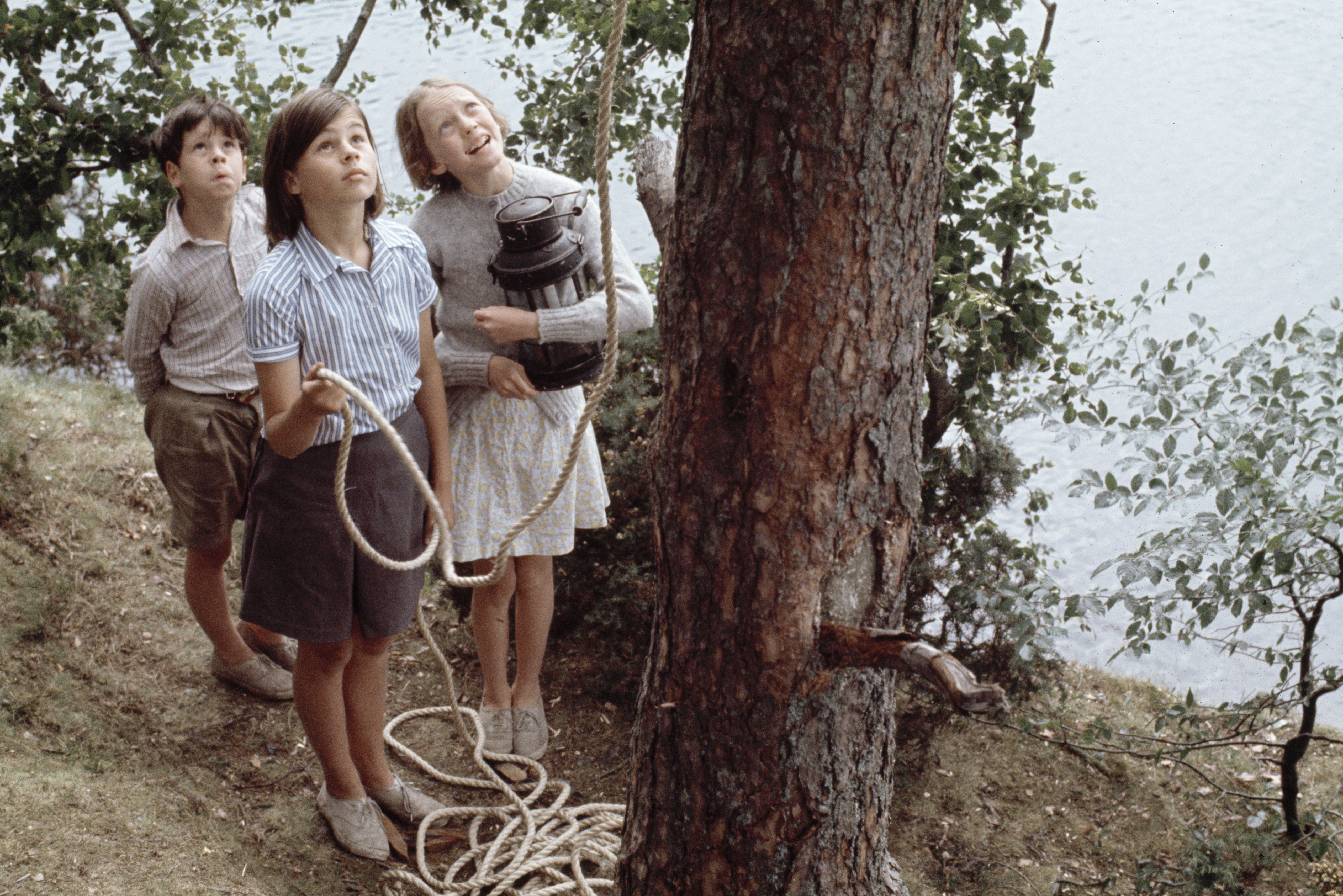
The crisis, in the story, is about the draft of a book being stolen, which I can only think must have been Ransome’s greatest fear. No one believes Titty, the youngest girl, who is sure she heard the burglars, so – in the film – she gets Roger to help her row Swallow to Cormorant Island where she finds it in what looks like a treasure chest.
Producer Richard Pilbrow and Production Associate Neville C Thompson on Derwentwater in the Lake District in 1973
Richard Pilbrow and Claude Whatham had a tough time making the movie. Filming in the Lake District with its unpredictable weather and pressure from tourists was not easy. We faced endless problems and over-ran by two weeks.
But Mum was praying, Granny was praying, the nuns must have been praying for me – we needed the covering: I was the only girl who never fell ill. Swallow’s mast broke. I fell in. Water sloshed into a support boat. The rain poured down. We nearly crashed into the Tern. Our life jackets proved useless. There was a gas leak in our bus. We could have had an explosion. Most of the crew smoked continuously.
Sophie Neville with Daphne Neville in the Lake District
The behavior of some members of the film crew was pretty toxic. Many drove too fast. A cow fell on to the producer’s car. I fell out of a tree whilst playing. Suzanna cut her finger. Ronald Fraser was almost permanently pickled. Someone got hit in the eye by a baseball. The film set was vandalized and I lost a tooth halfway through filming a scene with Virginia McKenna.
Virginia McKenna with Sophie Neville keeping her mouth shut ~ photo: Daphne Neville
We pushed on. Ran the race with perseverance. Somehow the challenges gave the finished film an edge, an enduring quality that made it into a classic.
Sophie Neville as Titty
The crew began asking if I would go on to act. The big question: was this a calling on my life? I didn’t just play Titty. I’d been part of the production team, suggesting that Ransome-like title graphics were used, that Seymour’s voice was used for Nancy. I didn’t want to act. I wanted to become a film director.
I’d enjoyed the post production work at Elstree Studios but disliked the fuss around the cinema release. Seeing yourself on camera always feels uncomfortable. The premiere of Swallows and Amazons was daunting.
Premier ticket for the Gala of ‘Swallows and Amazons’
It was first screened at the ABC in Shaftesbury Avenue alongside The Exorcist. But look! I literally had two guardians. My mother invited the nuns from school.
The ABC in Shaftesbury Avenue in 1974. It is now the Odeon Cinema.
Sister Allyne came. She didn’t flatter me but she was there.
Sister Allyne, Daphne Neville, Tamzin Neville and Sophie Neville
Like it or not, I ended up promoting the film on television. After I featured in ‘Animal Magic’, an image of me, rowing up the lake at Bakers Mill in the Cotswolds with a green parrot on my shoulder was used to replace the test card.
I grew too tall to continue playing children on screen and there was not much money for film finance in the 1970s when inflation was roaring. Sister Allyne prepared me for a film test for a musical Disney adaptation of ‘The Old Curiosity Shop’ but I wasn’t chosen. The movie flopped. I returned to my lessons.
At the age of fifteen I had a leading part in an adventure film with Vic Armstrong and Sophie Ward, called ‘The Copter Kids’, and I had a few little television parts in serials like ‘The Two Ronnies’ and ‘Crossroads’ while I was a student, but the drive wasn’t there. It was just as well. I didn’t have the bone structure.
Suzanna Hamilton playing Susan with Sophie Neville as Titty busy writing the ship’s log
Suzanna had a strong desire to act professionally and fought for parts. She went on to appear in Tess directed by Polanski, 1984 opposite John Hurt, Out of Africa with Meryl Streep, Whetherby with Vanessa Redgrave, Brimstone and Treacle with Sting, and a number of increasingly dark movies. She survived to appear in Casualty, New Tricks, Eastenders and is still working.
What she hated was the publicity. It’s a difficult part to any job. As she said at the age of twelve, having your photo on the front page of the Evening Standard ‘makes you felt a right twit’. She was furious with me for writing about her under sung talent in the Telegraph even though she looked beautiful in the arms of John Hurt.
I developed a burning desire to direct and went into television production. I made my first documentary for Channel 4 whilst driving from London to Johannesburg. I must have begun directing at the BBC at the age of 27 and produced my first series aged 29, but overdid it and was hammered by ill health. It was a good training. I learnt endurance, how to edit and I grew used to working to deadlines. I understood about moving the audience, cliff-hangers and bringing out books to accompany your work.
I didn’t learn to embrace the marketing aspect until I worked in the safari industry when I was assured it comprised 50% of the job. This attitude helped when I became and wildlife artist and later an author. After writing two books my readers – and my formatter – implored me to write about the making of Swallows and Amazons, especially once they learned that I had kept a diary whilst making it – as did Suzanna.
I first brought this out as a multimedia ebook, which is now in its second edition. It includes links to the cine footage my parents took on location. There are two versions of the paperback entitled ‘The Making of Swallows and Amazons’, seen here on the flag we captured.
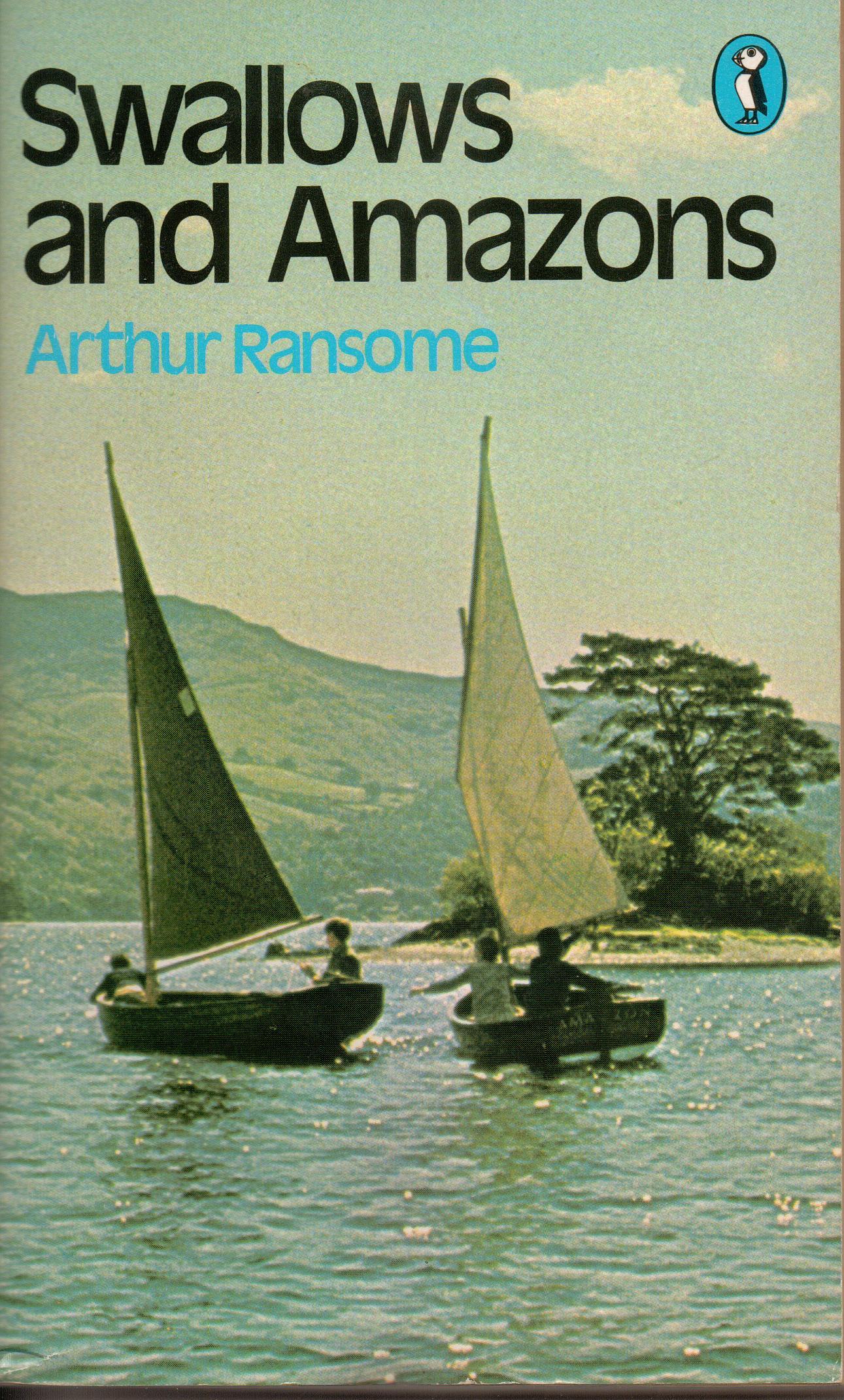
Different editions of ‘The Making of Swallows and Amazons (1974) by Sophie Neville’
It has been a delight to figurehead a story about sailing, a pillar of childhood that has influenced so many. Parents want me to engender a love for the outdoor life, sailing and exploring the lakes and countryside.
I hope I have helped to attract the right kind of people to the Lake District, that we have been able to inspire young people to read Arthur Ransome’s books, to get out into the countryside and sail, fish, go camping, build friendships, whatever the weather.
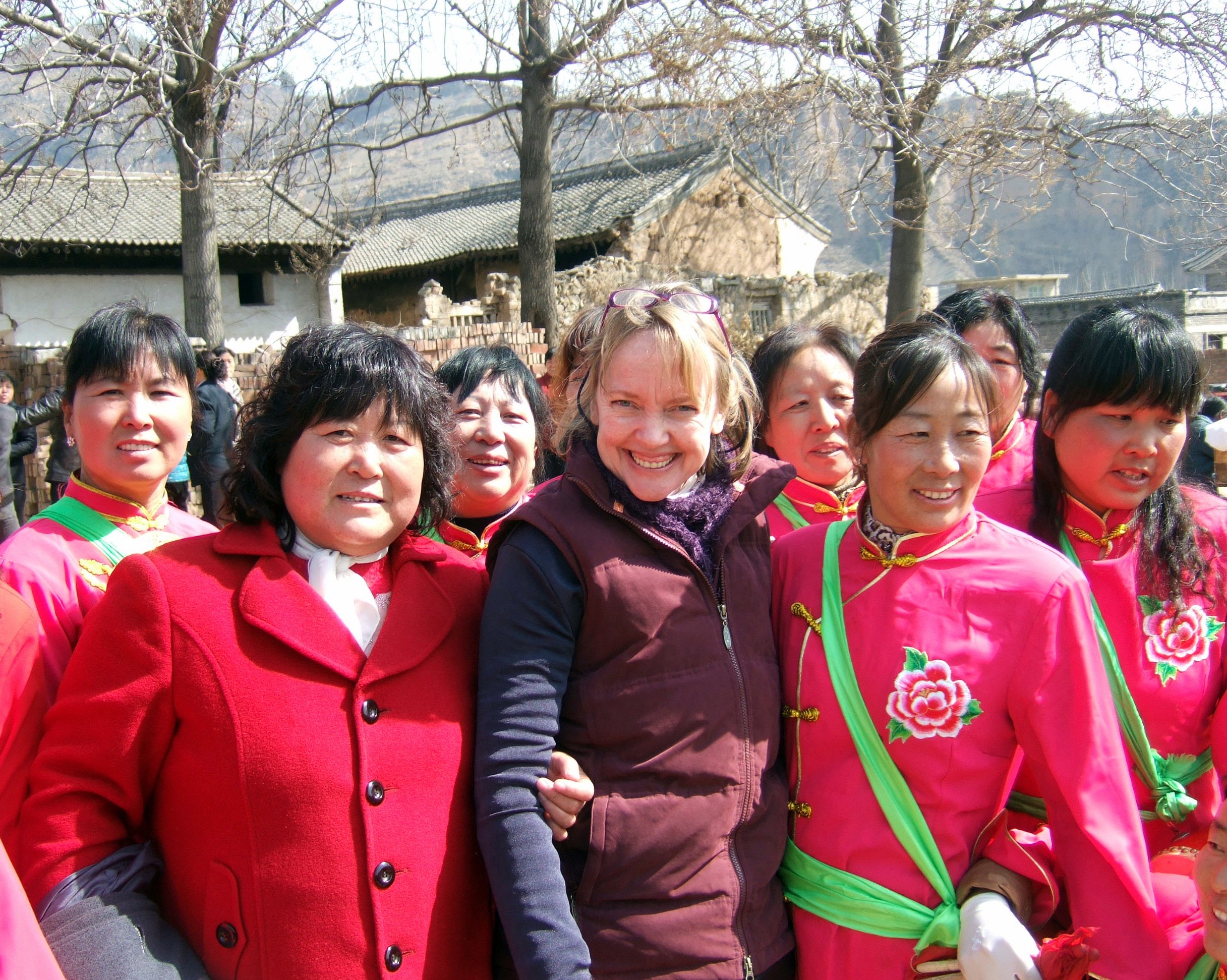
In the footsteps of Ransome’s great aunts, I went on a Bible Society mission to China. The people we met thanked us for coming, saying they hadn’t received European visitors for forty years. ‘But we’ve seen Europeans in town.’ ‘Them? They have just come to make money, not visit us.’
Does the old film shine a light, offer solace? People write in to tell me that the film of Swallows and Amazons carried them through a difficult patch. Some watch it once a week. It exists to remind people that they need not despair.
Does the symbolism still hold? It was my self-appointed job in the screenplay to wait, alone, and light the lantern, to be a light in the darkness that could be seen for miles.
Swallows and Amazons was not made to make money. It wasn’t the producer’s motivation. Richard Pilbrow just loved the books and wanted to bring them to life. We children didn’t do it for the money. There wasn’t very much. I earned £7.50 a day and was given a book token for appearing in the Lord Mayor’s Show. Even today, StudioCanal were reluctant to pay my expenses for re-launching the 40th Anniversary DVD when we were interviewed for the Extras package.
It doesn’t matter. I have been so warmly greeted so warmly by fans of the film. I was invited to become President of the Arthur Ransome Society, and have been offered numerous opportunities to speak about my books. I’ve passed on most of my speaking fees to charity – sending disadvantaged children in South Africa on an environmental course that has literally changed their lives.
Sophie Neville speaking at The Arthur Ransome Society
The treasure Titty found wasn’t pieces of eight. It was heavy to carry, but she was rewarded for her tenacity. She was given her heart’s desire, and parrots live a long time. They can easily outlive their owners.
The author Julia Jones points out that, ‘the treasure that was finally unearthed on Cormorant Island was a book. It might or might not have been a good book but the message of the story is quite clear: if you’re convinced that there’s something hidden under the rocks, all you can do is keep digging.’
An extra ordinary thing happened. When Richard Pilbrow was awarded an honorary degree from he invited Suzanna and I to lunch in London. As we left the restaurant in Covent Garden a group of buskers outside where singing the final sea shanty from the film, What Shall We Do With the Drunken Sailor? What were the chances of that? We hurried on to find transport and found ourselves outside the cinema where the premier had been held.
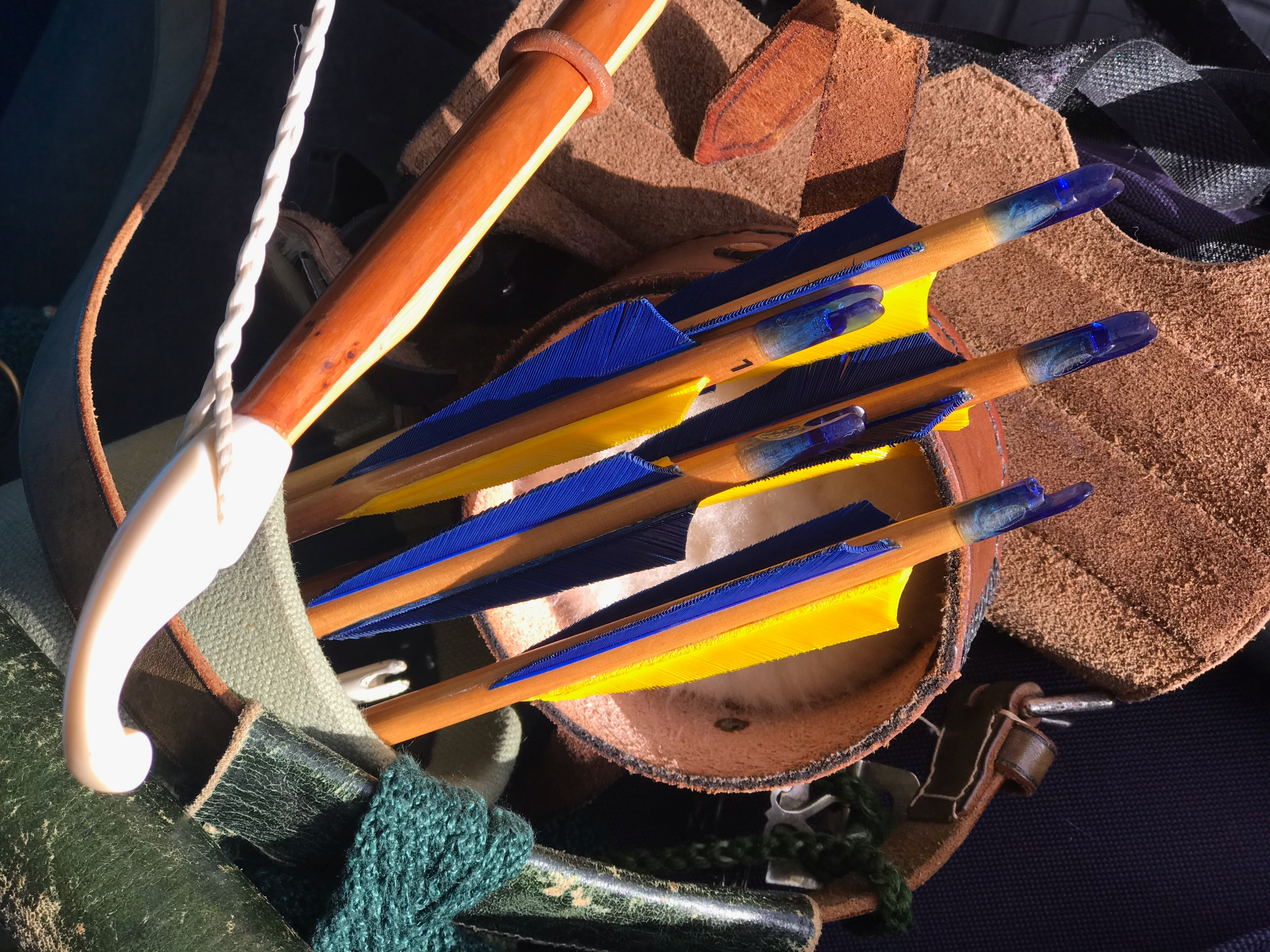
Something else happened to me as a result of Swallows and Amazons. Not what you might expect. We all wanted to learn to shoot with a bow and arrow. The next film role I was offered was as an archery champion. I kept up the sport, and ended up meeting my husband at a long bow meeting in the village where I was born. He was the chairman of the archery society. I won the Best Lady’s Gold. These are my colours:
Proverbs 23-23 talks of wisdom, instruction and insight. My name, Sophia, means wisdom. My hope is that others gain wisdom and insight from what I have written.
You can read more in ‘The Making of Swallows and Amazons’, which is coming out as an audiobook. It will available from all the retailers and is currently on Scribd here.
A write up of Sophie’s talk for BookBlest – the first Stroud Christian Book Festival – on The Making of Swallows and Amazons can be found on this website here
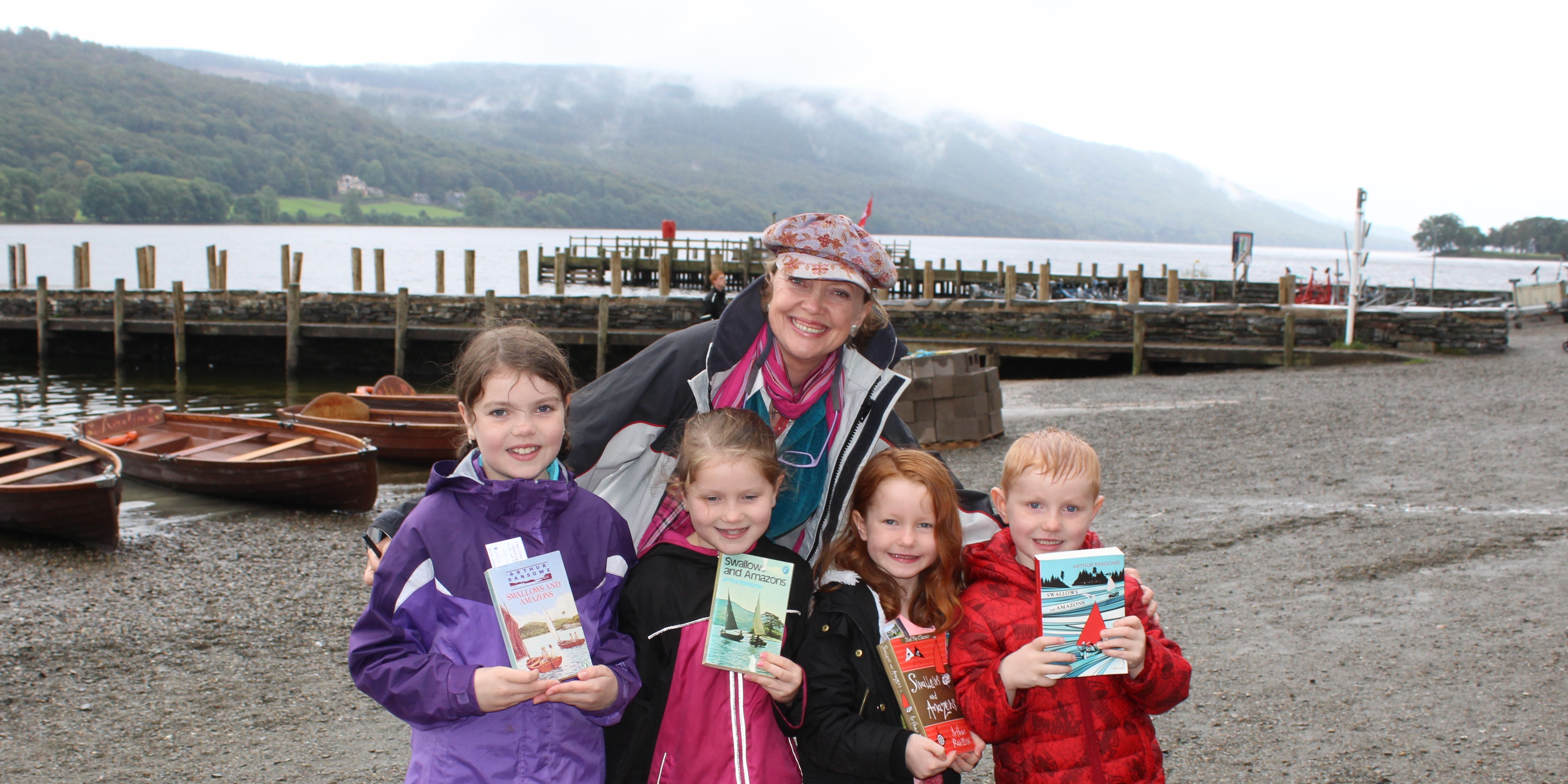
If you missed Sophie’s talk on ‘The Making of Swallows and Amazons’, you can read about her adventures in one of these editions, available online.
Different editions of ‘The Making of Swallows and Amazons (1974) by Sophie Neville’
There is a brief resume of the talk on this website, here Prepare to be taken back to the 1970s:
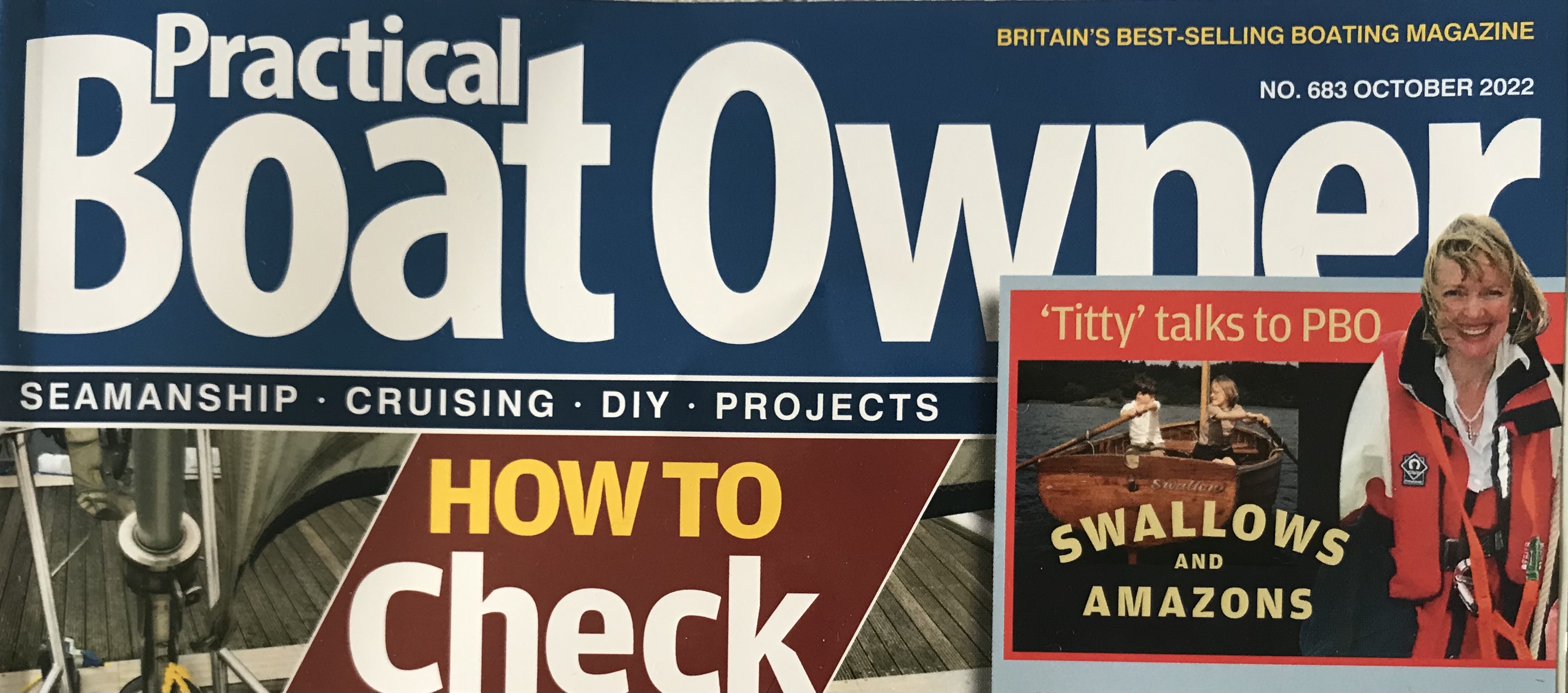
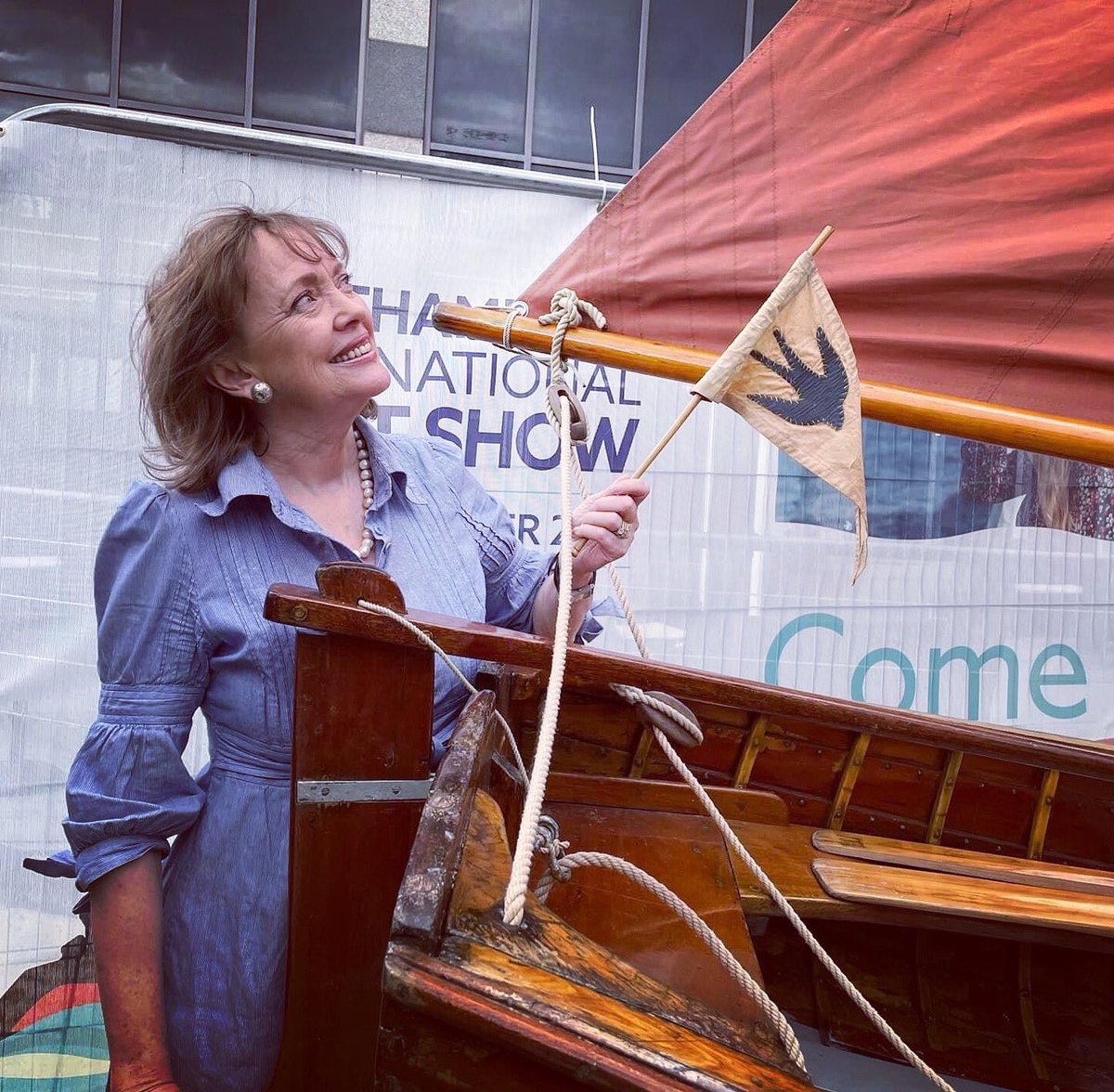
In 2022, Swallow, the dinghy that starred in the original film Swallows and Amazons was on display at the Southampton International Boat Show, greeting families as they arrive.
Sophie Neville who once played Titty Walker with her good little ship
Sophie Neville gave talks on filming afloat and the movie was made on location in the Lake District fifty years ago.
Over 103,000 people visit the show. Although busy, it did not feel crowded. There is a lot to see and do.
Sophie Neville speaking on the Foredeck Stage at #SIBS22
What is most memorable about the making of ‘Swallows and Amazons’ for you?
I love exploring the places Arthur Ransome features in his stories. We were privileged to live out the pages of the book on location in the Lake District, but sailing in nothing but a short cotton dress and a pair of navy blue gym knickers was decidedly chilly – we earned our passage.
Would you consider Susan to be an influence on Titty within the story?
Susan made camping on the island possible. Suzanna Hamilton, the remarkable British actress who played Susan in the original film of ‘Swallows and Amazons’, became our rock without becoming prim or losing the joy and excitement of adventure. She went on to play leading roles in a number of major movies including ‘Out of Africa’ opposite Meryl Streep and ‘1984’ with John Hurt and Richard Burton. She is still working on cutting edge productions and recently had a guest appearance in ‘Eastenders’.
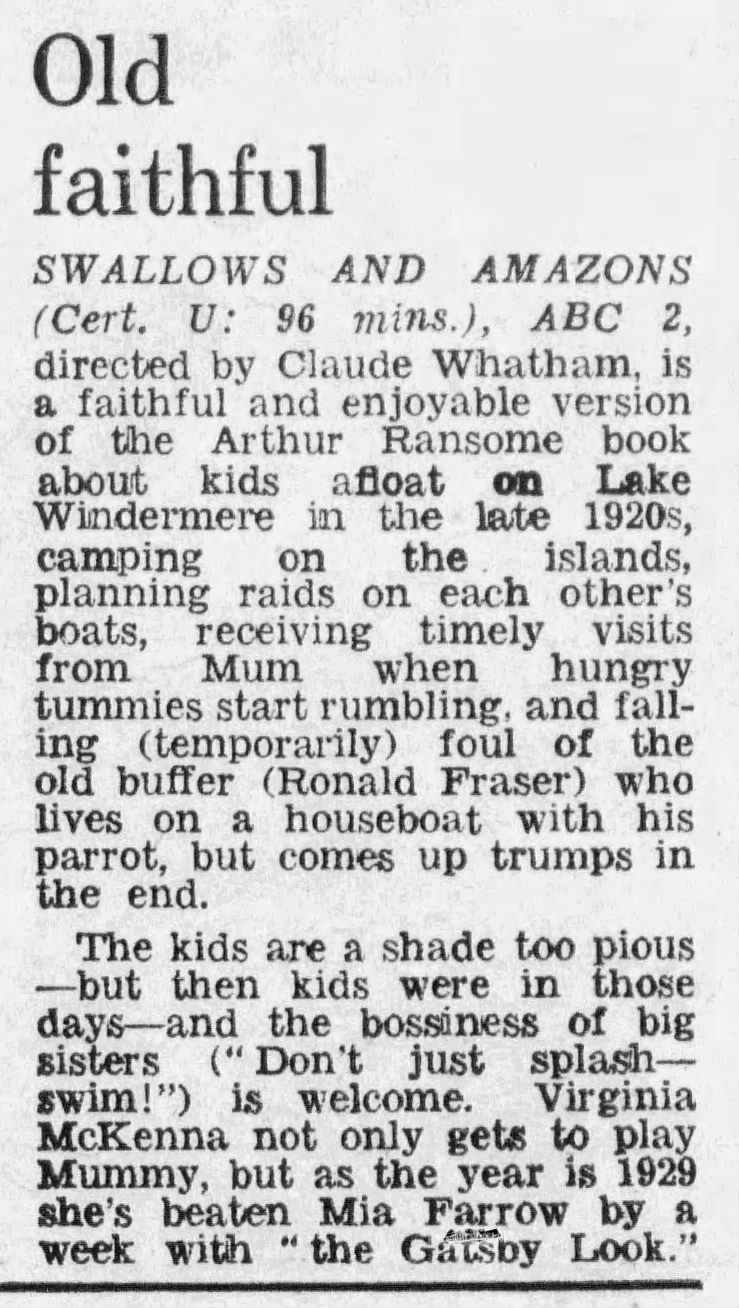
Time Out – April 1974
Is there anything you think should always be included in different versions of ‘Swallows and Amazons’?
You must feature the green parrot! It’s vital to enter the world of a 9-12 year old child, capturing the trepidation. It would be interesting to adapt Arthur Ransome’s books without featuring adults, or only including them as shadowy facilitators.
How did you feel about playing a part where you were able to be the cunning and playful younger sister?
In real life, I was the elder of three sisters so took on the roles of both John and Susan. Playing Titty felt something of a release. I was freed from the responsibility of taking the helm.
Titty is well-read and bright, creative and imaginative but I wouldn’t call her cunning. She longs to be alone on the island to experience what it was like to be Robinson Crusoe, which is why she volunteers to stay behind to light the candles, but is that a cunning plot? She is an innocent.
What was your favourite line in Swallows and Amazons?
Titty’s lines are challenging and can only be uttered with humour and an acceleration of charm. I rather enjoyed, ‘X marks the spot where we ate six missionaries’, although I don’t think it can be found in the book. ‘Thank you so much for letting us see your lovely serpent’ would probably be disallowed these days.
Did you have a favourite scene?
Finding the lighthouse tree was a short sequence that worked well. We shot it on the banks of Derwentwater towards the end of the filming. But I most enjoyed our day with the charcoal burners. They were wonderful.
What did you enjoy most about filming in the Lake District?
We loved High Force, the waterfall, and exploring the mossy woodlands. Secret Harbour on Peel Island is very special, as is One Tree Island where we found the treasure.
Do you feel that you and your character influenced children?
Even now, nearly 48 years after the film was released, I receive correspondence from people telling me how the original film of ‘Swallows and Amazons’ influenced their lives or helped carry them through a tough patch. It is always wonderful to hear how Titty has inspired others.
Maurice Thomas who used to live in Cockermouth wrote: ‘My mum and my Auntie Gladys took me to see this little children’s flick in 1974/5 as it was a double bill with ‘The Railway Children‘. I remember ‘The Railway Children‘ reasonably fondly, but ‘Swallows & Amazons‘ had me utterly mesmerised.’
If you were to give any advice to actors wanting to perform in ‘Swallows and Amazons’ what would it be?
Visit the locations. Go to Bank Ground Farm and run, fast, down the field to dip your hands in the lake as Arthur Ransome did as a child. Capture that feeling and carry it with you as you sing out the lines.
And be prepared for the impact the story will have. It could follow you all your life.



































 Sophie Neville