
16th May 1973, was the third day of filming the original movie ‘Swallows and Amazons’. My mother wrote a letter to my father who was at home in Gloucestershire with my two younger sisters.


Mum kept all her letters, my diaries and scrapbooks in a smart carrier bag. It once contained an expensive velvet dress bought for me in Carnaby Street when we met Claude Whatham, the director of Swallows and Amazons back in April 1973
1970’s English food ~
The food at our guesthouse was talking its toll. It was not a good idea to feed children on packet soups and baked beans in the days when 35mm film stock was so extremely expensive. No one realised why, but the ingredients made Sten hyper-active, or as my mother put it, ‘causing a little hoo hah.’ A visiting journalist wrote, ‘By the end of the day Roger, aged seven, had mown down the entire film crew using a hammer as a mock machine gun. He had fallen down several times and emerged with grazed knees all splattered with mud.’
Location catering ~
Suzanna Hamilton, who was playing Susan, simply refused to eat the revolting food. Mum said, “I couldn’t get her to eat anything.” Location catering is excellent now but back in the early 1970’s it could be pretty basic canteen food produced from a ‘chuck wagon’. We’d queue up for a tray of meat and two veg, which was usually consumed in a red London double-decker converted into a dining bus. There were no salads, no fruit, just a working man’s lunch with coffee in plastic cups and paste sandwiches provided later with tea. The tea was good.
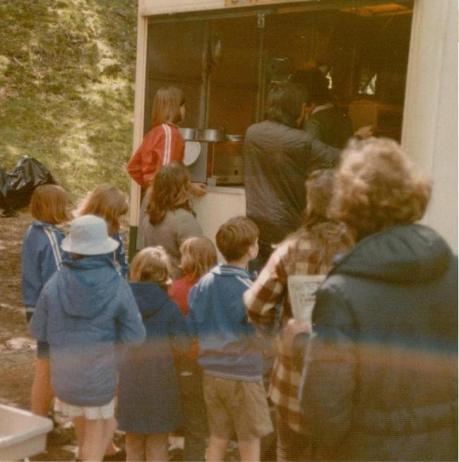
The fruit bowl in our bus ~
Mum started to order fruit and we relished it. Back then, it was a huge treat to have bananas or melon, oranges and grapes. A bowl sat in our bus where we were given lessons on Formica tables downstairs. The upper deck was used by Terry the Wardrobe Master as as our changing room. It was furnished with bunk beds, which Mum made me rest on after lunch. I don’t think she could pin down the Amazons and I objected at first but I must have needed to lie down and rest properly, especially when it was cold.

Molly and Richard Pilbrow on location with the two red London Double Decker buses where coffee was being served ~ photo: Daphne Neville
The film crew ~
Apart from Sue Merry, the ‘Continuity Girl’, the film crew consisted entirely of men, forty-five of them. I include the Hair and Make-up Designers, the Wardrobe Master, the Art Director, Set Dresser, Prop Master and Carpenter, Sound Recordist and Boom Operator, the Director of Photography, Camera Operator, Focus Puller and Grips with the Electricians from Lee Electric who looked after the lights and generators, Lorry Drivers and Sailing Director, the Director, three Assistant Directors and the Production Associate and Producer. I think there might have been a Film Accountant and Location Manager. Being a feature film financed by EMI Films we had a permanent Stills Photographer and a Publicity Manager. And this was a small crew as Terry seemed to cope without Wardrobe Assistants or Dressers. They all knew each other pretty well from being on previous movies. I have a list of where they had digs in Ambleside. It’s quite interesting to see who shared with who.
Whenever we needed boats, six local boatmen could also join the queue for the chuck wagon – and the mobile loos. Mum wouldn’t let me use them. They were looked after by a ratty looking chap who later managed to persuade one of the Ambleside girls that he was the film’s Producer.
Neville Thompson, who was effectively the on-line Producer, had a production secretary called Sally Shewing, but she must have been stuck in the office as we never saw her. Molly Friedel, Richard Pilbrow’s girlfriend and assistant, was often on location. We adored her. She was American, tall with long brown hair and always had time for us. I remember her working on the lighting design for the next Rolling Stones Concert by the shore of Coniston Water whilst we milled about, playing on the rocks.
We had our tutor, Mrs Causey and a wonderful mini-bus driver called Jean McGill. She had been a top air steward but had returned to Cumbria to look after her ailing mother and drove us around the area to keep busy. As soon as we found out that she was also a qualified nursing sister, Mum made sure that Jean was taken on as the official location nurse. This was great as it meant she could be around the whole time and we never had to wait for the bus. We found we soon needed a nurse too. Someone was always hurting themselves.

So in all, with our chaperones there were usually about six women around as well as journalists, friends and relatives who came to watch. It was a huge circus with often eighty people milling about. Certainly the Call Sheet asks the caterers to provide lunch for seventy on normal days. It would be much more when we had crowd scenes such as when we explored Rio.
The male:female ratio on crews is very different today. There are often more women than men, perhaps not on movie sets, but certainly on BBC drama crews. It was already different by 1983 when Richard and Molly Pilbrow came to visit us on the location of Coot Club in Norfolk, when there were about equal numbers of men and women on location. It made for a better, family atmosphere, certainly more appropriate with so many children involved. Since he still held the rights to Arthur Ransome’s series of Swallows and Amazons books, Richard Pilbrow was the Executive Producer on the BBC serial Joe Waters produced. It was so good to see him again. I gather he is still going strong having just been awarded the Knights of Illumination Lifetime Recognition Award for more than fifty years of work in theatre lighting.
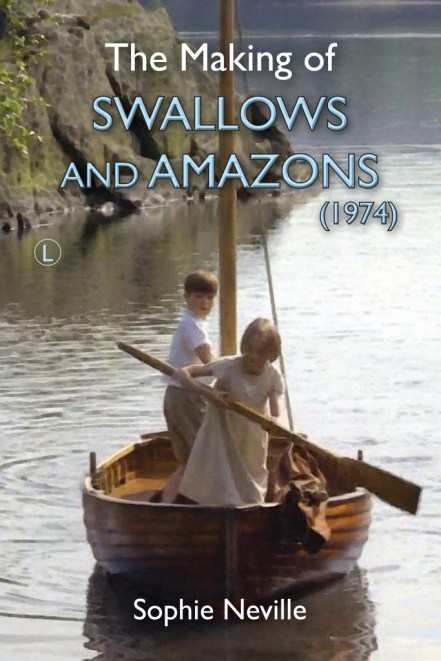
You can read more about ‘The Making of Swallows and Amazons’, now available as an audiobook.




 Sophie Neville