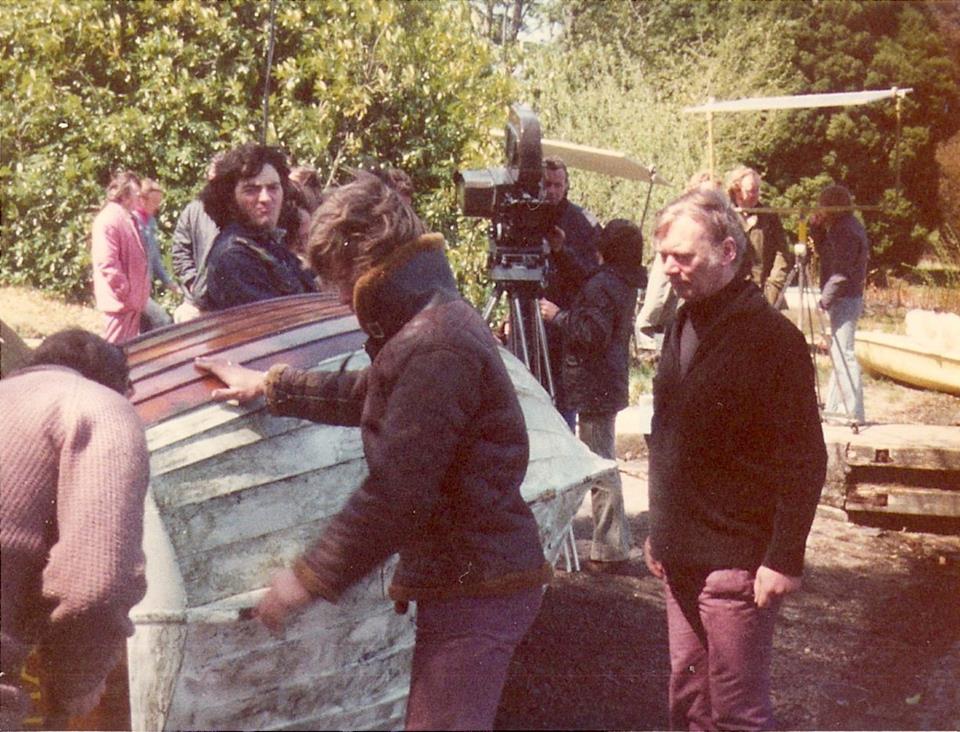
The Amazon’s time had come. In the script, the short scene where Nancy and Peggy careen their dinghy is set in the Amazon boathouse, but Claude Whatham shot them scrubbing its underside by the lake with Beckfoot beyond, showing their background. Nancy threw a bucket of water over him for his pains. It was a complete accident. She actually chucked the water onto the bottom of the boat but it splashed back. He was squatting below the camera to the right and got soaked by what must have been cold lake water. Kit Seymour flung back her head and roared with laughter. He took in it good spirit, but only up to a point. I don’t think he had anything else to wear.
David Blagden the sailing director, David Cadwallader the grip, and David Bracknell the first assistant looking at the Amazon’s bottom with DPO Denis Lewiston with the 35mm Panavision
Kit Seymour wrote in her diary:
‘This is the day I had been waiting for. The Amazons had at last begun filming. We got changed and had to be made up sunburnt. We then rehearsed what to do. We did the second scene. I quite accidently threw a bucket of water at Claude. After lunch we had to film the interior of the boat house. Peggy had to say, ‘Not a breath of wind.’ This was quite funny becasue our hair was flying about everywhere. They had to film this scene quite a lot of times.’ She was quote in The Times newspaper, spelling mistakes and all.
I was a conscientious child and keen not to fall behind with my school work. Children under the age of sixteen have to be issued with a licence by their local education authority before they can act in films. Mum, who was our legal chaperone on location, decided it would be quite fine if we did fifteen schooling hours a week rather than a minimum of three hours a day, as stipulated in the rule book. I spent my time catching up in our school bus as I had done little the day before as I had been acting with Virginia McKenna.
Mum was equally fluid about the time we spent on set – or indeed on location. Sten Grendon, who played Roger, was aged nine. I now know he was meant to go home every day at 4.30pm but we all returned together whenever it was deemed practical. However, Sten’s mother Jane was with him and if ever there was a child who needed to expend energy it was he. Sending him back to the Oaklands Guest House early could have endangered the people of Ambleside. It did us a lot of good to work hard, and cope with real, if channelled, responsibility. We were all busting with energy, so much that I grazed my leg badly climbing a tree at lunch time that day. Claude put a stop to any more dangerous activities as a result. He couldn’t risk any of us getting injured.
My sister Tamzin Neville broke her ankle when she was in the middle of playing Anthea, the leading role in a BBC serialisation of E.Nesbit’s The Phoenix and the Carpet. It could have been a disaster but she wore long Edwardian dresses with petticoats that covered up her splint. My legs were fully on display in Swallows and Amazons. If I hadn’t have been wearing dungarees when I climbed that tree the world would have seen the scratch.
I can remember admiring the large house featured as Beckfoot, the Blackett’s house on the lakeside, and wandering past towering the rhododendrons in the garden, but I have no idea where is is. Christina Hardyment felt that Arthur Ransome must have modelled Beckfoot on Lanehead, the Collingwoods’ house on the East of Lake road above Coniston, but the film required a big house with lawns going down to a lake. John Ward has written in to say that we used Brown Howe House on the western Shore of Coniston Water south of Peel Island. The boathouse is also there on the edge of the lake.
Here we are at lunchtime, captured on Dad’s cine camera:
It is aways wonderful to hear how the film of Swallows and Amazons has effected people’s lives. I have just had such an interesting e-mail from Australia. I only wish that Claude Whatham was alive to read it.
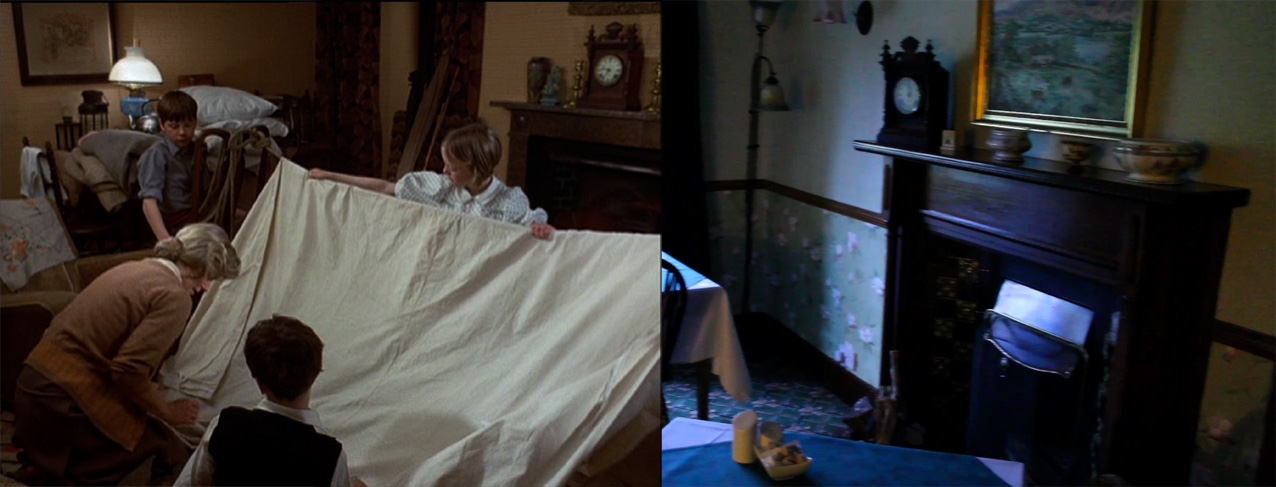
Did anyone else know about the the clock on the mantelpiece at Bank Ground Farm?
In the film – and in real life
Dear Sophie,
I can not tell you how much I am enjoying your website. I’ve searched for scraps of material regarding the making of Swallows and Amazons for decades, but you post more information in one day than I gleaned in a lifetime. It’s a fabulous insight, and one I really appreciate.
I became a film-maker largely because of Swallows and Amazons. I’ve written a small piece about this, which is going to be published in a promo for one of my film-making books. As a nine year old, I stumbled across Wild Cat Island just days after seeing the film. I was so thrilled to be standing where the film had been made, and so excited to see how clever use of the camera could exaggerate the feeling of a location and capture the magic of performance, that I set out to discover everything I could about film. It was a life-changing moment.
My daughters (5 and 7) adore Titty, and we are all impressed by your acting. I’ve directed my girls in a couple of things, and I know they gained confidence from having seen you perform. When Tabitha, my eldest daughter, saw the film for the first time, she burst into tears at the end. It was a release of pure joy, and is testament to the quality of the film.
I live in Australia now, but returned to the island in 2010 with Tabitha and Harriet (rowing all the way from the other end of the lake). We stayed at Bank Ground Farm. This months we went back and were lucky enough to sail Swallow into the Secret Harbour. It was a windy October day, and quite a frantic sail, but I can honestly say it was one of the highlights of my life.
When reading your recent post about set dressing at Bank Ground Farm, I wondered if you’d noticed that the clock on the mantlepiece is still there. It’s on the other mantlepiece, I believe, but it is still there. I have no idea whether it is a prop that was left behind, or whether the film-makers used the clock that belonged to the farm.
Thanks again.
Best wishes,
Chris
Christopher Kenworthy
Art Director Simon Holland painting labels for cans of Pemican on Mrs Batty’s lawn at Bank Ground Farm in 1973 ~ photo: Daphne Neville
Our set designer or ‘Art Director’ on Swallows and Amazons was Simon Holland. He worked tirelessly with his assistant Ian Whittaker and team of prop men, making every effort to use absolutely authentic props and set dressing. It must have involved quite a bit of research. Holly Howe, for instance would not have had mains electricity or back in 1929, so he made sure oil lamps were on set. These would have been modified by the Sparks so that it looked as if they lit the room in those evening scenes when we were busy packing.
The people of the Lake District still remember Simon asking if he could buy old tins of food. It seemed such an unusual request. When it came to making labels for the cans of ‘Pemmican’ he painted them himself ~
Simon had worked as the set dresser on the thriller Callan starring Edward Woodward, that we all saw in 1974. He had earlier been the Art Director on Bartleby, which featured Paul Scholfield with John McEnery in the title role. Swallows and Amazons must have been one of his first features. He was only thirty-two that summer of 1973.
Simon Holland went to to work on well known movies such as Equus, Greystoke, Quadrophenia, The Sleeping Dictionary set in Sarawakand Tales of the Riverbank which starred Stephen Fry as the Owl and Miranda Hart as Miss March. He sadly died in 2010 at the age of 70 but will be remembered fondly by us all.
I have found the entry that Suzanna wrote in her diary at this time when we were filming at Bank Ground Farm. She drew a picture of the blue and white checked dress she wore and described an interview with a reporter.
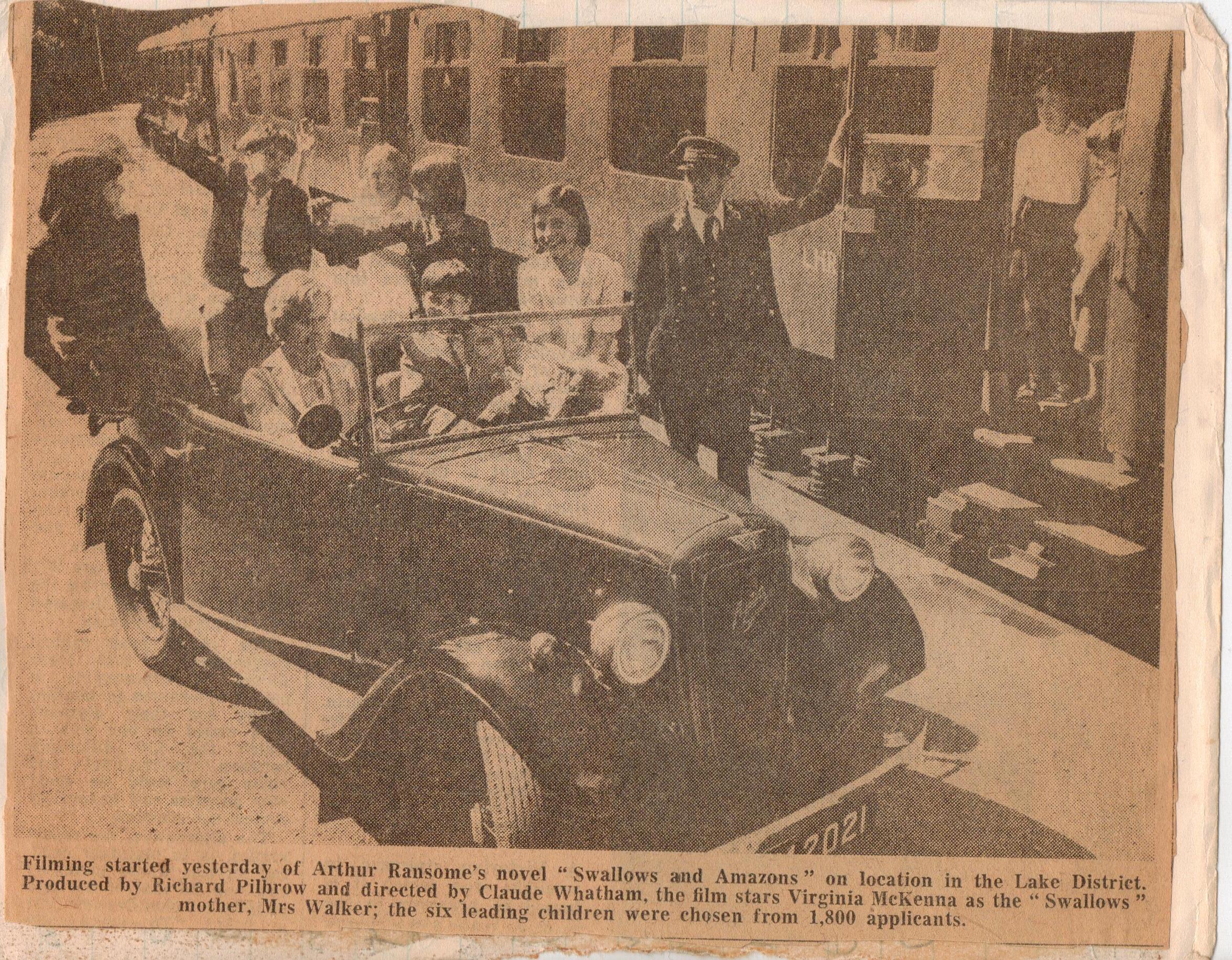
This is the newspaper clipping that Suzanna stuck in her dairy that featured Virginia McKenna and the six of us children in one of the old motors that Simon Holland found to dress the Railway Platform set at Haverthwaite Station on the first day of filming.
A clipping from The Guardian Newspaper 15th May 1973
Serendipity [ser-uh n-dip-i-tee] an aptitude or faculty for making desirable discoveries by accident
Serendipity indeed. The word has been quoted to me so many times that I’ve started to take note. The serendipit in question connects me to a rather large, bald man with massive moustaches called Arthur Ransome.
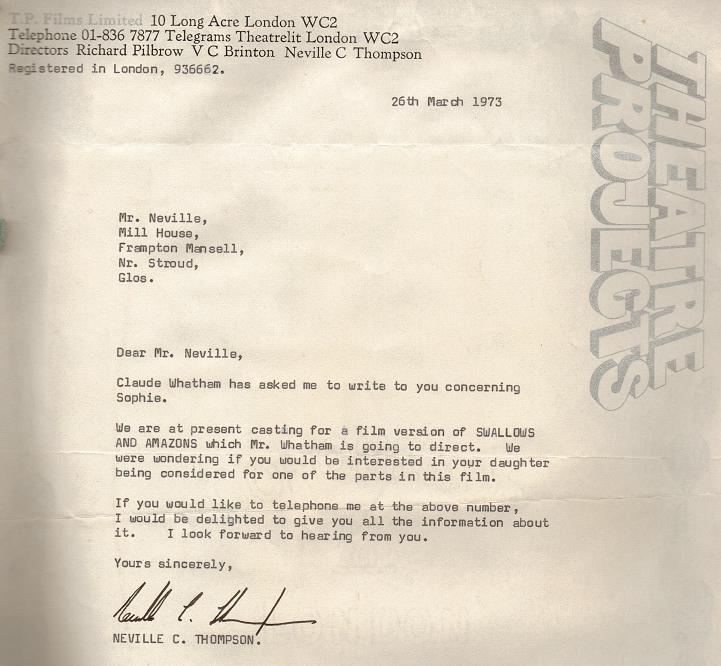
In March 1973 my father was sent a letter, completely out of the blue:
We are at present casting for a film version of SWALLOWS AND AMAZONS which Mr Whatham is going to direct. We were wondering if you would be interested in your daughter being considered for one of the parts in this film. Amazing!
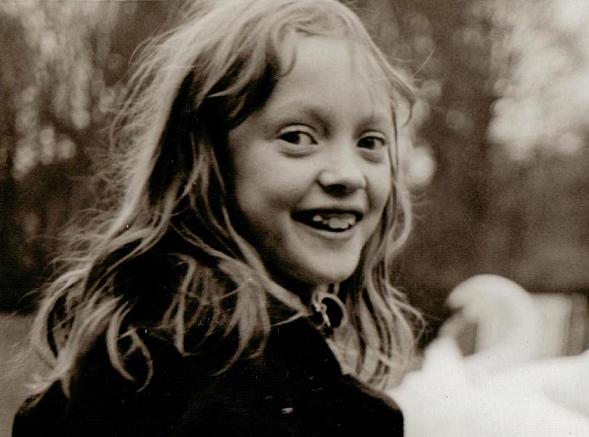
Sophie Neville as a child ~ photo: Martin Neville
To gain a part I had to be able to swim well. I think this was to do with ensuring I was unlikely to drown. As it happened I could row, sail and swim. My parents had taught me but I can’t remember Claude Whatham asking me about this when he interviewed me. He wanted to know what my favourite Television programme was.
‘Blue Peter!’
‘Why?’,
‘Because they show you how to do things.’
It was exactly what Mr Whatham wanted to hear. Why? Because that is what Arthur Ransome does in his books. He doesn’t tell. He shows his readers how to sail. And how to camp. By the age of twelve I had already read about seven books in the series and loved the stories. What I didn’t know then was the effect they would have on the rest of my life.
By May 1973 I was on my way up to the Lake District to play Titty Walker in the feature film being produced by Theatre Projects and distributed by EMI. I didn’t think I was right as Titty at all. In real life Titty had been Anglo-Armenian and grew up in Syria. The illustrations show her with dark hair, cut in a bob. And I thought of myself as far more like the practical Susan, Titty’s older sister. However I was assured that I could play Titty and I did. Able seaman Titty, crew of the Swallow. Thankfully they cut my straggly blonde hair and I sang out the dialogue that I already knew off by heart from reading the book, ‘I expect someone hid on the island hundreds and hundreds of years ago.’
How the real parrot arrived on my shoulder I can’t quite remember but within months of returning from Coniston Water I had a green and yellow parrot of my own. I think he had outlived his owner and was given to us to keep. He was good company and very chatty. I adored him and could take him anywhere. When I was asked to be in Animal Magic to talk about the film he sat on my shoulder while I was rowing a boat, and I think did most of the talking.What I didn’t realise was how themes from Arthur Ransome’s life would follow me through the rest of my life.
When the time came for me to matriculate I went to Collingwood College at the University of Durham. The name resonated later when I discovered that W.D. Collingwood’s grandchildren were the real Swallows. W.D. Collingwood was an archaeologist living above Coniston Water, where the books are set, and had excavated Peel Island– or Wild Cat Island– finding the remains of a Viking settlement there. Some one had hidden there hundred of years ago. WD Collingwood Titty’s grandfather studied at the Slade, as did my own grandfather, HW Neville. He may have been there at the same time as Titty’s mother Dora Collingwood.
Arthur Ransome won a Kitchener Scholarship. Years later these rare awards have been won by both my niece and my nephew. When Arthur Ransome first lived in London, he had digs in Hollywood Road. When I moved to London I shared flats with friends, first in Tregunter Road, then Harcourt Terrance, which ware merely extensions of Hollywood Road, which is off the Fulham Road in West Brompton. I had gained a graduate traineeship at the BBC. The first drama series that I worked on was Swallows and Amazons Forever! an adaptation of Arthur Ransome’s books set on the Norfolk Broads, Coot Club and The Big Six. It was not a chance thing, I contacted the Producer and asked if I could work on the series, but the fact that I’d heard about it was unusual, and amazing really that it was made that year when I was available to join the production team. I had first worked with Rosemary Leach, who played The Admiral – Mrs Barrable, when she starred, not as Missee Lee, but as Mrs Lee in Cider with Rosie. I later found myself working with William the Pug dog on Eastenders when he featured as Ethel’s ‘Little Willie’ . It was such fun to see him again. He was a playful little dog with a great sense of fun.
Coot Club and The Big Six
The first documentary I directed for the BBC involved an adder. I was filming in at a Nature Reserve in Dorset with a group of children who came across one immediately. It was huge, a black adder. The Billies would have declared this a great sign of luck. I’m not sure I thought much about Swallows and Amazons, over the next few years but I did film at a school in Cumbria and loved being back in the Lakes.
After working at the BBC for eight years I fell ill and, much like Arthur Ransome, had to abandon my full time job to work from home. Like him I had a yearning to spend as much time as possible in the great outdoors and chose to live in the wilderness. I spent my time exploring southern Africa, camping and cooking on fires. Of the subjects I’d studied at university the ones I most enjoyed were cartography and water-colours. I started to earn my living by drawing birds, animals and decorative maps. The maps usually depicted game reserves and involved giving names to landmarks as places of interest, just like Titty’s maps. I must have drawn forty maps in the style of those on the original cover of Swallows and Amazons, using the same borders and style of lettering. And I kept diaries, writing just as Titty would have done. I also worked freelance for the BBC, mainly setting up wildlife programmes. A rye smile did pass my lips when I was asked to find South African items for Blue Peter. I was thinking back to my first interview at Theatre Projects with Claude. They came to South Africa for their summer expedition one year, and it was I who sent them off to film the Outspan harvest and wild dog puppies in the Kruger National Park. After a while I fell into the pattern of flying back to England at Easter time and returning to Africa in the autumn. This was partly through choice, partly to comply with visa regulations and work commitments. I’d migrate every year with the swallows.
When we were making the feature film of Swallows and Amazons my mother looked after all six children. The girls playing the Amazons, Nancy and Peggy Blackett, needed to learn how to shoot with a bow and arrow. My mother taught them. She had learnt how to draw a long bow when she was first married, and was encouraged by an ex-Olympian called Bertie. I became interested too, which stood me in good stead as the next part I had in a feature film was playing Liz Peters, a fictional archery champion.
Thirty years after the premier of Swallows and Amazons I had flown back from Africa and was staying at my parents’ house, when a lady arrived from Korea. She timidly knocked on the door, explaining that she was translating Swallows and Amazons into Chinese and would love to talk to me about the book. She came bearing gifts: a hand-quilted wedding bedspread and a pile of silk garments amounting to a bride’s trousseaux. It was a week after I had met my husband-to-be. At that stage he had not even asked me out and I had no idea we would marry. I’d met him at the archery – shooting with my bow and arrow. He was Bertie’s grandson. My three sisters have never been a bit interested in archery. If I hadn’t been enthused by Swallows and Amazons, and consequently taken it up to play Liz Peters, I would never have met my husband. I still have the wedding quilt.
Sophie with her husband on the coast of South Africa
And then I met Dr Frankland, a Harley Street Consultant who was to become an historical adviser on a script I was developing. I soon learnt that Bill Frankland had been a good friend of Roger Altounyan and knew his sister Titty. As young men they both worked for Alexander Flemming.
Roger, Titty and their elder sisters Susie and Taqui were W.D.Collingwood’s grandchildren, the real characters on which Arthur Ransome based the Swallows. What I didn’t know was that Roger Altounyan became an allergist. He developed the spin-inhaler, experimenting on himself. Dr Frankland explained that he eventually died as a result. I was allergic to feathers as a child and prone to horrific asthma attacks. Not from parrot’s feathers but old pillows and eiderdowns. The Ventolin inhaler is something to which I probably owe my life. Dr Frankland, who is to celebrate his 100th birthday this March, still works as a Harley Street allergist and is often called upon to make broadcasts on Radio 4. He instigated the pollen count, numbered Saddam Hussein as one of his most grateful patients and has been the expert witness at a number of murder trials.
Bertie’s Olympic bow now hangs on my stairs. I am still sailing dinghies, still drawing maps but thankfully no longer suffer from asthma. Harbour Pictures with BBC Films are now planning a new film adaptation of Swallows and Amazons. A whole new generation of children will be shown how to sail and camp and cook on open fires. I couldn’t be more thrilled.








 Sophie Neville