I’m posting this collection of images with immense gratitude for all the help, support and encouragement I received in 2024.
I was unwell for the first six months of the year with one chest infection after another, but whilst languishing in bed I managed to improve a couple of screenplays I’ve been working on and the novels that accompany them.
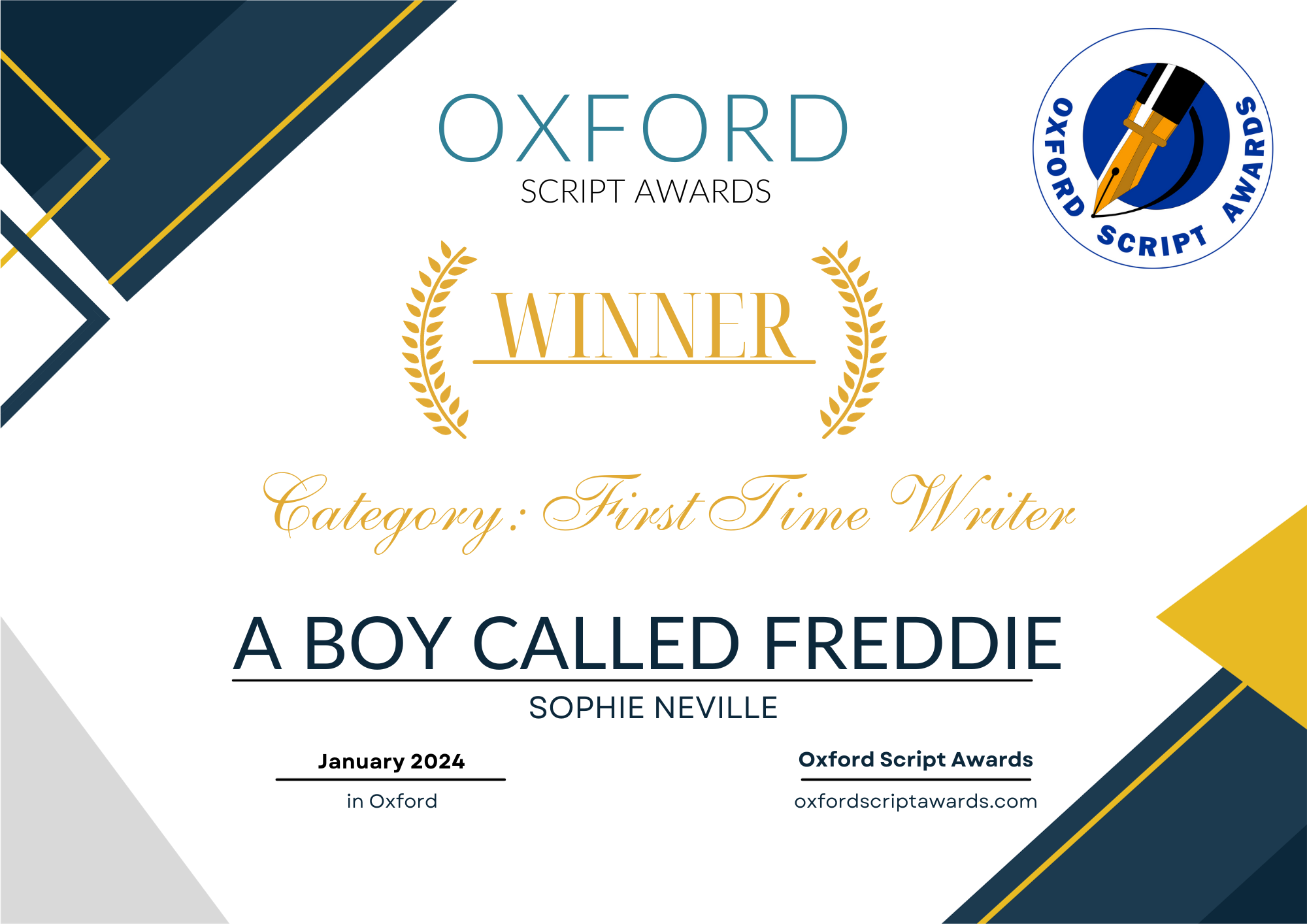
My biopic on Freddie Mercury’s teenage adventures in Zanzibar won about ten international script awards and was selected for many more including the Best Feature Screenplay at the Berlin Art Film Festival
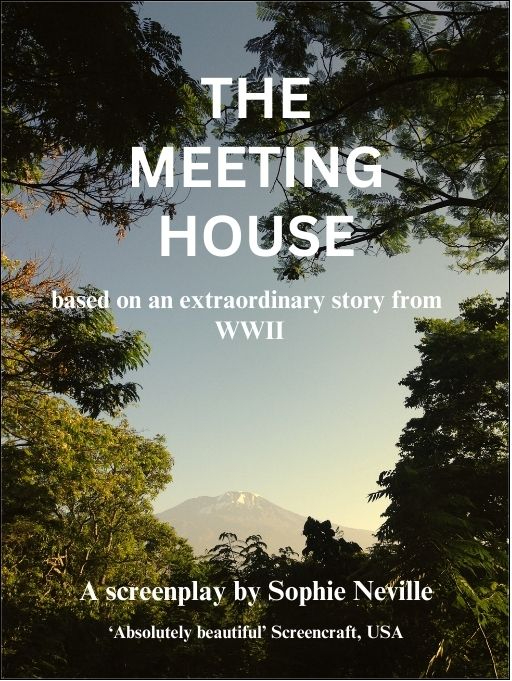
My WWII story set in East Africa, Burma and Japan won about seventeen awards including the Page Turner Award for Best True Story.
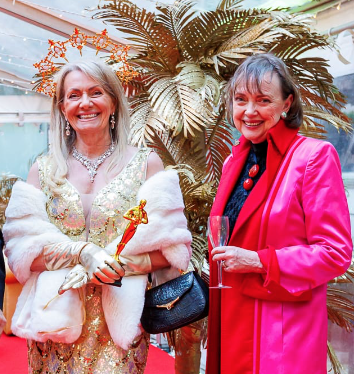
Sadly, I contracted Covid quite badly and couldn’t get to more than one awards ceremony but did make it to a Hollywood party in London.
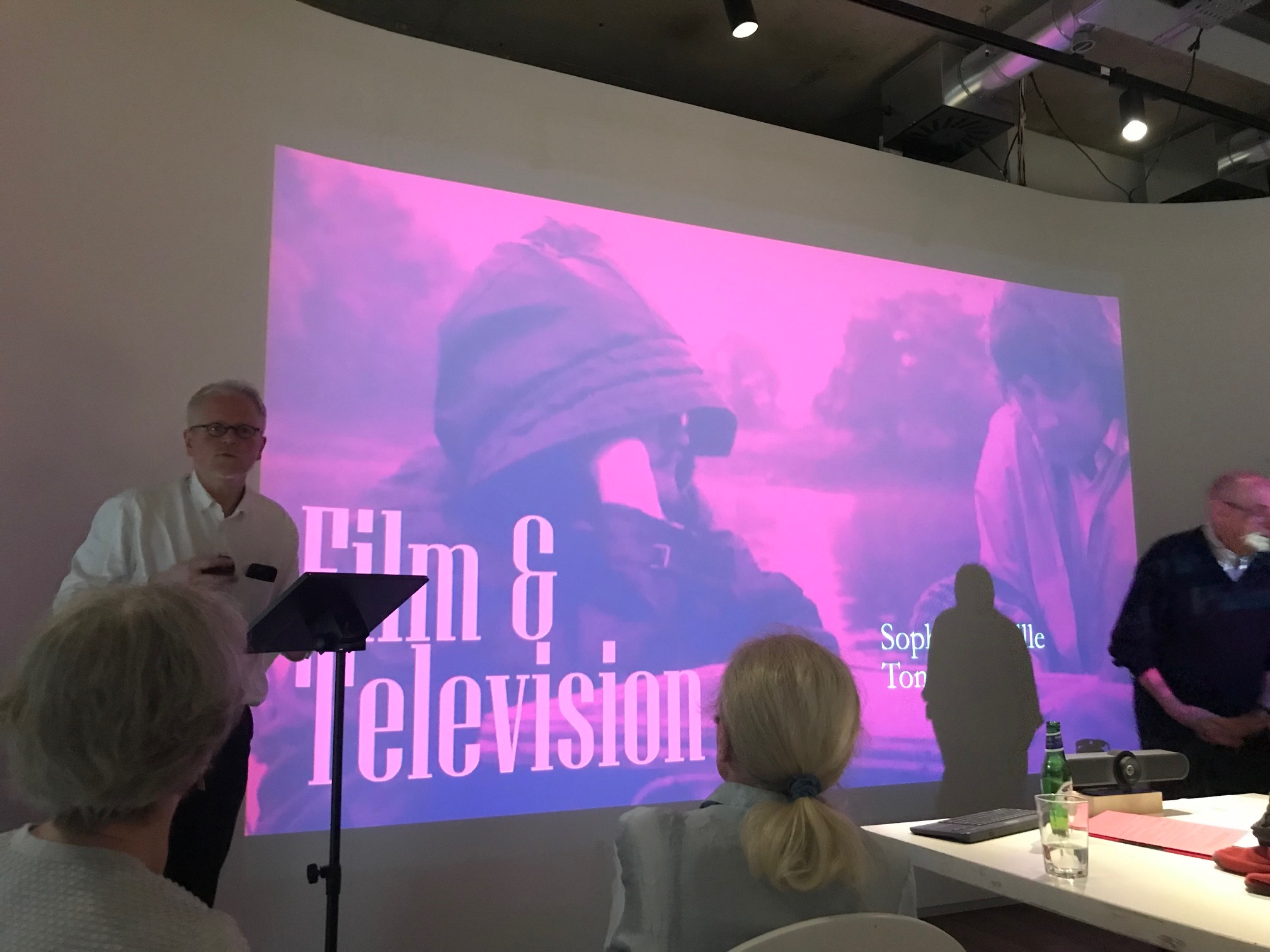
Fundraiser Caroline Dolby with Sophie Nevillle.
This story was well received in Europe, particularly in Germany.
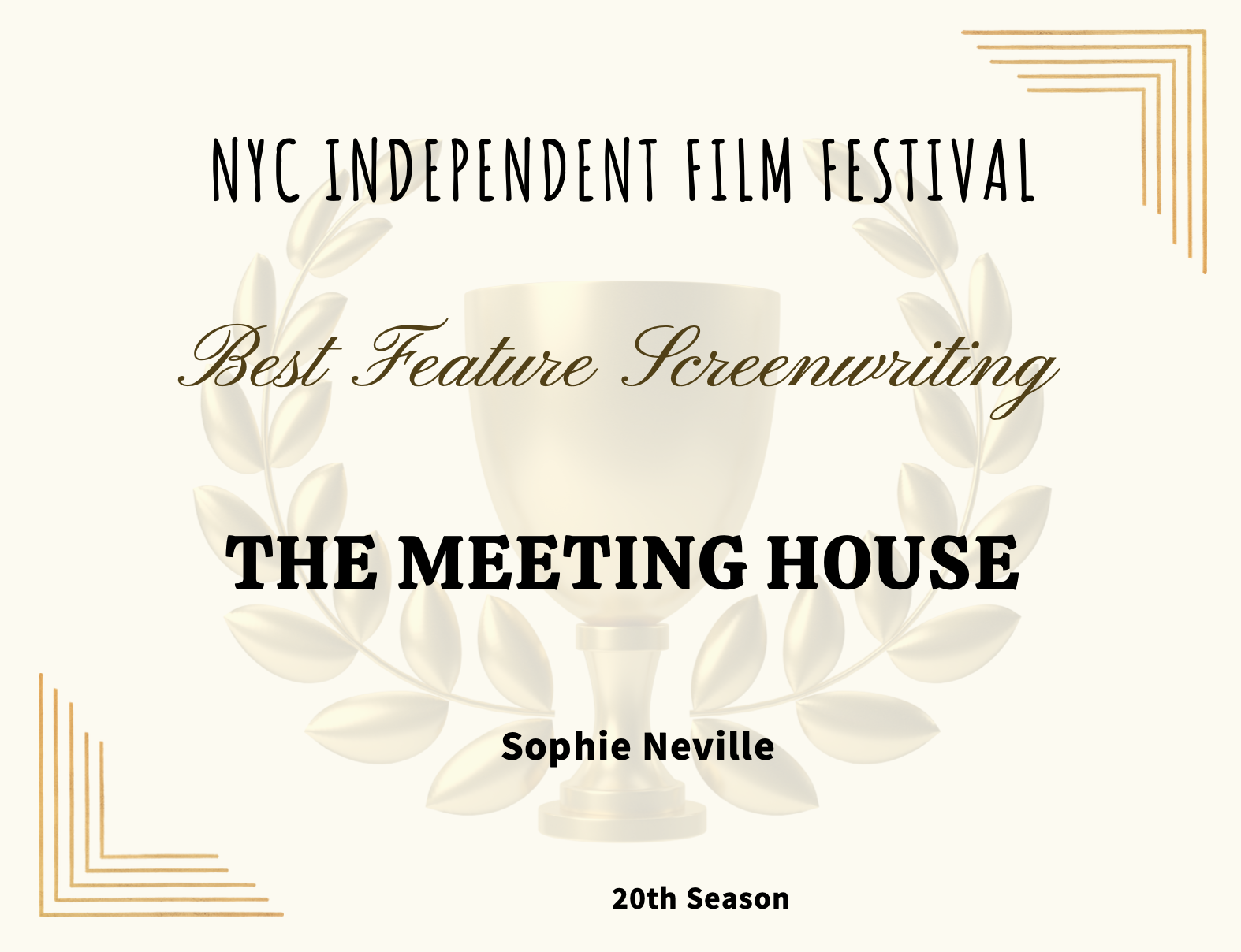
I proudly loaded some of the laurels I was sent on my website here.
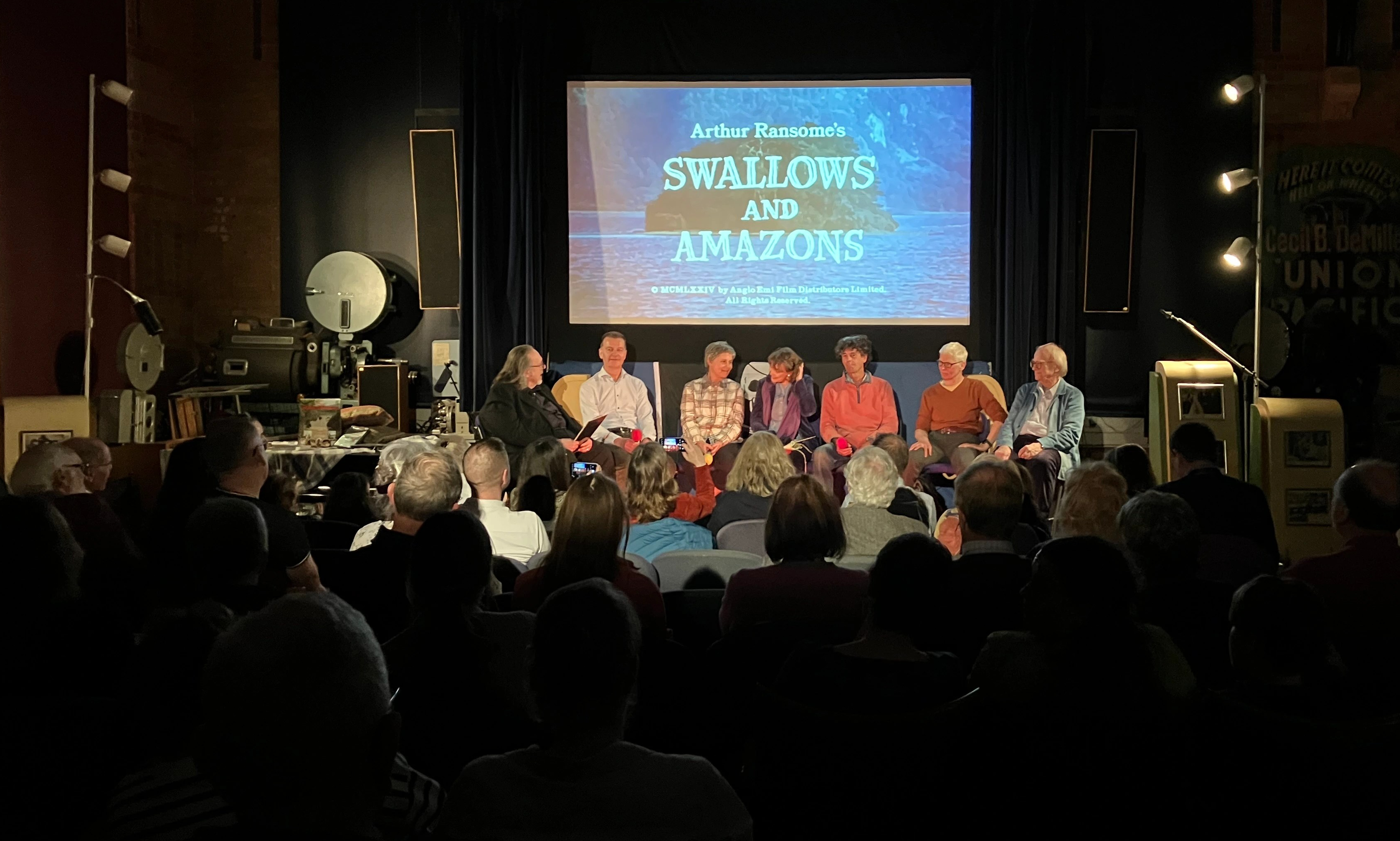
The cast of ‘Swallows and Amazons’ (1974) gathered for the 50th Anniversary – photo Lee Pressman of the Cinema Museum
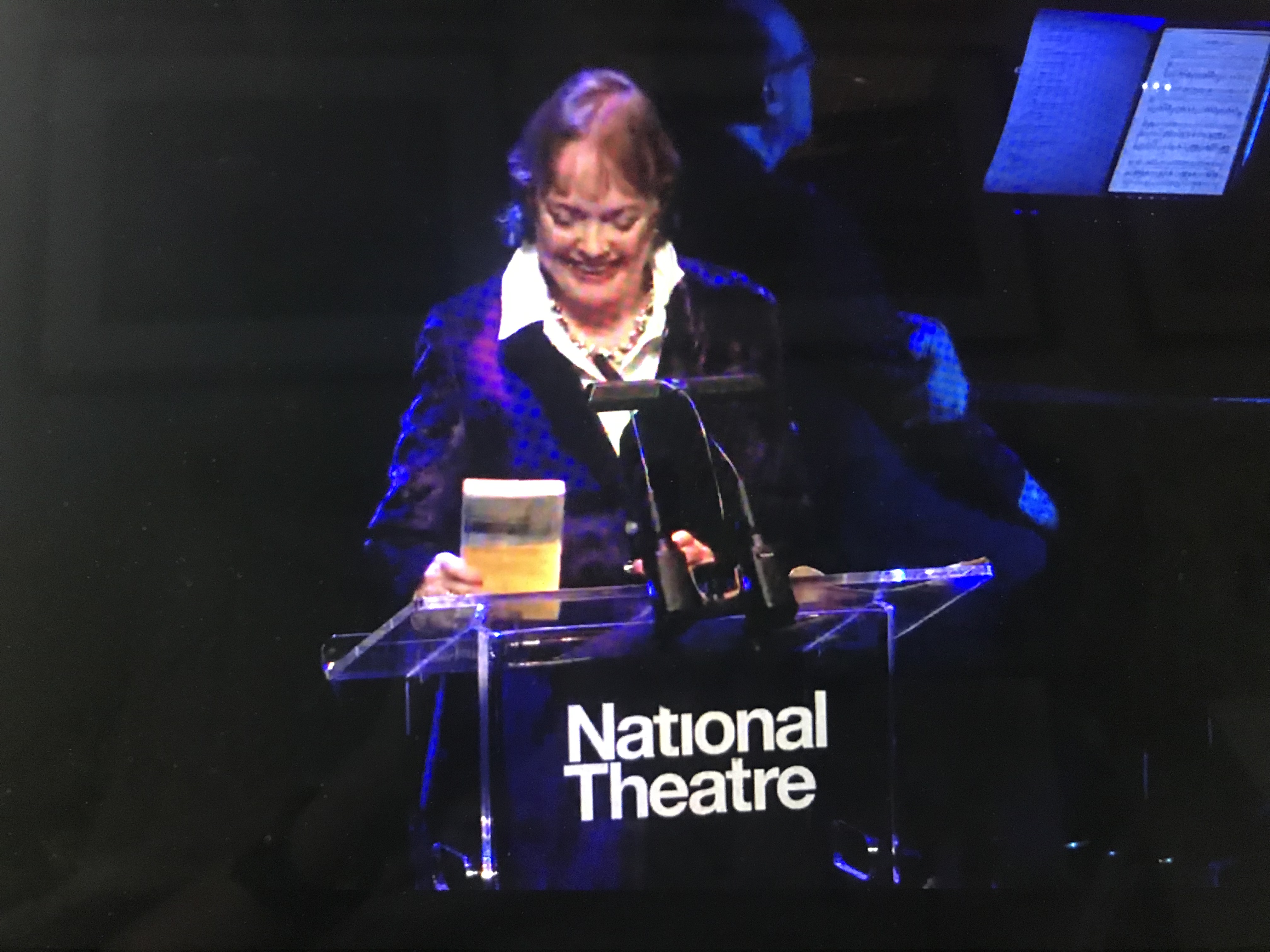
One of the highlights of the year was celebrating the 50th Anniversary of the release of the movie ‘Swallows and Amazons’. The original cast and screenwriter David Wood gathered at the Cinema Museum in London for a Q&A with Brian Sibley when I was invited to read out a message from Virginia McKenna. You can watch a recording of the often hilarious event here and David Wood’s interview here.
I wrote an article about appearing in the film for Hampshire Life magazine.
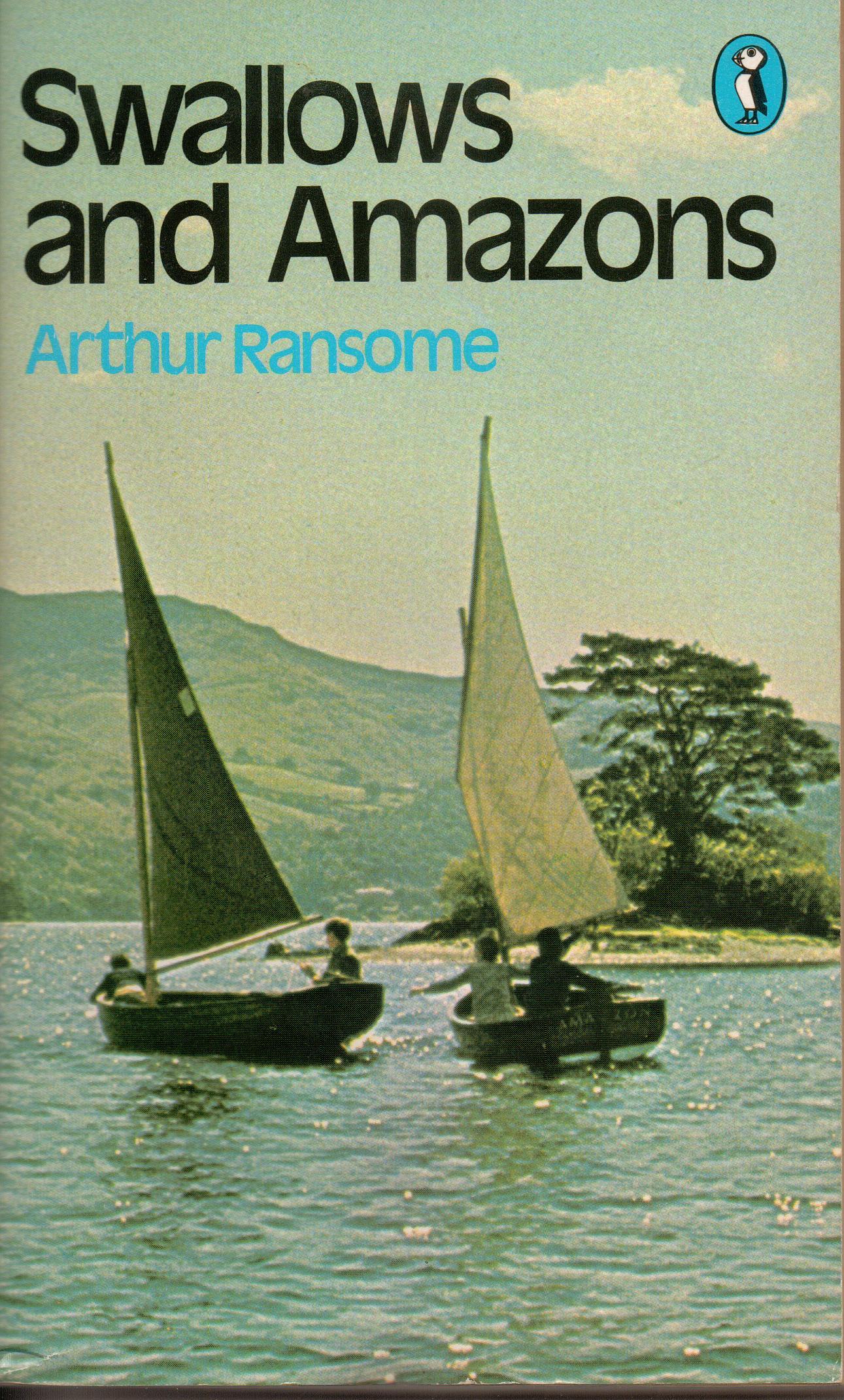
The Puffin copy of ‘Swallows and Amazons’ brought out to accompany the 1974 film
I then received a message out of the blue from someone I’d never met:
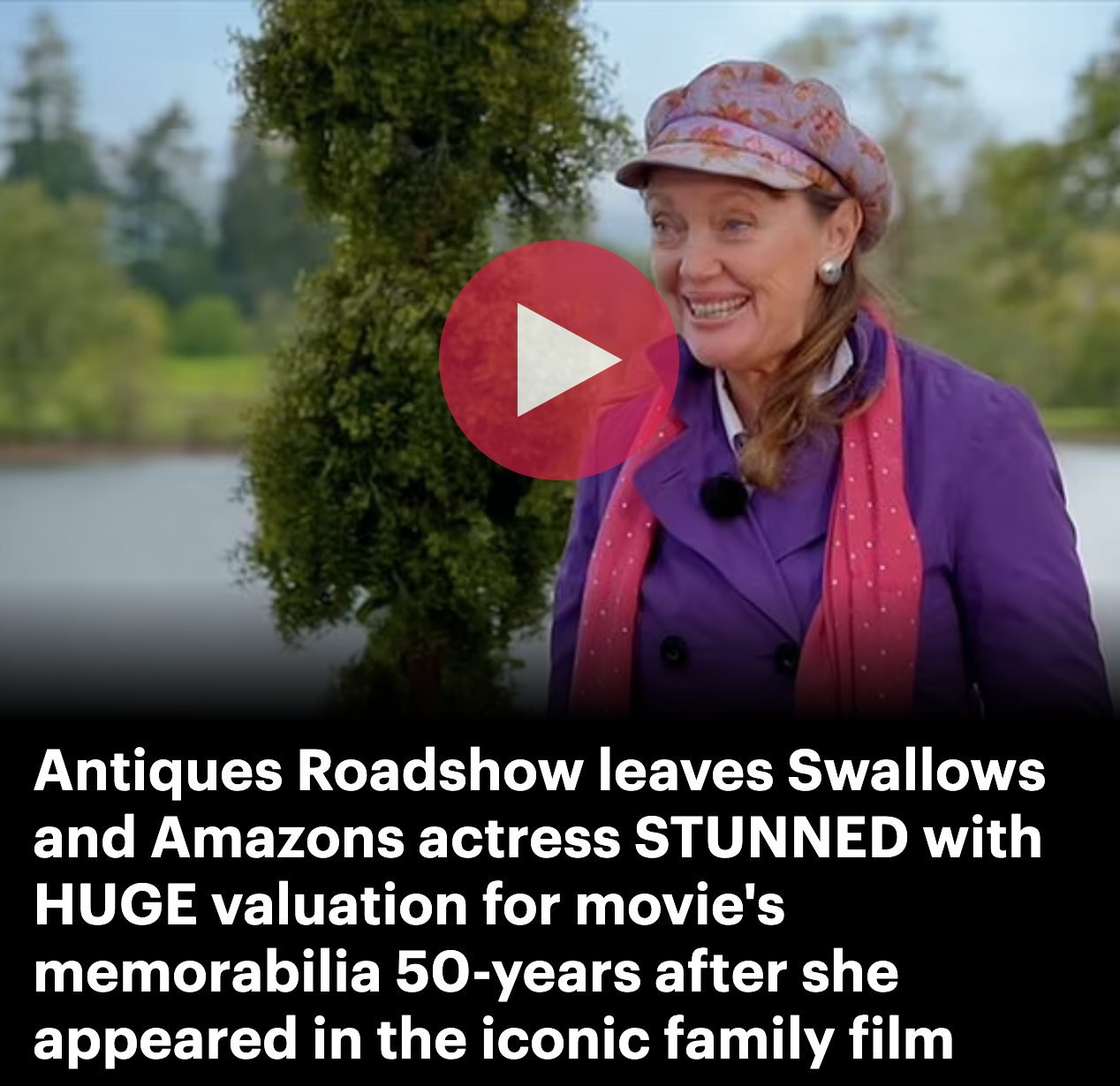
“I was so excited tonight. Your episode of Antiques Roadshow came up. I had to down tools to watch you! Loved all your memorabilia.” Suzie Eisfelder in Australia.
This took me by surprise but there I was on BBC One being interviewd by Marc Allum on the shores of Windermere.
GRUMPYBUG from North Yorkshire commented,’Most actors just take a bit of something for a memento. She nicked half the props.’ The truth was that Richard Pilbrow had sent me the flags from America. The exciting news was that Swallow and Amazon, the dinghies used in the film, have survived and are being renovated for anyone to sail from Hunters Yard on the Norfolk Broads where we made the BBC serial ‘Swallows and Amazons Forever!’ back in 1983.
The broadcast coincided with an online Q&A with the writer David Wood OBE and top Hollywood make up designer Peter Robb-King. All this was great pre-publicity for 50th Anniversary celebrations of the film in Cumbria when I met film fans, signed copies of my books, gave a couple of talks and was interviewed by John Sergeant, president of The Arthur Ransome Society who hosted the two-day event.
A good account of the weekend was featured in Flip the Media. It was covered by BBC News, there was an item on Look North, North West News and BBC Breakfast television.
Sophie Neville, Suzanna Hamilton and Kit Seymour on BBC Breakfast
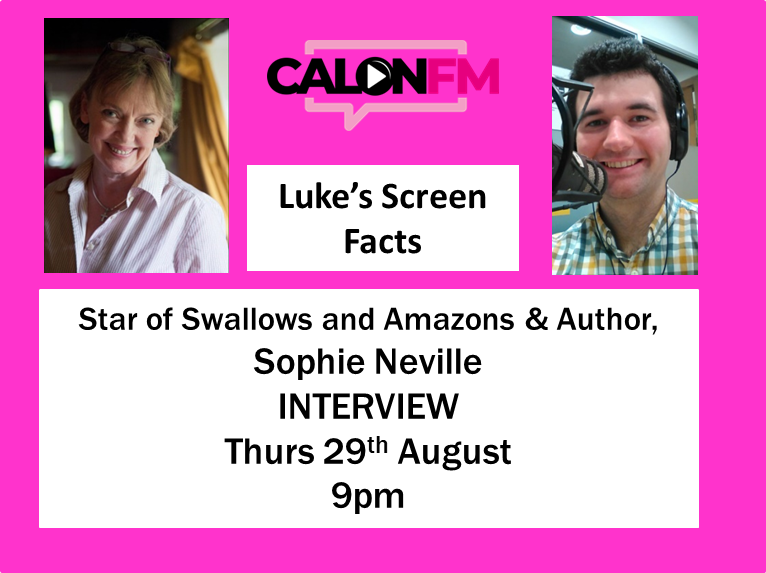
After chatting on BBC Radio Cumbria I was interviewed by Luke on CalonFM radio.
I returned from the north to write a Foreword to Dr Anthony Mitchell’s book ‘From Dust to Trust’, which describes life around Lake Turkana in Northern Kenya.
I then helped Paddy Heron to raise funds to help a little boy called Max get medical treatment in Germany by auctioning two signed copies of my books and later auctioned another book for BBC Children in Need.
As an ambassador for the UK charity Schoolreaders I was invited to an amazing event at the House of Commons hosted by Giles Brandreth and gave three talks on Zoom.
Having spoken at the Royal Thames and Army & Navy clubs in London, Arnside Sailing Club in Morecambe Bay and Royal Southern Yacht Club earlier in the year, I gave an illustrated talk at Yarmouth Sailing Club on the Isle of Wight before going on a trip the Galapagos Islands.
I returned to news that my mother had collapsed and focused on aspects of life that weigh-lay us all: hospital visits, repairs and redecorating, general admin and clearing out my mother’s house. She’s made a remarkable recovery. I’m left exhausted but am looking towards the year ahead with hope.
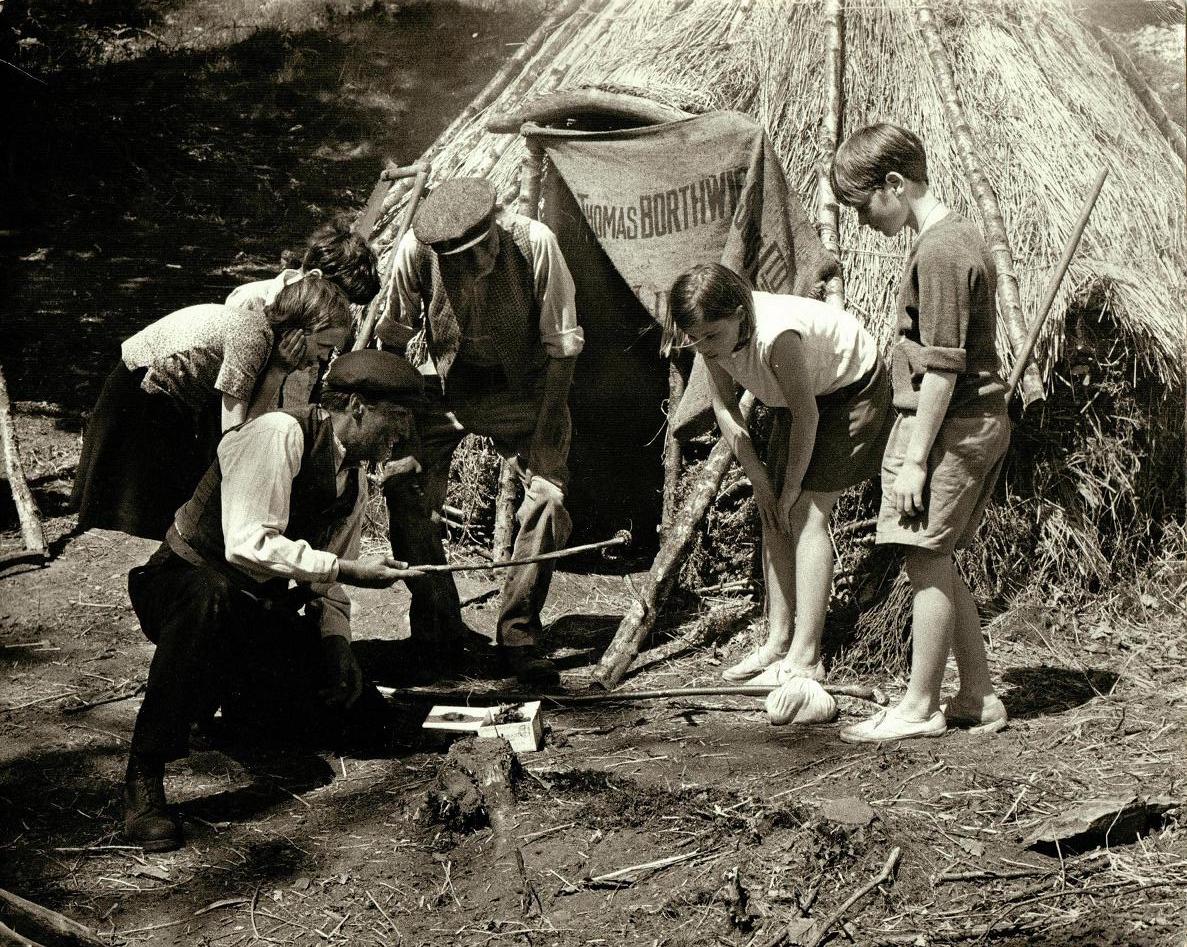
Sophie Neville, Sten Grendon, John Franklin-Robbins, Jack Wolgar, Suzanna Hamilton and Simon West looking at an adder in the original film ‘Swallows and Amazons’
In 2024 a ‘Swallows and Amazons’ festival at Windermere Jetty near Bowness-on-Windermere in Cumbria was organised by The Arthur Ransome Society and Lakeland Arts. Such was the publicity that I was contacted by a Lakeland charcoal burner who kindly sent me a report on his last talk:
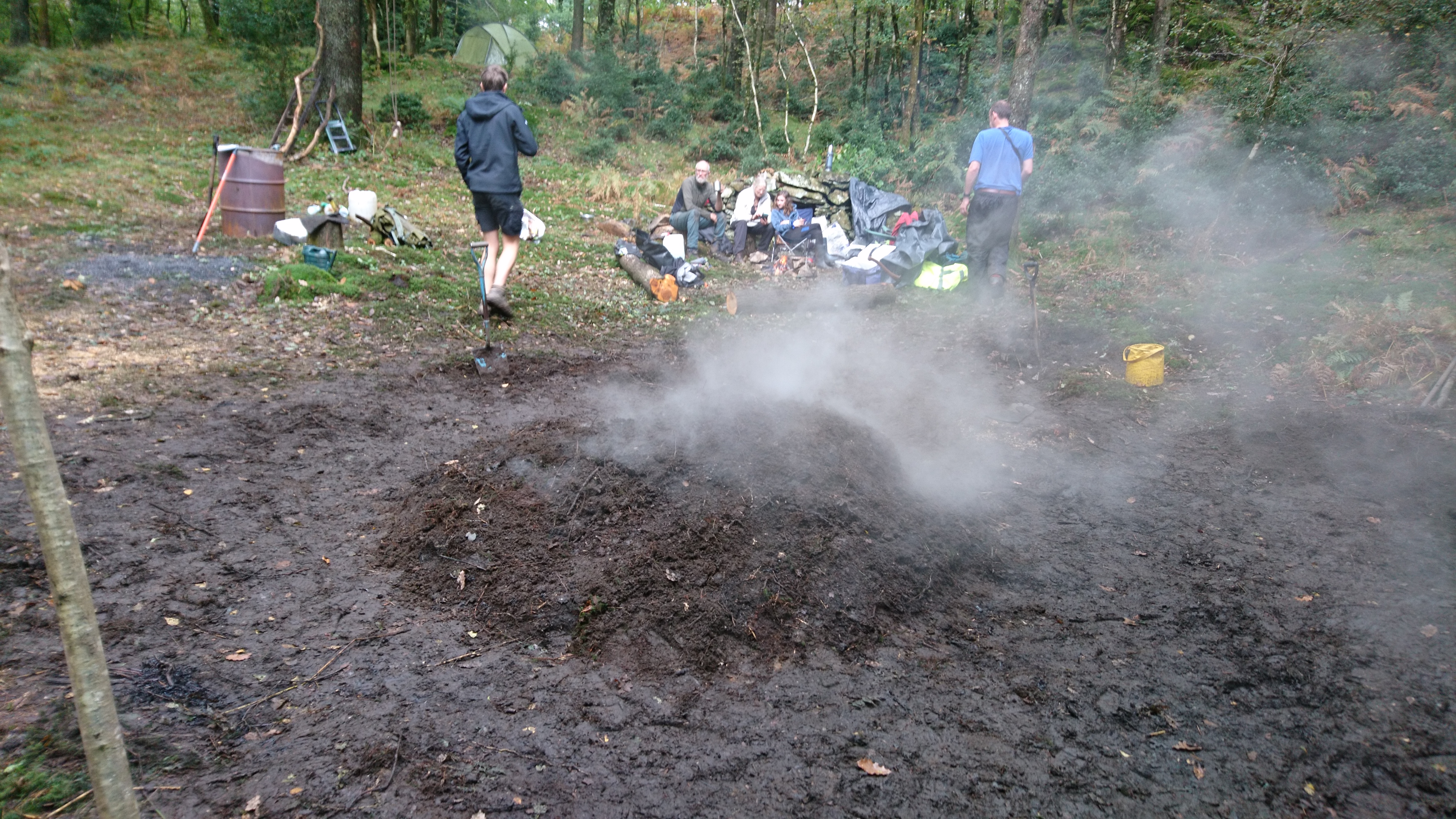
‘I, Brian Crawley, am currently President of the Coppice Association North West. In our late 50s, my wife and I embarked on a career change into coppicing, principally making barbecue charcoal. This presentation is not about earthburns in general, it is about but a specific site for them.
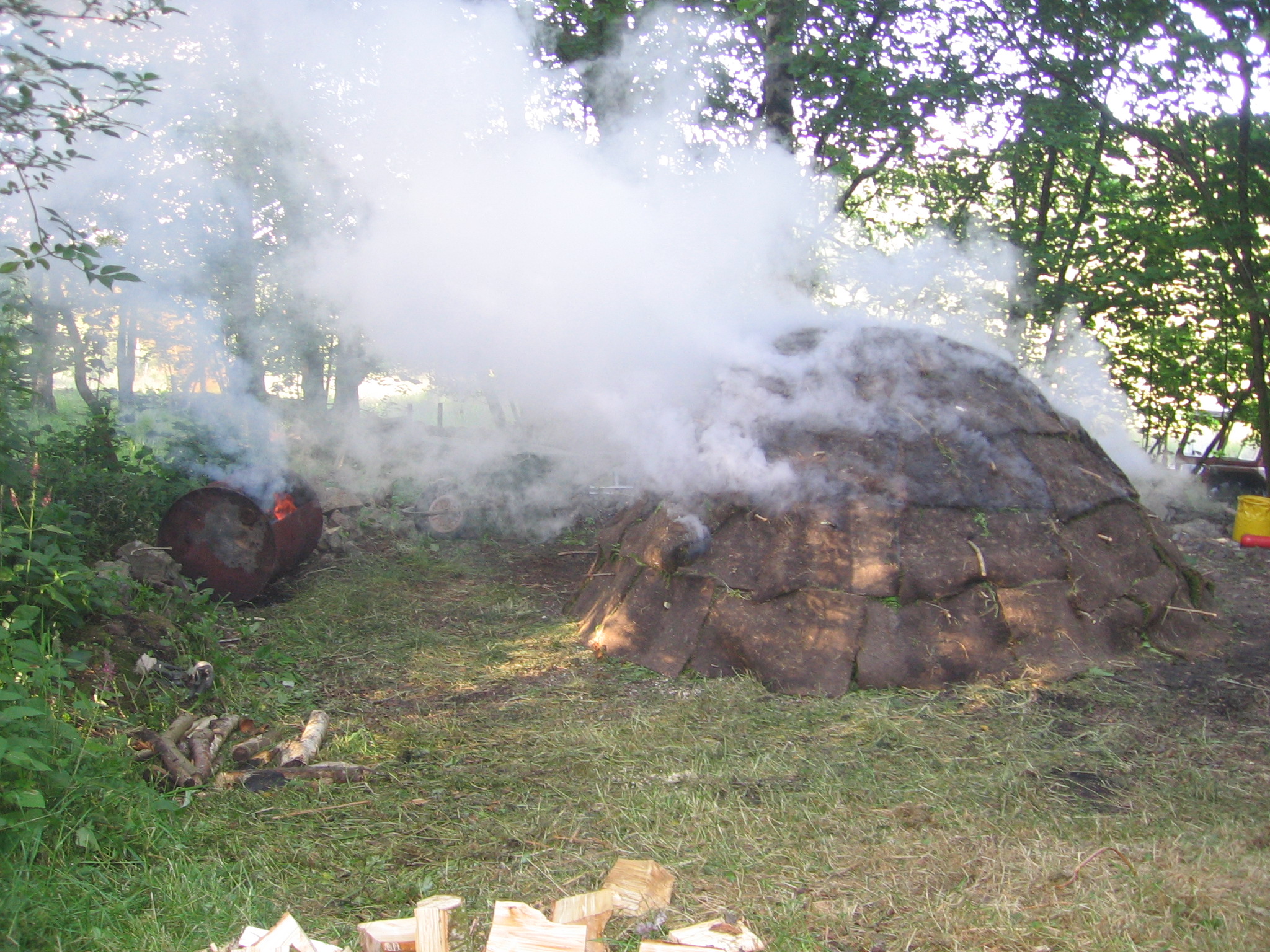
‘I had always been aware of the traditional way of making charcoal, ‘charcoal earthburns’ being a stack of wood covered with earth to limit the oxygen intake to the burn.
‘The receipt of a set of photographs of a charcoal earthburn from David Jones, who was a patient of my daughter’s, encouraged my interest in the subject. David’s photos were of an earthburn that had taken place in 1972 and were included in an extract from his book ‘A Lakeland Camera’.
‘I later discovered that the charcoal burn had taken place as a result of discussion between Mike Dow, who was Treasurer of Haybridge Nature Reserve in the Rusland Valley, and Mike Davies-Shiel, a prominent local archaeologist. They enticed local woodland worker Jack Allonby, who had a retired uncle Tyson Allonby, a charcoal burner, to do an earthburn. Jack was helped by Bill Norris who regularly helped local archaeologist Mike Davies-Shiel and lived in the same village as Jack. Mike Dow arranged that a film would be made of the burn and subsequently directed it. Bill Norris narrated it. I was put in touch with Mike Dow through our Coppice Association NW secretary Alan Shepley, who had worked with Mike Dow in earlier years, and I was given the “Charcoal Burners of High Furness” DVD, which I then played to the audience. It was not my way of doing earthburns, but was historically interesting. A photo of the charcoal burners of Furness is available on ebay here.
Our helper from Cumbria Woodlands with his 3 sons, John Allonby, Dan Sumner and June Norris with her husband
‘For many years I had been fascinated by the visit of the children in the movie Swallows and Amazons (1974) to the charcoal burners and had always wondered where it was filmed. A gentleman on a charcoal making course, which we ran, explained to us that he was there when it was made and took us to the site not far from where he lived at Ickenthwaite in the Rusland Valley. Myles Dickinson told us how amazed he was that they got a double decker bus up the lane to the site for the children’s classroom. However, our inspection of the site in Glass Knott wood on the very narrow, winding and steep Corker Lane up to Ickenthwaite, plus another look at the Mike Dow film and David Jones’s photos, convinced me that it was the correct location.
‘I can’t remember how I first got in touch with Sophie Neville, who played Titty in the 1974 film Swallows and Amazons, but she gives some interesting details about ‘The real Charcoal Burners – who we met whilst filming ‘Swallows and Amazons’.
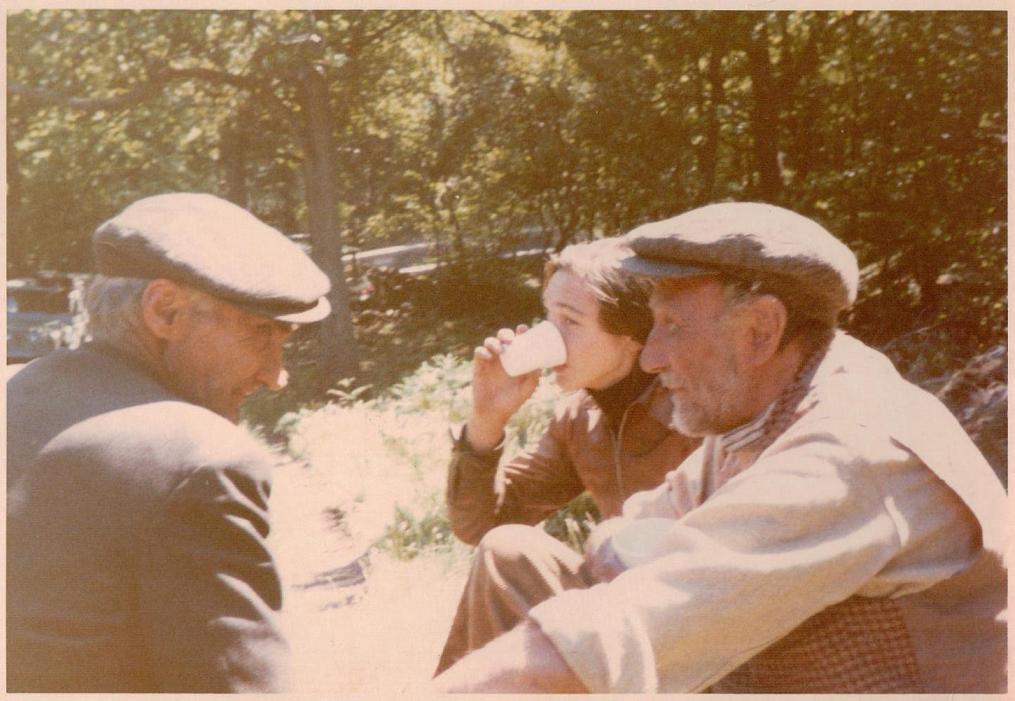
John Franklin-Robbins playing Young Billy chatting to the real charcoal burner during a coffee break on the set of ‘Swallows and Amazons’ ~ photo: Daphne Neville
‘I was able to make some extra comments to the blog as well as a photograph the site many years after the filming. I then played a clip of their visit from the Swallows and Amazons film, being shown by courtesy of Studiocanal who own the rights.
‘It became my obsession to carry out another charcoal burn on the site and became significant in 2023 when I realised that the original filming had been in 1973, 50 years previously. This year also turned out to be the visit to the North West of the National Coppice Federation annual gathering.
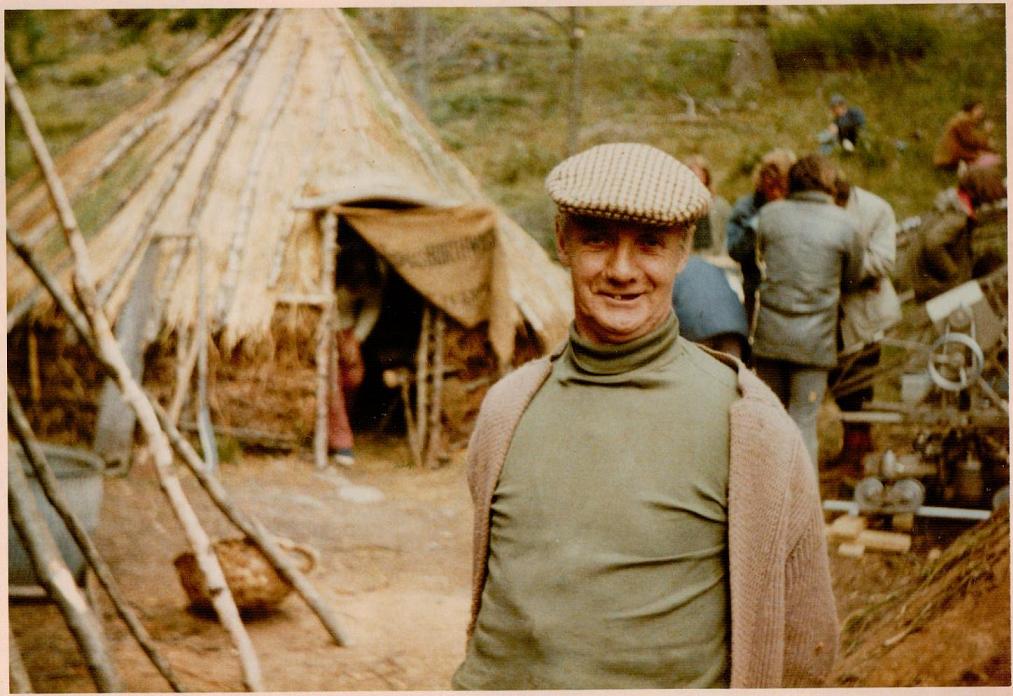
The real charcoal burner outside the hut. Behind him the 35mm Panasonic camera is being mounted on a short section of track ~ photo: Daphne Neville
‘Glass Knott wood is now owned by the Lake District National Park Authority. Permission to carry out the burn was requested and eventually approved with enthusiasm. At the same time Dan Sumner was looking for instruction on how to do an earthburn and we agreed that this was a good time for me to show him how, and for him to be responsible for the burn and provide the timber. The burn took place two weeks before the gathering and we had a fascinating visit to the site from Jack Allonby’s son John together with Bill Norris’s daughter June who had lived in the same small village, Spark Bridge, 50 years ago. A young John Allonby had been at the site with his father during both filmings. We also had a visit from Myles Dickinson who still lives nearby. We had a few very good helpers and some other visitors from LDNPA, Cumbria Woodlands, Coppice Association North West, The Arthur Ransome Society and Ruslands Horizons.
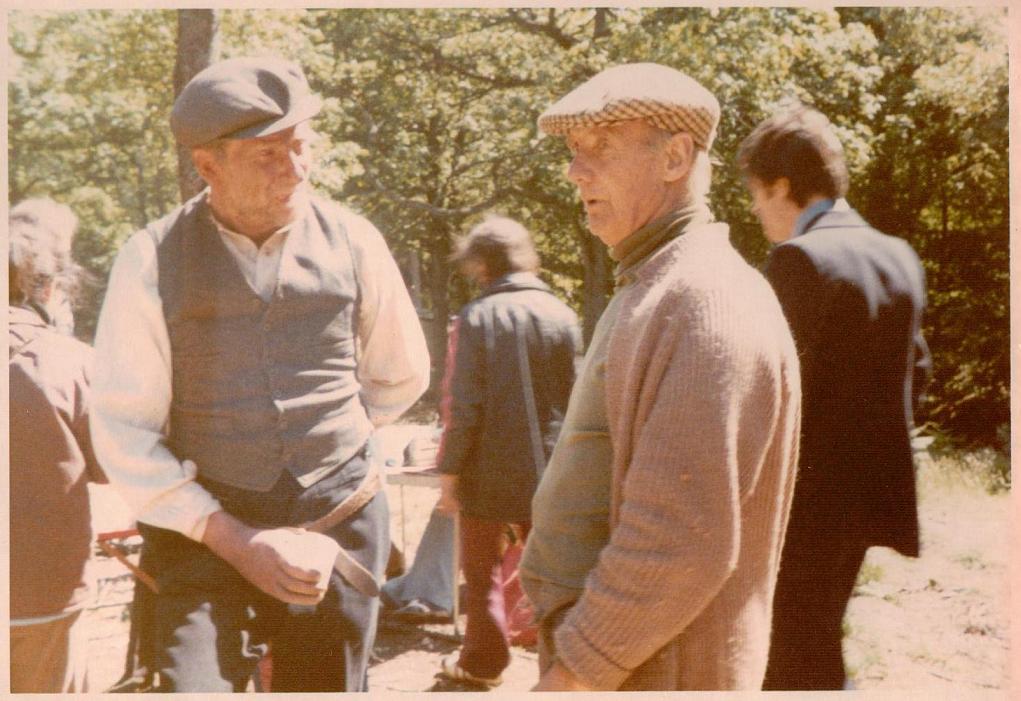
Jack Allonby talking to Jack Woolgar who was playing Old Billy ~ photo: Daphne Neville
‘I then showed some photographs of the weekend’s successful event and a few photos of Sophie Neville’s blog on the web.
Arriving at the Charcoal Burners’. Jack Woolgar with Simon West, Suzanna Hamilton, Sophie Neville and Stephen Grendon ~ photo: Daphne Neville
‘To finish, I then showed a DVD of the Millenium Burn, actually held in 2001, at which I learned earthburns from Arthur Barker, who was supported by Alan Waters and his friend Mark, at a site a bit further up the Rusland Valley where Jack Allonby had been filmed doing another earthburn by Sam Hanna, which can now be seen on the internet.’
Earthburns presentation by Brian Crawley, NCFed Gathering Oct 2023
John Franklin-Robbins playing Young Billy with Sophie Neville, Stephen Grendon and the adder.
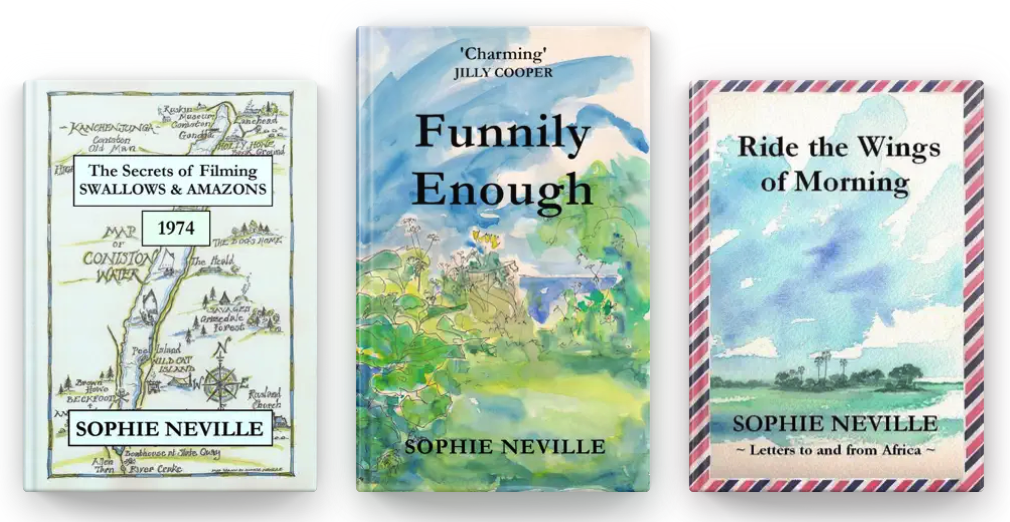
An original hardback copy of my book on how we made the 1974 film of Swallows and Amazons was sold in Paddy Heron’s online auction for £86 to raise funds for BBC Children in Need 2024.
It exceeded bids for the autobiographies of Theresa May, Michael Ball, Charles Spencer, Tim Peake, Lynda La Plante, Father Alex Frost and a number of amazing biographies.
An unframed print of a portrait of her playing Titty executed by C. Assheton was also sold in the online charity auction, which raised a total of £14,705 – which is fantastic.
Paperback and ebook editions of my same story are also available at Waterstones and online from all the usual stockists including Amazon
Neville Thompson acted as the online producer on the 1974 film of Swallows and Amazons. He choose an excellent crew and took daily responsibility for scheduling the production on location in the Lake District and later at Elstree Studios where the film was edited and post-synced.
Producer Richard Pilbrow and Production Associate Neville C Thompson on Derwentwater in the Lake District in 1973
Neville was born in Ipswich in 1933. Although gregarious at times, he was a quiet man who was once a maths teacher in Scotland. He had five children to support, but decided to go to RADA and become an actor. When a pair of twins came along he moved the family to Croyden and went into film production. He began work as a location manager for Mike Newell and became a production manager for Ken Russell.
Richard Pilbrow gained the rights and film finance for ‘Swallows and Amazons’ but came from a background in theatre and knew nothing about film production. He asked Neville to help set everything up.
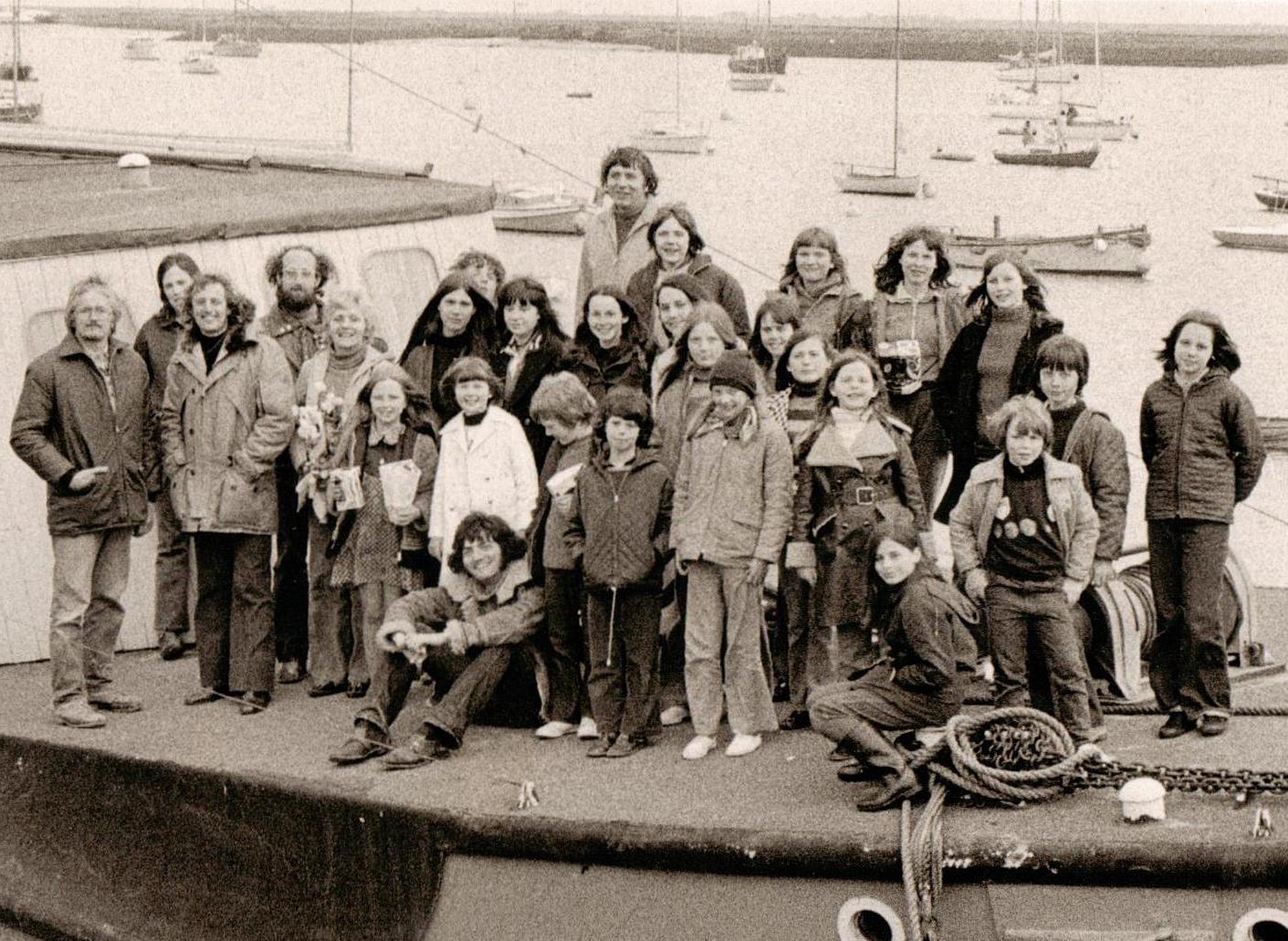
Neville C Thomas (top centre) with Richard Pilbrow, Claude Whatham et al
Neville came to Burnham-on-Crouch for our sailing audition when the dinghy ‘Swallow’ must have been purchased from the boatbuilders William King.
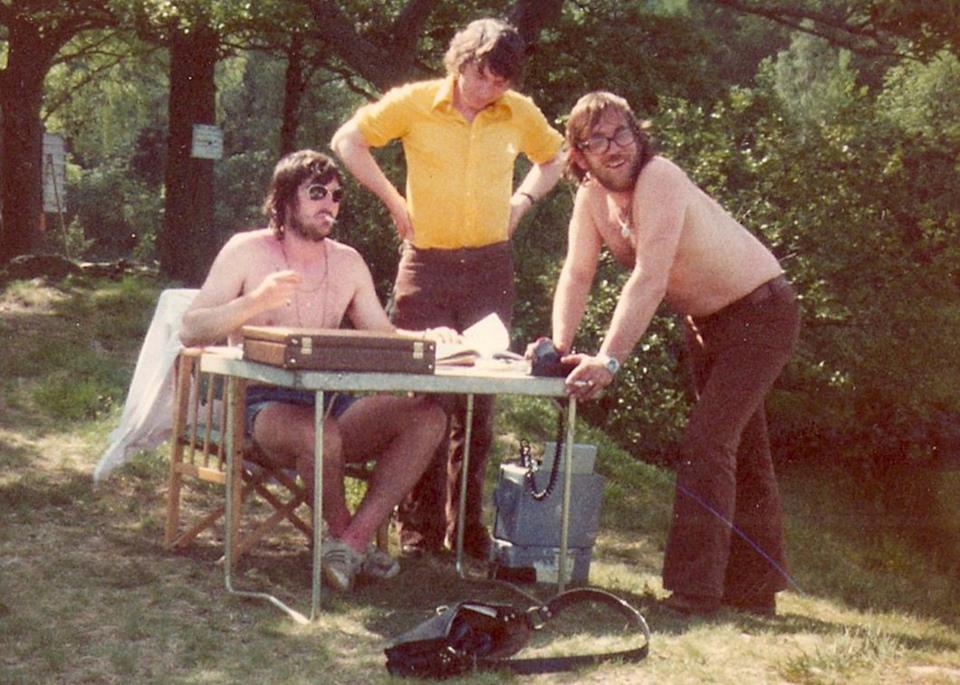
Second Assistant Terry Needham, Associate Producer Neville C Thompson and Production Manager Graham Ford with the unit radio on a sunny day in June 1973
Neville was passionate about film making, becoming known as ‘the last gentleman producer.’ He would have been the one making the executive decisions, the man ultimately in charge of the schedule, personnel, safety, insurance and bringing the film in on budget.
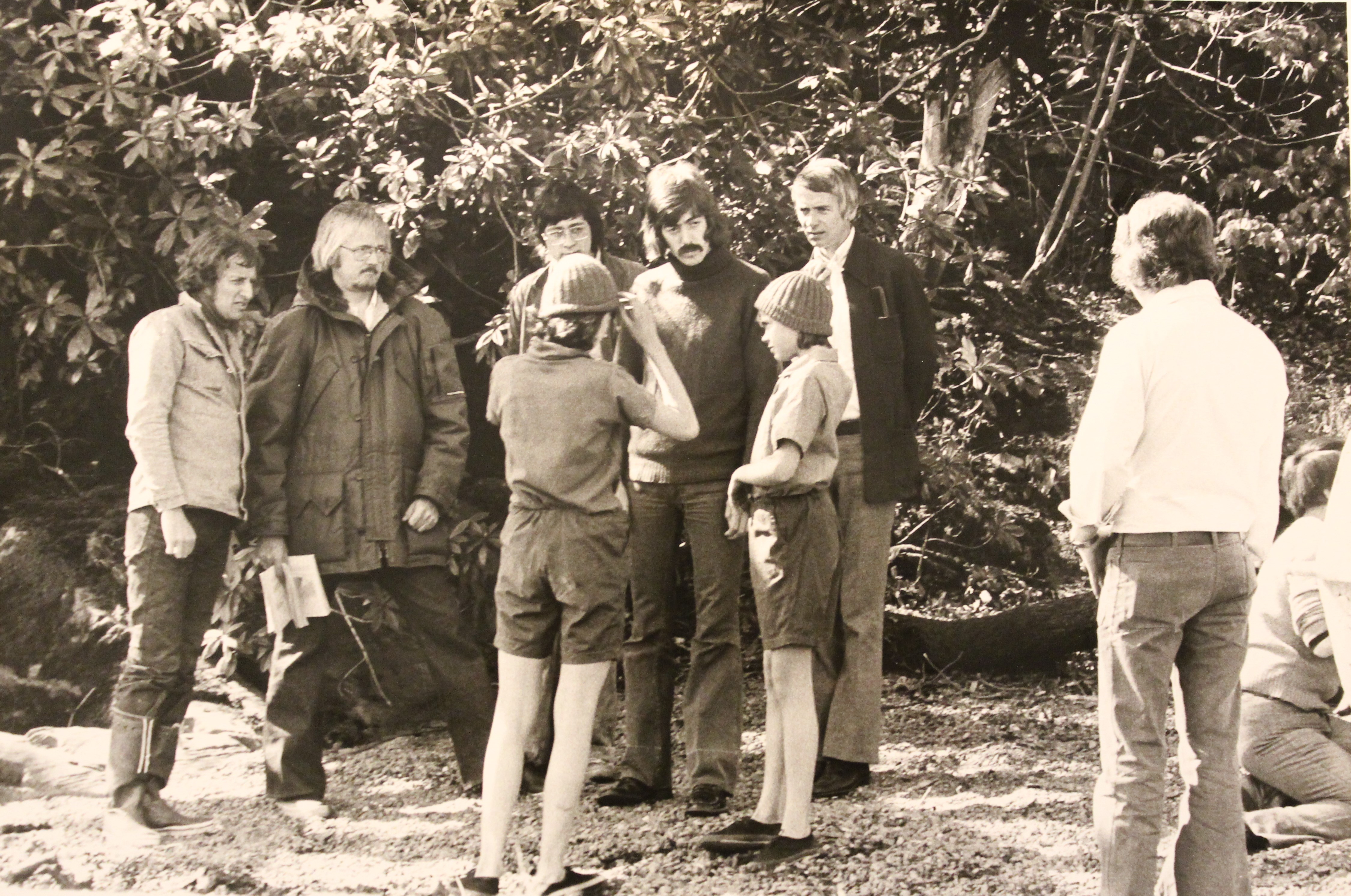
Claude Whatham, Richard Pilbrow, Gareth Tandy, Peter Robb-King, Ronnie Cogan and Neville C Thompson with Kit Seymour and Lesley Bennet trying on hats
His daughter, Mandy, told me that he was a wonderful Dad but had been away a lot. ‘He had eight children in nine years and was keen for them to make their own way in the world.’ Mandy became an occupational therapist, George became a ballet dancer, Chris Thompson went into film making. Neville was diagnosed with Lukemia at the age of 47 but lived another twenty years, ending his days in Woodbridge in Suffolk.
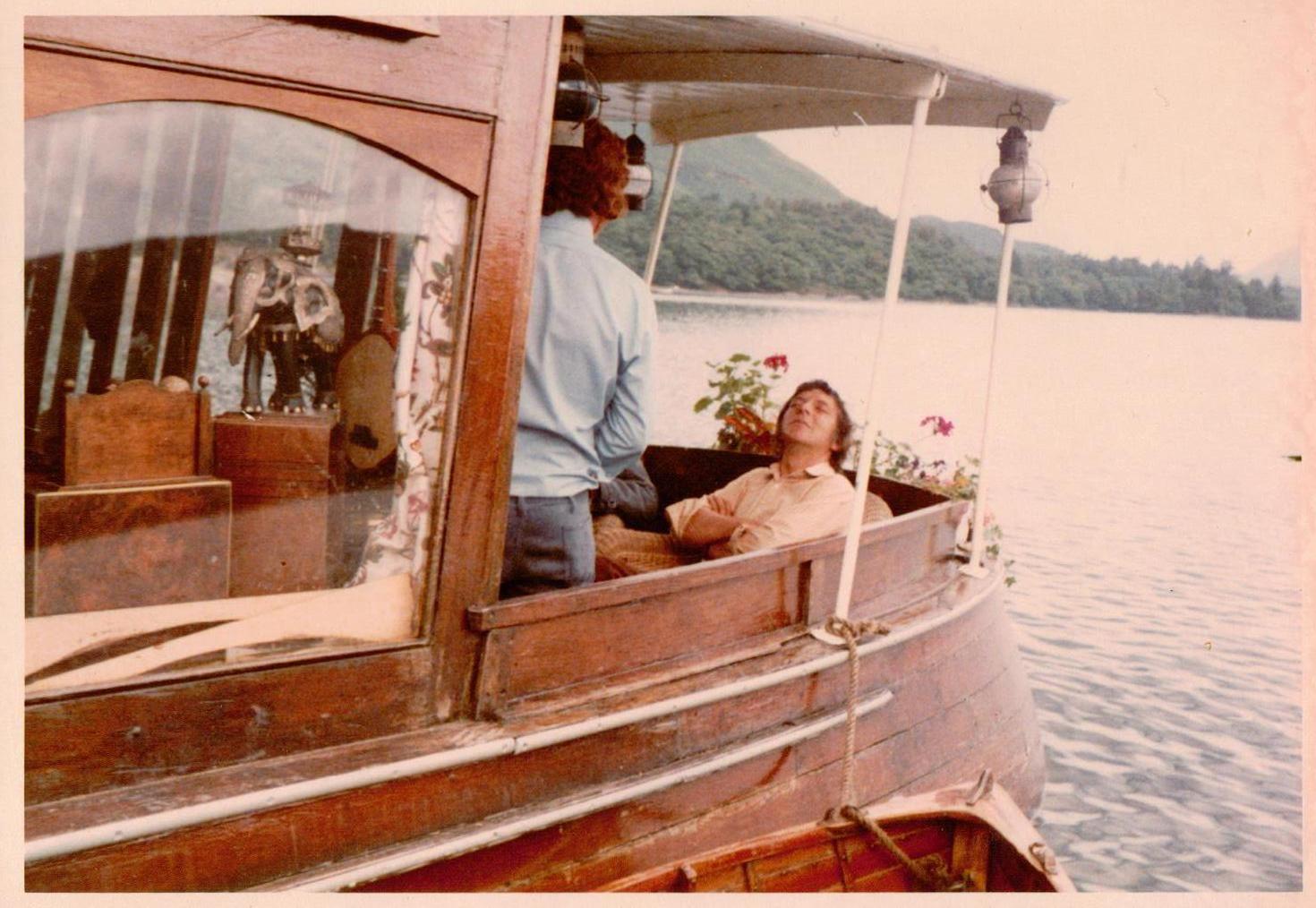
Neville Thompson relaxing on set – photo taken on Sunday 24th July 1973, by Daphne Neville
Neville established a production office at the unit hotel on Windermere. By the time he reached the location he was often exhausted. Everything he’d set up was in motion so, like an experienced parent, he could relax and enjoy the boats.
Richard Pilbrow and Neville Thompson ~ photo:Daphne Neville
When Neville died in Woodbridge in Suffolk at the age of sixty-nine in 2002, Richard told me that ‘Swallows and Amazons’ was broadcast on television as if in his honour.
You can find an impressive list of Neville C Thompson’s production credits on IMDb here
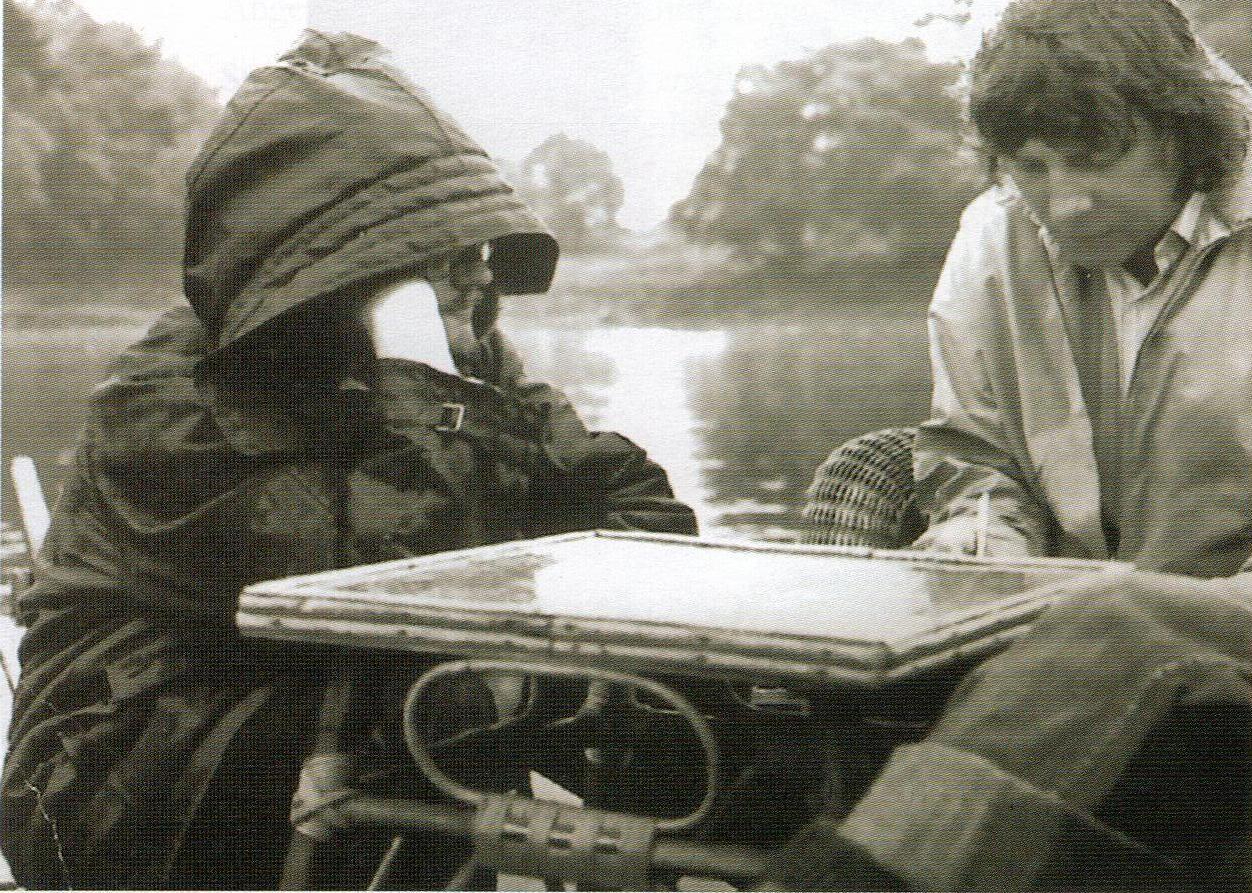
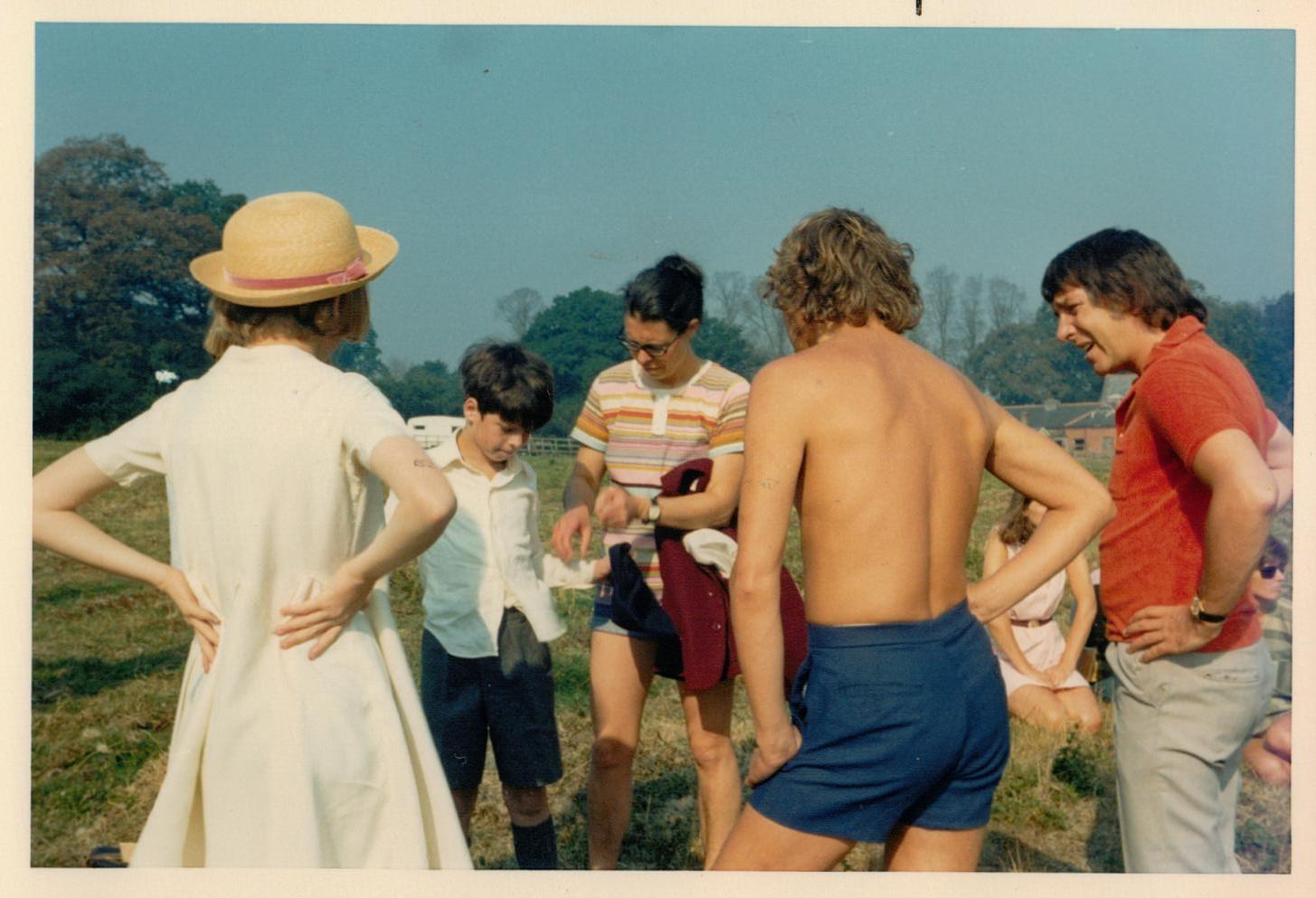
Sophie Neville looks on as Stephen Grendon organises his costume helped by Jane Grendon with Claude Whatham and Neville C Thompson when filming pick up shots near Epsom.
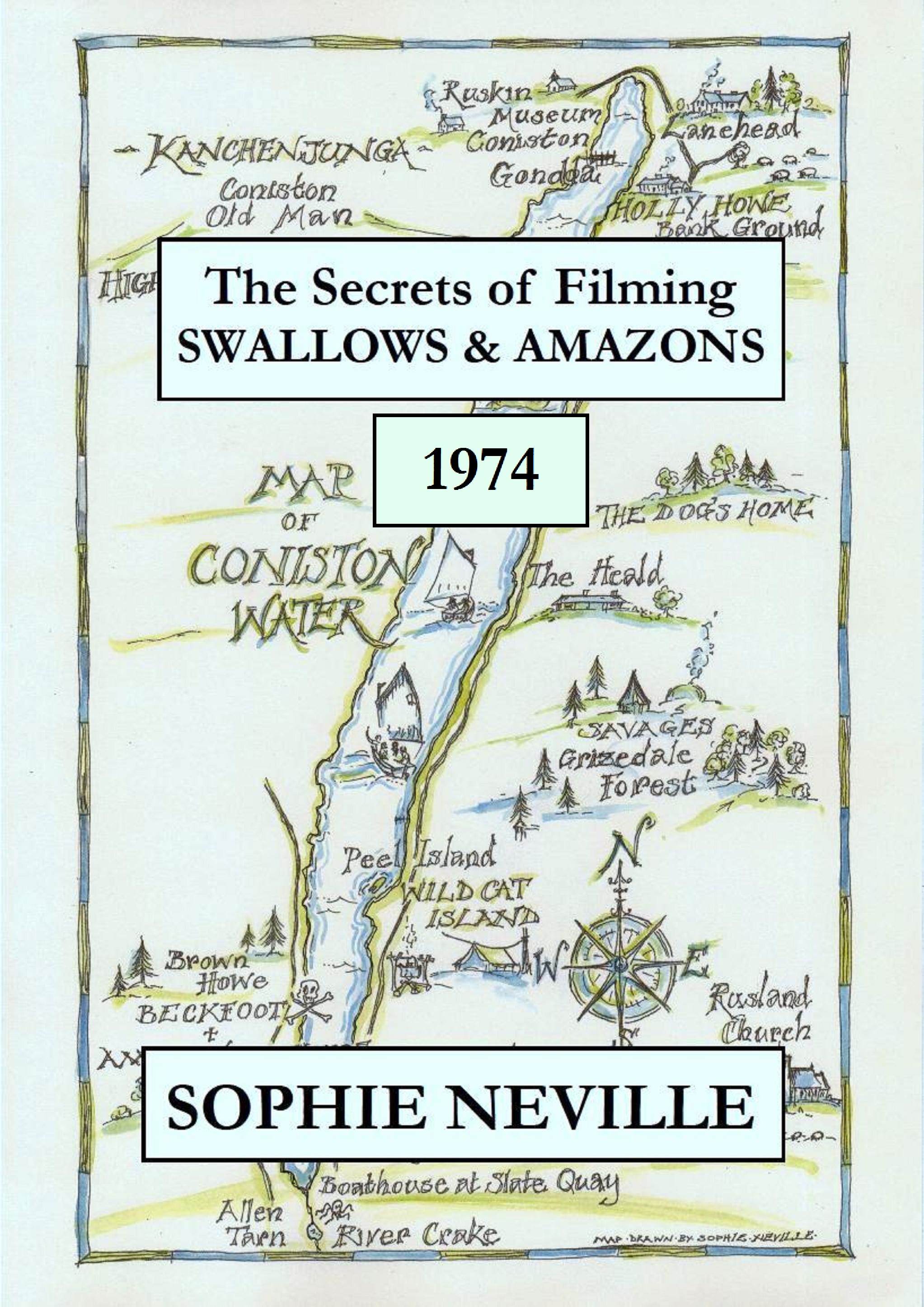
You can find details of how to purchase ‘The making of Swallows and Amazons’ here on line or listen to it on audible and other audiobook platforms.
It’s fascinating to hear about links people have with the original film of ‘Swallows and Amazons’ made on location in the Lake District in the early 1970s.
Art Director Simon Holland painting labels for cans of Pemican ~ photo: Daphne Neville
Amanda Currie wrote to say, ‘My family had quite a lot to do with the film. My cousin’s bro-in-law was the art director… My Dad was one of the Lake Wardens he had great fun keeping tourists away from the filming on the lake. Captain Flint stayed at our friends’ hotel and boy did they have some funny tales to tell. The couple who owned it were called Tim and Eileen, they would be in their eighties now I would think. Of course we were all extras.’
She added, ‘We were all massive Swallows and Amazons fans long before the film, as when my Grandma lived in Blackpool they used to stay at what was the Blackett’s house, and on occasion bumped into Arthur Ransome.’
Jean our driver and location nurse operating the radio with Sophie Neville ~ photo:Martin Neville
Jean McGill, our unit driver, used to pick up Ronald Fraser every morning, a difficult task as he was always drunk. “Dreadful man, swearing and shouting around the place,” she said. “Appalling behaviour.” Jean had been the Chief Air Stewardess and cabin services superintendent in Bahrain for what is now Gulf Air. “I had to leave because I wouldn’t marry the general manager, who was having a nervous breakdown.” She was going out with the Captain of the Sir Galahad, the ship that went down in the Falklands, “along with the coffee pot I’d given him.” She also told me that they had a known terrorist one of her flights, “who then got on the BOAC flight that landed in the desert.” He had wanted to free Lela Kallard.
Do you know where the Peak of Darien can be found? photo: Roger Wardale (with permission)
The Arthur Ransome Group have been discussing the true model for the Peak at Darien. Mrs Ransome told the film producer Richard Pilbrow that you could find it on Windermere.
Paul Flint says that, ‘good contenders are Brathay Rocks and Gale Naze Crag on Windermere’, pointing out that both were well known to the Ransomes. It would be interesting to know what islands you can see from these.
Friar’s Crag on Derwent Water was used for the opening titles of ‘Swallows and Amazons’ (1974) Stuart Clague informed me that it is a dolerite dyke intruded into softer Skiddaw slate, as mentioned in the book Lakeland Geology.
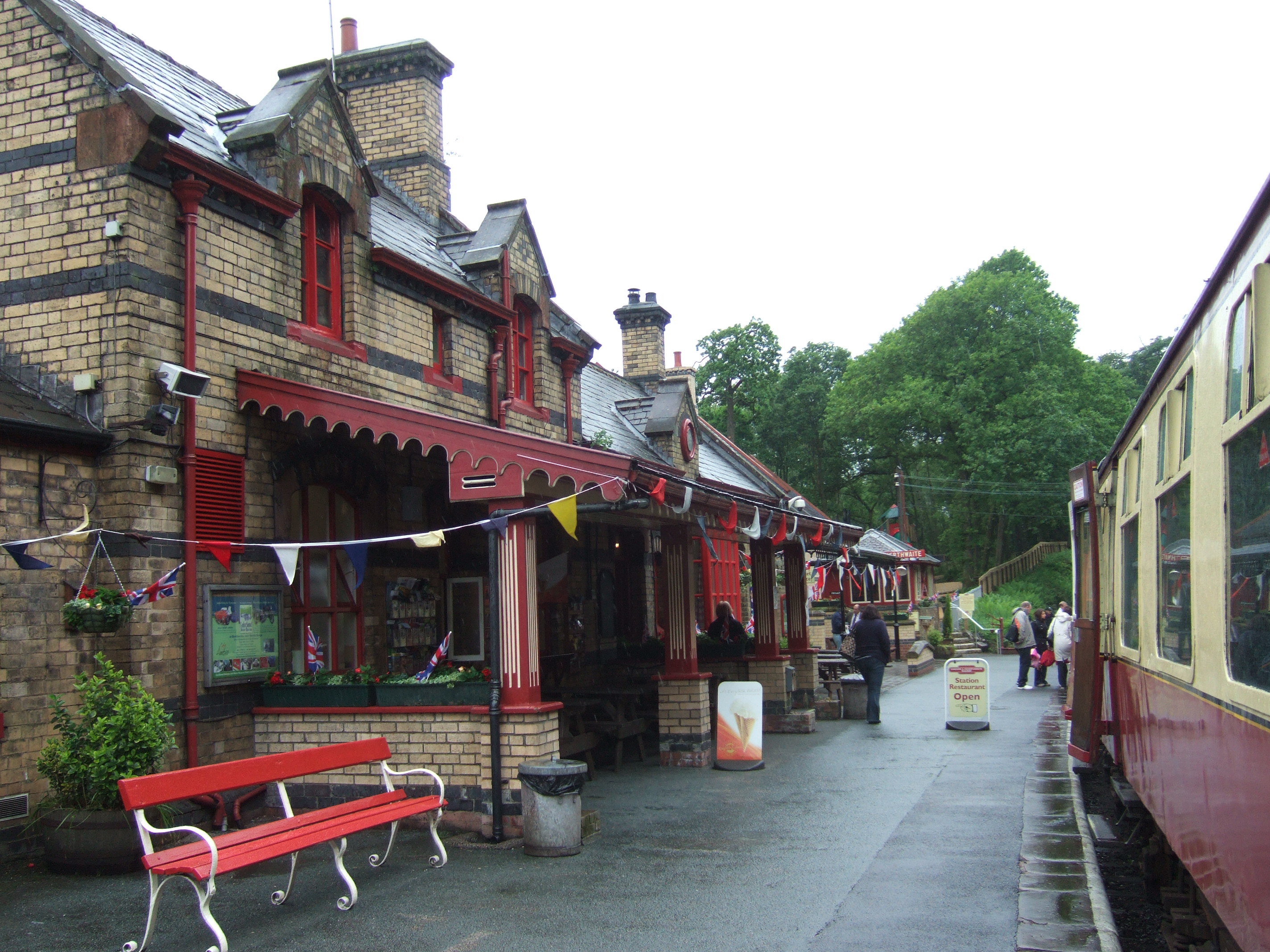
This is the platform at Haverthwaite station on the Lakeside & Haverthwaite Railway in Haverthwaite, Cumbria. Manuel Gurtner points out that the heritage railway also appears in ‘Without a Clue’ (1988), the witty movie starring Michael Caine as Sherlock Holmes and Ben Kingsley as Dr Watson. You can spot the carriages at scenes shot in the Lake District in the film trailer.
Simon West, Suzanna Hamilton, Sophie Neville & Sten Grendon in ‘Swallows and Amazons'(1974)
Julie Lamming wrote to say, ‘I used to drive my family mad singing “Spanish Ladies” after watching the film for the first time.’ This was the original movie of ‘Swallows and Amazons’ made on location in the Lake District in 1973 and released by EMI Films fifty years ago in 1974.
It took me a while to realise it, but the traditional British naval song Farewell and Adieu to you Fair Spanish Ladies is sung in a number of other feature films from The Buccaneers (1957) to Jaws, which was released in 1975, a year after the original film Swallows and Amazons.
The Buccaneers (1957) and Jaws (1975)
Robert Shaw sings a little more once at sea:
The ships crew come together singing it as a shanty in Master and Commander: The Far Side of the World
A Boston version is also sung in this television drama, Patrick Jane:
Can you think of anymore examples? Please add links to the Comments below.
I classic version of the song can be found here:
I’m afraid I sang it badly and made the mistake of muddling the words, Adieu and Farewell to you Fair Spanish Ladies rendered onto the LP of the film.
You can now listen to the audio book on ‘The Making of Swallows and Amazons’ that explains how the 1974 movie of Swallows and Amazons. It’s available on all the retail platforms and Audible here.
On 6th April, the original cast of ‘Swallows and Amazons’ (1974) gathered to celebrate the 50th Anniversary of the film’s release in London with David Wood who wrote the script.
It was unexpectedly amusing as can be seen in this recording kindly brought to us by Lee Pressmen and volunteers of the Cinema Museum where the original movie was shown before we were invited on stage by Brian Sibley.
Brian Sibley talks to Simon West, Suzanna Hamilton, Sophie Neville, Sten Grendon, Kit Seymour and screenwriter David Wood – photo Lee Pressman of the Cinema Museum
As soon as self-confessed ‘super fans’ arrived, the venue began to buzz with the question, “What was your favourite line from the film?”
“They’ve got India rubber necks.”
“They’re girls!”
“… must be a retired pirate. He’s working on his devilish plans.”
Sten Grendon, who played Roger, said it was undoubtedly: “I said – ‘Yes’.”
I’ve always liked: “X marks the spot where they ate six missionaries.” Although I often use, “Here we are, intrepid explorers making the first ever voyage into unchartered waters,” I think “I’ve got her. I’ve got her!” is the most appealing.
One viewer on Instagram claimed their favourite line was: “Titty that way.”
What is your favourite line?
Do add your line to the Comments below.
A recording of Brian’s interview with the screenwriter David Wood can be watched on this website here.
I began with working on book adaptations in 1971 with Laurie Lee’s memoir Cider With Rosie and went on to appear as Titty Walker in the 1974 film Swallows and Amazons when the screenwriter David Wood worked with Mrs Ransome to abridge her husband’s well-loved novel into a 90 minute movie.
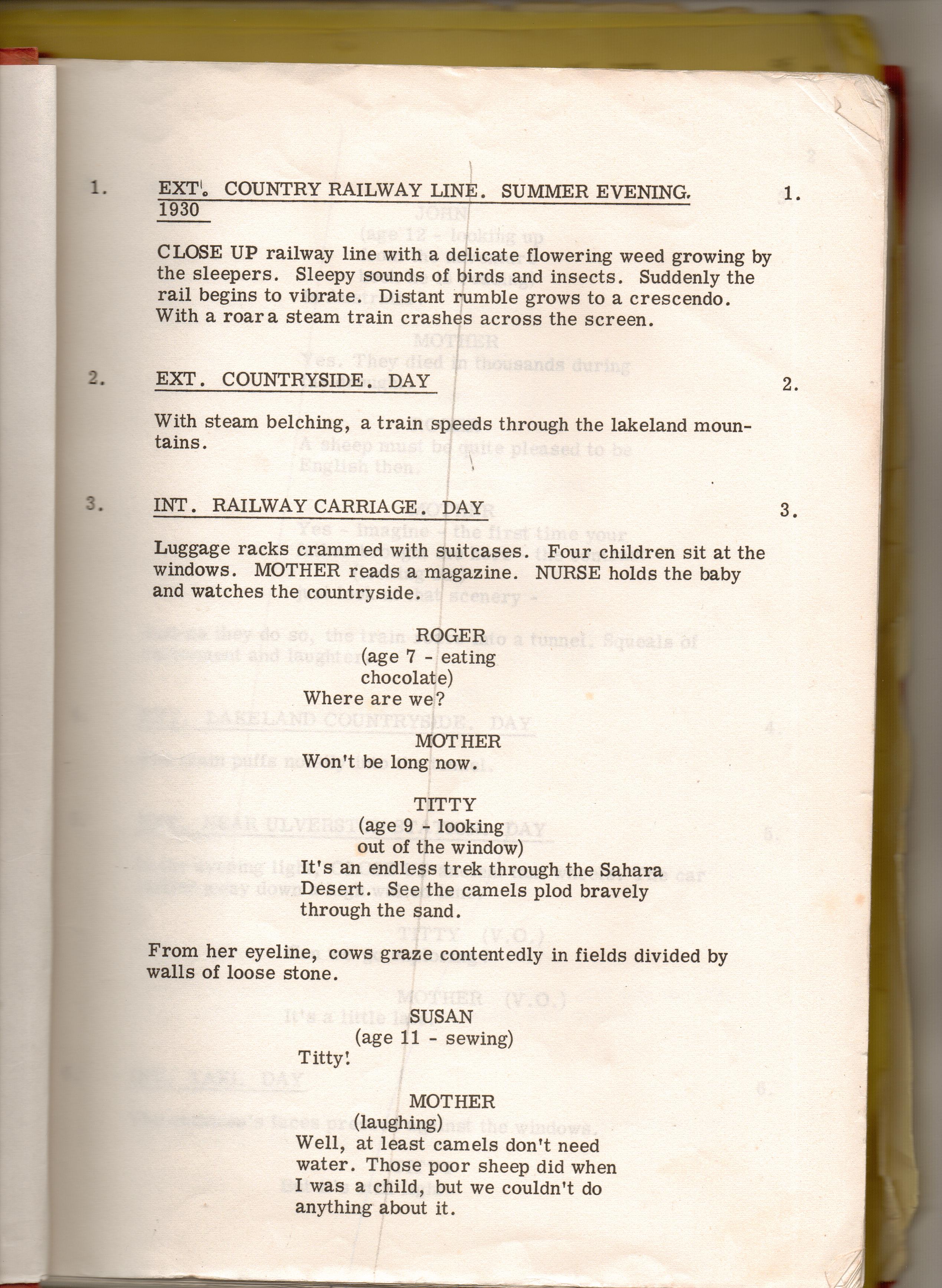
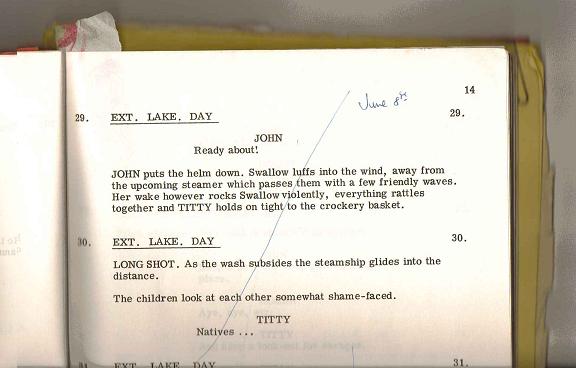
I’ve written about how the film was made and include pages from David Wood’s script of ‘Swallows and Amazons’ below. It is fascinating to see the original 1973 screenplay. Those who know the film well can appreciate how it was changed whilst we were on location.
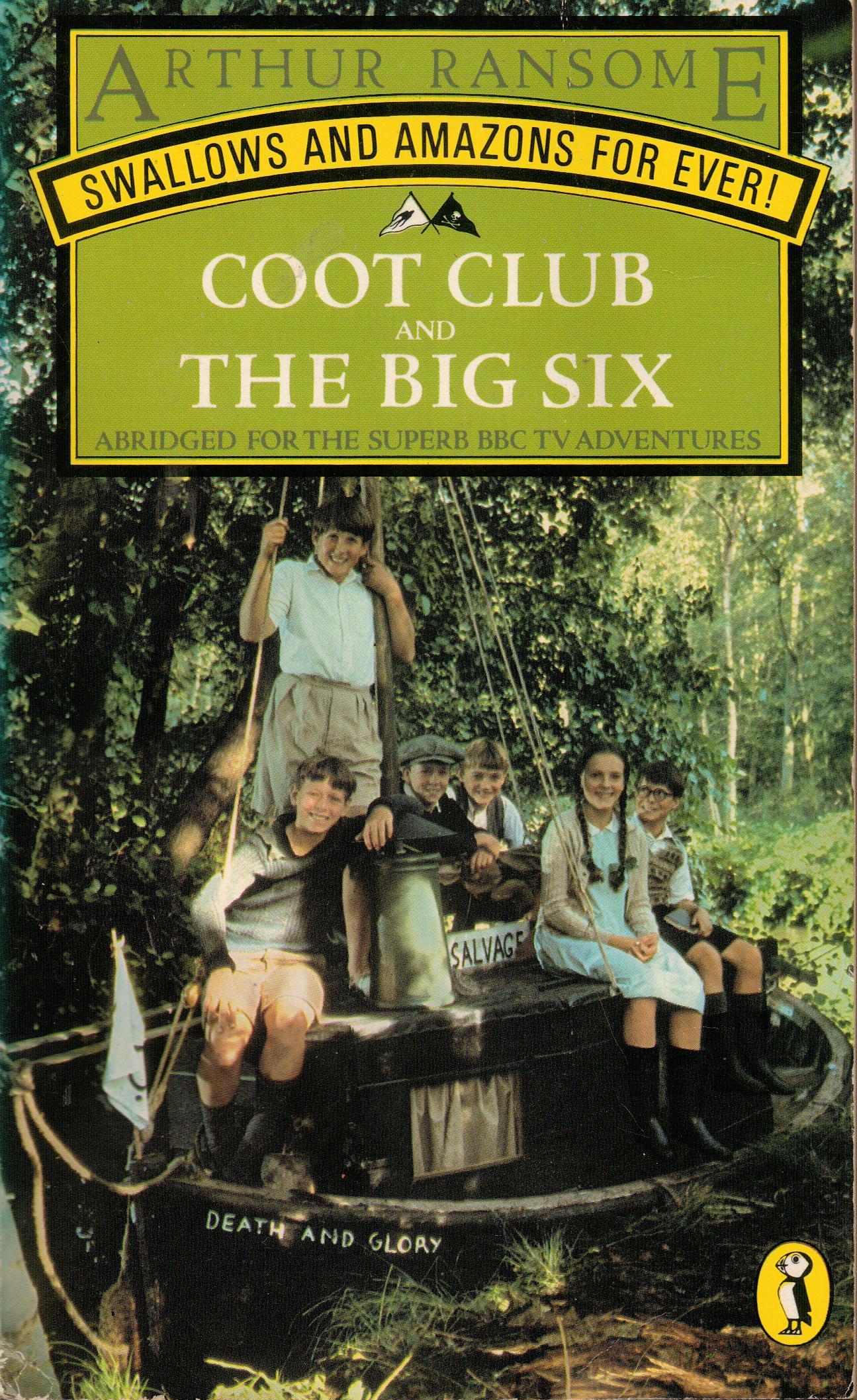
By 1983, I was working in television production on book adaptations such as Coot Club and The Big Six by Arthur Ransome, set in East Anglia.
My Family and Other Animals shot entirely on Corfu.
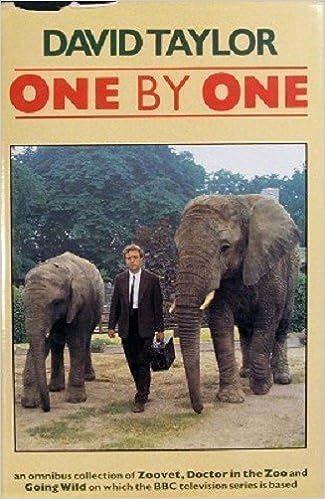
One by One, David Taylor’s memoirs of a zoo vet.
James Ellis as Paddy O’Reilly in the BBC vet series ‘One by One’, which ran to 32 episodes ~ photo: Sophie Neville
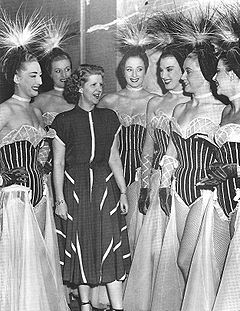
I also worked on The Diary of Anne Frank, Doctor Who, Eastenders, Rockcliffes Babies (a police procedure series), a Shakespeare play – Titus Andronicus and Bluebell – a costume drama based on the true life story of a dancer from Liverpool called Margaret Kelly.
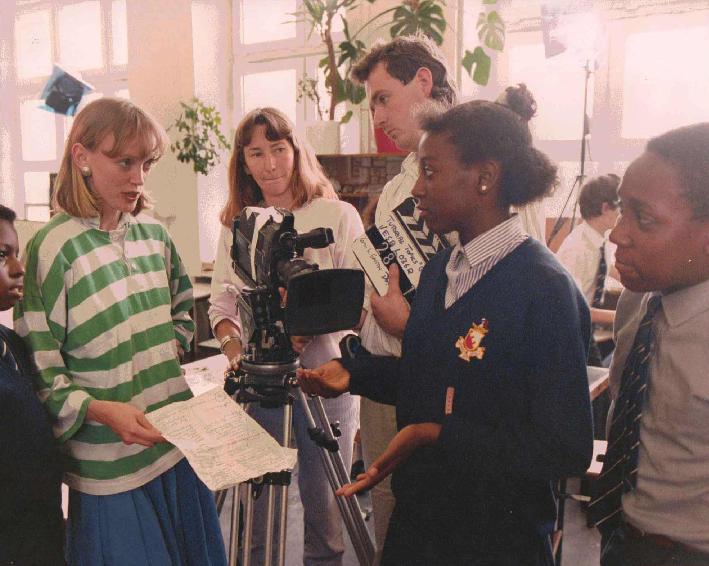
I then wrote/edited – five documentaries and two drama-docs that I produced for BBC Education, and one that I made for Channel 4. In all I’ve worked on about 100 different television programmes in 7 different countries and appeared in 100 others but am still learning how to write scripts.
Sophie Neville directing a sequence with BBC cameraman Lorraine Smith
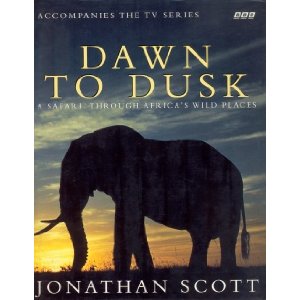
I’ve submitted numerous tv and film proposals. ‘Dawn to Dusk’ became a major Natural History series, broadcast on Thursday nights at 8.00pm.
Series originated by Sophie Neville, Produced by Alastair Fothergill
It is very difficult to get a new series or film accepted. George Marshall said, ‘Hollywood is like a whale, indiscriminately glupping plankton.’ He optioned one film script I’ve written.
‘But I’d love to get my books adapted for the screen’
You can pay someone to adapt your work – and then edit and market it yourself. But watch out for scammers.
‘How do I do it myself?’
It’s going to be a slog – and expensive – so ask yourself WHY you want to do it. You can always self publish a novel but there is little you can do with a script that won’t sell. The transposition exercise helps you improve on your prose, but it is a lot of work. Take a first step and record your novel as an audiobook. I have narrated two at Monkeynut Studios.
You need to build up a CV to give producers confidence. The easiest thing to get accepted is an item in a long-running magazine programme eg: BBC Antiques Roadshow. This cost me no more than my time and petrol but I had two (historical fiction) stories accepted instantly. They were repeated and got me in the Mail Online and OK magazine. You can see the photos on this website here.
‘That’s not my pigeon!’ But it’s what viewers want. Start small and move on to providing Countryfile with an historical story. ‘But I write Biblical fiction.’ OK – Horrible Histories.
2. Buy Final Draft software – (they give you a free trial) and read up on how to format a script. Free software is out there such as celtx or WriterDuet. MS word has a screenplay template but most professionals send each other manuscripts on Final Draft.
The formatting gives you the length: 1 minute a page – 90 minutes for a screenplay – ie script of 90 pages.
100 pages = a short story. When I transposed a screenplay into a novel, adding description, it was only 30,000 words long. It took me another five years to finish it.
3. Never submit rough work. Perfect it. One of my first jobs – aged 22 – was to put together A Russell Harty Christmas show starring Esther Rantzen, Peter Davison and Matthew Kelly. This was the first time I wrote for television: a pantomime piece. I walked into the rehearsal room with a rough copy and it was a disaster. They gave the commission to Nicholas Parsons – and paid him well.
4. Write plays for the stage or radio – they are cheaper to make and accept historical and biblical fiction with BBC Writer’s Room offering an open door. Write low budget material. Come up with a story that’s set in a church or an inexpensive venue.
5. Think Netflix. Think episodic: Would your books be suitable for a TV series? What kind? How long would each episode be?
A serial = long-running story with something happening in each episode. eg: we made My Family and Other Animals into 8 x 28.5 min episodes. (Interestingly Ep 2 looked weak on paper but turned out to be quirky and eccentric.)
A series = each episode a story with a continual tread. The James Herriot books made a good series: Each 50 min programme could stand alone as a TV film. Different characters in each. Silent Witness – a dramas with pairs of episodes within a series.
“I want to make one book into a feature film.”
6. Look at the market.What is selling? It’s difficult to get a film accepted, particularly an epic one. If you have an idea for one set in a swimming pool in LA it would be easier. The US market is looking for formulaic Christmas movies – 50 get made a year. High concept Rom Coms. Netflix series. Many filmmakers begin with shorts. Look up the length. See what they want.
The script for the movie ‘Swallows and Amazons’
It can happen! David Wood was asked to adapt Swallows and Amazons at the age of 28 in 1972. He added jeopardy – which was cut firstly by Mrs Ransome, secondly by time restraints and ultimately the producer and his assistant, who stuck to the simple story that had been a bestseller since 1931.
Sophie Neville and David Wood talking about films on CBBCTV
7. Do you write for children? Again, think in terms of sales and marketing. David said, that since parents tend to be very conservative, it is a good idea to adapt well-known stories, like the Tiger Who Came To Tea rather than attempt to devise your own. It’s easier for the producers to raise funding. Movie finances are far more risky than books. Bestsellers can still lose money.
Ransome began studied storytelling in Russia. Perhaps try adapting fairytales, traditional or out of copyright stories to make a name for yourself before you try to sell your own novel as a script.
8. Watch on catch up and take note. Watch good writers. What do you like? What don’t you? Who is producing what? Talk to writers. Gerald Durrell advised us about things like sound, encouraged us to edit the truth. Brian Sibley said that it’s good to begin with a journey. The dubbing editor on Swallows and Amazons amplified Titty’s imagination (cheaply) from the sound of wind in palm trees, parrots, chattering monkeys…
Gerald Durrell with Sophie Neville in 1987
The producer Joe Waters told me to ‘Put your money in front of the camera’ – the visual impact of steam trains, traction engines, period cars, horses and boats.
9. Get a job as a trainee script editor. All BBC producers work with a script editor. There were two on Eastenders when I worked on the series. See if you can work in this capacity. (NB: Script Editors are different from Script Supervisors who oversea continuity on location and script co-ordinators.)
The original screenplay of ‘Swallows and Amazons’ adapted by David Wood in 1973
There’s a lot to learn. eg: You need to number the Days. These examples are lacking. It should read: EXT: LAKE – DAY 2 . Remember the script will be ‘broken down’ by the costume, makeup and set designers.
Expect re-writes – hundreds. They will want Spot the dog.
The script of David Wood’s adapation of Arthur Ransome’s classic book ‘Swallows and Amazons’
What do you do with your finished script?
Screen writing competitions and pitch sessions. Page Turner in the UK offer a book adaptation as a prize or will adapt your book for a fee.
I have entered numerous screenwriting awards on FilmFreeway – winning 25 to date. Again, beware of the spammy ‘Film Awards’ offering discounts.
All the big American awards can be entered on Coverfly. You can register and set up a profile free of charge. I have accumulated 17 accolades and have a profile here.
The costs can mount up. Have a budget. I met someone who spent 3 years writing 4 feature films and sold nothing but remember that it can happen. Swallows and Amazons was made by very young professionals and it’s still being broadcast.
Remember: Script writing is a craft. The huge comfort is that Jesus was a carpenter. He knows how to put things together, so they last, and are finished well.
A page of David Wood’s original screenplay: ‘Swallow & Amazons’ (1974) that was completely changed.
Just do it.
As a young actor, Julian Fellows formed a partnership with the drama director Andrew Morgan when making Coot Club on location in Norfolk. Just when the Head of BBC Drama Series and Serials said ‘No more children’s book adaptations!’ they collaborated on two period costume drama serials for children: Little Lord Fontelroy and The Prince and the Pauper. He then won an Oscar forGosford Park.
Julian Fellowes as Jerry in ‘Coot Club’ photo: Sophie Neville
He’s the only writer I’ve encountered on location. ‘I’m like a make-up artist, ready to tweak.’
On 6th April 2024, the author and screenwriter Brian Sibley interviewed award-winning writer David Wood OBE at the Cinema Museum for the 50th Anniversary of the release of the classic film ‘Swallows and Amazons’. This can now be viewed on YouTube. I read a special letter from Dame Virginia McKenna towards the end.
Sophie Neville, Suzanna Hamilton & Sten Grendon with David Wood and Claude Whatham in 1973
Until I listened to this interview I didn’t know that Peter Hammond was originally going to direct the film or that Bernard Delfont was behind financing the movie at EMI. He also brought out ‘Murder on the Orient Express’ in 1974 and ‘The Deer Hunter’ in 1978.
Other secrets are revealed. Mrs Ransome (who held the rights) wanted all the Swallows to have blonde hair and blue eyes.
I’ll feature the Q&A with the cast on another blog in a few days time. Do sign up so you don’t miss it.
Brian said he drew his knowledge from ‘The Making of Swallows and Amazons’, which is now available on audible.
The audiobook narrated by Sophie Neville
A copy of the paperback is currently being auctioned to raise funds to help a little boy called Max who is very ill. You can see how the bidding is going on jumblebee

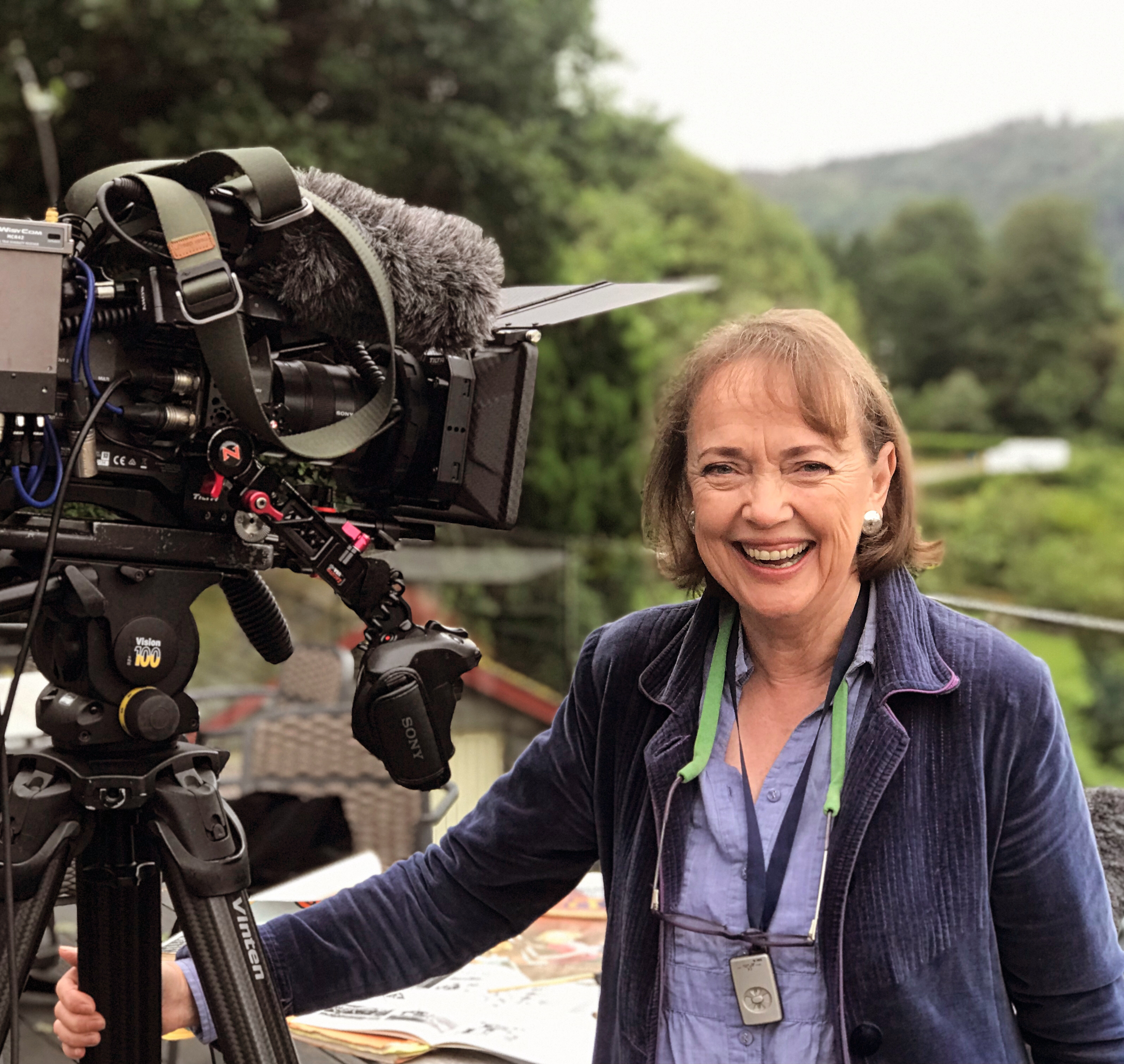

































 Sophie Neville