The Nancy Blackett Trust presented another screening of the classic film ‘Swallows & Amazons’ (1974) at the Riverside in Woodbridge. The cinema was celebrating 100 years of film and were thrilled to welcome a large and enthusiastic audience of 250, made up of children and Arthur Ransome enthusiasts one of whom told us he saw the film in Shaftesbury Avenue when it first came out.
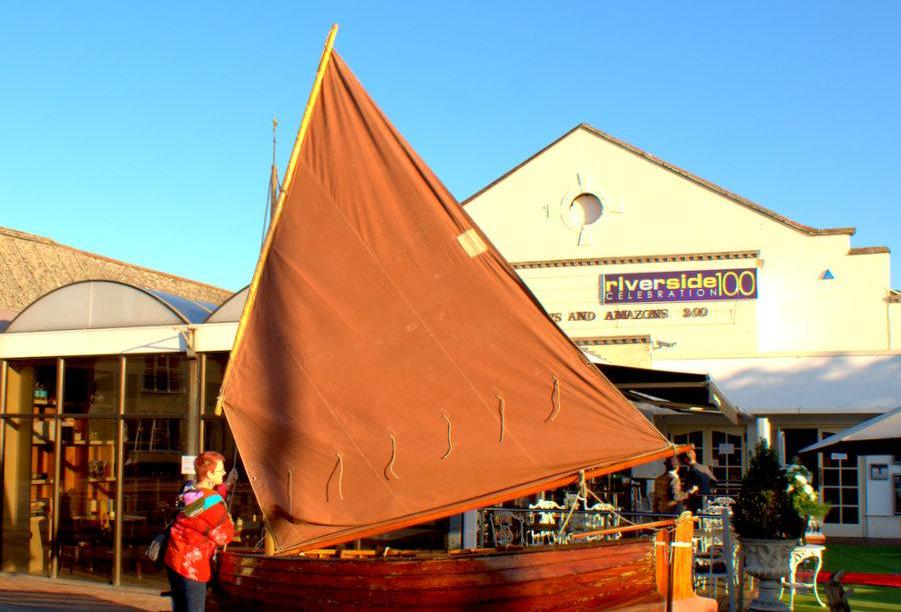
Swallow, the original dinghy used in the film was on display outside the cinema and I went along to answer questions about how the movie was made. Here are some of those asked by children in the audience:
Had you ever been on a boat before you started filming? Yes, my father was a great sailor and I’d crewed for him. As Titty, I had to row quite a bit – back from the charcoal burners, later when I captured Amazon and alongside Roger when we went to find the treasure on Cormorant Island.
How did you do the night time? We used Mrs Batty’s barn at Bank Ground Farm as a studio.
Which lake did you film on? Arthur Ransome wrote about an imaginary lake based on real places that we found on Windermere, Coniston Water, Derwentwater, Elterwater and a smelly lilly pond. the great thing is that you can go and find them too.
Did you enjoy filming? Yes, very much, but it could be chilly.
How long did it take to film? Forty-five days in all. It’s a 90 minute film so you can work out just how much we managed to film per day. It was well under the 4 minutes-a-day scheduled.
Did Titty actually keep the parrot? Titty did in the story but the parrot in the film was rather savage and had to be returned to Mrs Proctor of Kendal. However my parents bought a very tame green parrot called Chico who would sit on my shoulder, even when I went rowing.
Were you cold when you we filming the swimming scenes? Yes! We nearly passed out.
Why didn’t you wear life jackets? The film was set eighty-six years ago in 1929 when children didn’t wear life-jackets. We wore BOAC life-vests during rehearsals and when being taken out to the location.
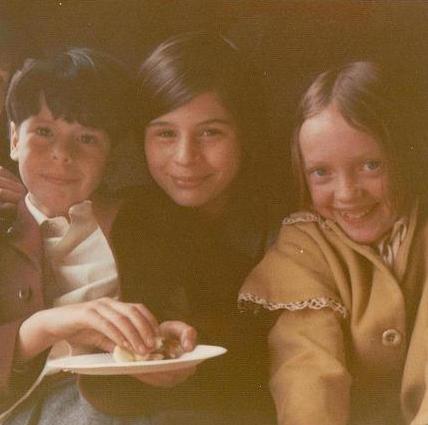
What are the children doing now? Working! Suzanna Hamilton is the only one of us to kept acting. She’s appeared in two feature films this year including ‘My Feral Heart’. Simon West has an engineering company that invents machines, Sten Grendon is a gardener, Kit Seymour is spending this year in Australia and I believe Lesley Bennett lives in the Netherlands, but I’m not sure. I’d love to make contact with her. Virginia McKenna is still acting as well as figure-heading her charity Born Free that does so much to relieve the suffering of animals.
In reality, how old were you all when you acted? Roger was 8, I was aged 12 pretending to be aged 9, Susan was 12 and John 11. Nancy was about the right age as she celebrated her 13th birthday towards the end of the filming. The secret was that Peggy was the eldest at 13.
Do you have a cameo role in the new film? You might just see me on the platform of the railway station but I am wearing a wig!
Why is Swallow’s flag brown? Because it a little elderly.
The camping kit – was it all packed in Swallow? We children didn’t know it at the time but it didn’t all fit in, although they did keep taking the tents down. Why we had a rolling pin on board, I do not know.
What happened to Amazon? The Amazon Arthur Ransome knew, which was originally called Mavis, can be seen at the Coniston Museum. The dinghy we used in the film was also used in the black and white BBC TV serial made in 1962. She is now in Kent – and still sailing. You can see her on ‘Country Tracks’ by clicking here.
After the film screening, I was told that students on the Open University Children’s Literature course with study Arthur Ransome’s classic book ‘Swallows and Amazons’, which is good news, especially since the BBC News headline rang out the question: Do children still need to read the classics of English Literature? Declaring, ‘Gone from bedroom bookshelves are the Famous Five, The Chronicles of Narnia,and the adventures of the Swallows and Amazons.’
Is this true? Do leave your comments below – or contact the BBC!
14th May 1973 – and it was the first day of making the original movie ‘Swallows & Amazons’ on location in the Lake District. A huge effort had been made to ‘dress’ Haverthwaite Railway Station, at the southern end of Windermere. The aim was to bring across the feel of a bustling holiday destination in the summer of 1929. Local people had been fitted with costumes in the Ambleside Church Hall, there was a horse and cart, porters’ trolleys laden with trunks and a number of old bikes, which were all of great interest to us.
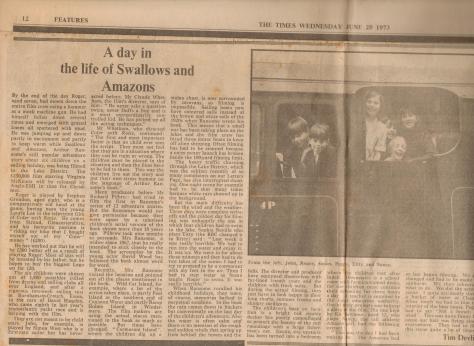
Having stepped down from the steam locomotive, where the Times photographer must have taken this shot (below) before we children were piled into an open-topped period vehicle, for further photographs.
A photograph taken for The Times of us all aboard the steam train at Haverthwaite
I thought the publicity photographs taken that day were silly, especially since Kit Seymour and Lesley Bennett, who played the Amazons, were wearing ordinary clothes rather than period costumes, but the results were later published far-afield from The Guardian to Woman’s Realm.
Viewers ask how old we were at the time. Sten Grendon, who played Roger was aged 8, Simon West (John) was aged 11. Although Titty is described as being aged 9 in the books, I was 12, as were Suzanna Hamilton (Susan) and Kit Seymour (Nancy). Lesley Bennett (Peggy) was 13, but looked younger. Virginia McKenna, who played my mother, has just been awarded a DBE – not before time!
A publicity shot featuring Virginia McKenna, with Kit Seymour, Steven Grendon, Sophie Neville, Lesley Bennett, Simon West and Suzanna Hamilton, taken on the first day of filming and published in the Guardian and other newspapers
The yellow motor used in the film for our taxi was superb. Would a real Lakeland taxi have been so grand? I recorded in my diary that Sten, playing Roger, hung out of the window as the director, Claude Whatham, ‘filmed us driving out of the station, along the platform at top speed.’
Once this shot was ‘in the can’ Virginia McKenna was interviewed by journalists while we were hurried away to get on with our lessons. Our tutor taught us Art. I drew the a picture of the motor car.
Director Claude Whatham talking to Virginia McKenna
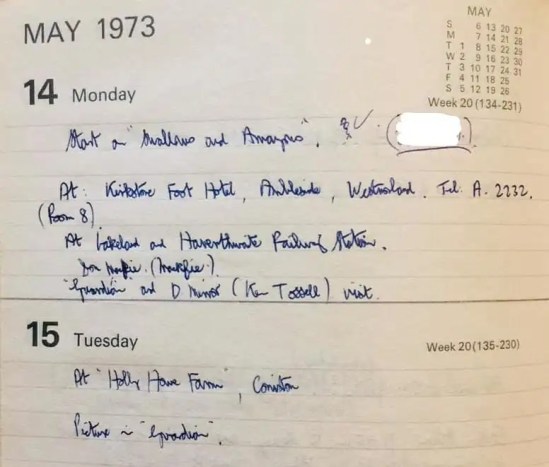
Journalists from the Times, Guardian and Daily Mirror were looked after by our publicist, Brian Doyle, whose diary was a little more functional than mine. I’m now struck by the telephone number for the unit hotel: Ambleside 2232
Dairy kept by Brian Doyle, the publicist on ‘Swallows and Amazons’
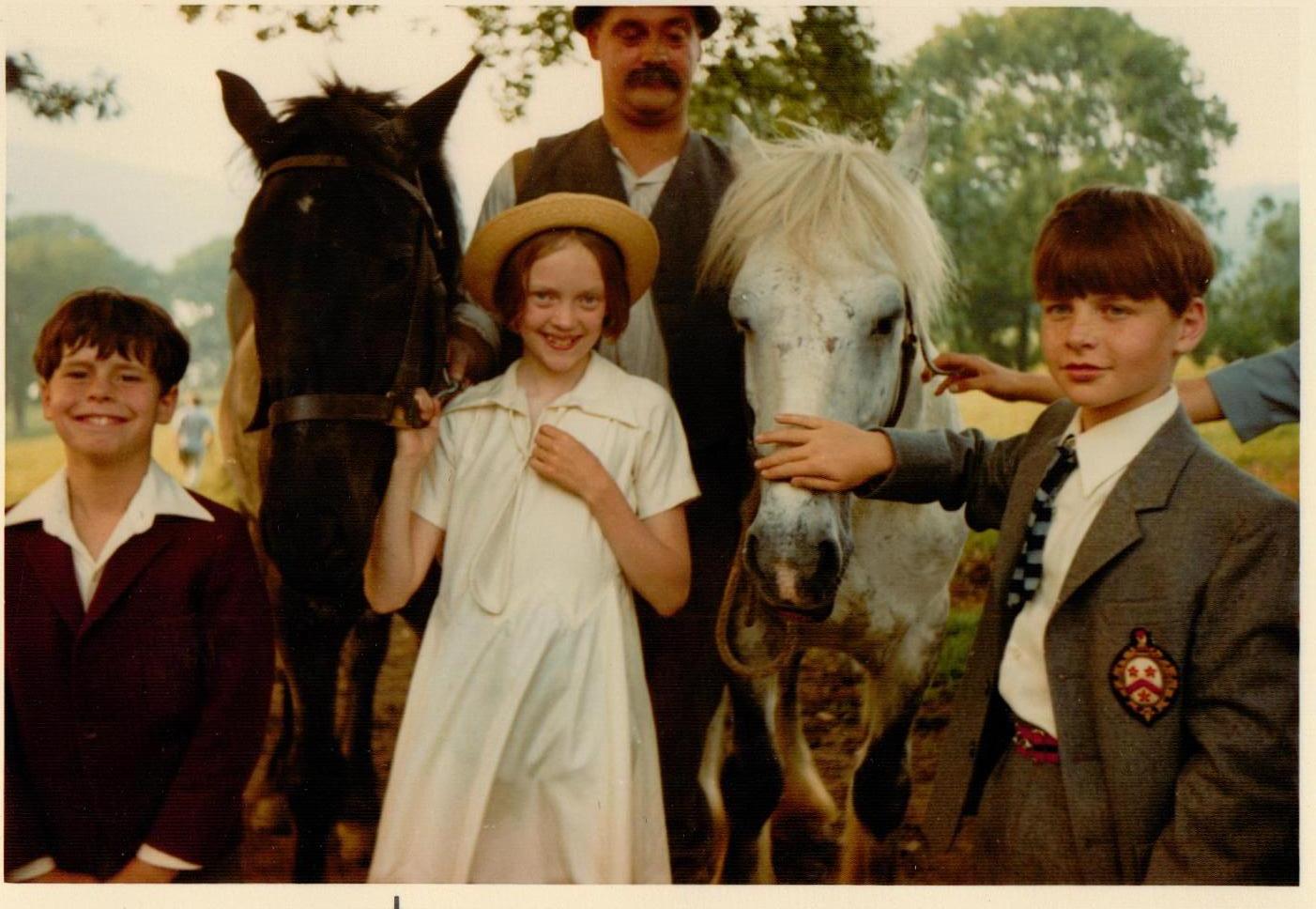
Arriving at Holly Howe in the taxi was truly exciting. It was not filmed the next day, as I think rain had set in. Claude waited for good evening light. But I remember the thrill of drawing up outside the farmhouse in the old car and pulling on my hat as we spilled out and ran past the big farm horses Mr Jackson was leading into the yard. Our OOV (out of vision) dialogue was added later.
The screenplay of the 1973 film ‘Swallows and Amazons’ adapted from Arthur Ransome’s book by David Wood
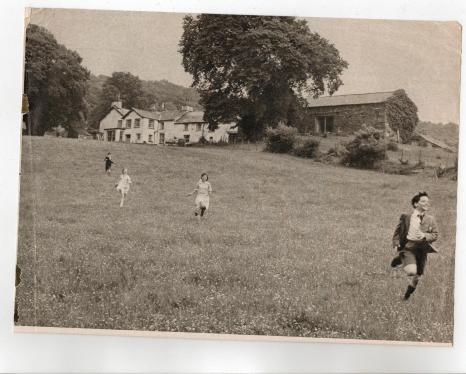
If you ever go to Bank Ground Farm near Coniston, named Holly Howe by Arthur Ransome in his books, you must run down the field to the lake as we did. As soon as you arrive. And at top speed. And you will be filled by the same feeling of elation as we were when we played the Walker children.
Steven Grendon, Sophie Neville, Suzanna Hamilton and Simon West at Bankground Farm above Coniston Water in the Lake District
The slope, formed by glacial scouring and subsequent deposits long ago, is steeper than you might think. We became adept at the art of glaumphing, advocated by Ransome in the book.
What struck me when I returned to Bank Ground Farm one Spring, was that sadly the great trees have gone from around the old farm gate and the boatsheds down by the lake. They must simply have reached the end of their lives, but their glory was captured on celluloid to be remembered forever.
Sten Grendon, Sophie Neville and Simon West with Mr Jackson at Holly Howe~ photo: Daphne Neville
Most Arthur Ransome devotees will know that the Peak at Darien, where once stood stout Cortez, is familiar to readers as it appears in two of the illustrations in the book. Sadly it can not be found below the farm in real life. Mrs Ransome said that you could find the headland on Windermere. In April 2011, when I was on an early recce with Nick Barton, CEO of Harbour Picture Productions, we did pass one promising spot. However Richard Pilbrow and Claude Whatham chose Friar’s Crag on Derwent Water for the location. I didn’t know it but Christina Hardyment writes in her excellent book, Arthur Ransome and Captain Flint’s Trunk, that they had found the very place Ransome had in mind, “without the slightest idea that they were quite right to be doing so.” She found that Ransome had marked up postcard of Friar’s Peak for his illustrator Clifford Webb to work from in 1930. It feels completely right when you are there, with the iconic view of an island under the towering mountains. It was over a shot of this that the opening titles were added.
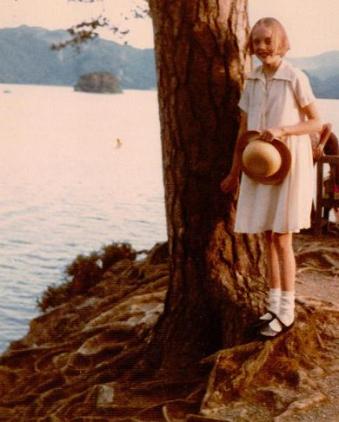
Sout Cortez was not around. Neither were we children. By the time we had been transported from Coniston to Derwent Water for this scheduled scene the sun was going down. We’d been delayed by the make-up artist who was determined to tone down the tans we had developed. This took ages as he used a very small sponge. My mother was frustrated, as she thought that this would never have shown up, but he put his foot down with the result that we were ‘late on set’ for the evening shots. Mum grabbed this photo but it was a disaster. Claude Whatham was very annoyed.
Sophie Neville as Titty arriving too late in the day to film at Friar’s Crag on Derwent Water. The island portrayed as Wildcat Island can be seen in the distance ~ photo: Daphne Neville
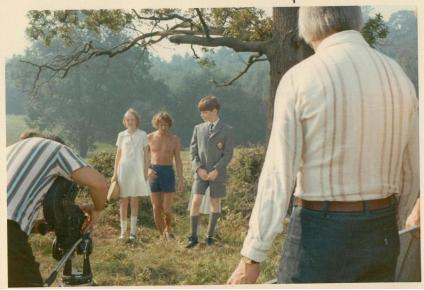
One of the big secrets of the film is that the sequence when we run up to the Peak at Darien and first set eyes on the island in the lake was shot under an oak tree in Runnymede, near the River Thames. We were not an island at all. It must have been an expensive ‘pick-up shot’ but Claude had made an effort to gather together the same crew members and I was back in my lovely silk dress once more. We knew how to act by then and the joy of being together again shows on our faces. The result was a scene to set the film off on the right foot. We were jubilant and so excited, that, like swallows, we could have taken flight.
Sophie Neville, Claude Whatham and Simon West with Richard Pilbrow, right ~photo:Daphne Neville
I would have to check with Richard Pilbrow to be certain, but I think that Simon Holland, the Art Director, penned the SWALLOWS and AMAZONS graphics for the opening titles. I remember a discussion about the font type. A very fashionable script used on the poster of the film was favoured. I said that they ought to use the handwritten capitals that Clifford Webb had penned on the map in the opening cover of the book, which were copied by Simon Holland (and me) on our chart. This was chosen.
A snazzy Seventies’ font, had been used for the titles of Lionel Jefferey’s movie The Railway Children and the poster of Swallows & Amazons. For sometime a DVD has been available which gives you both movies released by EMI Films.
Click on this image to see the poster of the film
As a viewer I felt that this soon dated it, whilst Swallows and Amazons sailed onto our television screens in the 1980’s and 1990’s, without being spoilt by what became most unfashionable graphics. Of course that particular retro font is now all the rage.
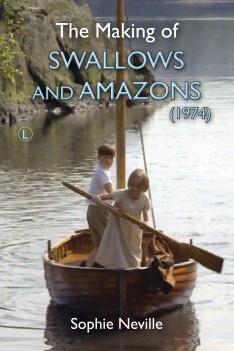
You can read more about the trials of producing the classic film in ‘The Making of Swallows and Amazons’ published by the Lutterworth Press, available online, at all good bookshops and to order from libraries.
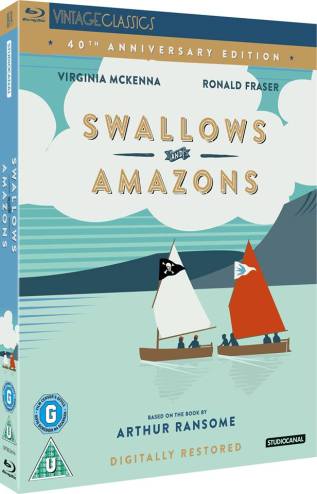
The remastered DVD with subtitles and an Extras package is available online.








 Sophie Neville