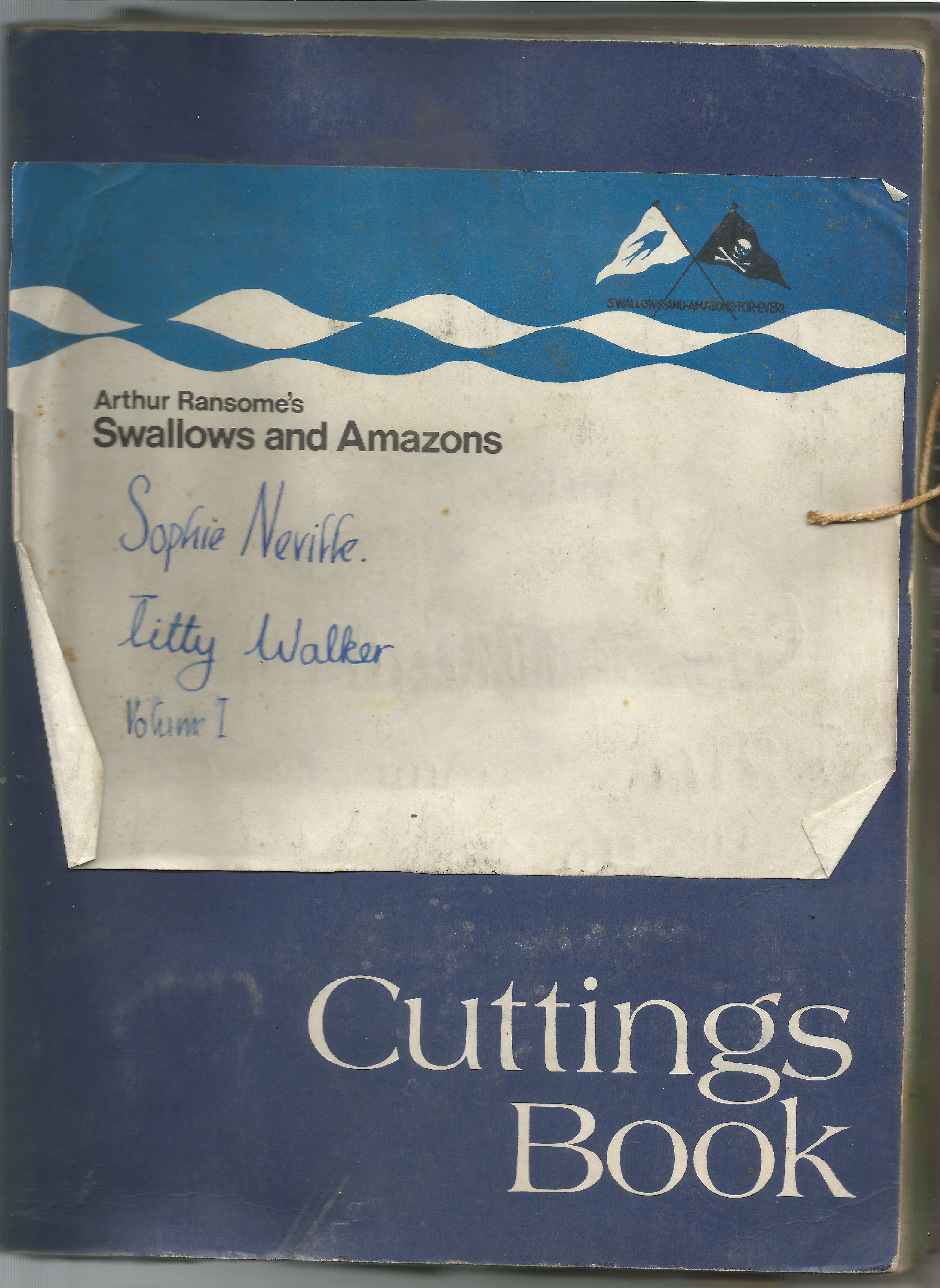
I thought I’d lost it! But, on clearing out our mother’s house, my sister found the cuttings book I kept whilst making the original movie ‘Swallows and Amazons’ in 1973.
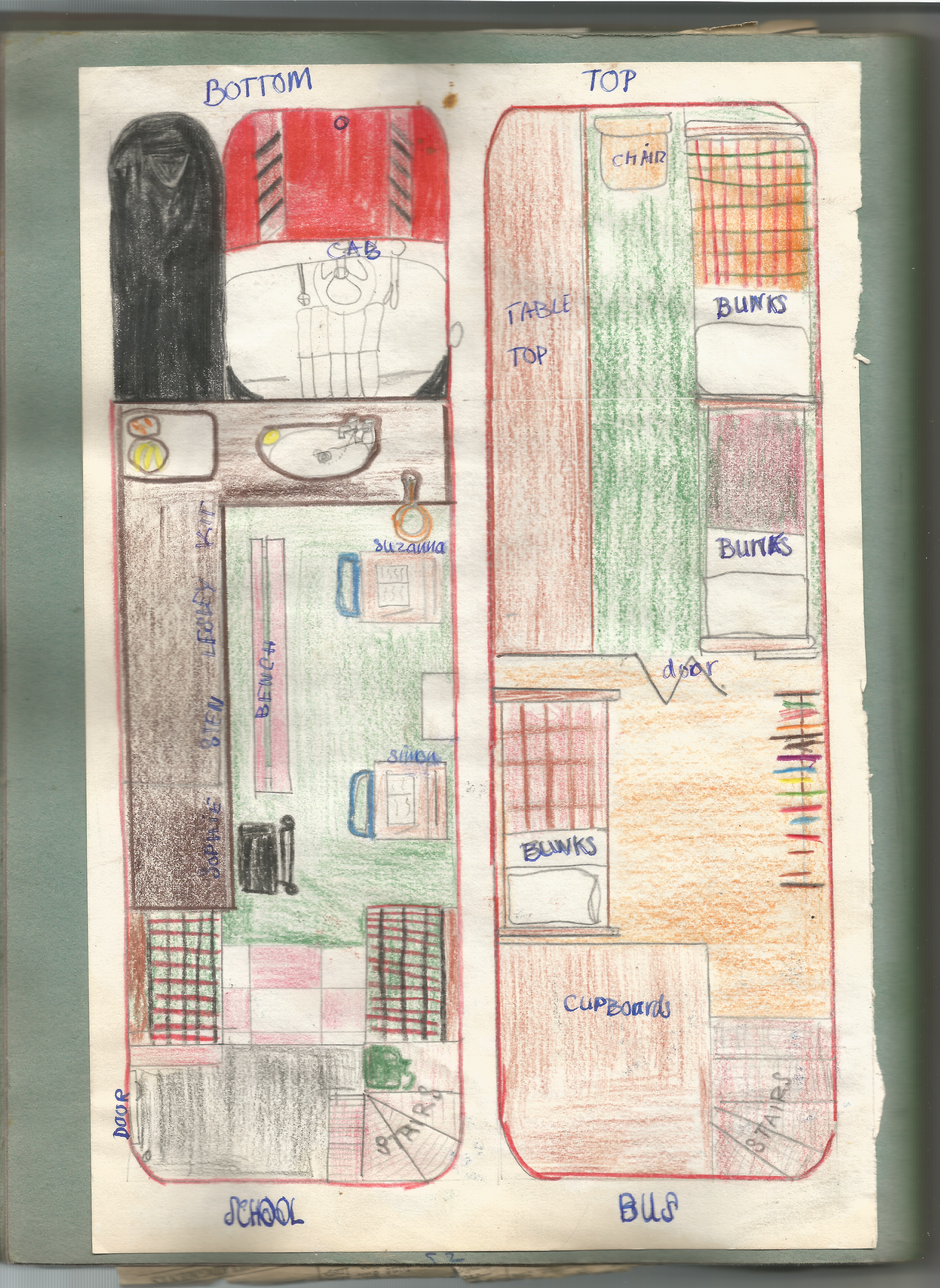
It includes a plan of the London double-decker bus where we received rudimentary lessons on location. Three bunkbeds on the top floor were meant to be used so we could rest after lunch. Mum said she forced me to lie down everyday but I can only remember a couple of occasion, once when I was reluctant, once when I was freezing cold after a swimming scene.
We changed into our costumes at the top of that bus, enjoying warmth from a gas stove that leaked rather alarmingly on one day necessitating an evacuation.

The exterior looked liked a conventional Routemaster with added curtains.
Lesley Bennett’s photo of the double decker buses at Bank Ground Farm in 1973
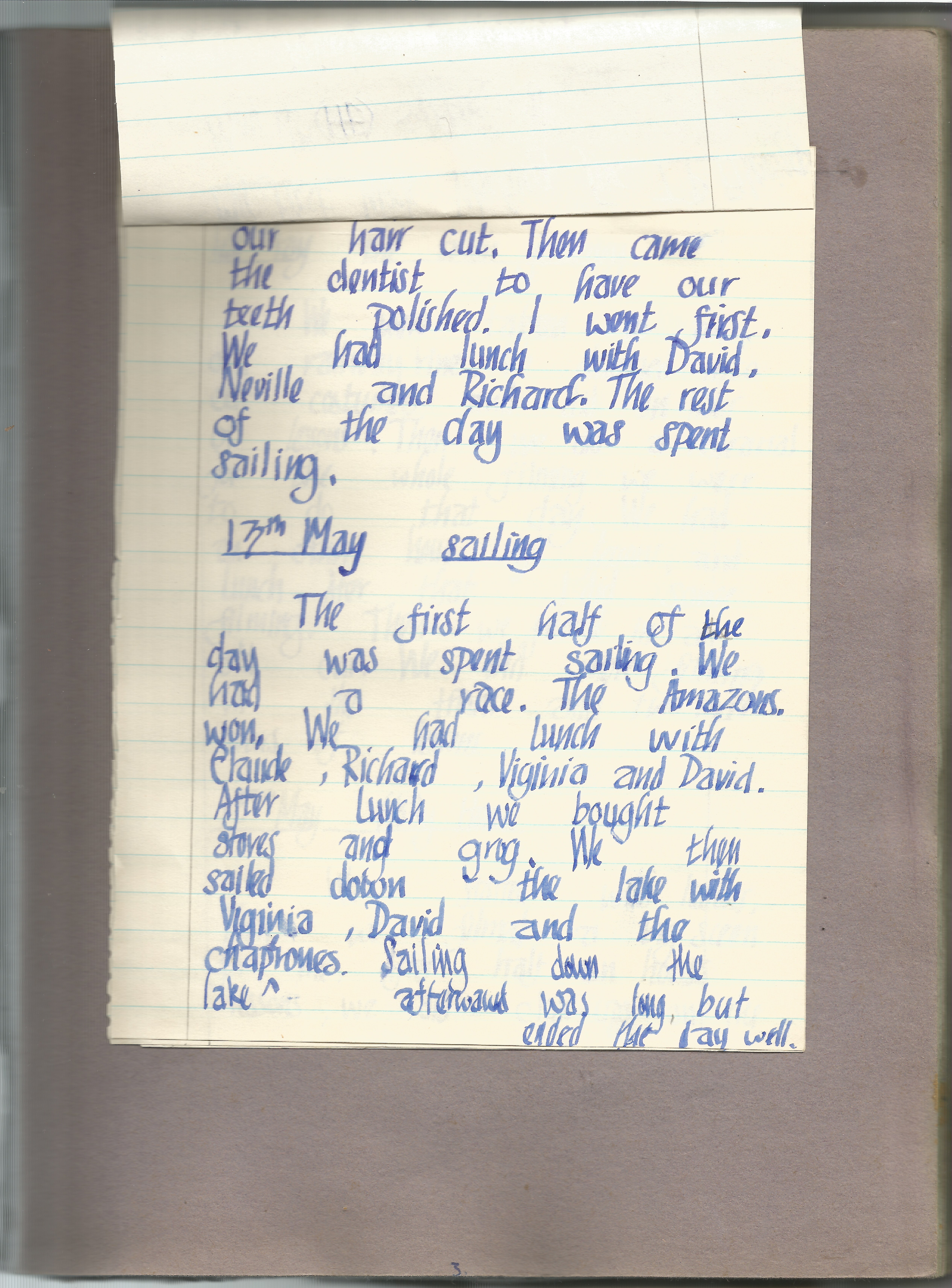
Once sitting at my desk, I found my italic fountain pen and began keeping a diary. One version of the first seven days spent in Cumbria is pasted into the scrap book. I later re-wrote a slightly more detailed and interesting version in a couple of notebooks and wrote about how I got the part of Titty, and the filming from different perspectives.
These pages describe the day spent travelling to Ambleside and a couple of days spent getting to know each other along with Dame Virginia McKenna, who played the Swallows’ mother, the producer Richard Pilbrow, David Blagden who was in charge of the sailing and the film director Cluade Whatham.
Encouraged by my mother, we began pasting in newspaper cuttings.
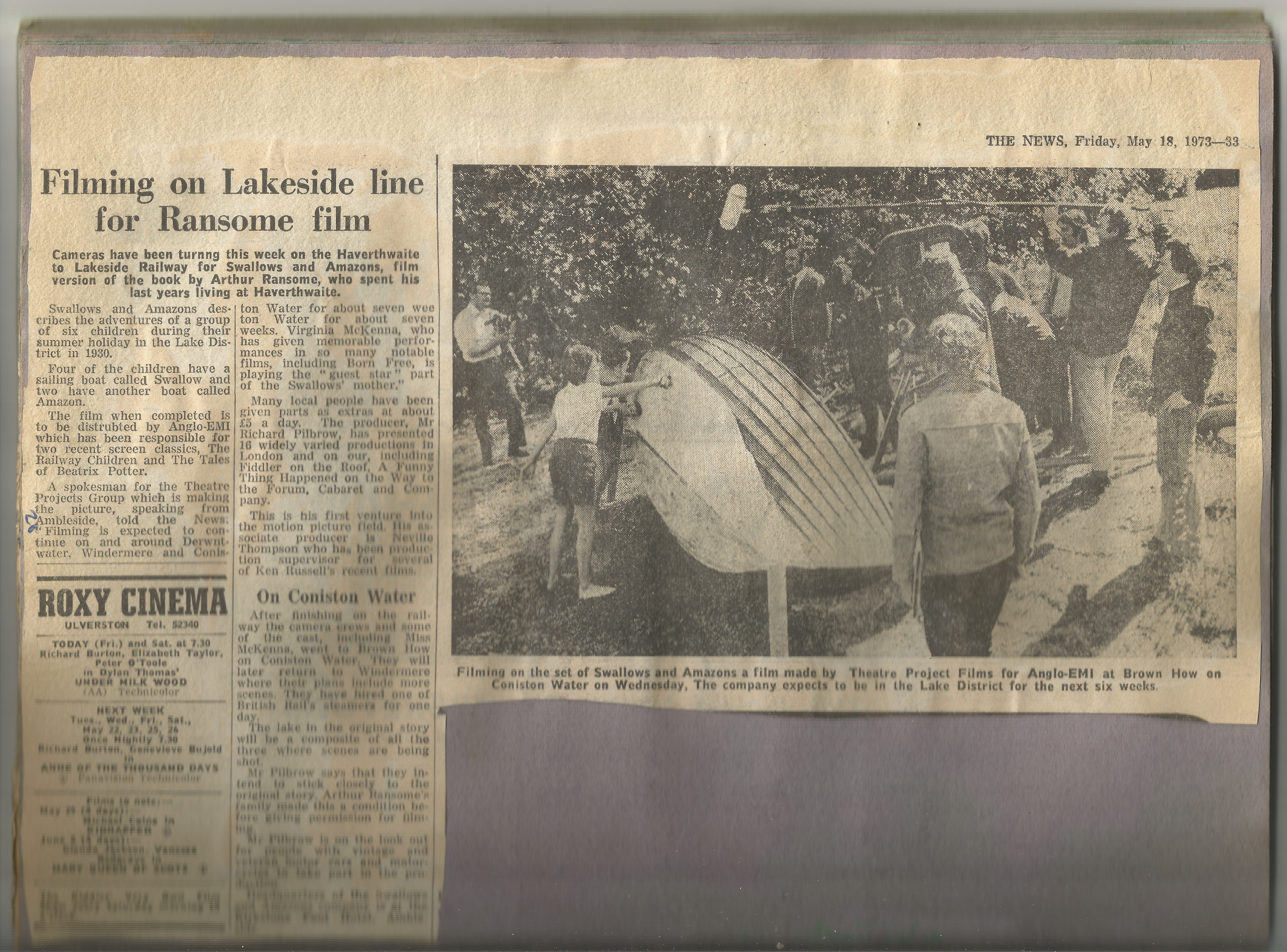
The Times and the Guardian were at Havethwaite Railway Station to take photographs on the first day of filming. The BBC Radio 4 newsreader, Alan Smith, who grew up in Cumbria, was a film extra that day and can be spotted standing in train doorway with his brother. He wrote to me with his memories of the day.
I began adding photos from contact sheets that Albert Clarke, the film’s stills photographer, took of the cast and crew. I wrote about the opening locations here.
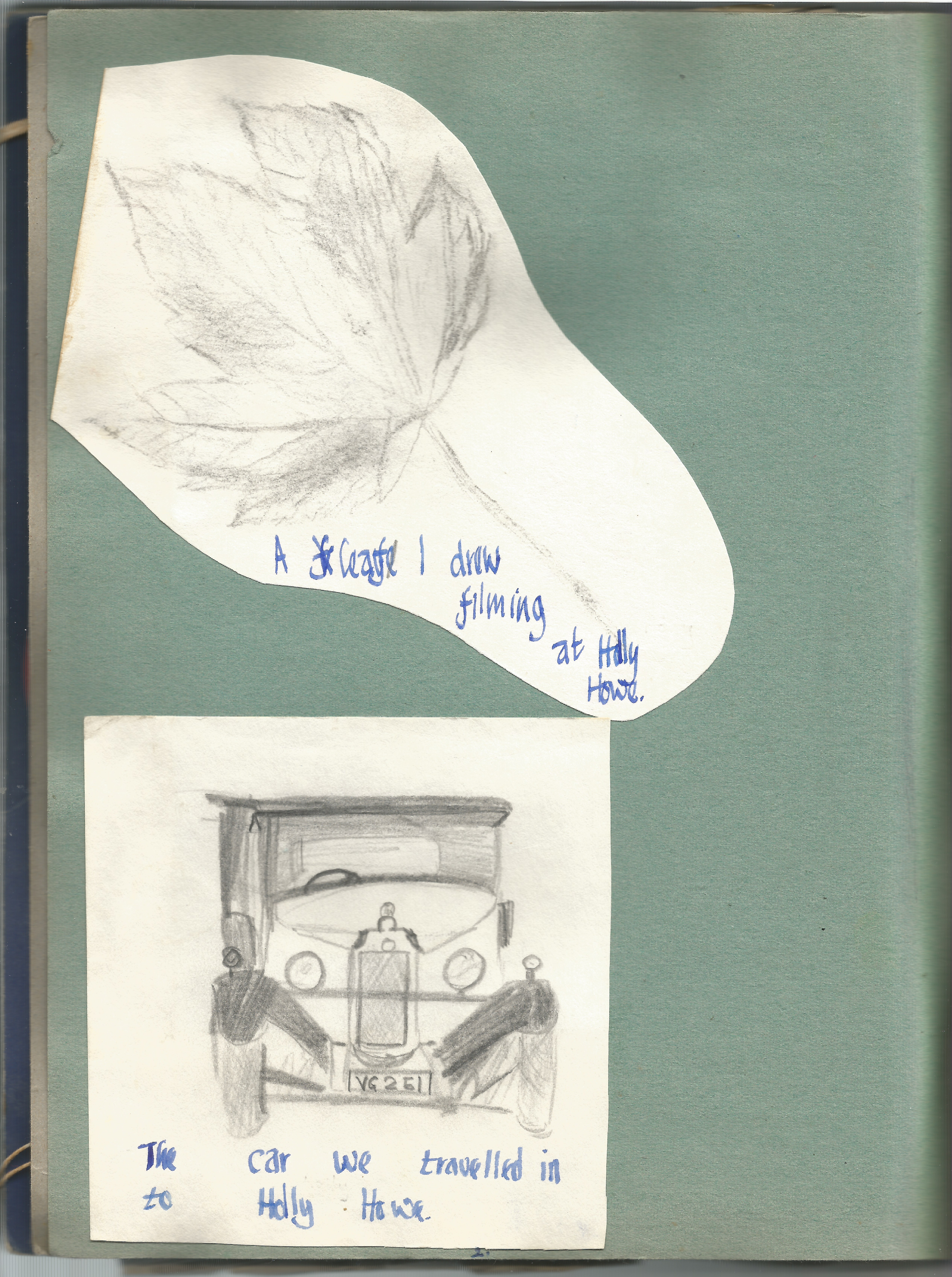
There are pages of dictation and a few sketches of the film props. I drew the yellow Austin ‘taxi’ we drove in at the station.
There were some cuttings that I hadn’t seen for years until until I opened the pages of this mislaid cuttings book. Others can be found on earlier posts.
I took pages of dictation, learning about the plants and geology of the Lake District, about Beatrix Potter and the National Trust, but it’s a wonder any schoolwork was accomplished at all. We spent so much time on set. I fell behind in French and Maths but gained respectable exam grades that summer, gaining 80% in Geography. Perhaps I wrote about glacial lakes.
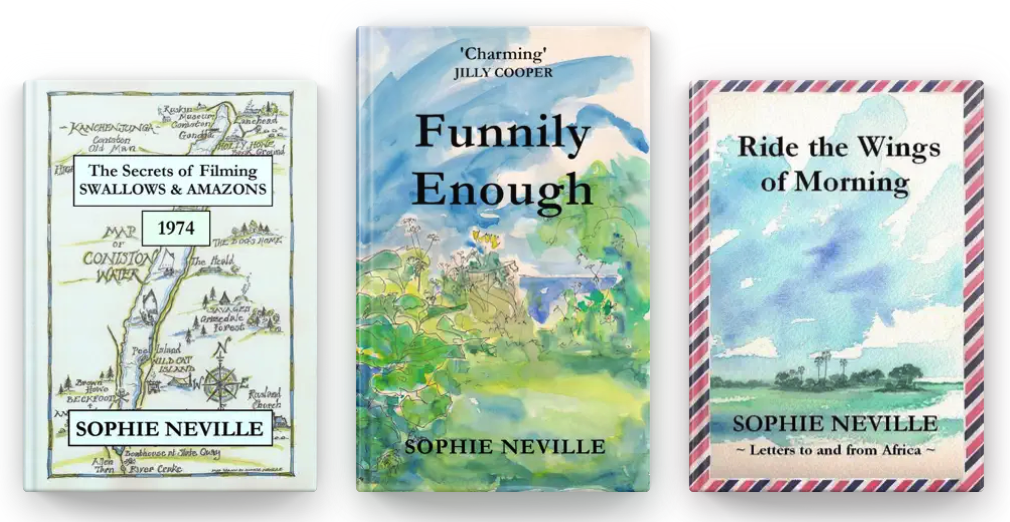
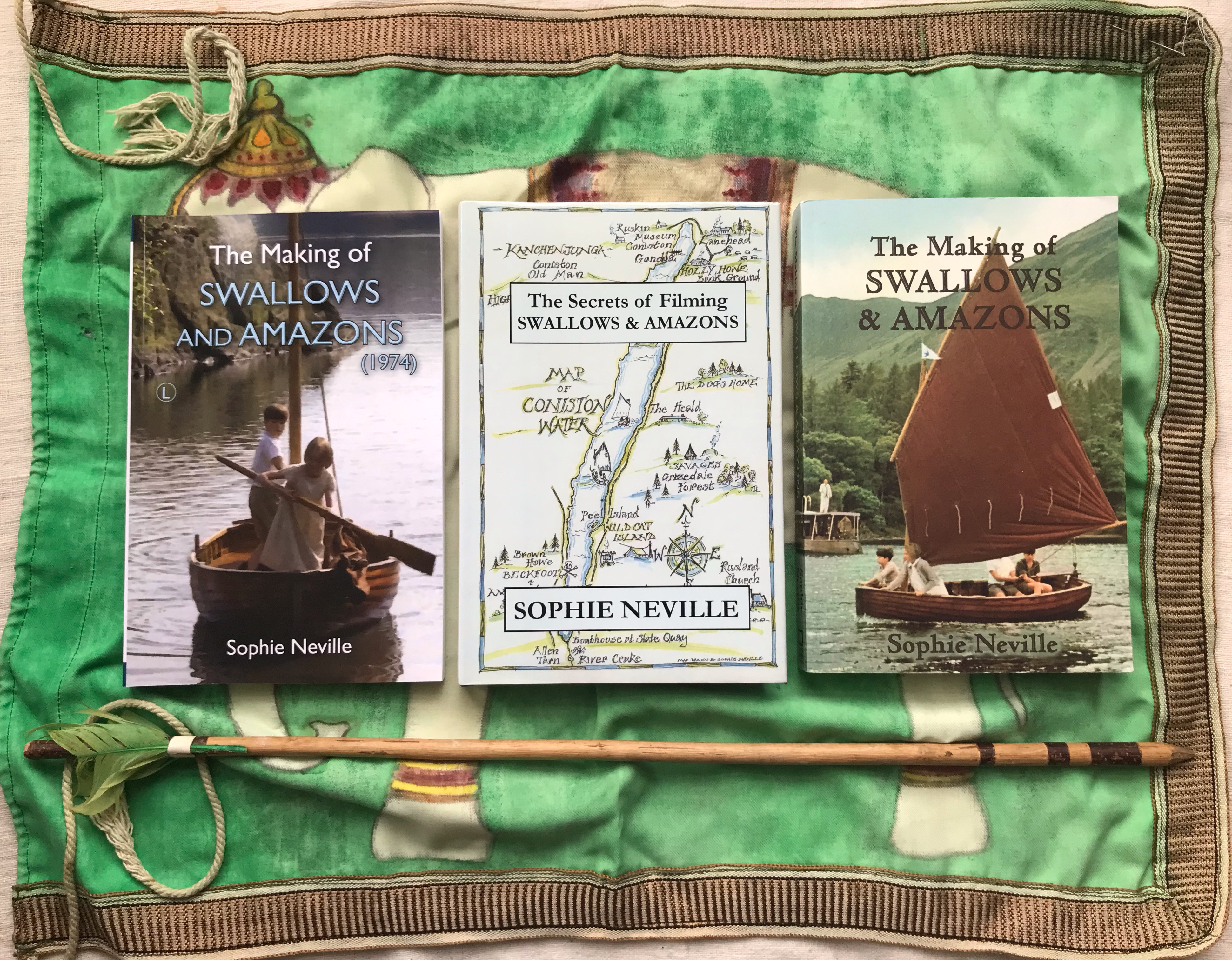
You can read more about the adventures we had whilst filming ‘Swallows and Amazons’ in books detailed on this website.
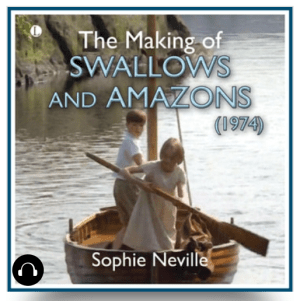
Different editions of ‘The Making of Swallows and Amazons (1974) by Sophie Neville’
There is now an audiobook on ‘The Making of Swallows and Amazons’ published by The Lutterworth Press and available on all online platforms including Audible.
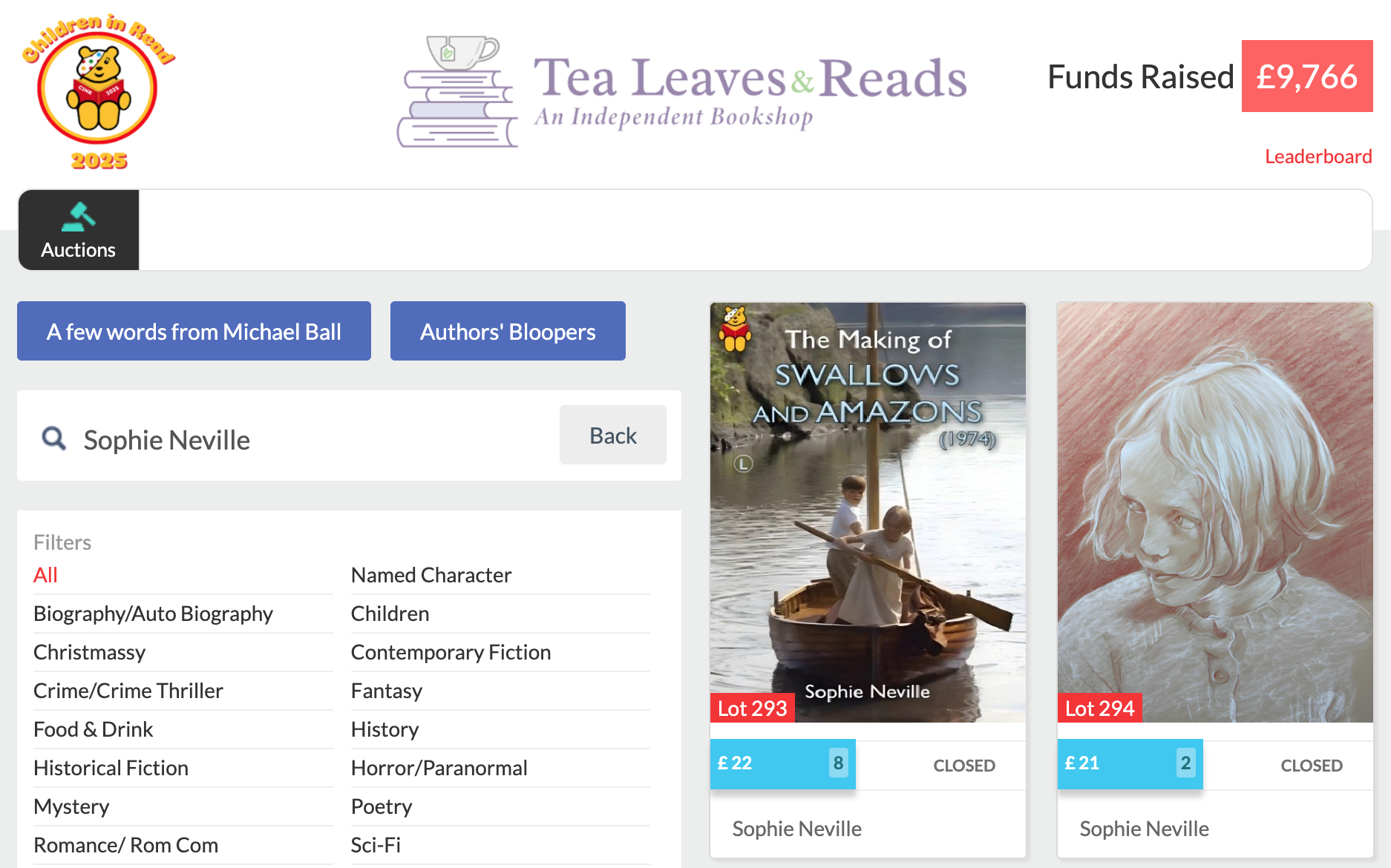
A book signed by the author always makes a good Christmas present. Each year, I take part in an annual online charity auction organised by Children in Read to raise funds for BBC Children in Need.
You can scroll through the site on Jumblebee. co.uk. and choose from an amazing selection of biographies and other books donated by contemporary authors.
Taking part is always great fun and offers authors a bit of publicity whilst presenting readers a choice of signed and dedicated books and illustrations.
In 2023, items in the Authors and Illustrators’ auction, raised a total of £24,061 for BBC Children in Need.
This year, authors and illustrators raised £9,766.
Over the eleven years that the annual event has been running a stunning total of £141,766 has been raised. I joined in 2020 and have raised a total of £616 for this cause.
Bidding has now closed but put the event in your diary for next year.
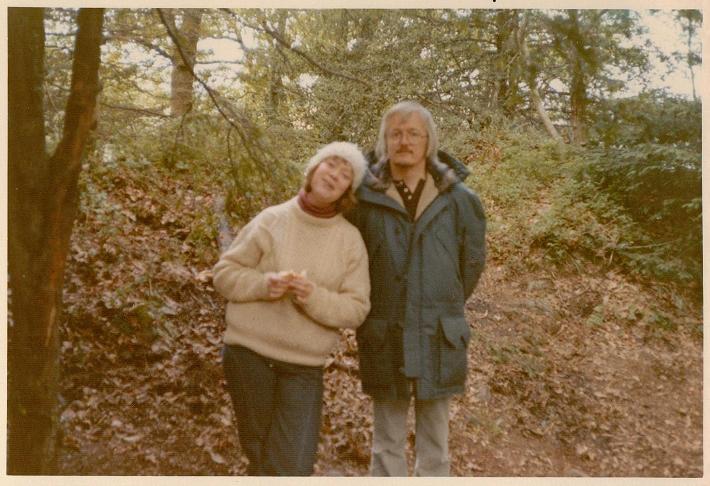
Daphne Neville with Sophie Neville while filming ‘Swallows and Amazons’ in Cumbria in 1973
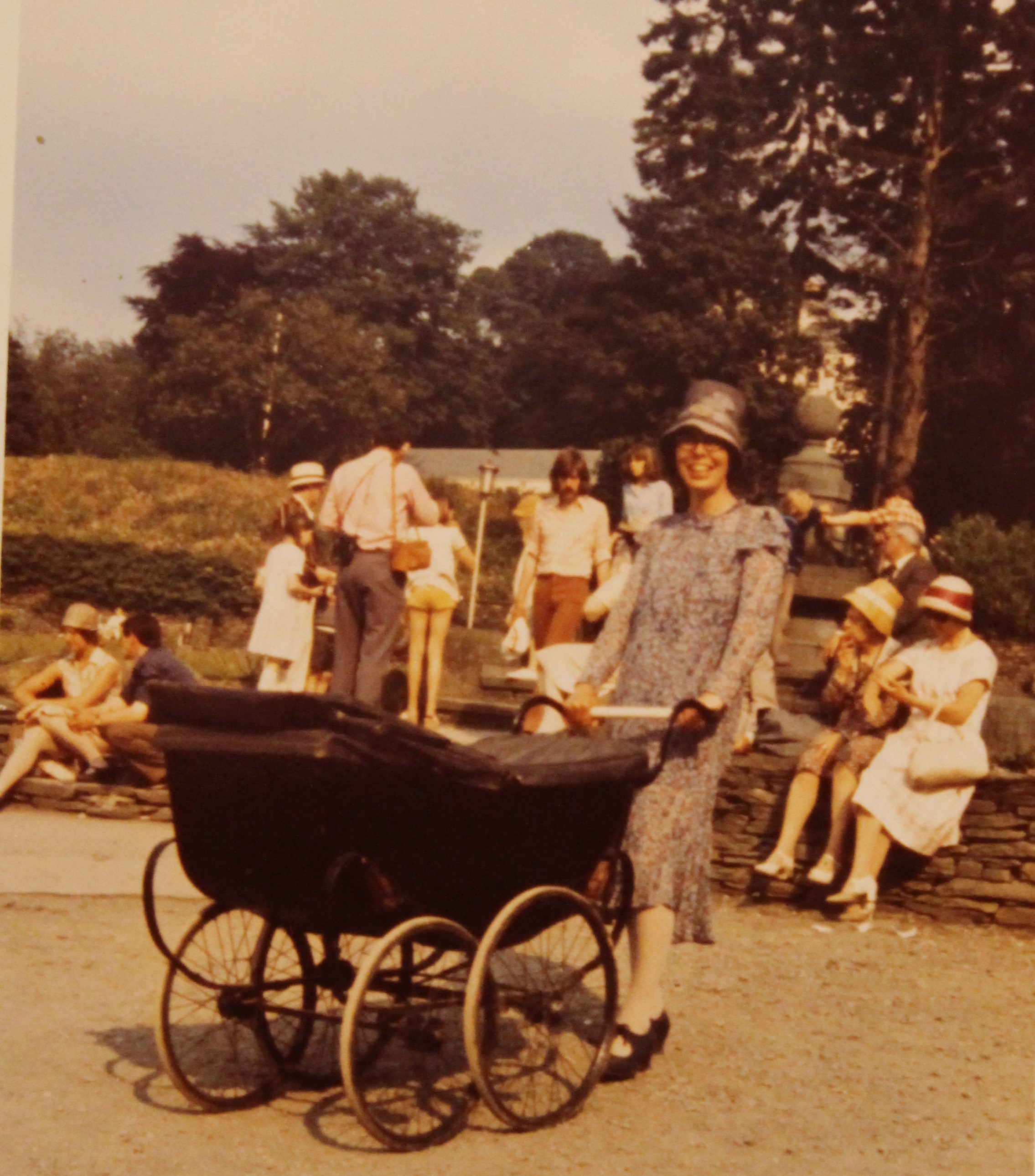
It wasn’t until we were making preparations for the 50th Anniversary of the EMI film ‘Swallows and Amazons’ that I began to list all the work my mother, Daphne Neville, accomplished behind-the-scenes.
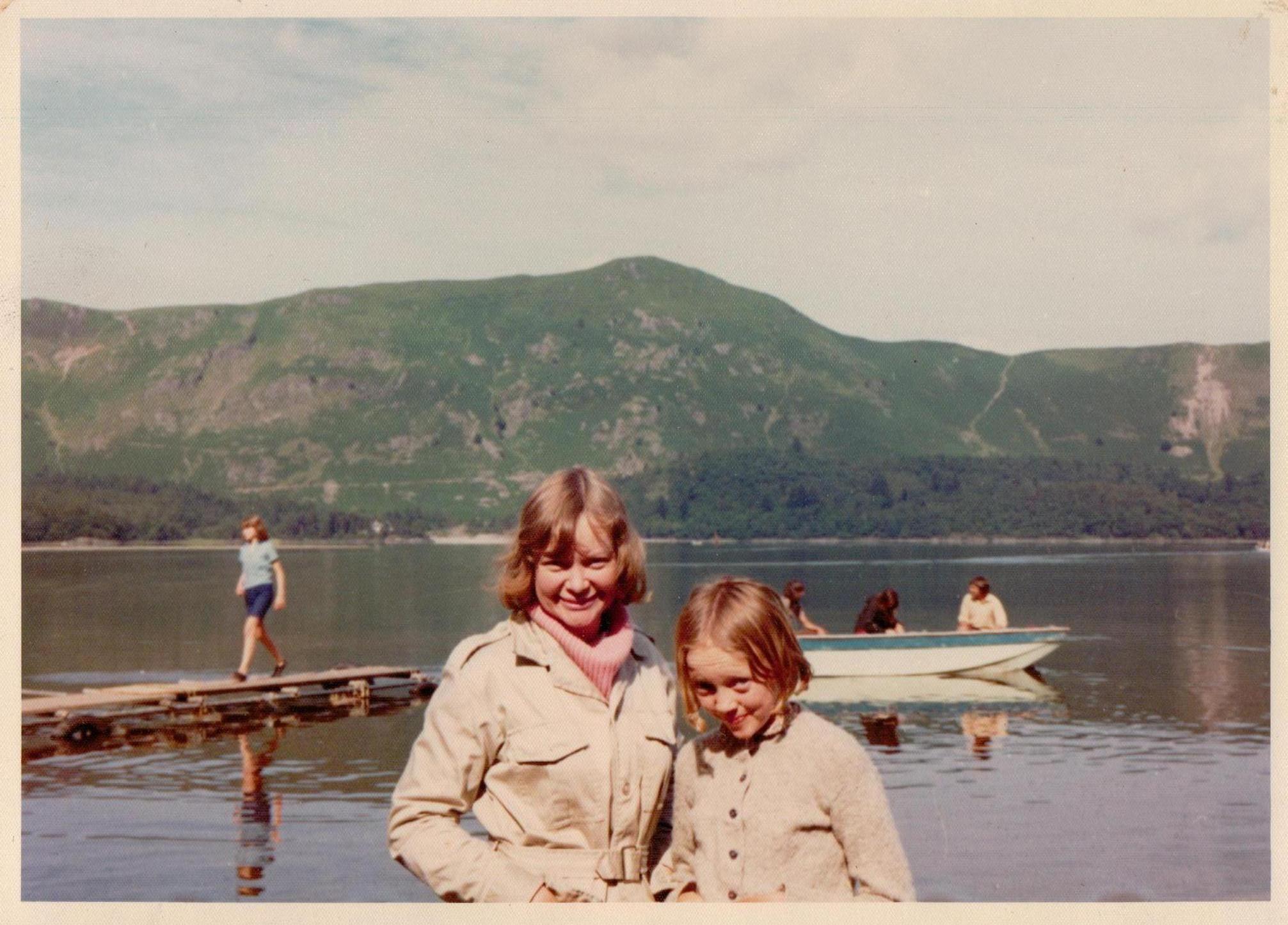
Daphne Neville accompanying Suzanna Hamilton, Kit seymour, Sten Grendon, Simon West, Sophie Neville, and Lesley Bennett out to the houseboat on Derwent Water
When I was offered the part of Titty Walker, she’d been invited to work as a chaperone, along with Sten Grendon’s mother, Jane Grendon. This proved to be a pretty demanding job. Getting us ready and into the minibus every morning alone must have been challenging. We stayed at the Oaklands Guest House where there were only two bathrooms shared between twenty-three residents – the eight of us, various students from the Charlotte Mason College of Education and the five members of the Price family who owned the house. We had to move out over Whitsun when it had been booked by holiday makers.
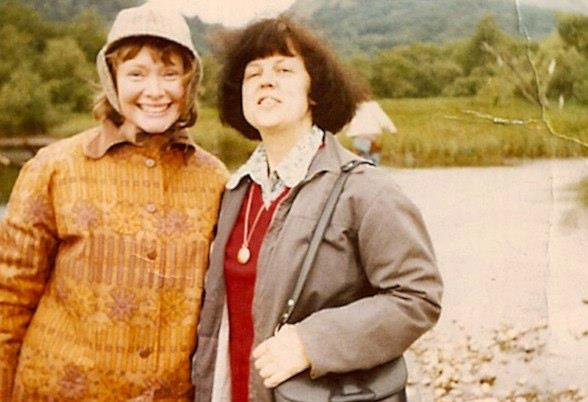
Dressed for the Cumbrian weather: Daphne Neville with Liz Lomas ~ photo: Richard Pilbrow
Mum was pretty horrified by the spaghetti hoops, cuppa soups and pasties given to us for supper and asked if we could have a fruit bowl in our school bus. Location catering in 1973 was good but aimed at providing electricians with meat and two veg, rather than food for children. We enjoyed salads and chicken drumsticks but baked beans could ruin a take and sugared food made us over-active and probably annoying.
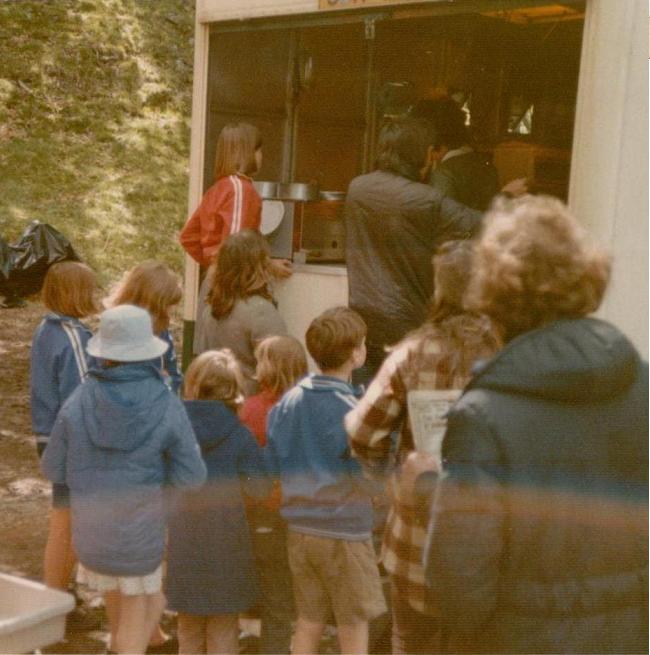
Suzanna Hamilton, in her red tracksuit top, seeing what the location caterers had for lunch on the set of ‘Swallows and Amazons’ by Coniston Water
On film sets you normally have female costume assistants or dressers to help change actresses into their costumes. On ‘Swallows and Amazons’ we had Terry Smith the wardrobe master and my mother. Whenever there was a scene with film extras, Mum helped him to fit them with shoes and hats, helping the ladies into costumes for the opening scene at the station.
Wardrobe Master Terry Smith with Sophie Neville and her mother Daphne Neville outside the Make-up caravan on location near Keswick in Cumbria
Our hair was cut and looked after by Ronnie Cogan but mine had to be washed every night by Mummy. She moved me into her bedroom, which was tiny, but had a basin. This seems a small thing, but watch the film and you see my hair flying around the whole time indicating the ever-present wind.
Daphne Neville and Richard Pilbrow on Peel Island on Coniston Water in 1973 Amazons
Mum tried to keep us warm on location, getting us into life jackets and sunhats before we were taken off to the set, which was often either a boat or island.
Daphne Neville with Sophie Neville and Simon West on Coniston Water
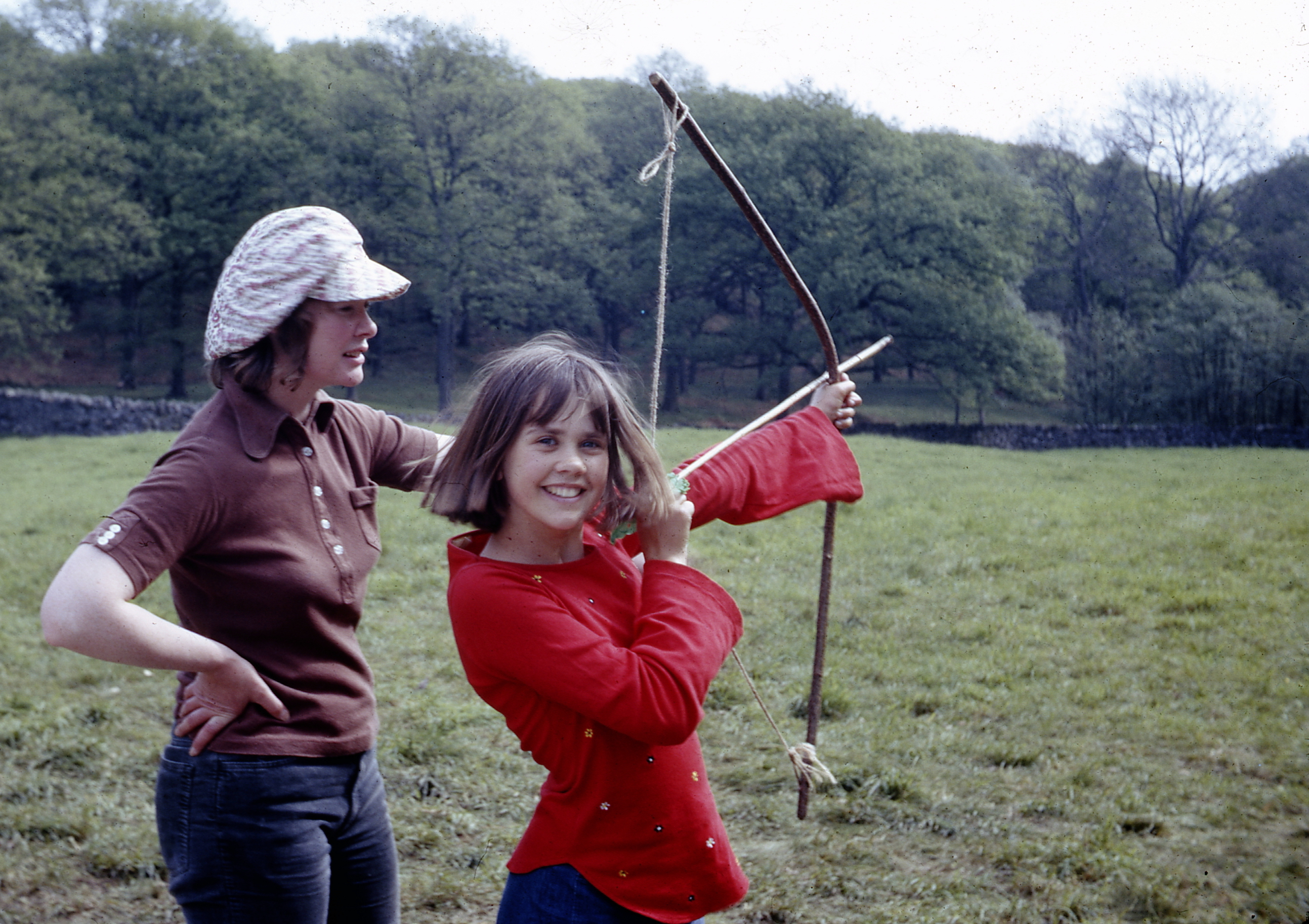
Having won prizes for archery, she taught the Amazons to shoot with a bow and arrow for their scene on Wild Cat Island.
Daphne Neville teaching Lesley Bennet, who played Peggy, how to shot with a long bow
She also took a vast collection of behind the scenes photos, some of which were very good.
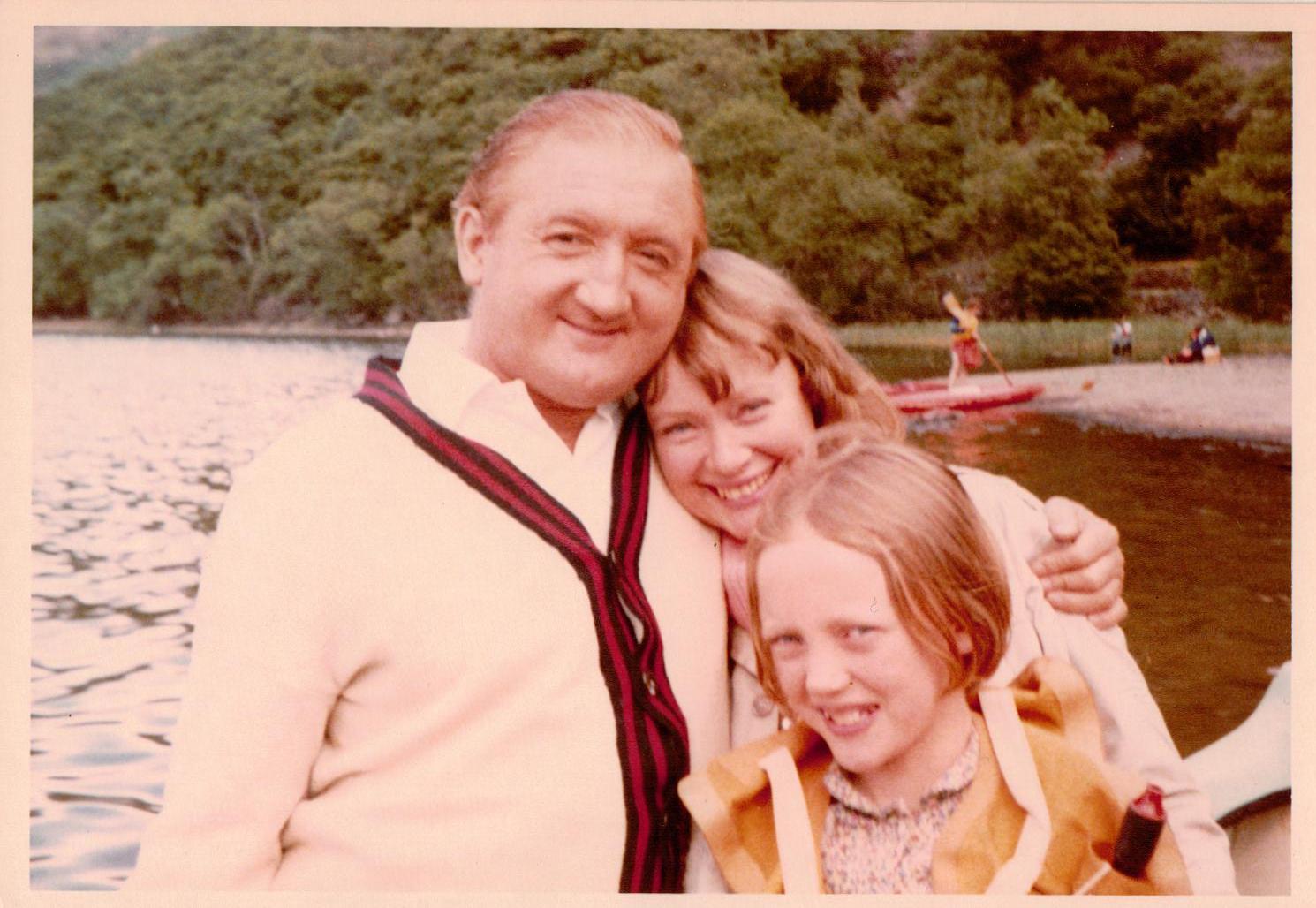
Ronald Fraser with Daphne Neville and Sophie Neville on Derwentwater in 1973
I couldn’t bear it when Ronnie Fraser flirted, but Mum enjoyed every moment of being on set. She longed to appear in the film as a supporting artist. My father, Martin, appeared in five different shots but Mum missed the crowd scene at Bowness and sequences taken aboard the MV Tern the next dau.
Jane Grendon with other film extras on the original movie ‘Swallows and Amazons’
Back home, she had a part-time job working for HTV who had given her leave but called her back to Bristol to present an episode of Women Only and promote the channel at the annual Bath and West Show. You can read more about this on her website here.
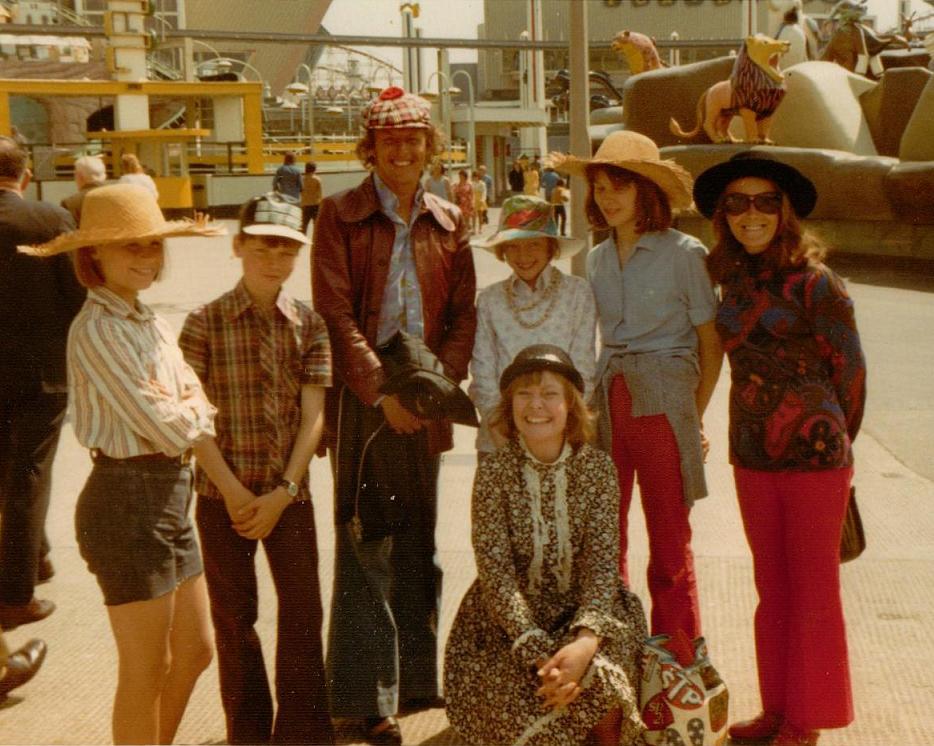
Suzanna Hamliton, Simon West, Claude Whatham Sophie Neville, Kit Seymour, Jean McGill with Daphne Neville kneeling at Blackpool funfair in 1973
While other members of the film crew were given one day off a week, our chaperones’ work never ended. Jane took us shopping or on walks up into the fells. Mum came with us on a trip to Blackpool.
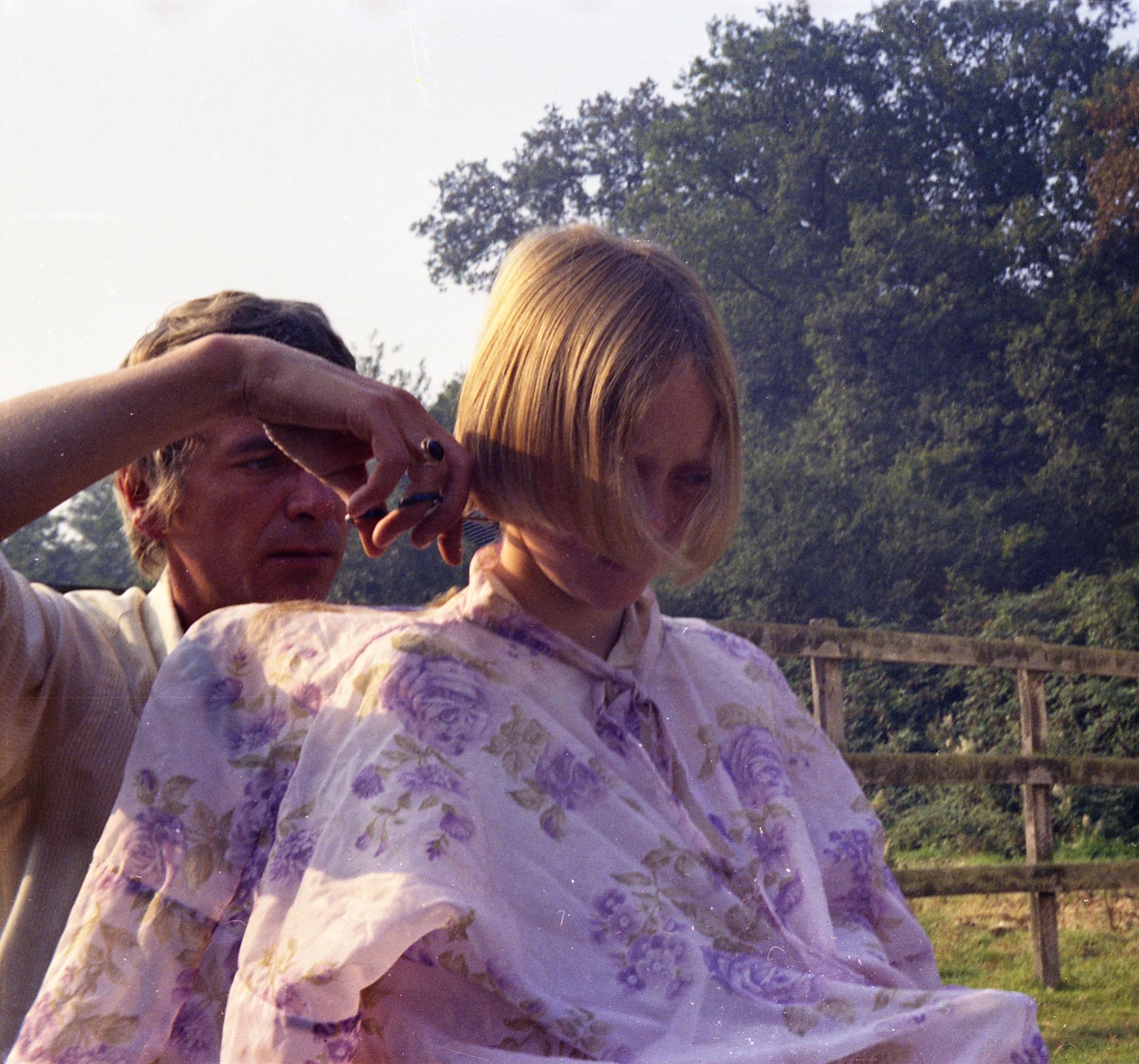
Sophie Neville having her hair cut on location for the part of Titty Walker in 1973
She must have driven me to Epsom for a pick-up shot in September when members of the Walker family had more haircuts and enjoyed being reunited.
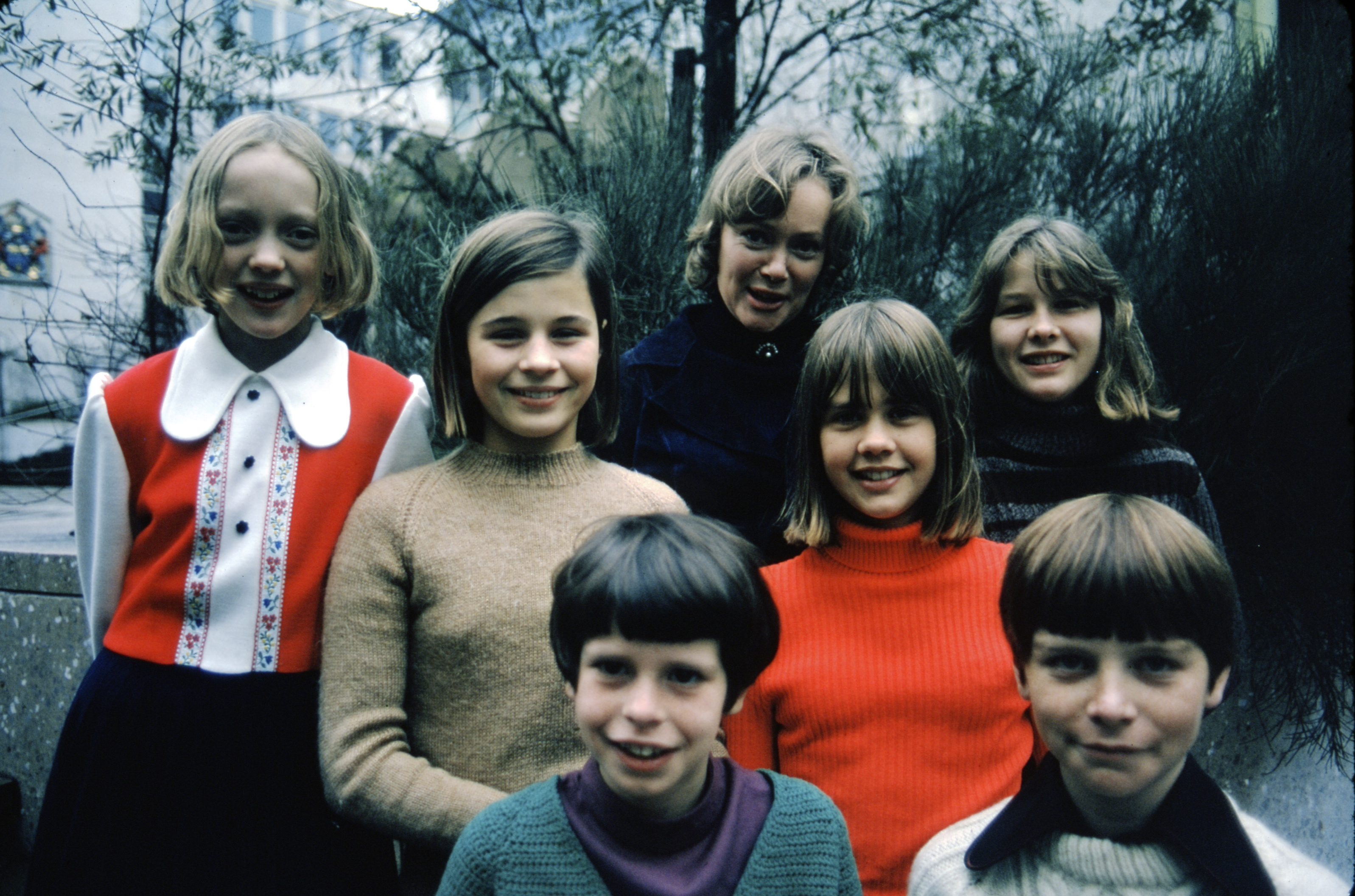
Daphne Neville with Stephen Grendon, Suzanna Hamilton, Sophie Neville, Jane Grendon and Simon West
While we hated the publicity that came with marketing the film, Mum embraced it to the full, collecting every newspaper and magazine article.
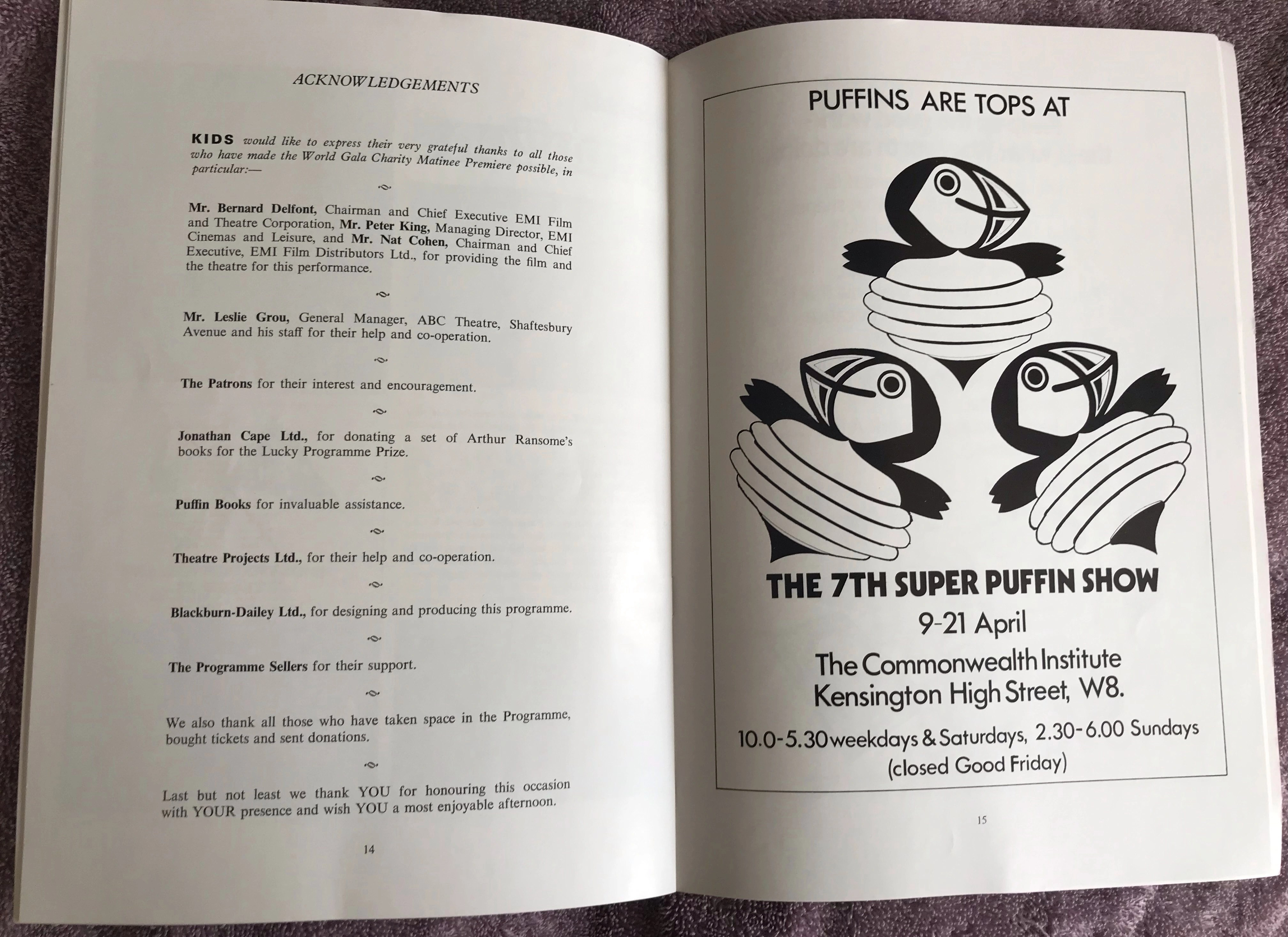
Sophie Neville, Suzanna Hamilton, Daphne Neville, Lesley Bennett, Kit Seymour, Sten Grendon and Simon West off to the Puffin Club Party at the Commonwealth Institute in London
She took us to London for a Puffin Club show at the Commonwealth Institute devised by Kaye Webb,
Kaye Webb’s Puffin Club Show – April 1974
and to the Lord Mayor’s Show when we rode on a float set up by EMI Films.
Suzanna Hamilton, Stephen Grendon, Leslie Bennett, Simon West and Kit Seymour sailing the streets of London in ‘Swallow’
Mum was thrilled when invitations to the film premier arrived and bought me a green dress to wear to the ABC Cinema in Shaftesbury Avenue where it was held.
Daphne Neville at the London premier of ‘Swallows and Amazons’ in Shaftesbury Avenue.
She framed a film poster and kept every photo, every scrap of paper related to the film along with the LP and other items of movie memorabilia.
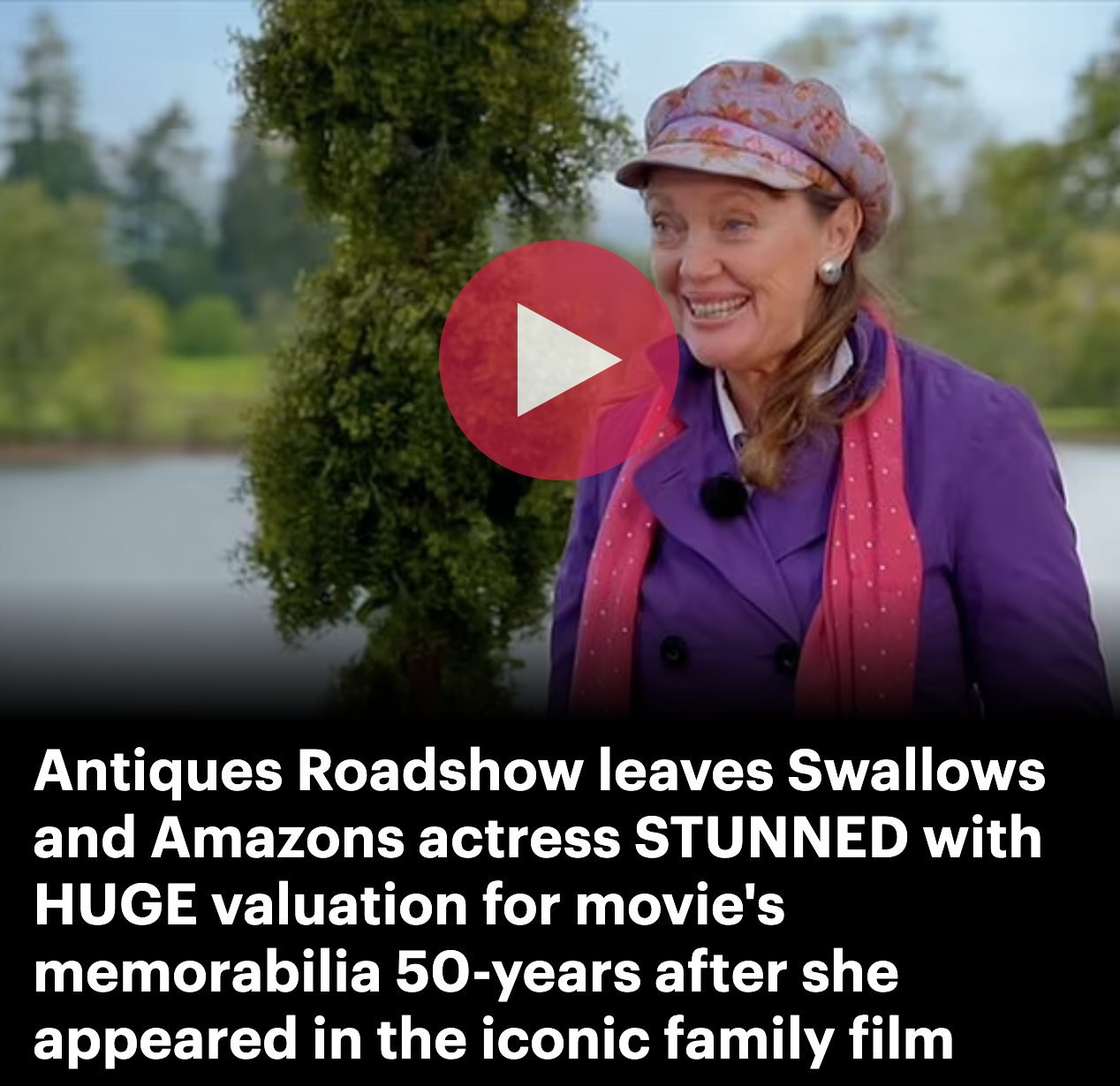
Fifty years later the items were valued on BBC Antiques Roadshow as being worth over £4,000.
To read Daphne Neville’s articles on being a chaperone, please find three earlier posts on this website beginning here.
The Saucepan and her mother on a scenic railway in Cumbria in 1973 ~ photo: Martin Neville
Like Arthur Ransome, I have ‘lived many lives in one.’ He also wrote, ‘Memory picks and choses’. Here are a few unusual ones:
A photograph of Sophie Neville photoshopped to look like Charlotte Rampling for ‘Broadchurch’
This gave me a fright: I was watching the ITV police series Broadchurch when I saw a photograph of me, aged seventeen, featured on screen. Only it wasn’t me. My face had been photo-shopped to look like a young Charlotte Rampling. Above is a screenshot. Here is the original:
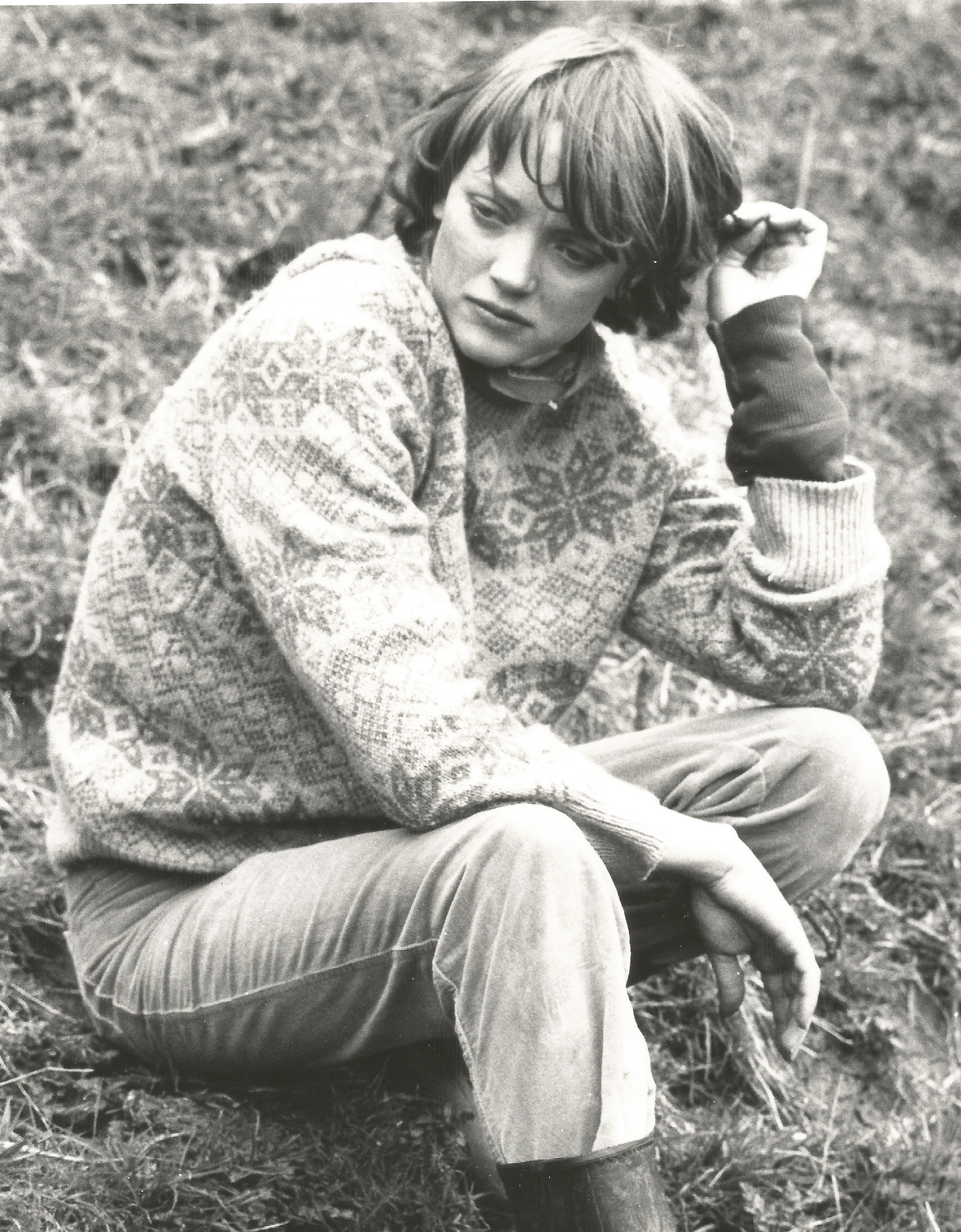
Sophie Neville aged seventeen
No one had asked my permission, but what can I do but take it as a compliment?
Around this time I was briefly involved in the HTV seriesKidnapped. I played a boy. But opposite David McCallum (The Man From U.N.C.L.E), so who was I to argue. And I was paid.
I got the part in an odd way. They had forgotten to cast anybody for the role, but the producer had previously cast my sister in Arthur of the Britons and knew we lived only a few miles from the location. I agreed on the morning the scene was shot.
Appearing as a messenger boy in ‘Kidnapped’ produced by Patrick Dromgoole for HTV. What did they do to my hair?
I later stood in for the little boy who played Gerald Durrell in the first BBC drama series of My Family and Other Animals. Brian Blessed thought it hilarious. I was working behind the camera by that time but was skinny enough to squeeze into the costume.
Sophie Neville standing in for the boy playing Gerald Durrell getting a kiss from Brian Blessed who played Spiro
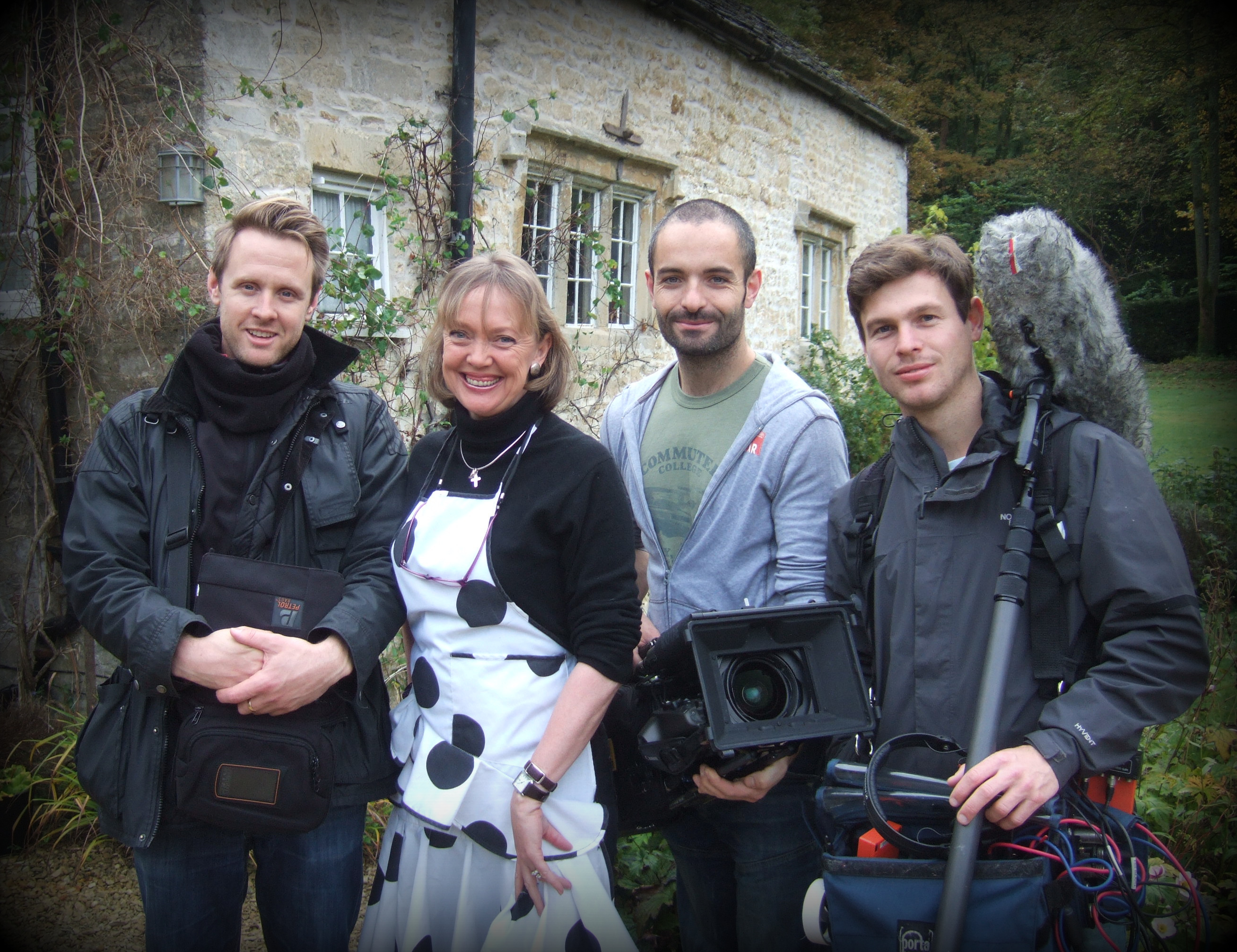
I was once on a train when the director of Obsessive Compulsive Cleaners asked if I could get to Gloucestershire to clear out my mother’s attic. I ended up filming with him for the next three or four days. It was exhausting – and unpaid – but a lot of de-cluttering got done. Check the apron from Seville. I’d bought it on honeymoon.
Sophie Neville filming in Gloucestershire with Betty TV
Piratøen – is the title for Swallows and Amazons in Danish – seen here on a flier that I only came across recently. I’d just had my DNA analyzed to discover I am 3% Danish due to admixture a few generations back. Do I look Danish?
Although I’ve worked on over 100 films and tv programmes, I have mostly been behind the camera, so don’t expect anyone to know who I am. They don’t. The marketing executive at StudioCanal had not, at first, wanted me to help promote the remastered DVD of ‘Swallows and Amazons’, which is understandable as Dame Virginia McKenna has the star billing. Then she must have watched the ‘filmen for hele familien’. I ended up giving Q&As at twelve cinemas. Some had audiences of 250 and the screenings were so popular that customers were being turned away.
Sophie Neville giving a Q&A in Kendal
And yet when a friend of mine told a lady that I was in ‘Swallows and Amazons’ she smiled apologetically and said she’d keep ‘an eye out for me.’
‘Why are you here?’ I was asked at Windermere Jetty in Cumbria. We had gathered to celebrate the 50th Anniversary of the release of ‘Swallows and Amazons’ in cinemas. How should I have answered that question? I replied saying, ‘I’ve been asked to give talk.’
Sophie Neville appearing on BBC TV at Windermere Jetty in Cumbria
You can now listen to the story of how the original film of ‘Swallows and Amazons’ was made on Audible.
The HTV series ‘Kidnapped’ (1978) is available on YouTube. Blink and you miss me, but the music is wonderful.
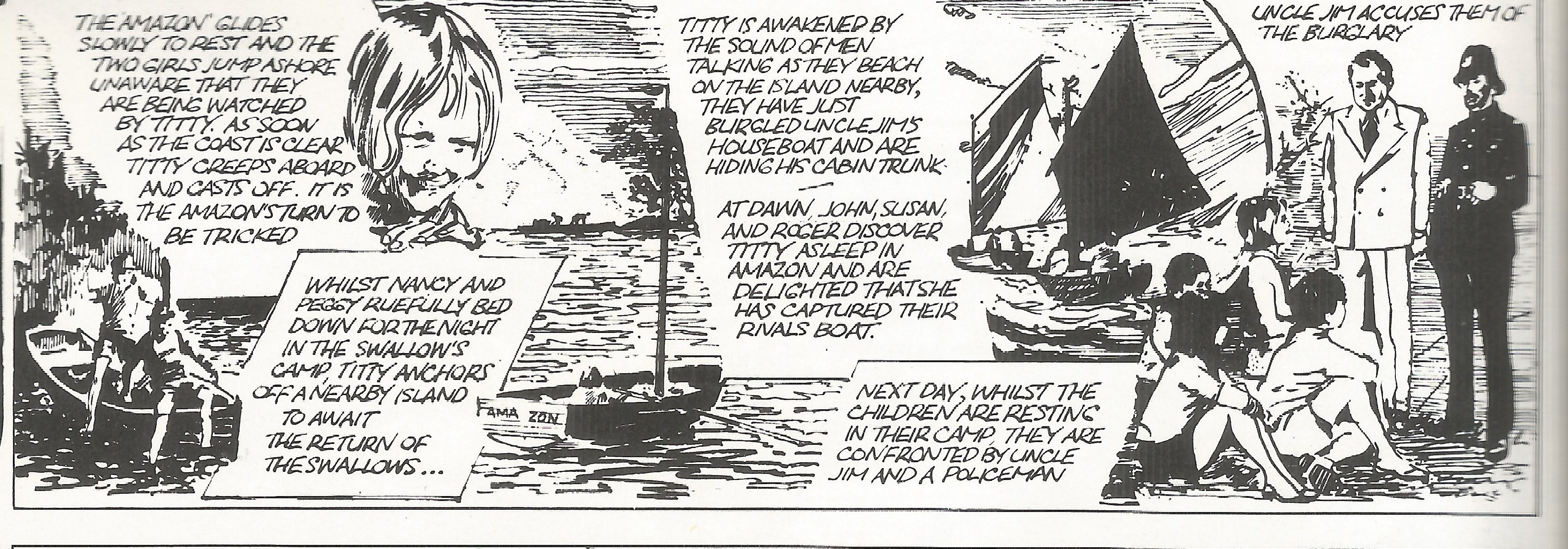
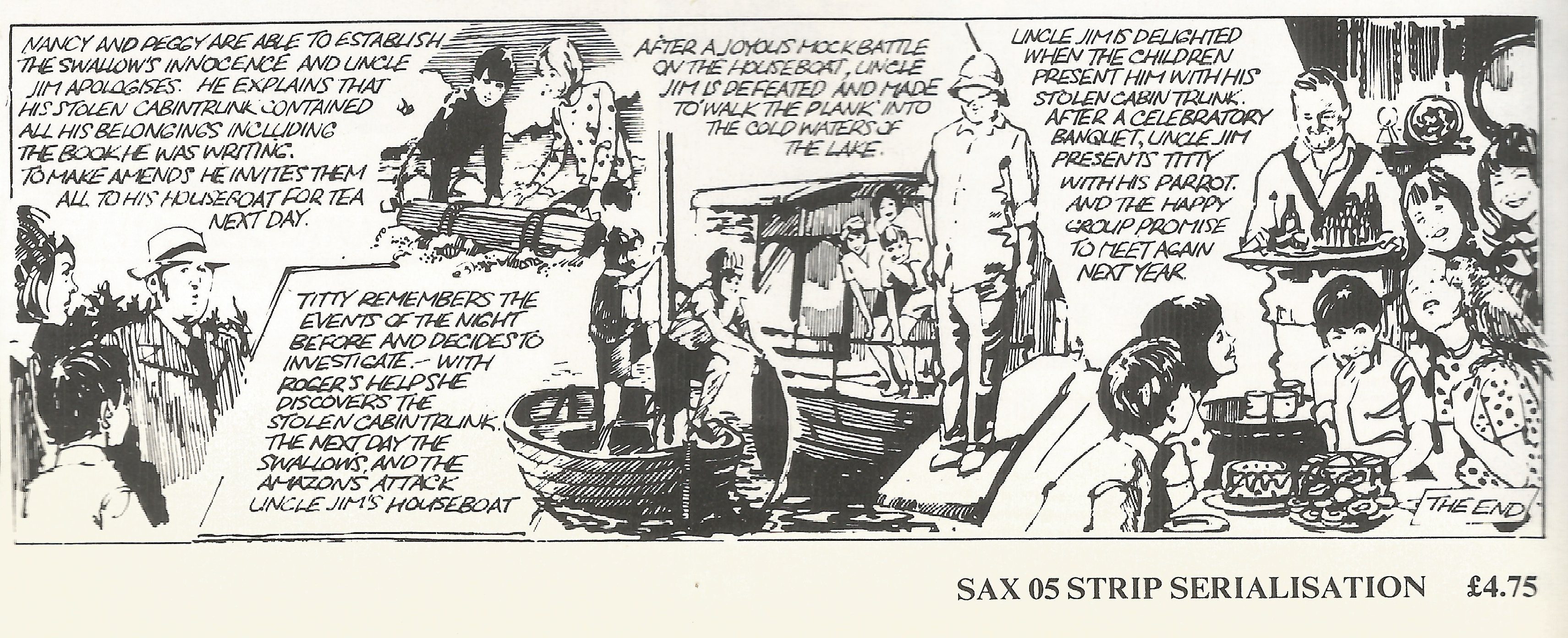
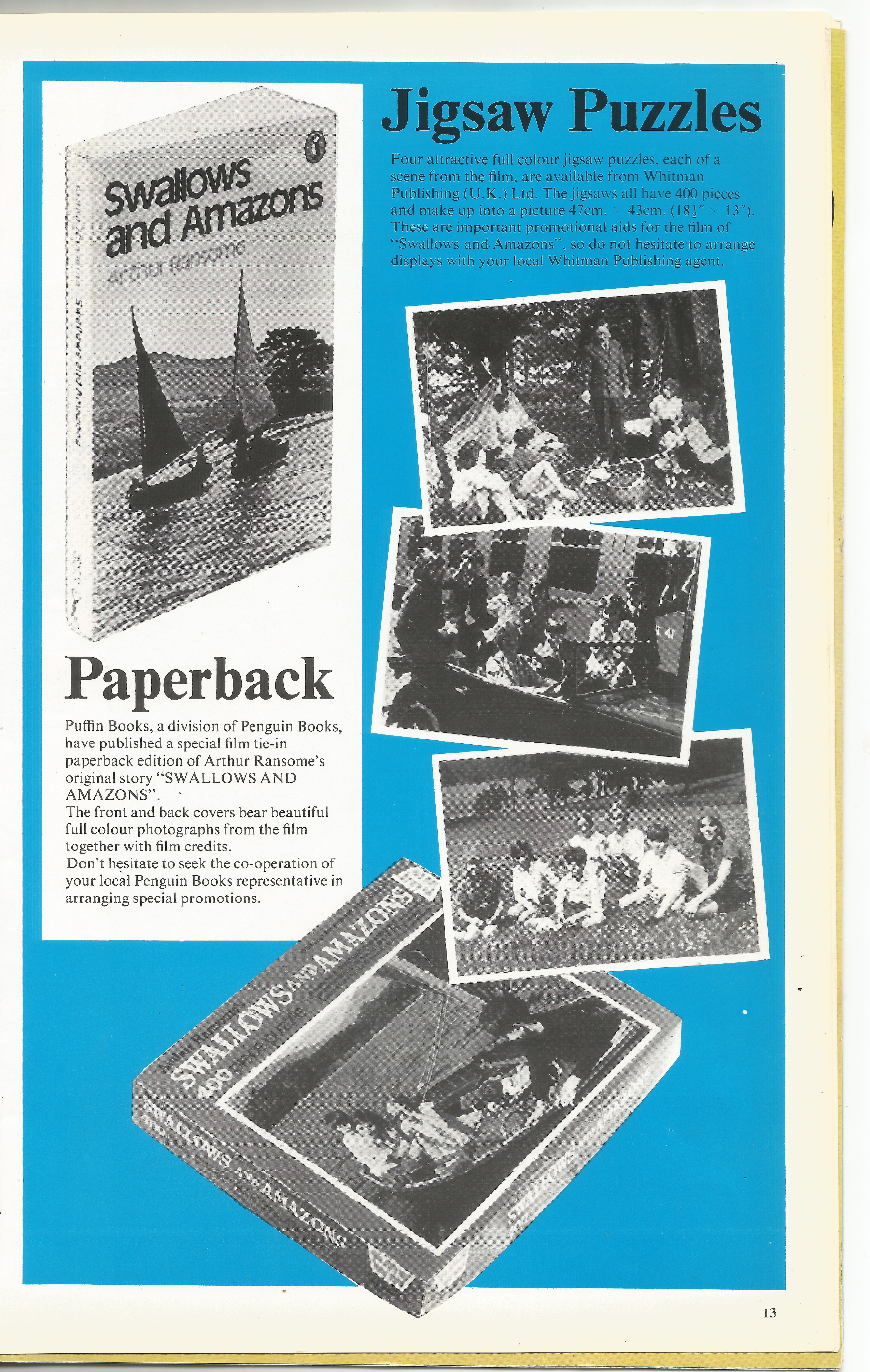
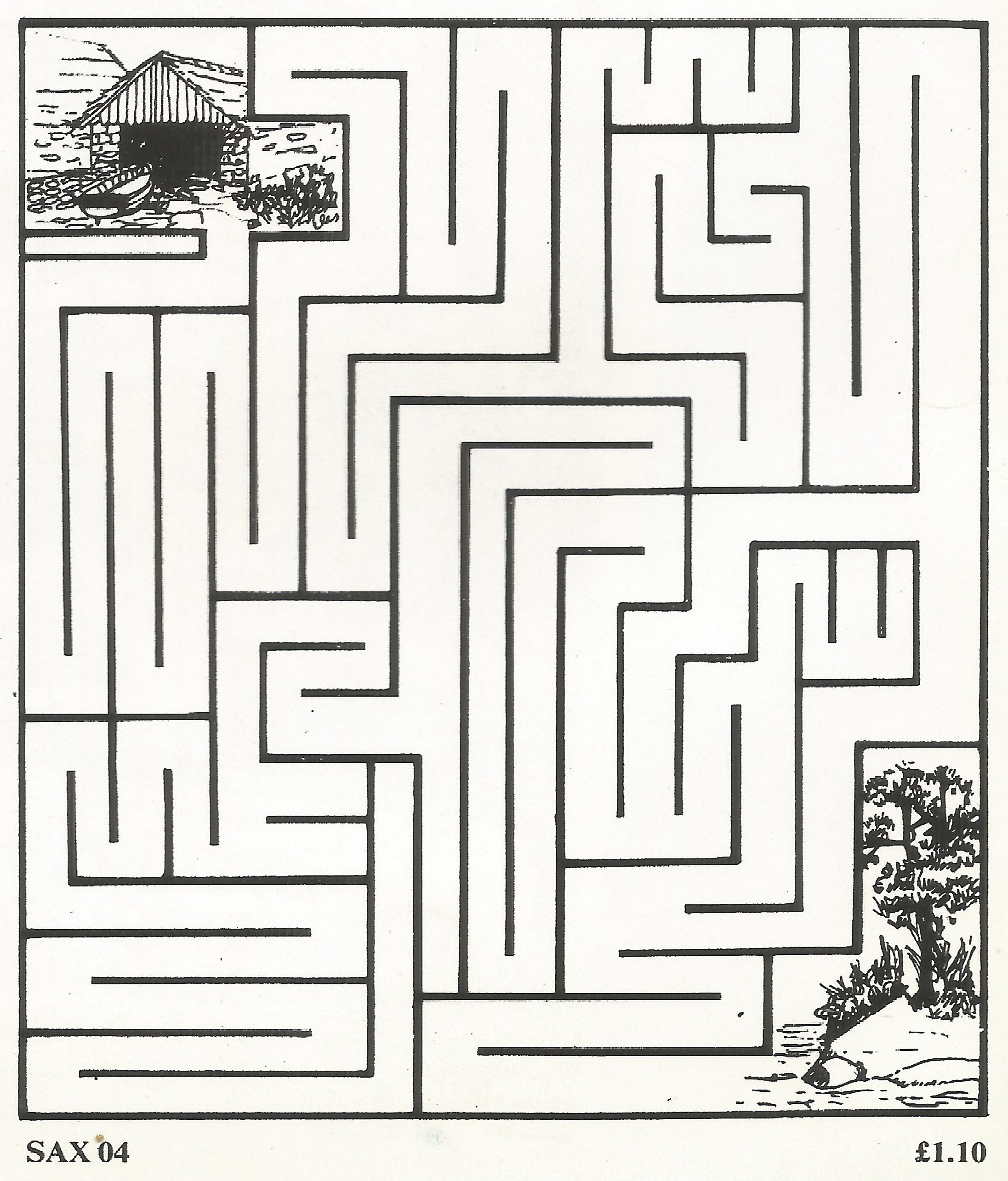
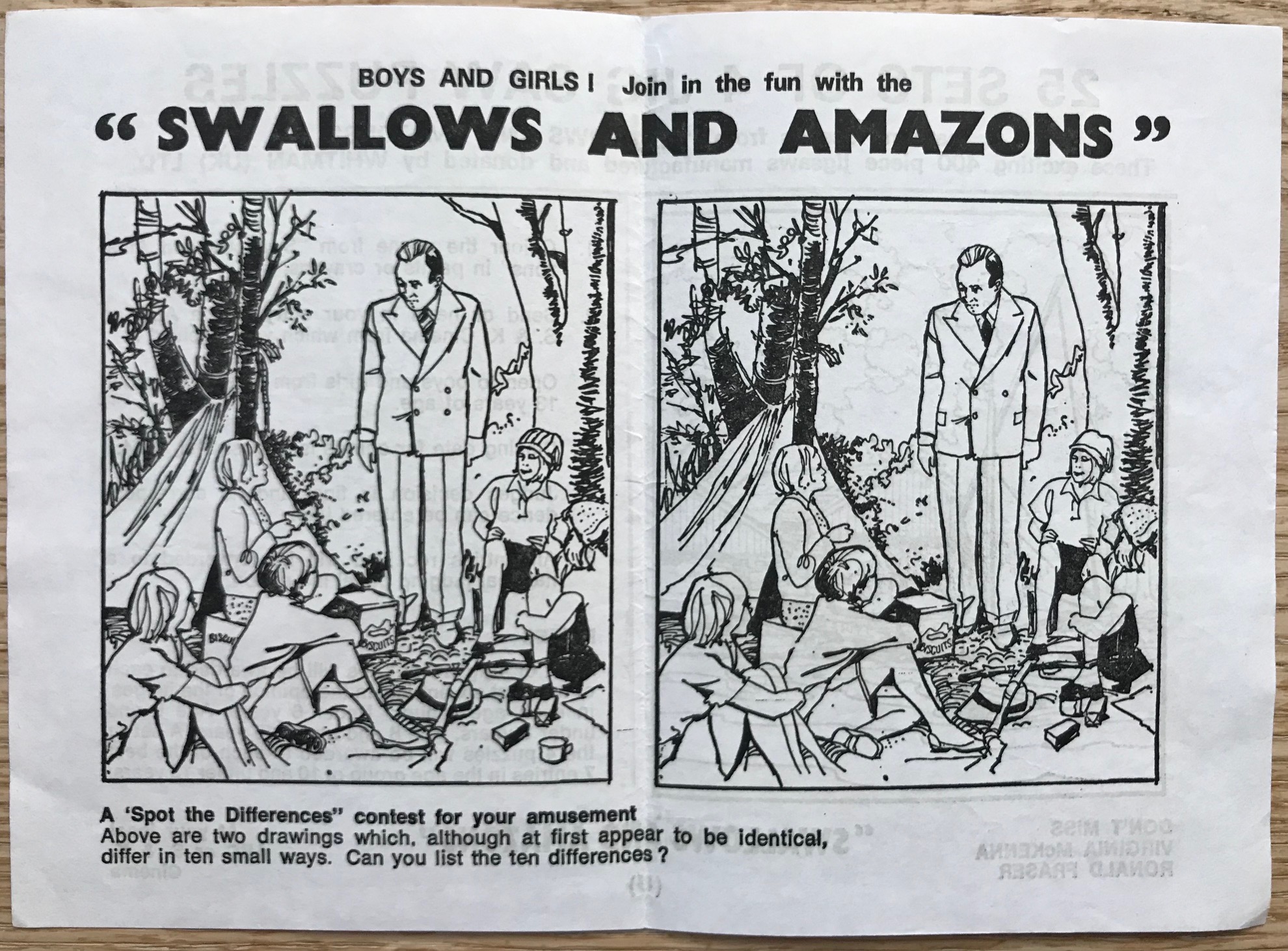
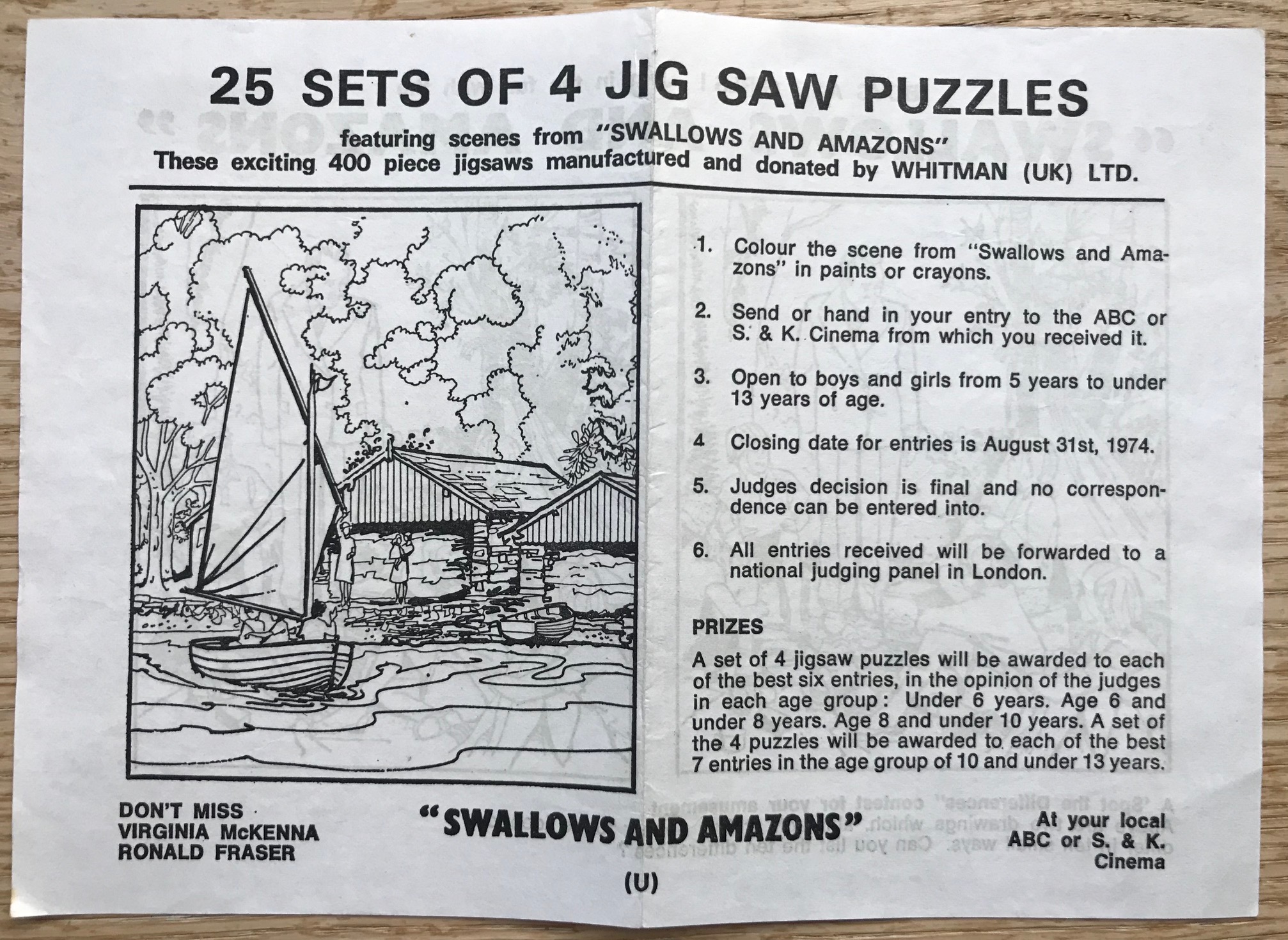
Having been released in cinemas in April 1974, the original movie ‘Swallows and Amazons’ was not accompanied by computer games but by puzzels, jigsaws and competitions. Here are a couple found recently whilst clearing out my mother’s house.
Few films are set in 1929, and yet it was that period, nearly a hundred years ago that gave the first film adaptation a certain style.
Graham Potter wrote saying: “I have just finished a DVD of S & A and found how much easier it is to see the details on the TV than in a cinema having to look from side to side. I was surprised to see how little sailing was shown and how the Amazons were not seen much. I think you were 12 or 13 at the time but looked younger. I have to to admit to enjoying the glimpses of the navy blue knickers in the opening scenes.”
One of the set of four jigsaw puzzles made when ‘Swallows & Amazons’ was released in cinemas in 1974, along with a Puffin paperback
Graham goes on to say, “I was surprised to see how you carried all the exciting scenes: left alone on the island, finding the secret harbour , dealing with leading lights , capturing and hiding Amazon, dealing with Mother’s visit during the night sailing, giving Captain Flint a good telling off for blaming John for firework and not listening to his warning about potential theft at his houseboat. Then the great finale when you are able to present him with his stolen life’s work in the trunk. Perhaps it was planned that you didn’t have too many lines to remember, as it enabled a very young girl to contribute such a lot to the film.”
This is very kind but I believe the film was made by the fact that Simon West who played John and Kit Seymour who played Nancy were good sailors. You can tell when they are sitting in a moored boat. While Claude Whatham was an exceptional director, ahead of his time stylistically, the director of photography uplifted the film by insisting we waited for clouds to pass. What else? – a hardworking and talented crew put together by Nevill Thompson. Simple costumes that never dated. Natural, well cut hair and a lack of make up – all the facets of filmmaking that you are not meant to notice.
Maybe our spiritedness as children carries the original film on. We are all in our sixties now, but the characters we played have become imaginary friends to many. As Shakespeare wrote, ‘Our revels now are ended. These our actors, as I foretold you, were all spirits and are melted into air, into thin air.’ The Tempest Would Ransome have agreed? I only know he discussed Shakespeare with Karl Radek.
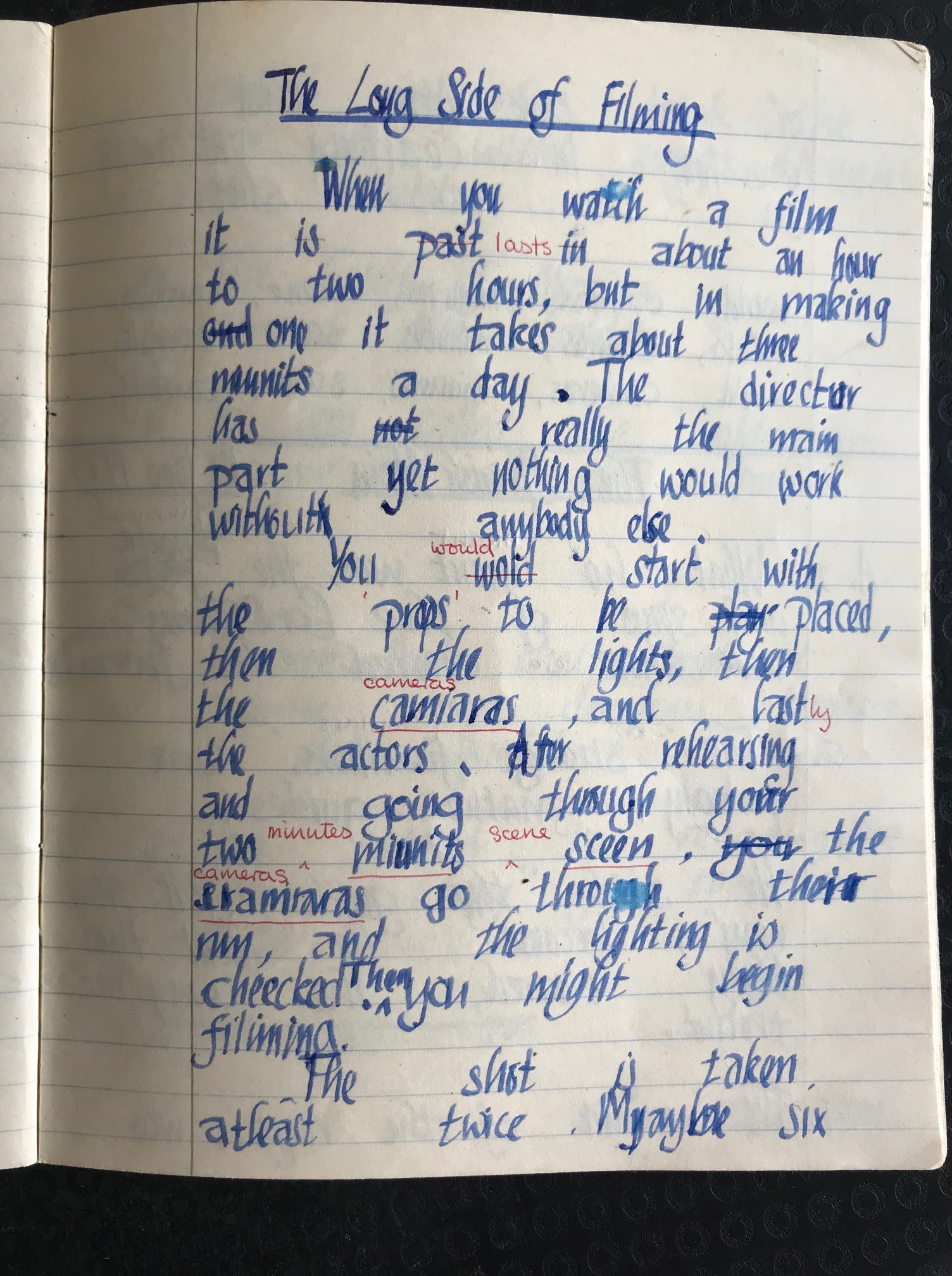
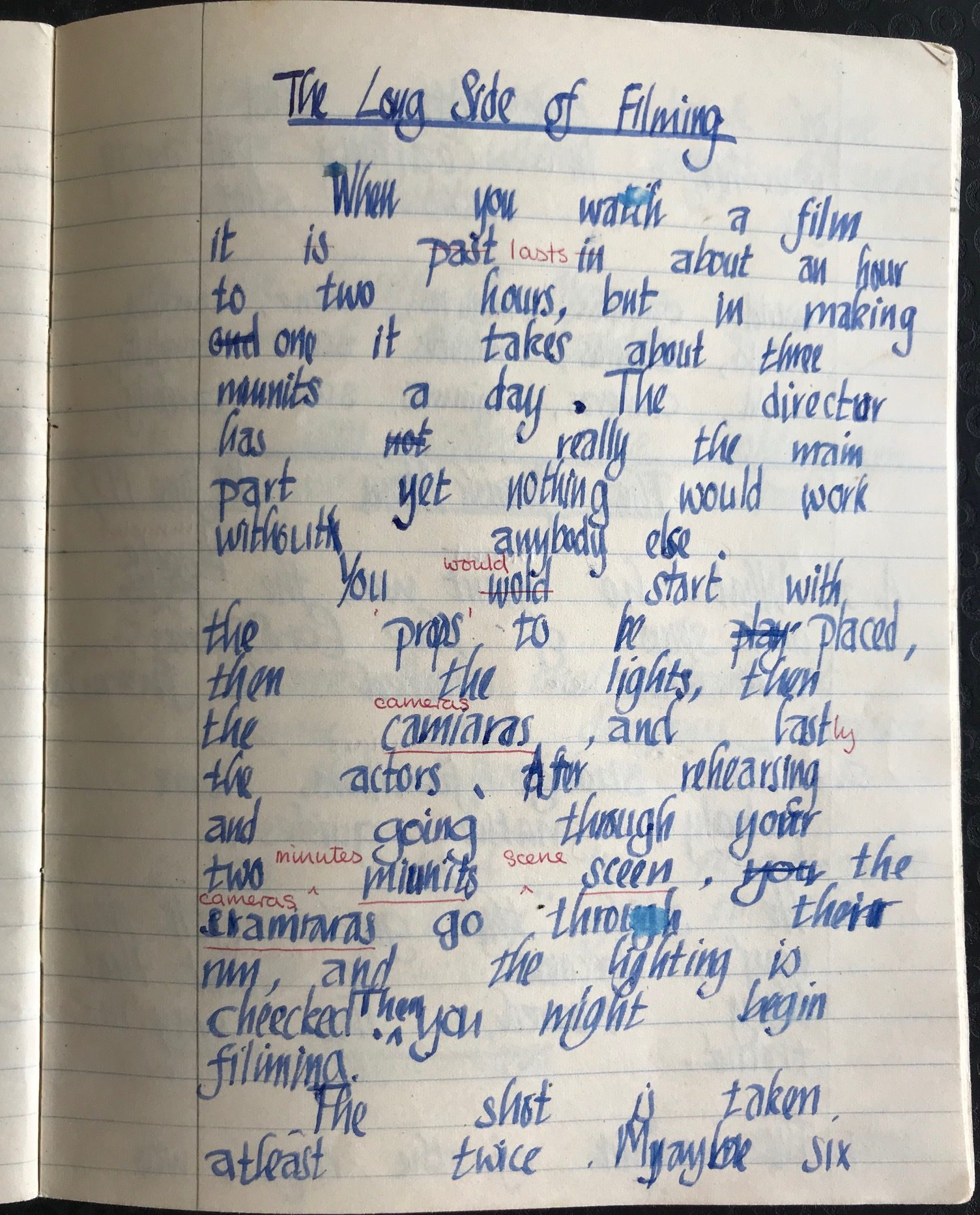
I came across an essay in one of my school exercise books that I must have written aged twelve whilst on location. I was trying to explain that only about three minutes of what will be the finished film are captured during a long day’s filming on location. The piece is not well written.
A school essay written in 1973.
We went on to learn about the Spanish Main, which may have been requested by Claude Whatham, the director of ‘Swallows and Amazons’ so that I would know what Titty was talking about. On 1st June 1973, I was on location in the Lake District filming in the capture of the Amazon in Secret Harbour on Peel Island.
Perhaps I should add these remenants to a future edition of ‘The Making of ‘Swallows and Amazons’ (1974)’. You can order the illustrated paperback from libraries, find it for sale online, or listen to the audiobook:
Chloe Williams has just written from Ontario in Canada, to say, “Some books entertain. Some enlighten. And some, like The Making of Swallows and Amazons and The Secrets of Filming Swallows & Amazons, manage to bottle something impossibly rare: the feeling of looking back through a child’s eyes and realizing it was all real; the lake, the sails, the laughter and somehow, you were part of it.”
“These aren’t just behind-the-scenes diaries. They’re sun-dappled time machines. Your voice, both in memory and in your original childhood notes, is a miracle of tone: witty, observant, buoyant, and deeply human.”
Of the original movie, she wrote: “What A Christmas Story is to snowglobes and childhood winters, Swallows and Amazons (1974) is to summers on the water and you’ve preserved that magic with charm, heart, and astonishing detail.
“What makes these books unforgettable isn’t just nostalgia. It’s how alive they are. We feel the smell of old sails and camera tape, the blur of location shoots, the uncertainty and excitement of being a child caught in a grown-up world of filmmaking yet utterly at home in it. We meet legends like Virginia McKenna not as distant stars, but as fellow travelers in the adventure. And it’s a joy.”
The Making of Swallows and Amazons seems to resonate with:
Readers of nostalgic memoirs that celebrate childhood, nature, and storytelling
Adults who are captivated by the lake-country magic of Arthur Ransome
Film lovers who cherish insider views of filmmaking
Educators and parents seeking real-life adventure stories for young readers
Fans of Call the Midwife, The Durrells, and 84, Charing Cross Road
“The joy and authenticity in your books mirror exactly why Swallows & Amazons (1974) still has such a hold on people’s hearts. The memoirs don’t just tell the story of making the film, they recreate it, letting readers smell the lake air and see the magic unfold through a child’s eyes.”
The new audiobook
I’m hoping the audiobook will also amuse readers. It’s now available on all the online platforms including Audible, where isis being offered for free on their membership trial.
Simon West as John Walker studying the chart before the voyage.
1. It’s good to begin a film with establishing shots that explain what is happening. This could be a chart, a poster, a yacht club, a moored boat or the landscape. Then tell the story, introducing the characters and different boats.
2. Once you begin filming boats the most important thing is to keep the horizon horizontal.
Simon West and Sophie Neville bring Swallow into the Secret Harbour on Wildcat Island
Alternatively, tilt your camera at a dramatically acute angle – but don’t use compromised shots like the one above.
Farewell and adieu to you fair Spanish ladies – can you spot the safety officer?
3. When you pan – side to side – first plan and rehearse the shot with good opening and ending frames. Hold for a beat on these – it gives you a transition to the next shot in the same way as a comma or full stop.
Simon West, Suzanna Hamilton, Sophie Neville and Sten Grendon in ‘Swallows and Amazons’ (1974)
Pans look better if the shot moves from left to right, as that is how westeners read.
A pan works best if it’s ‘motivated’ ie follows action. Only pan from right to left if you are following a subject, then let it pass out of shot.
Avoid panning from left to right and back again. Don’t wave the camera around.
Simon West as Captain John sailing Swallow . Sten Grendon plays the Boy Roger
4. Avoid using the zoom unless it is motivated. Tilting the camera works better eg: open on a shot of a boat’s name and tilt up to find the skipper.
5. A general rule is: If the subject is stationary you can move the shot. If the subject is moving, keep the shot still.
6. Low angle shots are atmospheric – try filming at chair height, especially if you are tall.
Suzanna Hamilton as Susan with Sophie Neville as Titty busy writing the ship’s log
7. Close ups and detail are good, especially if there is some movement. eg: burgee flying in the wind.
A montage of close-ups works well to explain what is happening and explain a passage of time.
8. People do well in front of the camera if you give them something intricate to do or look at. Show what they are doing, possibly from a different angle.
9. You will need to film one boat from another. We were lashed to a camera boat to achieve these shots.
Sophie Neville, Suzanna Hamilton and Simon West sailing Swallow in 1973
10. Make sure your lens is kept clean – or use water droplets for effect. Don’t let your camera get wet but capture the excitement.
Simon West and Suzanna Hamilton at the helm of Swallow with Stephen Grendon
I continue to hear amazing stories about how the 1974 film ‘Swallows and Amazons’ has influenced people’s lives. Someone wrote to say, ‘This was my favourite movie growing up in Australia and the main reason I ended up moving to the UK!’
Rob Boden talking to Rupert Maas on BBC Antiques Roadshow.
There has been quite a bit in the popular press about what Rupert Maas, the expert on paintings, said of the movie ‘Swallows and Amazons’ (1974) which he saw aged 14. “It’s fair to say it got me into sailing. Just watching the romantic lives of these children in this wonderful summer. It never seemed to rain, the sun was always out…” He ended up crossing the Atlantic Ocean.
Simon West as Captain John in Swallows and Amazons 1974
Marc Grimston writes, “I was read the books as bedtime stories when I was too young to read them myself… but when I was taken to see the film, the stories became alive to me. I had not seen the Lake District at that point and the film changed everything. I could visualise the landscape every time I read one of the books, that was due to the film. The characters in the stories now had faces I could recognise in my head from that point on. When I read the books now, the characters are still the same 51 years on. The books, the film and the TV series of Coot Club and The Bix Six gave me a love of boats, camping, the Lake District and the Norfolk Broads.
Krista French “Those books were my part of my childhood escape toolkit.”
Simon Leach saw a poster of the 1974 film ‘Swallows and Amazons’ and said that when it came out, “my family was living in South Australia. After watching this, my parents were so homesick, that we returned to the UK.”
Others comment on how it has given them solace during difficult times. One man wrote to say that he watches ‘Swallows and Amazons'(1974) every week.
Fiona Ring said, “It literally shaped my childhood, that was me, I was Titty, the adventures the love for the outdoors. I read and watched it over and over and now it’s even better that I’m reliving it all again with my girls. Travelling up to the lakes each year to find all your secret spots. It’s amazing. Kayaking to wild cat island with our girls in April was a dream come true.”
Sophie Neville with Suzanna Hamilton
Andy Stuart loved Arthur Ransome’s simple book illustrations. “And equally perfect were the the actors in the 1974 film. If I think of the Swallows and Amazons, those are the faces I see when I read the novels in which their characters feature, and my mind’s eye visions of the Norfolk children and the D’s are conjured from who I imagine would have fitted in alongside the original cast. You were all wonderful, Sophie Neville!”
Simon West, Sophie Neville, Suzanna Hamilton and Sten Grendon in Secret Harbour
The author Duncan Hall says, “I can’t remember if I read the books or saw the film first. I don’t remember picturing the Swallows and Amazons differently so I maybe saw the film first? But would have been at a similar time. It sparked a lifetime obsession with the Lakes, boats and stories.”
Lesley Bennett and Kit Seymour as the Amazon pirates dancing on Peel Island
Rob Twycross said, “I saw myself in the children in the film. We lived our childhood like that, going off exploring, discovering and learning. Halcyon days that I fear are gone now. It’s lovely to watch it again now and feel young again, if only in my head and heart for a little while!”
Sophie Neville as Able seaman Titty in Swallow
You can now listen to the story of how the 1974 film was made on location in the Lake District on any of the audio-book platforms, including Audible.
I have been told that the 1974 film ‘Swallows and Amazons’ has been broadcast on television more than any other British film. Arthur Ransome’s well loved series can be found on the shelves of most book shops. Many of his devoted readers belong to the Arthur Ransome Group on Facebook where they share interesting observations some of which I have collected here:
Jill Goulder was interested to learn that the film of ‘Swallows and Amazons‘ was made with EMI Film’s box office revenue from ‘The Railway Children‘ (1970), the adaptation of E Nesbit’s book starring Jenny Agutter . “So we have ‘The Railway Children‘ partly to thank! I’m thinking about themes in common. A focus on a family of children with father absent and mother in the background; the children fairly realistic (‘The Railway Children‘ may win on points here as the children argue among themselves); beautiful scenery; a key point of interest in the landscape (railway, lake) which influences the plot; male characters who aren’t always amiable but who are basically very attached to the children; an episode involving an accusation (false in the case of the firework, true in the case of the coal theft); etc!” The two films were bought out together on VHS.
Jill later pointed out, “In World War II, spy catchers interrogating possible German spies would check their knowledge of Arthur Ransome as a classic test of Britishness.”
I thought this ironic given the spy themes in The Railway Children and the 2016 film adaptation of Swallows and Amazons. And why did Commander Walker send such cryptic telegrams. Was he more than a Naval Officer? Was his ship really in Malta or on its way to Hong Kong?
Simon West, Sophie Neville, Suzanna Hamilton and Sten Grendon in Secret Harbour
Maurice Thomas noted that, “both Ransome and Nesbit (and CS Lewis) liked the fit of two girls and two boys, though the second boy is absent from ‘The Railway Children‘. Both ‘Swallows and Amazons‘ and ‘Five Children and It‘ have a “ship’s baby”. The trope of four seems to go wider, though – four hobbits, for example. I suppose it’s the smallest group where you can have “split quests” that still allow for character dialogue, otherwise it’s just one person and their thoughts. Lewis does it, of course, when Edmund becomes evil, but at least he has Jadis to talk to.”
Tamzin Neville playing Anthea in The Phoenix and the Carpet
My sister Tamzin played Anthea in the 1976 BBC adaptation of The Phoenix and the Carpet, when E Nesbit features a family of five children: two girls, two boys and a baby. The Captain Flint character, who facilitates their adventures, is the Phoenix, his houseboat/the Wildcat is a magic carpet. I wonder if Ransome, who knew E Nesbit, was influenced by this story.
Janet Mearns noted, “Louisa M Alcott’s ‘Little Women’, features four children, all girls but Jo is a forerunner of Nancy, one parent absent. Capt Marryat’s ‘Children of the New Forest’: two boys and two girls living off the land, both parents absent.”
Matthew Jones wrote, “What’s lovely about AR’s stories is how they pull his characters out of gloom (along with his readers) into the world of friends and connection and purpose.”
Simon West as Captain John rowing towards the Landing Place
The question, ‘How old is John Walker in Swallows and Amazons?’ is often typed into Google.
John Fenn expressed an interest in Captain John’s character. “In his illustrations Arthur Ransome found it hard to keep John young enough. I suspect that John was the boy Arthur Ransome wished he had been, easily gaining his father’s approval (especially in ‘We Didn’t Mean To Go To Sea‘ and ‘Secret Water’) which was so often withheld from Ransome himself. It’s not surprising he ‘saw’ John as more grown up than he was, and therefore could not keep him young in his illustrations. The upshot is that in the 1974 film it is a shock to us to see a John who looks the age he is supposed to be – about 12.” And yet Simon West, who was only aged 11 when he played Captain John, was adept at handling boats, climbing pine trees and negotiating with adults. He fell easily into the part.
Simon West as Captain John in Swallows and Amazons 1974
The author Jon Tucker writes, “An enduring children’s book is like an onion – multi-layered. The seven-year old is focused mainly on the action embedded in the narrative. The ten-year old is more aware of the underlying emotions. By a third reading at 13 or 14 years, the more mature teen reader can grasp the inter-relationships between the characters entwined within the outer layers. If the book has real substance, an adult reader will absorb those three layers, with a further understanding of the adult characters’ perspectives.”
Sophie Neville as Titty with Suzanna Hamilton playing Susan in 1974
“Taking Swallows and Amazons as an example, we adult readers can understand Titty’s slightly apprehensive emotions alone on Wildcat Island, alongside Mother’s somewhat concerned puzzlement on finding her eight/nine-year-old daughter apparently abandoned. We can also reach out to Captain Flint’s realization that he needs to pull out all stops to make amends for his nearly unforgivable behaviour towards John. A huge part of the success of this novel is the battle for Houseboat Bay, with Captain Flint’s endearing actions to put things right. Ransome’s enduring appeal lies in having a readership which has survived into adulthood.”
Michael Shaw said Titty is his daughter’s absolutely favourite character “because she makes everything into an adventure story” but not everyone can cope. Someone commenting elsewhere on Facebook wrote,”I could never read ‘Swallows and Amazons’, because one of the characters was named ‘Titty.’ It pulled me right out of the story. I just could not imagine everyone calling her that.” And yet the character was based on Titty Altounyan, a real person who was known as Titty all her life.
Sophie Neville playing Able Seaman Titty.
One Arthur Ransome enthusiast wrote: “Random thought, as it’s on @TalkingPicsTV tomorrow, but why has there never been a ‘Swallows and Amazons’ board game? There’s a brilliant strategy game somewhere in there.”
I recall being contacted by a friend who had just passed his driving test, and wished to spend a lazy day in the Lake District where he’d insisted on hiring a rowing boat in Bowness on Windermere in order to ‘enjoy the beauty of the lake’. While heading out from the jetty towards the ‘Lily of the valley’ island in rather a clumsy fashion, I was asked. ‘Who do you want to be, the Swallows or the Amazons?’
At a later date I was given the book ‘Swallows and Amazons’ written by Arthur Ransome together with a video and an original vinyl of the music soundtrack. Turning the pages of the 1930 novel was like opening a door to several other worlds for suddenly the lakes swept in like the most refreshing breeze that kindled an inner passion for hills, mountains, lakes, sleepy streams and mists, early morning stillness on the water and sailing adventures.
Watching the film for the first time was a turning point in my rather dull experience of being at school in the north west of England with its drab corridors, gray walls and endless smoking chimneys out to the horizon.
Within a very short time I too have taken a seat on a train en route to the Lake District in 1929 that had a family travelling together in one of those wonderful old carriages consisting of four children and their mother who were to spend a holiday together in a beautiful farmhouse nestling in the trees by the lake.
For some reason William Wordsworth’s immortal words ran through my mind: ‘Beside the lake beneath the trees fluttering and dancing in the breeze.’
The story touches on many human aspects that we all learn to accept as a part of our evolvement into adulthood and which today seems to have got lost in the quest for an increasingly fast world understanding and a computer generated experience.
The joy of the family arriving at the farmhouse and standing there looking out over the glorious Lakeland towards their dream island where it’s hoped they will be able to embark on a camping holiday after receiving permission from their absent father.
The four children, John Susan Titty and Roger Walker, all displayed an individual aspect of evolvement, with Titty engrossed in the book ‘Robinson Crusoe’, using her vivid imagination to create the island realm and keeping a hand written diary, while John seemed to be moving towards a Naval leaning by spending his time learning the basics of Morse code, boat handling and navigation. Young Boy Roger enjoys stuffing himself with anything he can possibly eat, appears to be showing signs of enjoying the great outdoors, and wants more adventure. Susan comes across as the mother figure who thinks about the younger siblings and what they all will be eating while on their adventures.
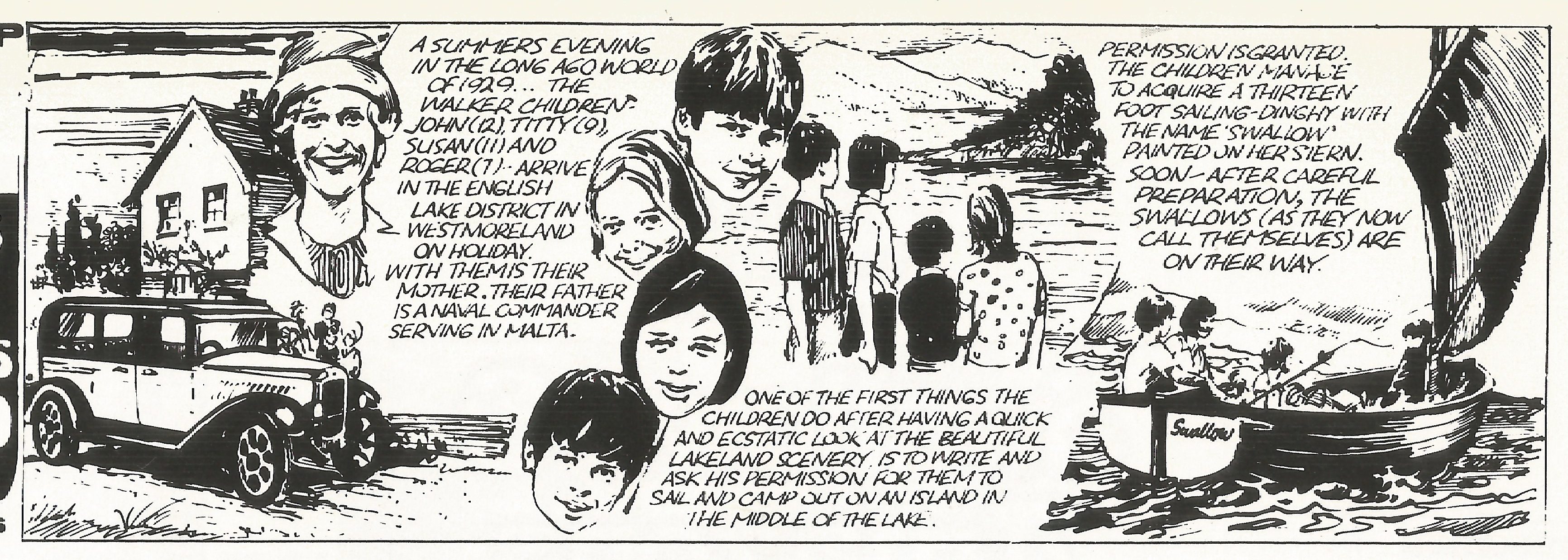
The story unfolds as the children receive the go ahead in a telegram from their father to sail over to their island to camp in a borrowed dinghy called ‘Swallow’. A burgee is sewn up to fly from the mast depicting a swallow. This news is received with unadulterated delight by the children who immediately begin the preparations.
The lake and mountainous surroundings featured in the film begin to open up as the children undertake their journey to discover sailing rivals in Nancy and Peggy Blackett who live in one of the houses bordering the lake and own a dinghy named ‘Amazon’ that sports a ‘pirate’ burgee.
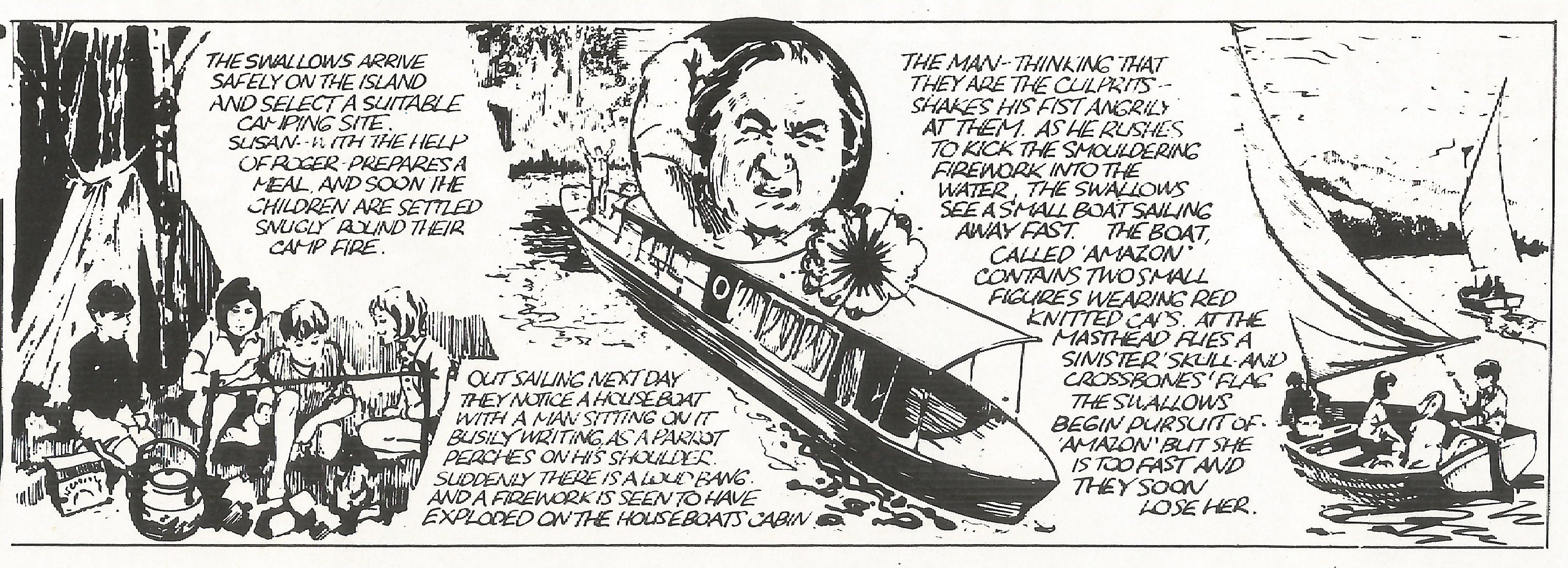
Initial rivalry erupts between the Walkers and Blacketts, which results in eventual harmony as the two sides join forces to capture a common enemy who just happens to be the Blacketts’ ‘Uncle Jim’ who owns a houseboat on the lake and is busy writing a book.
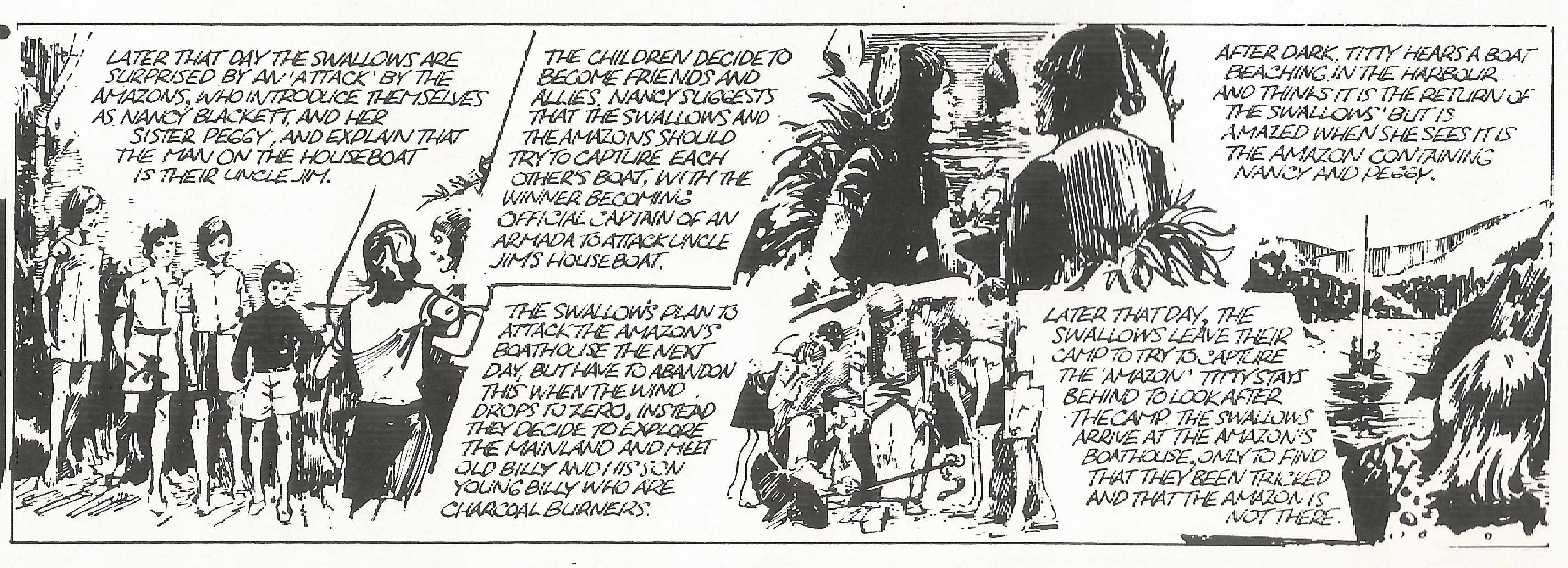
The Swallows and Amazons decide to host an expedition to capture Jim (‘Captain Flint’) and the houseboat, and, to determine who should be the leader, they make an attempt at capturing each other’s boats.
This requires sailing at night and some pretty shady manoeuvres, which are grievously frowned upon when discovered by the Walkers’ mother when she made a journey to the island to check up on the children and found Titty on her own. John has to confront his mother and explain his reasons to sail in the dark. She reluctantly accepts his explanations but with a proviso that no further actions of this sort will occur again for the remainder of the holiday.
Titty won the day by seizing an opportunity to capture the Amazon boat while the Blackett’s were on Wild Cat Island, making the Walkers the winners. This leads up to the finale where there is a sea battle as the Swallows and Amazons launch an assault on Captain Flint and the houseboat when he is captured and made to walk the plank. The end of the film sees Titty gifted with Flint’s pet parrot who seemed to have taken quite a shine to her, and everyone resolves to be kindred spirits for ever!
After watching this film my mind was transported to the lakes and sharing the beautiful sunny days, crispy clear water and blue skies with the backdrop of the mountains the wooden jetties and a sailing journey into Bowness for supplies. I could sense myself seated in the lugsail rig and feeling the tug on the main sail as the boat crept closer to the wind before going about and heading away onto another tack.
I was carried with the family into that other realm and other time where innocence and responsibility were coming to the fore, where family values were held dear and independence was something young people strove to achieve within the simplicity of their everyday existence. For the brothers and sisters to go camping on a small island in the middle of a lake away from any overseeing adult, and to arrived there by sailing over in a borrowed boat, leaves little to the imagination.
There was a sense of adventure with the children, and a wanting to show they could be responsible and look after themselves, something in today’s society we have to a degree lost touch with. That immortal sense of adventure within a landscape never changes, except within its own light that we know and love today as the Lake District.
This film is a journey into another dimension and another world steeped with love and belonging, adventure and moral understanding, which is shared between a family and accepted.
The characters are bought to life almost as if they are an infinite, integral part of the immortality of the story, each giving that picturesque understanding the viewer finds impossible to explain.
After watching this film one arrives back in real time with a resounding bang! We wonder why such a simple story can create such an iconic understanding, why watching this film can make you feel happy, totally complete and yearning to return again and savour that wonderful, eternal landscape we have all learned to grow and love as The Lakes.
Do think of leaving a review of this film on the International Movie Base site. The link for ‘Swallows and Amazons'(1974) is: https://www.imdb.com/title/tt0072233/