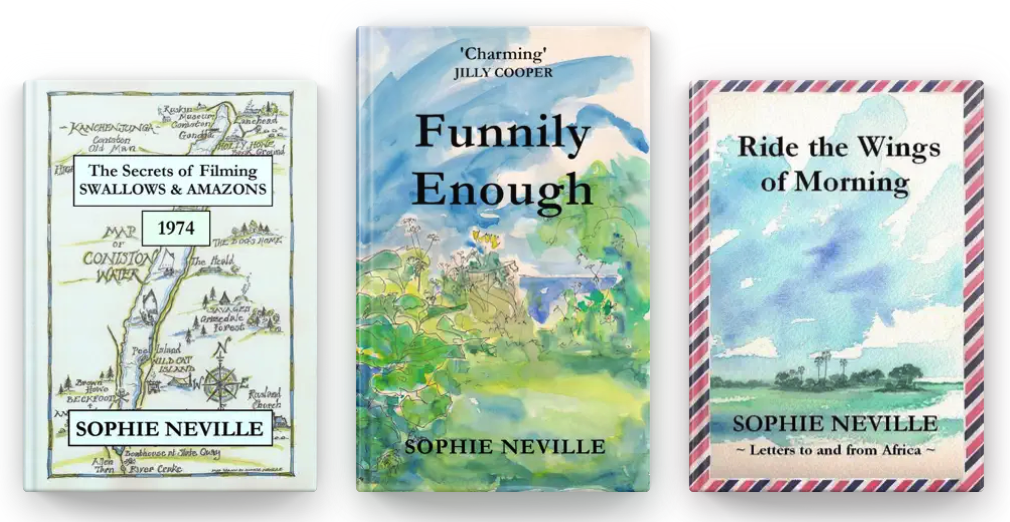
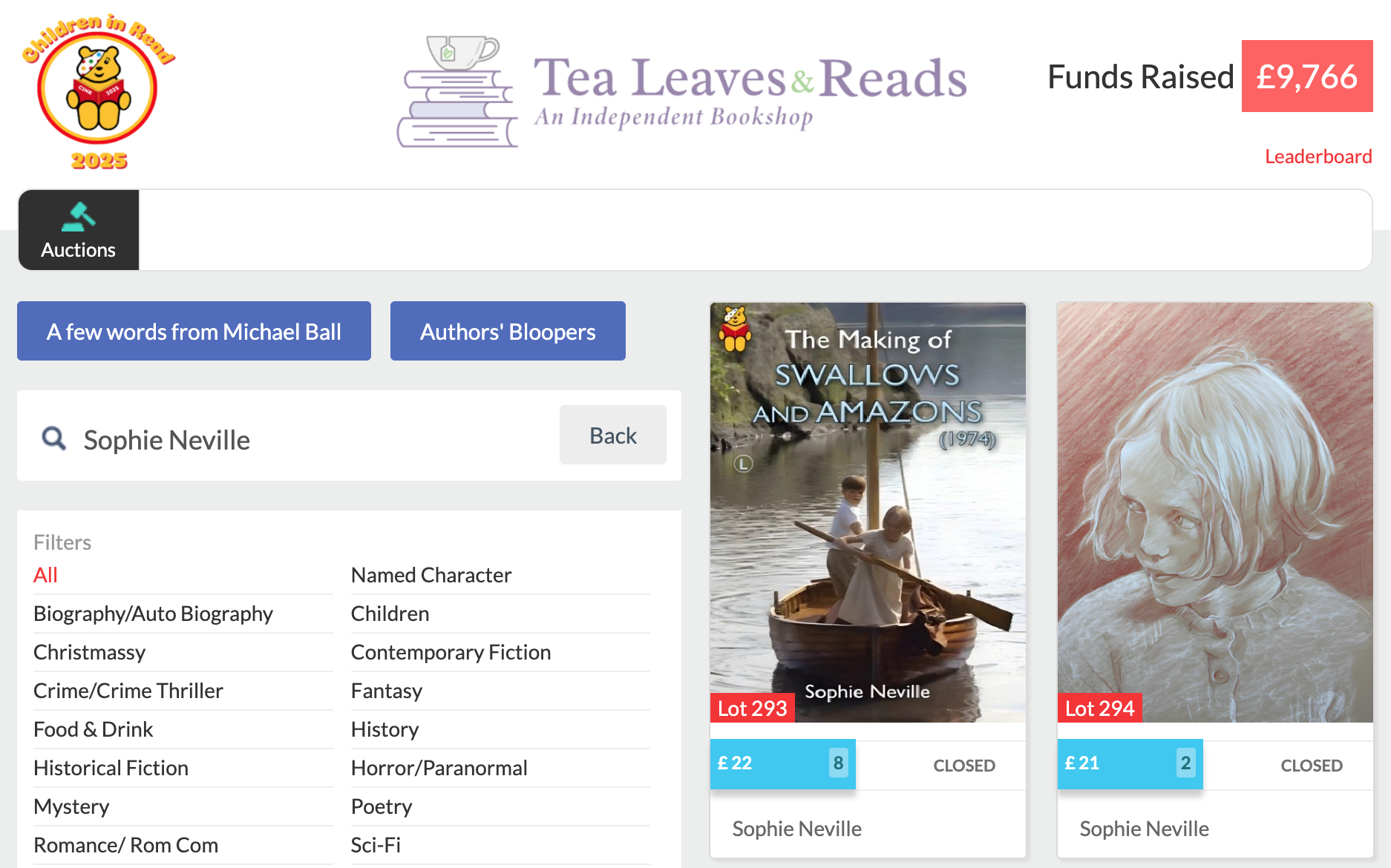
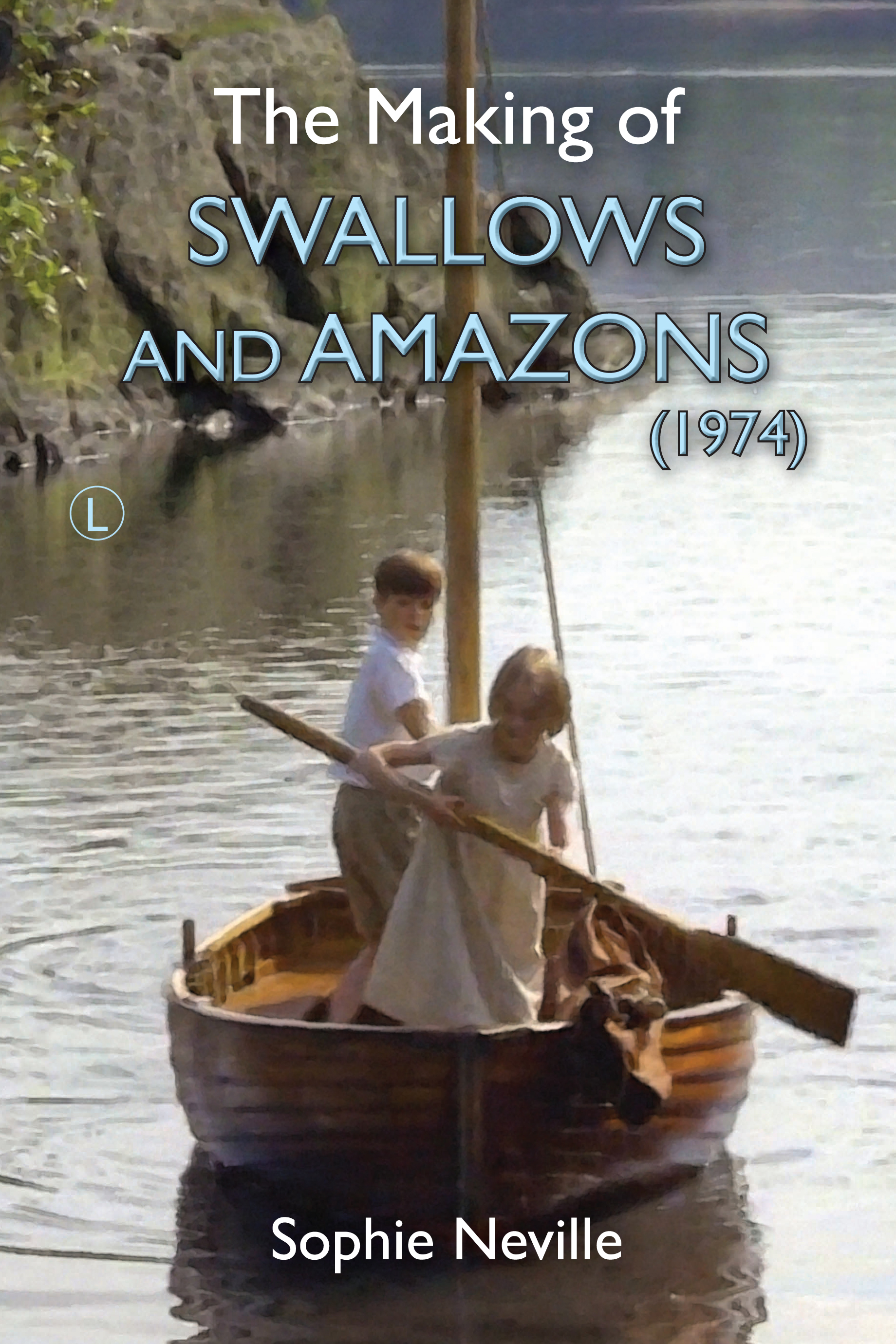
A book signed by the author always makes a good Christmas present. Each year, I take part in an annual online charity auction organised by Children in Read to raise funds for BBC Children in Need.
You can scroll through the site on Jumblebee. co.uk. and choose from an amazing selection of biographies and other books donated by contemporary authors.
Taking part is always great fun and offers authors a bit of publicity whilst presenting readers a choice of signed and dedicated books and illustrations.
In 2023, items in the Authors and Illustrators’ auction, raised a total of Β£24,061 for BBC Children in Need.
This year, authors and illustrators raised Β£9,766.
Over the eleven years that the annual event has been running a stunning total of Β£141,766 has been raised. I joined in 2020 and have raised a total of Β£616 for this cause.
Bidding has now closed but put the event in your diary for next year.
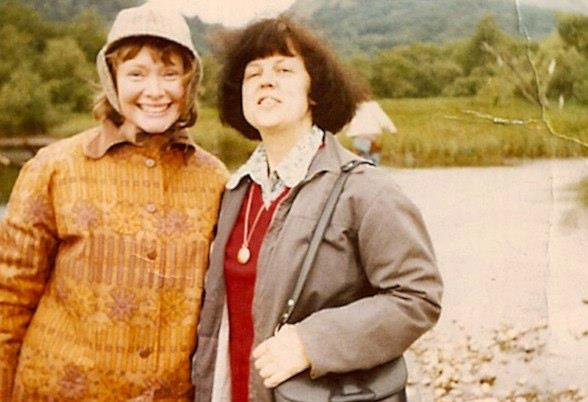
Daphne Neville with Sophie Neville while filming ‘Swallows and Amazons’ in Cumbria in 1973
It wasn’t until we were making preparations for the 50th Anniversary of the EMI film ‘Swallows and Amazons’ that I began to list all the work my mother, Daphne Neville, accomplished behind-the-scenes.
Daphne Neville accompanying Suzanna Hamilton, Kit seymour, Sten Grendon, Simon West, Sophie Neville, and Lesley Bennett out to the houseboat on Derwent Water
When I was offered the part of Titty Walker, she’d been invited to work as a chaperone, along with Sten Grendon’s mother, Jane Grendon. This proved to be a pretty demanding job. Getting us ready and into the minibus every morning alone must have been challenging. We stayed at the Oaklands Guest House where there were only two bathrooms shared between twenty-three residents – the eight of us, various students from the Charlotte Mason College of Education and the five members of the Price family who owned the house. We had to move out over Whitsun when it had been booked by holiday makers.
Dressed for the Cumbrian weather: Daphne Neville with Liz Lomas ~ photo: Richard Pilbrow
Mum was pretty horrified by the spaghetti hoops, cuppa soups and pasties given to us for supper and asked if we could have a fruit bowl in our school bus. Location catering in 1973 was good but aimed at providing electricians with meat and two veg, rather than food for children. We enjoyed salads and chicken drumsticks but baked beans could ruin a take and sugared food made us over-active and probably annoying.
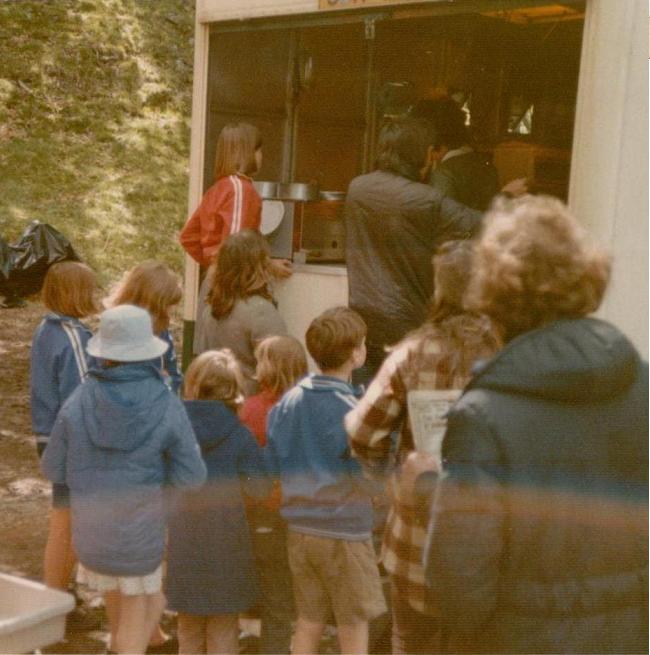
Suzanna Hamilton, in her red tracksuit top, seeing what the location caterers had for lunch on the set of ‘Swallows and Amazons’ by Coniston Water
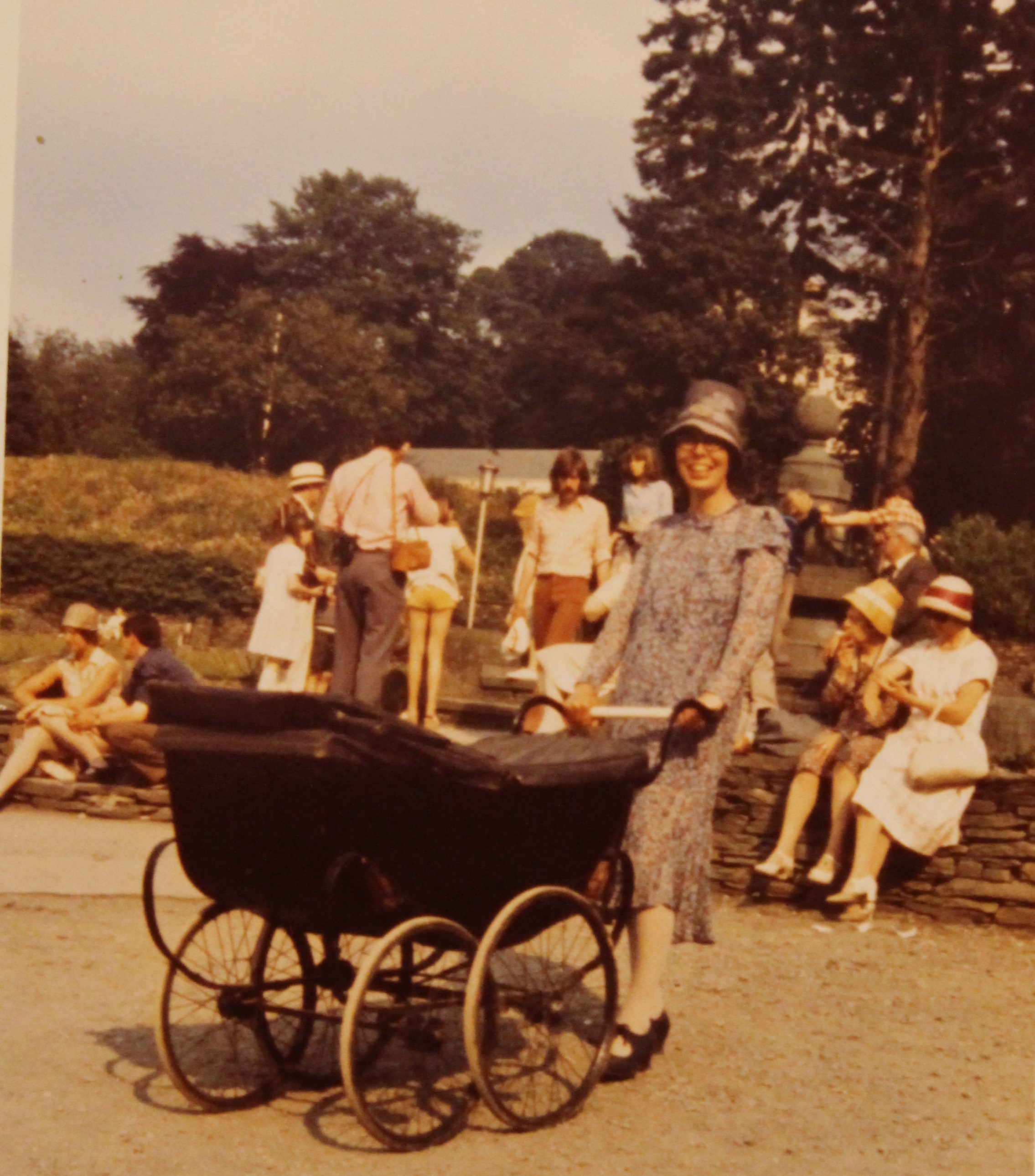
On film sets you normally have female costume assistants or dressers to help change actresses into their costumes. On ‘Swallows and Amazons’ we had Terry Smith the wardrobe master and my mother. Whenever there was a scene with film extras, Mum helped him to fit them with shoes and hats, helping the ladies into costumes for the opening scene at the station.
Wardrobe Master Terry Smith with Sophie Neville and her mother Daphne Neville outside the Make-up caravan on location near Keswick in Cumbria
Our hair was cut and looked after by Ronnie Cogan but mine had to be washed every night by Mummy. She moved me into her bedroom, which was tiny, but had a basin. This seems a small thing, but watch the film and you see my hair flying around the whole time indicating the ever-present wind.
Daphne Neville and Richard Pilbrow on Peel Island on Coniston Water in 1973 Amazons
Mum tried to keep us warm on location, getting us into life jackets and sunhats before we were taken off to the set, which was often either a boat or island.
Daphne Neville with Sophie Neville and Simon West on Coniston Water
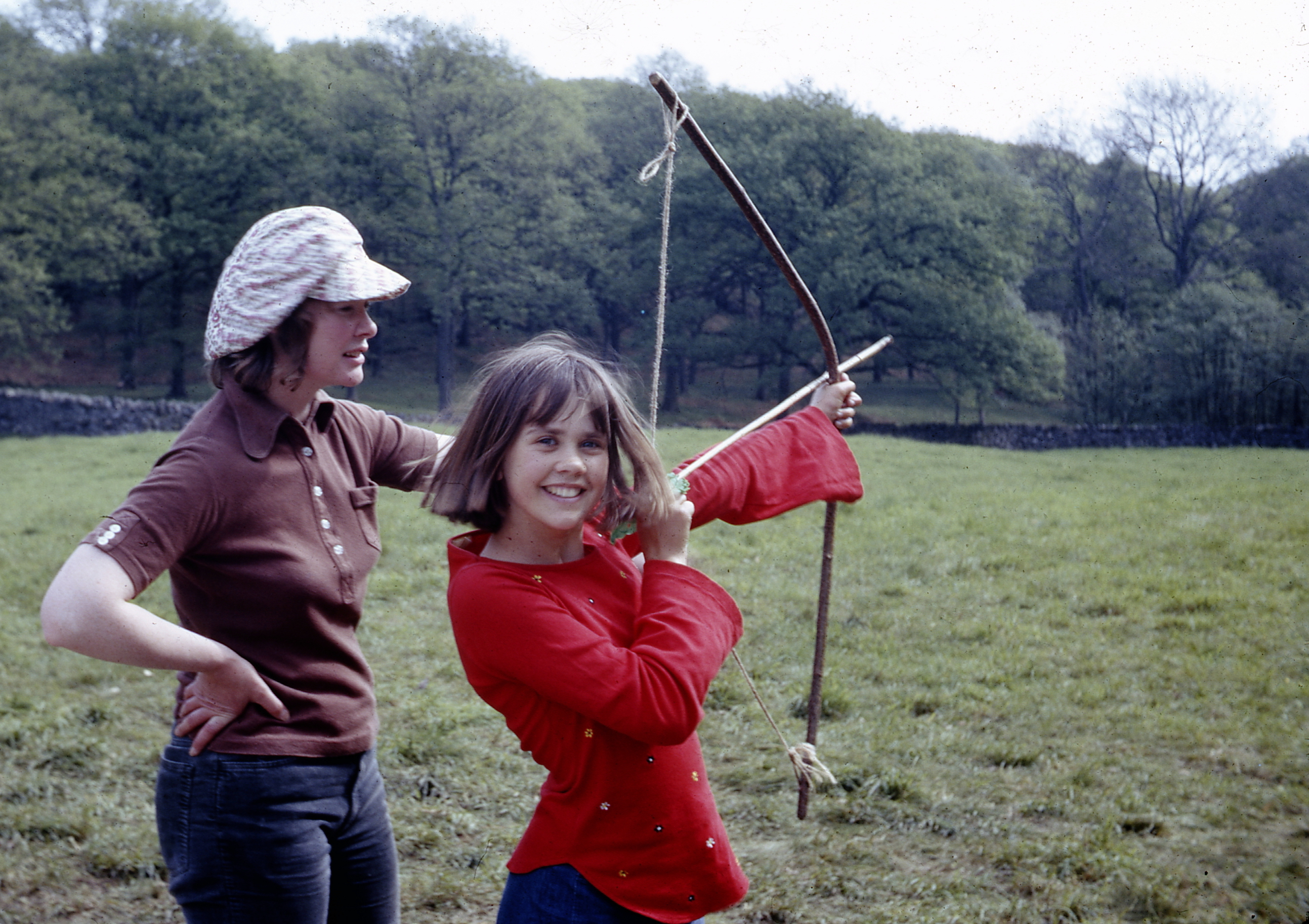
Having won prizes for archery, she taught the Amazons to shoot with a bow and arrow for their scene on Wild Cat Island.
Daphne Neville teaching Lesley Bennet, who played Peggy, how to shot with a long bow
She also took a vast collection of behind the scenes photos, some of which were very good.
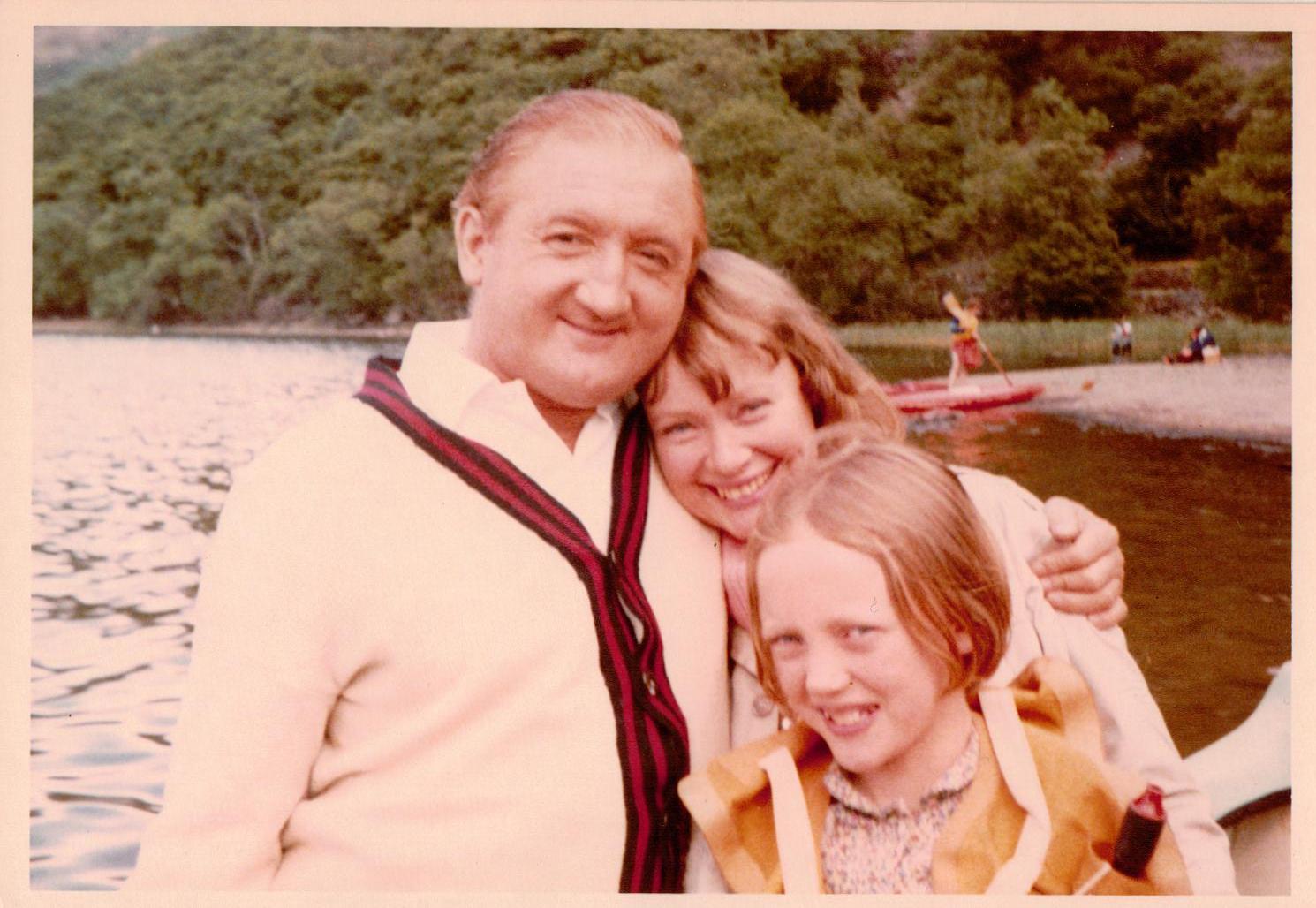
Ronald Fraser with Daphne Neville and Sophie Neville on Derwentwater in 1973
I couldn’t bear it when Ronnie Fraser flirted, but Mum enjoyed every moment of being on set. She longed to appear in the film as a supporting artist. My father, Martin, appeared in five different shots but Mum missed the crowd scene at Bowness and sequences taken aboard the MV Tern the next dau.
Jane Grendon with other film extras on the original movie ‘Swallows and Amazons’
Back home, she had a part-time job working for HTV who had given her leave but called her back to Bristol to present an episode of Women Only and promote the channel at the annual Bath and West Show. You can read more about this on her website here.
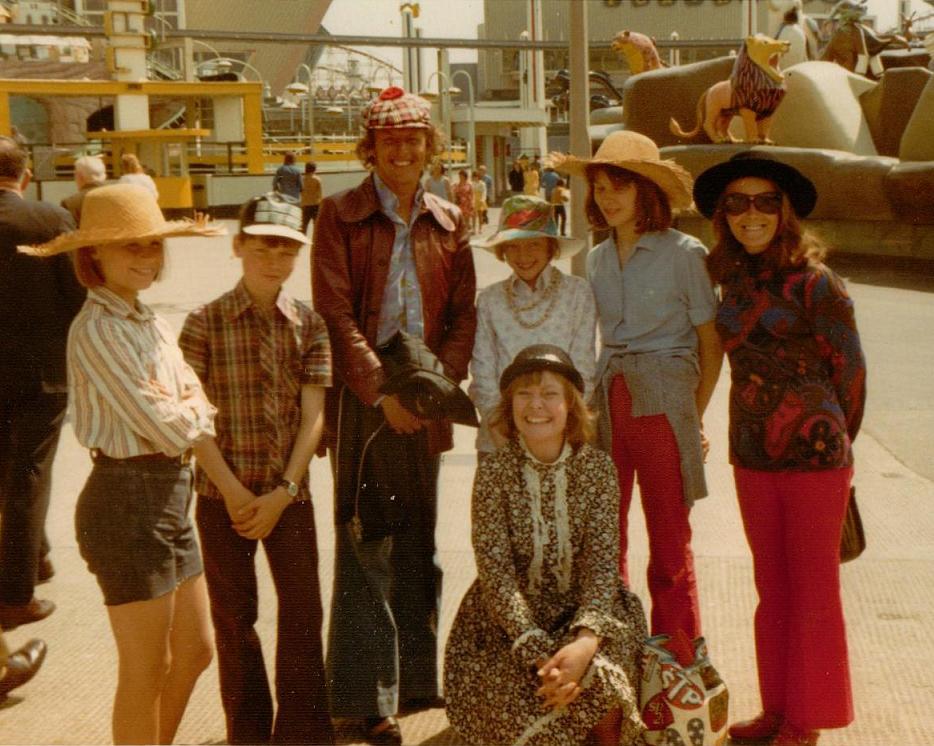
Suzanna Hamliton, Simon West, Claude Whatham Sophie Neville, Kit Seymour, Jean McGill with Daphne Neville kneeling at Blackpool funfair in 1973
While other members of the film crew were given one day off a week, our chaperones’ work never ended. Jane took us shopping or on walks up into the fells. Mum came with us on a trip to Blackpool.
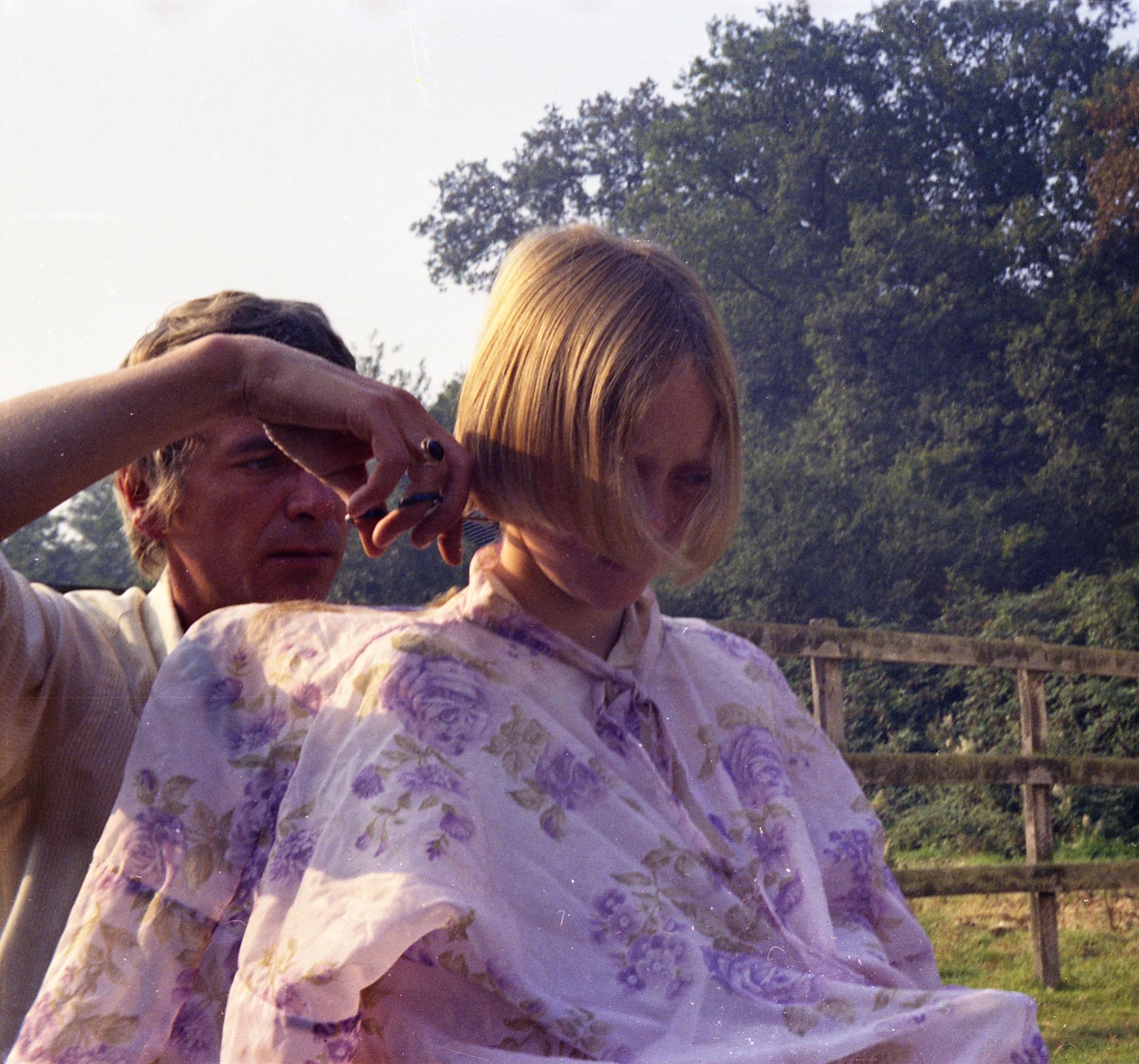
Sophie Neville having her hair cut on location for the part of Titty Walker in 1973
She must have driven me to Epsom for a pick-up shot in September when members of the Walker family had more haircuts and enjoyed being reunited.
Daphne Neville with Stephen Grendon, Suzanna Hamilton, Sophie Neville, Jane Grendon and Simon West
While we hated the publicity that came with marketing the film, Mum embraced it to the full, collecting every newspaper and magazine article.
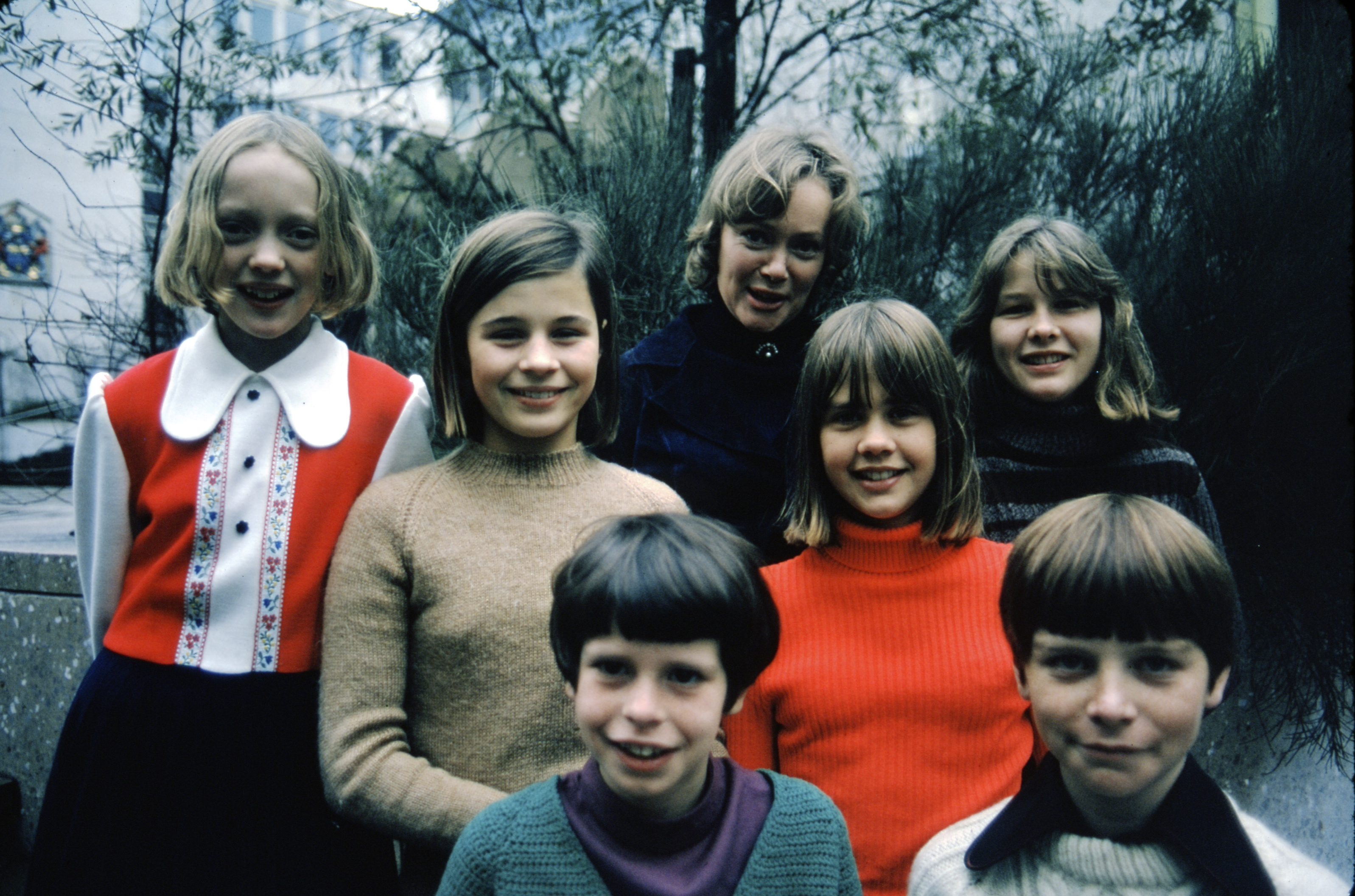
Sophie Neville, Suzanna Hamilton, Daphne Neville, Lesley Bennett, Kit Seymour, Sten Grendon and Simon West off to the Puffin Club Party at the Commonwealth Institute in London
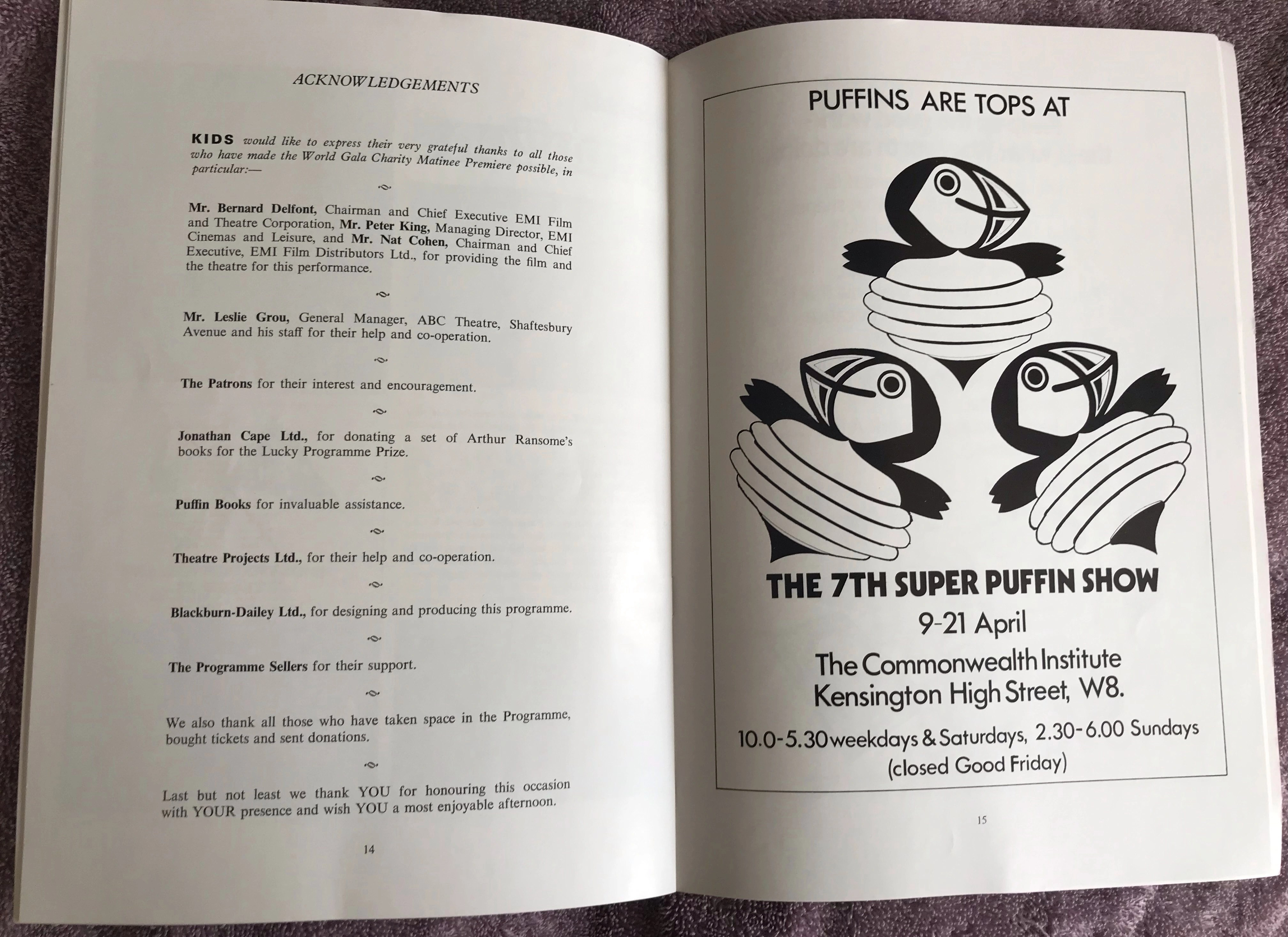
She took us to London for a Puffin Club show at the Commonwealth Institute devised by Kaye Webb,
Kaye Webb’s Puffin Club Show – April 1974
and to the Lord Mayor’s Show when we rode on a float set up by EMI Films.
Suzanna Hamilton, Stephen Grendon, Leslie Bennett, Simon West and Kit Seymour sailing the streets of London in ‘Swallow’
Mum was thrilled when invitations to the film premier arrived and bought me a green dress to wear to the ABC Cinema in Shaftesbury Avenue where it was held.
Daphne Neville at the London premier of ‘Swallows and Amazons’ in Shaftesbury Avenue.
She framed a film poster and kept every photo, every scrap of paper related to the film along with the LP and other items of movie memorabilia.
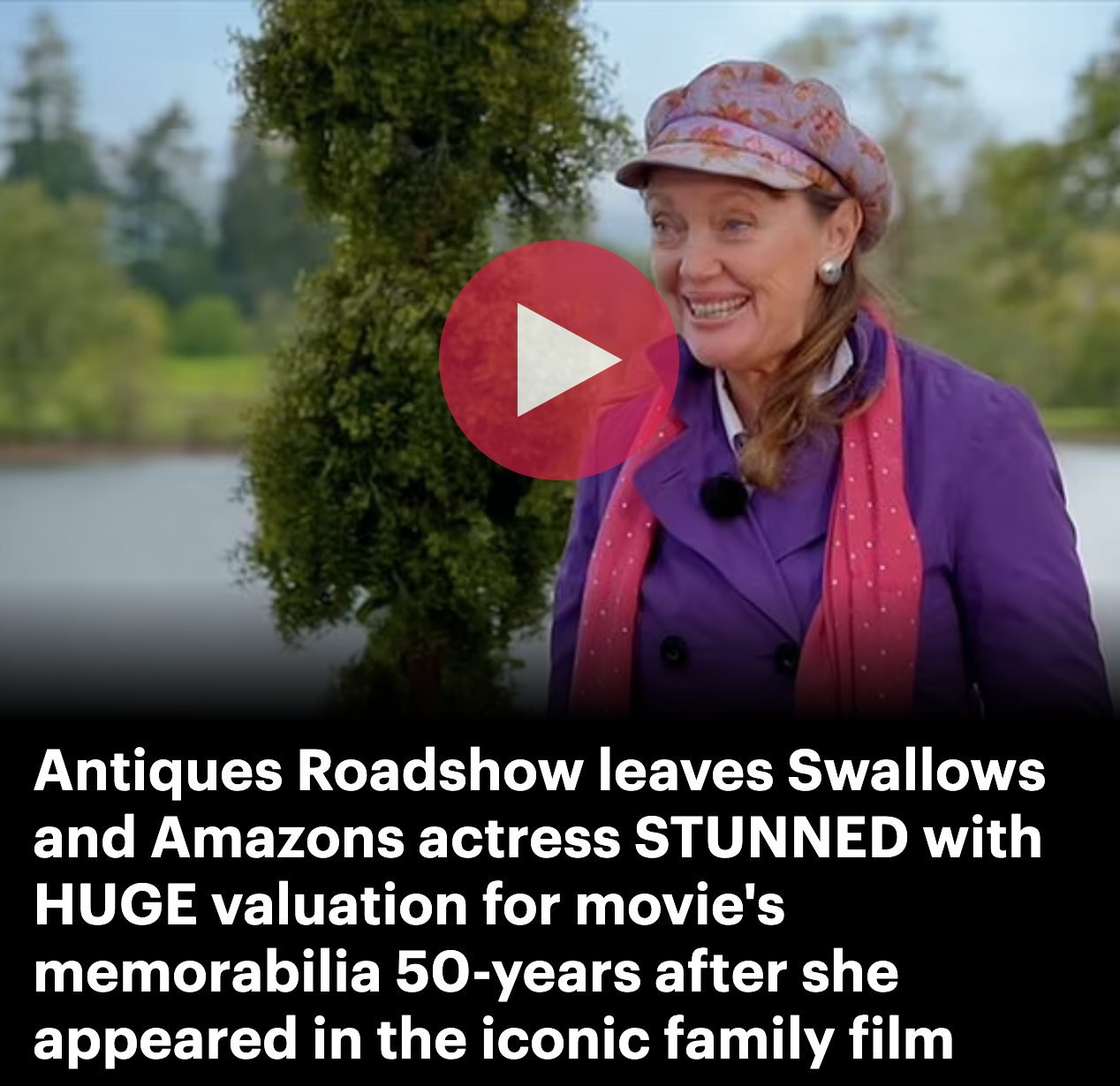
Fifty years later the items were valued on BBC Antiques Roadshow as being worth over Β£4,000.
To read Daphne Neville’s articles on being a chaperone, please find three earlier posts on this website beginning here.
The Saucepan and her mother on a scenic railway in Cumbria in 1973 ~ photo: Martin Neville
Like Arthur Ransome, I have ‘lived many lives in one.’ He also wrote, ‘Memory picks and choses’. Here are a few unusual ones:
A photograph of Sophie Neville photoshopped to look like Charlotte Rampling for ‘Broadchurch’
This gave me a fright: I was watching the ITV police series Broadchurch when I saw a photograph of me, aged seventeen, featured on screen. Only it wasn’t me. My face had been photo-shopped to look like a young Charlotte Rampling. Above is a screenshot. Here is the original:
Sophie Neville aged seventeen
No one had asked my permission, but what can I do but take it as a compliment?
Around this time I was briefly involved in the HTV seriesKidnapped. I played a boy. But opposite David McCallum (The Man From U.N.C.L.E), so who was I to argue. And I was paid.
I got the part in an odd way. They had forgotten to cast anybody for the role, but the producer had previously cast my sister in Arthur of the Britons and knew we lived only a few miles from the location. I agreed on the morning the scene was shot.
Appearing as a messenger boy in ‘Kidnapped’ produced by Patrick Dromgoole for HTV. What did they do to my hair?
I later stood in for the little boy who played Gerald Durrell in the first BBC drama series of My Family and Other Animals. Brian Blessed thought it hilarious. I was working behind the camera by that time but was skinny enough to squeeze into the costume.
Sophie Neville standing in for the boy playing Gerald Durrell getting a kiss from Brian Blessed who played Spiro
I was once on a train when the director of Obsessive Compulsive Cleaners asked if I could get to Gloucestershire to clear out my mother’s attic. I ended up filming with him for the next three or four days. It was exhausting – and unpaid – but a lot of de-cluttering got done. Check the apron from Seville. I’d bought it on honeymoon.
Sophie Neville filming in Gloucestershire with Betty TV
PiratΓΈen – is the title for Swallows and Amazons in Danish – seen here on a flier that I only came across recently. I’d just had my DNA analyzed to discover I am 3% Danish due to admixture a few generations back. Do I look Danish?
Although I’ve worked on over 100 films and tv programmes, I have mostly been behind the camera, so don’t expect anyone to know who I am. They don’t. The marketing executive at StudioCanal had not, at first, wanted me to help promote the remastered DVD of ‘Swallows and Amazons’, which is understandable as Dame Virginia McKenna has the star billing. Then she must have watched the ‘filmen for hele familien’. I ended up giving Q&As at twelve cinemas. Some had audiences of 250 and the screenings were so popular that customers were being turned away.
Sophie Neville giving a Q&A in Kendal
And yet when a friend of mine told a lady that I was in ‘Swallows and Amazons’ she smiled apologetically and said she’d keep ‘an eye out for me.’
‘Why are you here?’ I was asked at Windermere Jetty in Cumbria. We had gathered to celebrate the 50th Anniversary of the release of ‘Swallows and Amazons’ in cinemas. How should I have answered that question? I replied saying, ‘I’ve been asked to give talk.’
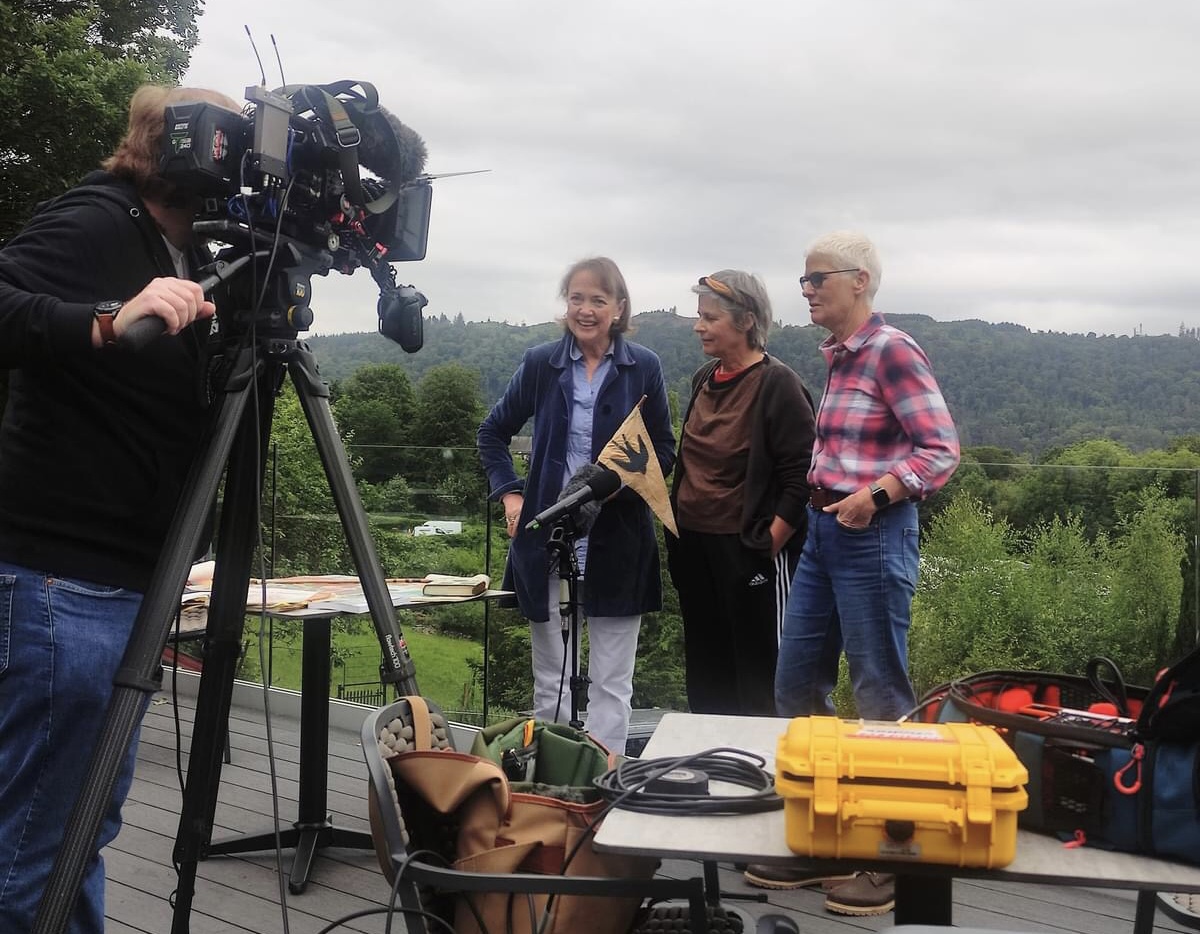
Sophie Neville appearing on BBC TV at Windermere Jetty in Cumbria
You can now listen to the story of how the original film of ‘Swallows and Amazons’ was made on Audible.
The HTV series ‘Kidnapped’ (1978) is available on YouTube. Blink and you miss me, but the music is wonderful.
Having won a Top Three Scripts award at the New Media Film Festival in Los Angeles, Sophie was asked about her screenwriting.
Can you tell us a little about how you got started?
I began writing for BBC Television at the age of twenty-two. It was a disaster. Instead of presenting a polished script, I produced a rough draft that I thought we could develop in the rehearsal room. Developed it was – by Nicholas Parsons, one of the stars. He rewrote his own soliloquy, taking all the credit and a substantial fee. I’ve welcomed harsh feedback from beta readers ever since.
What was the biggest challenge you faced in your journey to becoming a writer? How did you overcome it? Can you share a story about that that other aspiring writers can learn from?
Instant success with my first book was challenging. My illustrated memoir FUNNILY ENOUGH was at number 1 in Humor on Amazon Kindle in the UK (after free copies had been downloading at the rate of 250 a minute) but I had self-published, and had no team support. Instead pressing the go-button with a PR firm and marketing team, I was weigh-laid by the small stuff. Writers need skilled networks in place, especially in the age of New Media.
Funnily Enough – the paperback has black & white illustrations
It has been said that our mistakes can be our greatest teachers. Can you share a story about the funniest mistake you made when you were first starting? Can you tell us what lesson you learned from that?
I began my career in television by working with children. I could see the potential and it gave me a niche, but the hazards were numerous.
A teacher opened one scene for me by saying, ‘Some people believe the world is flat.’ A five-year-old called out, ‘No, but it’s not! It’s bumpy.’ The mistake was that we had too much camera judder – my cameraman had dissolved in hysterics. A lesson learned: I used a tripod when capturing the opinions of eleven-year-olds. The results were so amusing that they were repeatedly endlessly when Daytime TV was launched in the UK.
Sophie Neville directing a sequence with BBC cameraman Lorraine Smith
What are some of the most interesting or exciting projects you are working on now?
I felt compelled to write A BOY CALLED FREDDIE when I discovered Freddie Mercury, escaped from the violent 1964 Zanzibar revolution at the age of seventeen. If a year older, the man who became an international rock idol would have been forced into slave labour on coconut plantations. As it was, his family fled to London where his talent flourished and found stardom. Born Farrokh Bulsara, he became known as Freddie at school. The story of how he chose the name Mercury involves NASA but is only revealed in my screenplay – right at the end. Freddie’s father, Bomi, was a Parsee who worked as a cashier at the law courts where my Great-uncle Ronnie served as Chief Justice. I’ve been able to draw on my cousin’s stories of life in the heady days before a convicted rapist from Uganda brought mayhem to the archipelago of tropical islands, forcing the Sultan to escape by sea, along with my aunts and a plucky English women who had set up free and fair elections a month before mass murder broke out akin the movie HOTEL RWANDA (2004).
I’m also developing THE MEETING HOUSE, an exceptional true story from WWII about an East African serviceman I met who was airlifted out of a POW camp in Japan by his boyhood friend just before America bombed Tokyo. They landed in Silesia in the snow, which he’d only seen previously on the peak of Kilimanjaro, where he was born.
Can you share the most interesting story that occurred to you in the course of your career?
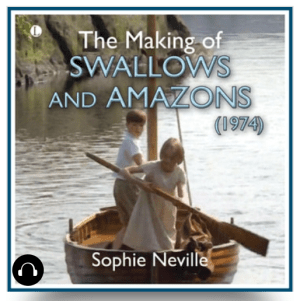
Film fans love to hear about disasters that befell us while making the EMI movie ‘Swallows and Amazons’ before the advent of CGI. I was persuaded to write THE MAKING of SWALLOWS and AMAZONS, now published by The Lutterworth Press.
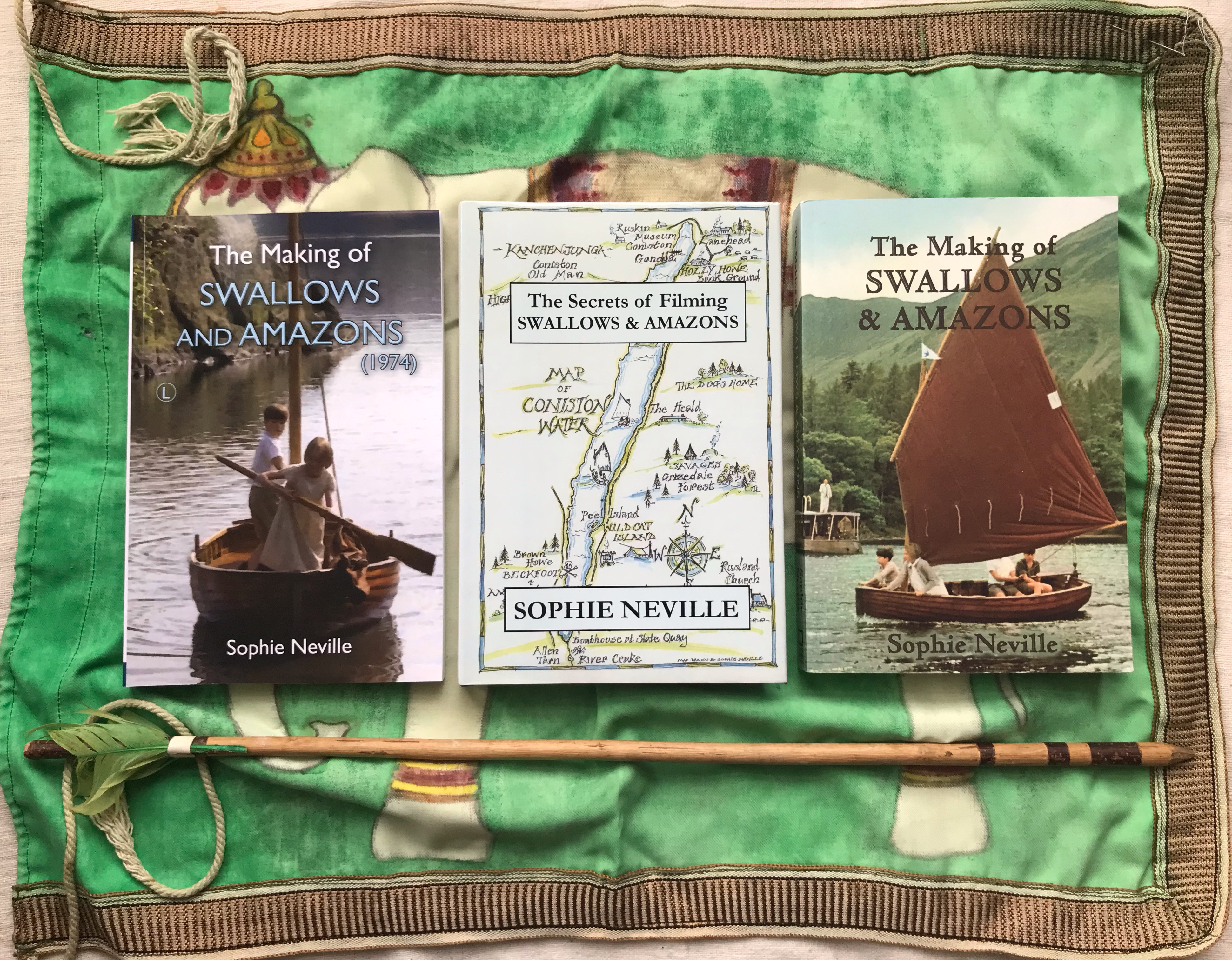
Editions of ‘The Making of Swallows & Amazons (1974) by Sophie Neville’
Although it’s been screened on television more times than any other British movie, it remains a classic that some have never heard of. ‘Why are you here?’ I was asked at the 50th Anniversary screening.
‘I’m giving a couple of talks on how the film was made,’ I muttered.
‘How would you know how it was made?’
‘I was there.’ In almost every scene. ‘I worked on it.’
‘You couldn’t have been,’ the man insisted.
I could only take this as a compliment, but he looked aggrieved.
Sophie Neville, Suzanna Hamilton and Kit Seymour in Cumbria
StudioCanal also thought I was an imposter as Dame Virginia McKenna had the star billing. Then the marketing executives watched the movie. When the DVD was launched they had me hosting Q&As at twelve cinemas and provided footage for all manner of TV programmes from CINEMANICS with David Wood the screenwriter to BBC BREAKFAST with my co-star Suzanna Hamilton.
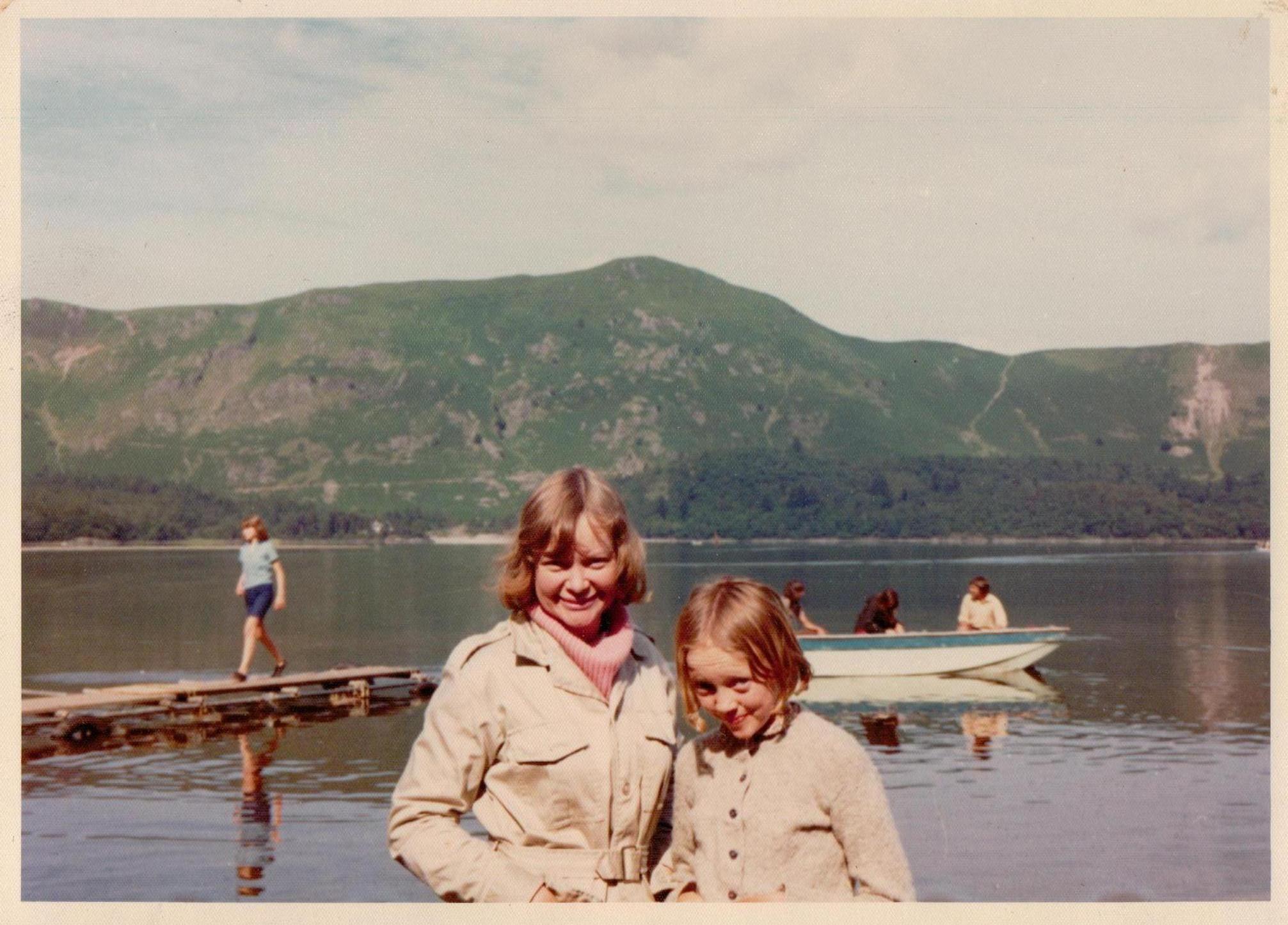
Sophie Neville, Suzanna Hamilton and Kit Seymour on BBC Breakfast
I’m currently working on an inspiring comic tale: BANANA MAN, THE TRUE STORY about Phil-the-Geek, a shy but good looking physicist, who increased the national consumption of bananas by 20% after exploiting a supermarket deal and making 8 pence on every bunch he bought – and gave away. His story hit international News headlines and won him the heart of a beautiful girl. I was her bridesmaid. Last week, their daughters have just graduated from Yale and Harvard, respectively. I intend to present the family with a fruit bowl.
Here is the main question of our interview. Based on your experience, what are the β5 Things You Need To Be A Successful Author or Writerβ? Please share a story or example for each.
Focus, forbearance and a five am start to the writing day are key, but I often come up with vital twists while soaking in the bath tub. I guess this is because my brain works best at periods of least resistance. The problem is that I end up groping for a notebook with wet hands.
Please share a story or example for each.
Personality, productivity, perseverance, patience, and a broken heart. We need to touch the audience with humor, in small ways that are easily identifiable. I have a scene in one novel about a man on the cusp of falling in love who loses his car keys in the heat of the day and is left feeling a fool in front of the girl he wants to impress. It’s based on the time I found my ignition keys with my feet. They had fallen into sand beneath the door of my car when I was driving through Botswana. The relief following this small miracle is etched deep in my soul.
In your opinion, were you a βnatural born writerβ or did you develop that aptitude later on? Can you explain what you mean?
I would describe myself as a ‘natural born story-teller’. Having a visual brain, I became a television director, attracted to Mike Leigh’s emerging art of improvisation on film. When on the converted BBC Drama Director’s Studio Course, I gave my actors the task of flirting whilst erecting a tent. It worked exceptionally well, except that they enjoyed the exercise so much it went on a little long. I should have provided them with earpieces to bring the story to a timely end.
We all need to hone the craft of writing. I had the amazing opportunity of assisting on drama serials such as ‘Doctor Who’ and ‘Eastenders’. Looking back, I could have become a BBC script editor. Instead, I’ve spent the last twenty years attending Curtis Brown Creative novel writing courses and acquiring the art of writing about love under the Romantic Novelists Association’s New Writers’ Scheme. Entering writing competitions has proved an incentive and the wins help build my CV. The competition is such that we need to build a pedigree and provide consumer confidence.
Which literature do you draw inspiration from? Why?
I write true-life stories set in the 20th century, so draw on any memoirs or biographies I can find. I love amusing autobiographical novels, such as Fran Hill’s trilogy on life as a teenager in foster care. She is a master craftsman and a truly inspirational writer. I feed off her infectious humour poured out to the world on Substack.
You are a person of enormous influence. If you could start a movement that would bring the most amount of good to the most amount of people, what would that be? You never know what your idea can trigger. π
Forced marriage needs to be recognized as conjugal slavery and made illegal worldwide. Female circumcision (FGM) needs to stop before more lives are lost to infection. I have no personal experience, but feel we must all speak out to support those unable to do so.
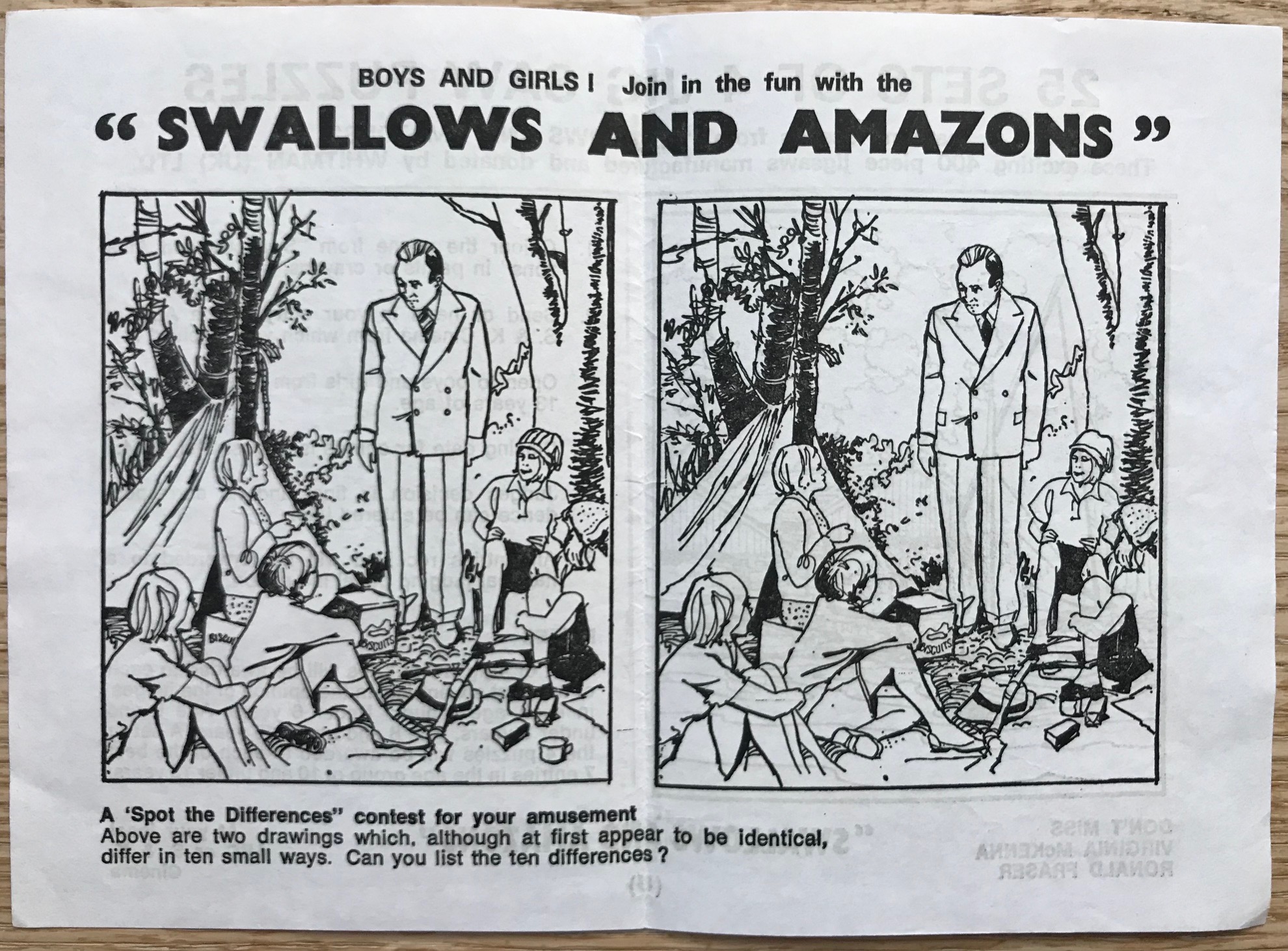
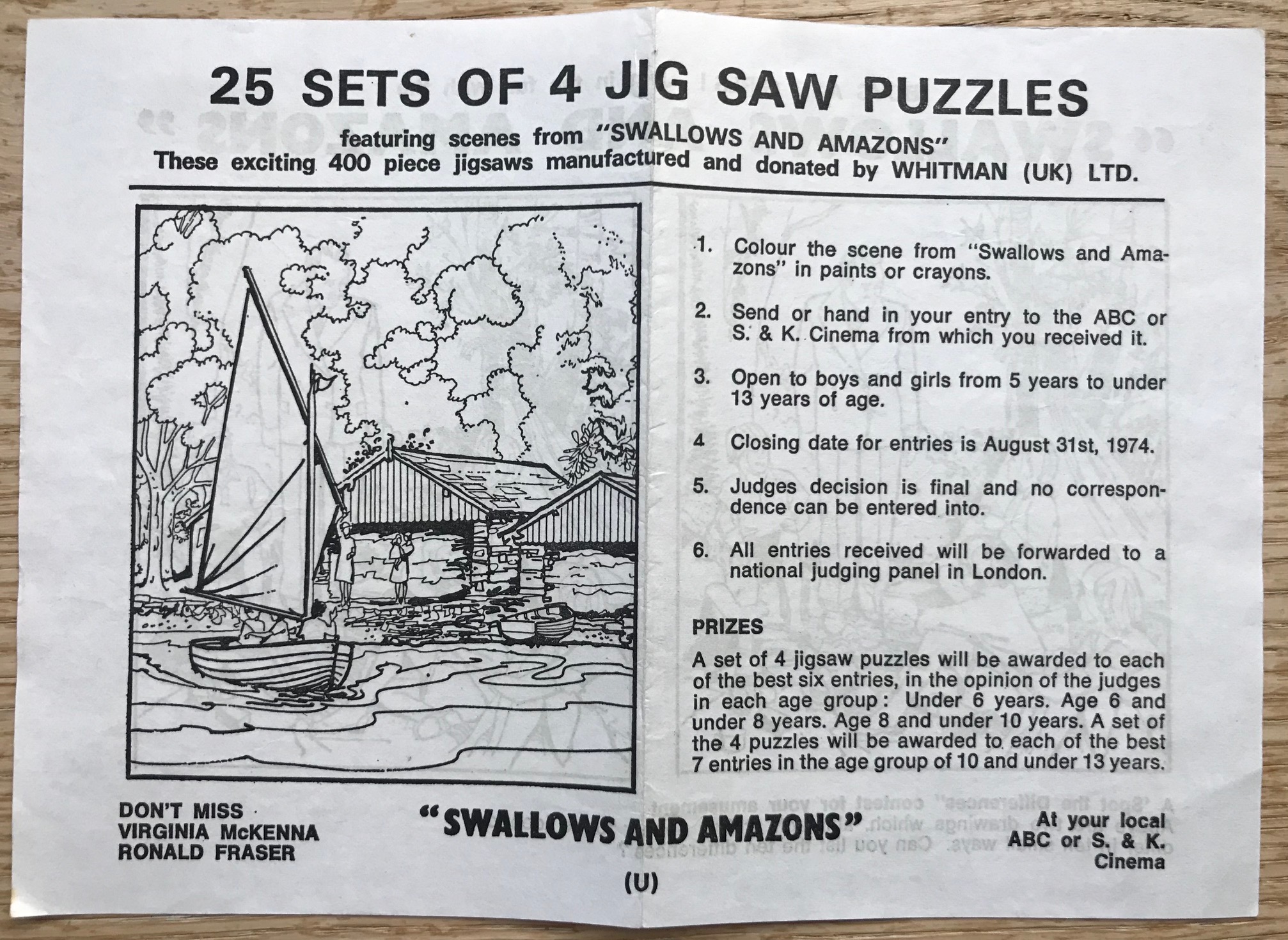
Having been released in cinemas in April 1974, the original movie ‘Swallows and Amazons’ was not accompanied by computer games but by puzzels, jigsaws and competitions. Here are a couple found recently whilst clearing out my mother’s house.
Few films are set in 1929, and yet it was that period, nearly a hundred years ago that gave the first film adaptation a certain style.
Graham Potter wrote saying: “I have just finished a DVD of S & A and found how much easier it is to see the details on the TV than in a cinema having to look from side to side. I was surprised to see how little sailing was shown and how the Amazons were not seen much. I think you were 12 or 13 at the time but looked younger. I have to to admit to enjoying the glimpses of the navy blue knickers in the opening scenes.”
One of the set of four jigsaw puzzles made when ‘Swallows & Amazons’ was released in cinemas in 1974, along with a Puffin paperback
Graham goes on to say, “I was surprised to see how you carried all the exciting scenes: left alone on the island, finding the secret harbour , dealing with leading lights , capturing and hiding Amazon, dealing with Mother’s visit during the night sailing, giving Captain Flint a good telling off for blaming John for firework and not listening to his warning about potential theft at his houseboat. Then the great finale when you are able to present him with his stolen life’s work in the trunk. Perhaps it was planned that you didn’t have too many lines to remember, as it enabled a very young girl to contribute such a lot to the film.”
This is very kind but I believe the film was made by the fact that Simon West who played John and Kit Seymour who played Nancy were good sailors. You can tell when they are sitting in a moored boat. While Claude Whatham was an exceptional director, ahead of his time stylistically, the director of photography uplifted the film by insisting we waited for clouds to pass. What else? – a hardworking and talented crew put together by Nevill Thompson. Simple costumes that never dated. Natural, well cut hair and a lack of make up – all the facets of filmmaking that you are not meant to notice.
Maybe our spiritedness as children carries the original film on. We are all in our sixties now, but the characters we played have become imaginary friends to many. As Shakespeare wrote, ‘Our revels now are ended. These our actors, as I foretold you, were all spirits and are melted into air, into thin air.’ The Tempest Would Ransome have agreed? I only know he discussed Shakespeare with Karl Radek.
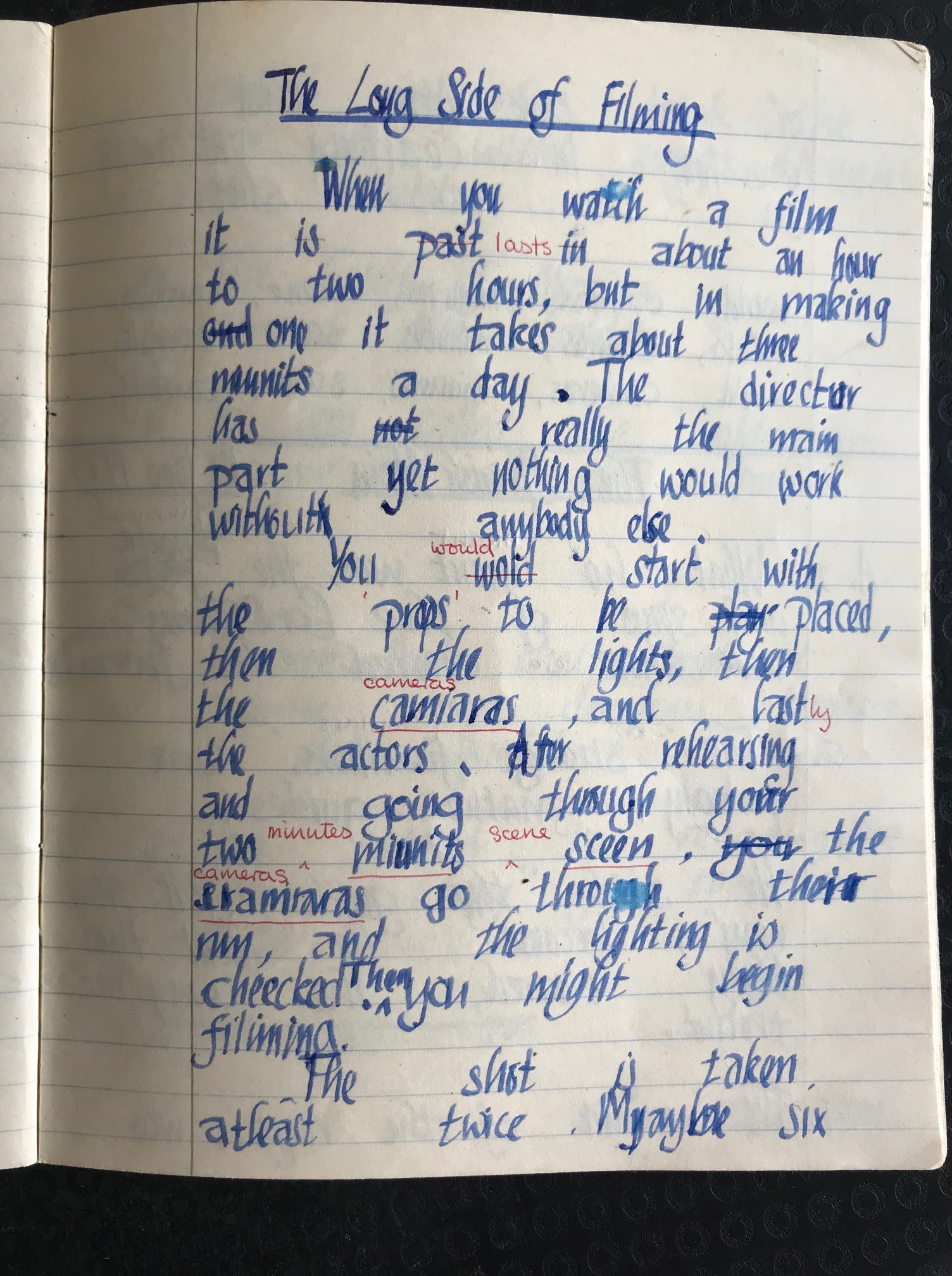
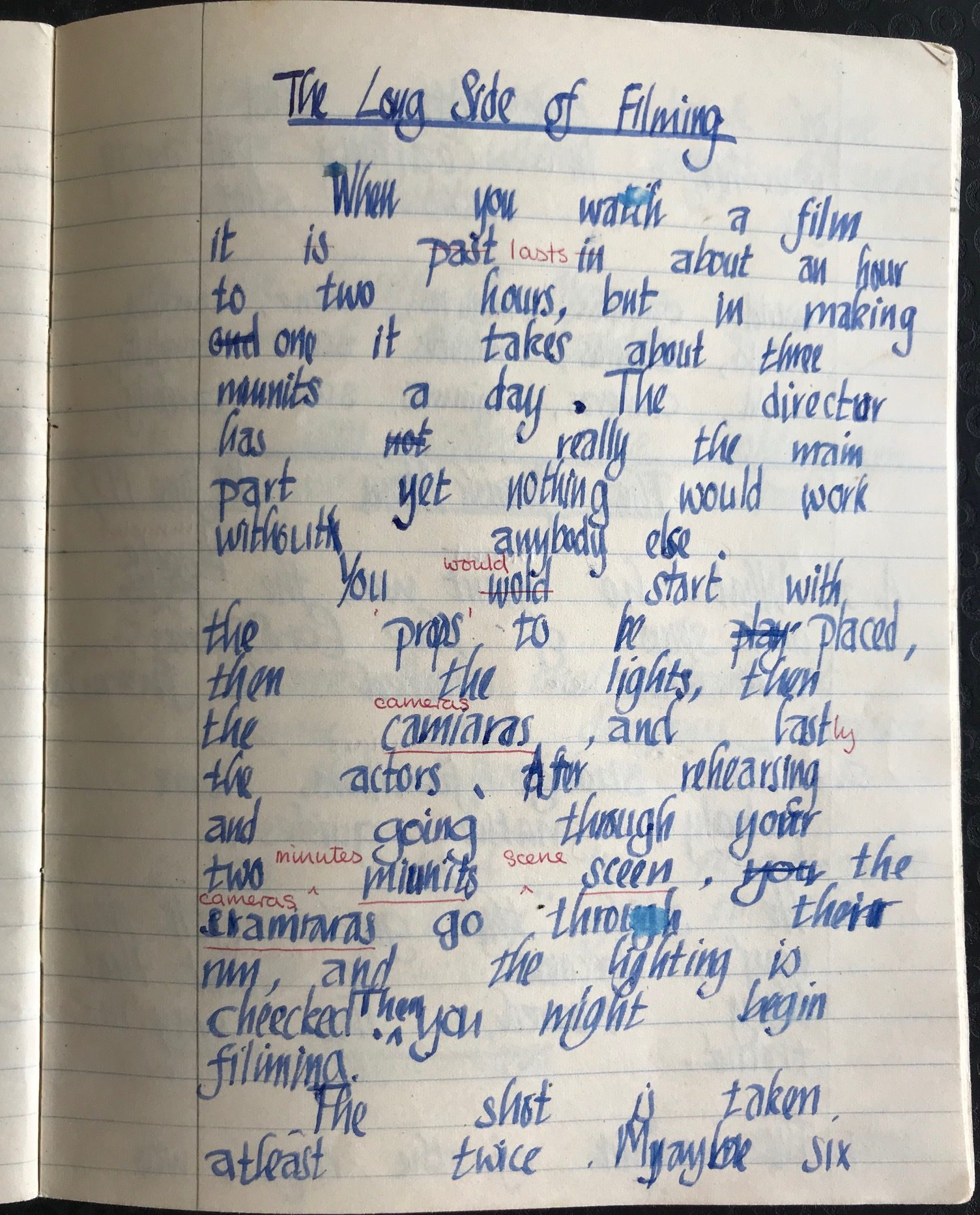
I came across an essay in one of my school exercise books that I must have written aged twelve whilst on location. I was trying to explain that only about three minutes of what will be the finished film are captured during a long day’s filming on location. The piece is not well written.
A school essay written in 1973.
We went on to learn about the Spanish Main, which may have been requested by Claude Whatham, the director of ‘Swallows and Amazons’ so that I would know what Titty was talking about. On 1st June 1973, I was on location in the Lake District filming in the capture of the Amazon in Secret Harbour on Peel Island.
Perhaps I should add these remenants to a future edition of ‘The Making of ‘Swallows and Amazons’ (1974)’. You can order the illustrated paperback from libraries, find it for sale online, or listen to the audiobook:
Chloe Williams has just written from Ontario in Canada, to say, “Some books entertain. Some enlighten. And some, likeΒ The Making of Swallows and AmazonsΒ andΒ The Secrets of Filming Swallows & Amazons, manage to bottle something impossibly rare: the feeling of looking back through a childβs eyes and realizing it was all real; the lake, the sails, the laughter and somehow, you were part of it.”
“These arenβt just behind-the-scenes diaries. Theyβre sun-dappled time machines. Your voice, both in memory and in your original childhood notes, is a miracle of tone: witty, observant, buoyant, and deeply human.”
Of the original movie, she wrote: “What A Christmas Story is to snowglobes and childhood winters, Swallows and Amazons (1974) is to summers on the water and youβve preserved that magic with charm, heart, and astonishing detail.
“What makes these books unforgettable isnβt just nostalgia. Itβs how alive they are. We feel the smell of old sails and camera tape, the blur of location shoots, the uncertainty and excitement of being a child caught in a grown-up world of filmmaking yet utterly at home in it. We meet legends like Virginia McKenna not as distant stars, but as fellow travelers in the adventure. And itβs a joy.”
The Making of Swallows and Amazons seems to resonate with:
Readers of nostalgic memoirs that celebrate childhood, nature, and storytelling
Adults who are captivated by the lake-country magic of Arthur Ransome
Film lovers who cherish insider views of filmmaking
Educators and parents seeking real-life adventure stories for young readers
Fans of Call the Midwife, The Durrells, and 84, Charing Cross Road
“The joy and authenticity in your books mirror exactly whyΒ Swallows & Amazons (1974)Β still has such a hold on peopleβs hearts. The memoirs donβt just tell the story of making the film, theyΒ recreateΒ it, letting readers smell the lake air and see the magic unfold through a childβs eyes.”
The new audiobook
I’m hoping the audiobook will also amuse readers. It’s now available on all the online platforms including Audible, where isis being offered for free on their membership trial.
“My professional life began at the age of ten when I gained a part in the first BBC adaptation of Cider With Rosie. Two years later, the director, Claude Whatham, invited me to interview for the part of Able Seaman Titty in the EMI film Swallows & Amazons (1974). He never thought to ask if either I, or Virginia McKenna who played my mother, could row a boat but I grew up next a lake in the Cotswolds where I was used to rowing a Thames skiff. In the film I had to row with a massive 35mm Panavision camera in the stern but it was fun. I started rowing more seriously at Durham University and managed to complete the five-hour Voga Longa in Venice on the crew of the Drapersβ shallop.
The Drapers’ Barge ‘Royal Thamesis’ in Venice
I began directing plays at university and won a place on the BBC General Trainee Scheme. After working on The Book Show and the live television chat show Russell Harty, I gained a job casting children on the BBC dramatisation of Coot Club and The Big Six. I then worked on serials such as My Family and Other Animals, Doctor Who, Eastenders and shot the wartime romance Bluebell in Paris before directing comic dramas for BBC Schools Television.
Sophie Neville, in stripy top, on the BBC Studio Director’s Course at BBC Elstree Studios, Borehamwood in 1990
I was twenty-two when I first wrote for television. It was a disaster. My concept was accepted but Nicholas Parsons had to re-write the dialogue. I later put together a few drama documentaries and an INSET series for Schools Television, which worked well. In 2004, I was commissioned to write a feature film about Germans in Africa. Sadly, the producer died but Iβve continued to develop this and written a second screenplay that is currently winning international script awards. Both are based on true stories about the lives of family members who emigrated to East Africa in 1919.
Iβve always been attracted to the wilderness and the amazing people you find there. In 1985, I drove from London to Johannesburg, making my first documentary for Channel 4. In 1992, I emigrated to Southern Africa where I set up a couple of BBC wildlife series and a Blue Peter Summer Special.
I bought a horse, lived on different game reserves and spent time between contracts writing stories illustrated with sketches made while working for friends as a safari guide.
In the western Okavango
Iβd begun riding at the age of four and had such obstreperous ponies as a child that nothing in the Africa bush daunted me. We had to do most of our own veterinary work in the Okavango Delta. I ended up nursing a stallion whoβd been scratched on the rump by a lion and became a great believer in Epsom salts.
I have drawn all my life but only turned professional as a wildlife artist after I broke my pelvis falling off someoneβs horse. My grandfather, HW Neville, was a landscape artist who became the first art master at Stowe School after service as a re-mounts officer in WWI. Like him, I took to painting watercolours outdoors, began exhibiting in London, and made enough money at a solo exhibition to go on a YWAM Discipleship Training Course in New Zealand. On returning home, I felt called to adapt a diary Iβd once kept into a humorous book entitled Funnily Enough, which was serialised in iBelieve magazine.
I somehow brought out Ride the Wings of Morning, followed byThe Secrets of Filming Swallows & Amazons when we were renovating the family home in Hampshire and began writing articles while contributing to non-fiction publications. I now belong to a consortium of Christian writers called Resolute Books, with Ruth Leigh, Clare Dunn, Paul Trembling, Liz Carter and members of the Association of Christian Writers. My paperback on The Making of Swallows and Amazons is published by The Lutterworth Press. They are based in Cambridge where I spoke on writing for the screen at the British Christian Writersβ Conference last year.
We had a little miracle: Funnily Enough, which is a Christian testimony, reached No. 2 in all categories for free Kindle downloads in the UK. It was down-loaded at 250 copies and hour. After giving away 16,000 e-copies, I was in bed, recovering from a horrid biopsy, when a cut-glass crystal trophy arrived in the post: Funnily Enough had won third prize in the International Rubery Book Award.
I love the writing of CS Lewis, Adrian Plass and Catherine Fox, although Arthur Ransome has had the greatest impact on my life. Iβve given over a hundred talks about filming Swallows and Amazons and will be appearing at the Swallows and Amazons Festival at Windermere Jetty in Cumbria this summer. The Arthur Ransome Society β the second biggest literary society in Britain – is bringing along the boats used in the film along. Members of the cast and crew will be able to see the original Amazon owned by members of the Altounyan family, Arthur Ransomeβs dinghy Coch-y-Bonddhu and hopefully travel on the MV Tern, which the Swallows nearly crashed into on film.
Iβve been representing Bible Society since going on a short-term mission to China in 2011. We visited the Amity Printing Press, various churches and met pastors around the country. Bible distribution is conducted openly, and is both well-organised and joyous. There are often speeches, music and songs, and sometimes free hair cutting or gynae scans for women whose health was compromised by the one-child policy. Iβm now Bible Societyβs volunteer speaker for the New Forest and Isle of Wight, so let me know if you need a slide show.
I now spend far too much time behind a laptop but live on the South Coast where I take exercise by collecting flotsam. Becoming New ForestBeach Cleaner of the Year was a surprise butlitter gives me plenty to write about. You find the strangest things. There are now about 2,000 Litter Pickers of the New Forest clearing up the National Park before our wildlife chokes to death. Theyβre all amazing.
Awarded ‘Litter Picker of the Year’
I met my husband at an archery meeting in Worcestershire. I was fed up with being single and complained to the Lord, asking βWhy canβt I marry that man?β. The archer in my sights proposed to me six weeks later. His grandfather had been an Olympic archer whoβd introduced my parents to the longbow in the βsixties. Mum had given the Amazons lessons on how to shoot for the film Swallows and Amazons when we children had all wanted a go. I picked up the basics in the Lake District and became just good enough to gain the leading role as an archery champion in an adventure movie called The Copter Kids when I was fifteen. We now belong to three archery societies and sometimes win the odd trophy. Itβs the only word that rhymes with Sophie.
Other answers to prayer have been pretty dramatic. Try taking medicines into a war-torn African country and youβll find out. Shattered lives, cruelty, destruction and waste make me angry. Litter falls under this category. Fulfilment of potential makes me happy. I like walking along beaches and riding through the wilderness. I love the sound of waves and horses.
The promises of God are what give me hope for the future. I pray for their fulfilment. If locked in a church it would be nice to be with my husband. Heβs never ever failed to stop and pray with me but we risk talking about the mundane. The South African intercessor Bernie Mostert would probably use the time most powerfully, but Iβm yet to meet him.
Thereβs an apparent demand for family films and faith-based scripts in America. My own work in progress is called Banana Man β The True Story. Itβs about singleness and marriage with humour akin to Debbie Isittβs film Nativity! starring Martin Freeman. Spare me a prayer. It would be fun it that got off the ground.”
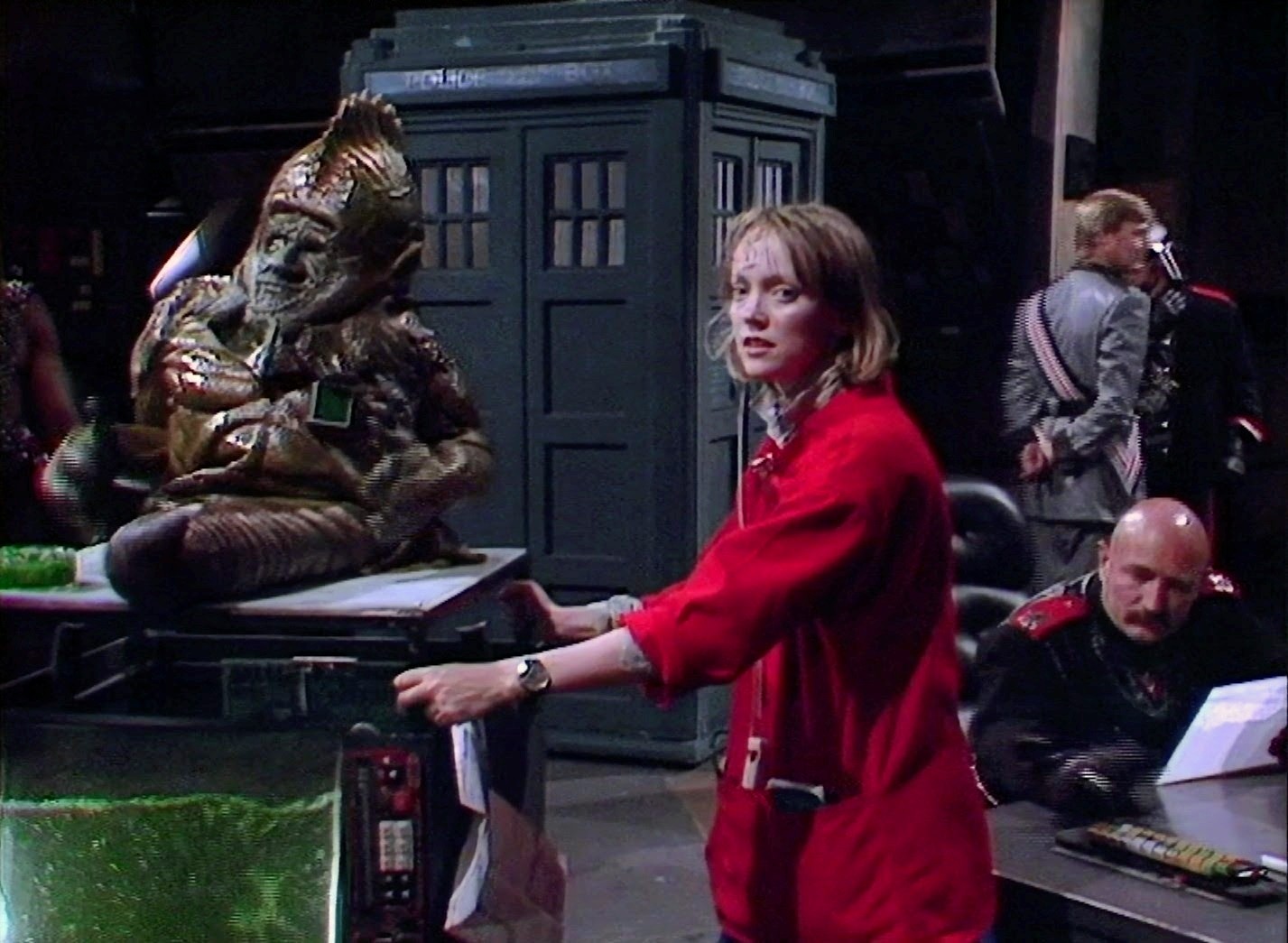
On Sunday 9th February 2025, I was invited to join the Projections in Time panel since I worked on ‘Doctor Who’ in the summer of 1984 .
An email arrived with this wonderful invitation:
“Over the last few years, I have been part of a team at Riverside Studios in Hammersmith, organising screenings based around a number of television series, but the most popular and regular of these events have been based around Doctor Who.”
“In conjunction with the Doctor Who Appreciation Society, the next event at will be a screening celebrating Vengeance on Varos, a Doctor Who story made in the studio at BBC Television Centre.
The story will be shown, followed by Q&As, as well as a photo studio session, in which fans can have a photo with the guests, and an autograph session. So far, Colin Baker, Nicola Bryant, Nabil Shaban, Gerladine Alexander, Stephen Yardley and Forbes Collins will be joining us. You can buy tickets here.
“I always do my best to include crew at these events as I think they have more of an overall impression.” Apparently those on the production team have been very popular and do well at the autograph table. I’ve been thinking up some stories.
Sophie Neville working on the set of Doctor Who in TC6 with Nibil Shaban, Martin Jarvis and Forbes Collins
Below is a plan of the day after, lunch for the guests, with two panels of guests.
“At the autograph table weβll provide photos to sign, although attendees normally bring their own items. There are normally a handful of posters of the event, which we ask all of the guests to sign, which are then sold for charity.”
The story was recently re-released on a Bluray – with studio footage.
In 1983, I worked for the director Andrew Morgan on the BBC adaptation of Arthur Ransome’s books ‘Coot Club’ and ‘The Big Six’ that was screened under the title ‘Swallows and Amazons Forever!’ and is now available on DVD.
Swallows And Amazons Forever! (Coot Club & The Big Six) SPECIAL EDITION [DVD]
Andrew cast Colin Baker as Doctor Dudgeon. I had found Henry Dimbleby to play his son Tom Dudgeon, the hero of the story.
Colin Baker as Doctor Dudgeon in ‘Coot Club’ – photo Sophie Neville
I also took this photo, below, of Patrick Troughton who played Harry Bangate the eel man in in ‘The Big Six’.
Patrick Troughton playing Harry Bangate the eel man in ‘The Big Six’ – photo Sophie Neville
Many of those working on our crew worked on episodes of Doctor Who at some stage, including Di Brookes, Liz Mace and the sound recordist Colin March. I have written about the Doctor Who connection here. Having read Andrew Morgan’s memoir, I remember that Colin found out that he’d been offered the part of The Doctor while he was with us on location in Norfolk. He was thrilled.
Assistant Make-up Designer Penny Fergusson with John Woodvine who played PC Tedder in ‘Coot Club’, having appeared in ‘Doctor Who’
If we could promise a big enough audience, I could ask if Riverside Studios would host a similar event celebrating ‘Swallows and Amazons Forever!’ Please let me know if you’d be interested in coming in the comments below. I’ll ask Colin Baker if he could come when I see him on 9th February.
Those who played Time Lords had other incarnations. As a researcher, I invited Peter Davidson to sing on the chat show Russell Harty’s Christmas Party, which was fun, and appeared with Tom Baker in Sherlock Holmes. He was brilliant in that role. I wore rather a tight corset.
Sophie Neville with Tom Baker in ‘Sherlock Holmes’
You can read more about the adventures I had working in film and television in ‘Funnily Enough’, now also available on audible.
Funnily Enough – the paperback with black and white illustrations
βThe smell is just the same.β Suzanna Hamilton began rowing me across Coniston Water from Bank Ground Farm, taking us back to childhood days.
βIt sounds the same.β The colours, the landscape, the feeling of being out on the water was still magical.
Suzanna Hamilton and Sophie Neville at Coniston Water in the Lake District
As girls, Suzanna and I had appeared as Mate Susan and Able seaman Titty in Richard Pilbrowβs original film of Swallows and Amazons, adapted by David Wood and released in cinemas on 4th April 1974. It starred Dame Virginia McKenna and Ronald Fraser but it was the two of us who were invited to return to the film locations in 2003 to be interviewed by Ben Fogle for an episode of the long-running BBC series Country File. Thanks to sunshiny weather and the support of Geraint and Helen Lewis, his report proved so successful that it was repeated on Country Tracks and featured in the series Big Screen Britain alongside iconic landscape movies such as The Dam Busters and Whistle Down the Wind.
We had been talking about swimming off Peel Island soon after we began filming Swallows and Amazons in the Lake District in May 1973. The director, Claude Whatham, was fresh from making a BAFTA nominated adaptation of Cider With Rosie when he cast Sten Grendon as young Laurie Lee, and the rock-and-roll movie Thatβll Be The Day starring David Essex and Ringo Starr. Although happy out on the water, he knew little about boats. The producer, Richard Pilbrow, had insisted on finding children who could sail well rather than audition young actors and teach them to sail, and advertised the opportunity in sailing clubs. This was pivotal. Simon West (who played John), Kit Seymour (Nancy) and Lesley Bennett (Peggy) all had experience with a natural feeling for the wind and emanated confidence. They were only given a couple of days to get used to sailing the little boats used as Swallow and Amazon before filming began and yet their skill ended up making the film a classic.
Farewell and adieu to you fair Spanish ladies
We had instruction from a sailing director in the form of a good looking actor called David Blagden. Heβd recently crossed the Atlantic in a nineteen foot yacht called Willing Griffin but was unfamiliar with blustery Lakeland winds and did not know how to break down a script. Simon, aged eleven, ended up explaining to Claude how to get a decent shot. Suzanna took her lead from him and I clung to the gunwales, trying hard not to shiver in a costume designed by Emma Porteous that consisted of no more than a short yellow dress and enormous pair of navy blue gym knickers.
It was unusual for a movie to feature so many scenes set in two small boats. Mike Turk, whose family had been building boats since 1295, and Nick Newby of Nicol End Marine on Derwentwater, took up the challenge of constructing Claude a cross-shaped pontoon to act as a mobile camera mount so that our dialogue could be captured. This extraordinary vessel had two outboards but wasnβt easy to handle. The dinghies were wired to it with underwater cables but tended to pull away. The base to Swallowβs mast broke, proving safety was an issue, but the idea eventually worked.
Richard Pilbrow and his film crew on the camera pontoon
A grey punt was also used. I remember Simon West towing it as he rowed us into Rio. It was easy to transport from one lake to another but must have been tippy. Somehow David Cadwallader, the grip, managed to keep the horizon horizontal using no more than a spirit level. Shadows were lifted from our faces by using huge reflector boards apt to catch the wind. It must have been impossible to use filler lights out on the water, although they somehow managed to power a number of sets on Peel Island.
Sophie Neville in the Amazon with DOP Denis Lewiston, his 16mm camera and a reflector board ~ photo: Martin Neville
Richard Pilbrow kindly sent me Swallowβs pennant from his home in America. Unlike Ransomeβs original sketch of the crossed flags, the bird flies away from the mast, which is technically incorrect, but I was thrilled to receive the genuine film prop used in vision. If you look closely you can see some of the stitches I made whilst in conversation with Mother, played by Virginia McKenna.
It would have been good if Swallowβs hull had been painted white in line with illustrations in the books. Her varnished planks are a nod to the 1970βs when everyone was busy stripping pine, but the important detail is that she has a keel rather than a centerboard. It makes her difficult to turn, and markedly slower than Amazon, but grants her stability. This feature may have saved us when we really did just miss colliding with the MV Tern on Windermere, which alarmed my father who was on the Ternβs deck. He knew how difficult Swallow would be to turn with the larger vessel taking our wind. We were fully laden with camping gear and yet totally lacking buoyancy of any kind.
Simon West as Captain John sailing Swallow. Sten Grendon plays the Boy Roger
One secret of filming Swallows and Amazons is that it was set on four different lakes, a smelly lily pond that served as Octopus Lagoon, and Mrs Battyβs barn where night sailing sequences were shot with Swallow mounted on a cradle. One challenging scene was when the Swallows were cast off from Wild Cat Island to sail north to the Amazon River, leaving Titty behind to light the lanterns. I slipped underwater whilst pushing her free of branches overhanging the landing place but regained my footing and waved them off. Simon caught βa fair windβ but the boom swung so far out that Suzanna held the mainsheet by the figure-of-eight knot and Swallow sped up Coniston Water like a βpea in a peashooterβ, as Ransome wrote in Winter Holiday. A gust hit them broadside as they cleared the island and Swallow gybed, but Simon calmly stood to catch the boom, scarified the wind and took her on up the lake. Watching the sequence still brings tears to my eyes.
Simon West and Suzanna Hamilton at the helm of Swallow with Stephen Grendon in the bows, while Sophie Neville looks on from the shore of Peel Island
No one had given much consideration to the rowing involved in the story. Built as a run-about boat by William King of Burnham-on-Crouch, Swallow has two sets of rowlocks but it was tricky to keep time when she was wired to the camera pontoon. The first scene attempted was when the Boy Roger and I had to row her back from the charcoal burners with Susan at the tiller.
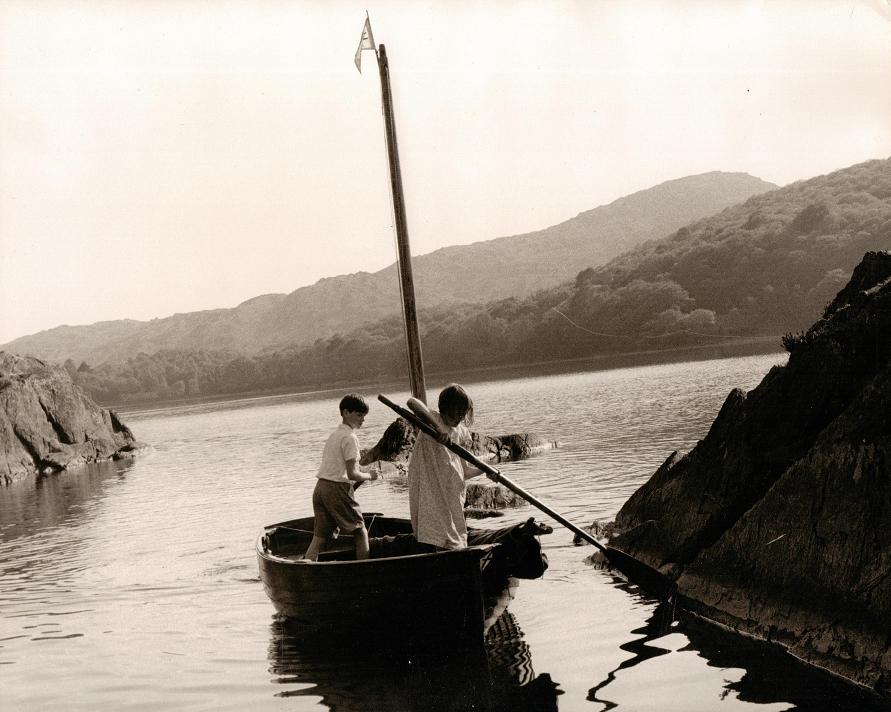
Sophie Neville as Titty and Stephen Grendon as Roger rowing to Cormorant Island
We rowed again on Derwentwater, making our way out to Cormorant Island to look for the treasure. It took everything in me, but I later managed to row Amazon out of Secret Harbour in one take at the end of a long day filming. The action was repeated with Denis Lewiston, the lighting-cameraman, and his 35mm Panavision camera in the stern. Cold, with wet feet, I completed the scene but had to be carried ashore by a frogman acting as the safety officer. Titty later anchors Amazon off Cormorant Island on Derwentwater, but the shot of her wrapped in the sail, sleeping aboard, was taken in the darkened barn at Bank Ground Farm. The fishing scenes were recorded on Elterwater with Swallow moored near the reedbeds.
Sophie Neville as Titty and Simon West as John
My one regret is that we didnβt follow the book when sailing the captured Amazon back to Wild Cat Island. The wind was up and Claude Whatham needed Simon to sail Swallow ahead of the Amazon which was lashed to the pontoon. I originally took the tiller as Titty is urged to in the story, but had trouble with the rudder and Susan is at the helm on the cover of the paperbacks brought out to accompany the film and a DVD distributed by the Daily Mail.
I was somewhat surprised to see Swallow outside Elstree Studios where we went to post-sync the film. They set up a tank on the sound stage so that Bill Rowe, the dubbing editor who was to win an Oscar for The Last Emperor, could capture the sounds so taken for granted and yet so evocative of handling wooden boats. I was concerned that sheβd been given away (and she nearly was) but, as Richard Pilbrow made plans to adapt other Ransome books, she was sent to Mike Turkβs warehouse in Twickenham and stored with maritime props such as the Grand Turk, a replica of HMS Indefatigable, built in 1996 in Turkey for Hornblower.
When Mikeβs collection was eventually auctioned in 2010 I was alerted, first by my father, then by Magnus Smith. We found Swallowβs details online, took one look at the photos and clubbed together to purchase her, launching SailRansome at the 2011 London Boat Show. The idea that others could go out in her with an experienced skipper was greeted by John McCarthy who recorded the sounds of sailing Swallow for Paddling With Peter Duck, his programme made for BBC Radio 4.
Peter Willis in the Nancy Blackett with John McCarthy
The Arthur Ransome Society now own both historic dinghies. Rupert Maas valued Swallow highly when she appeared on BBC Antiques Roadshow in 2021.Everyone gasped but her true worth is akin to Captain Flintβs hidden treasure: instead of gold ingots his trunk contained precious memories that no doubt kept him on course when the storms of life blew in. Just as Arthur Ransomeβs books grant us solace, my prayer is that many will be able to grab the chance of sailing the little boats that take us into the stories immortalized on film so long ago.
Back in 1974, none of us knew that Amazon had been used in the BBC adaptation of Swallows and Amazons made just eleven years previously and broadcast in 1963. I met the White family when they brought Amazon from Kent to Cumbria to feature in Country File. Ben Fogle had found their twin daughters on Peel Island, looking very much like Nancy and Peggy in damp bathing costumes having been swimming in the lake. It has been extremely generous of them to enable other families to sail such a precious boat.
Not so very long ago, a few TARS joined me at Keswick for a talk and screening of Swallows and Amazons at the Alhambra cinema when we grabbed the chance to go aboard the Lady Derwentwater. Nick Newby explained how she had been decommissioned in 1973 to appear as Captain Flintβs houseboat. Her temporary conversion was overseen by Ian Whittaker, the set dresser who went on to be nominated for a number of awards and won an Oscar in 1993 for his work on Howardβs End. The Lady Derwentwater has since been given a new stern but is in good shape, back in her role as a passenger launch.
The mfp Vinyl LP of ‘Swallows and Amazons’ with Sophie Neville and Simon West bringing Swallow into her harbour
Arthur Ransome was taught to sail on Coniston Water by the Collingwoods in a boat they kept below Lane Head, now known as Swallow I. People often ask if the original Swallow II, a sea-going dingy with a standing lugsail built by William Crossfield, and sailed by the Ransomes, is still around. After being kept on a mooring in Bowness Bay, where she was looked after by a boatman called John Walker, she was sold in September 1935 and sadly βvanished without a traceβ.
The Amazon, originally named Mavis, and also sailed by the Altounyan family, now resides in the John Ruskin Museum at Coniston where she can be visited much like a great aunt. Ransomeβs dinghy Coch-y-bonddhu or Cocky, the model for Scarab in his books, restored and owned by TARS, is on display at Windermere Jetty, the museum where the fourteen foot RNSA dinghies used in the 2016 movie of Swallows and Amazons have been moored. A few of the steamboats used to dress the scenes set at Bowness-on-Windermere or Rio in 1973, such as Osprey and George Pattinsonβs launch Lady Elizabeth, may be in residence. They are currently restoring the SL Esperance used by Ransome as his model for the houseboat.
In 1983, I worked behind-the-scenes on the BBC drama serial of Coot Club and The Big Six (and wrote Extras for the DVD titled Swallows and Amazons Forever!) We spent three months filming on the Broads, using the four-berth gaff sloop Lullaby to play the Teasel, a vintage dinghy for Titmouse and a punt for Tom Dudgeonβs Dreadnaught. They have all been kept at Hunterβs Yard, near Ludham in Norfolk where you can hire classic boats. While exploring the Broads you can track down the Death and Glory, Janca, used to play the Hullabalooβs Margoletta, and the wherry Albion used for Sir Garnet along with yachts like Pippa that were also featured in the serial. Hopefully, Arthur Ransomeβs βgood little shipβ the Nancy Blackett, bought with his βSpanish goldβ or royalties, will one day star as Goblin in a film adaptation of We Didnβt Mean To Go To Sea. Wouldnβt that be wonderful?
Arnaldo Putzu’s poster for the EMI film Swallows and Amazons (1974)
Half a century has passed since the original film Swallows and Amazons first came out in cinemas, the good little ships featured sailing improably on the poster. Thanks go to Magnus Smith, Rob Boden, Diana Wright, Marc Grimston, and all those who have looked after and lovingly restored the inspirational boats that appeared in the movie. They mean so much to so many. Three million cheers to those at The Arthur Ransome Society who are working with Hunters Yard in Ludham to make both little ships available for hire in 2025 .
Amazon will soon be available to hire at Hunter’s Yard, Ludham
If all goes to plan, you will be able to take them out. When you do, smell the freshness for me. Stroke the varnish, take in the feel of the ropes, the weight of the oars. It may be chilly, but that too is part of the experience of liaising with old boats out on the water.
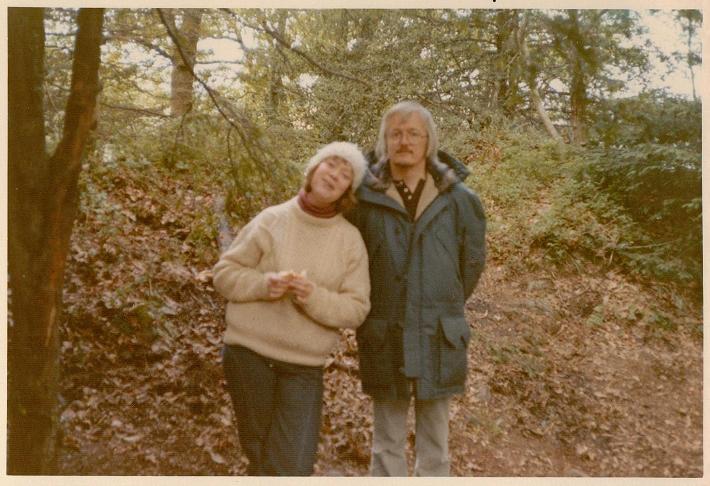
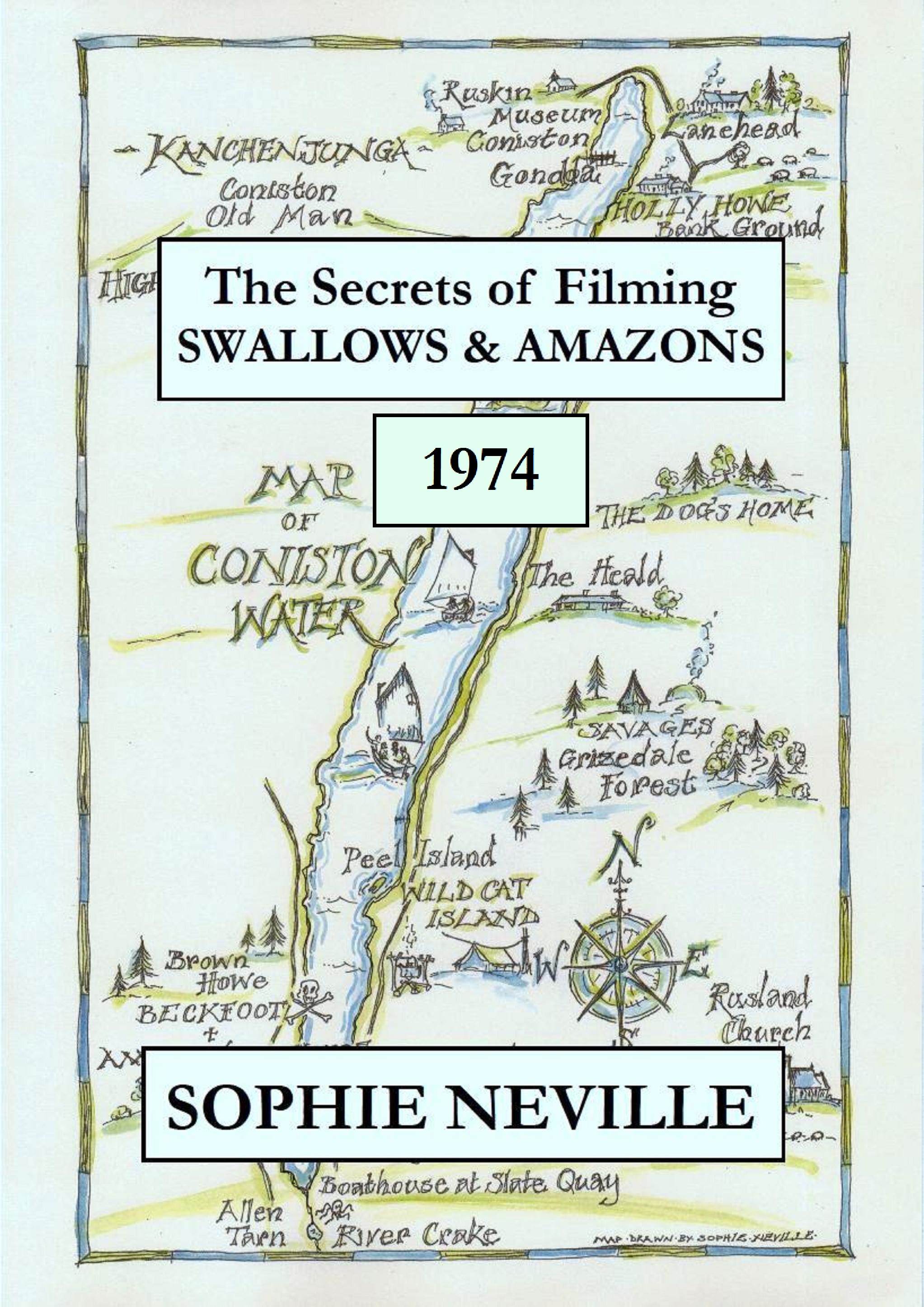
An original hardback copy of my book on how we made the 1974 film of Swallows and Amazons was sold in Paddy Heron’s online auction for Β£86 to raise funds for BBC Children in Need 2024.
It exceeded bids for the autobiographies of Theresa May, Michael Ball, Charles Spencer, Tim Peake, Lynda La Plante, Father Alex Frost and a number of amazing biographies.
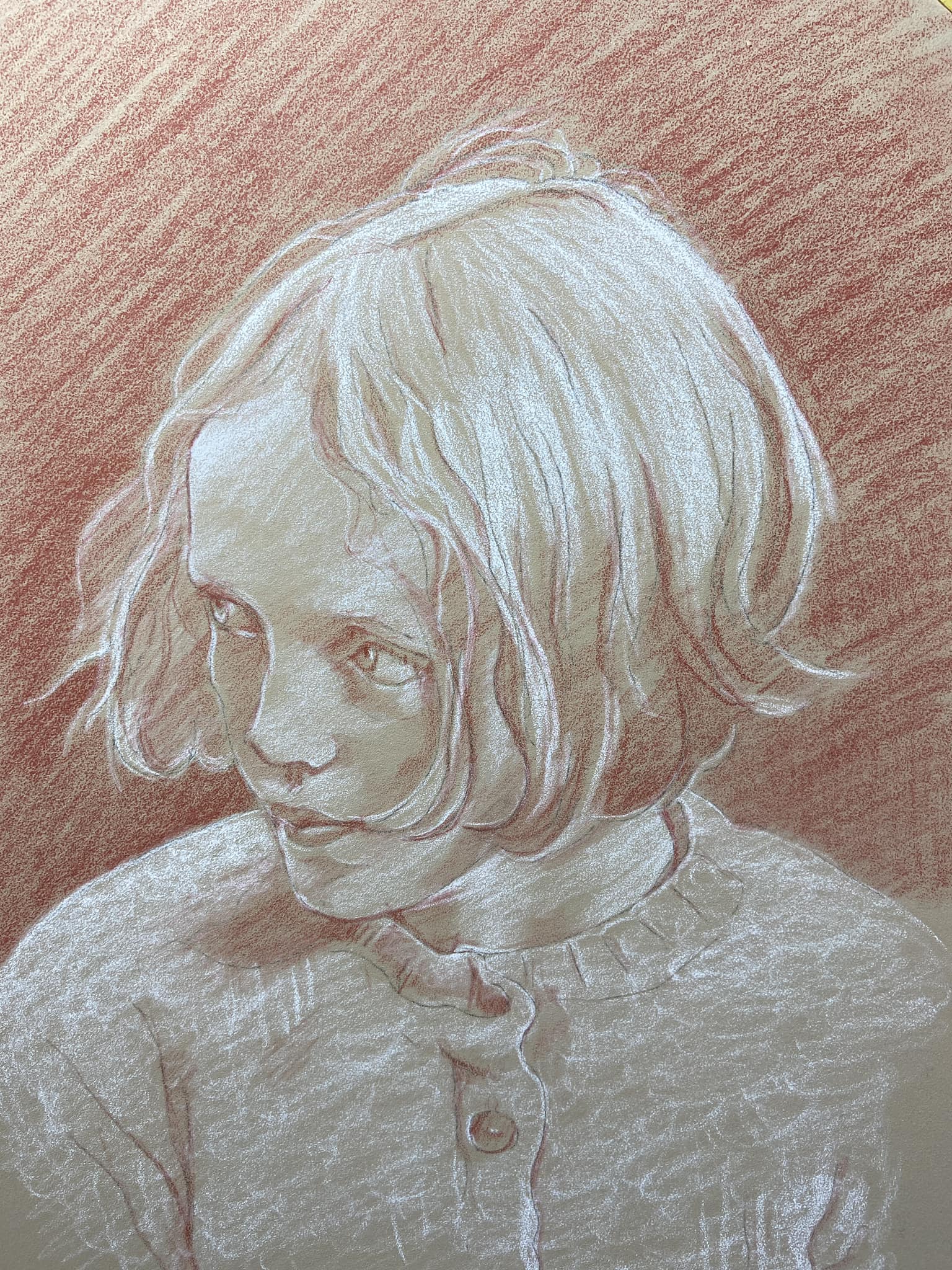
An unframed print of a portrait of her playing Titty executed by C. Assheton was also sold in the online charity auction, which raised a total of Β£14,705 – which is fantastic.
Paperback and ebook editions of my same story are also available at Waterstones and online from all the usual stockists including Amazon