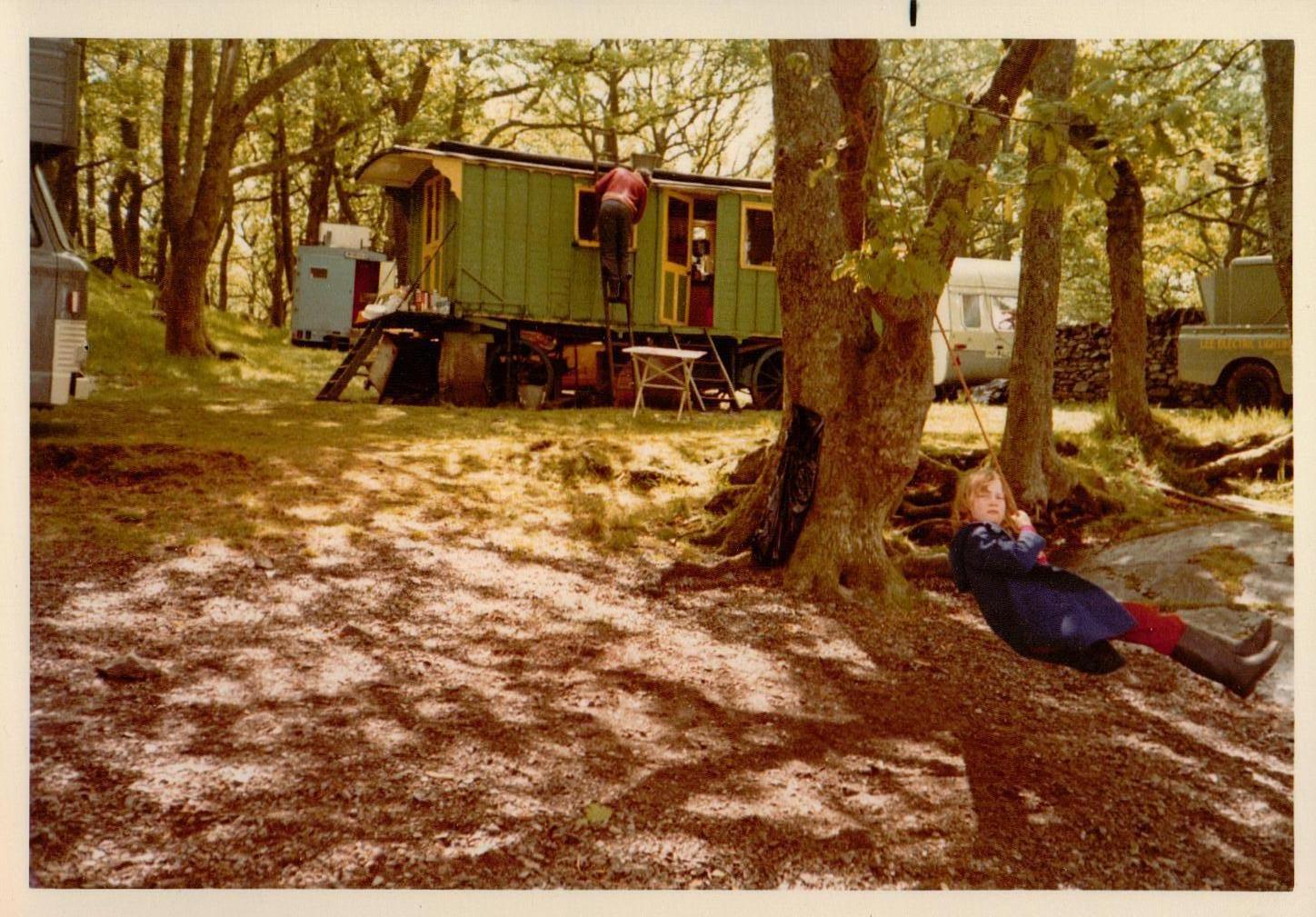
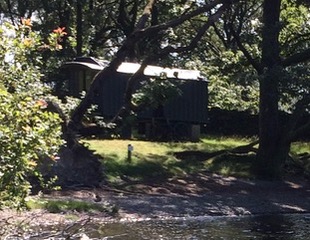
Readers often ask me about the green wooden caravan parked in the woodland opposite Peel Island where our unit vehicles were based when we made the original film of ‘Swallows and Amazons’ in the early 1970s.
My little sister on the swing at the unit base opposite Peel Island ~ photo: Martin Neville
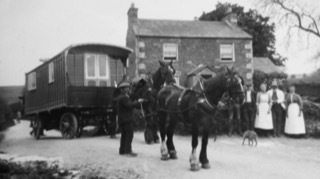
It is actually a postal surveyor’s van bought in Halifax by the Smithson family in 1913 and pulled by two horses to Coniston Water. John Smithson, now in his nineties, provided this photo:
Once it was in Coniston, John’s niece’s family the Bowmans, and his friend Charles Rothwell joined the venture, but the caravan was eventually left with Charles Rothwell’s descendants. It has been maintained, visited and used for holidays by members of his family ever since. They turned up during the May half-term whilst we were filming in 1973.
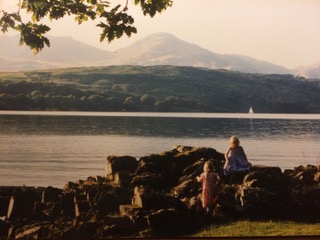
“I was one of those ‘gypsies’, aged 9 at the time,” writes Sarah Bennet. “We were about as surprised to see you as you were to see us – I remember driving into the field and unexpectedly there was a red double decker bus in front of us! I also remember playing with your younger sisters on the promontory rock by the jetty whilst filming was going on.”
My father was given a short-back-and-sides haircut outside the caravan so he could appear in the film that was set in 1929 when Ransome wrote the book. You can see different angles of of the wooden exterior here after shots of the film crew our on the lake:
The green caravan is currently cherished and used by the 5th generation of Charles Rothwell’s family. “Unfortunately, the National Trust (‘landlords’ since 1932, long after the Caravan was placed in the field) have now given notice of terminating our licence to be there. If we cannot successfully challenge this, we will have to ‘remove’ the Caravan by January 31st 2025. Since the wheels rotted long ago, and it is resting on breeze blocks, this actually means its complete destruction.”
By Coniston Water in 1913
Since the wooden caravan has been positioned on the banks of Coniston Water for more than one hundred years, it must have been known to Arthur Ransome when he wrote Swallows and Amazons in 1929. “It is right opposite Peel Island and was then brightly painted in red and gold.” The trees would have been young at the time. “So he must have seen it, and it must have been part of the vision for his books.” It is still used for the sort of adventure holidays that he promoted – camping, boating, camp-fire cooking, exploring the woods and hills.
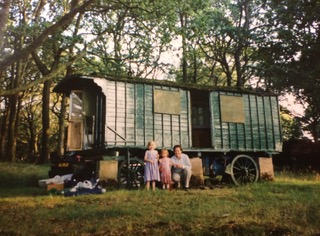
The green postal surveyor’s van today
Could members of The Arthur Ransome Society and those who love heritage features of the area appeal to the National Trust and ask for the licence to be extended?
The date 1913 is corroborated by a note from Agnes, Charles Smithson’s niece. She spent a holiday at the caravan as a child in 1913 and mentions sleeping in red felt tents ‘on mattresses filled with bracken’ saying that that the caravan was originally painted green, yellow and purple. In 1928, Agnes married George Bowman. She said that by then the caravan was in a bad state but that “G. mended it all up marvellously”, so it might have been repainted then.
Neville Thompson acted as the online producer on the 1974 film of Swallows and Amazons. He choose an excellent crew and took daily responsibility for scheduling the production on location in the Lake District and later at Elstree Studios where the film was edited and post-synced.
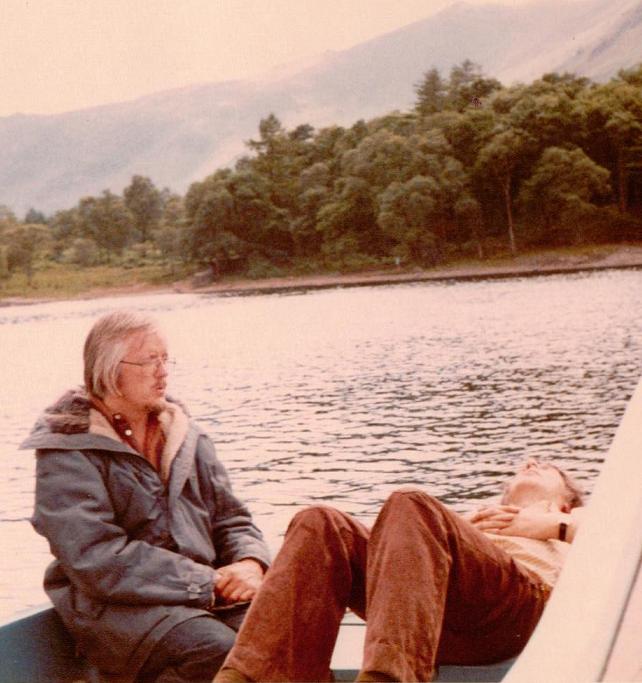
Producer Richard Pilbrow and Production Associate Neville C Thompson on Derwentwater in the Lake District in 1973
Neville was born in Ipswich in 1933. Although gregarious at times, he was a quiet man who was once a maths teacher in Scotland. He had five children to support, but decided to go to RADA and become an actor. When a pair of twins came along he moved the family to Croyden and went into film production. He began work as a location manager for Mike Newell and became a production manager for Ken Russell.
Richard Pilbrow gained the rights and film finance for ‘Swallows and Amazons’ but came from a background in theatre and knew nothing about film production. He asked Neville to help set everything up.
Neville C Thomas (top centre) with Richard Pilbrow, Claude Whatham et al
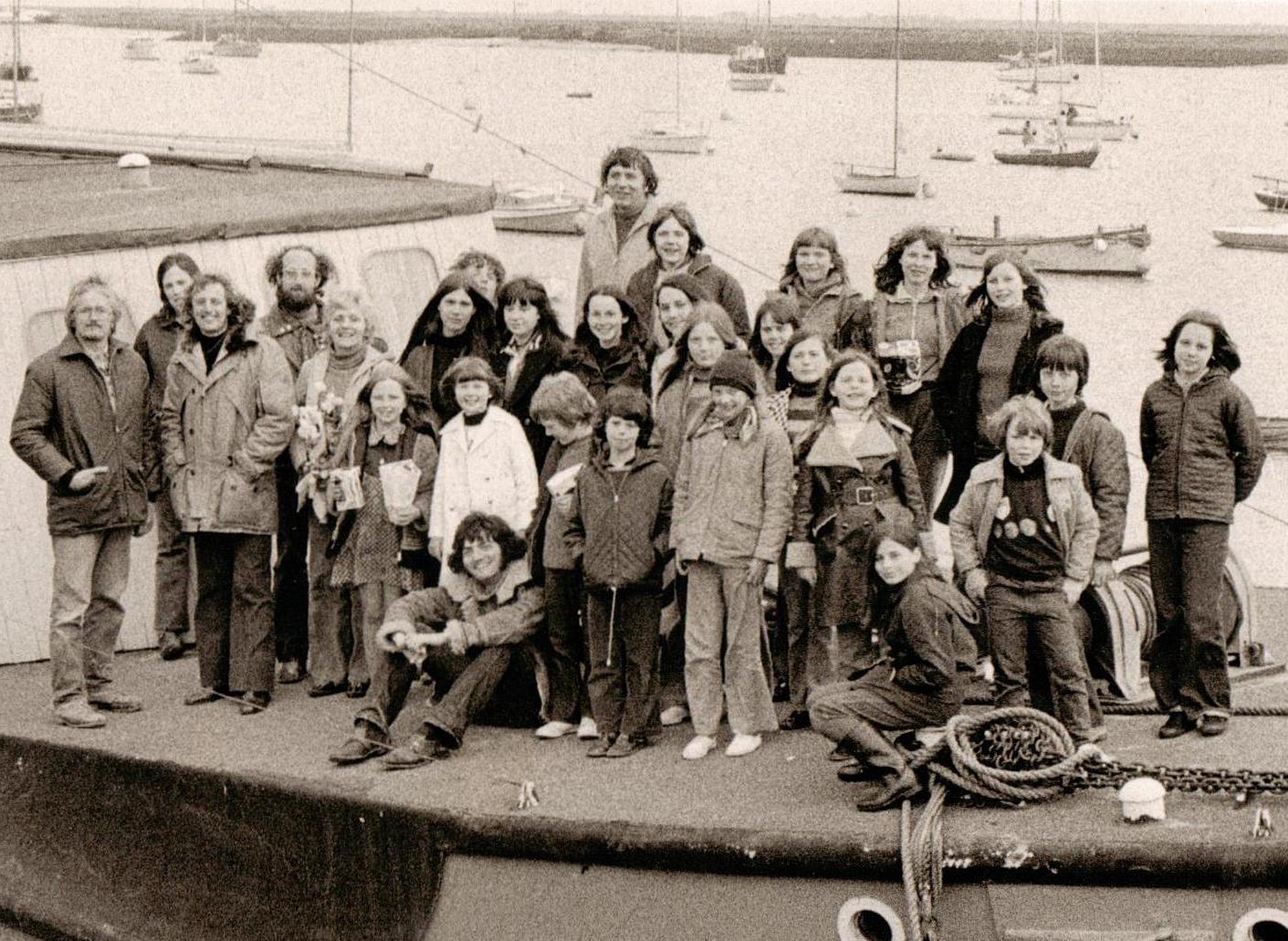
Neville came to Burnham-on-Crouch for our sailing audition when the dinghy ‘Swallow’ must have been purchased from the boatbuilders William King.
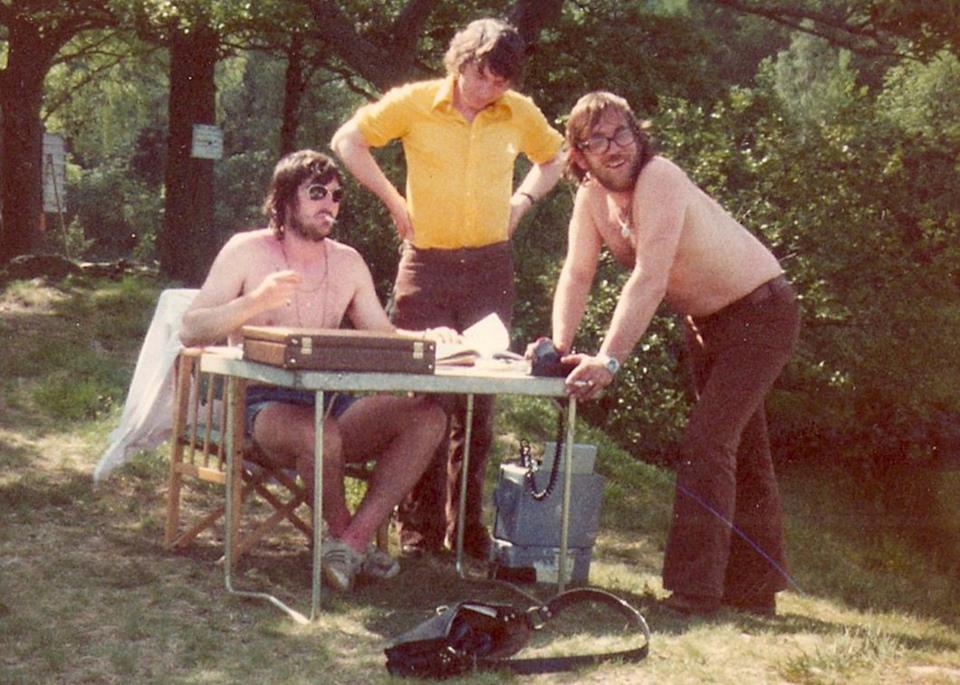
Second Assistant Terry Needham, Associate Producer Neville C Thompson and Production Manager Graham Ford with the unit radio on a sunny day in June 1973
Neville was passionate about film making, becoming known as ‘the last gentleman producer.’ He would have been the one making the executive decisions, the man ultimately in charge of the schedule, personnel, safety, insurance and bringing the film in on budget.
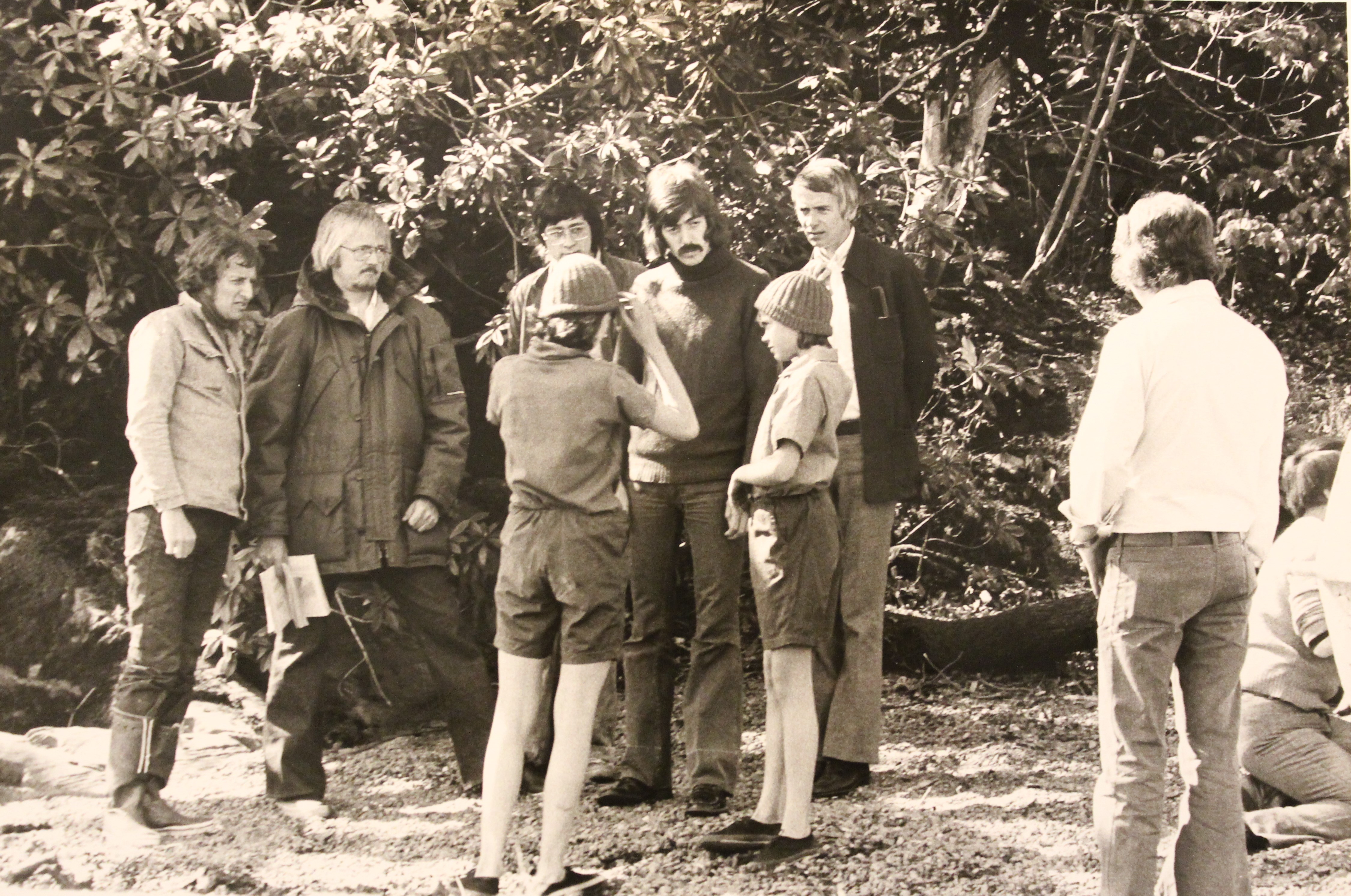
Claude Whatham, Richard Pilbrow, Gareth Tandy, Peter Robb-King, Ronnie Cogan and Neville C Thompson with Kit Seymour and Lesley Bennet trying on hats
His daughter, Mandy, told me that he was a wonderful Dad but had been away a lot. ‘He had eight children in nine years and was keen for them to make their own way in the world.’ Mandy became an occupational therapist, George became a ballet dancer, Chris Thompson went into film making. Neville was diagnosed with Lukemia at the age of 47 but lived another twenty years, ending his days in Woodbridge in Suffolk.
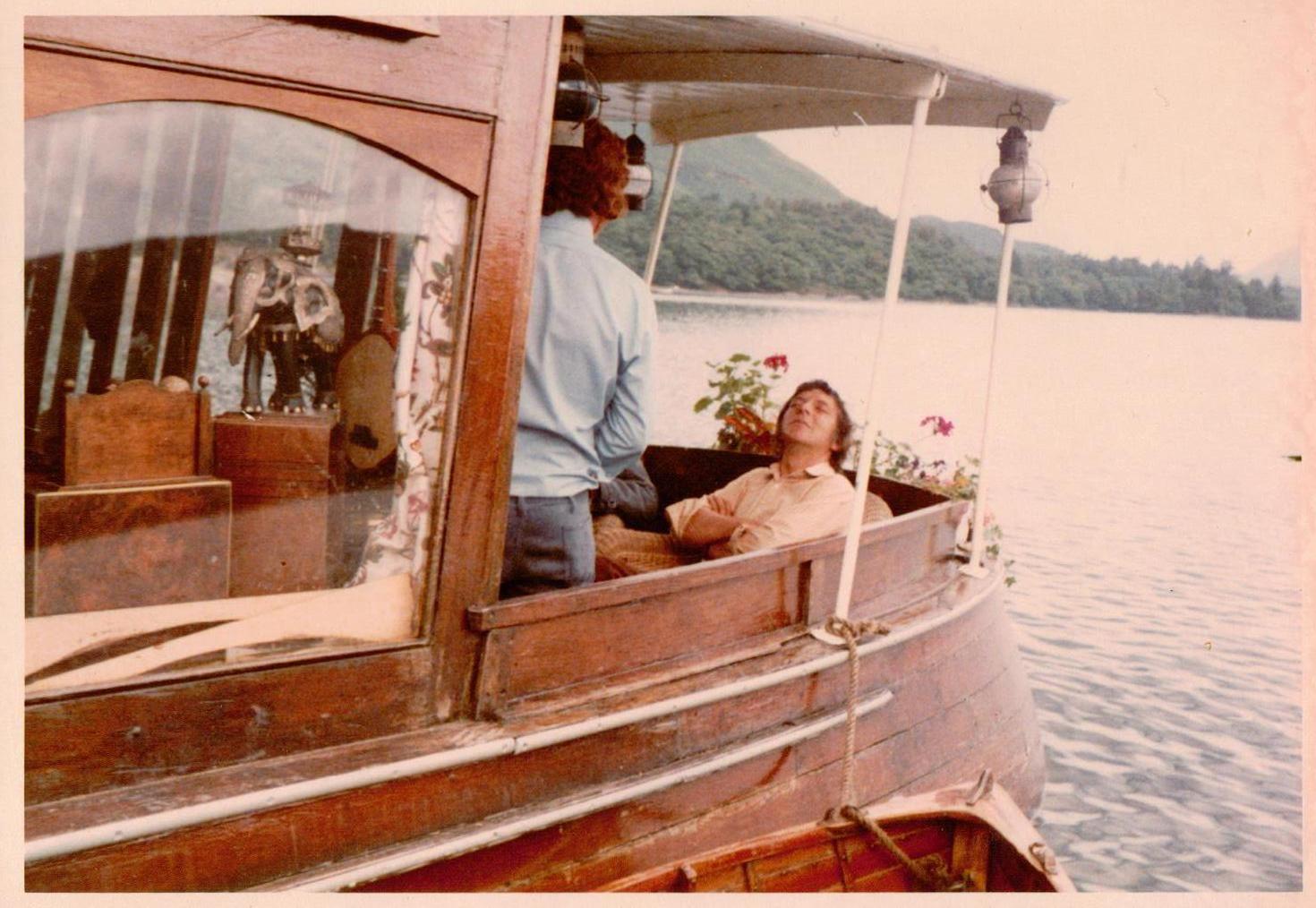
Neville Thompson relaxing on set – photo taken on Sunday 24th July 1973, by Daphne Neville
Neville established a production office at the unit hotel on Windermere. By the time he reached the location he was often exhausted. Everything he’d set up was in motion so, like an experienced parent, he could relax and enjoy the boats.
Richard Pilbrow and Neville Thompson ~ photo:Daphne Neville
When Neville died in Woodbridge in Suffolk at the age of sixty-nine in 2002, Richard told me that ‘Swallows and Amazons’ was broadcast on television as if in his honour.
You can find an impressive list of Neville C Thompson’s production credits on IMDb here
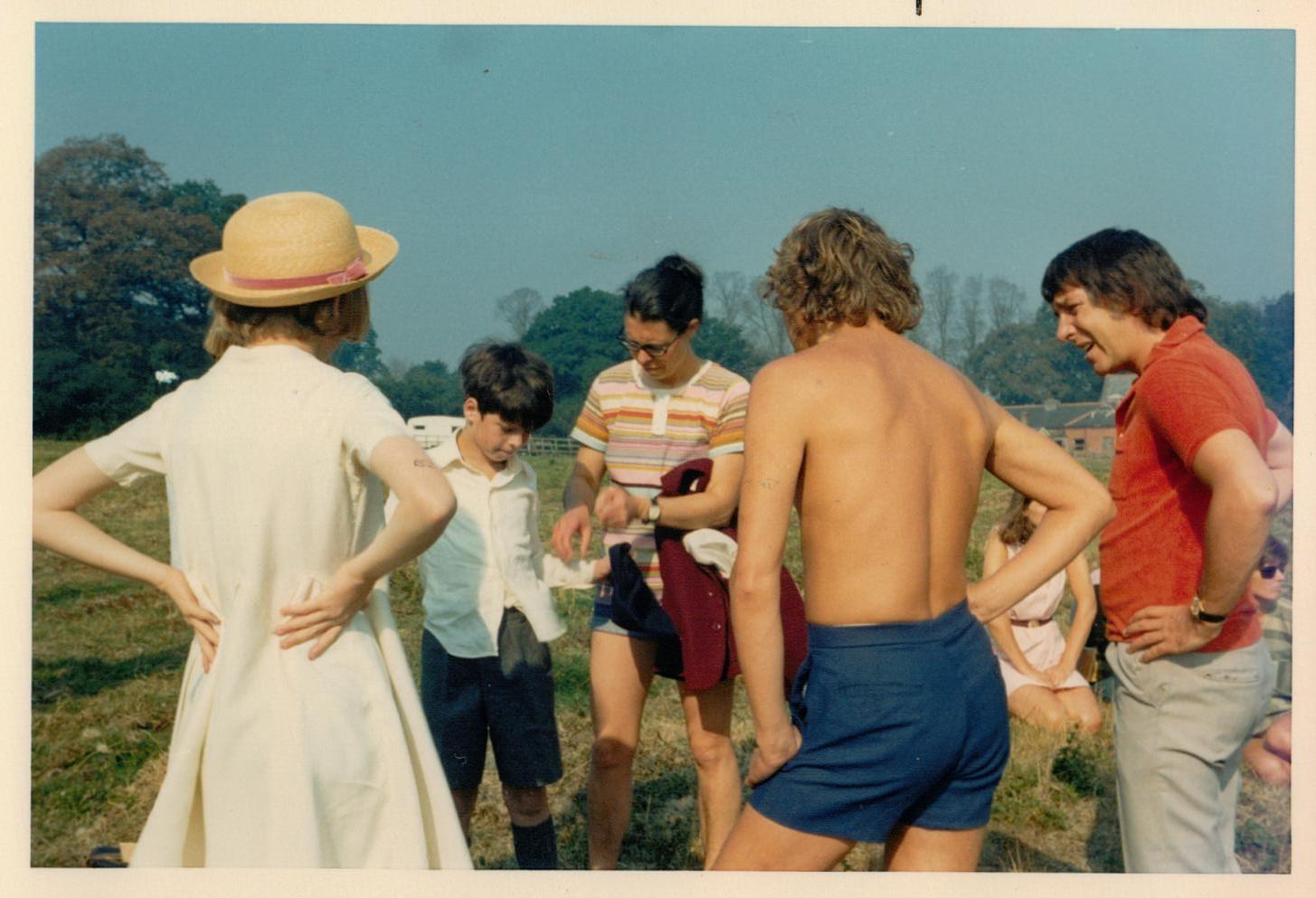
Sophie Neville looks on as Stephen Grendon organises his costume helped by Jane Grendon with Claude Whatham and Neville C Thompson when filming pick up shots near Epsom.
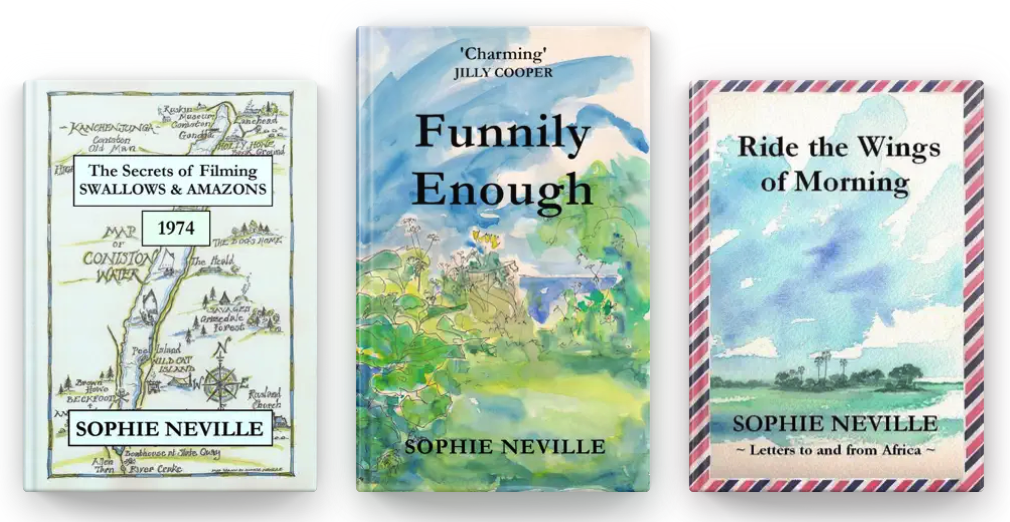
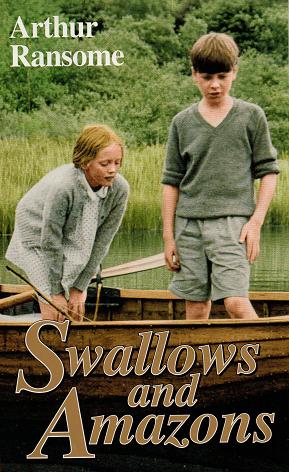
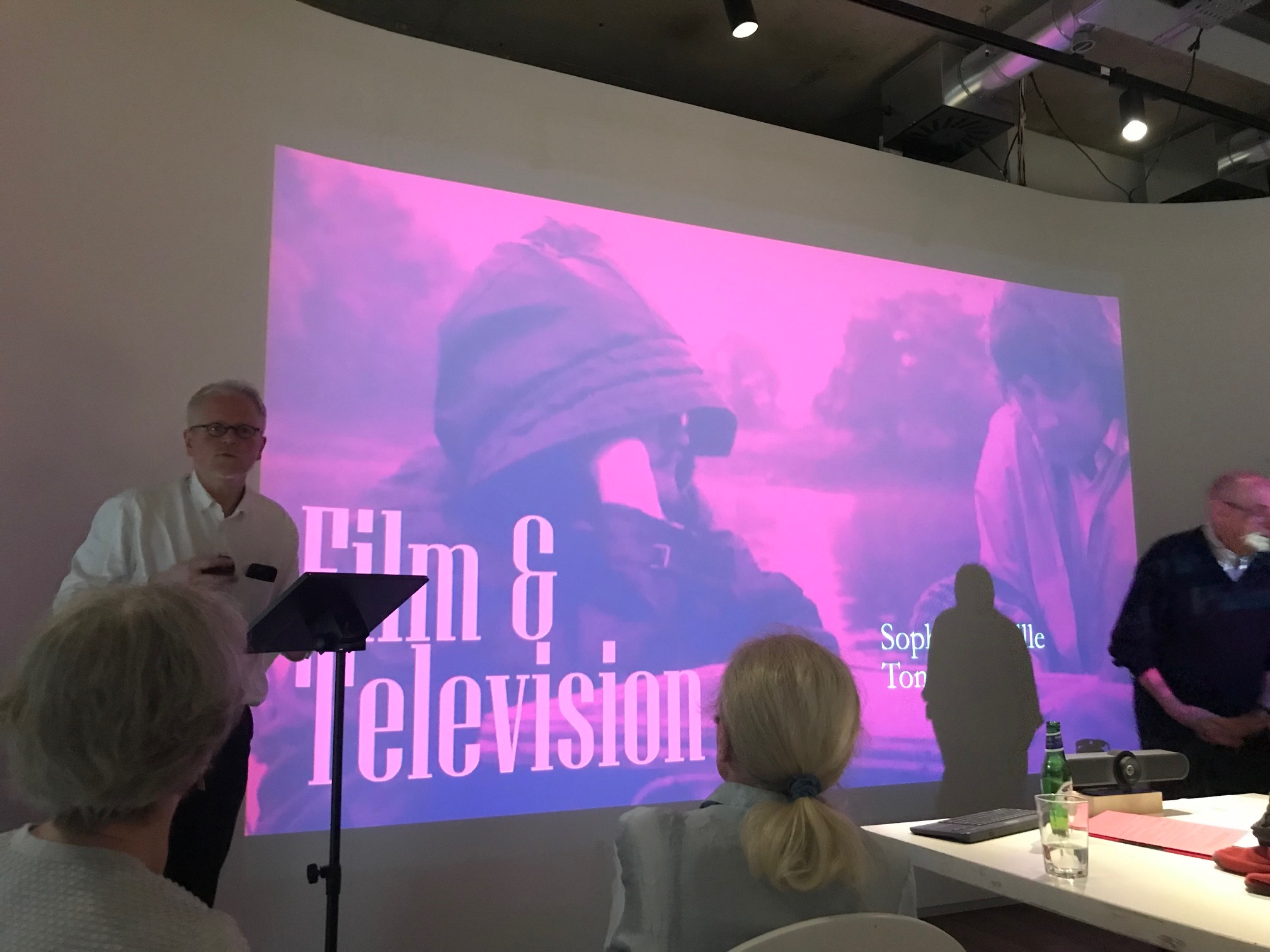
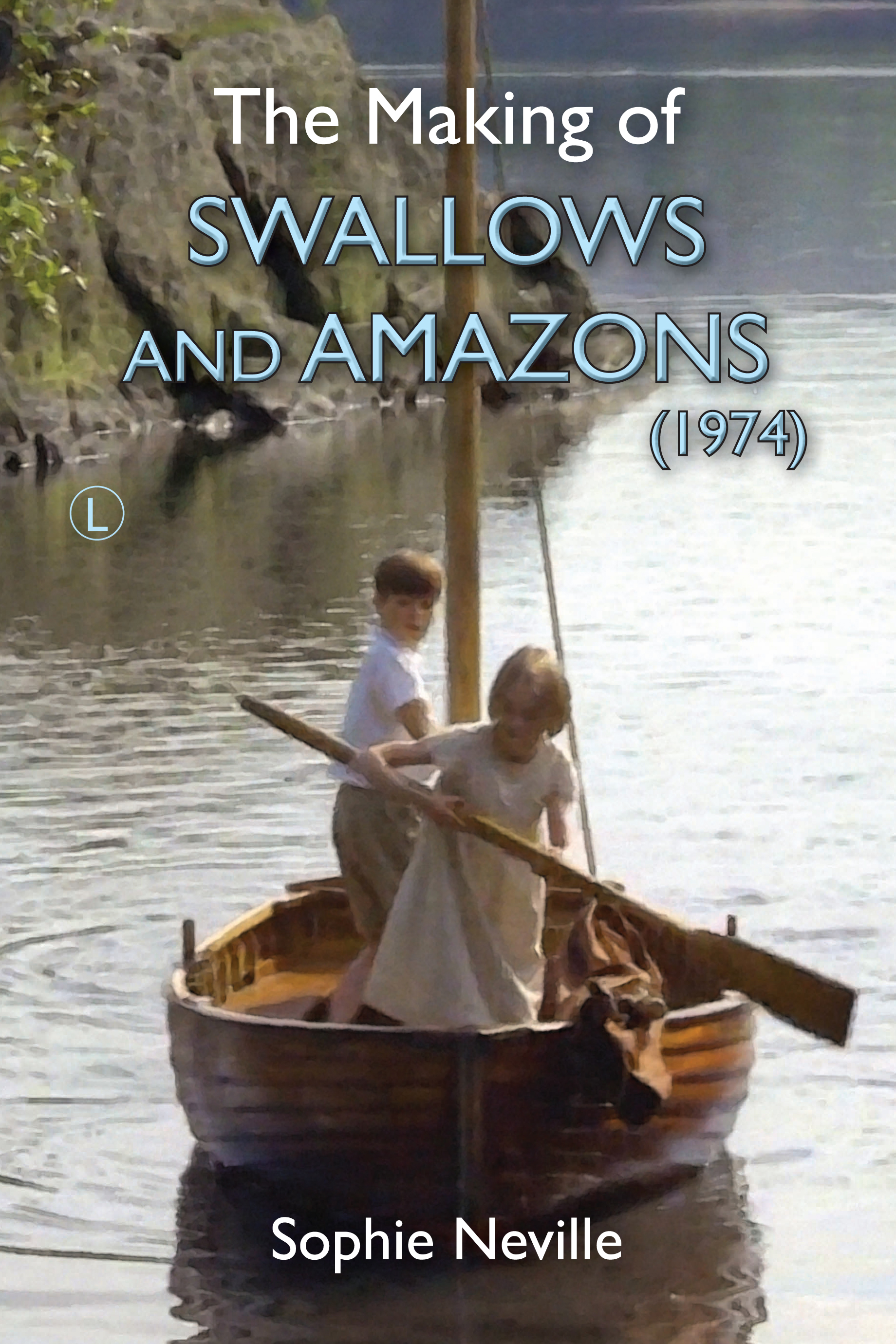
You can find details of how to purchase ‘The making of Swallows and Amazons’ here on line or listen to it on audible and other audiobook platforms.
It’s fascinating to hear about links people have with the original film of ‘Swallows and Amazons’ made on location in the Lake District in the early 1970s.
Art Director Simon Holland painting labels for cans of Pemican ~ photo: Daphne Neville
Amanda Currie wrote to say, ‘My family had quite a lot to do with the film. My cousin’s bro-in-law was the art director… My Dad was one of the Lake Wardens he had great fun keeping tourists away from the filming on the lake. Captain Flint stayed at our friends’ hotel and boy did they have some funny tales to tell. The couple who owned it were called Tim and Eileen, they would be in their eighties now I would think. Of course we were all extras.’
She added, ‘We were all massive Swallows and Amazons fans long before the film, as when my Grandma lived in Blackpool they used to stay at what was the Blackett’s house, and on occasion bumped into Arthur Ransome.’
Jean our driver and location nurse operating the radio with Sophie Neville ~ photo:Martin Neville
Jean McGill, our unit driver, used to pick up Ronald Fraser every morning, a difficult task as he was always drunk. “Dreadful man, swearing and shouting around the place,” she said. “Appalling behaviour.” Jean had been the Chief Air Stewardess and cabin services superintendent in Bahrain for what is now Gulf Air. “I had to leave because I wouldn’t marry the general manager, who was having a nervous breakdown.” She was going out with the Captain of the Sir Galahad, the ship that went down in the Falklands, “along with the coffee pot I’d given him.” She also told me that they had a known terrorist one of her flights, “who then got on the BOAC flight that landed in the desert.” He had wanted to free Lela Kallard.
Do you know where the Peak of Darien can be found? photo: Roger Wardale (with permission)
The Arthur Ransome Group have been discussing the true model for the Peak at Darien. Mrs Ransome told the film producer Richard Pilbrow that you could find it on Windermere.
Paul Flint says that, ‘good contenders are Brathay Rocks and Gale Naze Crag on Windermere’, pointing out that both were well known to the Ransomes. It would be interesting to know what islands you can see from these.
Friar’s Crag on Derwent Water was used for the opening titles of ‘Swallows and Amazons’ (1974) Stuart Clague informed me that it is a dolerite dyke intruded into softer Skiddaw slate, as mentioned in the book Lakeland Geology.
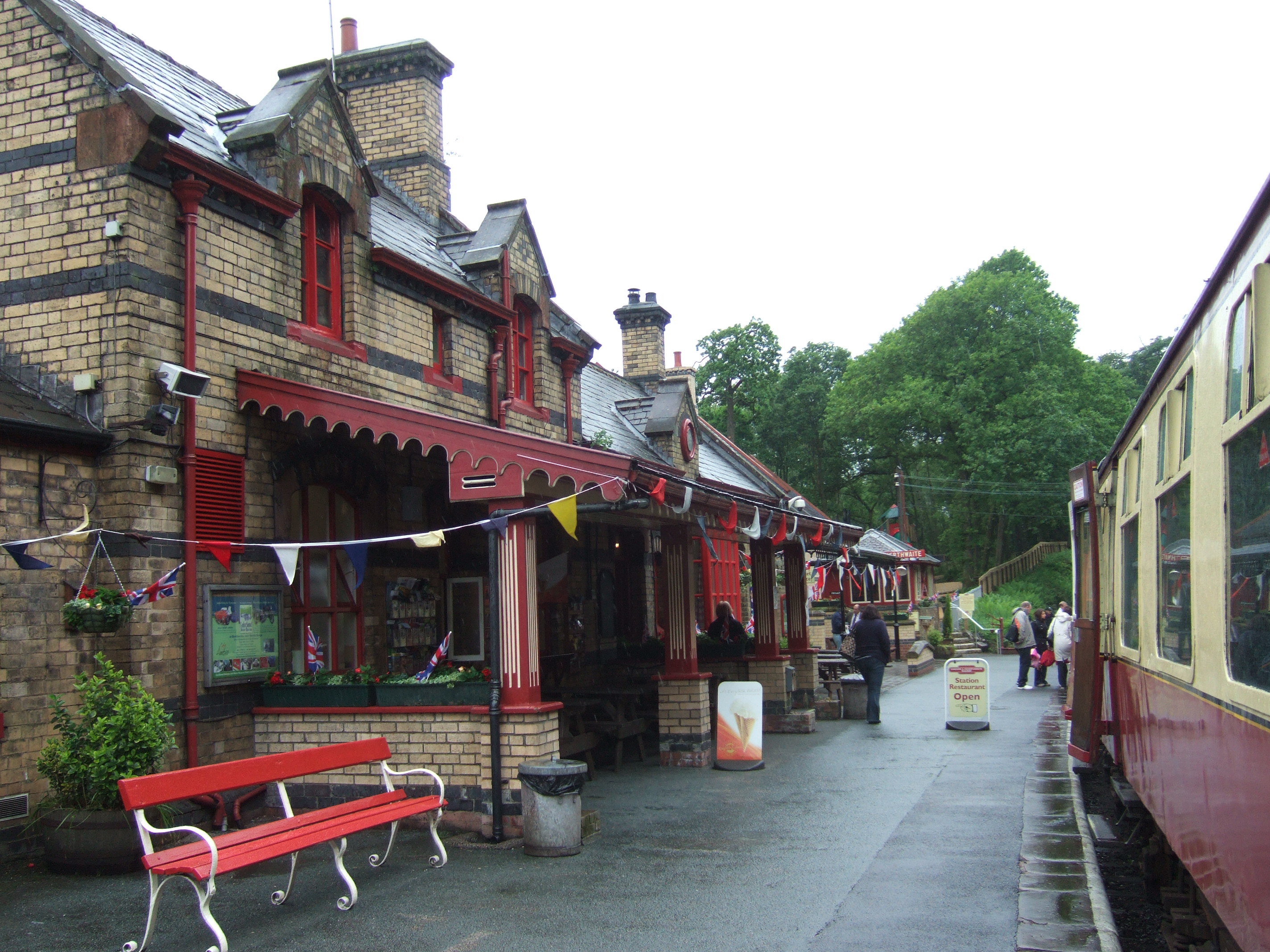
This is the platform at Haverthwaite station on the Lakeside & Haverthwaite Railway in Haverthwaite, Cumbria. Manuel Gurtner points out that the heritage railway also appears in ‘Without a Clue’ (1988), the witty movie starring Michael Caine as Sherlock Holmes and Ben Kingsley as Dr Watson. You can spot the carriages at scenes shot in the Lake District in the film trailer.
Simon West, Suzanna Hamilton, Sophie Neville & Sten Grendon in ‘Swallows and Amazons'(1974)
Julie Lamming wrote to say, ‘I used to drive my family mad singing “Spanish Ladies” after watching the film for the first time.’ This was the original movie of ‘Swallows and Amazons’ made on location in the Lake District in 1973 and released by EMI Films fifty years ago in 1974.
It took me a while to realise it, but the traditional British naval song Farewell and Adieu to you Fair Spanish Ladies is sung in a number of other feature films from The Buccaneers (1957) to Jaws, which was released in 1975, a year after the original film Swallows and Amazons.
The Buccaneers (1957) and Jaws (1975)
Robert Shaw sings a little more once at sea:
The ships crew come together singing it as a shanty in Master and Commander: The Far Side of the World
A Boston version is also sung in this television drama, Patrick Jane:
Can you think of anymore examples? Please add links to the Comments below.
I classic version of the song can be found here:
I’m afraid I sang it badly and made the mistake of muddling the words, Adieu and Farewell to you Fair Spanish Ladies rendered onto the LP of the film.
You can now listen to the audio book on ‘The Making of Swallows and Amazons’ that explains how the 1974 movie of Swallows and Amazons. It’s available on all the retail platforms and Audible here.
Sten Grendon (Roger), Simon West (John), Virginia McKenna (Mother), Suzanna Hamilton (Susan) and Sophie Neville (Titty) with their hats ~ photo: Daphne Neville
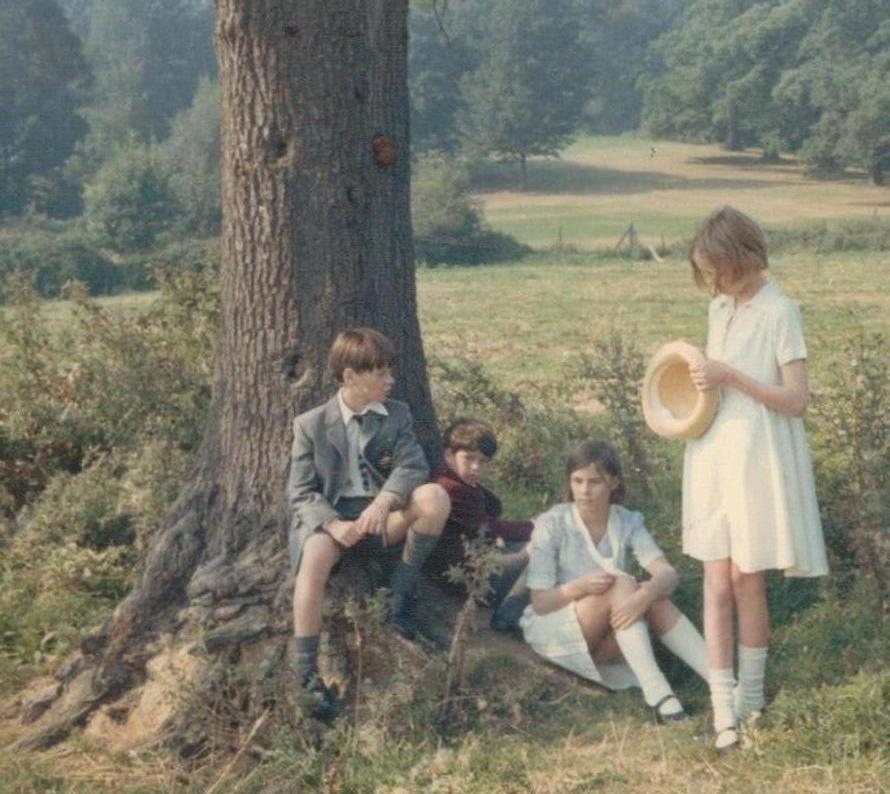
Arthur Ransome wrote ‘Swallows and Amazons’ in 1929 when hats were worn in England, certainly in north Lancashire where the book is set. Would members of the Walker family have been wearing them?
Sophie Neville as Titty in 1973
When I took part in Claude Whatham’s movie ‘Swallows and Amazons’, made in the early 1970s, we were given school hats to wear when we arrived at Holly Howe in the opening sequence. While the boys had caps, I was given a straw hat but found it blew off when we ran down the field to the Peak at Darien where I spotted the island of my dreams. It ended up being quite a useful thing to hold in my hands.
In later books in the series such as Peter Duck,Missee Lee and Great Northern Arthur Ransome depicts the Swallows wearing white linen sunhats but these do not appear in the Lakeland books until the hot summer of Pigeon Post. It only seems to be the Amazons who wore hats in Swallows and Amazons.
Sten Grendon, Simon West, Kit Seymour and Lesley Bennett in Secret Harbour
I rather envied the warmth these provided out on the water but they could get hot. This is possibly because in 1973, when they were sourced locally by the second assistant director, they could have been made of acrylic rather than Westmorland wool.
Claude Whatham, Richard Pilbrow, Gareth Tandy, Peter Robb-King, Ronnie Cogan and Neville C Thompson with Kit Seymour and Lesley Bennet trying on hats
The first knitted hats that turned up on our film set were pink, and quite a bright pink at that. This photo shows them being tried and rejected, which is why Nancy and Peggy are not wearing hats in the scenes set at Beckfoot.
Kit Seymour and Lesley Bennett playing the Amazons
It seems natural enough, shows them in a different light and works well when they are careening Amazon.
Kit Seymour with the director Claude Whatham, 1973
The second hats to arrived on set may not be have been exactly right in design but they weren’t too bad. Does anyone know if they were knitted specially and by whom?
Sophie Neville, Kit Seymour, Suzanna Hamilton, Sten Grendon, Simon West and Lesley Bennett in ‘Swallows and Amazons’ (1974)
Would the Amazons have removed their hats inside the houseboat? The great aunt would have certainly taken tea in her hat and this was a pirate feast.
Kit Seymour as Nancy and Sophie Neville as Titty with the green parrot
Perhaps the fact that the Swallows don’t sail in hats adds accent to the Amazon pirates and Nancy triumphantly wearing hers.
Kit Seymour in ‘Swallows and Amazons’ (1974) by the film poster artist Arnaldo Putzu
My mother was given one of the pink rejects but wore a huge floral Donny Osmond cap on set.
She made me wear both a hat and sunscreen behind the scenes in an attempt to stave off sunstroke.
There were not many very sunny days but it was I who wore a hat at Beckfoot. I now prefer something with a wider brim and a string under the chin to ensure it doesn’t blow off and sink to the bottom of Derwentwater as my mother’s did.
Sophie Neville at Brown Howe, the location used for Beckfoot
Sophie Neville and Sten Grendon in Swallows and Amazons 1974
When I played Titty Walker in 1973, I tried to capture something of the style of the 1920s and portray her as the nine year-old girl in the illustrations Arthur Ransome’s drew in his book Swallows and Amazons. Although I shared the Scots/Irish/English ancestry of Titty Altounyan, a real little girl who the character had been based on, I lacked her Armenian heritage and dark, bobbed hair. However, Mrs Ransome had insisted that in the film Titty was to be played by ‘an English Rose’. Dame Virginia McKenna had accepted the part of our mother, who grew up in Australia, it seemed right that one of her children might have fair hair.
Virginia McKenna and Sophie Neville on Peel Island ~ photo: Daphne Neville
My Scottish grandmother would have been aged sixteen in 1929. She loved clothes and had great style. People say that I look like my mother but I bear a greater resemblance to Granny in her youth.
I’d inherited my father’s long legs, which made me a couple of inches taller than Simon West who played my elder brother, John. Since this would clearly look wrong on screen, I was encouraged to devise ways of disguising my height, but this was difficult to do in boats.
Sophie Neville as Titty and Simon West as John
We often had to sit on the ground in Swallows and Amazons. The long legs needed to be folded up, exposed as they were by the short dresses or divided skirts designed by Emma Porteous.
Sophie Neville as Titty
I remember meeting Emma at a fitting at Angels Costumes on Shaftesbury Avenue in London when I tried on the original silk dress worn for our arrival at Holly Howe. It came with a straw hat similar to one I’d worn as a child.
Simon West, Stephen Grendon, Suzanna Hamilton and Sophie Neville as the Walker children dressed as they arrived at Holly Howe at the start of their holiday in the Lake District ~ photo: Daphne Neville
I had no idea how well known Emma Porteous was to become. She designed the costumes for the James Bond movies, along with Aliens and Judge Dread. Finding the boy’s school uniforms must have been a bit dull for one so talented but she found elegant vintage dresses for Dame Virginia McKenna who looks elegant in every scene.
Stephen Grendon, Simon West, Virginia McKenna, Suzanna Hamilton and Sophie Neville, trying not to look as tall as she was in 1973 ~ photo: Daphne Neville
Emma had most of my clothes made up for me. These included a brushed cotton nighty, worn at Holly Howe, pajamas for camping, and a swimming costume with little legs. Mine was far from glamorous being red, wooly and apt to ride up in the most unflattering manner. I was given a smart yellow coat to wear in the train, but it was too hot in the compartment and, although pretty, it was never seen in the finished film. It had buttons in the shape of flowers and may have been an original garment from 1929.
Sten Grendon, Suzanna Hamilton and Sophie Neville
The silk dress revealed my ‘passion killers’. These navy blue elasticated gym knickers were an item of clothing requested by Claude Whatham, the film director, who remembered wearing long underwear himself. He insisted that I tucked my dress into these voluminous knickers, which the crew called ‘passion killers.’ This seemed natural as it was common practice. I’d done it myself, as had the Altounyan girls, but the tucking in became difficult to maintain and my legs were too gangly to warrant exposure. The knickers contained a hanky, used on two occasions. Growing up in the 1960’s – with a Scottish grandmother – I’d keep a hanky in my own over-knickers so found this quite natural. Even aged eleven my school uniform listed gym knickers (brown) and underpants.
Sophie Neville as Titty in 1973
Emma admitted to my mother that the dresses she’d had made for me would have been longer in 1929. She chose shorter, ‘out-grown’ hemlines as a nod to ‘Seventies fashion but these made my skinny legs look even more alarming.
Mum liked the pale yellow dress with scalloped detail. I didn’t then, but do now, although I don’t have the right colouring wear either yellow or green.
Simon West and Sophie Neville on Peel Island in 1973
By the time I was pretending to be Robinson Crusoe, the yellow dress had been paired with a grey cardigan buttoned up to my neck for warmth. The quality of the material gave it a more natural, scruffy look than the white spotty dress with a Peter Pan collar. This looked a bit new for Titty, although it was much like the dresses Granny made for me, by hand, when I was aged nine. There was a little bit of smocking below the shoulders. I rather preferred Susan’s low-waisted gingham dress.
Simon West, Suzanna Hamilton and Sophie Neville
Did anyone find jackets for us to wear out on the water? No! We froze but the flimsy costumes we wore sailing to the island do give them impression of an idyllic summer holiday.
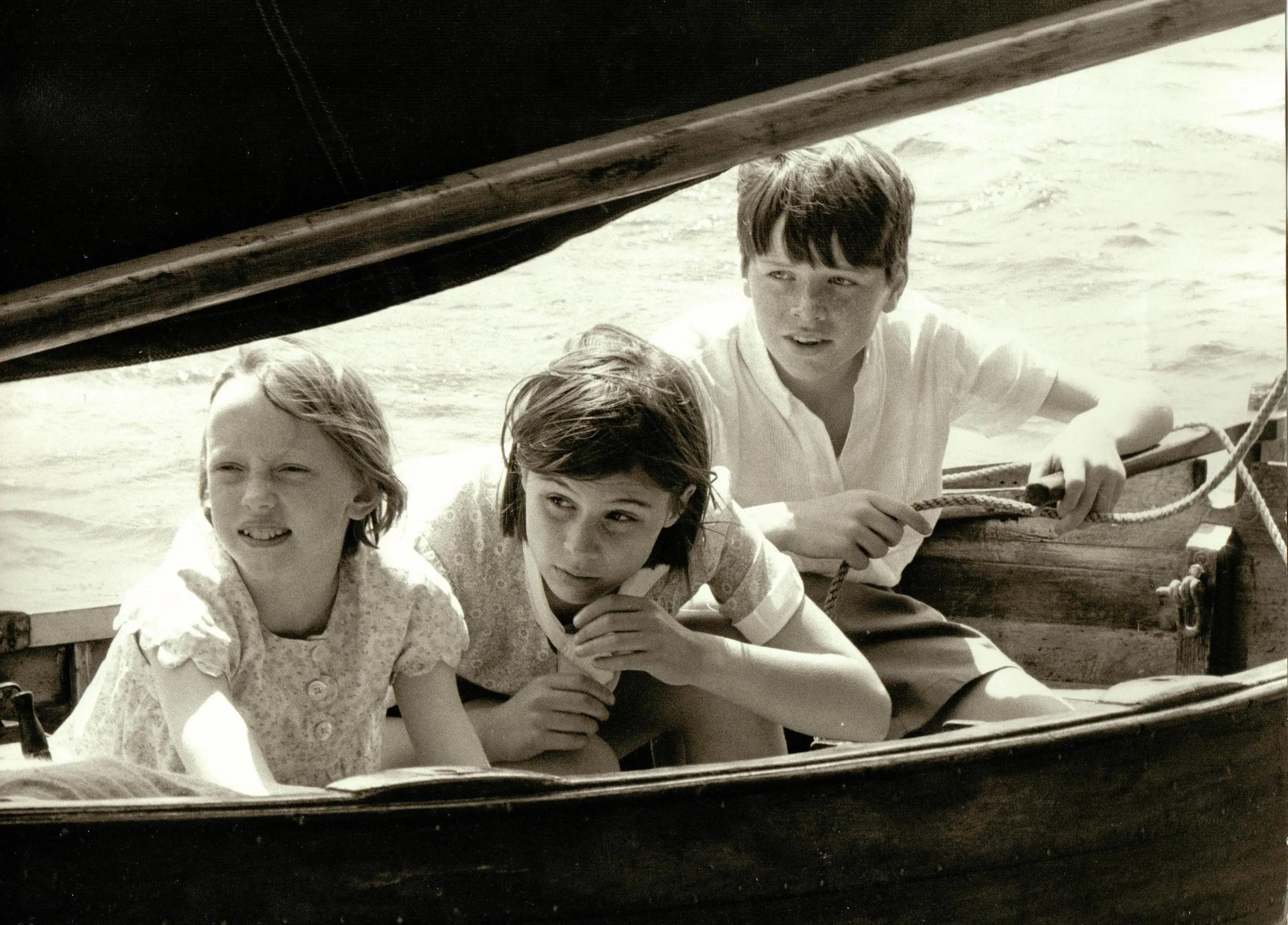
Sophie Neville, Suzanna Hamilton and Simon West sailing Swallow in 1973
Emma only ever made one visit to the location, early on when Dame Virginia McKenna was on set. Our clothes were looked after by the wardrobe master Terry Smith who kept them crumpled up in suitcases rather than on a costume rail. He had no assistant or dressers except for my mother who helped him fit the film extras with costumes and had me wriggling into mine.
Wardrobe Master Terry Smith with Sophie Neville and her mother Daphne Neville outside the Make-up caravan on location near Keswick in Cumbria
Apart from the school shoes I arrived in, we wore white(ish) gym shoes, which were forever getting wet. I would have preferred gumboots but the Swallows wore ‘sand shoes’ in all the books, so that was that. Terry dried them with the help of a gas heater, which once leaked dangerously in the Routemaster bus that was used as our dressing room. There could have been an explosion.
Sophie Neville as Titty Walker
People often ask what my favourite costume was. This undoubtedly consisted of the floral blouse and dark divided skirt, which equated with the illustrations in the books. I went to such an old-fashioned convent so was used to wearing a tailored divided skirt on the school games field and found it always hung well. Mum buttoned up the collar so that I could wear a vest underneath when we were sailing. It was in this Tomboy-ish outfit that I discovered the treasure and bordered the houseboat. Ultimately this style sold the movie, although my blouse was painted an alarming shade of pink on the film poster designed by Arnaldo Putzu. I got away lightly. He depicted Virginia McKenna in orange.
Sophie Neville in ‘Swallows and Amazons’ (1974) by the film poster artist Arnaldo Putzu
I was asked recently if I was able to keep any of my costumes. I was told they would be used in other films and wonder if they could still be at Angels Costumes.
I do still have the dress I wore to the premier, along with a pink gingham prairie dress that my mother wore to the wrap party that has shot back into fashion.
The Neville girls off to the premier of Swallows and Amazons in 1974
My mother wore Donny Osmond caps on location. One of these sunk to the bottom of Derwentwater, but I wear a purple velvet one of the era. It should probably be on display at the V&A but I find it useful in the rain. The film producer, Richard Pilbrow, sent me Swallow’s flag. It is the very best of accessories anyone could wish for.
The navy blue woolen hat that I wore to the original sailing audition has been attacked by moths but was stuffed into a cupboard with other memorabilia from the film. I’ll bring as much as I can along to Windermere Jetty for the 50th Anniversary of ‘Swallows and Amazons’ on 29th and 30th June 2024. Join us there if you can.
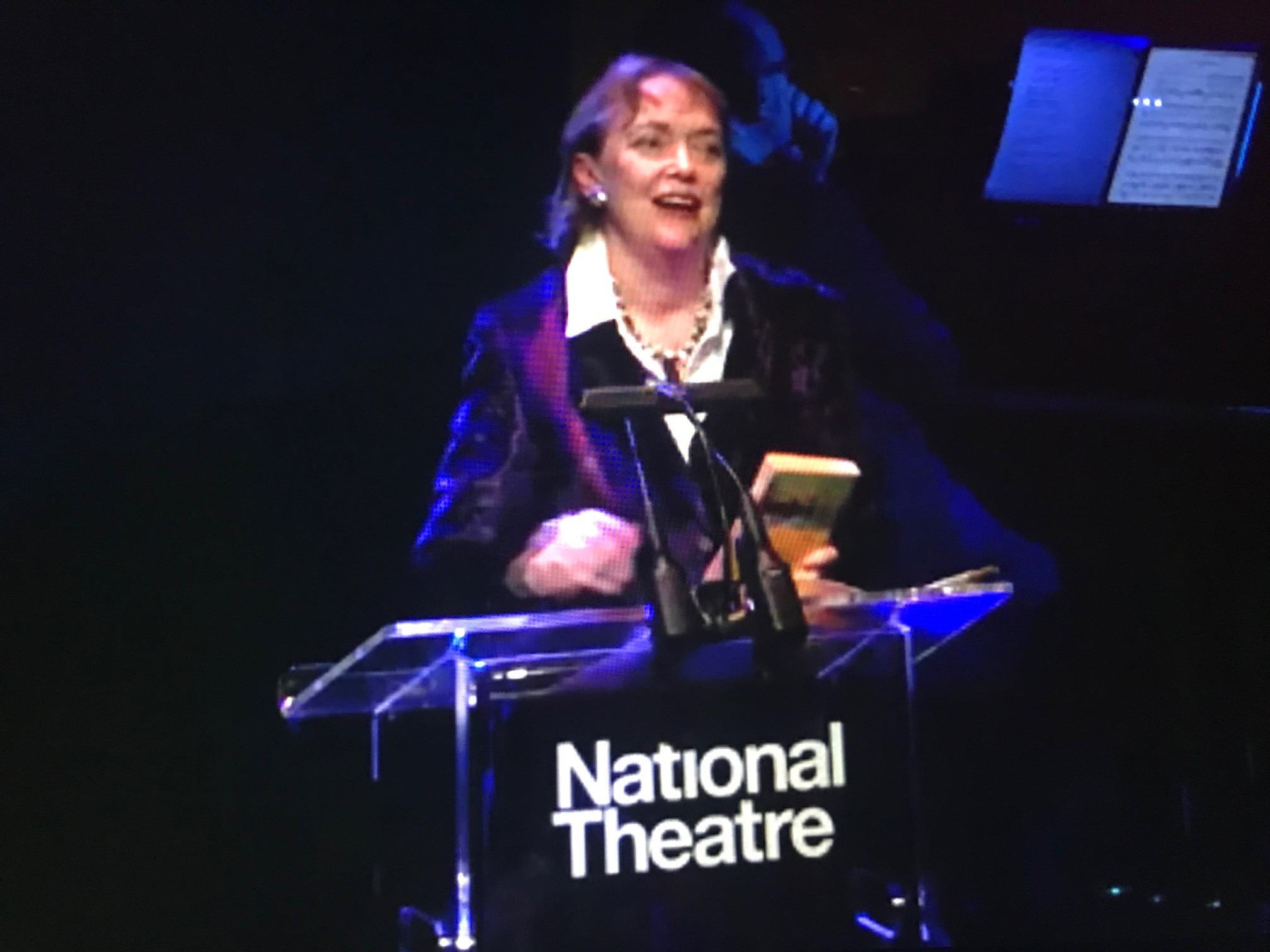
Sophie Neville speaking about Richard Pilbrow at the National Theatre
I was invited to speak at the National Theatre by Fred Pilbrow who rehearsed the presentation at his studio in London.
He put together the most extraordinary celebration of the life and works of his father, Richard Pilbrow, who died recently at the age of ninety.
The most talented technicians in the theatre world gathered to speak on his life and works. A recording of the event has been made available on Youtube.
Sophie Neville speaks about making ‘Swallows and Amazons’ (1974) at 1.15.15
It was a fitting tribute to the man who lit up the lives of many and produced a movie that apparently has been broadcast on television more than any other British film and fifty years after the premier in Shaftesbury Avenue is streaming on Amazon today. Read more in ‘The Making of Swallows and Amazons’ now available on Audible.
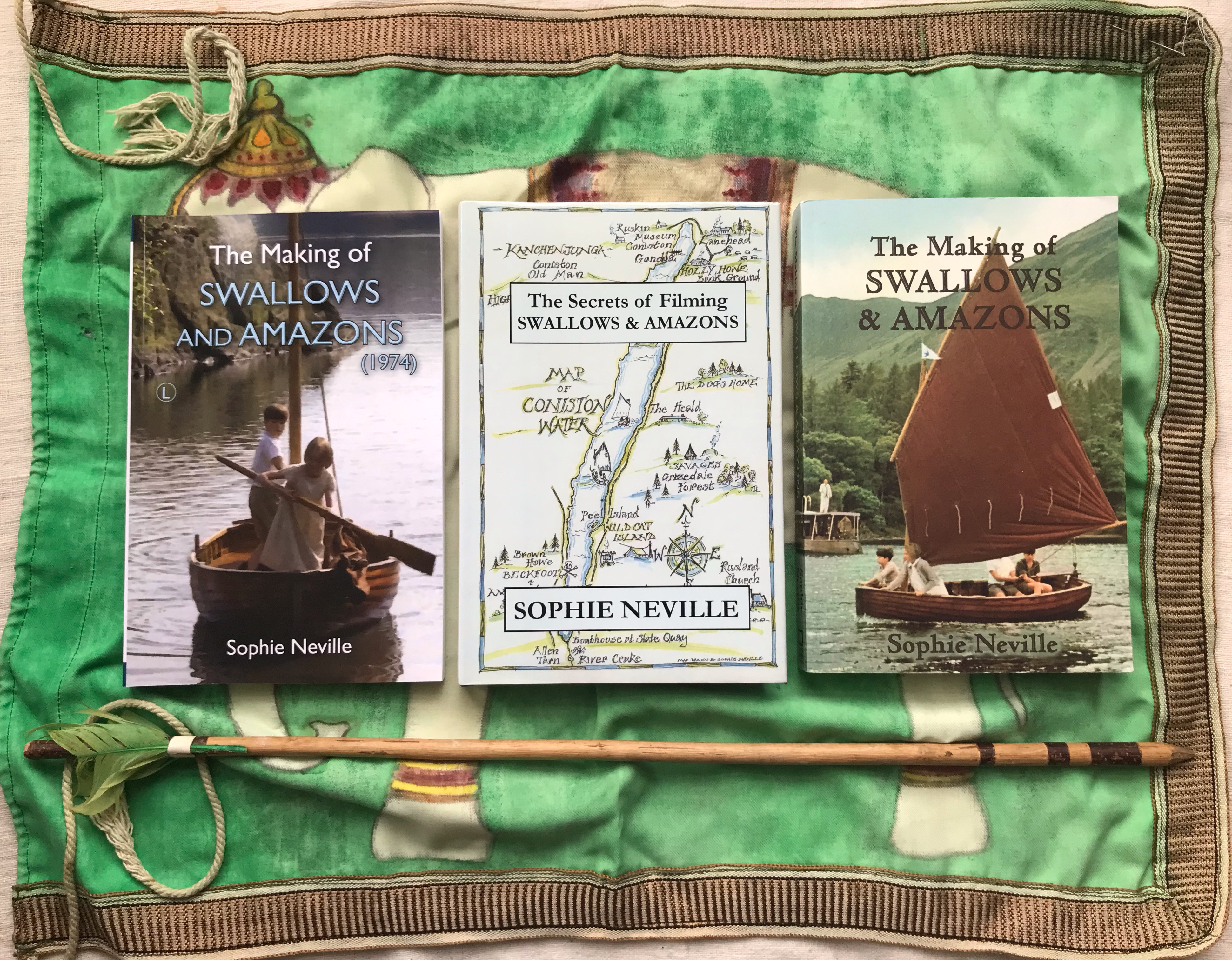
Different editions of ‘The Making of Swallows and Amazons (1974) by Sophie Neville’
Richard Pilbrow told me that the most difficult thing he ever had to do was to persuade Mrs Ransome to grant him the rights to make ‘Swallows and Amazons’ into a movie.
But he did. He found funding from EMI Films and asked Dame Virginia McKenna to play Mother.
Virginia McKenna at Bank Ground Farm in 1973 ~ photo: Daphne Neville
Neville Thompson put together a great crew
Second Assistant Terry Needham, Associate Producer Neville C Thompson and Production Manager Graham Ford with the unit motoroller on a sunny day in June 1973
with Denis Lewiston as DoP,
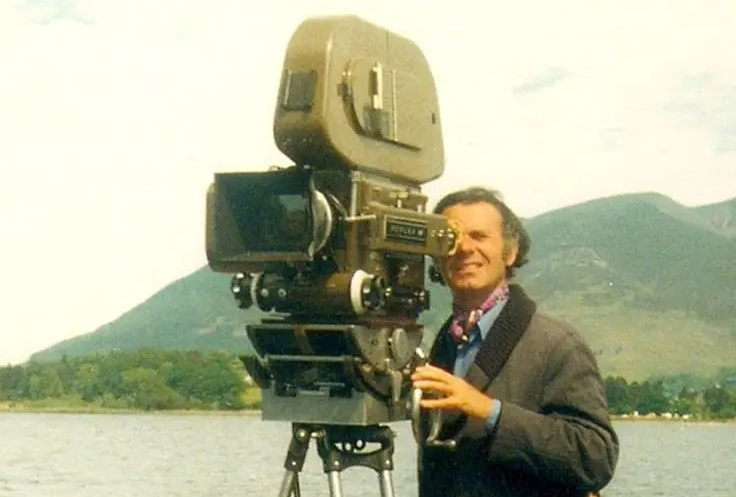
Dennis Lewiston, director of Photography on ‘Swallows and Amazons’ ~photo:Richard Pilbrow
the Oscar winning set dresser Ian Whittaker,
The local fisherman, Ian Whittaker, Simon Holland and Gareth Tandy ~ photo: Daphne Neville
and the avant guard director Claude Whatham fresh from making ‘That’ll Be the Day’ with David Essex and Ringo Starr.
Claude Whatham with the children he eventually cast as the Swallows
Filming on location in the Lake District wasn’t easy.
Producer Richard Pilbrow and Production Associate Neville C Thompson on Derwentwater in the Lake District in 1973
How they lit the scenes on Peel Island I do not know.
Dame Virginia McKenna as Mother with Sophie Neville as Titty WalkerKit Seymour with Claude Whatham, 1973
It rained so hard that Simon Holland had to order black drapes from Pinewood Studios so they could shoot the night scenes in Mrs Batty’s dusty barn.
Sophie Neville as Titty
But the film worked because Richard had insisted that the children playing the lead characters could sail.
Filming Swallows and Amazons (1974) from a camera pontoon
The film didn’t make much at the box office but it worked well on television.
Sophie Neville as Titty Walker in the ITV trailer for the movie of ‘Swallows and Amazons’ when it was first shown on television in 1977
I’m told it has been broadcast more than any other British Film. Having a U certificate it has allowed many parents a lie-in on Sunday mornings.
Simon West, Sophie Neville, Suzanna Hamilton and Sten Grendon in Secret Harbour
Families assure me that they have watched the VHS or DVD thirty times or more. StudioCanal remastered it for cinemascope Blu-ray and we filled the big northern cinemas.
Sophie Neville with Suzanna Hamilton
The good news is that, fifty years after the premier in Shaftesbury Avenue,
Sophie Neville and Suzanna Hamilton with Ronald Fraser in Swallows and Amazons
we are restoring the dinghies: Swallow and Amazon for families to sail.
I wrote up the diary I kept on location as a twelve year-old. Richard sent me the flags.
Different editions of ‘The Making of Swallows and Amazons (1974) by Sophie Neville’
At the 50th Anniversary celebrations this April a man in the audience stood up to say that as a young doctor, he was working at a hospital on Good Friday. As he walked around he found peace in every ward, sick children snuggled up and happy. They were all watching ‘Swallows and Amazons’ on television. Richard’s gift.
Arnaldo Putzu’s poster for the EMI film Swallows and Amazons (1974)
Richard and Molly’s dream became an inspiration to many.
Molly and Richard Pilbrow in 1973
Here you can see Richard and Molly with Claude Whatham, Neville, Fred, Abigail, Suzanna Hamilton and me at the sailing audition held in Burnham-on- Crouch. Simon West who was cast as Captain John went on to win the Optimist British Championships and represented the UK overseas.
Richard and Molly Pilbrow, Claude Watham, Fred Pilbrow, Sophie Neville, Suzanna Hamilton, Abigail Pilbrow
Richard Pilbrow produced the original movie ‘Swallows and Amazons’ (1974) in which I appeared in a as a girl. I’m told that it has been broadcast on television more times than any other British movie and has been an inspiration to many.
Arnaldo Putzu’s poster for the EMI film Swallows and Amazons (1974)
Back in the early 1970s, Richard was busy producing iconic West End musicals such as ‘A Funny Thing Happened On The Way to The Forum’ when he was inspired to make a film adaptation of Arthur Ransome’s novel while taking a break in the Lake District.
Richard Pilbrow on location with his colleague Neville Thompson ~ photo:Daphne Neville
He said the most difficult task he ever took on was persuading Mrs Ransome to grant him the rights. Arthur Ransome had famously disliked a BBC adaptation and passionately did not want a ‘Disneyfication’ of the book based on his own childhood memories.
Richard said that raising the film finance was relatively easy. Nat Cohen of EMI Films happened to be looking for a classic story akin to ‘The Railway Children’, which had been a box office success. He’d never heard of ‘Swallows and Amazons’ but an assistant in his office was wildly enthusiastic and Richard secured a budget of £250,000 to make a ninety minute movie entirely on location in the Lake District.
Producer Richard Pilbrow and Director Claude Whatham discussing the script in the Capri on Derwentwater. Molly Pilbrow is in the boat with them ~ photo: Daphne Neville
Richard loved being out on the water and took Mrs Ransome to find authentic locations. Being determined that the six children playing the Swallows and the Amazons should be able to sail well, he advertised in yacht clubs and interviewed about 1200 candidates. I met the director at the Theatre Project offices in Shaftesbury Avenue. Those short-listed were taken on a sailing weekend in Burnham-on-Crouch to see how they coped afloat.
Richard Pilbrow, Claude Watham, Fred Pilbrow, Sophie Neville, Suzanna Hamilton
Mrs Ransome kept a close eye on the script, insisting that the part of Titty was played by ‘an English rose’, which must be why I was cast as the heroine.
Sophie Neville as Titty Walker in the ITV trailer for the movie of ‘Swallows and Amazons’ when it was first shown on television in 1977
My mother came up to look after us six children who played the Swallows and Amazons. We landed on Wild Cat Island and began playing out the characters that sprung from the pages of the book.
Daphne Neville and Richard Pilbrow on Peel Island on Coniston Water in 1973
Claude Whatham was actually the second director appointed to work on the film. He had only made one other feature – ‘That’ll Be The Day’, starring David Essex and Ringo Starr, but he was an outdoorsy person and got on well with Richard who gave him a free rein. They embraced the 1929 period and the idea of somehow capturing childhood innocence.
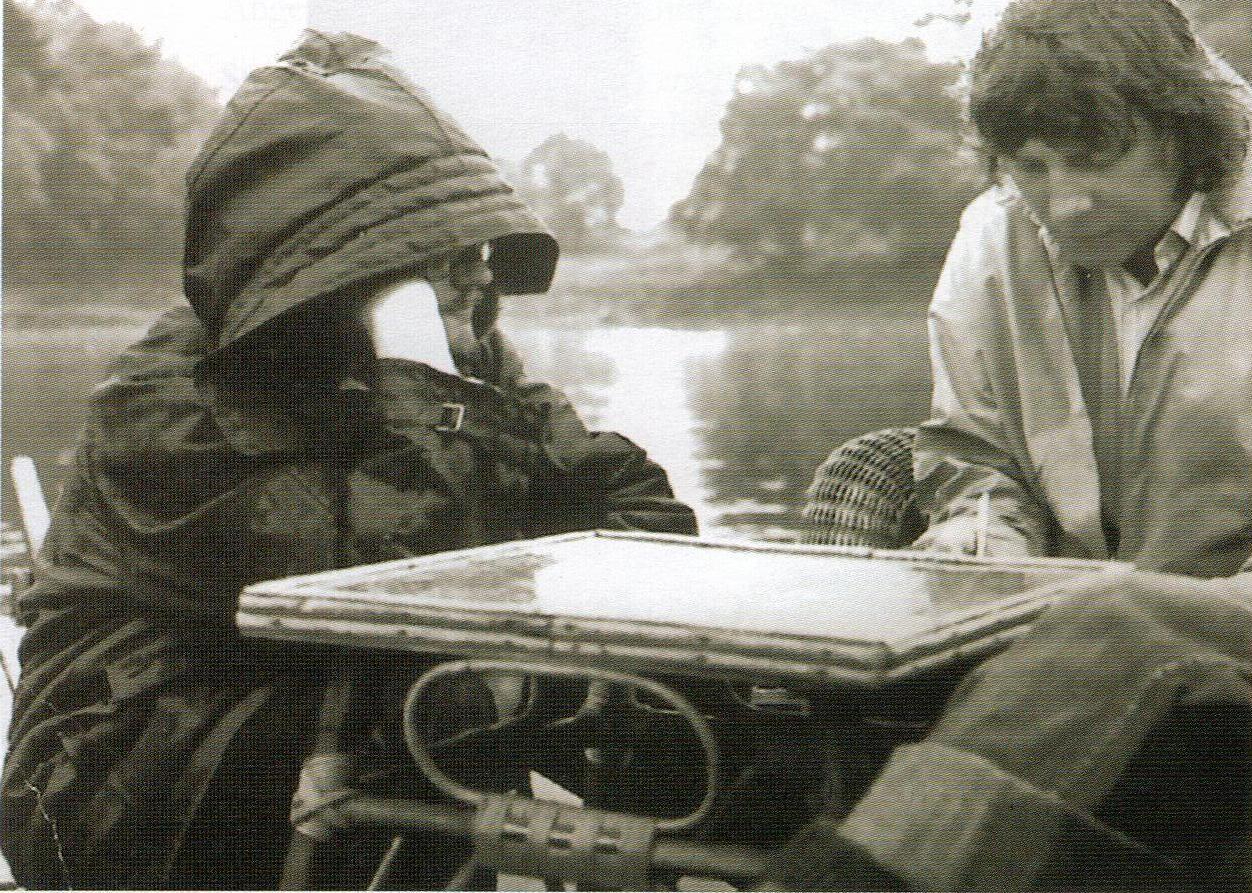
Producer Richard Pilbrow with Director Claude Whatham in their wet weather gear at The Secret Harbour on Peel Island, Coniston Water
Unpredictable Lakeland weather and working out on the water could make scheduling and logistics a nightmare but Richard had the support of an excellent production team working under Neville Thompson who also organised the post-production work at Elstree Studios where the film was post-synced.
Producer Richard Pilbrow and Production Associate Neville C Thompson on Derwentwater
Neville was passionate about film making, becoming known as ‘the last gentleman producer.’ Although gregarious at times, he was a quiet man who had begun working as a location manager for Mike Newell and became a production manager for Ken Russell.
Neville C Thompson, the Associate Producer relaxing on set – to be fare this shot may well have been taken on Sunday 24th July 1973, by Daphne Neville
Neville was diagnosed with Lukemia at the age of 47 but lived another twenty years, ending his days in Woodbridge in Suffolk. you can find his impressive list of production credits here
Director Claude Whatham with Sophie Neville, Stephen Grendon, Suzanna Hamilton and Simon West. Producer Richard Pilbow looks on ~ photo: Daphne Neville
The Pilbrows spent their family holidays on the Isle of Coll, so it was not surprising that Richard wanted to make ‘Great Northern?’ as a sequel even though Mrs Ransome wasn’t keen.
Henry Dimbleby and Rosemary Leach in ‘Coot Club’ and ‘The Big Six’
Sadly it was too difficult in the mid-1970s to raise money for filming and Richard never produced another movie. He sold the rights to adapt ‘Coot Club’ and ‘The Big Six’ to the BBC, and I saw him in Norwich in 1983 when I was setting up the drama series with Joe Waters.
When Richard heard that I was giving talks on ‘The Making of Swallows and Amazons (1974)’ he kindly sent me Swallow’s original burgee and Captain Flint’s white elephant flag, along with a Jolly Roger – all handmade props used in the original film.
We last met up in Covent Garden when he came to London to receive an honour from the Central School of Dramatic Art where he had originally studied Stage Management and Technical Theatre Studies.
Sophie Neville with Suzanna Hamilton
He later wrote to thank me for collecting information on how the film of ‘Swallows and Amazons’ was and writing about the impact it had. He loved hearing about our Q&As at cinemas and admired StudioCanal’s remastered DVD. ‘They really did a beautiful job—a very subtle enhancement.’
Simon West, Sophie Neville, Suzanna Hamilton and Sten Grendon in Secret Harbour
I sent Richard and his family on safari to the Waterberg in South Africa, where he ended up riding a horse past grazing rhinos. He is survived by his three children, grandchildren and his wife Molly who worked as his assistant on ‘Swallows and Amazons’.
Sophie Neville in Swallow
Richard’s obituary in the Telegraph can be found here
The momentous story of his life and work is recorded in his memoir ‘A Theatre Project’ available online here.
Suzanna Hamilton, Richard Pilbrow and Sophie Neville
David Wood OBE shares an insight into filming one of the most outrageous British films of all time.
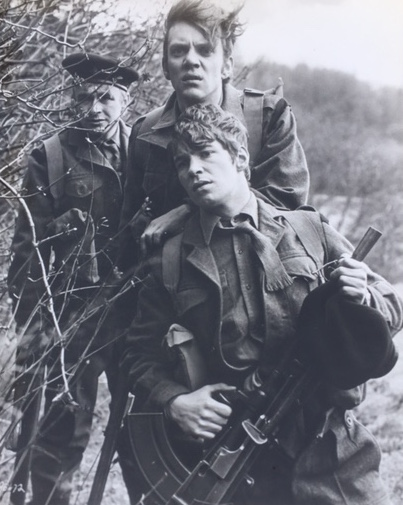
Filming If…. is the first written memoir about the cult classic film with rather a short title directed by the talented Lindsay Anderson in 1968. David Wood co-starred as one of the three public school boys, alongside Malcolm McDowell (Mick) and Richard Warwick (Wallace), who led a revolution against authority. This was regarded by many as a metaphor for the social and political situation in the UK.
If…. celebrates its 50th anniversary this year. The book contains David’s memories of the personalities involved, the day-to-day challenges, and the reception given to the avant garde film, which won the Palme d’Or at Cannes. David Wood reflects the brilliance of Lindsay Anderson and his team. With a foreword by Malcolm McDowell and an afterword by George Perry.
Filming If…. has been highly endorsed and enjoyed by many:
“…What a brilliant thing you have done, recalling what it was like beingdirected by the great Lindsay Anderson, and being part of this hugelyimportant film and its dazzling cast.” – Joanna Lumley OBE
“David Wood has written a wonderfully evocative insider’s view of the shooting of one of the best British films ever made.” – Sir Alan Parker
“If…. is a classic movie – I was at the première in 1968 and we all sensed itthen… I’ve a feeling this book’s going to be something of a classic, too.” – Gyles Brandreth
“What are you waiting for? David Wood’s gentle memoir of the film and itslegacy is required, one-sitting reading.” – Total Film Magazine
David Wood went on to write or adapt a huge number of plays, musicals, television programmes and feature films. The first screenplay he wrote was for ‘Swallows and Amazons’ (1974). He wrote to me with stories of working with the audacious Mrs Ransome, which I posted on this website here.
David’s movie ‘Back Home’ won a gold award at the New York Film and Television Festival in 1991. He went on to receive enormous acclaim in the West End, winning an Olivier Award in 2013 for his stage adaptation of ‘Good Night Mr Tom’, and the JM Barrie lifetime achievement award for his contribution to children’s arts in 2017. You can find his website here.






























 Sophie Neville