

‘It would make a superb lighthouse,’ but not for a good few years yet. The Scots pine planted by The Arthur Ransome Society on the northern end of Peel Island was growing well when I last paid it homage.

I hope I don’t spoil the magic if I explain that the pine used in the 1973 film of ‘Swallows and Amazons’ is on a promontory above Derwentwater. An appropriate tree was chosen that overlooked the location we used for Houseboat Bay.

If you can avoid being distracted by David Bracknell’s trendy two-tone trousers, you can see a bit more of the lighthouse tree location with the lake beyond. I’ve been told it is at Friar’s Crag. Can anyone find the actual tree?


As a child reading Swallows and Amazons I was always deeply impressed that Captain John managed to climb the pine tree in Arthur Ransome’s drawing. Simon West was able to use branches but he really did climb quite high. The cameraman had a scaffold tower.

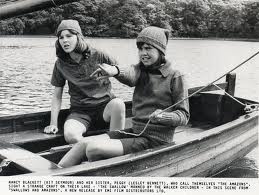
Suzanna wrote that, ‘In the late afternoon the Amazons were filming on the pontoon. Kit wasn’t feeling well.’ Lesley had recovered a bit but there was a ‘flu-like bug going around. Neither of them look that well in the resultant photograph but they survived.
If you would like to read more, upload a copy of ‘The Secrets of Filming ‘Swallows and Amazons'(1976)’ for sale on Amazon Kindle and other e-readers for £2.99

Sophie will be giving illustrated talks on ‘The Making of Swallows and Amazons’ at the Southampton International Boat Show in September.


 Sophie Neville
excellent, I love reading your blog as I am a big fan of ‘Swallows…’…very very interesting
Thanks for taking the time to post a comment. you must let me know if you have any questiosn about the filming.
Thank you again.
Lovely stuff as always, Sophie – logging in from rural Turkey where I’m on a dig for the summer, but it’s worth enduring the grindingly slow internet to see the latest blog – keep it up for all of us!
Much of what I am doing feels like archaeology – digging up the past and piecing it together. I have been finding out that our second assistant director Terry Needham went on to have the most fascinating career in movies working with all the great directors.
Thank you Sophie for all the fascinating background to the film which all our family love. I have spent ages identifying and visiting the locations in the film and books – I am fairly sure houseboat bay is brandlehow bay and the lighthouse tree is on Brandlehow point
John white
I am so glad your family have been enjoying the posts. thank you so much for the information about our Houseboat Bay – I will add it to my book! Did we meet at Bank Ground Farm in 2003?
I don’t think we’ve met sadly – but it would be good to! I’ve just bought funnily enough and am enjoying it greatly
It is great to hear that you are enjoying ‘Funnily Enough’. I was just thinking that I must write another post for the Funnily Enough website. Let me know if you have any questions or would like to know more about anything in the book. Please see the Funnily Enough Blog-spot for photos of the animals and location: http://funnily-enough.blogspot.co.uk/
Another excellent piece of the story, thank you. It’s intriguing how all the bits, often filmed out of sequence, finally come together to make a convincing and seemingly seamless whole.
Claude began by wanting to shoot the film in story order for our sakes but it proved impossible. You can have fun watching how the trees came into leaf – and went back into bud! Did you notice when you first watched the film?
No, I hadn’t noteiced that at all; but I shall look out for it next time!
Richard Pilbrow worried about it. We did begin filming in May and Cumbria is pretty far north. You can compare the railway scenes shot on Day 1, with scenes featuring the houseboat, which were filmed in July.
It is funny having a filming order and how that relates to the story line of the finished film. In my limited experience it can seem very disjointed for the cast, as we filmed a funeral scene for a character who then was filmed alive and well the very next day! The conditions were perfect for the funeral scene however, the gloomy weather at the church being just what the writer wanted. He was co-directing and was very particular. Our only problem was with the sound, as we were using a pretty, little rural church in a village called Owermoigne near Dorchester. The local residents kept appearing, asking if it was someone famous that had died, with all the camera crew and equipment stacked around the churchyard. We had to repeatedly explain that we were making a film and no one had actually died. There was some confusion as the actor playing the vicar was not the parish vicar and people were wondering if he had actually died! It was a very confusing day for the villagers.
We did get the scenes done eventually, but it was a struggle with the unwanted ‘local’ input, and keeping our fingers crossed that it wouldn’t actually rain. A very long, hard day!