Like Arthur Ransome, I have ‘lived many lives in one.’ He also wrote, ‘Memory picks and choses’. Here are a few unusual ones:
A photograph of Sophie Neville photoshopped to look like Charlotte Rampling for ‘Broadchurch’
This gave me a fright: I was watching the ITV police series Broadchurch when I saw a photograph of me, aged seventeen, featured on screen. Only it wasn’t me. My face had been photo-shopped to look like a young Charlotte Rampling. Above is a screenshot. Here is the original:
Sophie Neville aged seventeen
No one had asked my permission, but what can I do but take it as a compliment?
Around this time I was briefly involved in the HTV seriesKidnapped. I played a boy. But opposite David McCallum (The Man From U.N.C.L.E), so who was I to argue. And I was paid.
I got the part in an odd way. They had forgotten to cast anybody for the role, but the producer had previously cast my sister in Arthur of the Britons and knew we lived only a few miles from the location. I agreed on the morning the scene was shot.
Appearing as a messenger boy in ‘Kidnapped’ produced by Patrick Dromgoole for HTV. What did they do to my hair?
I later stood in for the little boy who played Gerald Durrell in the first BBC drama series of My Family and Other Animals. Brian Blessed thought it hilarious. I was working behind the camera by that time but was skinny enough to squeeze into the costume.
Sophie Neville standing in for the boy playing Gerald Durrell getting a kiss from Brian Blessed who played Spiro
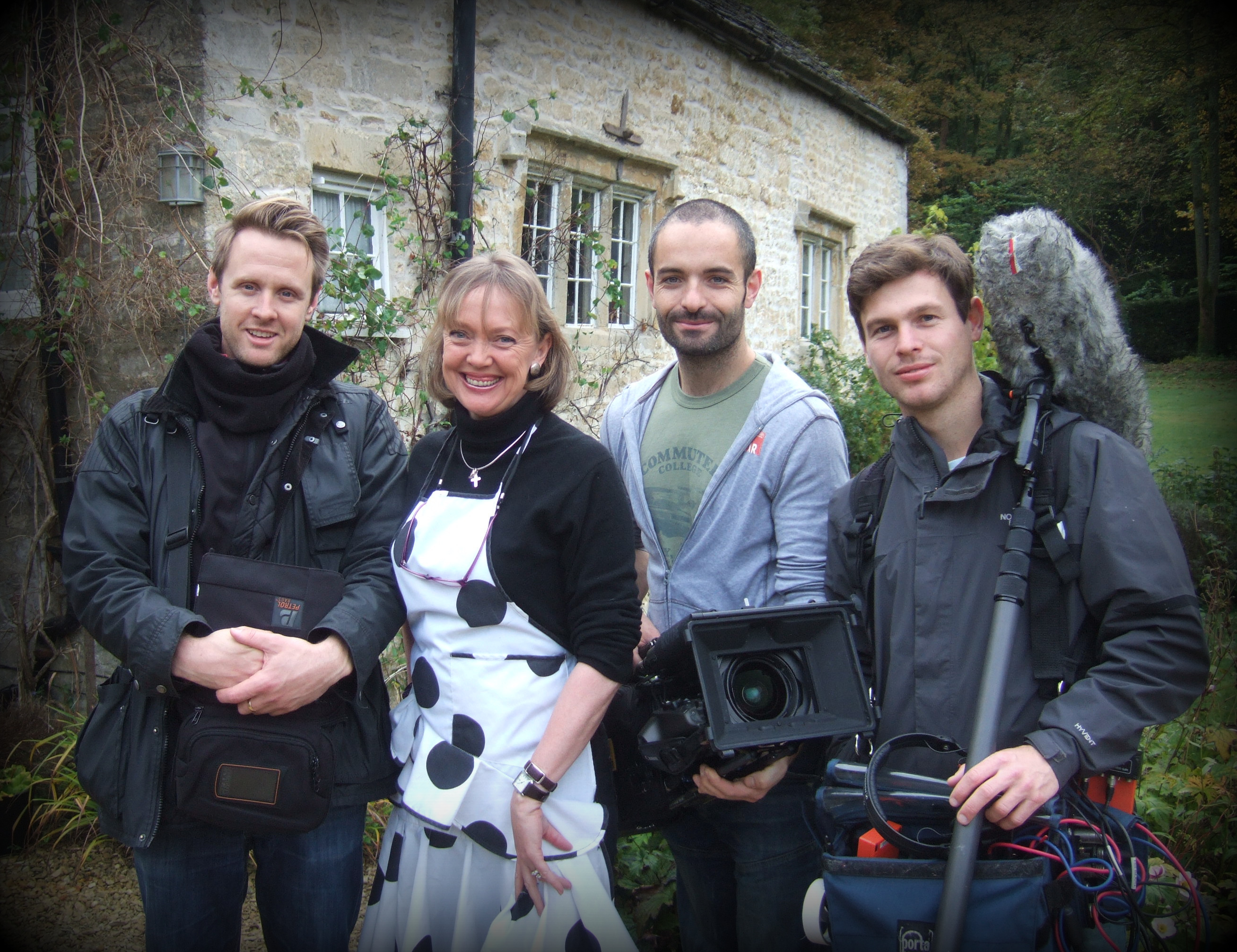
I was once on a train when the director of Obsessive Compulsive Cleaners asked if I could get to Gloucestershire to clear out my mother’s attic. I ended up filming with him for the next three or four days. It was exhausting – and unpaid – but a lot of de-cluttering got done. Check the apron from Seville. I’d bought it on honeymoon.
Sophie Neville filming in Gloucestershire with Betty TV
Piratøen – is the title for Swallows and Amazons in Danish – seen here on a flier that I only came across recently. I’d just had my DNA analyzed to discover I am 3% Danish due to admixture a few generations back. Do I look Danish?
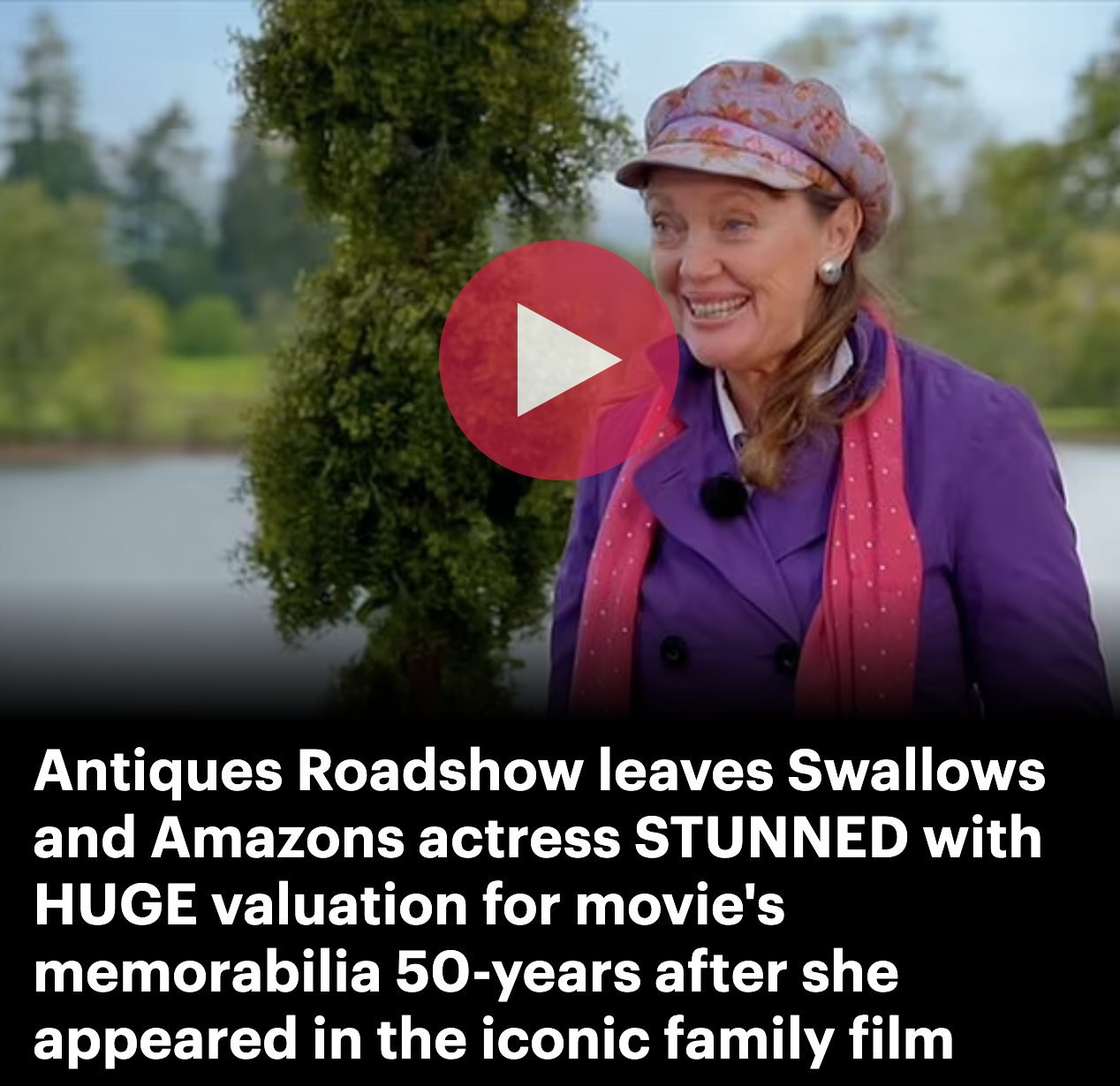
Although I’ve worked on over 100 films and tv programmes, I have mostly been behind the camera, so don’t expect anyone to know who I am. They don’t. The marketing executive at StudioCanal had not, at first, wanted me to help promote the remastered DVD of ‘Swallows and Amazons’, which is understandable as Dame Virginia McKenna has the star billing. Then she must have watched the ‘filmen for hele familien’. I ended up giving Q&As at twelve cinemas. Some had audiences of 250 and the screenings were so popular that customers were being turned away.
Sophie Neville giving a Q&A in Kendal
And yet when a friend of mine told a lady that I was in ‘Swallows and Amazons’ she smiled apologetically and said she’d keep ‘an eye out for me.’
‘Why are you here?’ I was asked at Windermere Jetty in Cumbria. We had gathered to celebrate the 50th Anniversary of the release of ‘Swallows and Amazons’ in cinemas. How should I have answered that question? I replied saying, ‘I’ve been asked to give talk.’
Sophie Neville appearing on BBC TV at Windermere Jetty in Cumbria
You can now listen to the story of how the original film of ‘Swallows and Amazons’ was made on Audible.
The HTV series ‘Kidnapped’ (1978) is available on YouTube. Blink and you miss me, but the music is wonderful.
Having won a Top Three Scripts award at the New Media Film Festival in Los Angeles, Sophie was asked about her screenwriting.
Can you tell us a little about how you got started?
I began writing for BBC Television at the age of twenty-two. It was a disaster. Instead of presenting a polished script, I produced a rough draft that I thought we could develop in the rehearsal room. Developed it was – by Nicholas Parsons, one of the stars. He rewrote his own soliloquy, taking all the credit and a substantial fee. I’ve welcomed harsh feedback from beta readers ever since.
What was the biggest challenge you faced in your journey to becoming a writer? How did you overcome it? Can you share a story about that that other aspiring writers can learn from?
Instant success with my first book was challenging. My illustrated memoir FUNNILY ENOUGH was at number 1 in Humor on Amazon Kindle in the UK (after free copies had been downloading at the rate of 250 a minute) but I had self-published, and had no team support. Instead pressing the go-button with a PR firm and marketing team, I was weigh-laid by the small stuff. Writers need skilled networks in place, especially in the age of New Media.
Funnily Enough – the paperback has black & white illustrations
It has been said that our mistakes can be our greatest teachers. Can you share a story about the funniest mistake you made when you were first starting? Can you tell us what lesson you learned from that?
I began my career in television by working with children. I could see the potential and it gave me a niche, but the hazards were numerous.
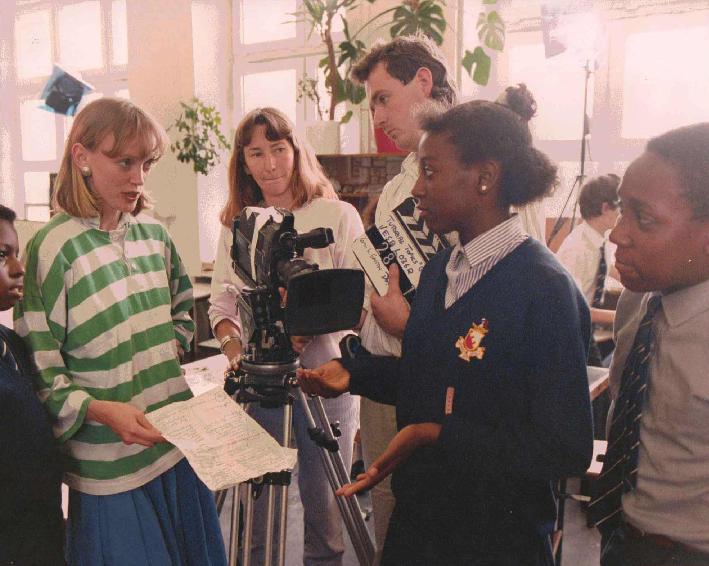
A teacher opened one scene for me by saying, ‘Some people believe the world is flat.’ A five-year-old called out, ‘No, but it’s not! It’s bumpy.’ The mistake was that we had too much camera judder – my cameraman had dissolved in hysterics. A lesson learned: I used a tripod when capturing the opinions of eleven-year-olds. The results were so amusing that they were repeatedly endlessly when Daytime TV was launched in the UK.
Sophie Neville directing a sequence with BBC cameraman Lorraine Smith
What are some of the most interesting or exciting projects you are working on now?
I felt compelled to write A BOY CALLED FREDDIE when I discovered Freddie Mercury, escaped from the violent 1964 Zanzibar revolution at the age of seventeen. If a year older, the man who became an international rock idol would have been forced into slave labour on coconut plantations. As it was, his family fled to London where his talent flourished and found stardom. Born Farrokh Bulsara, he became known as Freddie at school. The story of how he chose the name Mercury involves NASA but is only revealed in my screenplay – right at the end. Freddie’s father, Bomi, was a Parsee who worked as a cashier at the law courts where my Great-uncle Ronnie served as Chief Justice. I’ve been able to draw on my cousin’s stories of life in the heady days before a convicted rapist from Uganda brought mayhem to the archipelago of tropical islands, forcing the Sultan to escape by sea, along with my aunts and a plucky English women who had set up free and fair elections a month before mass murder broke out akin the movie HOTEL RWANDA (2004).
I’m also developing THE MEETING HOUSE, an exceptional true story from WWII about an East African serviceman I met who was airlifted out of a POW camp in Japan by his boyhood friend just before America bombed Tokyo. They landed in Silesia in the snow, which he’d only seen previously on the peak of Kilimanjaro, where he was born.
Can you share the most interesting story that occurred to you in the course of your career?
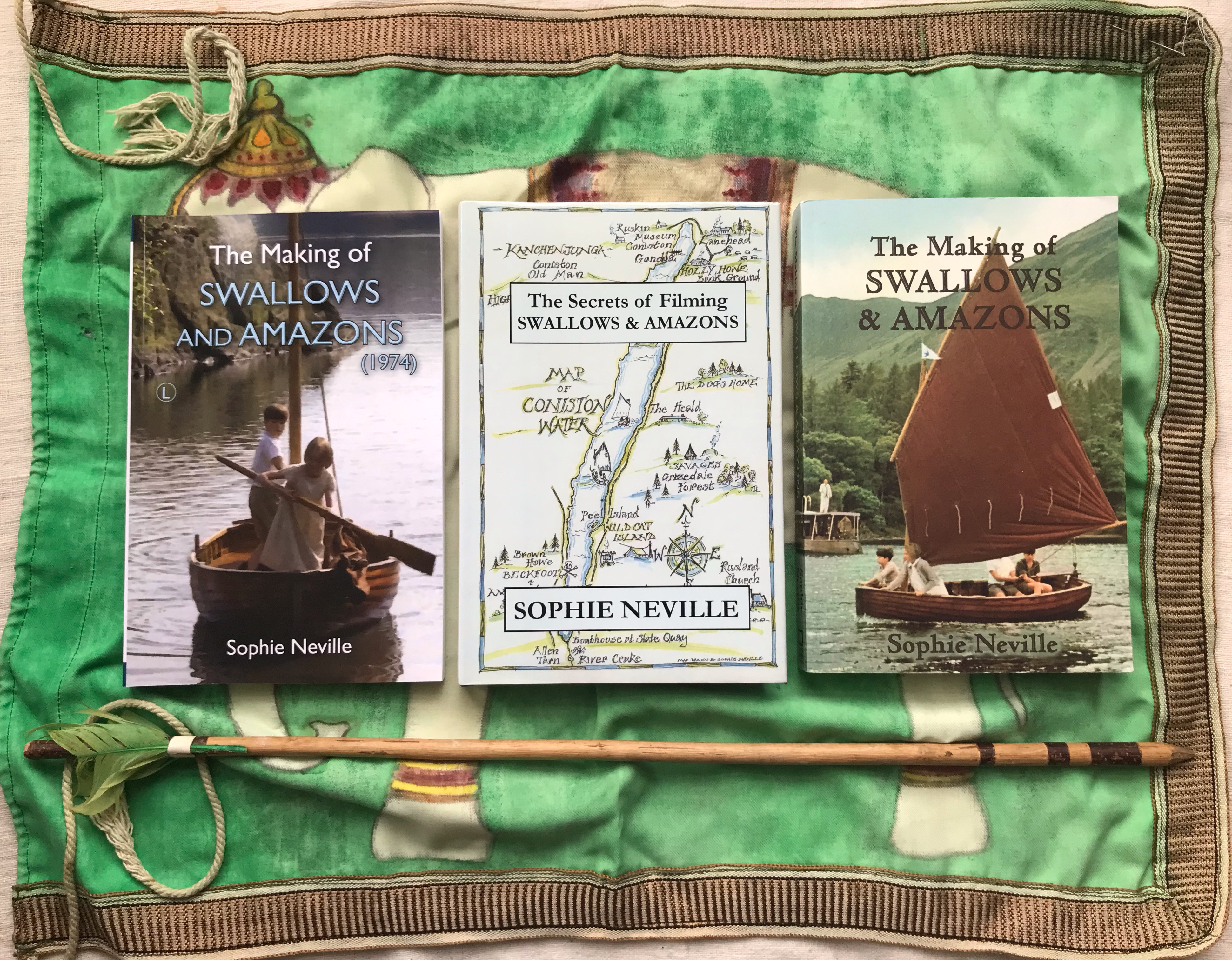
Film fans love to hear about disasters that befell us while making the EMI movie ‘Swallows and Amazons’ before the advent of CGI. I was persuaded to write THE MAKING of SWALLOWS and AMAZONS, now published by The Lutterworth Press.
Editions of ‘The Making of Swallows & Amazons (1974) by Sophie Neville’
Although it’s been screened on television more times than any other British movie, it remains a classic that some have never heard of. ‘Why are you here?’ I was asked at the 50th Anniversary screening.
‘I’m giving a couple of talks on how the film was made,’ I muttered.
‘How would you know how it was made?’
‘I was there.’ In almost every scene. ‘I worked on it.’
‘You couldn’t have been,’ the man insisted.
I could only take this as a compliment, but he looked aggrieved.
Sophie Neville, Suzanna Hamilton and Kit Seymour in Cumbria
StudioCanal also thought I was an imposter as Dame Virginia McKenna had the star billing. Then the marketing executives watched the movie. When the DVD was launched they had me hosting Q&As at twelve cinemas and provided footage for all manner of TV programmes from CINEMANICS with David Wood the screenwriter to BBC BREAKFAST with my co-star Suzanna Hamilton.
Sophie Neville, Suzanna Hamilton and Kit Seymour on BBC Breakfast
I’m currently working on an inspiring comic tale: BANANA MAN, THE TRUE STORY about Phil-the-Geek, a shy but good looking physicist, who increased the national consumption of bananas by 20% after exploiting a supermarket deal and making 8 pence on every bunch he bought – and gave away. His story hit international News headlines and won him the heart of a beautiful girl. I was her bridesmaid. Last week, their daughters have just graduated from Yale and Harvard, respectively. I intend to present the family with a fruit bowl.
Here is the main question of our interview. Based on your experience, what are the “5 Things You Need To Be A Successful Author or Writer”? Please share a story or example for each.
Focus, forbearance and a five am start to the writing day are key, but I often come up with vital twists while soaking in the bath tub. I guess this is because my brain works best at periods of least resistance. The problem is that I end up groping for a notebook with wet hands.
Please share a story or example for each.
Personality, productivity, perseverance, patience, and a broken heart. We need to touch the audience with humor, in small ways that are easily identifiable. I have a scene in one novel about a man on the cusp of falling in love who loses his car keys in the heat of the day and is left feeling a fool in front of the girl he wants to impress. It’s based on the time I found my ignition keys with my feet. They had fallen into sand beneath the door of my car when I was driving through Botswana. The relief following this small miracle is etched deep in my soul.
In your opinion, were you a “natural born writer” or did you develop that aptitude later on? Can you explain what you mean?
I would describe myself as a ‘natural born story-teller’. Having a visual brain, I became a television director, attracted to Mike Leigh’s emerging art of improvisation on film. When on the converted BBC Drama Director’s Studio Course, I gave my actors the task of flirting whilst erecting a tent. It worked exceptionally well, except that they enjoyed the exercise so much it went on a little long. I should have provided them with earpieces to bring the story to a timely end.
We all need to hone the craft of writing. I had the amazing opportunity of assisting on drama serials such as ‘Doctor Who’ and ‘Eastenders’. Looking back, I could have become a BBC script editor. Instead, I’ve spent the last twenty years attending Curtis Brown Creative novel writing courses and acquiring the art of writing about love under the Romantic Novelists Association’s New Writers’ Scheme. Entering writing competitions has proved an incentive and the wins help build my CV. The competition is such that we need to build a pedigree and provide consumer confidence.
Which literature do you draw inspiration from? Why?
I write true-life stories set in the 20th century, so draw on any memoirs or biographies I can find. I love amusing autobiographical novels, such as Fran Hill’s trilogy on life as a teenager in foster care. She is a master craftsman and a truly inspirational writer. I feed off her infectious humour poured out to the world on Substack.
You are a person of enormous influence. If you could start a movement that would bring the most amount of good to the most amount of people, what would that be? You never know what your idea can trigger. 🙂
Forced marriage needs to be recognized as conjugal slavery and made illegal worldwide. Female circumcision (FGM) needs to stop before more lives are lost to infection. I have no personal experience, but feel we must all speak out to support those unable to do so.






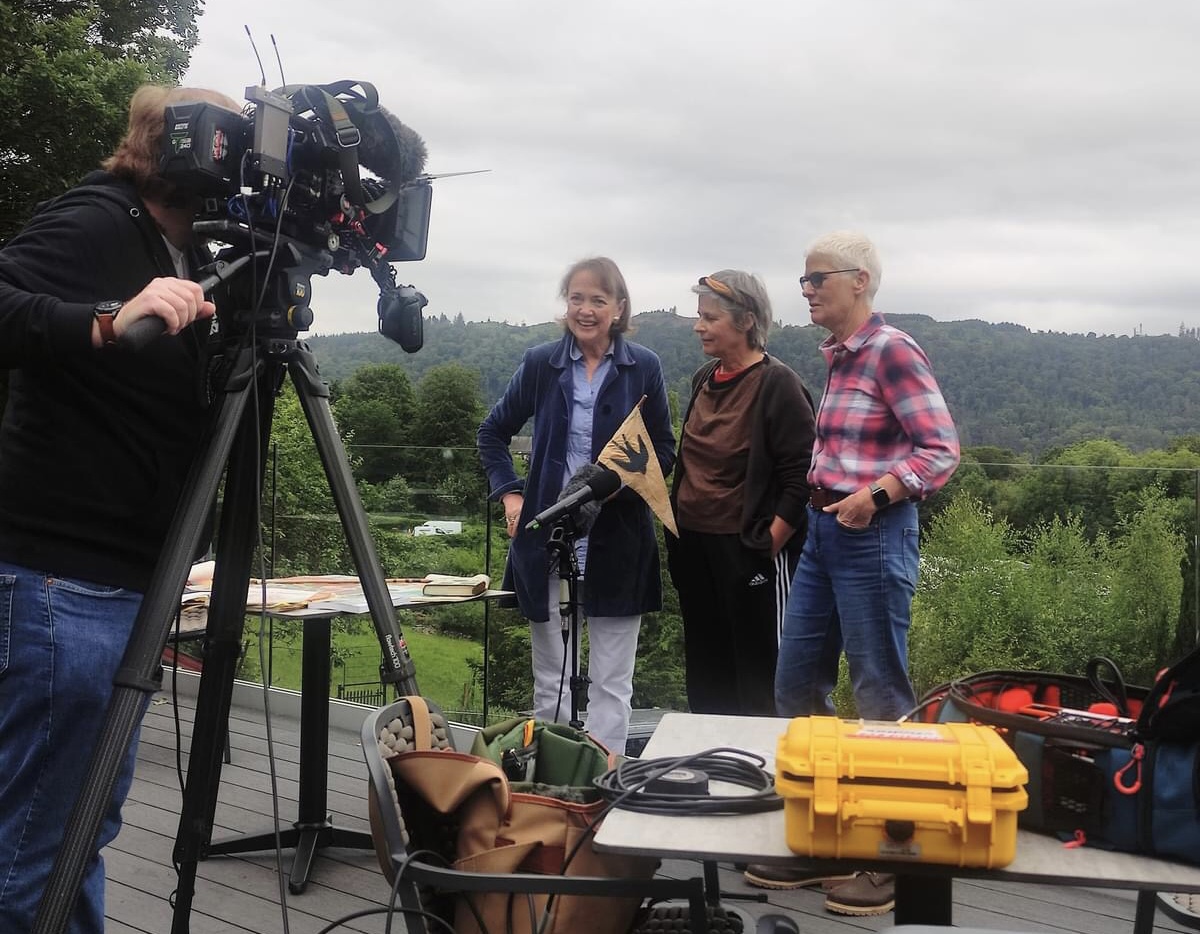


 Sophie Neville