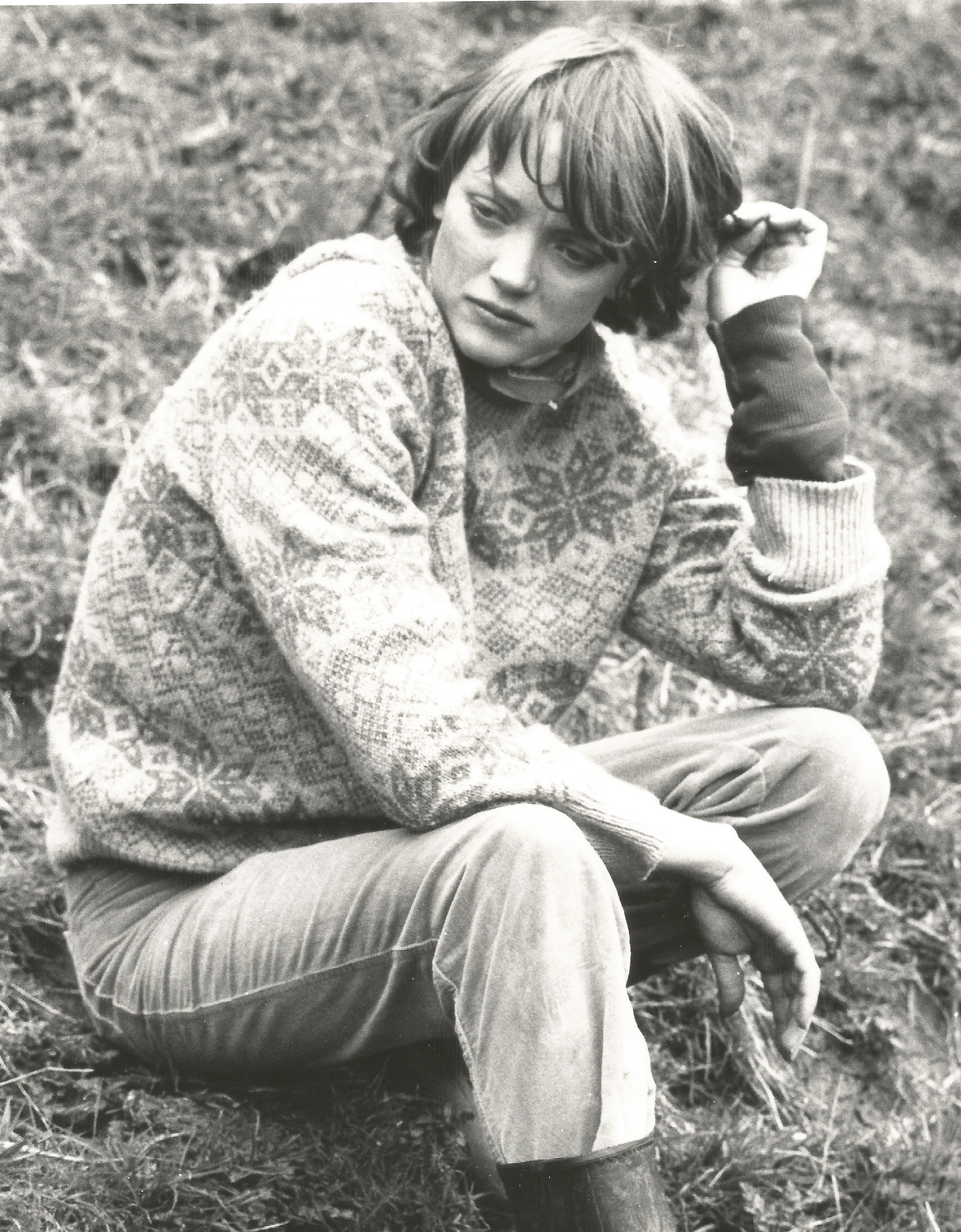
A long-forgotten photograph of Sophie Neville aged 21
I reached the end of 2025 wondering what on Earth I’d accomplished apart from clearing out my mother’s house – an irksome project as she’d lived there for sixty years, but I found a lot of photos, piles of hand-written letters and other relics from making the original film ‘Swallows and Amazons’, including a news cuttings book and other finds, which I added to this website. I came across more graphics only yesterday, so watch this space.
Sue Anstruther, Alex Moore and Sophie Neville signing books at Riverside Studios in Hammersmith
February 2025, marked my first Doctor Who convention, when I was invited to speak on the panel after a screening of ‘Vengeance on Varos’. Great fun!
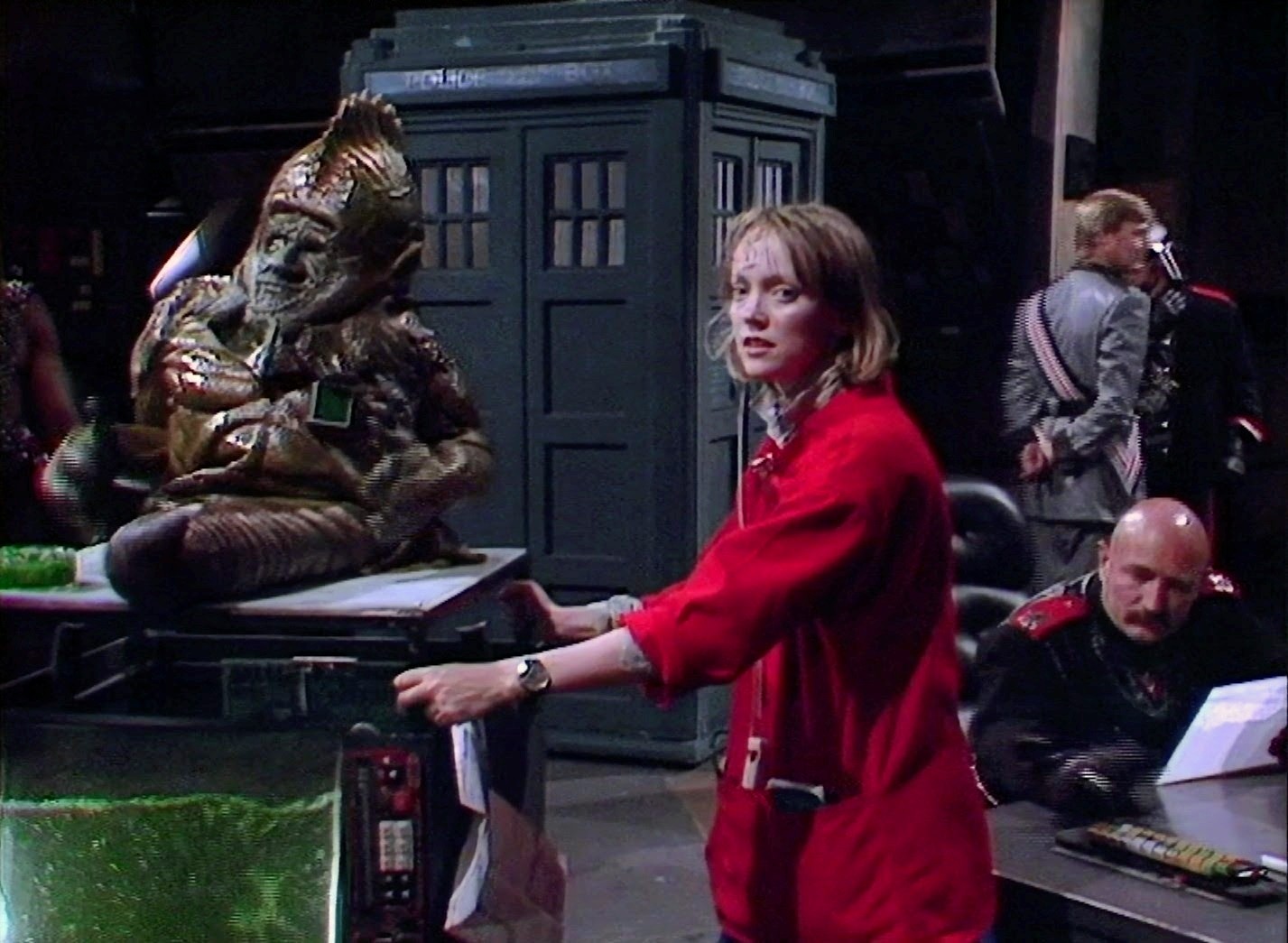
The fans have worked out that those on the production team have lots of stories and I was made very welcome. I’d forgotten that I had invented Varian knitting or wore red in the studio. Sadly, Nabil Shaban, who played our monster, Sil, was too ill to join us and died in October 2025.
Sophie Neville working on ‘Doctor Who’ with Nibil Shaban, Martin Jarvis and Forbes Collins
However, it was great to be reunited with other members of the cast including Geraldine Alexander who rushed over from the set of ‘Bridgerton’, and Colin Baker who I’d also worked with on ‘Coot Club’. You can read more about the day on this website.
Rob with Sophie Neville, Geraldine Alexander, Nicola Bryant, Stephen Yardley, Colin Baker and Forbes Collins
As a member of a film crew you are busy but invisible until your name is worthy of a credit. As a writer you are invisible until you win an award. One of my screenplays written in 2024 reached the semi-finals of the Scriptwriters & Co International Festival, which was exciting.
I was awarded an Honourable Mention for excellence in screenwriting at the glitzy International Film Gala in London, when I was joined by Lucy Calcott who has been editing my work.
This script was one of ten finalists in the Pitch Now screenplay competition.
I won a Lonely Wolf screenplay award, was in the running for a Creative Worlds Award
Being nominated and winning a screenwriters award at the New Media Film Festival in Los Angeles was exciting. While in Spain, I took part in an onscreen Writer’s Block Q&A chaired by Dr. Maya Rockeymoore Cummings and was interviewed by Susan Johnston on what I’ve learnt as a writer. (I’ve learned that smelt is spelled smelled in America!)
The same WWII story won a genre award in the Page Turner Awards and another was shortlisted in their Culture Award.
Right at the end of the year, literally on 30th December, I won the Eyelands Book Award for an unpublished historical novel, which was encouraging. It’s the third award they have bestowed on me. I absolutely treasure the ceramic tree trophies.
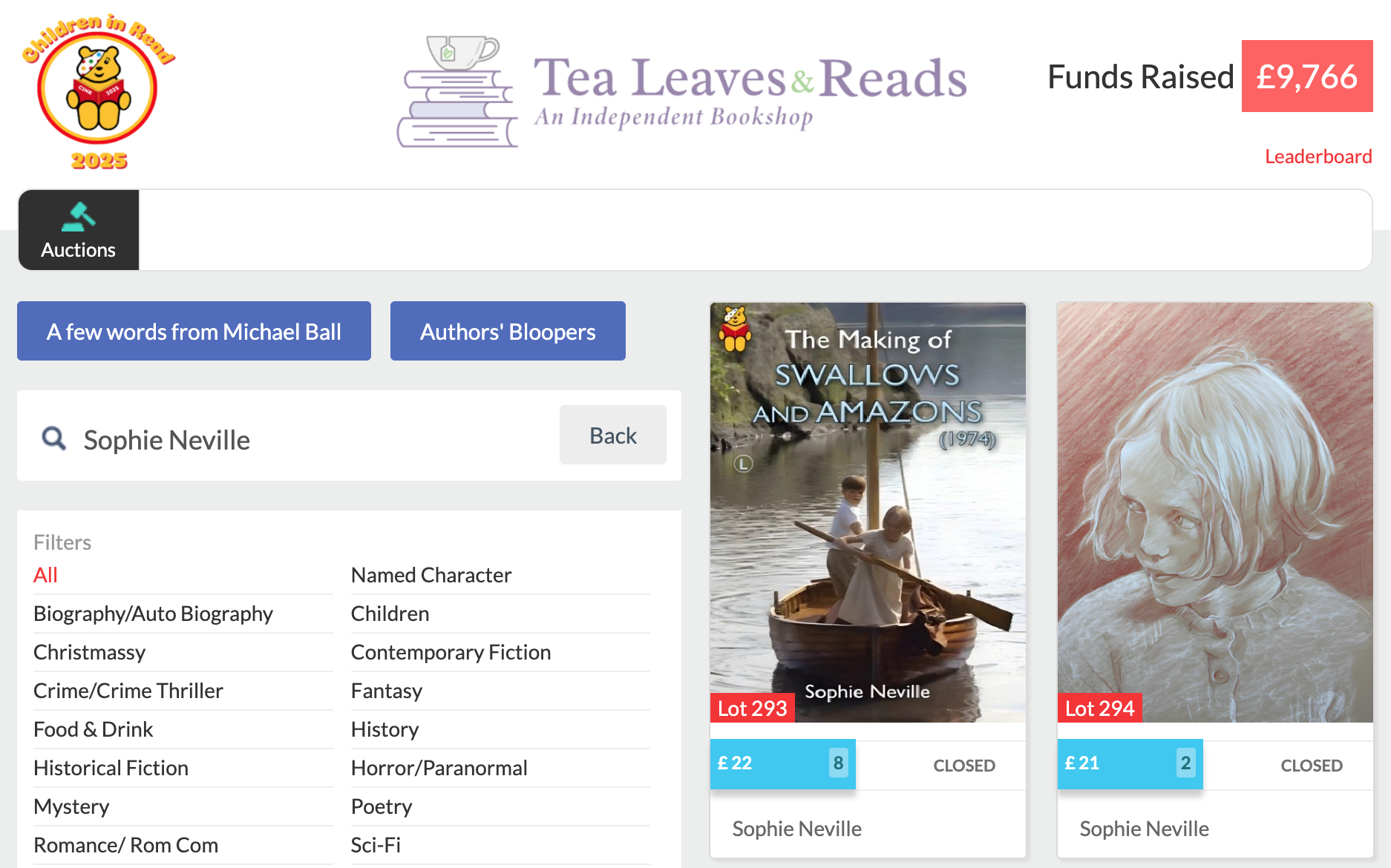
From August 2025 onwards, I helped Children in Read raise nearly £10,000 for BBC Children in Read by taking part in an online charity book auction, which was fun and involved dialogue with many amazing writers.
It was great to receiver this illustrated review of the film ‘Swallows and Amazons’. My non-fiction books received flattering online reviews, which is always appreciated and Resolute Books inspired me to bring out my memoires as a trilogy of life as a single girl. This is exciting but on the back burner for now.
The Gondola on Coniston Water today, re-built and restored by the National Trust.
Meanwhile the National Trust asked if they could use my ‘Swallows and Amazons’ map of Coniston Water to promote MY Gondola’s cruises.
Map showing film locations around Coniston Water
Items featuring this map and others can be purchased from Redbubble:
Mugs printed with maps used to illustrate Sophie’s books
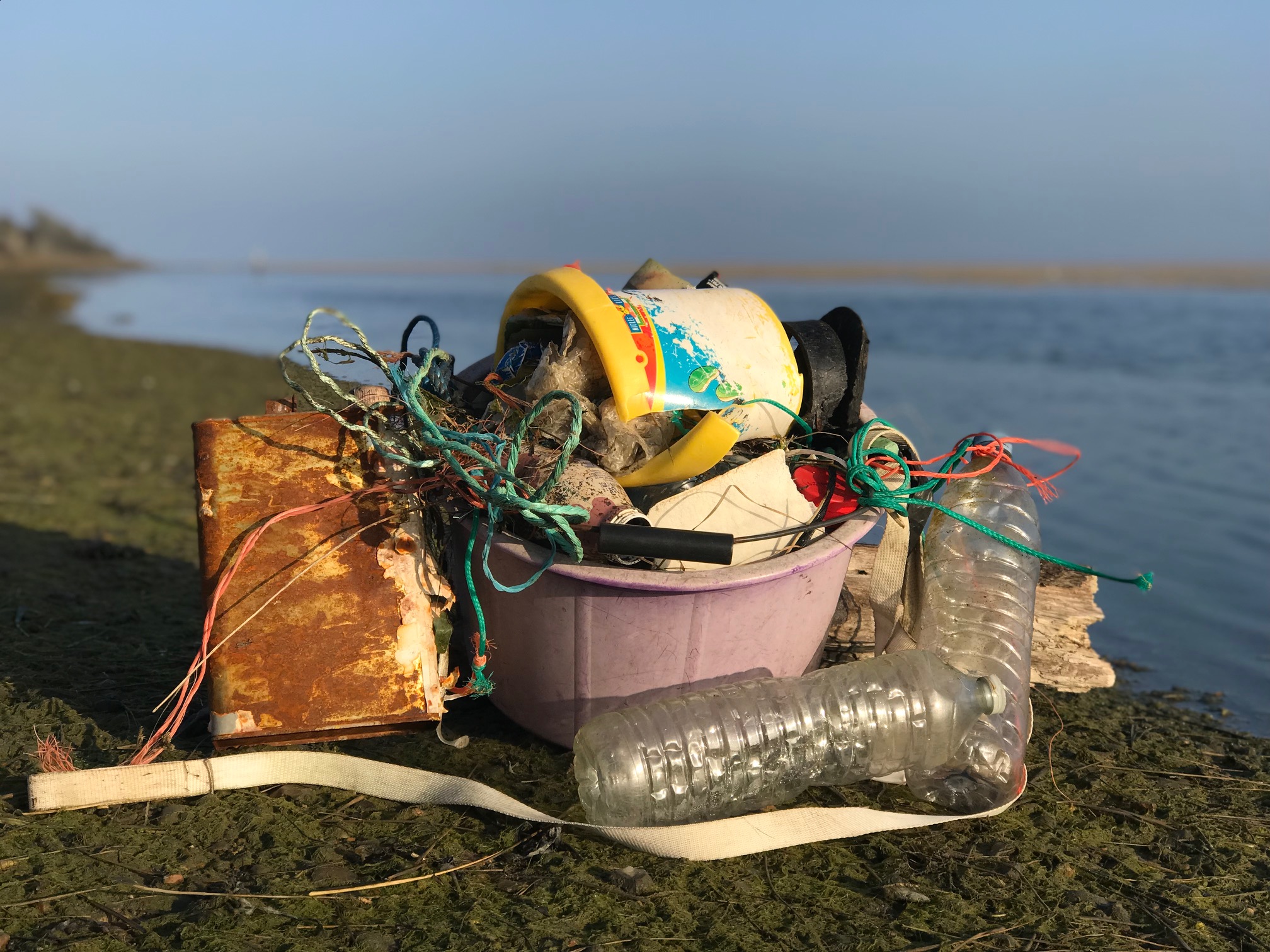
Meanwhile, real life continued to plung forward. We’ve had our house on the market and, whilst my mother was diagnosed with medium dementia, she refused to leave home. It made finding time for anything else tricky, but I managed a little litter picking.
We ploughed on with sorting through the vast number of letters and photographs Mum had stored all a-muddle.
What a task! As one friend said, ‘it’s bad enough finding homes in the house for things that come in use, let alone things that don’t!’
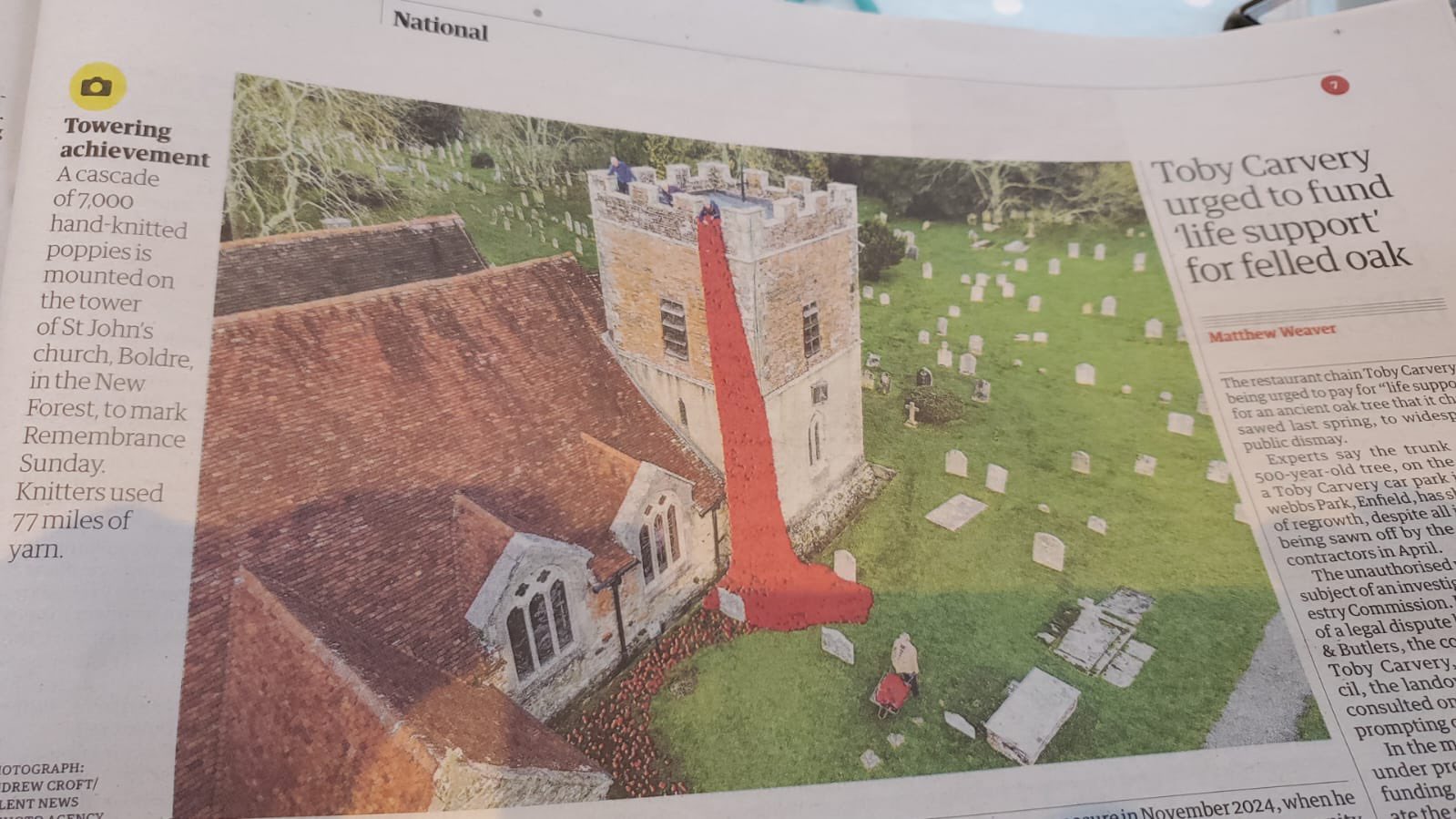
I was beginning to feel overwhelmed when I was asked to knit poppies for a commemorative installation at church. This was so calming that I made about 150 whilst watching dramas. My excuse for imbibing every crime serial available is that I need to examine script construction. I shot footage of our ‘towering achievement’ for BBC South Today and aided a drone photographer who took this shot for The Guardian and other national papers.
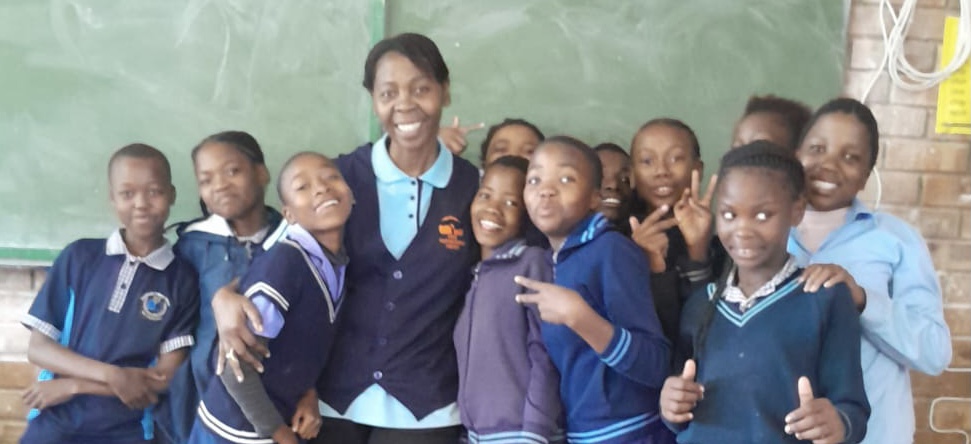
For some years now, I have been the webmaster for The Waterberg Trust, a UK registered charity supporting amazing projects in a corner of rural South Africa. We sponsor the role of the only school nurse working in the Limpopo Province. Along with caring for pupils, she has established four school vegetable gardens and distributes food parcels to those in need. I’ve started a project knitting hats to take them as an encouragement in 2026.
You can read about life at my parents’ house in my memoir ‘Funnily Enough’, which won a Rubery Book Award when it first came out and is now available as a paperback for £7.99, on Audible and other audiobook platforms. The illustrations look best on the ebook version. You can see a free sample here.
Funnily Enough – the paperback with black and white illustrations
Having won a Top Three Scripts award at the New Media Film Festival in Los Angeles, Sophie was asked about her screenwriting.
Can you tell us a little about how you got started?
I began writing for BBC Television at the age of twenty-two. It was a disaster. Instead of presenting a polished script, I produced a rough draft that I thought we could develop in the rehearsal room. Developed it was – by Nicholas Parsons, one of the stars. He rewrote his own soliloquy, taking all the credit and a substantial fee. I’ve welcomed harsh feedback from beta readers ever since.
What was the biggest challenge you faced in your journey to becoming a writer? How did you overcome it? Can you share a story about that that other aspiring writers can learn from?
Instant success with my first book was challenging. My illustrated memoir FUNNILY ENOUGH was at number 1 in Humor on Amazon Kindle in the UK (after free copies had been downloading at the rate of 250 a minute) but I had self-published, and had no team support. Instead pressing the go-button with a PR firm and marketing team, I was weigh-laid by the small stuff. Writers need skilled networks in place, especially in the age of New Media.
Funnily Enough – the paperback has black & white illustrations
It has been said that our mistakes can be our greatest teachers. Can you share a story about the funniest mistake you made when you were first starting? Can you tell us what lesson you learned from that?
I began my career in television by working with children. I could see the potential and it gave me a niche, but the hazards were numerous.
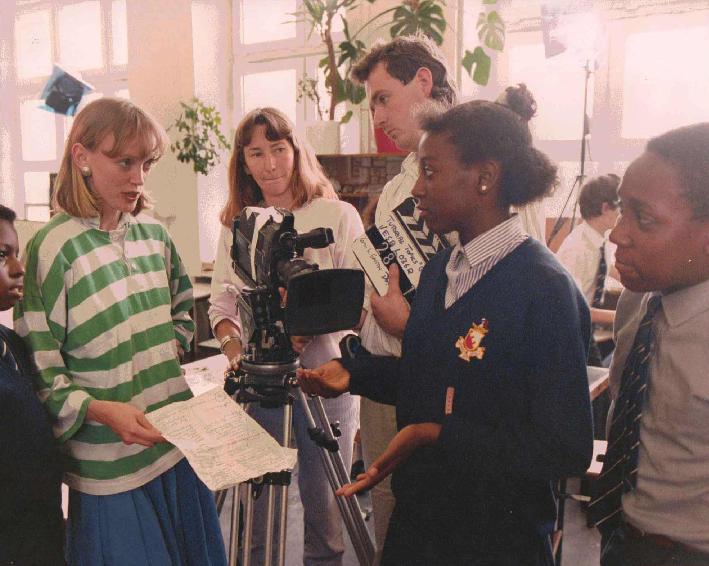
A teacher opened one scene for me by saying, ‘Some people believe the world is flat.’ A five-year-old called out, ‘No, but it’s not! It’s bumpy.’ The mistake was that we had too much camera judder – my cameraman had dissolved in hysterics. A lesson learned: I used a tripod when capturing the opinions of eleven-year-olds. The results were so amusing that they were repeatedly endlessly when Daytime TV was launched in the UK.
Sophie Neville directing a sequence with BBC cameraman Lorraine Smith
What are some of the most interesting or exciting projects you are working on now?
I felt compelled to write A BOY CALLED FREDDIE when I discovered Freddie Mercury, escaped from the violent 1964 Zanzibar revolution at the age of seventeen. If a year older, the man who became an international rock idol would have been forced into slave labour on coconut plantations. As it was, his family fled to London where his talent flourished and found stardom. Born Farrokh Bulsara, he became known as Freddie at school. The story of how he chose the name Mercury involves NASA but is only revealed in my screenplay – right at the end. Freddie’s father, Bomi, was a Parsee who worked as a cashier at the law courts where my Great-uncle Ronnie served as Chief Justice. I’ve been able to draw on my cousin’s stories of life in the heady days before a convicted rapist from Uganda brought mayhem to the archipelago of tropical islands, forcing the Sultan to escape by sea, along with my aunts and a plucky English women who had set up free and fair elections a month before mass murder broke out akin the movie HOTEL RWANDA (2004).
I’m also developing THE MEETING HOUSE, an exceptional true story from WWII about an East African serviceman I met who was airlifted out of a POW camp in Japan by his boyhood friend just before America bombed Tokyo. They landed in Silesia in the snow, which he’d only seen previously on the peak of Kilimanjaro, where he was born.
Can you share the most interesting story that occurred to you in the course of your career?
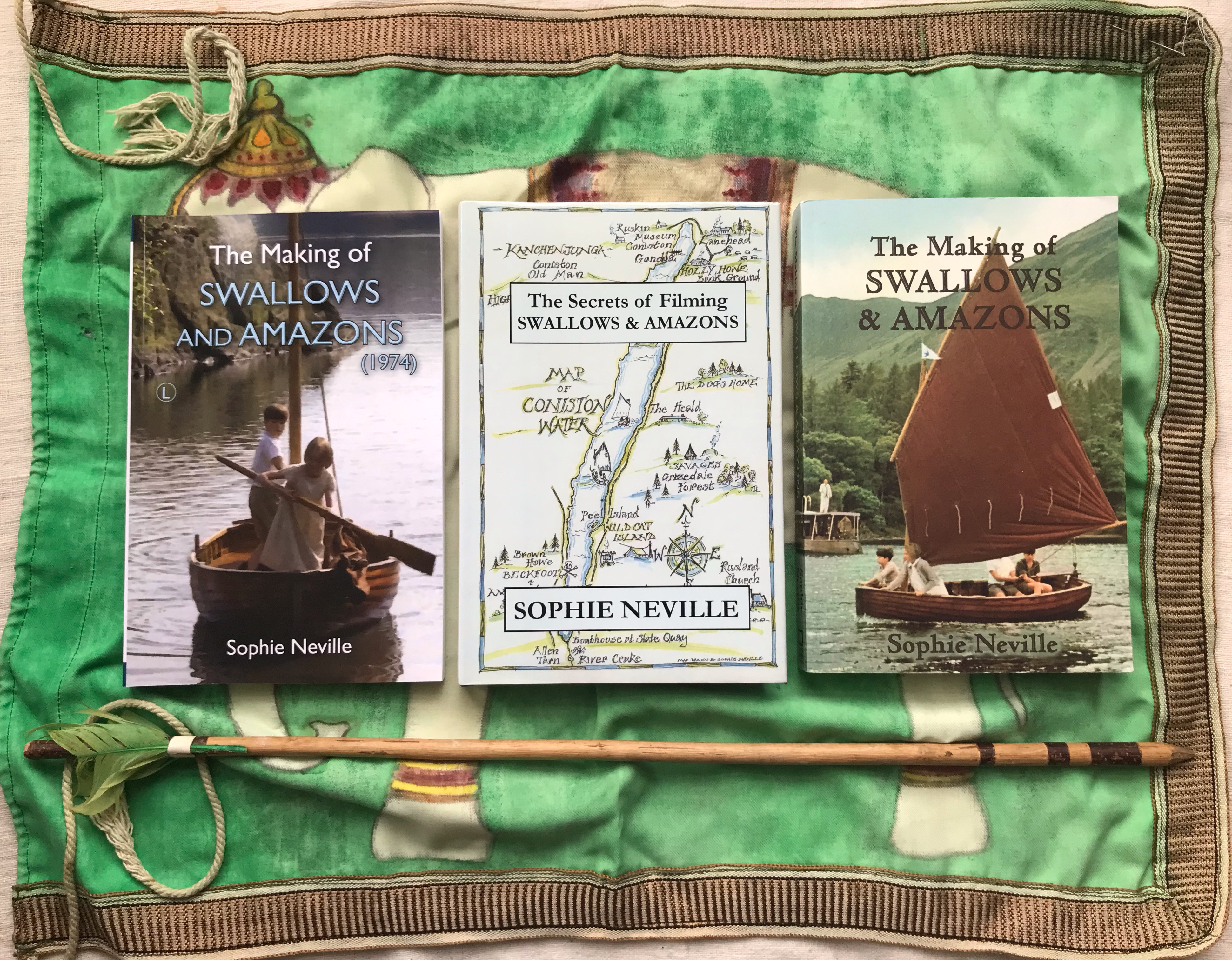
Film fans love to hear about disasters that befell us while making the EMI movie ‘Swallows and Amazons’ before the advent of CGI. I was persuaded to write THE MAKING of SWALLOWS and AMAZONS, now published by The Lutterworth Press.
Editions of ‘The Making of Swallows & Amazons (1974) by Sophie Neville’
Although it’s been screened on television more times than any other British movie, it remains a classic that some have never heard of. ‘Why are you here?’ I was asked at the 50th Anniversary screening.
‘I’m giving a couple of talks on how the film was made,’ I muttered.
‘How would you know how it was made?’
‘I was there.’ In almost every scene. ‘I worked on it.’
‘You couldn’t have been,’ the man insisted.
I could only take this as a compliment, but he looked aggrieved.
Sophie Neville, Suzanna Hamilton and Kit Seymour in Cumbria
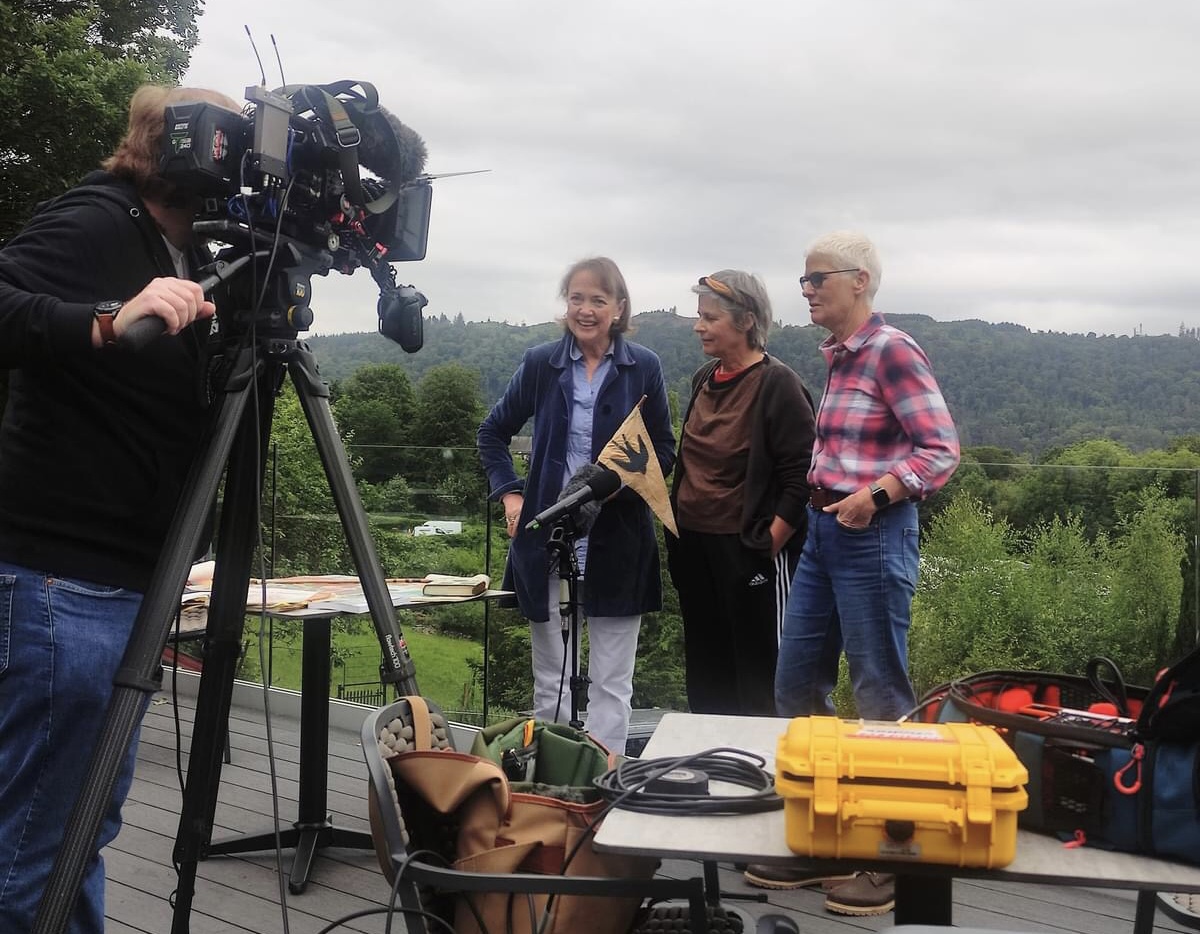
StudioCanal also thought I was an imposter as Dame Virginia McKenna had the star billing. Then the marketing executives watched the movie. When the DVD was launched they had me hosting Q&As at twelve cinemas and provided footage for all manner of TV programmes from CINEMANICS with David Wood the screenwriter to BBC BREAKFAST with my co-star Suzanna Hamilton.
Sophie Neville, Suzanna Hamilton and Kit Seymour on BBC Breakfast
I’m currently working on an inspiring comic tale: BANANA MAN, THE TRUE STORY about Phil-the-Geek, a shy but good looking physicist, who increased the national consumption of bananas by 20% after exploiting a supermarket deal and making 8 pence on every bunch he bought – and gave away. His story hit international News headlines and won him the heart of a beautiful girl. I was her bridesmaid. Last week, their daughters have just graduated from Yale and Harvard, respectively. I intend to present the family with a fruit bowl.
Here is the main question of our interview. Based on your experience, what are the “5 Things You Need To Be A Successful Author or Writer”? Please share a story or example for each.
Focus, forbearance and a five am start to the writing day are key, but I often come up with vital twists while soaking in the bath tub. I guess this is because my brain works best at periods of least resistance. The problem is that I end up groping for a notebook with wet hands.
Please share a story or example for each.
Personality, productivity, perseverance, patience, and a broken heart. We need to touch the audience with humor, in small ways that are easily identifiable. I have a scene in one novel about a man on the cusp of falling in love who loses his car keys in the heat of the day and is left feeling a fool in front of the girl he wants to impress. It’s based on the time I found my ignition keys with my feet. They had fallen into sand beneath the door of my car when I was driving through Botswana. The relief following this small miracle is etched deep in my soul.
In your opinion, were you a “natural born writer” or did you develop that aptitude later on? Can you explain what you mean?
I would describe myself as a ‘natural born story-teller’. Having a visual brain, I became a television director, attracted to Mike Leigh’s emerging art of improvisation on film. When on the converted BBC Drama Director’s Studio Course, I gave my actors the task of flirting whilst erecting a tent. It worked exceptionally well, except that they enjoyed the exercise so much it went on a little long. I should have provided them with earpieces to bring the story to a timely end.
We all need to hone the craft of writing. I had the amazing opportunity of assisting on drama serials such as ‘Doctor Who’ and ‘Eastenders’. Looking back, I could have become a BBC script editor. Instead, I’ve spent the last twenty years attending Curtis Brown Creative novel writing courses and acquiring the art of writing about love under the Romantic Novelists Association’s New Writers’ Scheme. Entering writing competitions has proved an incentive and the wins help build my CV. The competition is such that we need to build a pedigree and provide consumer confidence.
Which literature do you draw inspiration from? Why?
I write true-life stories set in the 20th century, so draw on any memoirs or biographies I can find. I love amusing autobiographical novels, such as Fran Hill’s trilogy on life as a teenager in foster care. She is a master craftsman and a truly inspirational writer. I feed off her infectious humour poured out to the world on Substack.
You are a person of enormous influence. If you could start a movement that would bring the most amount of good to the most amount of people, what would that be? You never know what your idea can trigger. 🙂
Forced marriage needs to be recognized as conjugal slavery and made illegal worldwide. Female circumcision (FGM) needs to stop before more lives are lost to infection. I have no personal experience, but feel we must all speak out to support those unable to do so.
Swallows and Amazons, the well-loved children’s classic, was released in cinemas in April 1974. After fifty years, it has been screened on television more than any other British film and is now streaming on Amazon Prime. Having also appeared in the BBC play Cider With Rosie, Sophie went on to appear in Animal Magic, Crossroads, The Two Ronnies, and had a leading part in an adventure movie, The Copter Kids, opposite Sophie Ward and Derek Fowlds.
I remember Swallows and Amazons, and The Two Ronnies in particular. I loved their Charley Farley and Piggy Malone series in which Sophie appeared.
After directing plays at university, Sophie won a contract on the Graduate Trainee Scheme and worked in television production, assisting on Doctor Who (I am a life-long fan) Eastenders, the police series Rockcliffe’s Babies, and the first BBC adaptation of My Family and Other Animals made on Corfu. She filmed the wartime drama Bluebell in Paris and directed the animation and visual effects sequences for Through the Dragon’s Eye. She went on to produce an INSET series, directed a number of comedy dramas for BBC Schools Television and ended up working on well over a hundred different television programmes.
In 1985, Sophie drove from London to Johannesburg, making her first documentary for Channel 4. In 1992, she emigrated to Southern Africa where she set up a couple of BBC wildlife series and a Blue Peter Summer Special. She bought a horse, lived on different game reserves and spent time between contracts writing stories illustrated with sketches made while working for friends as a safari guide.
Sophie is now working on the third edition of her filmography The Making of Swallows and Amazons, which is already out on audio. Her Christian memoir Funnily Enough won 3rd prize in the International Rubery Book Award. She is republishing this illustrated paperback and the sequel Ride The Wings of Morning with Resolute Books.
Do also check out her YouTube book trailers. Links given at the end of the interview. Sophie gives talks on a number of subjects, often speaking at yacht clubs, the Southampton International Boat Show and literary events.
This year, 2024, saw the 50th anniversary of Swallows and Amazons being released in cinemas. Fans gathered for screenings with Q&As at the Cinema Museum, and Windermere Jetty in Cumbria when Sophie was interviewed by John Sergeant.
If anyone could be said to fully embrace the creative life, it is Sophie Neville. She has won seven awards for screenwriting in the last few weeks.
Sophie, your incredible career exudes creativity. What are the joys of creativity for you?
I’ve always enjoyed making things and feel called to leave a legacy of illustrated stories.
What have been your favourite things about your acting and production work?
I loved being on location with a creative team of designers. Having worked with the Oscar-winning set dresser Ian Whittaker as a child, I enjoyed working with props at the BBC. These included a number of animals from an Indian Elephant on board a ferry in Harwich to a tortoise that made rather a mess of my unit car.
How have the different aspects of your work fed into one another?
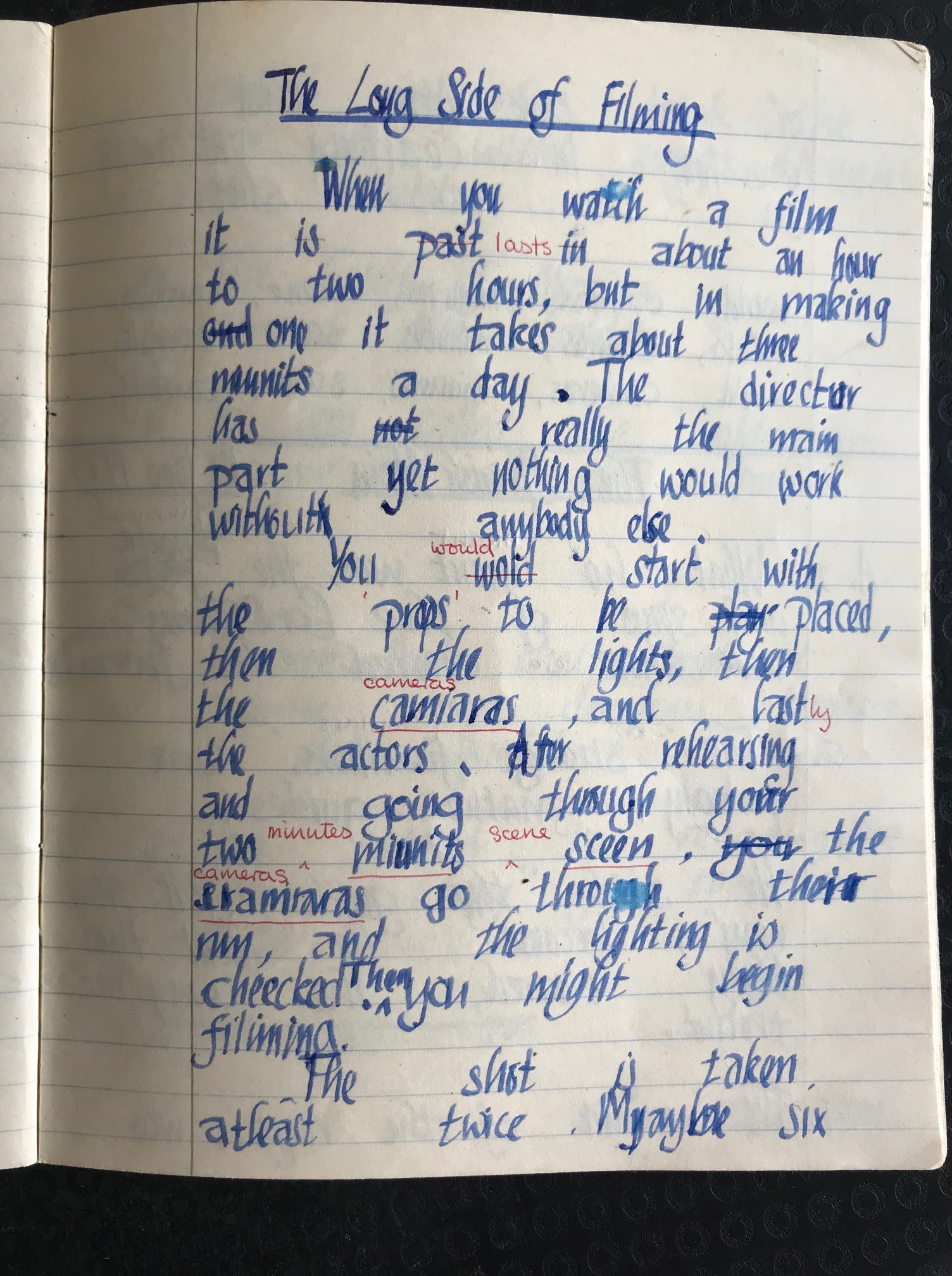
Acting in films and in television as a girl gave me invaluable experience when it came to writing screenplays. I spent so much time in rehearsal rooms in my twenties that I find script writing easier than putting novels together. It was my job to record the time of each scene with a stopwatch and report back to our script editor who would compare lengths with the read-through. I’m guilty of writing rather short scenes now and wish that I’d kept some of our old scripts, which show the edits. However my mother kept numerous scripts. I have two for Prime Suspect, and other television series she appeared in. We found copies of the original Swallows and Amazons script adapted by David Wood. All the added jeopardy he must have worked so hard to include was cut along with a scene that featured Virginia McKenna, but stories take on their own pace and most of the best scenes can have no dialogue at all. Swallows and Amazons is a landscape movie with a little girl saying, ‘I’ve got her, I’ve got her.’ Those words were never scripted. They exploded from my mouth after lying alone in a damp dinghy on Derwentwater. It’s often the simplest lines that make a movie. The best line of all time in any movie must be, ‘My daddy, my daddy!’
Sophie Neville aged ten by Caroline Assheton
I first wrote for television at the age of twenty-two when working on Russell Harty’s Christmas Party. It was a disaster. My idea for a pantomime theme was accepted, and worked well, but I only took a rough draft of the dialogue to the rehearsal room. Nicholas Parsons re-wrote it on the spot, which was mortifying. Esther Rantzen carried the musical number for me by sheer force of character. I’d asked her to arrive in Dick Whittington costume, which was a great success. No one knew what fabulous legs she had until the moment she came on to sing with the studio audience. No one knew that the lettering on the song sheet lowered was still wet. I’d had to grab a paintbrush and improve it within minutes of going on air. It was literally a matter of writing for television – 7.00pm on BBC One.
There is a lot of preparation behind-the-scenes for talks. Do you find this easier to do now?
Preparation, preparation, preparation, with an extra speech up your sleeve. I needed I.T. lessons in how to load up a Point Presentation but soon learnt to gain momentum and dramatic effect by pre-empting my slides. This requires memorising the order. I can use up to 120 for a 45-minute talk but the images release me from the need for notes. I use a couple of short films or book trailers while people are talking their seats if I need to establish an atmosphere in a large venue. Simple things like asking for blinds to be drawn or testing the mic is vital. I always ask what colour the seats are. I once turned up in a dress that merged me with the curtains and tablecloths until I became almost totally camouflaged. All you can see in the photos is my head. I once wore a baby-pink coat to venue where all the walls were orange. I thought it would be safe to wear navy blue and white for the next yacht club talk only to find myself standing in front of blue and white striped curtains that matched what I was wearing exactly. I should have worn the pink.
What have you found are the most useful tips for public speaking?
I am a volunteer speaker for Bible Society who give us media training, which is invaluable. It’s good to have three points lined up and a couple of funny stories when you are interviewed on the radio. It’s best if you can prepare the presenter by providing them with bullet point information about books or events you are publicising, otherwise the best opportunity for plugging something is right at the beginning of the interview. I had the opportunity to appear on BBC Antiques Roadshow in 2021 and simply answered the questions. What I should have said was, “I kept a diary that I felt compelled to bring out as an illustrated paperback. It’s now available online….” Of course advertising is forbidden, and will almost certainly be cut out, but I could have kept one of the books in my hand. Visual aids are always effective. Prepare a basketful.
Did the pandemic get in the way of giving talks or have things like Zoom made more things possible?
Lockdown introduced me to Zoom, which has been a blessing, although I’ve had my fill. While Covid restrictions swept away my plans for public speaking, I gave a number of author interviews that are now on Youtube, and read a children’s book for BBC Radio Suffolk.
You are a patron of the UK Wild Otter Trust. How did you get involved with this?
My family kept tame otters for forty years. Our mission was to raise awareness about the need for pure water and undisturbed habitat. I began talking to crowds of people at country fairs, which is good experience for any speaker as the questions can be bizarre. The otters we were asked to hand-rear acted as ambassadors for their species while we delivered facts by telling stories in whatever ways we could, a bit like a safari guide. I ended up being photographed with the Prince of Wales and a naughty otter for the front page of the Daily Telegraph.
I was able to write about living with otters in Funnily Enough. This amused the editor of iBelieve magazine who published double page extracts for eleven months. The tame otters appeared on a huge number of television programmes from detective serials to movies such as Scottish Mussel, a rom-com written, directed by and starring Tallulah Riley. We made that on location near Dunoon in 2015. Otter wranglers are not given much credit but it got the conservation message across to audiences who might never watch wildlife programmes. The film is now streaming online. You can guess how wet I got chasing otters through boggy woodland.
What does the UK Wild Otter Trust aim to do?
The UK Wild Otter Trust is based in North Devon where they look after rescued otters and orphaned cubs before releasing them back into the wild. The trust offers advice to fish farms, anglers and game keepers, helping landowners to build holts. It’s a great charity to support. Back in 1982, wild otter populations in England and Wales had dwindled to about 150 pairs. You now need to take care when driving by rivers at night as young males are expanding into new territories. They don’t like swimming under road bridges.
You kept a diary of your time while filming Swallows and Amazons. Can you recall how easy or otherwise it was to keep that going? What drove you to keep a diary? Also do you keep a diary related to your work now?
Swallows and Amazons was made during the summer term, so we girls kept diaries on location as part of our schoolwork. My mother was very keen on this. I started writing a journal when we went to Tanzania in 1972 and I kept diaries whilst at boarding school. Perhaps I should type them up, but I fear they are not terribly interesting. “Alex was sick in needlework,” is about as sensational as it gets.
My granny taught me how to knit and sew. I find it helps to compare the craft of constructing stories to embroidery or knitting with different colours. You can stitch in extracts from diaries or letters. I’m darning a few holes right now, but once accomplished the garments will be ready to wear straight away.
Other than Arthur Ransome’s wonderful work, which other authors have made an impact on you, both as a child and as an adult? Why do you think this is? Also what do you most enjoy reading? What do you think the benefits of reading are for writers?
I read a lot of memoirs, many of which are self-published. They have provided me with extraordinary facts and stories that I’ve been able to weave into my novels set in the 20th century.
Hundreds of authors have inspired me from James Herriot, Jilly Cooper and Helen Fielding to CS Lewis, Adrian Plass and Catherine Fox but Laurie Lee, Gerald Durrell and Arthur Ransome have probably influenced me more than others as I’ve spent so long working on adaptations of their books. I also worked on the dramatised biographies of the dancer Margaret Kelly (Bluebell), the zoo vet David Taylor (One by One) and The Diary of Anne Frank.
You wrote Funnily Enough based on your experience of struggling with chronic fatigue. Was that a book you just felt you had to write? How hard was it to be so open about ME? Did you find writing the book therapeutic? I was touched to read the reviews showing many found reading the book to help them that way.
I returned from completing a Discipleship Training Course with YWAM – Youth With a Mission – wanting to deliver my testimony in an amusing way but got stuck until I found the illustrated diary that I’d kept when I fell ill with ME. I withdrew it from the bookshelf feeling led to lay everything else aside and type it up.
A story behind the story: Having spent weeks putting the first draft of Funnily Enough onto a disc, my bag was stollen in the Masai Mara. It was pretty dramatic. I woke to find my safari tent had been slashed open while I’d been asleep. Everyone was shocked but I felt compelled to look for the bag, which I found discarded in a ditch. My binoculars and Psion (I’d naively assumed that I could write a book on palmtop) were missing but I retrieved the disc. I was able to begin editing the manuscript on a shiny new PC that had been donated to a primary school where I lived in South Africa. I gave the headmistress lessons on how to use Microsoft Word and worked on Funnily Enough whilst she was busy teaching. She asked me to look after the computer over the Christmas holidays, which enabled me to keep writing until I could afford to buy a new laptop. After three years, the palmtop was returned by a Masai student at university in Alaska. He had opened my Psion to see that I’d been helping the people of Africa by writing newsletters for Waterberg for Jesus.
Memoirs are inevitably exposing, especially if you are taking about your faith. I knew that in order to be of real help to readers, I needed to put my soul on the page, but tried not to embarrass my friends. Thankfully, Mum let me write whatever was entertaining and is happy to bear the brunt of my jokes. This shocked a few Christian readers until they watched her on an outrageous series of Come Dine With Me and an episode of Chanel 4’s Obsessive Cleaners that featured me in de-cluttering mode. Notes of sympathy poured in, unaware that Mum was playing to the camera and loving the attention. She is eighty-eight now and still wants to appear in movies. ‘You must write a starring role for me!’
We had a little miracle with Funnily Enough when it reached No. 2 in all categories for free Kindle downloads in the UK. I gave away 16,000 e-copies. I was thanked by some stinky reviews from atheists but as John Wesley said, you have to expect a few rotten tomatoes. I laughed a great deal writing that book. There are one or two stories that still have me in fits. I could hardly narrate the audiobook. People say that Ride the Wings of Morning also has them laughing out loud. The best bits are letters written by my sisters. It’s a love story – but of love between family and friends rather than artificial romance. My (then) boyfriend was furious when he saw an early draft, but he later wrote from Afghanistan to say how much he loved it and couldn’t turn the pages fast enough. He spent nine years looking after snow leopards in the mountains so enjoyed looking back on our mad adventures in Southern Africa. I hope it helped him survive the isolation. Writing has certainly helped me to get my thoughts in order and fulfilled an urge to record the best moments in life before they evaporate.
You’ve travelled a lot. How easy or otherwise have you found it to readjust back to life in the UK? Have you been able to use travelling time to write? Or do you have to block out times to write when you are at home?
My great love is long-distance riding. I’ve ridden horses down the coast of Uruguay, across South America, through the Okavango, Ethiopia, Georgia, and across the Namib Desert. I set up wildlife documentaries in Botswana, Namibia and Natal, taking on the research for a Blue Peter exploration of South Africa.
I settled on the south coast of England when I got married in 2004 but was immediately confronted by a crisis that could not be laughed off. There was a terrible accident when we were on honeymoon in southern Spain. My husband was accused of negligent homicide. He was released by the magistrate, and a second judge but I spent the next six years preparing for a civil case (one summons to court after another thanks to endless postponements). I tried to process the angst by writing about what happened but ground to a halt as it would have been disrespectful to bring in humour. Perhaps one day I will be able to use the facts. I now know about shot-induced heart attacks, which I don’t think has been covered on film, and now stress the importance of testing for morning-after alcohol in the blood, which is not carried out in all post mortems overseas.
If your writing is important it will usually surpass other busy-ness. I ended up bringing out my first two books while renovating our house. We had no roof, but there I was, working with my formatter and toddling off to the London Book Show. I now find it best to write between five and nine in the morning but the networking involved in presenting the finished product takes me out and about. I’ve given over one hundred talks and have a full diary of festivals and events this year. My husband wants to move to a retirement village so that I can travel more.
I put together a number of scripts and PR announcements while I worked in television but didn’t begin writing books and feature articles until I was forty. It was a lovely occupation to have in the African bush. Roald Dahl claimed he only wrote for four hours a day, and yet was highly productive. I hang on to that advise when boring admin and accounts crowd out the rest of the day.
How did you find going from writing books to writing scripts? Two very different disciplines there. What would you say were the advantages of both forms? What have you found the most frustrating elements to both forms (I should imagine there are some!)?
We need to use our strengths. I’m good at concepts, writing dialogue and knitting the plot together, which can be easier with a script. I enjoy innovative structure but building that can be exhausting. Plot holes usually force one to find a new twist, and twists are in high demand these days, but the whole business boils down to patience and tenacity. Push out boundaries and you are bound to get as many rejections, especially if you are a Christian writer, but persevere and all the pruning has to bear richer fruit. I’m just a craftsman used to working to deadlines.
I remember walking down Lime Grove in Shepheard’s Bush wondering how on Earth I was going to edit three fly-on-the wall documentaries I’d just shot for the BBC when I remembered that Jesus was a carpenter and knew how to fit things together. I would be nowhere without the inspiration of the Holy Spirit.
I admire anyone who has any talent for art. Your artwork is amazing. Do you find working on any art to be soothing, a challenge, or a mixture? An obvious question perhaps but how do you find the time? What does art mean to you? Do you find it feeds into your writing?
I worked as a professional wildlife artist in southern Africa between freelance television contracts. At one point I was selling twenty pieces of artwork a month. Taking commissions, mounting exhibitions and being interviewed by the Inland Revenue certainly prepared me for the business and discipline of writing on a self-employed basis. I drew a lot of decorative maps and was able to use sketches and unsold artwork to illustrate my books. If you own the copyright to your own book cover you can get it made up into cards and mugs. I sell a few online via Redbubble to publicise my books.
Is there an actor you have not worked with but would love to do so?
Twenty years ago, I wrote a part for Eddie Redmayne who read my script while on a villa holiday with my stepson. The screenplay was optioned and has won a number of writing wards but its an epic and taking so long to sell that Eddie can no longer pass as a nineteen year-old, which is a bit of a pity.
If you were stuck on a desert island for a short period but you were allowed to have eight books with you, which would you choose and why? The Bible and Shakespeare are already there and, as I am a fan, Jane Austen is too.
Eight books full of blank pages and a pen, please. I’d love a paintbox too.
What would you say were the writing tips which have most helped you?
‘Writing is re-writing’. I need to go to draft 100 every time, needing the help of at least three proof-readers before sending anything off.
Last but not least, what themes in stories mean the most to you? The Bible has wonderful stories and the Book of Psalms has fabulous poetry. Many themes have come from here. I once heard an interview with an EastEnders scriptwriter who revealed many of their themes do come from the Bible (and from the little I’ve seen, I would say they’ve used the theme of Cain and Abel as well as Delilah a lot!)
We writers have much to learn from the persistence of biblical scribes and narrators, not forgetting those who lugged around the scrolls. I try to quote from scripture imaginatively. It’s great to be able to draw on so many famous, yet copyright free stories presented to us by the Bible. I’m interested in exploring those that involve slavery but I’m sure it’s the historical romances that sell. I enjoyed reading The Red Tent and love the British movie Nativity!
I’ve enjoyed contributing chapters to the ACW publications Merry Christmas Everyone and Write Well. Perhaps the next one could be a collection of Easter stories. A study of slavery in the Bible might open up discussion and sell well. It’s such a hot topic. Looking at women in the Bible is another option. I’m sure ACW writers would have lots of brilliant ideas.
Sophie loves hearing from readers and appreciates reviews.
The Making of Swallows and Amazons is available direct from the publishers, The Lutterworth Press, from Waterstones, and all the usual online retailers.
Sophie narrated the audiobook copy.
The paperback, illustrated with maps, film stills and behind-the-scenes photos is similar to the multimedia Kindle copy entitled The Secrets of Filming Swallows and Amazons, which includes links to home movie footage taken on location.
Ride the Wings of Morning is an illustrated paperback that will take you to southern Africa where Sophie tells of her adventures working as a safari guide and wildlife artist. It looks fabulous in ebook form as her watercolours are back lit on colour screens. The Kindle ebook sells at £2.99
















 Sophie Neville